Loading
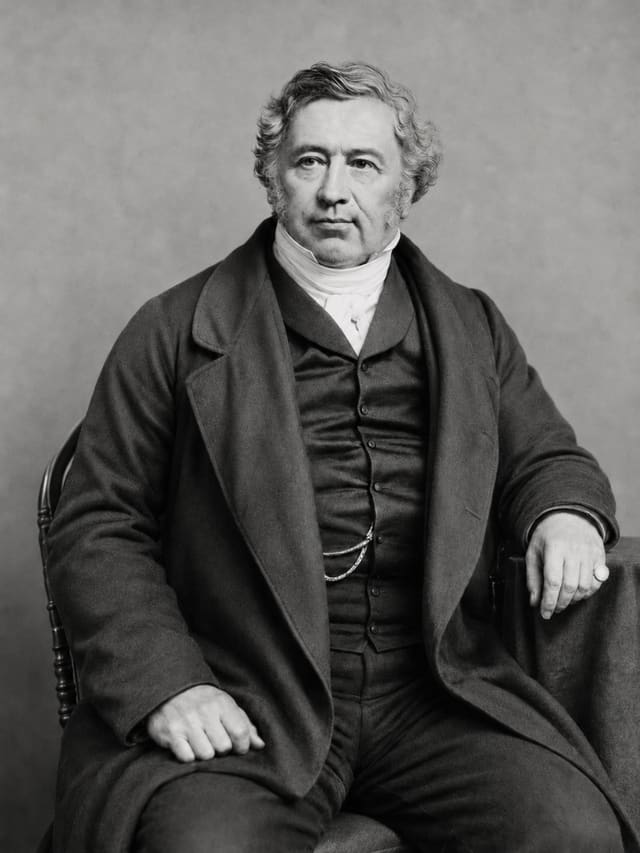

In a house on The Mall, in Kensington Gravel Pits, a sixty-two-year-old man lay dying — a man the London papers called the finest chronometer maker in the country. The illness had dragged on for a long time, and it was not the only thing poisoning his last year: his old rival, the clockmaker Benjamin Lewis Vulliamy, kept saying in public, and with some relish, that Dent would never build the clock for the Westminster tower. Dent had won that commission a year earlier, after eight years of litigation, intrigue and correspondence with officials. The movement stood unfinished in his workshop.
And he never did build it. His stepson finished the clock, and it was not started until 1859 — six years after the funeral. Today the whole world hears it and calls it by somebody else's name: Big Ben.
But the finest story in his life isn't the one about the tower. It's about a Frenchman who came to London with an instrument nobody in France wanted, and about an Englishman who was sceptical at first and then sold thousands of them, turning it into the thing that now hangs in the hallway of every second old house. The instrument is the aneroid barometer.
We have to begin, however, with tallow and candles.
Edward John Dent was born in London on 19 August 1790, to John and Elizabeth Dent, and was baptised on 18 October at St Clement Danes on the Strand — a stone's throw from the street where he would keep a shop for half his life. His brother William followed eighteen months later. Their mother died before the elder boy was three; she was buried in May 1793.
What comes next is the ordinary fate of a London boy without money. On 20 August 1804, aged fourteen, Edward was bound apprentice to his grandfather, John Wright Dent, a tallow chandler. Seven years of rendered fat. The grandfather was obliged to house his apprentice and lodged him with a relative — Richard Rippon, a clockmaker of King Street and a master of repeating work.
That decision, taken purely to save money, settled everything. Candles did not interest the boy; clocks took him over completely. On 13 February 1807 the grandfather — credit where it's due — did not dig his heels in, and agreed to turn the rest of the term over to the watchmaker Edward Gaudin of Clerkenwell, the horological capital of London at the time.
The term ended around 1811. Dent went back to live with Rippon and began working for the best firms in the city, largely on Rippon's recommendation. At Barraud & Son he got to grips with chronometers in earnest; he also worked for Vulliamy & Son (remember that name — it comes back under unpleasant circumstances). And by 1814, at twenty-four, he was making things under his own name: that year the Admiralty took delivery of a standard astronomical clock from him, and the Colonial Office of at least one pocket chronometer for the African expedition.
The firm of Dent still counts 1814 as its founding year. That's easy to accept: a man who would be arguing about seconds with the Astronomer Royal twenty years later started right here.
For a decade and a half he worked for other people — including, it seems, the Callum brothers of Castle Street, famous for their repeaters — and in parallel ran the experiments that in his trade meant everything: compensation balances and springs of steel, gold, palladium, glass. This was the problem an entire generation was stuck on: making a chronometer keep the same rate in the tropics and in the Arctic, while the metal expands and the elasticity of the spring drifts away from you.
In 1826 he submitted chronometers No. 54 and No. 55 for trial at Greenwich — which means he had already made at least fifty-five of them. The Observatory took notice. From 1828 he was employed to check and repair other men's chronometers, charging up to 25 guineas for a repair — an almost indecent sum for the day, but it was paid. In March 1829 the Astronomer Royal John Pond wrote to the Board of Ordnance that Dent was among the best makers of the present day. He was trusted to strip Hardy's escapement out of the Greenwich transit instrument and fit a Graham escapement in its place: not a job handed to just anyone.
And in August 1829 the thing he had been waiting for happened: the marine chronometer Dent No. 114 took the First Premium — £300 — at the seventh annual chronometer trial of the Royal Observatory.
After which Dent displayed the quality that stayed with him to the end: he knew how to sell. Number 114 turns up in every advertisement he placed for the next twenty years. Around the same time he introduced his secondary compensation — a correction to the correction, removing a chronometer's tendency to gain at middling temperatures when the main compensation has been set for the extremes. That part isn't advertising; that's engineering of the first order.
In 1830 word reached him that John Roger Arnold — son of the legendary John Arnold — needed a skilled man at his workshop at 84 Strand. Dent, forty years old, went in to apply for a job and came out a partner. The agreement was signed on 30 September 1830.
The arrangement suited both. Arnold was sixty-one and gratefully dumped the whole practical side on his partner while keeping his own inventive hobby-horses. Dent got a shop window with a great name on it, and a market. He placed advertisements in The Nautical Magazine and sent his experimental results to the same pages — today we'd call it engaging with the professional community; then it was simply good form for a man who wanted captains to buy his instruments and nobody else's.
In 1831 Captain FitzRoy was issued twenty-two chronometers for the Beagle. Among them were instruments by Arnold & Dent; Dent himself mentions No. 633 in his article "Hints on Chronometers" (February 1833). On board, as everyone knows, was a young naturalist named Darwin. The connection is indirect but real: some of that voyage's instruments were made by the firm.
The last two years of the partnership, though, were miserable. Dent had expected to buy the business out; it didn't happen. A man who admitted openly and without embarrassment that he wanted to be the finest chronometer maker in the world had spent ten years with his name in second place. On 30 September 1840 the partnership was dissolved. Arnold died in 1843, and his business passed to Charles Frodsham.
On 1 October 1840 — the day after the separation from Arnold, without a single day's pause — the firm of E. J. Dent, London, opened at 82 Strand.
What follows is a decade compressed so tightly that you wonder how one man got through it.
On 21 March 1842 he took out a patent, "Certain Improvements in Chronometers and other Timekeepers": designs for the compensation balance and a remontoire for marine chronometers. In January 1843 a second premises opened at 33 Cockspur Street, off Trafalgar Square, where among other things he displayed Breguet clocks (he had met Breguet back in the Arnold years). Later a third address was added: 34 Royal Exchange. The workshops were in the Savoy district, at Somerset Wharf.
His own quiet story belongs to the same period. On 1 July 1843 Dent married Elizabeth Rippon — widow of that same Richard Rippon in whose house he had lodged as an apprentice, and who had died in 1835. They would have no children of their own. But there were two stepsons, Frederick and Richard, and two stepdaughters. Under the will the boys would have to take the name Dent — and one of them, eleven years later, would finish his stepfather's greatest work.
The firm received the Royal Warrant: clockmaker to Queen Victoria and to Prince Albert. The dials began to carry the engraving "Chronometer Maker to the Queen".
In October 1842 Dent met the architect William Tite, who was building the new Royal Exchange to replace the one that burned in 1834. Tite needed a clock. The Astronomer Royal, George Biddell Airy — by then already close to Dent — recommended him.
The tender was accepted, as the Herald reported on 20 August 1843. And here the amusing part emerges: Dent, a master of the finest instruments you can hold in your palm, had taken on a mechanism the size of a room, about which he knew rather little. England had almost no dedicated turret-clock makers, and the men who did make tower clocks regularly flatly refused to help a competitor.
He got out of it in a way that was entirely characteristic: instead of copying, he recalculated the whole design from scratch, so that it came out both more accurate and cheaper. The clock was installed in 1844, and English tower clocks stood level with the Parisian ones for the first time. Helping him with the calculations was a man called Edmund Beckett Denison — a barrister who gave clockwork more time than some people give their profession. That pair, the practical man and the theorist, had another act to play.
The same year, 1843, brought an episode that explains beautifully what sort of man Dent was.
The dipleidoscope. An instrument for fixing true noon by the sun's transit of the meridian — a cheap substitute for an expensive transit instrument. Dent had been tinkering with the idea for several years and by 1840 had a working scheme based on shadows. Then he came across the reflecting arrangement of the barrister James Mackenzie Bloxam — a glass front face and two mirrored faces at 60° — and without argument admitted it was better than his own.
What followed was business scrupulousness of a high order. Bloxam, who valued his reputation as a lawyer, did not want to be seen in trade; so they agreed that the patent (GB No. 9793, 1843) would be taken out in his name but at the manufacturer's expense, with the rights passing to Dent for an agreed payment. The instrument carries the name "E. J. Dent". The first dipleidoscopes went on sale in March 1843 at two guineas apiece and stayed in production for a quarter of a century. With the coming of the railways, when accurate shared time turned from a convenience into a necessity, the instrument proved very timely indeed — it came with an instruction booklet including a section on converting local time to Greenwich time.
To the same series belongs his "Paper on the Patent Azimuth and Steering Compass" (1844). Behind the compasses lay one of the great problems of the age: iron ships drove the magnetic compass out of its mind, and from 1838, at the Admiralty's request, Airy had been developing a system for compensating the deviation with permanent magnets and soft iron. Dent was Airy's standing executor of ideas.
Now for the main story.
Lucien Vidie was born in Nantes in 1805. Trained as a lawyer, he abandoned the law around 1830 for steam engines, took up manometers and pressure, and arrived at a notion that seemed at the time not exactly mad, but hopeless: to measure atmospheric pressure with no mercury at all.
The idea was not new. The instrument historian W. E. Knowles Middleton names three predecessors: Leibniz (1698), Zeiher (1763) and Nicolas-Jacques Conté (1798). Conté, who taught at the aeronautical school at Meudon, proposed a vacuum vessel the size of a pocket watch: a thick iron bottom, a thin steel top, springs inside, the air pumped out — the thin lid was to follow the pressure. Conté abandoned the attempt when he found the instrument responded more readily to temperature than to pressure. Dent himself, in his 1849 treatise, expressed honest astonishment that so many distinguished men had improved the old mercury barometer without ever seriously trying to replace it with a vacuum box.
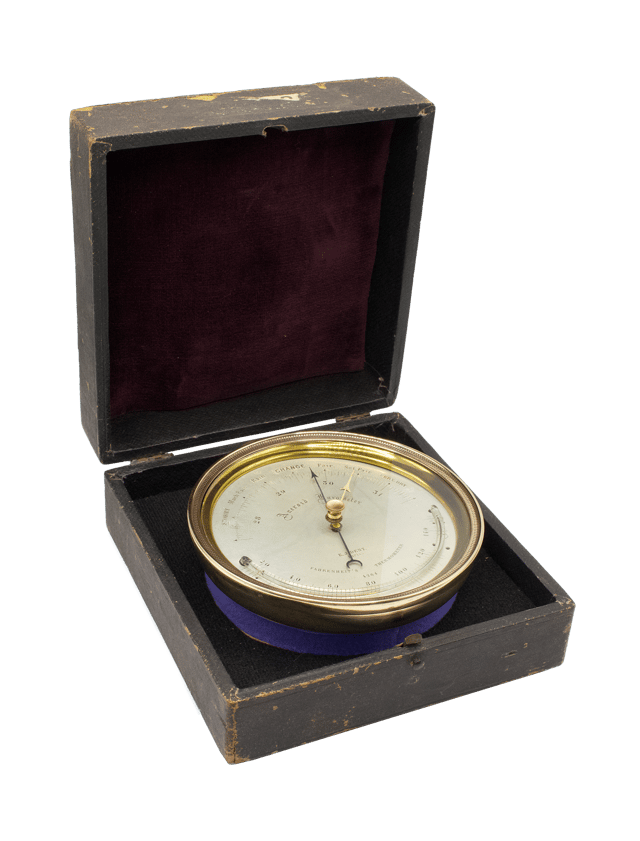
Vidie tried. He built the first working metal barometer in 1843 and obtained his patent in 1844. The heart of the instrument is a flat circular box with corrugated walls from which the air has been evacuated: the capsule de Vidie. The atmosphere compresses it; as the pressure falls, the box expands again. Its walls are kept from collapsing by a spring, either internal or external. In the earliest design the corrugated diaphragm was supported by thirty-three helical springs, and the minute deformations were multiplied through a system of levers and a chain until they reached the pointer. It appears that this mechanism, with its many internal springs, never went into mass production, and the first patent was soon supplemented by a description of a mechanism with a single external helical spring. Temperature compensation was provided either by a bimetallic strip or by leaving a small quantity of air inside the capsule.
The name was Vidie's own: aneroid, from the Greek a — "without" — and nēros — "liquid". A barometer without liquid. A French obituarist in 1867 called the word a barbarism, which did not stop it entering every language.
In France the instrument went nowhere at all.
Vidie ordered the first batch, about a hundred pieces, from the clockmaker Antoine Redier — the man who invented the wind-up alarm clock. Vidie judged the quality unacceptable and refused to pay. Redier sued and won. Add to that a cold reception from the public, scepticism from colleagues and difficult relations with French manufacturers, and the result was this: fewer than a hundred sold in France. Vidie's biographer Auguste Laurant wrote that the inventor spent his entire fortune on his research and carried on only thanks to a friend's help.
It's worth pausing to take in the position. A man had invented an instrument that within fifty years would stand on every ship, in every observatory, and in half the hallways of Europe. And that man was ruined, in litigation with his contractor, and unable to sell a hundred units.
On the advice of Pierre-Armand Le Comte de Fontainemoreau, Vidie turned to the English market. Fontainemoreau took out the English patent in Vidie's name. During the trials the instruments were carried up to the dome of St Paul's to measure its height by the difference in pressure — it would be hard to devise a more vivid demonstration for Londoners.
And Vidie went to London to do a deal with the most famous clockmaker in the city.
Dent, according to every surviving account, was cool about the whole idea. What follows is a story that has been passed around the literature and is too good not to repeat — with the caveat that the documentary support for it is thin: some British naval officer bought a single instrument, tried it in earnest, and immediately ordered thirty more. After that, Dent's scepticism evaporated.
The figures Laurant gives speak for themselves: over the first few years Vidie supplied Dent with around five thousand instruments. Against fewer than a hundred sold at home.
Precision matters here, because a good deal of noble nonsense has grown up around this episode.
The following is reliably documented. In 1849 Dent published A Treatise on the Aneroid, a Newly Invented Portable Barometer — a work at once educational and promotional, after which sales climbed sharply (Charles Frodsham wrote about the instrument the same year). Through the 1840s the aneroid was tested seriously in Britain: compared against mercury barometers, where the readings agreed; carried along the railways, from London to Chester in 1848 and from Preston to Carlisle, as a test of its use as an altimeter; examined at the Royal Observatory. Airy himself, having gone through the readings in 1849, concluded cautiously that the discrepancies followed no intelligible law, and that the instrument had perhaps read a little low over time — but so little that the very existence of the drift was doubtful. It is impossible to praise anything more guardedly, and coming from Airy this is close to rapture.
What the serious sources do not contain is any specific mechanical improvement that can be firmly credited to Dent personally, as opposed to the general evolution of the design around 1847. So the familiar formula that "Dent perfected the instrument" needs adjusting: what Dent perfected was the instrument's standing in the minds of potential buyers — he effectively launched a new product. He gave it a firm's name that sailors and scientists trusted, the quality of its manufacture, a book, and a shop window on the Strand.
That was enough for the aneroid to come back to France by way of its English success and spread across the world. So the claim that it was Dent who gave Vidie's instrument to the world is essentially correct — provided "gave" is understood as a commercial and reputational act rather than a technical one. Vidie invented it. Dent rescued it.
In 1849 the engineer Eugène Bourdon patented his own metal barometer with a flattened curved tube. Vidie saw this as an appropriation of his principle and went to court.
He lost the first action (1852). He lost the appeal. He pressed on, obtained a review, and in 1858 secured recognition of his priority over Bourdon and a ban on selling tube barometers until his patents expired. The 25,000 francs awarded to him were reduced to 10,000 in 1861.
By then, though, it was half a victory at best: Vidie's patents had lapsed back in 1855, an extension was refused, and the aneroid was taken up by all comers — Naudet and Dubois & Casse in France, Negretti & Zambra in Britain in partnership with Admiral FitzRoy (the same FitzRoy whose Beagle had once carried Arnold & Dent chronometers — history enjoys a rhyme like that).
Lucien Vidie died in Nantes in April 1866. His contemporaries put his death down to an excessive enthusiasm for hydrotherapy, which for a man who spent his life measuring pressure sounds very nearly like an epigram.
Back to London.
On 16 October 1834 the old Palace of Westminster burned down. In 1842 the architect Charles Barry included a clock tower in the design for the new building, and in March 1844 he asked Benjamin Lewis Vulliamy — a prominent clockmaker and Master of the Clockmakers' Company — for an estimate. Dent, hearing of it, wrote to Airy in July 1845 to say that he intended to compete.
Airy was appointed referee — and made no secret of backing Dent. In June 1846 he published a specification that raised eyebrows across the trade: the first stroke of the hour was to be correct to within one second. For a tower clock with hands metres long, catching the wind, the snow and the ice, the requirement sounded like mockery.
Vulliamy refused to compete if Airy were to be sole judge. His drawings — by common consent handsome, but bulky — were dismissed by Airy in May 1847 as the design of a "village clock". Vulliamy never forgave that. The third contender was John Whitehurst of Derby.
On 8 August 1846 Dent tendered at £1,500. Then came years of bureaucratic swamp: correspondence, committees, and litigation launched by Vulliamy through the House of Lords (in 1848 a separate volume of documents appeared, A Portion of the Papers Relating To The Great Clock — its mere existence tells you how high feelings were running).
In 1848 Denison joined Airy as second referee and effectively redesigned the clock from the ground up, marrying his theory to Dent's practice.
On 29 January 1852 the final requirements were approved: a 14-ton hour bell, four dials, cast-iron wheels, and the whole pendulum inside the clock room. Dent's final tender was £1,800, with two years to build. Whitehurst had died by then, leaving Dent the only contender with a live bid.
On 25 February 1852 the tender was accepted. Almost eight years after Barry first approached Vulliamy.
The numbers deserve comparison: Whitehurst had asked £3,373, and Vulliamy's own internal estimate was around £3,605. Dent took the commission at what was practically a loss — for the name.
The sequel was entirely in keeping with the rest of the story: an inspection of the tower in March 1852 revealed that the internal dimensions had been built for Vulliamy's movement and that Dent's clock physically would not fit. Airy and Denison recut the layout, and £100 was added to the estimate.
Dent began work early in 1852. On 8 March 1853 he died.
The clock was finished by his stepson, Frederick Dent, who had inherited the Strand and Royal Exchange premises. The inscription on the movement records that the clock was made in 1854 by Frederick Dent of the Strand and of the Royal Exchange, from the designs of Edmund Beckett Denison.
The key technical discovery is Denison's double three-legged gravity escapement. Its point is to uncouple the pendulum from the hands completely: whatever is going on outside with wind and ice, none of it reaches the pendulum. Denison had been thinking about an improved gravity escapement since 1846, arrived at the three-legged version in 1851, and finished the definitive double version by 1860 — and the clock is still regulated by it today. Dent lived to see a successful trial: with a pendulum weighing about six hundredweight, the escape wheel weighed a little over a quarter of an ounce.
The clock was formally started on 31 May 1859.
Denison, a lawyer by profession who understood perfectly well how much money he could have made, deliberately did not patent his escapement — so that the design would pass into general use as quickly as possible. In a history full of patent wars, that is worth noting.
Two years before his death Dent received what, in his trade, counts as the summit. At the Great Exhibition of 1851 at the Crystal Palace he was awarded the only Council Medal in the horology class — for a large tower clock, cited for combining strength and accuracy with a cheaper method of manufacture. That very exhibition clock was later moved to the tower of King's Cross station, where it stood until 1965.
By then other honours had accumulated: in 1843, during a trip to Russia, he received a gold medal by order of the Emperor for the services rendered by his chronometers; the Royal Irish Academy thanked him for his help in determining the longitudes of Dublin and Armagh. Standard clocks of his making went out to Geneva and to observatories.
He was a Fellow of the Royal Astronomical Society, an Associate of the Institution of Civil Engineers from 1833, and a member of the Institution of Mechanical Engineers from 1849. He lectured on horology at the Royal Institution and at the United Service Institution, published in the astronomical society's transactions, and sent communications to the reports of the British Association, to the Nautical Magazine, and to the American Silliman's Journal.
By this time his chronometers had been to the hardest places on the planet. Arnold & Dent instruments were with James Clark Ross's Antarctic expedition aboard Erebus and Terror (1839–1843) — No. 1212, for instance, which afterwards wandered from ship to ship in the navy and was sold at Christie's polar sale in 2006. Two years later those same two ships would sail into the Arctic with Franklin and never come back.
The louder names, though, call for caution. The company's own history attributes chronometer Dent No. 1800 to David Livingstone and links Dent instruments to Henry Morton Stanley. The chronology doesn't contradict it, but this is the marketing of one's own past rather than a strictly verified fact.
The will was proved in May 1853. The personal estate was valued at £70,000 — for the son of an obscure Londoner, a more than substantial fortune.
The business and its stock went to the stepsons on condition they took the name Dent. But they went separately: to Richard Edward, the Cockspur Street premises (the "E. Dent & Co" line); to Frederick William, the Strand and the Royal Exchange (the "E. J. Dent & Co" line). Hence the confusion and rivalry between two nearly identically named firms, which ran on for decades.
The heirs did not last long. Richard died in 1856 intestate; his widow Marianne Frederica appears to have carried on the business under the initials "M. F. Dent & Co". Frederick — the one who completed Big Ben — died in 1860. For a time the business was run by Dent's own widow, Elizabeth; after her death around 1865 it was controlled by the Buckney and Gardner families, descendants of Frederick's sisters.
The firm, however, outlived them all. In 1876 the triangular trademark was introduced — "DENT" inside a triangle — to fight counterfeits: a sure sign that the name had come to be worth money in its own right. In 1871 Dent was given the honour of making the standard clock of the Royal Observatory at Greenwich. And in 1924 the Greenwich regulator Dent No. 2016 began transmitting the BBC time signal — the famous six pips, by which several generations set their watches.
While we're at Greenwich: Dent's part in the Observatory's famous gate clock with the 24-hour dial is routinely overstated. The master-and-slave system with galvanic impulses was created by Charles Shepherd, who showed it at the 1851 Exhibition; the gate clock itself was installed on 13 August 1852 by Airy's direction and is Shepherd's work. The Dent firm built the large galvanic chronographic apparatus for the Observatory, and later the standard clock. The distinction matters and shouldn't be blurred.
Dent is usually placed alongside Arnold, Earnshaw and Frodsham, and rightly so. But there is something more interesting: the two great works he is remembered for were not his inventions.
The Great Clock of Westminster was designed by Denison. The aneroid barometer was invented by Vidie. The dipleidoscope was Bloxam's idea. The compass problem was Airy's.
And yet without Dent not one of these things would have become what it became. He possessed a rare and underrated talent: recognising a good idea that belonged to somebody else, admitting at once that it was better than his own, and bringing it to the state where it could be sold, hoisted into a tower, or taken aboard a ship. He did it honestly — Bloxam got his patent and his payment; Vidie got his five thousand orders and his rescued invention.
The most satisfying thing about Dent's life is perhaps the symmetry of its beginning and its end. A boy lodged with a clockmaker purely to save money grew into the man to whom a ruined French inventor came for rescue. And both of his great works were completed without him: the aneroid spread across the world after he was gone, and the clock over which his rival taunted him struck for the first time six years after the funeral — and has not fallen silent since for longer than it takes to repair it.
His surviving work can still be seen: the regulators Dent No. 2, No. 587, No. 2009 and No. 2016 at Royal Museums Greenwich; a chronometer with a glass balance spring at the Science Museum; pocket watch No. 10215 (1851) at the British Museum; dipleidoscopes at the Whipple Museum; and individual Arnold & Dent chronometers at the Smithsonian.
And if there is a round barometer in a brass case hanging on your wall — know that it got there by way of the Strand.