Loading
Introduction
There are firms whose history fits into a single line of a catalogue, and there are those whose history can be read like a novel about the nineteenth century itself — with its scientific ambition, its imperial sweep, its wars, its self-taught inventors and its workmen whose hands remembered the smell of mercury and hot glass. Negretti & Zambra belonged to the second kind.
In the course of a century and a half this London workshop managed to: win the only prize medal for meteorological instruments at the first Great Exhibition; become official photographers to the Crystal Palace and issue the first commercial photographs in history of China, Japan and Siam; raise a camera on a balloon over London; supply the instruments of Admiral Fitzroy, who coined the very word "forecast"; hang barometers on drinking fountains and in poor fishing villages to save lives; lower a thermometer to a depth of more than four kilometres; carry its own aneroids into the stratosphere aboard balloons; and then, having changed both its century and its craft, build the instruments without which not a single Spitfire would have taken off. One of its founders — a sedentary master glassblower — exposed a miscarriage of justice in passing and saved an innocent man from the gallows.
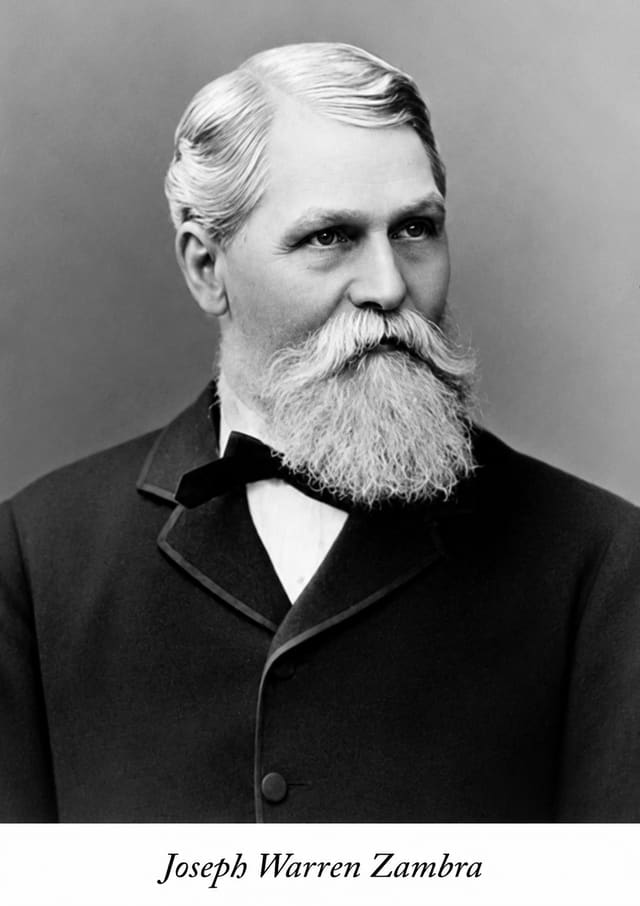
All of this was begun by two men of Lombard blood and London obstinacy — Henry Negretti and Joseph Warren Zambra, both descendants of families from the shores of Lake Como. They did not arrive on empty ground: behind them stood a whole generation of émigré Italian craftsmen who had quietly transplanted the art of barometer-making into foggy England. And their firm ended exactly as all Victorian instrument-making ended — dissolving into an age of electronics that no longer had any need of mercury, or of hot glass, or of the hands that remembered them.
This is an attempt to tell the story in full and in order — from the last quarter of the eighteenth century, when the barometer first "spoke Italian" on English walls, to the year 2000, when the name finally disappeared from the shop-fronts. As far as is known, scarcely any instrument-making firm of its century was ever granted so full and eventful a biography. This one earned that fullness.
Part I. Italian Roots: How the Barometer Came to England
When, in 1850, a shop-front bearing two surnames — Negretti and Zambra — first appeared over a London workshop, Britain stood on the threshold of its most self-assured decade. A year later the Great Exhibition would open, the empire was gaining colonies, and the science of the weather was slowly turning from a body of signs and sayings into a discipline armed with figures and scales.
But to understand where a firm that within a year became the best in Britain came from in 1850, one must begin not with the firm itself but with a whole migration of a people.
Both founders came from the world of the London Italians — that small but close-knit community of craftsmen that had settled in the quarters around Hatton Garden. The very name Como road, later given to one of the streets near their works, quietly recalled the family's Lombard roots. The migration of Italian craftsmen had already begun in the last quarter of the eighteenth century, after the revolutionary upheavals in Europe and especially in the period when northern Italy, including the region of Lake Como, lay under political pressure and economic constraint. The local people, particularly from the villages on the slopes above the lake — such as Stazzona, Tavernario, Careno and Dolceacqua — began to seek a living beyond Italy, relying on what they knew best: work in wood, glass, metal and precision instruments. It was from these regions that such makers came as Samuel Bregazzi, Joseph Cetti, Giovanni Kalabergo, Francis Amadio, and the founders of large concerns: Casartelli, Ronchetti, Somalvico, Zanetti, Negretti and Zambra.
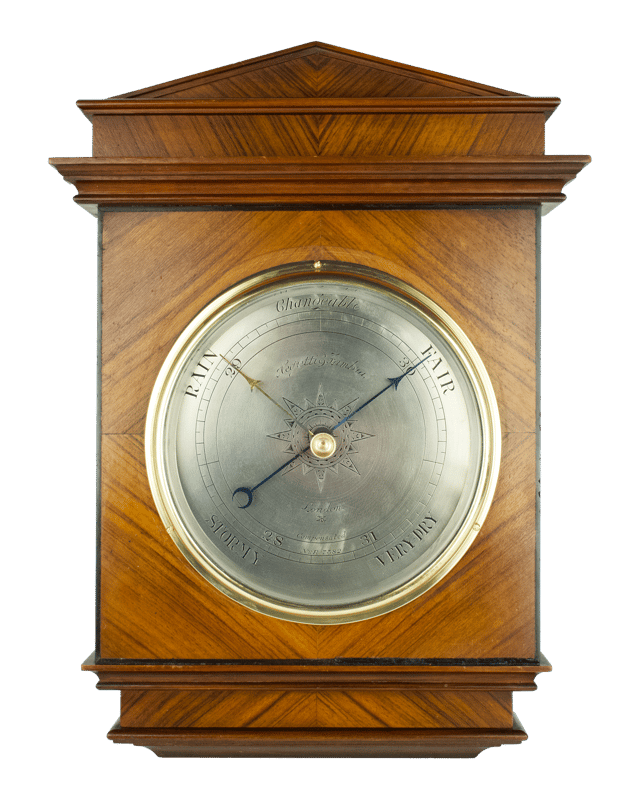
Among the settlers were a great many skilled craftsmen who brought with them the art of making meteorological instruments. Their influence was such that from the 1780s onward the wheel (dial) barometers of their design became a British standard. One need only look at the signatures on early English barometers — almost all bear the surnames of Lombard émigrés: Gatty, Cetti, Casartelli, Aiano, Polti, Ronchetti, Somalvico, Tagliabue. If a piece does not bear one of these names, the odds are that it was made by Italians all the same and merely sold to a retailer under another name.
The Italians who settled in London made their homes around Holborn — the district was cheap and already had a reputation as a centre of instrument-making. Neighbouring Hatton Garden in time became a veritable capital of the trade, and it was there that the future firm's first premises would stand. Ties with home remained strong; and a whole industry grew up of jobbing makers who specialised in particular parts of instruments and sold them on to larger London or provincial firms for finishing — an early and highly characteristic nineteenth-century example of the division of labour. The growth of the railways at the start of the century allowed London retailers to employ travelling agents (whom local rivals contemptuously called "hawkers") to seek out business beyond the capital.
It was one such agent's post that was taken up by Joseph Cesare Zambra — father of the future co-founder of the firm. Born in 1796, he had been engaged in the building trade before his arrival in Britain in 1816; his emigration was, it seems, eased by family ties with the Cetti family, already prospering in London. His new work required him to cover the eastern counties outside the capital, and five years later he married Phyllis Warren, a farmer's daughter from near Saffron Walden in Essex. There he settled, founding his own regional instrument-making business — and there, in 1822, Joseph Warren Zambra was born.
The Negretti family had established itself in Britain even earlier than the Zambras. The surname appears on barometers dated to the end of the eighteenth century; in that early period the Negrettis worked chiefly in the West Country, in centres such as Plymouth and Bristol. So two Lombard surnames, each separately putting down roots in English soil, moved toward one another for decades until their paths met in Holborn.
Part II. Two Masters: Negretti and Zambra Before 1850
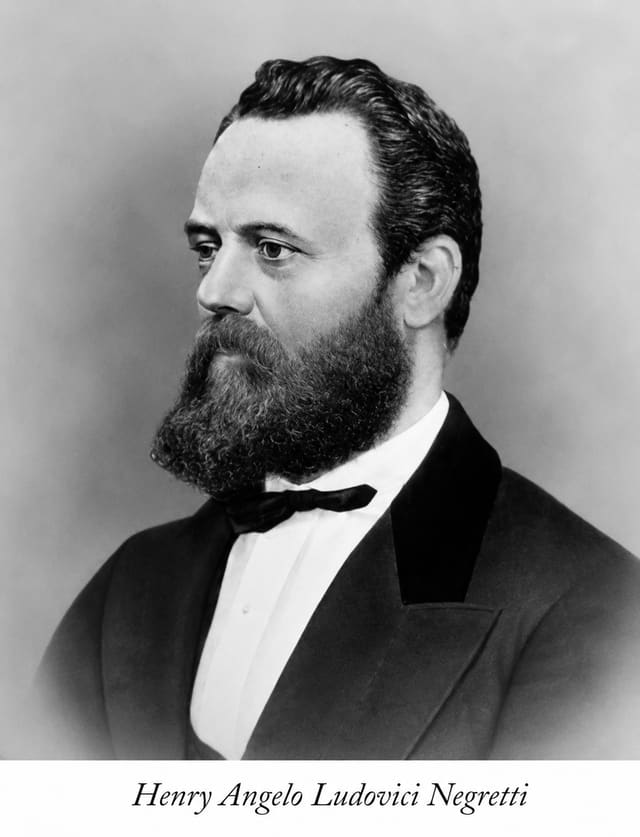
Henry Negretti. Enrico Angelo Lodovico Negretti was born in 1818 in the country of Lake Como and moved with his family to Britain around 1830, still a boy. The youth was soon apprenticed to Angelo Tagliabue — a member of another well-established Italian family. At about the same time Louis Casella, a gifted maker and future close rival of Negretti's, was apprenticed there too; he would in the end inherit Tagliabue's business (having, incidentally, married into the family). These interwoven apprenticeship ties would tell more than once later on.
Tagliabue's workshop at 17 Leather Lane passed, by the turn of the 1840s, to the Pizzi family, and Negretti worked first for Valentino Pizzi and, after his death in 1841, for his widow, Jane Pizzi. By this time Negretti was already an accomplished glassblower, and through his technical gifts he entered a partnership renamed Pizzi & Co. Just how that partnership ended is unclear, but by 1845 the firm of Negretti & Co had come into being, and Henry ran it right up to the founding of Negretti & Zambra five years later. In other words, by the time of the famous partnership Negretti was no beginner but the owner of an already established and successful business — a circumstance that explains the swiftness of the rise to come.
Joseph Warren Zambra. Having trained, in all likelihood, under his father at Saffron Walden, Zambra moved with his family to London in 1840, at the age of eighteen. Their address was listed at 23 Brooke Street, where a certain Joseph Pini also lived; it may have been sheer overcrowding that prompted the young Zambra to seek a partnership outside the family — with John Tagliabue, at 11 Brooke Street, around 1843. Thus the name Tagliabue came to be linked with both Negretti and Zambra; by 1843 the future partners must surely have known of one another's existence. Both, incidentally, attended the London Mechanics' Institute (now Birkbeck College) — an institution founded in 1823 to teach science and technology to working men.
The partnership. The exact reason Negretti took Zambra as a partner remains unknown. On the very earliest instruments the firm signed itself "H. Negretti & Zambra" — a likely echo of the former name "H. Negretti & Co," which indirectly confirms Zambra's somewhat junior standing at the outset. Whether Zambra brought capital into Negretti's already settled business will probably never be established; but he was a trained glassblower, and so the partners shared the common and absolutely essential craft for meteorological instruments. On 24 April 1850 the partnership of Negretti & Zambra was formally established, with new premises at 11 Hatton Garden. (Some sources give 23 April — a discrepancy of a single day, no more.)
Henry Negretti was a man not only enterprising but of that reputation for probity which would later make him the hero of one of the most remarkable courtroom dramas of the age. Joseph Warren Zambra complemented him with commercial shrewdness and scientific curiosity — it was no accident that his own papers on scientific instruments would still be appearing in the specialist press in the 1880s.
Part III. The Crystal Palace and the Birth of a Reputation (1851)
The firm's first year was given over almost entirely to preparing for the event that would shape its whole future course — the Great Exhibition of 1851, held in Hyde Park from 1 May to 15 October beneath the roof of the Crystal Palace.
The image of the Crystal Palace, built for the Great Exhibition of 1851 in London, became a symbol of civilisation, progress and an ideal future — and, at the same time, an object of fierce ideological controversy among the Russian intelligentsia.
Nikolai Chernyshevsky published in The Contemporary (Sovremennik) a review of its architecture, its exhibits and its grounds after the building's re-erection in 1854. In the palace he saw the architectural embodiment of utopian socialism, and in his novel What Is to Be Done? he described a future in which people live in vast crystal collectives — a dream of progress, equality and liberation. Fyodor Dostoevsky, for his part, having visited London in 1862, saw in the Crystal Palace the embodiment of a soulless rationalism, of pride and of spiritual suppression. His characters in Notes from Underground and Crime and Punishment reject Chernyshevsky's utopian project, setting against it suffering, the freedom of desire and the individual will — even the irrational kind.
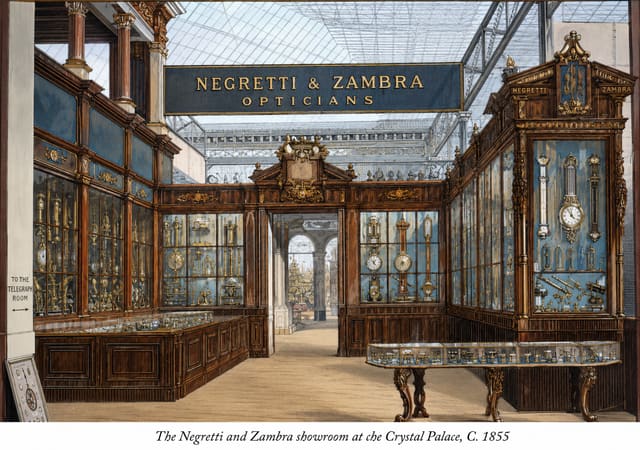
Negretti & Zambra, who could scarcely have known of this debate between two Russian titans, took Stand 106A at the Exhibition, in Class X, which the official catalogue styled "Philosophical, Musical, Horological and Surgical Instruments." Their neighbours were the finest makers of the age — Dollond, Newton & Son, Andrew Ross, Smith & Beck, C. W. Dixey, Powell & Lealand. Their display was, unsurprisingly, built around meteorology: on the stand one could see standard open-cistern barometers, self-registering barometers, pocket sympiesometers, Six's self-registering thermometers, hygrometers and pressure gauges. For these labours the firm won the only prize medal at the whole Exhibition for meteorological instruments — no small feat, considering how many instrument-makers were listed in the catalogue.
There soon followed a second honour, far weightier than the medal: a Royal Appointment from Queen Victoria for the making of meteorological instruments. A prize medal and a Royal Warrant in a firm's very first year — an achievement all but incredible, and it set the trajectory for everything that came after. The cash books of the first half of the decade show that the firm was already supplying many of London's oldest émigré Italian houses — Tagliabue, Pini, Ronchetti, Pastorelli — and even the firm of Casella, which had arisen after the death of Angelo Tagliabue in 1844. Among the customers were English houses too, many of them fellow exhibitors at the same show: Smith & Beck, Horn & Thornthwaite, Carpenter & Westley; and provincial firms — J. B. Dancer, Abraham, Chadburn, Gardner, J. Davis & Son. The clientele also included the Royal Observatory at Kew, the British Meteorological Society and numerous government and military departments. Over the door of the premises at 11 Hatton Garden the arms of the Royal Appointment were proudly displayed — and on a surviving engraving of those years the quantity of goods set out in the windows looks all but improbable.
Part IV. A Workshop of Inventions: Thermometers and the First Patents (1850s)
In its early years the firm was engaged in what were then called "philosophical instruments" — meteorological instruments. Thermometers, barometers, hygrometers: a modest range, but exacting in its precision. Already in this a creed was declared to which the firm would never be untrue: the first consideration was always quality. Not cheapness, not quantity — accuracy and reliability. It was on this footing that orders soon came in from the Admiralty, the Meteorological Office, the polar expeditions and private men of science whose names would enter the history of the discipline.
Thanks to the partners' glassblowing skill, it was thermometers above all that became the firm's speciality from the first, and over the course of the 1850s Negretti & Zambra patented a great many self-registering models for particular purposes — for mines, for the sea, for solar observation.
Their chief triumph was the patent maximum thermometer. Of it the Astronomer Royal wrote, with a warmth unusual in an official, in his report of 1852: for years meteorologists had struggled with the unreliability of maximum self-registering thermometers, but the construction of Negretti & Zambra appeared likely to evade the difficulty — the specimens tried had answered very well. The instrument proved so successful that a century later it was still in universal use and the only one employed for meteorological readings. For this same invention the firm received an "Honourable Mention" at the Paris Exhibition of 1855 — curiously, the firm did not exhibit there itself, the thermometer being shown as part of the Kew Observatory's collection.
The second innovation was simpler in appearance but changed thermometry the world over: the application of white enamel to the back of the thermometer tube. The enamel made the finest thread of mercury visible and thus allowed an ever thinner bore, raising the instrument's sensitivity. From then on the enamelled back became the standard for all thermometers.
The decade of inventions culminated in the publication of the first edition of the great Encyclopaedic Illustrated and Descriptive Catalogue. In its preface the firm stated its aim plainly: to make the book not a mere price-list but a guide for the purchaser of scientific instruments, with every instrument clearly described. Commercially this was a calculation: accessible explanations widened the circle of buyers. But the catalogue at the same time raised the general scientific literacy of its reader — and it remains to this day a most valuable reference on the instruments of the age.
Part V. Photographers to the Crystal Palace: The Firm's Second Business
There is a side of Negretti & Zambra's work that instrument histories usually let slip — and wrongly, for at its height it was no mere adjunct to the main business but a full-fledged second enterprise that made the firm one of the great names of Victorian photography.
It all began with the Crystal Palace. When, in 1853–1854, the exhibition building was taken down in Hyde Park and re-erected at Sydenham, Negretti & Zambra became official photographers to the Crystal Palace Company, which gave them the right to photograph the interior and grounds of the new building. The firm made instant use of this and set up the production of stereographs, as well as photographic studios and a showroom at the new palace. Their carte-de-visite portraits came into fashion with well-to-do visitors; from the number that survive to this day one may judge the trade this brought in.
But the firm's ambitions reached far beyond the exhibition halls. In 1855–1857 Negretti & Zambra engaged the Swiss photographer Pierre Rossier (1829–1886) to travel to China and record the course of the Second Opium War. Rossier proved unable to join the Anglo-French forces in the end, but he remained in Asia for several years — and produced the first commercial photographs of China, Japan, the Philippines and Siam, which the firm published. He was the first professional photographer to work in Japan, where he taught the craft to the first generation of Japanese masters — Ueno Hikoma, Maeda Genzō, Horie Kuwajirō. In November 1859 the firm issued a set of fifty of Rossier's views, including stereo pairs; the photographic journals received them favourably. The choice of a Swiss was, in all likelihood, a shrewd one: a neutral nationality eased Rossier's passage aboard British and French ships. It was a hazardous and costly expedition — and, at the same time, one of the most important in the early history of documentary photography.
Asia was not the end of it. In 1856 the firm financed a photographic expedition by Francis Frith to Egypt, Nubia and Ethiopia. In 1864 Negretti and Zambra themselves photographed Shakespeare's house at Stratford-upon-Avon: the sepia print was pasted onto a card and given to visitors to the Crystal Palace so that they might compare it with the model of the building on display.
And, finally, the sky. Negretti's interest in ballooning was most likely kindled by his acquaintance with the pioneering aeronaut James Glaisher, of whom more shortly. In the early 1860s Henry Negretti conducted experiments in aerial photography, ascending by balloon over Sydenham to a height of about 4,000 feet with a darkroom specially fitted out for work in the air — and he proved that aerial photography was indeed possible. He is likewise credited with the first aerial photographs of London, taken in 1863 from a balloon piloted by Henry Coxwell. In the age of the wet-collodion process, which required a plate to be developed immediately after exposure, to hoist a whole portable laboratory into the basket of a balloon was an all but reckless undertaking.
The firm professed the photographic business as seriously as the instrumental one: it was London agent for Steinheil's patent photographic lenses and prisms, and at the 1862 Exhibition it earned a separate medal in the photographic class. Of that exhibition — in the next chapter.
Part VI. Admiral Fitzroy and the Barometer That Saved Lives
No name is so tightly interwoven with the history of the firm as that of Vice-Admiral Robert Fitzroy. Many of its most celebrated instruments were born of his requirements, and the fame of the "Fitzroy barometers" became for decades a synonym for Negretti & Zambra itself.
The man. Fitzroy was born on 5 July 1805 at Ampton Hall in Suffolk — of the second marriage of Charles Fitzroy, himself the second son of the third Duke of Grafton; among his forebears was an illegitimate son of King Charles II, and on his mother's side Viscount Castlereagh. From this aristocratic but nervous stock he inherited a strong, industrious and painfully sensitive temperament. At thirteen he entered the Royal Naval College at Portsmouth, and at twenty-three he took command of the brig Beagle.
The second voyage of the Beagle (1831–1836) made him famous twice over. First, as a surveyor: the Strait of Magellan and the greater part of the mainland coast of South America were charted, and a chronometric line was carried round the globe for the first time. Second — by a bitter irony — as the unwitting godfather of the theory of evolution: the naturalist whom Fitzroy himself chose and took aboard almost at the last moment was Charles Darwin. Five years in a cramped cabin drew them together, but also drove them apart: the devout Fitzroy clung ever more firmly to a literal reading of Scripture, and in the Patagonian cliffs with their marine fossils he saw not evolution but the traces of the universal Flood, whereas his companion was moving toward precisely the opposite conclusion.
Disappointments were not lacking in the admiral's life — from the failure of his charitable scheme to "civilise" three Fuegians to his forced resignation from the governorship of New Zealand, where he drew down upon himself the anger of the settlers by defending the rights of the Maori. But it was at the close of his career that he did his greatest work. In 1854 he was placed at the head of the newly created meteorological department of the Board of Trade. Here he created a system of storm warnings, set up observing stations, began to print "synoptic charts" (the term is his coinage) and accustomed the readers of newspapers to a new word — "forecast," also invented by him. The wreck of the Royal Charter off the coast of Anglesey, which cost hundreds of lives, gave him the political backing to see the matter through.
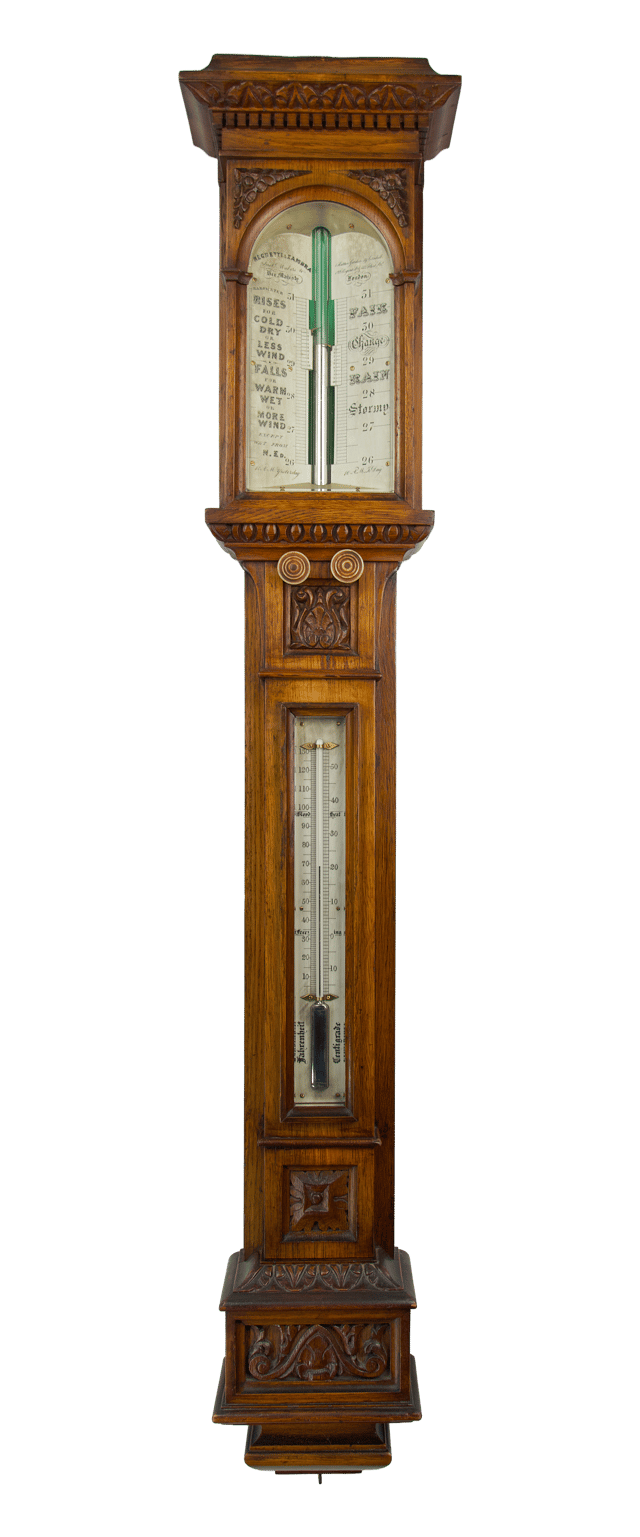
The collaboration. Fitzroy needed a barometer of a special kind — one that warned of what was about to happen, and one accessible to the plainest skipper. In 1857 he asked Negretti & Zambra to design a "stick" barometer fit for installation at sea-coast stations throughout the country, and at the same time commissioned from them a double-bulb deep-sea thermometer, brought in the end to withstand a pressure of seven tons. The instruments were at first distributed through the Meteorological Office at public expense; by 1864 the firm was advertising the porcelain-scaled version to the general public, as is recorded in its Treatise on Meteorological Instruments. The advertisement stated that many poor fishing villages and towns had been provided by the Board of Trade, at the public expense and through the humane effort of Admiral Fitzroy, with first-class barometers, each fixed in a conspicuous position and accessible to all.
By 1859 Fitzroy had also drawn in the Royal National Life-boat Institution (RNLI): the sea-coast, or storm, barometer of Fitzroy began to reach the RNLI stations through government funding and voluntary contributions; these examples, fitted with distinctive scale plates, are noticeably rarer.
Meanwhile a quiet dispute over construction was going on. The Kew Observatory had commissioned Patrick Adie to develop a marine stick barometer— the outcome of the Brussels Congress of 1853, at which several nations had agreed on a single accurate instrument for measurement at sea. Adie's design the Board of Trade adopted as a standard on land and sea for many years, but Fitzroy did not approve of it: the metal trunk seemed to him too vulnerable to concussion and to gunfire. This was precisely what prompted the admiral to develop, together with Negretti & Zambra, the "gun" marine barometer, packed in vulcanised india-rubber so as to withstand the discharge of the guns. The trials were conducted in earnest, aboard H.M.S. Excellent, and passed into legend. From Captain Hewlett's report to Fitzroy: in the third series of experiments, Mr. Negretti being present, five of the new-pattern barometers were subjected to the concussion produced by firing a 68-pounder gun with shot and 16 lb. of powder — and every one withstood it without the slightest injury.
The brief inscriptions on the barometer's scale were composed by the admiral himself, and there was a poetry in them: "RISE" — at cold, dry, northerly winds, toward fair weather; "FALL" — at warm, moist, southerly winds, toward wet and wind; and the folk rule composed aboard the Beagle: "Long foretold, long last; short notice, soon past." Detailed directions for the genuine instrument were given in the Barometer Manual, compiled by Fitzroy for the Board of Trade and costing sixpence; the firm, for its part, publicly warned the public against cheap imitations of the admiral's barometers.
The end. In 1859 On the Origin of Species appeared, and Fitzroy defended his fundamentalist convictions furiously — in public and under the pseudonym "Senex" in the columns of The Times. The same Times increasingly mocked his forecasts; working himself to exhaustion, he broke. At about eight o'clock on a Sunday morning, 30 April 1865, the sixty-year-old vice-admiral cut his throat with a razor.
It is worth noting that during the admiral's lifetime the firm did not attach his name to the barometer. Only after his suicide did Negretti & Zambra begin to call the instrument "Admiral Fitzroy's Storm Barometer" — in preference to the dry old "Sea Coast Barometer." Fitzroy's successor at the Meteorological Office did not approve, but the firm, having worked with the admiral for so many years, probably felt itself entitled.
Part VII. Expansion and Removals: From Hatton Garden to Regent Street (1857–1869)
The collaboration with Fitzroy was but one of the summits. By the middle of the century Negretti & Zambra had become a veritable workshop of wonders, where under one roof were born instruments for the sea, the mountains, the mines, the balloon and the farmstead. The 1860s were for the firm a time of vigorous growth, and the geography of its London addresses changed almost as quickly as its range of wares.
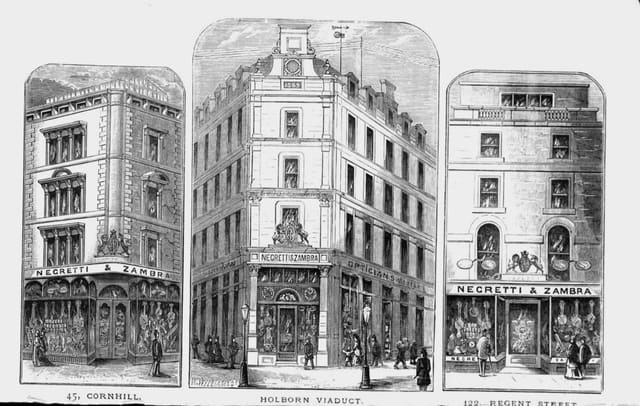
First Negretti & Zambra moved from 11 Hatton Garden to more spacious premises at 1 Hatton Garden, having already, in 1857, taken additional premises at Cornhill. Then the redevelopment of Holborn into what would become Holborn Viaduct forced a further removal — to a brand-new building at 38 Holborn Viaduct. The grand opening of the new district in 1869 was honoured by the presence of their patron, Queen Victoria, and the firm's premises stood at the very heart of the proceedings.
Earlier still, in 1862, the firm had bought the business of the London instrument-maker John Newman, whose premises at 122 Regent Street gave it a prestigious flagship shop in the heart of the capital. Newman was a respected maker of meteorological instruments — and it was he who supplied Darwin's instruments for the voyage of the Beagle with Fitzroy. After Newman's death in 1860 and the purchase of his business two years later, Negretti & Zambra went on for many years to reproduce and improve his famous station barometer.
Here it is fitting to correct an old error. The firm's centenary brochure of 1950 proudly claimed that Negretti & Zambra instruments had sailed on the Beagle with Darwin. This is impossible: the Beagle put to sea in 1836, fourteen years before the firm was founded. The instruments for the Beagle were made by Newman, and only through the purchase of his business did Negretti & Zambra acquire an indirect claim to that glory. It seems that no one dared correct the compiler of the brochure, Paul Ernest Negretti.
The year the Regent Street shop opened coincided with the second great exhibition in the firm's history — the International Exhibition of 1862 in South Kensington, on the site of the present Natural History Museum. It opened in May and gathered some thirty thousand exhibitors. Negretti & Zambra exhibited in Class XIII, "Philosophical Instruments and Processes Depending on Their Use," surrounded by the finest makers — Casella, J. B. Dancer, De Grave Short & Fanner, Elliott Brothers, J. Hicks, Pastorelli, Pillischer, Smith Beck & Beck, Breguet, E. G. Wood, Naudet. But, unlike in 1851, the firm now entered itself also in Class XIV — "Photography and Photographic Apparatus." It was during this exhibition that Henry Negretti conducted his famous ballooning experiment over Sydenham. Both displays brought a prize medal each: one for meteorological instruments, "for many important inventions and improvements, together with accuracy and excellence," the other "for the beauty and excellence of photographic transparencies and the adaptation of photography to book illustration."
The firm was drawn ever closer to the scientific elite. Its interest in ballooning was fed by its acquaintance with James Glaisher — pioneering aeronaut and Superintendent of Meteorology at the Royal Observatory, who made his ascents in 1862–1866 (the memoirs of which appeared as the book Travels in the Air). Whether Glaisher accompanied Negretti on his flight is unknown, but it was the firm that supplied the aneroids for the experiments. Glaisher later wrote that a third aneroid, graduated down to five inches, read the same as the mercurial barometer throughout the high ascent to seven miles on 5 September 1862, and that he took this instrument up with him on every subsequent high ascent.
Amid all the turmoil of the viaduct and the removal, the firm found time to bring out one of its most influential publications — the Treatise on Meteorological Instruments of 1864. Like the encyclopaedic catalogue, it was at once a price-list and a textbook, but with a narrow aim at meteorology — that very bastion which remained the firm's mainstay for almost its whole life.
Part VIII. Science in the Deep and in the Sky: Instruments of the 1860s–70s
It was on these two decades that the firm's flowering as a workshop of wonders fell. It is worth going through its armoury — it explains, better than words, why the name became a byword.
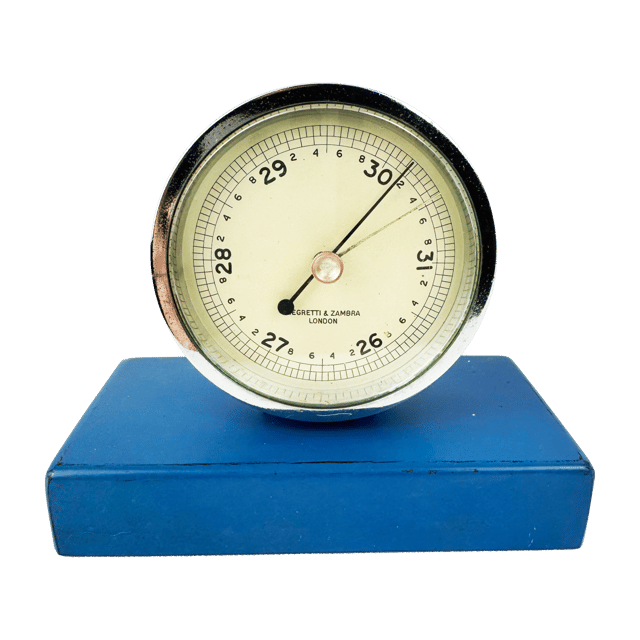
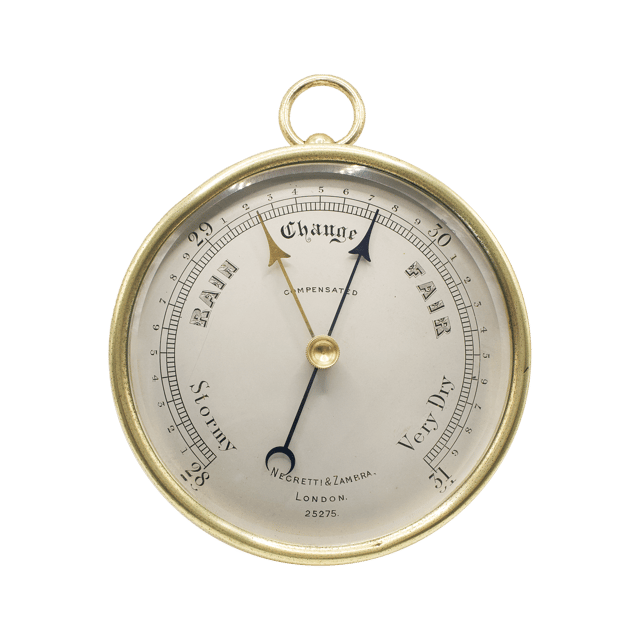
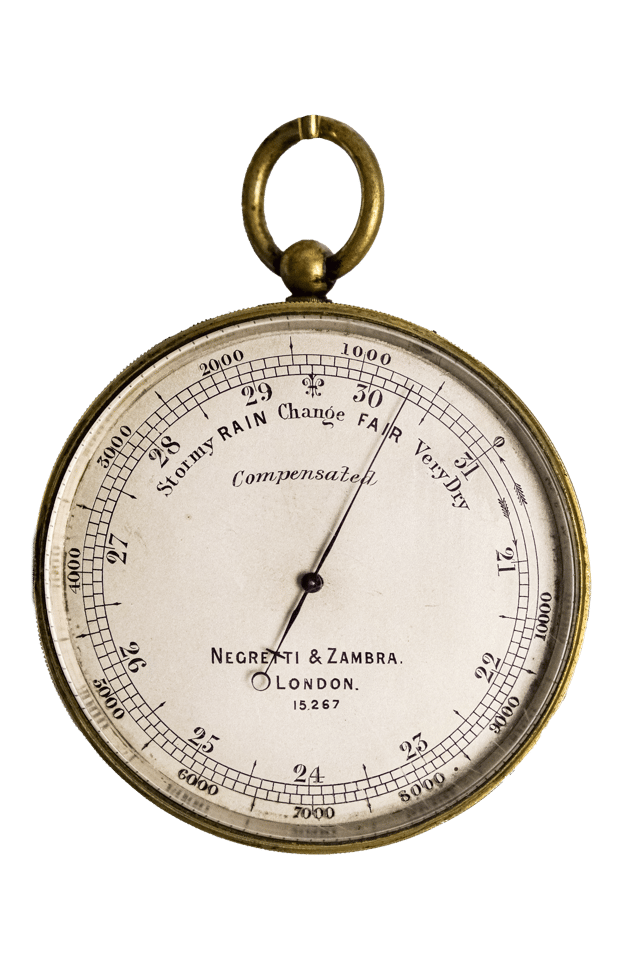
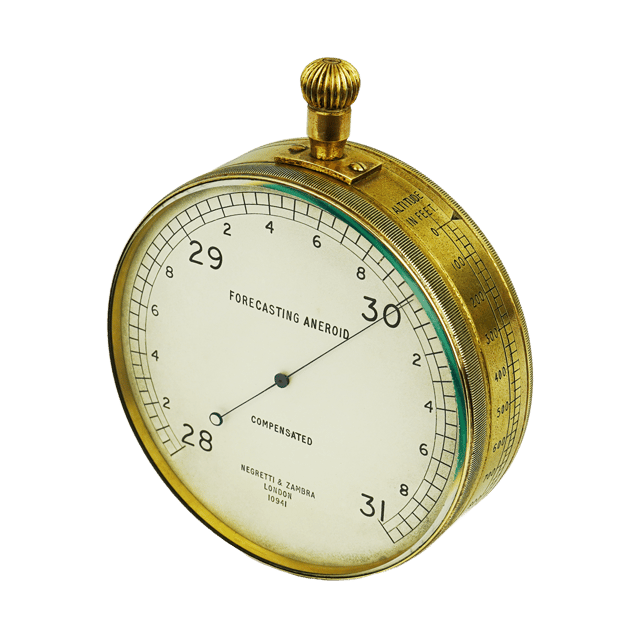
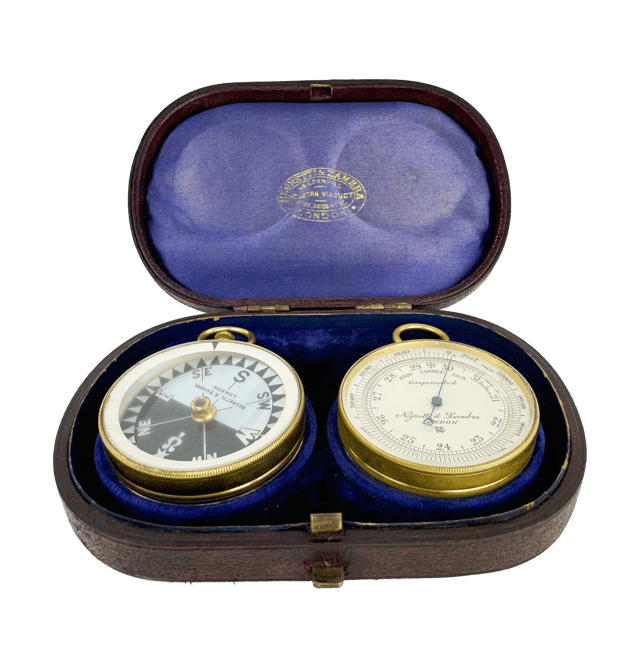
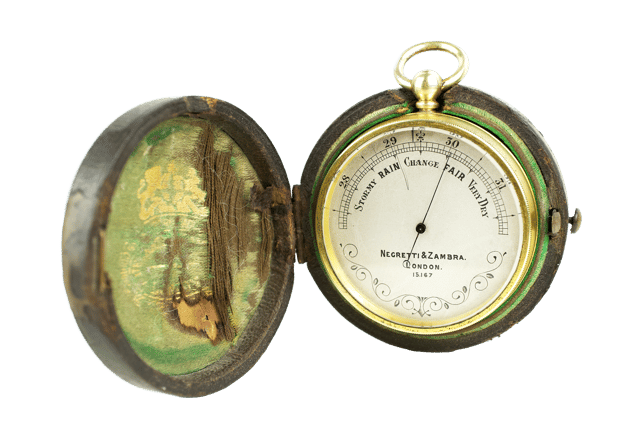
The aneroid goes into the pocket. The last year of the 1850s coincided with the lapse of Lucien Vidie's patent on the aneroid barometer. Negretti & Zambra were among the first to take advantage of it, and Fitzroy commissioned from them a reduced, portable version of the instrument. The firm became the first to bring the "pocket" aneroid to perfection. The early examples are thicker than the later ones, but it was they that gave rise to yet another highly saleable article. How the aneroid worked the firm explained simply in its catalogue: the elastic top of the vacuum box acts like a cushion, rising and falling with the change of pressure; a lever magnifies the tiny movement, and a chain and a spiral spring turn the needle. The altitude scale for it, calculated for 50° Fahrenheit, was worked out and kindly presented to the firm by the Astronomer Royal, Professor Airy.
The thermometer goes to the deep. The double-bulb deep-sea thermometer, begun for Fitzroy, the firm brought to a new and improved pattern, which in the early 1870s was employed in the Royal Society's Challenger Expedition — one of the most scientifically fruitful exploratory missions in centuries.
The barometer goes down the mine. The practical uses of the barometer the firm thought out to the last detail. The mining barometer was advertised readily and evidently sold well: after it was found that a change of pressure was always recorded before an explosion in a mine, the government in 1872 issued a directive. The Mines (Coal) Regulations Act of 1872 required that, after dangerous gas had been found, a barometer and thermometer be placed above ground in a conspicuous position near the entrance of the mine. The heavy inflammable and suffocating gases — firedamp and chokedamp — are, when the pressure falls, driven into the lowest and least-ventilated workings; hence such disasters occurred more often when the barometer was low.
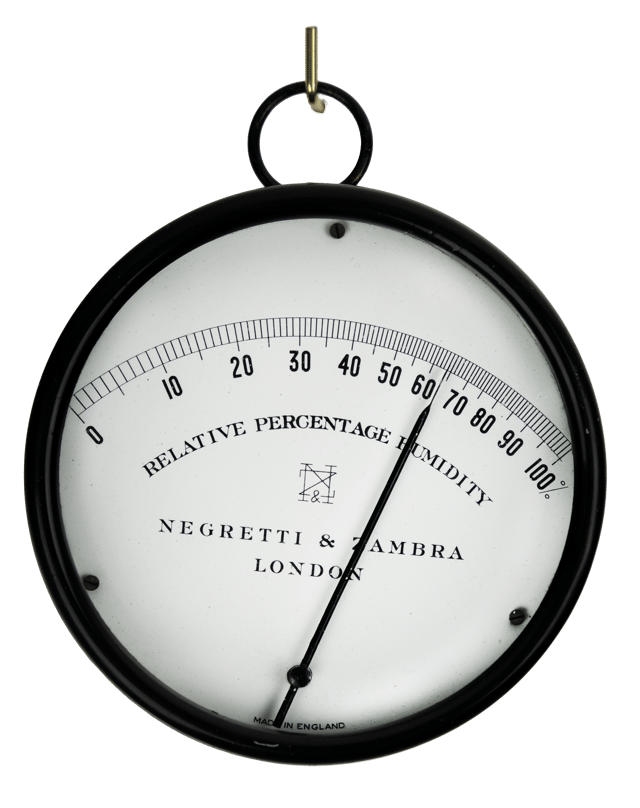
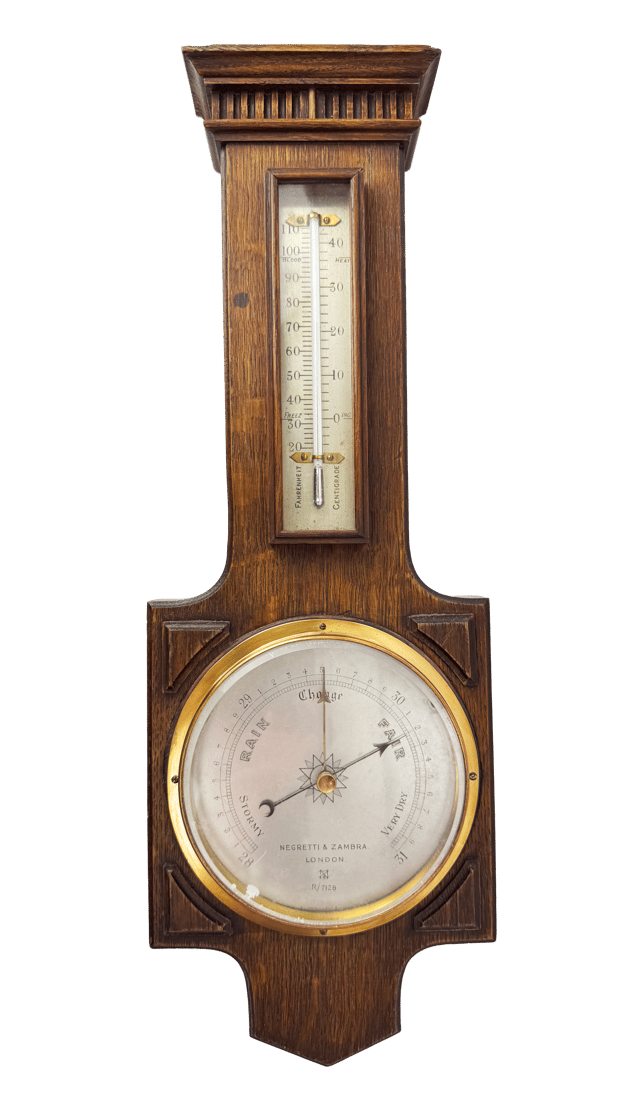
The barometer comes to the farm. There appeared, too, a farmer's barometer with a more accurate hygrometer — an instrument "for ascertaining the humidity of the atmosphere, the general character of the weather, and the approach of wind and rain," combining barometer, thermometer and hygrometer, and, in the words of the catalogue, equally valuable to the agriculturist and the invalid. In the same text the firm referred to James Glaisher as secretary of the British Meteorological Society — under whom thousands of accurate observations had been gathered and registered, permitting the changes of the weather to be interpreted.
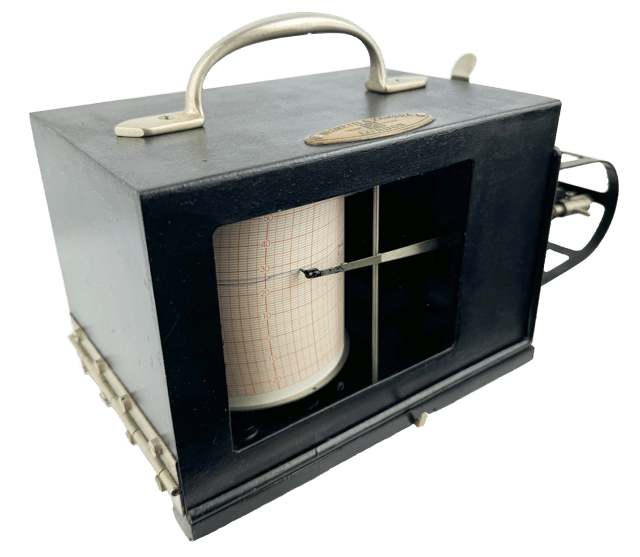
The birth of the barograph. The most far-sighted invention of this period was the "self-recording aneroid barometer." The aspiration toward self-registering instruments the firm had been nursing ever since its early thermometers, and after the pocket aneroid the next step was obvious — to make the instrument record its readings without the observer's constant attendance. The result was a large cased instrument uniting clockwork with a fusee (spring) movement, a large aneroid and a brass drum with a paper chart and a pen. All three parts were linked: the clock drove the drum and governed the periodic engagement of the pen with the chart, while, just before recording, a small tap lightly struck the barometer to verify the accuracy of the reading; the pen itself moved in step with the pressure needle. This was one of the earliest appearances — after Breguet's barometrograph — of what we now call the barograph. In later instruments the clock was moved inside the drum, which allowed the size to be reduced, but these early examples yield nothing to them, either technically or aesthetically. The catalogues of Negretti & Zambra, Casella, Hicks, J. H. Steward and others advertised them widely for about ten years — until their own offspring, the compact barograph, drove them from the stage.
A gallery of instruments. The firm's catalogue of the time is a very encyclopaedia of pressure. In it is the Kew marine barometer, recommended by the Brussels Congress, with its carefully calibrated upper tube, its constriction against the mercury's "pumping" in a seaway, and Bunten's air-trap. And the sympiesometer — an elegant substitute for the long mercurial barometer, in which a column of coloured sulphuric acid moves under the joint action of pressure and temperature, so sensitive that it catches a change before the ordinary marine barometer does. And the ingenious "long-range" instruments that stretch out the meagre working range of an ordinary barometer: Howson's barometer, in which the cistern seems to hang in the air, supported by the pressure of the atmosphere alone and the buoyancy of a glass rod; and McNeild's, on the exactly opposite principle — with the tube floating in the mercury; as "meteorological binoculars" for the minutest changes, they surpassed the ordinary instrument. And there were uses of the barometer now forgotten: the estimation of the height of the tide (a rise of pressure of an inch answering to a fall in the level of about a foot — what sailors called "frost nips the tide") and a whole set of barographs of others' design — Milne's, King's, the photographic siphon — which the firm knew and described.
These two decades were the golden age: from the fishermen's fountain to the edge of the stratosphere, from the coal-face to the ocean deep — the range of a single London workshop.
Part IX. World's Fairs and the Passing of the Founders (1875–1897)
From 1875 the latter half of the decade was given over largely to the world's fairs that went on multiplying after the success of 1851. The catalogue of the 1880s proudly listed the awards: a prize medal for "optical and physical instruments" at the Santiago Exhibition (Chile) of 1875; three prize medals at the Philadelphia Exhibition of 1876 — for "meteorological instruments, thermometers and microscopes"; a gold medal at the Paris Exhibition of 1878 for meteorological instruments. In between, the firm found time to lodge patents — in 1876 for hydrometers, in 1877 for thermometers and hygrometers.
After thirty years of unbroken success, 1879 was a mournful year. On 27 September the founder Henry Negretti died of an acute lung infection. His son, H. P. J. Negretti, had by then already been involved in the business for some time, and together with Joseph Warren Zambra and his son J. C. Zambra a new partnership was concluded. The loss of the founder did not lay the firm low: it retained the patronage of the scientific community, of government departments and of the Crown.
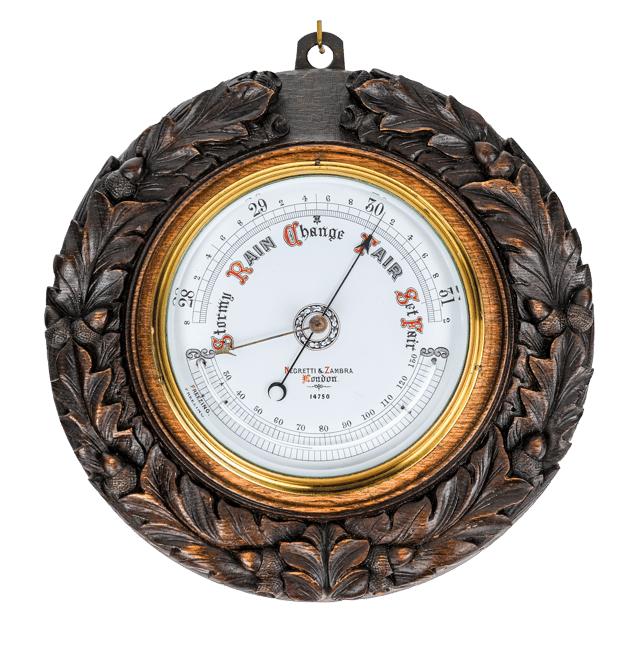
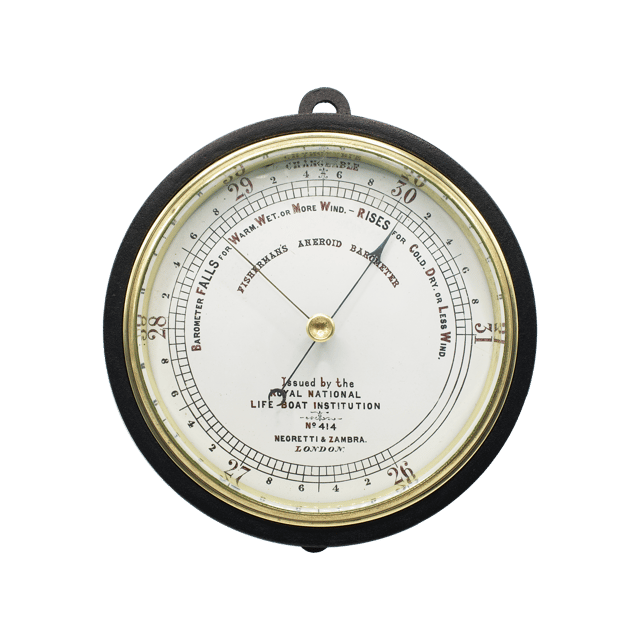
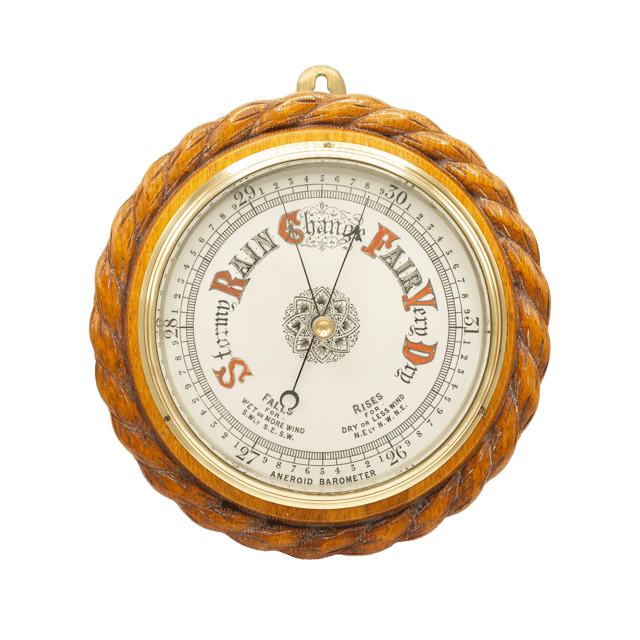
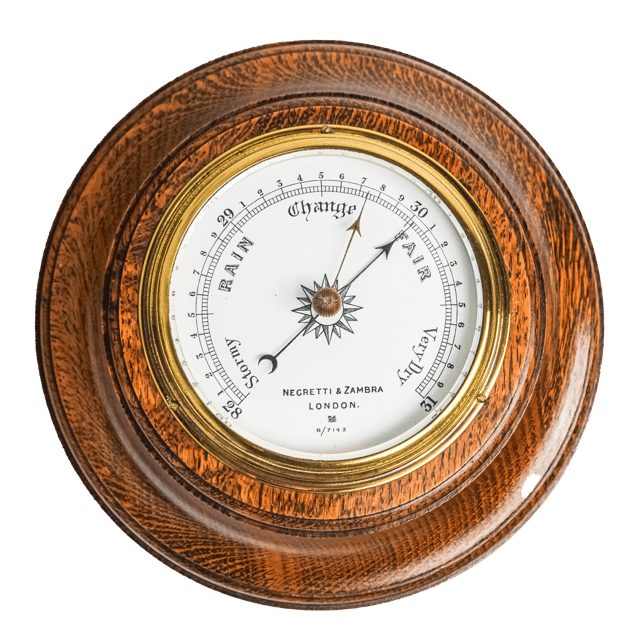
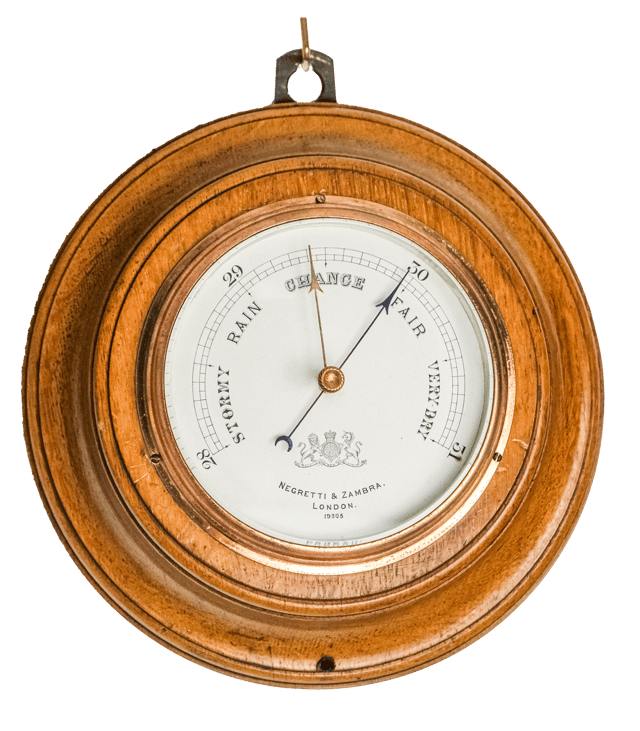
The collaboration with the RNLI continued too. In the early 1880s it was decided to furnish mariners and fishermen with an aneroid barometer fit for small vessels and, more importantly, affordable to men of modest means. The purpose was the same as with the original storm stick barometer, but these small, portable and far hardier instruments allowed foul weather to be foretold at sea itself.
Drawing the public's attention to the fisherman's barometer, the Institution issued the following appeal on the subject, which is to be found at most of its life-boat stations and at certain other places along the coast:
"The attention of the National Life-boat Institution has been drawn to how useful an aneroid barometer would be aboard fishing vessels for indicating the approach of bad weather. Experience shows that warning of an approaching storm is often given by the aneroid — as it is by the ordinary mercurial barometer — several hours before the gale itself is actually felt. It may therefore reasonably be hoped that, were such an instrument placed in the hands of sensible fishermen, it might deter them from putting to sea when a storm is at hand, or enable them to judge when it would be the more prudent to make for harbour; and some reduction may thus be looked for in the loss of life aboard fishing craft overtaken by squalls of wind. Certain fishermen, like other seafarers, will doubtless profit by its use and will probably be enabled to avoid some of the dangers that now so often prove fatal to them. The Committee of the National Life-boat Institution, having in these circumstances secured the assistance of some of the most experienced makers, is now able to offer to the owners or masters of fishing vessels such an instrument at a price greatly reduced from its cost to the Institution. The aneroids will be manufactured by Messrs. Negretti and Zambra and Messrs. Dollond and Co., both of London, and each one, before being sent to the coast, will be carefully tested and put into reliable order."
Negretti & Zambra went on making these fisherman's aneroid barometers for the RNLI and for general sale for over half a century. The design is simple — and yet it produced one of the most beautiful and sought-after aneroids, beloved of collectors to this day.
At the same time, in the early part of the decade, another instrument of impeccable elegance appeared — the long-range glycerine-and-mercury barometer, conceived for a more precise reading of the pressure on an extended scale. It is built as a siphon: the long closed limb, of about 33.5 inches, is filled with mercury; the short limb is continued by a thin tube, partly filled with glycerine — a fluid much lighter than mercury; and, owing to the difference of diameters and specific gravities, the rise and fall of the mercury is "spread out" over a greater length. The range of such barometers is from six to ten inches to a single inch of an ordinary barometer, and a hundredth of an inch may easily be seen without a vernier. They are rarely met with, were evidently made in small numbers, and were meant for the domestic buyer as a way of avoiding the vernier — but for that very reason the serious scientific user probably thought them unserious. A rare case where the firm's ingenuity missed its market by trying to please two audiences at once.
The exhibition calendar remained full, though now chiefly closer to home: the Fisheries Exhibitions at Norwich, Edinburgh and London in 1881–1883 brought a number of medals, and at the International Health Exhibition of 1884 the firm's thermometers were once again in the judges' favour. The most distant and unusual of all was the Java Exhibition of 1883 — a gold medal for optical instruments being, one must suppose, consolation enough for the distance.
The generations changed almost by the clock. In 1888 the last of the founders, Joseph Warren Zambra, withdrew from the business, and his second son, M. W. Zambra, joined his brother J. C. Zambra and H. P. J. Negretti. Only four years later, in 1892, J. C. Zambra died, predeceasing his father the other way about — by five years: Joseph Warren Zambra himself died on 23 December 1897 in Hampstead and was buried in Highgate Cemetery. After all these changes and the loss of both founders, the 1890s do indeed look a period sparse in invention for the firm — which by no means signifies that its affairs went worse.
Part X. The Negretti Case: How an Instrument-Maker Saved a Man from the Gallows
There was in Henry Negretti's life a story that had nothing whatever to do with barometers, but that showed better than any barometer of what stuff the senior partner of the firm was made.
On Boxing Day, 1865, at the Golden Anchor, a public house in the City of London kept by a former policeman, Frederick Shaw, a brawl broke out between a group of Englishmen and a group of Italians. One of the Englishmen was killed. The blame fell on an Italian wounded in the same affray — Serafino Pelizzioni. The court sentenced him to hang.
Negretti, a respected man to whom his countrymen had long been accustomed to turn as an unofficial arbiter, was puzzled by the affair. He took up an investigation of his own — and the logic of an instrument-maker, used to the rigour of facts, bore fruit. The murder weapon was found twenty yards from the pub, but the accused could not have left the building and so could neither have thrown nor dropped the knife after the alleged blow. Further inquiry showed that at the height of the fray Pelizzioni had been in an altogether different tavern, and that the culprit was his cousin, Gregorio Mogni, who resembled him.
Despite all Negretti's arguments, Pelizzioni had already been sentenced to death. So the instrument-maker, through his connections, tracked down Mogni, obtained a confession from him and repeated that confession to the Superintendent at the King's Cross police station. But there he was not taken seriously — and Negretti resorted to the old British right of a private person to arrest the offender himself. The Crown declined to prosecute, so it fell to Negretti to bring the charge of murder as a private case. Now the evidence earlier ruled out as hearsay could be heard, and several eyewitnesses identified Mogni as the man with the knife. The jury returned a verdict of manslaughter without hesitation; Mogni was given five years. Negretti was publicly commended for his public-spirited act, and the authorities were sharply rebuked for an error that had all but cost an innocent man his life.
In this story is the whole character of the firm in miniature: accuracy of observation, distrust of ready conclusions, and a stubborn faith that a fact can and must be verified.
Part XI. At the Turn of the Century: Half Moon Works, Telescopes and Optics (1899–1914)
Of the firm's prosperity at the close of the century its property speaks more eloquently than its inventions. Negretti & Zambra took up the manufacture of telescopes in earnest only when, around 1899, they bought the Half Moon Crescent business of Captain Hammersley in Barnsbury; with it they took over his premises too. In 1901 the firm acquired a plot on Half Moon Crescent in Islington in order to consolidate its manufacturing base; after the demolition of the old buildings and the erection of new ones, the famous Half Moon Works arose here by 1911, and served the firm for many decades.
By the end of the nineteenth century the range had broadened markedly toward optics: telescopes, terrestrial and astronomical, theodolites, levels, gun sights. The firm also acted as London agent for others' goods — Bourdon's pressure gauges, Ritchie & Sons' patent liquid compasses, Steinheil's photographic lenses and prisms. The house entered the new century confidently, on the solid foundation of the reputation amassed over half a century.
Part XII. War, Aviation and "Mercury-in-Steel" (1914–1939)
The First World War turned the firm's course sharply. Throughout the war Negretti & Zambra worked for the Ministry of Munitions, supplying instruments for military use; it was then, too, that their part in the development of early aviation instruments began — which would set the direction for decades to come. When the war ended, a strategic decision was taken: to give up optics and concentrate on industrial and aviation instruments.
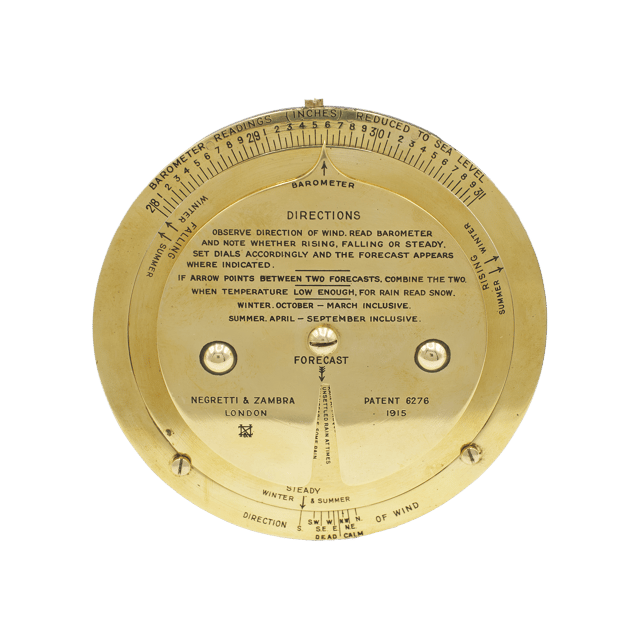
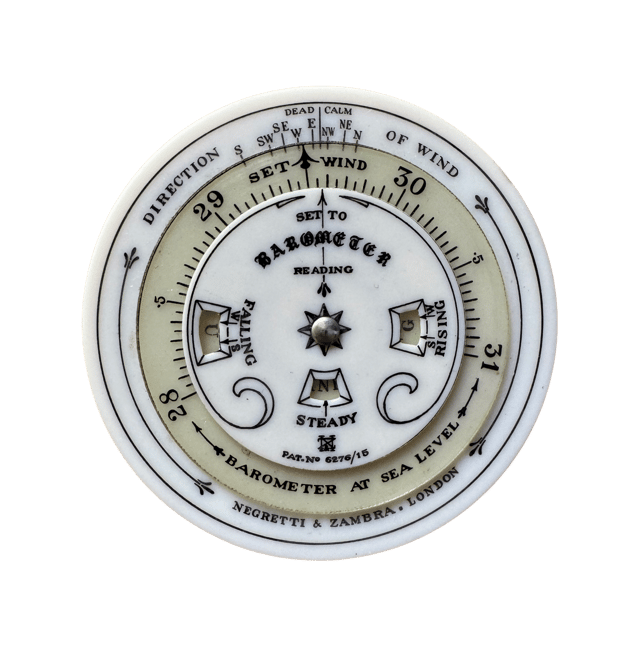
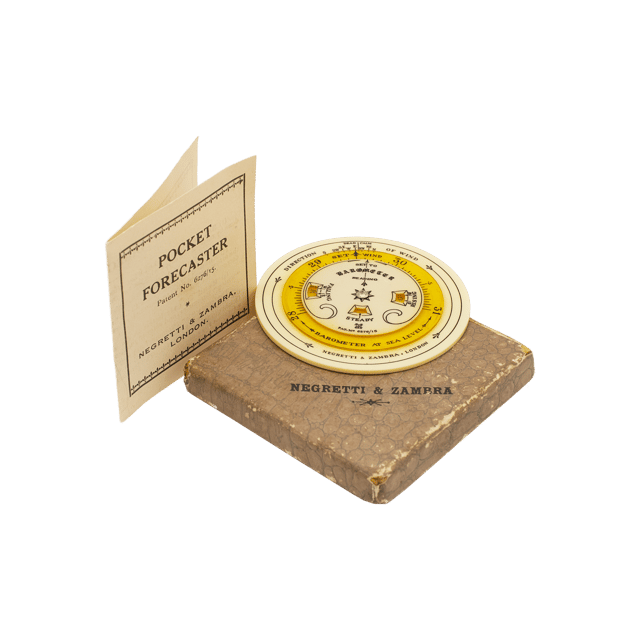
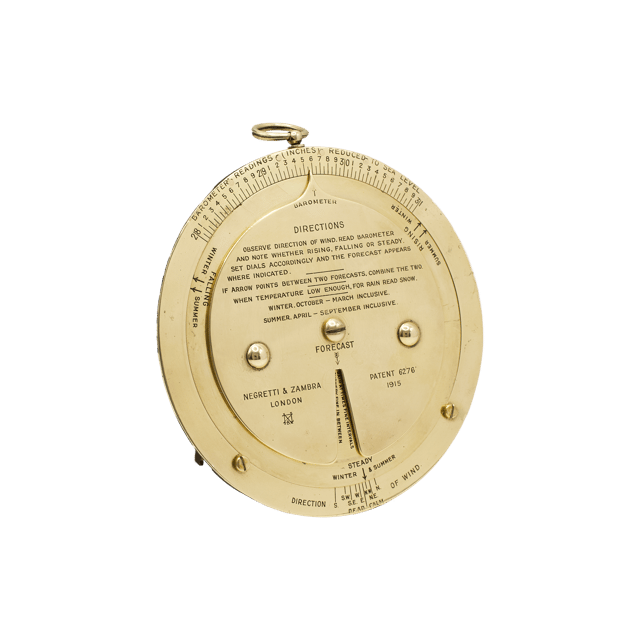
But meteorology the firm did not abandon — on the contrary, one of its most popular patents was lodged in 1915: a whole set of weather-forecasting instruments. Throughout its history Negretti & Zambra had striven to make weather instruments more accessible to the domestic buyer, and the novelty, which allowed pressure and wind direction to be translated at a moment's notice into a reasonably accurate forecast, quite literally demystified the puzzling movements of the barometer needle. The set suited every purse — from large travelling cases with a forecasting aneroid and a desk forecaster to pocket versions, simple ivorine discs and desk instruments that worked in tandem with any aneroid. It proved enormously popular in the post-war years and was, perhaps, the firm's last domestic novelty to break the mould — before the wireless forecast took that role from it. In its London shops the firm even began to publish forecasts of its own, drawn up with this instrument.
The industrial side, meanwhile, was gaining weight. In 1920, at the request of the Air Ministry, the firm developed and patented a "mercury-in-steel" distance thermometer for measuring the temperature of oil and air in aircraft; the same principle soon found use in industrial processes, in boiler-houses and at sea, and demand flared up at once. The mercury-in-steel system was brought to perfection by Harold William Ibbott, who came to the firm from the Royal Aircraft Establishment at Farnborough — that same Ibbott under whom more than one generation of makers would work (and to whom, incidentally, is credited the idea of first adding a flashing lamp to the stroboscope). Between the wars there followed boost gauges, transmitting oil- and fuel-pressure gauges, a fuel flowmeter for aero-engines, electrical resistance thermometers and thermocouple pyrometers; and in 1930 the firm introduced the hardened and tempered steel diaphragm for the boost control of aero-engines.
The changes were reflected in the catalogues too. The M2 catalogue of Standard Meteorological Instruments, which appeared in the 1920s, was markedly slimmer than the lavish Victorian range, but it introduced aviation and industrial equipment for the first time — a clear sign of the retreat from high-street retailing. Gone, too, were the detailed explanations of former days: the firm now plainly reckoned on a better-informed, scientifically inclined buyer. In the 1930s a similar catalogue, the M3, appeared.
The composition of the partnership shifted as well. H. P. J. Negretti died in 1919; G. Zambra withdrew in 1921; the business was carried on by H. N. Negretti, P. E. Negretti and M. W. Zambra. The firm, begun by two men, had long since become a dynasty. And in the workshops, meanwhile, there were trials of another kind: the slump of the early 1930s brought months of short-time working — from those years when the workmen saved a few pence on the bus by walking miles on foot.
Part XIII. The Second World War: Bombs, Spitfires and Dispersal (1939–1948)
The Second World War once again turned the firm into a defence enterprise — but on an incomparably larger scale, and it left deep wounds in its body.
In May 1941 the premises at Holborn Viaduct were destroyed by Luftwaffe raids. They were never rebuilt; the head office was moved to the existing premises at 122 Regent Street, which had both an office and a shop at street level. The Half Moon Works, working for the government, suffered too; this forced the firm to take safer temporary premises in Chesterfield, where they made various gauges and thermometers for the aircraft of the Royal Air Force and where hundreds of people worked. After the war the Chesterfield works could not be kept on because of the distances, and for aviation a factory was set up at Chobham. The diaphragm boost controls were even manufactured in the U.S.A. under licence for the American air force. By 1950 the firm employed 821 people in this country alone.
The firm's contribution to the war in the air is hard to overstate. Together with Ibbott, they developed here the Hobson carburettor control system — the very one fitted to every Hurricane and Spitfire. And the making of Bourdon tubes, organised by a strict method, saved more than the firm alone: when, in the African campaign, two competitors suffered failures of the Bourdon elements of their aircraft instruments, the Air Ministry asked Negretti to supply them with its own — and the firm turned out over 1,400 elements a week, of which 600 went to the competitors.
The end of the war brought a changing of the guard too: in 1945 H. N. Negretti died. In June 1946, for family reasons, the business was converted into a private company, and in September 1948 into a public one, with control remaining in the hands of the Negretti family.
Part XIV. The People of the Firm: Three Generations at the Forge
The history of the company cannot be told through patents alone. Negretti & Zambra in its long life gave work to thousands; some families worked in it into the third generation. And this continuity is conveyed best of all by the fate of Frederick George Pither — "Fred," as both he and his father were called.
Fred was born on 30 July 1902 in Holloway; his father, George Pither, had served Negretti and Zambra as a glassblower from the day he left school — as early as 1883 one of his first duties was to raise and lower the shutters over the plate-glass windows on Holborn Viaduct, morning and evening. Fred's childhood was one of removals — from Stoke Newington to Highams Park in Essex — and of country holidays with his grandfather, a retired police sergeant near Salisbury, from whom the boy learned to value work and to "earn" his treats. At school he did best at drawing — and this nearly led him into engraving: first as an apprentice to an engraver in High Holborn, then, on a scholarship, at the School of Arts and Crafts on Southampton Row. But the war scattered these plans: his master was called up, and the boy became an errand-boy, carrying a Gladstone bag of other men's jewellery about all London, with armfuls of walking-sticks under his arm.
In 1917, against his father's wish that his son should not take up glassblowing, Fred nonetheless entered Negretti & Zambra as an apprentice — at the Half Moon Works, to which the firm had moved its factory hands on the eve of the war. Then the war contracts were running: anti-aircraft gun sights, directors for torpedo tubes, howitzer firing mechanisms. He began with the tea for the men, the sweeping-up, the oiling of the machines; then came the grim work of pickling castings in vitriol in the open air in all weathers, his hands cut raw by the wire brush; then the "bluing" of steel parts in hot sand in a cramped five-foot hut of a "furnace." These trials, he admitted later, forged a character able to take the harder blows of life. It served him well: he learned to turn on the large screw-cutting lathes, and after the sudden peace of 11 November 1918, when the contracts were cancelled and dismissals began, it was the unfinished meteorological work that gave him a "man's" job.
Then came the ascent of a master. Fred entered as the third man in the new mercury-in-steel department under Mr. Ibbott, learned welding (mostly self-taught) at evening classes in Hackney, "all but teaching the teacher." He made two barometer mountings for the ill-fated airship R101; he made, under Ibbott's guidance, the first diesel spring-stem thermometer — "with a knife and fork," so to speak, without any jigs — and it passed its strict tests and sold in vast numbers. He was given chargehand status, taught his squad to weld, solder and file, and laid the foundations of a repair section that cemented relations with customers.
By the outbreak of the Second World War Fred was senior chargehand of the whole welding department of forty men, and with Ibbott he was developing the Hobson carburettor control system — the very one later fitted to every Hurricane and Spitfire. When, after the sudden death of a chargehand, the Bourdon-tube section — which no one would take on — began to fall apart, Fred took it and pulled it through, the greatest challenge, by his own account, of his life. He set up a system of method in which every step was recorded, ordered precision tungsten-carbide dies at £350 (a huge sum) in place of the useless cast-steel ones, and laid the foundation of the Bourdon production that, in the war, saved more than the firm. In the African campaign two competitors suffered failures of the Bourdon elements of their aircraft instruments, and the Air Ministry asked Negretti to supply them with its own — the firm adjusting the critical "Bourdon figure" to their requirements and turning out, in the end, over 1,400 elements a week, of which 600 went to the competitors.
The war left its scars too. One evening in 1943, just as the shop had emptied, a flying bomb burst by the factory; Fred was thrown down by the collapsing roof of the lavatory, and in the department there reigned an indescribable chaos — burst heating pipes, a fallen glass roof, dead and wounded among those already on their way home. The very next day he was ordered to transfer men, equipment and himself, together with the Bourdon and Hobson units, to Chesterfield within three days. To persuade the workers to uproot themselves and their families a hundred and sixty miles away was far harder than to load the machines onto six lorries under ceaseless alarms. And then came the months when, once a fortnight, he caught the midnight train from King's Cross to see his wife and children, and returned to a seven o'clock shift, reaching his frozen Chesterfield lodgings sometimes at three in the morning, knee-deep in snow.
Fred's fate is an exact mirror of the firm's: half a century (1917–1967), from the tea for the men to responsibility for the whole mercury-in-steel production. In 1953, when the firm had acquired premises at Aylesbury and was struggling to persuade departments to move, it was Fred again who went as "pioneer" — with a new air-operated transmitting thermometer that others would not take on. In that same year his father died — a devoted maker of barometers and thermometers who had worked to the age of seventy for the war effort and had served the firm for fifty-five and a half years. And in 1968, at sixty-six, Fred sat down and wrote his life — not out of vanity, but because he had all his life treasured his own father's writings, thinking them a more personal memorial than a headstone, and hoped that his son too would find the manuscript.
The Pithers were not alone. Alongside them grew other lives — some droll, some dramatic. There was Geoffrey John Gill, who in the late 1850s, at seventeen, went round all London in search of a draughtsman's place and was already heading home empty-handed when, at a drawing-materials shop, he was advised to call at Negretti and Zambra's on Regent Street. There was no draughtsman's vacancy, but the personnel manager kindly offered him an errand-boy's job with the promise of promotion when a place fell vacant — and allowed him to keep up his college course one day a week. For three months Gill carried tea, coffee and buns from a Greek café on Wardour Street, franked the letters, and climbed to the roof to collect the charts from the sunshine glass-ball recorder, the rain gauge, the barograph and the hygrometer box — for in those days it was common to telephone N&Z and ask what the weather had been over the past day, which was the firm's brand of service. And then fate turned: the draughtsman left, and the promised place fell to Gill. In the contracts department he drew up schemes for pneumatic 30 psi control systems and electrical wiring diagrams, working side by side with a certain Ivan — "the ultimate boffin," a Bill Gates look-alike, ready to take a doctorate in anything at all for the pleasure of it. When the London office was to be closed and everything moved to Aylesbury — "the other side of the world," as it seemed to the young man — the head of the contracts department, Fred Messer, who had been like a father to Gill, kept his word and, through his connections, found him a new place. In the end Gill rose to be managing director of a multinational company in Melbourne and thanked Negretti and Zambra to the end of his days for the start in life.
There was Leonard ("L. B.") Lambert, who gave the firm twenty-five years (1939–1964): technical sales manager at Holborn until the offices were bombed in 1940, then at 122 Regent Street, and after the war overseas sales manager and director. There was Jack Charman, who came in as a fifteen-year-old apprentice and worked until his retirement in 1985 (with a break in the Air Force in 1939–1945), roaming as a technical representative from London to Birmingham, Sheffield and Leeds, where he became regional manager — he ended his career after N&Z had passed to Rototherm. There was a lively sales team — Eric Smith, Jack Charman, Bill McDowell, John Hyde. There was Frank Barnes, senior salesman for Surrey, Sussex and South London, chairman of the Fuchsia Society, who, by family tradition, had the best temperature-control system in the world in his greenhouse. There was Tommy Burns, general manager of 122 Regent Street, who joined in 1921 and retired in 1972.
And there was that almost familial life of the works town, of which only faded photographs now remind us: the N&Z cricket team of about 1947, with Peter Negretti standing as umpire; the football team of "E Shop" in Alfred Rose Park, Aylesbury, in March 1954, where the forty-seven-year-old Harold Sullivan played alongside the young men. In the photographs are people whose names would otherwise have been erased for ever.
Part XV. The Centenary, Aylesbury and the Slow Decline (1950–1980)
The firm came to its centenary of 1950 on the rise. A commemorative brochure was issued (the very one with the legend of the Beagle), and the board of directors was headed by Paul Ernest Negretti, chairman and managing director, with P. A. and P. N. Negretti, S. H. Pitt and H. W. Ibbott beside him. The post-war years brought growth: to increase output and secure the future, the firm bought a modern factory at Stocklake, Aylesbury — 50,000 square feet with land for extension — and built a housing estate for the workers moving from London; several streets there were named after the firm's connections, among them Como road, a quiet bow to the founders' Lombard roots. The formal opening at Aylesbury took place on 12 March 1965, and the main removal of production was complete by the middle of the decade. Abroad, a network grew up — Negretti & Zambra (Benelux) at Zeist in Holland, and offices in South Africa, Canada and Australia.
The removal, for all its logic, turned into a painful upheaval, of which Fred Pither wrote without embellishment: 1964 was a "nightmare period," when everything was so shuffled about that no one knew where anything was, and to this was added an enormous backlog of orders. The flagship shop at 122 Regent Street closed its doors in 1965; a smaller retail outlet was opened at 15 New Bond Street and an opticians' at 15C Clifford Street, but for how long is unclear. The Half Moon Works was closed and demolished.
Outwardly the firm looked a growing international group. Under its wing had gathered British subsidiaries — Williamson Manufacturing, Visual Engineers, New Western (Engineering), Mechanism Ltd, Bryans Ltd (aircraft test equipment), acquired around 1970, Kollsman Instruments (1975), and the aviation arm, Negretti & Zambra (Aviation). But behind the façade the classic drama of the Victorian instrument-maker trying to keep his footing in the age of electronics and microprocessors was playing out. From the early 1960s the firm was accompanied by consultants and efficiency surveys; J. E. Samson, brought in as group managing director, wrote in 1968 a detailed "Appreciation of Negretti & Zambra Limited" — and by 1970 was tendering his resignation amid alarming reviews carried out by P. A. Negretti himself. The company turned ever more often to merchant banks, and in 1970–1971, to raise money, sold and leased back an office block and a sports ground. By the middle of the decade internal documents were speaking plainly of the precariousness of its position; in 1977 the firm asked the Department of Industry for financial assistance, and in 1979 papers appeared concerning the disposal of assets.
The last truly bright episode was the 125th anniversary at Aylesbury in 1975: sixty-five employees with thirty-five years' service or more were photographed, and the longest-serving of those still at work, Bill Morand — who was about to complete fifty-three years of service — was presented with a memento. It was from this crest that the descent began. The instrument business, for the sake of which the firm existed at all, in effect ceased by 1980, when this part of the company was sold to the British Rototherm Company, and the Negretti family finally parted with the business it had begun a hundred and thirty years before.
A word, too, is owed to the fact that the history all but vanished together with the firm. As is candidly admitted in the preface to the Science Museum's catalogue, no connected archive of Negretti & Zambra existed, apart from the brief commemorative brochure: many of its records perished under the bombs and in the removal to Aylesbury. What survived was saved from oblivion by John Bradley, who found the papers at the home of one of the last living directors — P. A. Negretti; he arranged their transfer to the Science Museum, and in June 1995 the collection was formally presented to it. There, too, came Fred Pither's manuscript — "a more personal thing," in his own words, "than a headstone."
Part XVI. After Negretti: Meggitt and an Inglorious End (1980–2000)
With the family's departure the history did not break off, but it rolled downhill. The Negretti & Zambra Group went on supplying industry and aviation, slowly fading. The aerospace side — with its high-technology products such as fuel flowmeters — was acquired by the Meggitt group, and in 1993 the name was changed to Meggitt Aviation. The remaining automation arm was sold off separately, and in the year 2000 it ceased to exist altogether. An inglorious end for the most famous instrument-making firm of its time.
The change of course toward industry in the unsteady climate of the early twentieth century was perhaps the right move — but in the end it was that too which led to the firm's demise. Whether a continued reliance on retail would have kept it afloat, in the altered tastes of the post-war world, we shall never know.
The fate of Negretti & Zambra was no exception; it was the rule. As the Science Museum's archivist soberly observed, all the Victorian instrument-makers who survived to 1950 faced one and the same task — to pass from mechanical skill to electronics, and then to microprocessors — and most did not survive that decade. Negretti & Zambra held on longer than almost all of them.
Part XVII. What Remains: The Legacy
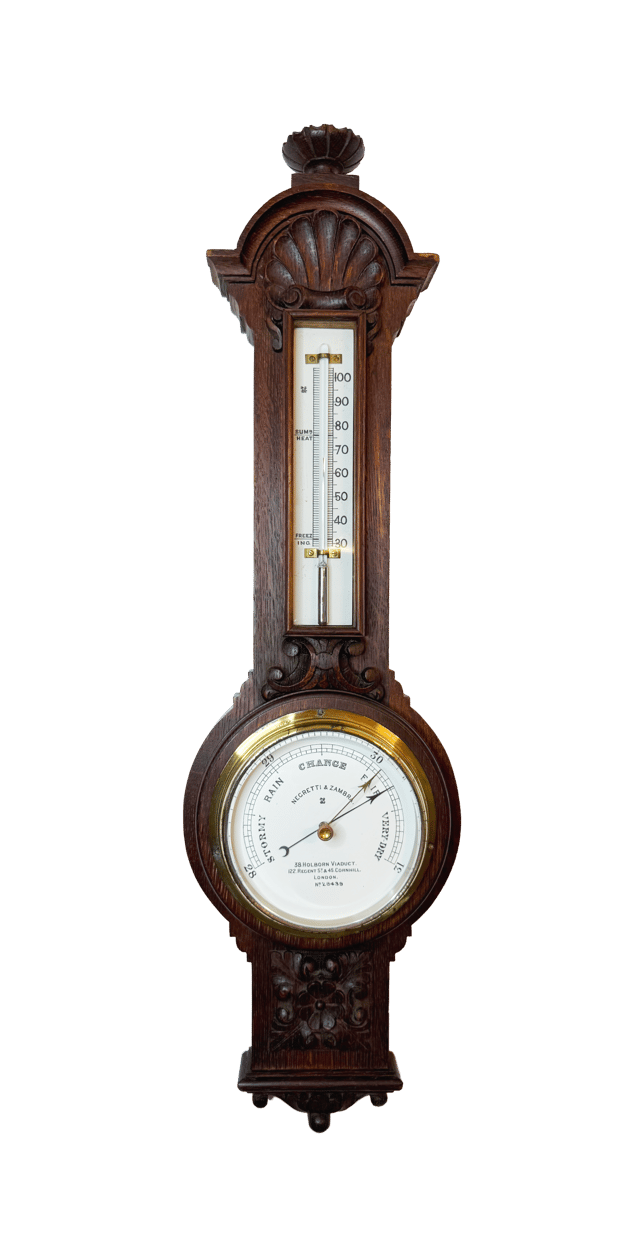
So what did this firm leave behind? It left instruments that outlived their makers. The maximum thermometer of 1851 served meteorologists for a century. The enamelled back of the thermometer became a world standard. The marine barometer that withstands a broadside, the deep-sea thermometer that endures seven tons, the "fisherman's" aneroid of the RNLI and the storm barometer of Fitzroy with the admiral's words on its scale — all of these, a century on, were still at work in their places or passing from hand to hand among collectors. The firm's self-recording aneroid was the direct ancestor of every barograph. And its aviation instruments — from the Hobson carburettor system to the Bourdon elements — kept the fighters of a whole war in the air.
It left, too, a photographic legacy that any specialist house might have been proud of: the first commercial photographs of China, Japan, the Philippines and Siam, the first aerial photographs of London, thousands of stereo pairs and cartes-de-visite that taught the Victorians to see the world in depth.
It left people — three generations of Pithers at one forge, errand-boys turned apprentices, veterans with half a century's service, whose names would otherwise have been erased for ever. And it left the very habit of trusting the instrument: on a deck under fire, at the coal-face, in the cockpit, at the height where the air gives out.
The firm, begun with two Lombard surnames on a London shop-front, lived exactly the life that a true craft alone can live: it served its calling longer than most of its rivals, and it departed, leaving behind not ruins, but accuracy.
Conclusion
It is easy to tell the history of Negretti & Zambra as a history of decline — from the prize medal of 1851 to the disposal papers of 1979 and the quiet end of 2000. But this would be one of those half-truths against which old Henry Negretti so stubbornly rebelled when he went to save an innocent man from the noose.
For to measure such a life by the date of its ending alone is to judge a barometer by its last fall of mercury, forgetting all the storms it foretold in good time. In a century and a half this workshop made the invisible visible: it taught the farmer to read the coming storm in three needles in an oak frame, gave the fisherman on the quay half a minute's start on the squall, put an aneroid into the pilot's pocket — and into the cockpit a gauge without which no engine could be held in the thin air. It raised a camera above the clouds when photography was still alchemy, and lowered a thermometer into an abyss of which almost nothing was known. It was there wherever man contended with the elements — and more often than not it let him win.
There is a peculiar justice in fate having brought it together with Robert Fitzroy. Both — the admiral and the firm — believed that the weather could be not merely endured but foreseen; both gave their lives to turning signs into science. Fitzroy broke under the weight of that belief; the firm carried it for a hundred and thirty years and handed it on — into museum boxes, into other hands, into instruments that still swung a needle when the name itself was no longer over the door.
The Victorian age knew how to make things as though they would outlast their makers — and in that sense Negretti & Zambra did not die at all. It was scattered: into the standard of the enamelled thermometer back, into the design of the marine barometer, into the very idea that an instrument must work not on an exhibition table but in battle, in the mine, in the storm and at altitude. So long as some old barometer hangs on a wall with the admiral's words on its scale, and someone, tapping the glass, peers in to see whether the mercury is falling or rising — the history of this firm is not yet over.
It is merely waiting for the next change in the weather.
Sources