Loading
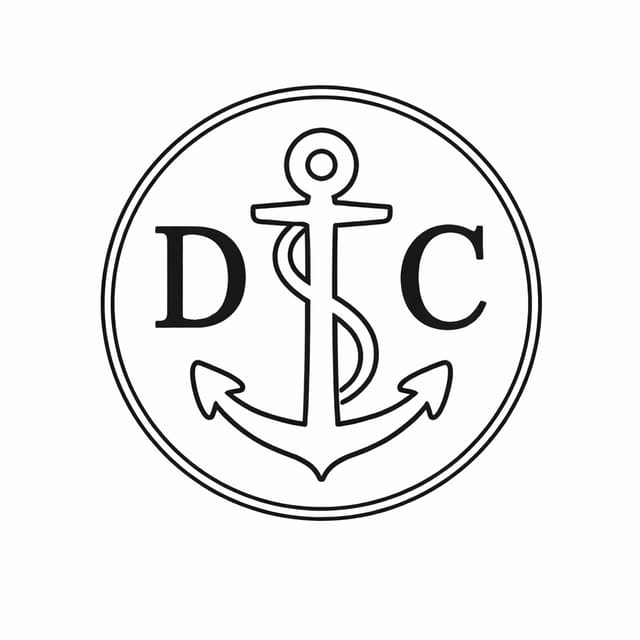
On the back plate of a brass barometer — the kind that turns up by the dozen at European flea markets — an anchor is stamped. To its left, the letter D; to its right, C. The mark is neat and confident, made by a firm that expected to be recognised.
And it still is. Dubois et Casse instruments hang in British sitting rooms, surface at Dutch auctions, sit in boxes at Spanish dealers'. Yet who the man behind the first name actually was, we do not know. No forename, no dates, no face. There exists a single document in which a Paris clerk placed an initial before the surname — and that is all.
This is the story of a firm that invented something which outlived it by a good hundred years, won awards at two World's Fairs, gave one of its instruments to a national museum — and contrived to leave behind almost nothing personal about itself.
The metal barometer was the idea of Lucien Vidie. It was an audacious one: measure atmospheric pressure not with a column of mercury but with the deformation of a sealed box containing rarefied air. The box sags very slightly or springs back very slightly, and an ingenious train of levers converts these minute movements into the swing of a needle. Vidie obtained his patent in 1844.
What followed is what usually follows a successful invention. Eugène Bourdon, author of the famous curved tube, disputed priority. The litigation dragged on for years and ended in 1858 in Vidie's favour. A year later, in 1859, his patent expired — and the very design they had just been fighting over passed into common property.
Paris reacted at once. In the trade directories of the early 1860s, under the heading Baromètres, a dense row of names lines up: Naudet et Cie, Redier, Desbordes, Guilbert et Cie, Ducomet, Lion et Guichard, T. Hüe, Félix Richard and others. Into this row steps a new name — Dubois et Casse.
The partnership was founded in Paris around 1860. The address: 17, rue du Grand-Saint-Michel, in the faubourg Saint-Martin. The street ran from the rue Marqfoy down to the Canal Saint-Martin; today this is the 10th arrondissement. By the end of the 1860s the directories give number 15.
The partners styled themselves ingénieurs-mécaniciens — engineer-mechanics, not "manufacturers" and not "opticians". The press described them more plainly: fabricants de baromètres et manomètres métalliques.
In legal terms this was a société en nom collectif, a general partnership. The phrase is not decorative: that form required a written deed, registration with the clerk of the Commercial Court, and mandatory publication. So by December 1860 — the date of the first patent — the firm was already constituted, and the deed itself had been drawn up earlier, most probably in 1859 or 1860.
And here is the single line in which Dubois acquires at least an initial. Bulletin des lois de l'Empire français, 11th series, vol. XX, second half of 1862, page 1148:
«271° Le brevet d'invention de quinze ans, dont la demande a été déposée, le 27 août 1861 au secrétariat de la préfecture du département de la Seine, par la société E. Dubois et Casse, mécaniciens, à Paris, rue du Grand-Saint-Michel, n° 17, pour un instrument propre à mesurer la pression des fluides élastiques.»
The initial E. — and nowhere else. Not in the patent catalogues, not in the exhibition lists, not in the press. It is worth remembering that the Bulletin des lois published grants a year to eighteen months in arrears, so 1862 is the date of publication, not the date the firm existed.
If this is not a clerk's slip, the pool of period forenames is small: Étienne, Eugène, Édouard, Émile, Ernest. There is as yet nothing on which to choose between them.
With the second partner the situation is reversed: the name is known, but for decades it has been attached to the wrong man.
Because so little was known about the firm, a consensus formed that Dubois's associate was Alfred Casse — another Paris barometer maker, known for taking over the house of Guilbert & Cie around 1890 and subsequently being absorbed by the Maxant firm. A convenient version, and entirely wrong.
Alfred Casse existed as an independent commercial identity as early as the beginning of the 1880s. The Annuaire officiel du commerce et de l'industrie from the Brussels city archive for 1882–1883 gives, under the heading for barometer makers: «CASSE (A.) Rue Thorigny, 18 et 20». That is precisely the address printed under the name ALFRED CASSE, Succr. on the well-known catalogue of the former house of Guilbert & Cie — and there the confusion began.
The matter is settled conclusively by the Didot-Bottin of 1891, where both firms stand in the same trade rubric, on separate lines, one directly after the other:
«CASSE (ALFRED) (ancienne maison Guilbert et Cie), baromètres anéroïdes, pour agriculture, appartements… rue Meslay, 1.»
«Casse (Ch.) et Cie, Paris 1878, fabr. de baromètres et manomètres métalliques, Terrage, 5.»
Two different Casses, two different addresses, one page. Whether they were related is unknown; the surname is not rare enough to assume it, nor common enough to rule it out.
The real partner's forename was preserved by a military archive. The finding aid of the Service historique de la Défense records: «Nouveau manomètres de MM. Dubois et Casse. 1864-1865. Baromètre et manomètre de M. Charles Casse. 1884.» One file, two dates, one and the same line of descent — the partnership in the mid-1860s and Charles Casse on his own twenty years later.
The firm's patent activity fits into four years, and all of it concerns the same family of instruments:
The firm's working life coincided with fierce competition among other instrument makers. In 1860 the house of Naudet (PHBN) patented an "improved barometer", and Dubois et Casse were obliged to alter their own design in order to keep selling in France. Even so, the firm became one of the first Paris workshops after Vidie to establish genuinely industrial production of aneroids.
But their principal invention is not exhausted by patent formulae. Émile With, in Les machines (1870–1873), describes it briefly and with evident respect:
«M. Casse a imaginé la manière de produire par l'emboutissage des plis dans un tube en laiton. Il est certain que cette invention aura des emplois féconds dans la mécanique.»
Casse conceived a way of pressing folds into a brass tube. This invention will certainly find fruitful applications in mechanics.
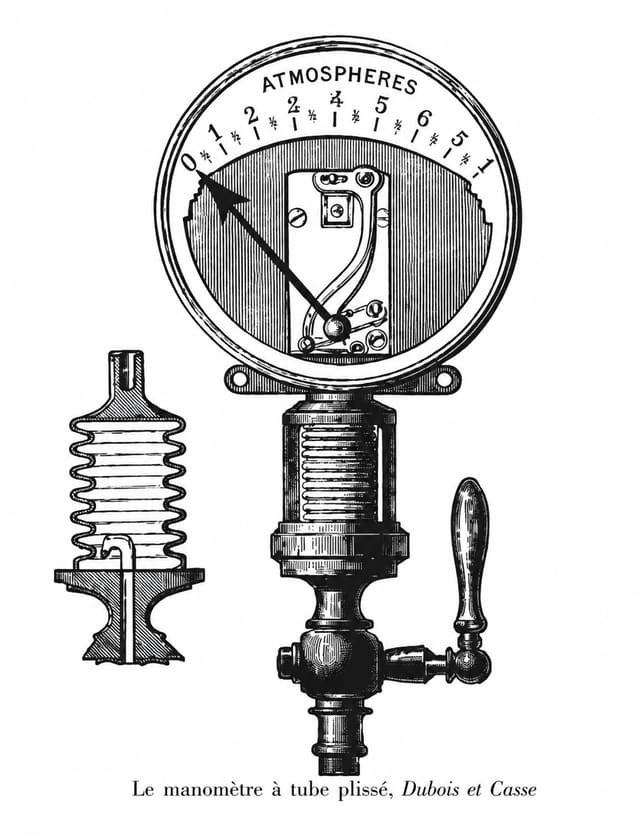
Casse had worked out how to stamp transverse corrugations into a single seamless brass tube. A corrugated tube without a soldered joint anywhere — that became the face of the firm. The principle is a cousin of Vidie's aneroid capsule: the same elastic metal envelope working on changes of pressure, only drawn out into a tube and therefore capable of far greater travel.
Just how good this was is explained by J. Hirsch and A. Debize in Leçons sur les machines à vapeur:
The steam acts directly inside the corrugated tube. Changes in its length are transmitted to the needle through a magnifying mechanism. The tube is made without solder and therefore possesses a very high uniformity, which almost entirely eliminates the leaks that always have to be feared with soldered tubes. By virtue of its very form, this tube is capable of considerable elongation; yet the elongations produced under steam pressure remain well below its elastic limit. As a result, once the pressure is removed it returns exactly to its original length, and the needle to its original position.
In other words: no seams, no leaks; a generous margin of elasticity, and therefore no accumulated error. On a steam engine, that is not a nicety — it is the difference between an instrument and an ornament.
Casse later mastered a second technology as well. In the 1870 directory his output is described as manomètres métalliques (à tube plissé et à tube cintré, sans soudure) — corrugated tube and curved tube, that is, the Bourdon type. By the end of the 1870s the advertising lines would carry mainly système Bourdon, and the firm's own pleated tube would drop out of them.
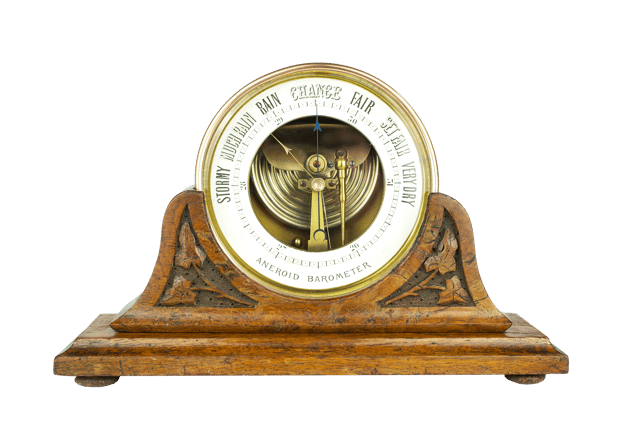
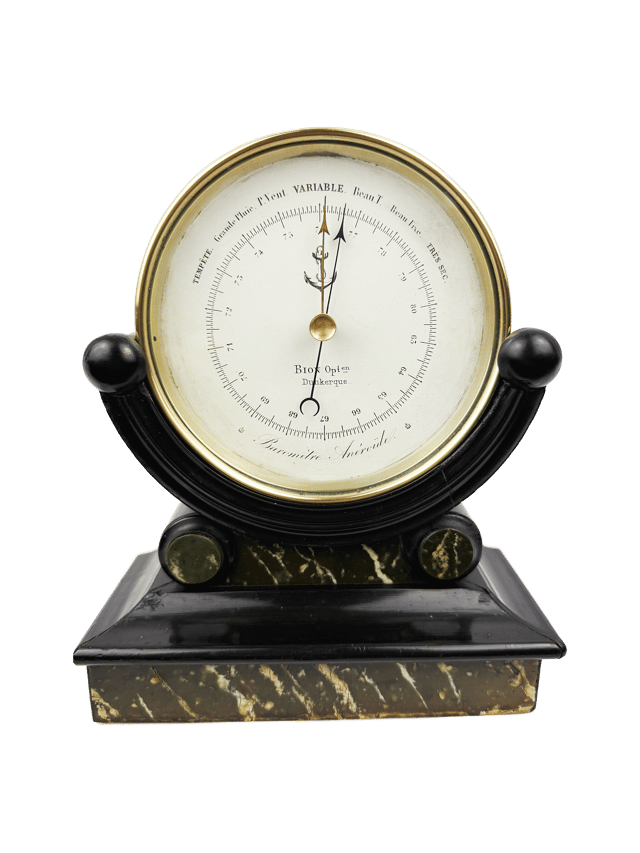
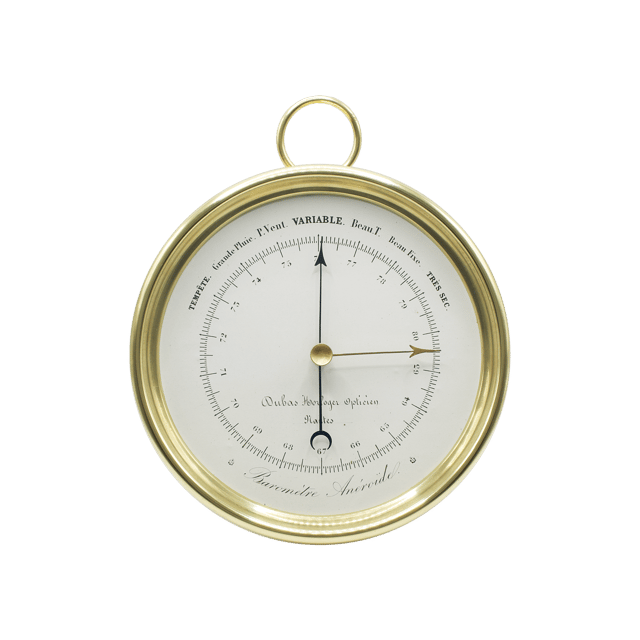
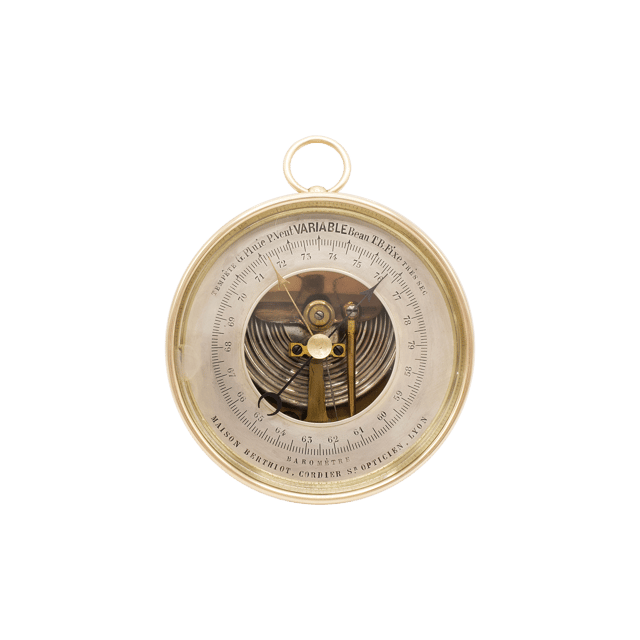
The principal output was aneroid barometers of every kind — wall, table, and portable barometer-altimeters for travellers. Alongside them came manometers for industrial use, and later, under Casse, compasses and steam fittings as well.
Surviving examples are recognisable by the anchor flanked by the letters D and C on the back plate. The dials are often unsigned, or signed with somebody else's name: the firm worked readily for retailers. Dubois et Casse instruments turn up bearing the name of the Edinburgh optician Lennie; examples made for the Belgian and Spanish markets also appear. This was the standard arrangement of the period: a Paris workshop makes the movement, a London or Edinburgh dealer puts his own name on the dial.
One gesture from 1882 deserves separate mention. In the catalogue of the collections of the Conservatoire national des arts et métiers, item number 124 in the section on receivers reads: «Manomètre de MM. Dubois et Casse, donné par eux» — presented by the makers themselves. The partnership had by then been out of existence for a decade and a half, yet the instrument remained in the national collection under the old name.
1864, Mulhouse. Ernest Zuber presents their manometer to the mechanical committee of the Mulhouse Industrial Society, and recommends it the way one recommends something tested on one's own shop floor: «ces appareils d'un prix beaucoup moins élevé que celui des autres manomètres métalliques, ont donné jusqu'à ce jour d'excellents résultats dans ses ateliers» — far cheaper than the other metallic manometers, and giving excellent results in his own works. Note the argument. The firm competed not only on design but on price.
1864, Évreux. A regional show. In the section for instruments not covered by the programme: «Mentions honorables: MM. Dubois et Casse, à Paris, baromètres».
1865, Bordeaux. The 11th exhibition of the Philomathic Society; exhibitor no. 116, metallic barometers, next to Redier. The local paper La Guienne is warm, almost affectionate: «les bons et gracieux baromètres et manomètres métalliques de MM. Dubois et Casse, de Paris».
1865, Chaumont. Two entries at once: no. 293 for barometers, no. 196 for metallic manometers. It is here that the partners are named in full and with their address: «Dubois et Casse, ingénieurs-mécaniciens, rue du Grand-Saint-Michel, 17, à Paris».
1867, Paris, Exposition Universelle. The high point. The firm receives a mention honorable in two classes at once: Class 13 of Group II — Instruments et matériel de l'enseignement des sciences — for the «manomètre à tube plissé», and Class 53 of Group VI — Machines et appareils de la mécanique générale — for manometers. In the same Class 13 list, only a few lines away, stands «Naudet et Cie. Paris. — Baromètres système Vidi». Two Paris workshops grown from the same expired patent, side by side in a single roll of awards.
There is a tradition that the firm's barometers caught the attention of Napoleon III at the 1867 exhibition, and that he purchased one of them. No documentary confirmation of this has been found in the exhibition catalogues or the press, and for the moment the episode survives in the firm's history as a legend.
The partnership ended around 1868–1869.
The bracket is narrow and dependable. The Almanach des 40 000 adresses for 1868 still gives "Dubois et Casse". But the Didot-Bottin for 1870, compiled in 1869, already prints the succession formula in so many words:
«Dubois (E.) et Casse (Ch. Casse successeur), baromètres et manomètres, Terrage, 15»
This is a cross-reference for anyone looking up the old name, and it persists in the directory for years — 1870, 1871, 1873, 1874, 1875, 1876. It also confirms the initial E. a second time.
What became of Dubois is unknown. He did not set up a competing business, did not move to another maker, did not surface at any neighbouring address — he vanishes from the barometer and manometer rubrics entirely and for good. For a man who had just taken two awards at a World's Fair, this looks more like death or serious illness than a falling-out. But it is an argument from silence, not a document.
One indirect touch points the same way. Casse did not hurry to rename the business. For several years he keeps both his own name and the reference to the former one — which is what people do when the goodwill of a mark is worth more, and there is nobody left to contest it.
Here a common misunderstanding needs clearing up. In the directories after 1867 the firm's address changes from rue du Grand-Saint-Michel to rue du Terrage — and this looks like a move. There was no move. The street was renamed in 1867; the former impasse/rue du Grand-Saint-Michel became rue du Terrage, still in the 10th arrondissement.
The directory records this itself, Didot-Bottin 1870:
«Casse (Ch.), MH exposit. univers. 1867, fabrique de manomètres métalliques (à tube plissé et à tube cintré, sans soudure), robinetterie pour machines à vapeur, rue du Terrage, 15, anc. rue du Grand-St-Michel»
The workshop stood on the same spot throughout its history.
1873, Vienna. The official French catalogue of the World's Fair mentions Charles Casse twice, in two different technical sections. Under manometers: «CASSE, Charles, Paris, rue du Terrage, 18. — 2 mentions honorables. Paris 1867. — Manomètres». In another section: «CASSE, CH., Paris, rue du Terrage, 18. Mention honorable, Paris 1867. Baromètres. — Boussoles». Note those "two honourable mentions" — precisely the two awards of 1867, in two classes, that we find in the Paris awards catalogue. The catalogues agree.
1877–1878. Didot-Bottin: «Casse (Ch.), MH, exposition universelle 1867, fabrique de baromètres, manomètres métalliques, système Bourdon, Terrage, 15».
1878, Paris. The second World's Fair brings the firm actual medals. The official list of awards gives a bronze medal in Class 15 (Group II, Instruments de précision) and a silver medal in Class 54 (Group VI). The directories of the following years reflect this punctiliously: «méd. Ⓐ et Ⓑ Paris, 1878» — silver and bronze.
1883–1898. The business runs steadily. In 1883: «baromètres et manomètres métalliques, boussoles». By 1891 the firm has become Casse (Ch.) et Cie. The final entries are those of 1896, 1897 and 1898, at «rue du Terrage, 5». In the 1898 rubric the neighbouring line already reads «RICHARD FRÈRES (J. Richard successeur), manomètres enregistreurs» — a new generation, recording instruments, another era.
After 1898. In the volumes for 1904, 1906 and 1910 there is no Casse on the rue du Terrage at all. The firm fades out somewhere between 1898 and 1904 — some forty-odd years after its first patent.
Dubois et Casse lasted as a partnership for less than a decade, and as a production line for more than forty years. That was enough to leave a mark in three places at once.
In technology — Casse's seamless corrugated tube, which outlived both the firm and its successor. The bellows still sits in manometers, regulators and expansion joints today, and this is its ancestor.
In engineering culture — their manometer held its place in the textbooks for decades. The Manuel de l'ingénieur des ponts et chaussées (1870s), Leçons sur les machines à vapeur (1880s), Traité de mécanique (1890s): the firm is gone, the partnership dissolved twenty, thirty years earlier, and the instrument is still named after its inventors and analysed as a model of its kind.
And in collectors' hands — hundreds of brass cases with an anchor between a D and a C.
What this history did not leave behind is people. We know where their workshop stood, we know their patent numbers, we know what their manometers cost relative to the competition and what Ernest Zuber thought of them. We do not know Dubois's forename. We do not know when he was born, or why he disappeared from the Paris directories over the winter that turned 1868 into 1869. We do not know how old Charles Casse was when he was left alone, or whether he was glad of it or crushed by it.
All of this very probably exists — in the partnership deeds of the Commercial Court of the Seine, in the civil registers of the 10th arrondissement, in the INPI patent files with the applicants' full names. Records of that kind rarely perish. It is simply that nobody has opened them yet.
Until somebody does, what we have is an anchor between two letters — the trademark of men about whom we know everything except themselves.