Loading
In the summer of 1900 the members of the international jury of the Paris Exposition Universelle were making their way past the showcases of Class 15, "Instruments de précision", when they stopped at an exhibit they later described as follows: «M. T. Hue présente une très belle exposition de baromètres métalliques de toutes formes et de toutes grandeurs, les uns du système Bourdon, les autres du système Vidie» (Monsieur T. Hue presents a very fine exhibition of metallic barometers of all shapes and sizes, some of the system, others of the system) [10]. Alongside them lay pressure gauges that responded to a pressure of fifteen centimetres of water, a levelling barometer able to register a difference in height of one metre, and a barometer with a recorder built right into its dial. At the other end of the exhibition, in the aerostation class, the same house was showing barometer watches and travelling kits for aeronauts.
The name Hüe is familiar from the dials of French metallic barometers, from the stamps on their movements and from the pages of trade catalogues. The people behind the name long remained hidden behind the initials "T." and "E.". Exhibition catalogues, patents and jury reports now make it possible to name them in full: the founder of the house was Alexandre-Théodore Hüe, his successor was his son Eugène, and in 1900 Eugène's brother Ferdinand worked alongside him. Earlier still, in 1866, a patent for a metallic barometer was signed together with Théodore by Guillaume-Louis Hüe, a compass maker. The history of the firm begins in a workshop for physical instruments on the banks of the Seine, passes through a long collaboration with the Richards in the manufacture of Bourdon barometers, through a dozen patents of its own, through the skies of balloons and aeroplanes, and breaks off on the eve of the Second World War, when its German owner was forced to give up the Paris business.
The origins of the house of Hüe lie in the workshop of Oscar Hempel, a Paris maker of mathematical and physical instruments. In 1842 «MM. Hamann et Hempel, fabricants d'instruments de mathématiques, place Dauphine, 11» (Messrs Hamann and Hempel, makers of mathematical instruments, 11 place Dauphine) presented to the Société d'encouragement pour l'industrie nationale a new compass for drawing ellipses, on which Théodore Olivier delivered a report [2]. By the mid-1850s Hempel had settled at 55 quai des Grands-Augustins. At the Exposition Universelle of 1855 he exhibited, under No. 1671, «Balances d'essai pour les monnaies. Cathétomètres. Machine pneumatique. Modèle de locomotive pour l'enseignement de la mécanique» (assay balances for coins, cathetometers, an air pump, a model locomotive for teaching mechanics) [1]. Antoine d'Abbadie noted that Hempel had no catalogue of his own and used that of Lerebours [17]. In 1867 Hempel received a silver medal in Class 12, "Instruments de précision", for an electrical machine and balances [3]; in 1878 his showcase again held carefully made balances [4].
The link between Théodore Hüe and this workshop can be traced through several independent clues. The Hüe firm itself later stated: «La Maison a été fondée en 1865, par le titulaire actuel» (the house was founded in 1865 by its present owner) [12]. In the list of its awards printed in 1900, Hüe placed first the line «Paris 1867, Médaille d'argent (en collaboration)» (Paris, 1867, silver medal, in collaboration) [8] — and Hempel was among the silver medallists of Class 12 in 1867. The dictionary of French precision instrument makers records that in 1871 Hempel founded the partnership "Hempel & Cie", later known as "O. Hempel & T. Hüe", and that Hüe subsequently became his successor [17]. The patent application of February 1866 shows, moreover, that by that time Théodore Hüe was already working as an independent barometer maker (see the chapter "The Patents of Théodore Hüe"): he entered the partnership with Hempel as an established craftsman. Finally, the trade card of the following period opens with the words «Ancienne Maison O. Hempel & T. Hüe. Ci-devant: Quai des Grands Augustins, 55» (formerly the house of O. Hempel & T. Hüe; previously at 55 quai des Grands-Augustins) [19].
The founder's full name has been preserved by his patents: almost all the French patents of 1876–1896 were granted to "Alexandre-Théodore Hüe", and under the same name in 1891 he also patented his barometer watch in Switzerland [26, 16]. The patents also show how he described his trade at different times: in 1866 as a barometer maker, in 1876 and 1878 as an «opticien» (optician), and in 1879 as a maker of precision instruments [26]. In the catalogue of the Amsterdam exhibition of 1883 he is entered as "HUE, Théodore" [5]; in the catalogues of the Paris exhibition of 1900 as "Hue (Théodore)" and "Hue (Théodore-A.)" [8, 9]. In business he remained "T. Hüe"; the surname was written both with and without the diaeresis — Hüe, Hue, and in some documents Huë.
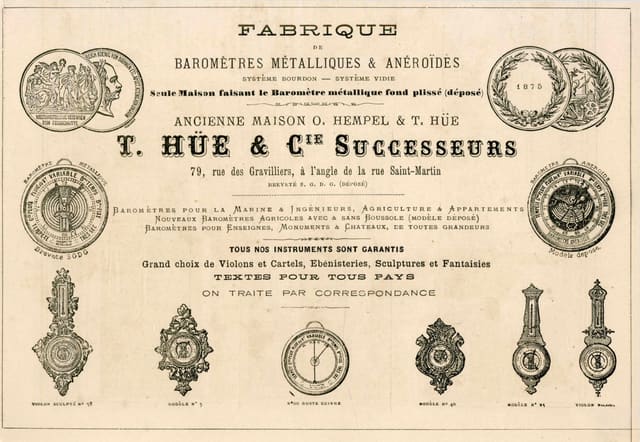
The next address of the house was in the Temple quarter — the rue des Gravilliers, one of the centres of small-scale Paris mechanics, bronze work and "article de Paris". The trade card of this period lists everything the firm lived by [19]:
«Ancienne Maison O. Hempel & T. Hüe. Ci-devant: Quai des Grands Augustins, 55. T. Hüe & Cie Succrs. Breveté S.G.D.G. Déposé. 79, Rue des Gravilliers, Paris, à l'angle de la rue St Martin. Fabrique de baromètres métalliques & anéroïdes. Système Bourdon & Système Vidie. Seule Maison faisant le Baromètre Métallique à fond plissé (Déposé). Montage de tout genre de Cadres pour MM. les Opticiens et Horlogers. Baromètres pour la Marine & Ingénieurs.»
(Formerly the house of O. Hempel & T. Hüe; previously at 55 quai des Grands-Augustins. T. Hüe & Co., successors. Patented without government guarantee. Registered. 79 rue des Gravilliers, Paris, at the corner of the rue Saint-Martin. Manufacturer of metallic and aneroid barometers. Bourdon system and Vidie system. The only house making the metallic barometer with a pleated back (registered). Mounting of frames of every kind for opticians and clockmakers. Barometers for the navy and for engineers.)
Two instruments are pictured on either side of the text. On the left is a «Baromètre métallique» marked "Breveté SGDG": behind its open dial the C-shaped Bourdon tube is visible, and behind the tube a concentrically corrugated back — the "fond plissé" itself. On the right is a «Baromètre anéroïde», "Modèle déposé". The line about mounting frames "for opticians and clockmakers" points to the other side of the business: the house worked not only under its own name but for the trade, supplying movements and finished barometers to those who put their own names on the dials.
By 1883 "Théodore Hue" appears in catalogues at "79, rue des Gravilliers" [5]; the house remained there until the very end of the nineteenth century.
Two French inventions of the mid-nineteenth century opened the age of the mercury-free barometer. In 1844 Lucien Vidie built the aneroid with an evacuated metal capsule. In 1849 Eugène Bourdon (1808–1884) applied a curved, flattened tube to the barometer and called the instrument simply the «baromètre métallique» — the metallic barometer [18, 20]. The licensed manufacturer was Félix Richard, whose house, according to the Richards themselves, was founded in 1845 and produced «en exclusivité» (exclusively) metallic barometers with compensated Bourdon tubes [21]. Vidie and Bourdon fought each other in court for many years; a Paris court finally decided the case in Vidie's favour on 9 July 1861, although Vidie's patents had by then already expired, on 27 April 1858 [20].
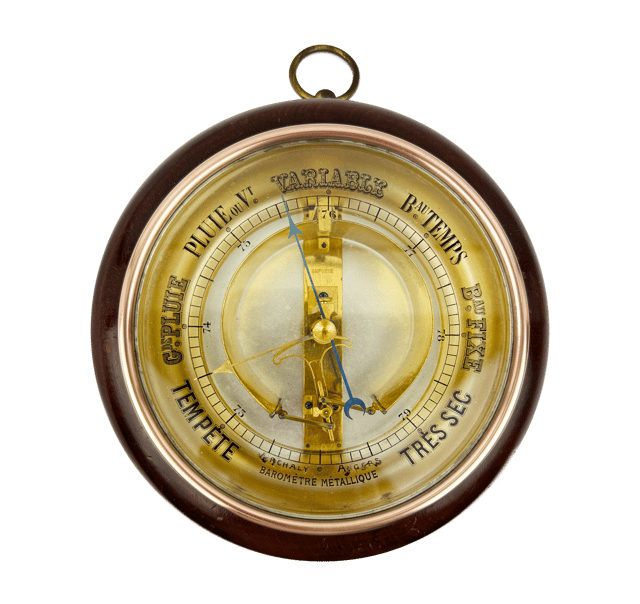
The construction of the Bourdon barometer has been analysed in detail by Rainer Holland [18]. Its principal part is a large C-shaped ring, the Bourdon tube: hollow, evacuated, with a wide, pointed-oval cross-section. The outer surface of the tube is larger than the inner, so atmospheric pressure acts on it with greater force: as pressure rises the tube curls more tightly and its ends draw together; as it falls they move apart. The transmission sits between the ends. Two connecting rods turn a toothed sector, and the sector turns a pinion on the hand arbor. The multiplication is in two stages: small movements of the rod attachment points become a long travel along the toothed arc, and a rotation of the sector of only 20° gives the hand almost a full turn. Because the sector, pivoted at the bottom, is top-heavy, a cylindrical counterweight was fitted below its arbor; a small ball weight at the side kept all the joints under constant tension so that there was no backlash. The tube was hung freely at its apex, without clamping: no two tubes ever came out identical, and the free suspension allowed each to "settle" asymmetrically with respect to the sector arbor. For setting to the local altitude a central key hole was provided in the back: the key first locked the toothed wheel with a spring wedge, then turned the hand arbor by its square. This key mechanism is found on all Bourdon barometers from about No. 1000 onwards; for transport a short key without a square was used, which only locked the movement.
Félix Richard described the making of the tube himself in 1867; Paolo Brenni has reconstructed the process from that description [18]. The brass tube was produced from a round blank, flattened on a mandrel between wooden blocks, bent in rolls with rollers of different diameters, then polished outside and inside on special machines, which at the same time compacted the metal. A compensating strip of spring steel about 0.4 mm thick, held in the end caps, was inserted inside; the caps were soldered on, and the air was pumped out through a soldered-on tubule with a multi-stage pump of Richard's design having four or eight glass cylinders. The finished instrument was checked under a bell jar against a mercury barometer, the length and position of the rods being chosen individually for each tube. The first compensated tubes, around 1860–1865, bore the word "COMPENSÉ" on their caps; later it was moved to the plate, then to the scale; when the business passed to Richard's sons the inscription was dropped altogether — compensation had become the norm [18].
Holland distinguishes three ways of connecting the rods to the sector. The first, "direct mounting", is found on the very earliest instruments, for example on Félix Richard's barometer No. 329; it allowed no adjustment of the scale. The second, "indirect selective", was devised by Richard: a set of mounting plates with different attachment points and rods of different lengths, which had to be exchanged during adjustment, each time dismantling the assembly; it was in use before No. 1000. The third, "indirect variable", simplified matters: the sector acquired two opposed long arms of nearly square section carrying sliding holders, which were fixed with pointed screws wherever required — it then remained only to choose the rods and the attachment points [18].
In 1876 Félix Richard died. The business passed to his sons, Jules (1848–1930) and Félix-Max, trading as "Richard Frères"; from 1891 Jules Richard ran it alone [21, 25]. The brothers turned quickly to recording instruments: at the Exposition Universelle of 1878 they showed a recorder writing on paper, and by 1900, according to the jury, their workshops had turned out thirty thousand recording instruments since 1881 [20, 10]. The Bourdon barometer remained in their range, but from 1876 onwards it began to change.
Holland traces this turning point through the construction [18]. Before 1876 Richard made toothed sectors whose side ends tapered away to nothing, and the return spring of the key-lock wedge lay in front of the toothed wheel. From 1876 the ends of the sectors became blunt, in the form of "eyelets", the spring moved behind the wheel and became so small as to be almost invisible; the word "COMPENSÉ" disappeared. The numbering also started afresh: to the 19,000–20,000 barometers made by Richard before 1876 was added a new series starting from zero, which by 1900, according to Stöhr, had reached 40,000. Hence the duplicate numbers on Richard instruments, which can be told apart by the "eyelets", the rear position of the spring and the third method of mounting the rods.
All instruments associated with the name Hüe are made only by the third method and only with the post-1876 features. From this Holland draws the conclusion that became the key to the whole story: «Hüe begann etwa 1876 für Richard zu fertigen» (Hüe began manufacturing for Richard around 1876) [18]. The collaboration thus began while Théodore Hüe was still in charge and coincided with the change of generations at the Richards themselves: while the brothers built recorders, the classic Bourdon barometer was increasingly being made in the rue des Gravilliers.
Théodore Hüe had come to the Bourdon mechanism itself much earlier. His first patent, applied for in February 1866, describes ball-jointed rods acting directly on the two arms of a balance lever, with their heads in sleeves sliding along the arms, and a key lock with an inclined plane and a return spring [26]. In principle this is precisely Holland's third, "indirect variable" method, in which all Hüe instruments are made [18]. The work for the Richards from 1876 thus continued ten years of Hüe's own experience with the construction of the metallic barometer (see the chapter "The Patents of Théodore Hüe" for details).
A few years later Hüe began to produce Bourdon barometers under his own name as well — according to Holland, around 1880–1890; the numbering of these instruments reached approximately No. 36,000 [18]. «Alle mit Hüe gekennzeichneten Barometer wurden zwischen 1880 und 1914-1916 von ihm hergestellt» (all barometers marked Hüe were made by him between 1880 and 1914–1916) [18]. Hüe kept the third method of mounting the rods until the end of production.
Holland also sees a difference between Hüe and Richard in the compensation. Hüe tubes contain no steel strip — as magnet tests show; the hands of these barometers are noticeably more mobile than those of Richard instruments, to which the steel strip gave stiffness. To all appearances, from the 1880s Hüe compensated for temperature by means of residual gas pressure in the tube — a method known from Vidie capsules [18].
On the dials of his Bourdon barometers Hüe placed his own round stamps, or "medallions" — "Breveté S.G.D.G. à Paris" and "Marque de fabrique" with a monogram — distinct from the Richard medallions. The formula "Breveté S.G.D.G." rested on Hüe's own patents, the first of which, of 1866, concerned precisely the metallic barometer [26].
That the Bourdon barometer was not an episode for the house but a permanent line is confirmed by documents spanning three decades: the "T. Hüe & Cie" trade card with the formula "Système Bourdon & Système Vidie" [19], the 1900 jury report [10] and the early twentieth-century catalogue, in which Nos. 1281–1296 are «Baromètres métalliques système Bourdon. Extra sensible» — with a dial on glass and a fully visible movement, from 139 to 500 mm in diameter, priced from 33 to 363.50 francs, and up to 382 francs with a thermometer [13].
The end came during the First World War and was common to both houses: «Alle Produktionen wurden bei Richard und auch bei Hüe um 1914-1916 eingestellt. Es mangelte im Krieg an Rohstoffen. Kupfer wurde z.B. für die Kupferführungen an Granaten zwingend benötigt. Außerdem nahm die Konkurrenz der Aneroid Barometer nach Vidie stark zu.» (All production at Richard and at Hüe ceased around 1914–1916. In wartime there was a shortage of raw materials: copper, for example, was urgently needed for the driving bands of shells. In addition, competition from aneroid barometers of the Vidie type grew strongly.) [18]. This refers to the Bourdon barometers: the firms themselves continued to operate.
In its 1900 list of awards the house of Hüe named: Paris 1867 — silver medal (in collaboration), Paris 1878 — bronze, Amsterdam 1883 — silver, Paris 1889 — silver, Brussels 1897 — gold [8, 9]. The early twentieth-century catalogue adds Paris 1875, the "Académie nationale" and the "Club alpin" in 1892, and Paris 1900 [13].
At the International Colonial and Export Exhibition in Amsterdam in 1883, Théodore Hüe exhibited under No. 2931 in Class 28, "Horlogerie, pendulerie. — Baromètres, thermomètres, etc. Compteurs divers", described as «Fabricant de baromètres métalliques et anéroïdes» (maker of metallic and aneroid barometers) [5]; his neighbour in the class was Antoine Redier. In the official French report on the exhibition his name — with a misprinted initial, "J. Hue" — appears in the list of bronze medals of Group IV, "Mobilier, ameublements et accessoires" [6]. At the Paris exhibition of 1889 Hüe received a silver medal in Class 15 [7].
In 1891 Théodore Hüe patented the product that became one of the hallmarks of the house — the barometer watch: on 26 June in France (No. 214448; see the chapter "The Patents of Théodore Hüe" for details) [26], and then in Switzerland. Swiss patent No. 4225 for the barometer watch was granted to Alexandre-Théodore Hüe: the application was filed on 3 December 1891 and the patent published on 15 March 1892 [16]. The pocket watch combined with an aneroid remained in the range for decades, and the patent itself was cited much later in the American patent US 3,157,985 of the firm Favre-Leuba [16].
More than seventy years later, in the 1960s, this Swiss firm Favre-Leuba developed and brought to market the Bivouac model — the world's first mechanical wristwatch with a function for measuring atmospheric pressure and altitude. Its design was based on an aneroid mechanism integrated into the watch case.
In 1897 the house of Hüe made an important acquisition: «En 1897, M. Hüe a réuni à sa Maison la Maison Boileau, qui s'était fait également une spécialité de la construction des baromètres anéroïdes» (in 1897 M. Hüe merged into his house the house of Boileau, which had likewise specialised in the construction of aneroid barometers) [12]. In the same year the firm received a gold medal at the Brussels exhibition [8].
Exhibition medals show how the house of Hüe looked in the eyes of the jury. What occupied the master himself at the workbench is best shown by his patents. The French industrial property archive (INPI) holds nine patent files applied for between 1866 and 1896, with descriptive specifications, drawings and grant decrees [26]. All were granted under the law of 5 July 1844 as a «brevet d'invention de quinze ans, sans garantie du gouvernement» (patent of invention for fifteen years, without government guarantee): the state merely registered the application, without examining either its novelty or its usefulness. Hence the formula familiar from dials, "Breveté S.G.D.G." — «sans garantie du gouvernement» (without government guarantee). Applications were filed through patent agents — Lemonnier of the office of Ch. Denos-Gardissal, Charles Desnos, the firm of Le Blanc & Pagès, Armengaud aîné, E. Chassevent; the Paris addresses in the documents belong to these offices (by law the applicant chose there his «domicile élu», his legal address for service), not to the Hüe workshop.
The first application was filed on 17 February 1866, and patent No. 70429 was granted on 20 April. There were two applicants: Théodore Hüe, «fabricant de baromètres» (barometer maker), and Guillaume-Louis Hüe, «fabricant de boussoles» (compass maker). What Guillaume-Louis was to Théodore — brother, father or cousin — the document does not say. The subject of the patent is «Perfectionnements apportés au baromètre métallique» (improvements to the metallic barometer), that is, the barometer with a curved evacuated tube — the Bourdon barometer.
The specification opens with an analysis of three shortcomings of the existing design. The ball joints at the ends of the tube are connected obliquely to the ends of the levers, so that the hand moves unevenly. The heads of the joints can neither be brought closer to the centre of the balance lever nor moved away from it: the barometer is adjusted at the factory, and only there. Finally, the locking lever for transport, in the authors' opinion, "somewhat complicates" the mechanism. In other words, by 1866 a transport lock already existed on Bourdon barometers, and the Hües proposed to simplify it.
The solution is shown on four drawings. The spirally curved tube acts through two ball-jointed rods directly on the two arms of a balance lever, which turns the hand through a toothed sector and a pinion. The heads of the rods sit in sleeves that slide along the arms; by moving them apart or closer to the pivot, the craftsman changes the speed of the hand and so adjusts the instrument. In a second version the sleeves are moved by screws, the nuts having four holes for a pin with which they are turned. The lock works as follows: a key inserted into a small tube pushes back an inclined plane, a small lever swings, and its tooth enters between the teeth of the pinion; when the key is withdrawn, a spring returns everything to its place. Three claims are made: the direct oblique action of the rods on the balance lever, on-site adjustment of the barometer by moving the heads, and the locking device.
Sliding holders on two arms are exactly the "indirect variable" method of mounting the rods that Holland identifies as the only one used by Hüe [18]. The 1866 patent shows that Théodore Hüe patented the principle of this method ten years before he began working for the Richards.
The next two patents appeared in the spring of 1876, the very year from which Holland dates Hüe's collaboration with the Richards. In both, Alexandre-Théodore Hüe describes himself as an «opticien» (optician), and Ch. Desnos acts as agent.
Patent No. 112092 (applied for 27 March, granted 20 May) — «Système d'indicateur de pressions maxima et minima, applicable aux baromètres et aux manomètres» (system of maximum and minimum pressure indicator, applicable to barometers and pressure gauges). As it moves, the main hand pushes two additional hands — by a small lug or a pin — and these remain at the extreme readings the pressure has reached. In one version the indicators turn on a separate arbor over a small scale of their own (in the example, from 740 to 798 mm); in the other they share the arbor of the main hand and read on the main scale, and are brought back to it by a glass hand with an aluminium pin, turned over the glass.
Patent No. 112194 (applied for 1 April, granted 26 May) — «Perfectionnement aux baromètres à cadran» (improvement to dial barometers). The graduated scale becomes movable and independent of both the hand and the weather words. It can be marked on a rotating transparent glass or turned by a knurled knob through gearing. The purpose is stated plainly: the owner can instantly set the barometer to the altitude of his locality without dismantling the instrument. The task that in 1866 had been solved by adjusting the rods inside the case was now solved from outside.
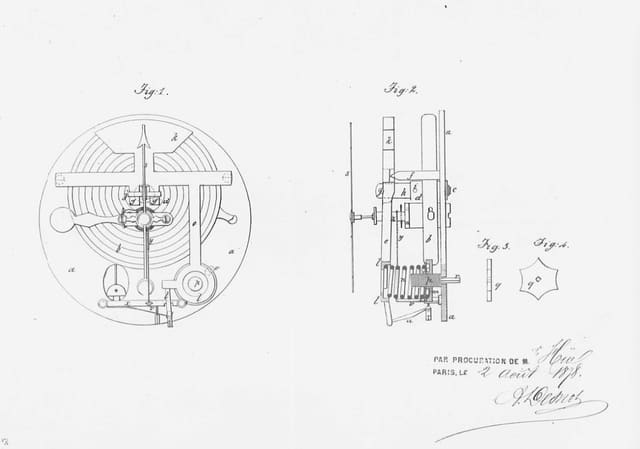
Patent No. 125931 (applied for 2 August 1878, granted 30 November) — «Perfectionnements apportés aux baromètres anéroïdes» (improvements to aneroid barometers) — is the first devoted to the aneroid, that is, to a movement with a vacuum capsule of the Vidie system. The adjusting screw ends in a square: it is turned either by a knob passing through the case or by a watch key, and for precision an auxiliary dial with a pointer can be added. Along the way the specification describes the movement itself in detail: a front plate on pillars, the vacuum capsule, the main lever on an arbor between posts, a ball joint, a counterweight, a spring compressed by a nut-plate on a screw, a second lever on an arbor running in pivots, and a Hall chain winding round the pulley of the hand arbor. This is the lever movement that later appears in the catalogue as «à levier» (lever type).
Patent No. 131788 (applied for 17 July 1879, granted 30 September) — «Perfectionnements aux instruments de précision» (improvements to precision instruments) — is unexpectedly decorative. Here Hüe describes himself for the first time as a «fabricant d'instruments de précision» (maker of precision instruments). An aneroid, thermometer, compass or small clock is placed in a glass casing in the shape of an hourglass — «sablier» (hourglass) — with two chambers; the casing can also be made of wood, marble or ceramic, or assembled from two hinged cups with a clasp. The precision instrument became a desk ornament — a direction later continued by the many decorative barometers of the "E.H. Paris" catalogue.
Patent No. 153316 (applied for 25 January 1883; agents Le Blanc & Pagès) again concerns a barometer with a movable scale, this time with two dials: a fixed ring bearing the weather words and a movable millimetre dial. The movable part is turned by a toothed ring meshing with a wheel; a spring presses the wheel against the ring so that the mesh is maintained regardless of wear, and the teeth are cut on an arc. The knob is brought outside the case. The honesty of the specification is telling: the author acknowledges that the combination of two dials as such is in the public domain and claims rights only to the mechanism.
Patent No. 179221 (applied for 25 October 1886, granted 28 April 1887; agents Pagès & Joubert) — «Système de baromètre dit baromètre universel altimétrique» (system of barometer called the universal altimetric barometer). Around the pressure scale runs a concentric ring marked with altitudes — 0, 100, 200 metres and so on. Beneath the glass is a pointed stylus that engages the knurled edge of the ring; the stylus is operated by a tilting knob on a rod with a spring. Before an ascent the traveller sets the zero of the ring against the hand, and at the summit reads the height gained directly — for example, 350 metres. From this idea descend the house's altimetric barometers with movable scales, "le Touriste" at the 1900 exhibition, and the catalogue's range of pocket altimeters.
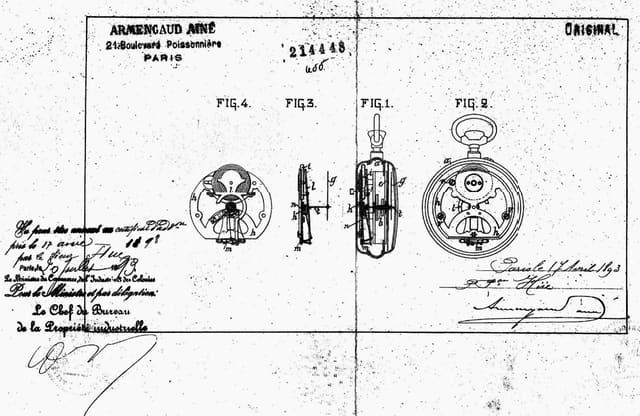
Patent No. 214448 (applied for 26 June 1891; agent Armengaud aîné) — «Montre-baromètre» (barometer watch). A watch and an aneroid are enclosed in a single pocket case. The arbor of the barometer hand passes through the hollow arbor of the minute hand, and both time and pressure are read on one dial; a movable glass serves to read differences in altitude. On 17 April 1893 Hüe obtained a certificate of addition to the patent: the watch became thinner, both movements were mounted on a common plate so that each could be removed or adjusted independently, and motion was transmitted to the central arbor by a lever and a chain with a counter-spring. Swiss patent CH 4225, applied for on 3 December 1891, is the foreign counterpart of the French one [16]. In the "E.H. Paris" catalogue this line is represented by Nos. 1656–1665.
The last known patent, No. 253293 (applied for 18 January 1896, granted 30 April; agent E. Chassevent of the firm of Ch. Desnos), is «Système de baromètre enregistreur» (system of recording barometer). Instead of the drum with a paper strip familiar from the Richard recorders, Hüe proposed a circular disc turned by clockwork once a week. Around the periphery are marked seven day sectors, each with twelve two-hour divisions; pressure is plotted along the radii. The pen on its lever receives motion from vacuum capsules through a rod, a shaft, a bell-crank lever and a ball joint; a special device lifts the pen so that the chart can be changed. The same principle, the specification notes, is suitable for thermometers, hygrometers and vacuum gauges. Four years later the jury of the Exposition Universelle would single out in Hüe's showcase the «enregistreurs à cadran» (dial recorders), and the catalogue would offer "recording barometers with a dial" in two sizes under Nos. 1764–1765, next to the drum recorders Nos. 1761–1763.
Nine patents and one addition form a consistent line. It begins in 1866 with the adjustment and locking of the Bourdon barometer, passes through the movable scales of 1876, 1883 and 1886, through the lever aneroid and the barometer watch, and ends in 1896 with a recorder. Almost every invention answers the same question: how to let the owner set the instrument himself — at his own altitude, in the mountains, on the road — without returning it to the workshop. His self-descriptions change too: "barometer maker" in 1866, "optician" in 1876 and 1878, "maker of precision instruments" from 1879. The craftsman with a single product was becoming the owner of a broadly based factory.
At the Exposition Universelle of 1900 Hüe was represented twice. In Class 15, "Instruments de précision", the catalogue recorded: «Hue (Théodore), à Paris, rue des Gravilliers, 79. — Baromètres métalliques et anéroïdes. Instruments divers. Enregistreurs. Manomètres extra sensibles. Montre baromètre, etc.» (metallic and aneroid barometers, various instruments, recorders, extra-sensitive pressure gauges, barometer watch, etc.) [8]. The jury report singled out in the exhibit [10]:
In the same class exhibited Jules Richard and the Stuttgart house of G. Lufft, with «baromètres métalliques, les uns à montures très décoratives» (metallic barometers, some in very decorative mounts) [10]: the future owner of the house of Hüe then stood in the neighbouring showcases.
The second exhibit was in Class 34, "Aérostation". The catalogue: «Hue (Théodore-A.), à Paris, rue des Gravilliers, 79. — Instruments de précision: Baromètres altimétrique et orométrique enregistreurs, pour l'aérostation» (precision instruments: recording altimetric and orometric barometers for aerostation) [9]. The jury awarded a bronze medal: «M. Hüe a présenté différents instruments météorologiques à l'usage des aéronautes: montres-baromètres, baromètres à deux sensibilités pour ascensions à petites et grandes hauteurs; baromètres à maximum, trousses d'aéronaute contenant baromètre, thermomètre» (M. Hüe presented various meteorological instruments for the use of aeronauts: barometer watches, barometers with two sensitivities for ascents to low and great heights, maximum barometers, aeronaut's kits containing barometer and thermometer) [11]. The maximum barometers went back to the patent of 1876, the dial recorders to the patent of 1896, the barometer watches to the patent of 1891 (see the chapter "The Patents of Théodore Hüe").
In its section on collaborators the report names the next generation of the family: «Une mention honorable a été décernée à M. Eugène Huë, frère et collaborateur de M. Ferdinand Huë, titulaire d'une médaille de bronze» (an honourable mention has been awarded to M. Eugène Huë, brother and collaborator of M. Ferdinand Huë, holder of a bronze medal) [11]. Thus by 1900 both brothers, Eugène and Ferdinand, were working in the business, and the bronze medal of Class 34 is credited in the jury report to Ferdinand, although the exhibitor entered in the catalogue is Théodore-A. Hüe.
Around 1900–1901 the firm moved to 63 rue des Archives. The catalogue of the Syndicat des constructeurs en instruments d'optique et de précision for 1901–1902 presents it as follows [12]:
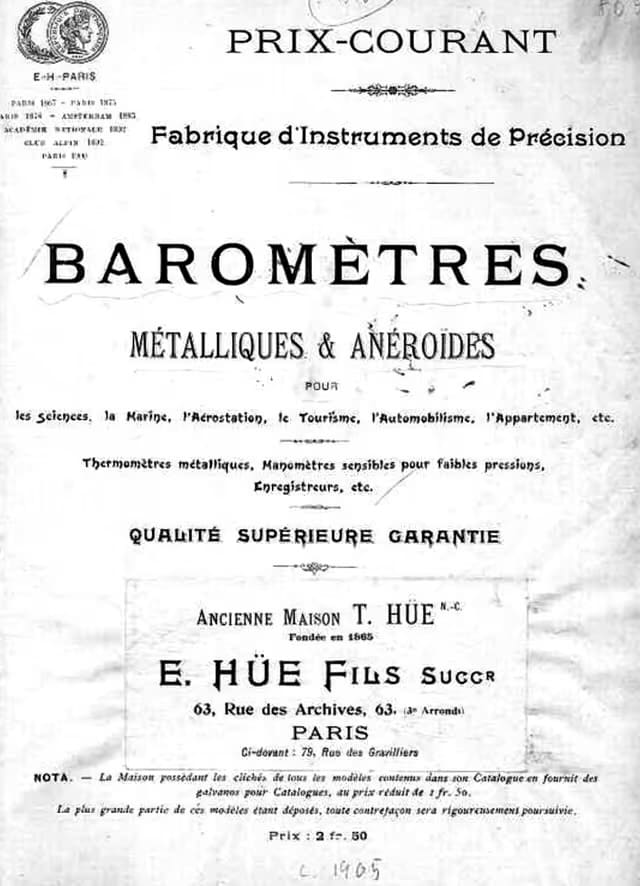
«T. Hüe. Instruments de précision. Baromètres, manomètres, etc. 63, Rue des Archives, Paris. Anciennement: 79, Rue des Gravilliers. La Maison a été fondée en 1865, par le titulaire actuel. Elle s'occupe spécialement de la construction des baromètres métalliques et anéroïdes, des thermomètres métalliques, des manomètres extra-sensibles pour recherche de fuites, petites pressions, usage médical, etc. Ces divers types d'appareils sont établis soit à indication directe, soit, pour quelques-uns, avec système enregistreur. Toutes les parties de ces appareils, depuis les pièces mécaniques précises, traitées avec un soin particulier, jusqu'aux pièces d'habillage et d'ornementation des instruments, sont entièrement fabriquées dans la Maison. Elle dispose à cet effet, outre ses ateliers de mécanique et d'horlogerie, d'ateliers de sculpture et d'ébénisterie.»
(T. Hüe. Precision instruments. Barometers, pressure gauges, etc. 63 rue des Archives, Paris. Formerly 79 rue des Gravilliers. The house was founded in 1865 by its present owner. It is chiefly concerned with the construction of metallic and aneroid barometers, metallic thermometers, and extra-sensitive pressure gauges for leak detection, low pressures, medical use, etc. These various types of apparatus are made either with direct reading or, in some cases, with a recording system. All the parts of these instruments, from the precise mechanical components, treated with particular care, to the casing and ornamental parts, are made entirely in the house. For this purpose it has, besides its mechanical and clockmaking workshops, workshops for carving and cabinetmaking.)
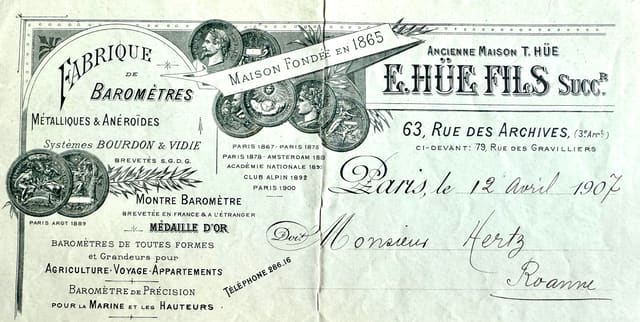
Théodore is still listed here as the owner. But in the first years of the new century the business passed to Eugène: catalogues began to appear under the monogram "E.H." in a circle with the word "PARIS", and a label on one copy of the catalogue states that the firm had been taken over by the son, E. Hüe [19].
The fullest source on the house's products is a price list of the early twentieth century in four languages (French, English, Italian and Spanish), dating from about 1905 [13, 19]. Its title page reads: «Prix-courant. Fabrique d'Instruments de Précision. Baromètres métalliques & anéroïdes pour les Sciences, la Marine, l'Aérostation, le Tourisme, l'Automobilisme, l'Appartement, etc. Thermomètres métalliques, Manomètres sensibles pour faibles pressions, Enregistreurs, etc. Qualité supérieure garantie» (price list of a precision instrument factory: metallic and aneroid barometers for science, the navy, aerostation, touring, motoring, the home, etc.; metallic thermometers, sensitive pressure gauges for low pressures, recorders, etc.; superior quality guaranteed). The catalogue cost 2 francs 50 centimes, and a note on the title page stated: «La Maison possédant les clichés de tous les modèles contenus dans son Catalogue en fournit des galvanos pour Catalogues, au prix réduit de 1 fr. 50. La plus grande partie de ces modèles étant déposés, toute contrefaçon sera rigoureusement poursuivie» (the house, possessing the printing blocks of all the models in its catalogue, supplies electrotypes of them for catalogues at the reduced price of 1 fr. 50; as most of these models are registered, any counterfeit will be rigorously prosecuted). Hüe models were thus reprinted in dealers' catalogues. One surviving copy bears the stamp of American agents: "A. C. Triaca — Ch. Levée, Agents U.S.A., 146 West 56th Street, New-York" [13].
The range opens with domestic and wall barometers, arranged by type of movement:
The second large part of the catalogue covers instruments for the road, the mountains, the sky and the motor car:
Also offered separately were extra-sensitive pressure gauges «pour pression minima de 0 m 25 à 2 m d'eau» (for minimum pressures from 0.25 to 2 m of water) — for acetylene, gas-leak detection, medicine and other purposes; recording barometers (Nos. 1761–1765) — drum models, small and large, in mahogany cases, a miniature travelling model in gilt bronze, and «à cadran» (dial) models with a circular chart; thermographs (Nos. 1776–1779) and metallic thermometers, including alarm and maximum-minimum models (Nos. 1786–1789).
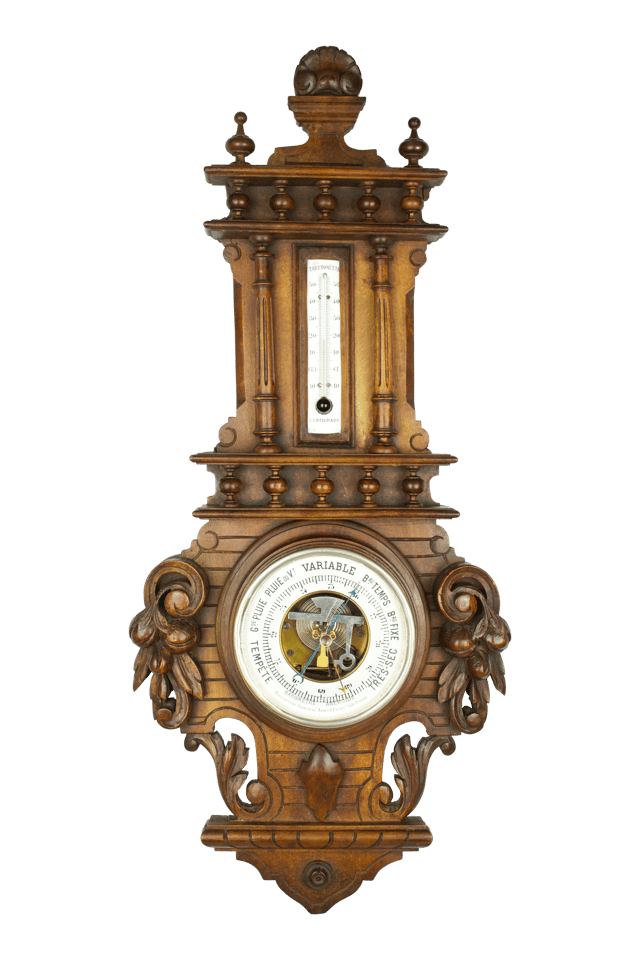
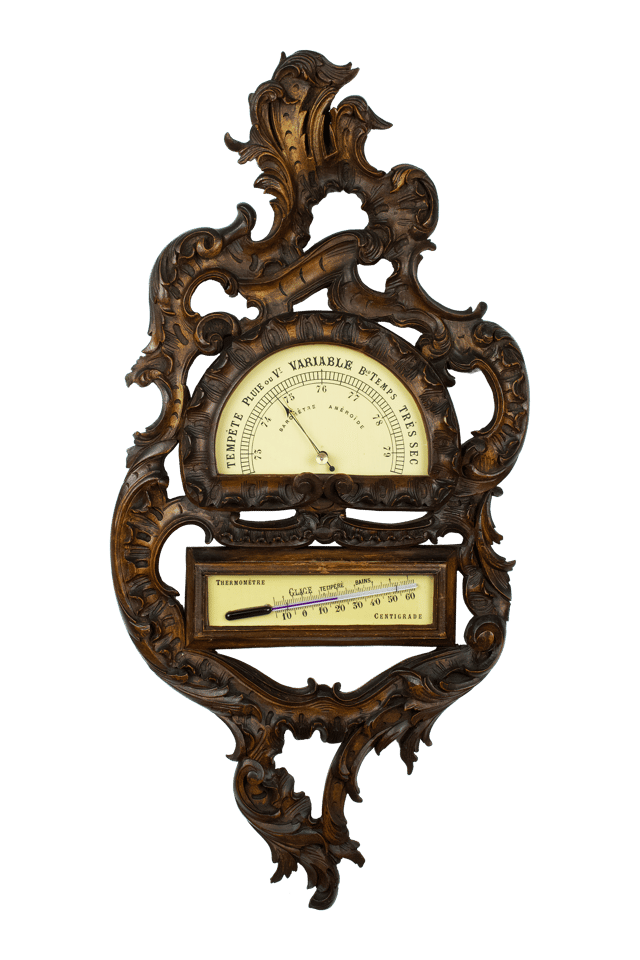
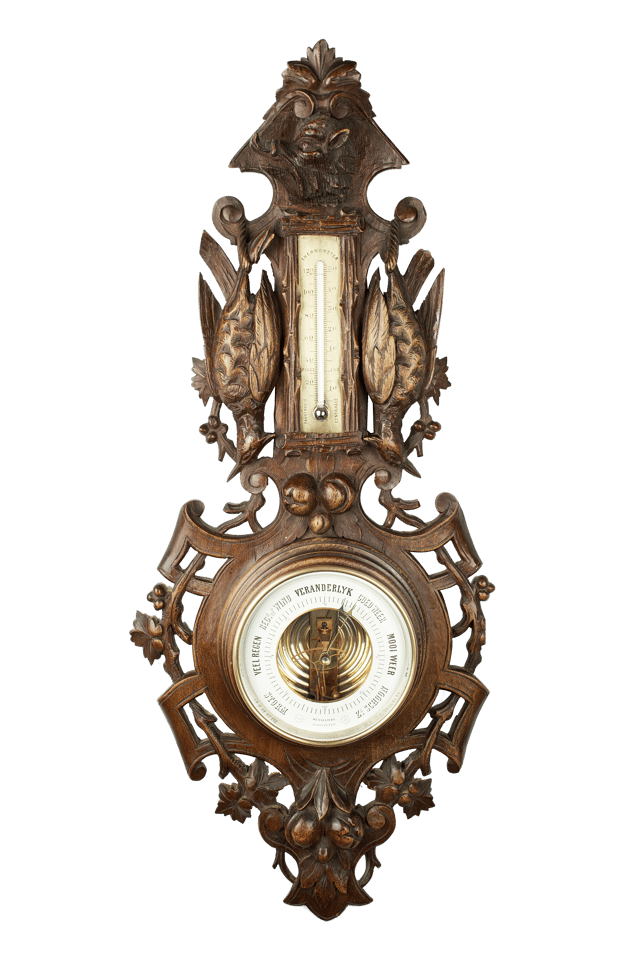
The last few dozen pages are given over to frames — the reason the house kept carving and cabinetmaking workshops. Barometers with lever movements or curved springs were set into carved violin-shaped frames and cartels: «végétations» (foliage), Renaissance, hunting scenes with boars, birds and woodcock, Henri II, François I, Louis XIII and XIV, Gothic, Art Nouveau, "Chinese" and "Japanese" styles, frames of walnut, mahogany and rosewood, Empire, Louis XV and XVI, lacquered and gilt. Here too are carved stands, thermometers and small clocks, as well as «Cartels pendules à quinzaine avec baromètres» (cartel clocks with fifteen-day movements and barometers) — wall cartels combining a barometer and a fifteen-day clock. Prices ran from 13 francs for a simple carved violin frame to 550 francs for a richly carved cartel [13].
Eugène Hüe led the house in the direction already marked out in 1900 — towards aerostation and aviation. In the Paris-Hachette directory for 1910 and 1912 the firm's address carries the entry "Hue (A.-E.), 63, R. des Archives"; the mark "A.-E." denotes membership of the Aéro-Club de France [14]. In 1910 a nineteen-page catalogue, «Maison Hue, instruments de précision», was published; it is now held in the library of the French Ministry of the Armed Forces among navigation instruments [24]. Among the firm's publications is also an eight-page brochure, «Viseur de direction du Capitaine Sazerac de Forge construit par M. Hüe» (direction sight of Captain Sazerac de Forge, constructed by M. Hüe; Paris, Merckel) [24].
At the International Exhibition in Turin in 1911, «M. HUE (Eugène), 63, rue des Archives, Paris» was secretary of the committee of the combined Classes 6–9 of the French section — instruments for measuring length, area and volume, drawing instruments, timekeeping instruments, mechanical and physical apparatus — and exhibited there with «Baromètres. Thermomètres. Boussoles» (barometers, thermometers, compasses). In the "Aérostation scientifique" section he showed «Instruments de précision: altimètres, enregistreurs, statoscopes, boussoles» (precision instruments: altimeters, recorders, statoscopes, compasses) — in the same list as Jules Richard and his recording barometer [15]. The former partners in Bourdon barometers were now rivals in instruments for aeronauts.
The war stopped the production of Bourdon barometers, but not instrument making. The firm's recording barographs served in aviation: the National Air and Space Museum in the United States holds a barograph marked "E. Hue S.A." in a wooden case, with a scale to 8,000 metres and the date 1918, which was used on the record flight of the PN-7 flying boat in 1924; the museum also holds another barograph by the same firm [23].
After the war the house of Hüe became known as "Établissements E. Hüe". In the 1920s its showroom and office were at 28 rue Notre-Dame-de-Nazareth, and its factory at Bagnolet, outside Paris; a 1928 catalogue is held in the archive of the Ultimheat museum [19].
By this time the firm had passed into German hands. It was bought by G. Lufft of Stuttgart — a house founded in 1881, when, in the words of Lufft's anniversary history, «Metallbarometer waren in Deutschland in jener Zeit schon bekannt, mussten jedoch aus Frankreich importiert werden» (metallic barometers were already known in Germany at that time but had to be imported from France) [22]. Sources give different dates for the purchase: Stöhr's book gives 1928, citing the Lufft anniversary publication of 1956 [19], while several later publications on Lufft's history give 1925 and even 1923. The German period proved short: «1939 musste Lufft den zwischenzeitlich erworbenen Pariser Konkurrenten Etablissements E. Huë Sarl wieder aufgeben» (in 1939 Lufft had to give up again the Paris competitor it had acquired in the meantime, Etablissements E. Huë SARL) [22]. With this the documented history of the house of Hüe breaks off.
The history of the house of Hüe is a history not of spectacular inventions but of precise craftsmanship and of being in the right place at the right time. Théodore Hüe began as a maker of metallic barometers, worked alongside the physical instrument maker Hempel, and took up the Bourdon barometer just as the Richards themselves were turning to recorders. For almost half a century — from the first patent of 1866 to the First World War — metallic tubes from the rue des Gravilliers and the rue des Archives went out under the Hüe name and under other names, on the dials of opticians and clockmakers. Théodore left a dozen patents — from the adjustment and locking of the Bourdon barometer to the barometer watch and the recorder with a circular chart — and built a house in which mechanic, clockmaker, carver and cabinetmaker worked under one roof, and in whose catalogue the five-franc "Simplex", a sign barometer the height of a man and a gold barometer watch sat side by side.
His sons led the firm towards aerostation and aviation — to statoscopes, altimeters and recording barographs. The house outlived the Bourdon barometer by a quarter of a century; it did not outlive German ownership. What remains are instruments, numbers, stamps, addresses and medals, from which this history has been reconstructed.
| Person | Role | Documents |
|---|
| Alexandre-Théodore Hüe ("T. Hüe") | founder (1865, according to the firm), partner and successor of Hempel, head of "T. Hüe & Cie"; still the owner in 1901–1902; author of nine French patents (1866–1896) and a Swiss patent of 1891 | [5], [8], [9], [12], [16], [17], [19], [26] |
| Eugène Hüe ("E. Hüe", "E.H.") | son; collaborator (honourable mention, 1900), then head of the firm; member of the Aéro-Club de France; secretary of the committee of Classes 6–9 in Turin (1911) | [11], [14], [15], [19] |
| Ferdinand Huë | Eugène's brother; in the 1900 jury report, holder of the bronze medal of Class 34 | [11] |
| Guillaume-Louis Hüe | compass maker; co-applicant with Théodore for the 1866 patent on the metallic barometer; relationship not established | [26] |
| Oscar Hempel | maker of physical and mathematical instruments; 55 quai des Grands-Augustins; "Hempel & Cie" (1871), later "O. Hempel & T. Hüe" | [1]–[4], [17], [19] |
| Maison Boileau | aneroid barometers; merged into the house in 1897 | [12] |
| G. Lufft, Stuttgart | owner of "Établissements E. Hüe" from 1925 (or 1928) to 1939 |
| Period | Name | Address |
|---|
| before the move to the rue des Gravilliers | O. Hempel & T. Hüe | 55, quai des Grands-Augustins |
| by 1883 — c. 1900 | T. Hüe & Cie; Théodore Hüe | 79, rue des Gravilliers, at the corner of the rue Saint-Martin |
| c. 1900–1901 — no later than 1912 | T. Hüe, later E. Hüe | 63, rue des Archives |
| 1920s (1928) | Établissements E. Hüe | 28, rue Notre-Dame-de-Nazareth; factory at Bagnolet |
| Year | Exhibition | Result | Source |
|---|
| 1867 | Paris | silver medal "en collaboration" (Hempel also received silver in Class 12 that year) | [3], [8] |
| 1875 | Paris | listed in the catalogue's list of awards | [13] |
| 1878 | Paris | bronze medal (according to the firm's list) | [8] |
| 1883 | Amsterdam | No. 2931, Class 28; bronze medal in the French report, silver according to the firm's list | [5], [6], [8] |
| 1889 | Paris | silver medal, Class 15 | [7] |
| 1892 | Académie nationale; Club alpin | listed in the catalogue's list of awards | [13] |
| 1897 | Brussels |
| No. | Applied for | Granted | Applicant and profession as stated | Title | Agent |
|---|
| FR 70429 | 17.02.1866 | 20.04.1866 | Théodore Hüe, fabricant de baromètres; Guillaume-Louis Hüe, fabricant de boussoles | Perfectionnements apportés au baromètre métallique (improvements to the metallic barometer) | Lemonnier, office of Ch. Denos-Gardissal |
| FR 112092 | 27.03.1876 | 20.05.1876 | Alexandre-Théodore Hüe, opticien | Système d'indicateur de pressions maxima et minima, applicable aux baromètres et aux manomètres (maximum and minimum pressure indicator for barometers and pressure gauges) | Ch. Desnos |
| FR 112194 | 01.04.1876 | 26.05.1876 | Alexandre-Théodore Hüe, opticien | Perfectionnement aux baromètres à cadran (improvement to dial barometers) | Ch. Desnos |
| FR 125931 | 02.08.1878 | 30.11.1878 | Théodore Hüe, opticien | Perfectionnements apportés aux baromètres anéroïdes (improvements to aneroid barometers) | Ch. Desnos |
| [19], [22] |
| gold medal (according to the firm's list) |
| [8] |
| 1900 | Paris | Class 15 — exhibit noted in the jury report; Class 34 — bronze medal, honourable mention to Eugène Hüe | [8]–[11] |
| 1911 | Turin | Eugène Hüe — secretary of the committee of Classes 6–9 and exhibitor; exhibitor in the scientific aerostation section | [15] |
| FR 131788 | 17.07.1879 | 30.09.1879 | Alexandre-Théodore Hüe, fabricant d'instruments de précision | Perfectionnements aux instruments de précision (improvements to precision instruments) | Le Blanc & Pagès |
| FR 153316 | 25.01.1883 | — | A.-Th. Hüe | Perfectionnements aux baromètres anéroïdes (improvements to aneroid barometers) | Le Blanc & Pagès |
| FR 179221 | 25.10.1886 | 28.04.1887 | Alexandre-Théodore Hüe | Système de baromètre dit baromètre universel altimétrique (universal altimetric barometer) | Pagès & Joubert |
| FR 214448 | 26.06.1891 | — | A. T. Hüe | Montre-baromètre (barometer watch); certificate of addition of 17.04.1893 | Armengaud aîné |
| CH 4225 | 03.12.1891 | 15.03.1892 (publ.) | Alexandre-Théodore Hüe | Barometer watch | — |
| FR 253293 | 18.01.1896 | 30.04.1896 | Alexandre-Théodore Hüe | Système de baromètre enregistreur (system of recording barometer) | E. Chassevent, firm of Ch. Desnos |
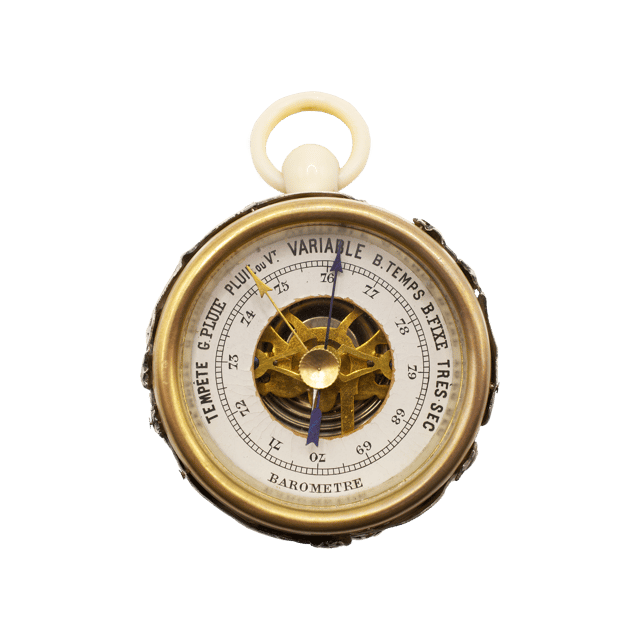
Ivory-cased silver-mounted aneroid barometer