Loading
Maison Richard: The History of a French Dynasty of Precision Instruments
Among the celebrated French makers of scientific and measuring instruments, the name Richard holds a special place. For more than a century and a half, this Parisian firm—successively trading under the signs “Maison Richard,” “Richard Frères,” and “Jules Richard” — supplied observatories, the navy, laboratories, weather services, and aeronauts with precision instruments: barometers, barographs, thermographs, hygrographs, anemographs, meteorographs, and a host of other recorders of physical quantities. The story of this firm is at once the story of a whole dynasty of mechanics and opticians, the story of the rise of the French “precision-instrument industry,” and the story of the close bond between instrument-making and the worlds of great science and nascent aviation.
The Founder: Félix Richard and the Context of French Precision Mechanics
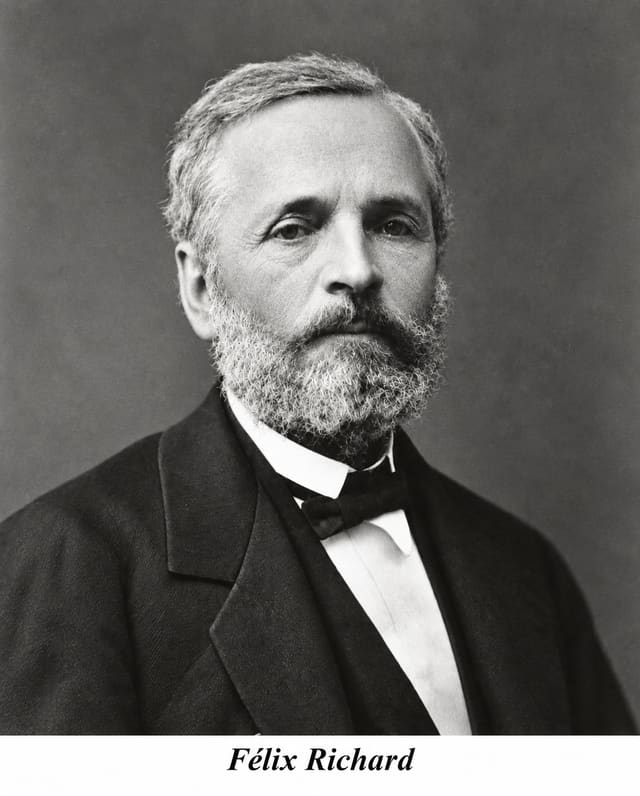
The story begins with Félix Richard, born on 1 February 1809 in Lyon and died on 14 July 1876 in Paris (19th arrondissement). By profession he was an optician and a manufacturer of precision instruments (“Opticien, Fabricant d’instruments de précision”). He came from a Lyon family distantly connected to the silk trade. On 14 June 1843, in Lyon, he married Françoise Antoinette Fromont (1821–1911); the marriage produced four sons: Antoine Fromont-Richard (1845–1921), Jules (1848–1930), Félix-Maxime (1856–c. 1949), and Georges (1863–1922). Through his wife, the family became allied with the world of precision mechanics: the sons’ maternal uncle was the renowned maker of electrical instruments Paul-Gustave Fromont.
The era in which Félix opened his business was a time of flourishing for the French “precision-instrument industry” (l’industrie française des instruments de précision)—a trade that brought together opticians, watchmakers, and mechanics serving observatories, laboratories, the navy, and the emerging field of meteorology. According to a well-established tradition, going back to the firm’s own records and corroborated by the Smithsonian Institution, Félix Richard founded his workshop around 1845. On 18 June 1849, Eugène Bourdon patented the principle of the tubular pressure gauge, and Félix Richard was the first to obtain a licence from the inventor. He then set about manufacturing metallic barometers with the Bourdon tube. It is worth noting that Félix was not merely a licensed contractor: while Bourdon spent years perfecting his design, Richard was himself working on pressure-gauge projects—that is, he was a man deeply immersed in the subject.
Local Parisian historiography (a study of the Belleville quarter) adds that in 1862 Félix, having moved up from the Lyon region, opened a factory of measuring instruments on the Boulevard de la Villette; the workshops then moved to No. 8 Impasse Fessart, which in 1899 was transformed into the Rue Mélingue. These two dates (1845 and 1862) do not contradict each other: 1845 is the traditional founding date of the business itself, whereas 1862 refers to the Parisian period and the opening of a large factory.
Félix Richard was not only an industrialist but also a prominent public figure in Belleville: having grown wealthy, he partly withdrew from business and turned to politics—he served as mayor of the 19th arrondissement of Paris in 1870–1871 (provisionally appointed after 4 September 1870) and as a municipal councillor until 1874. It was in this capacity that he furthered the cause of vocational education for working-class youth: he offered the city his premises on the Boulevard de la Villette on favourable terms, and in January 1873 a municipal trade school opened there—the future Lycée Diderot. His taste for the “good life” and for politics cost the enterprise dearly: by the time of Félix’s death in 1876, the firm was on the brink of bankruptcy.
The Sons and the “Richard Frères” Partnership
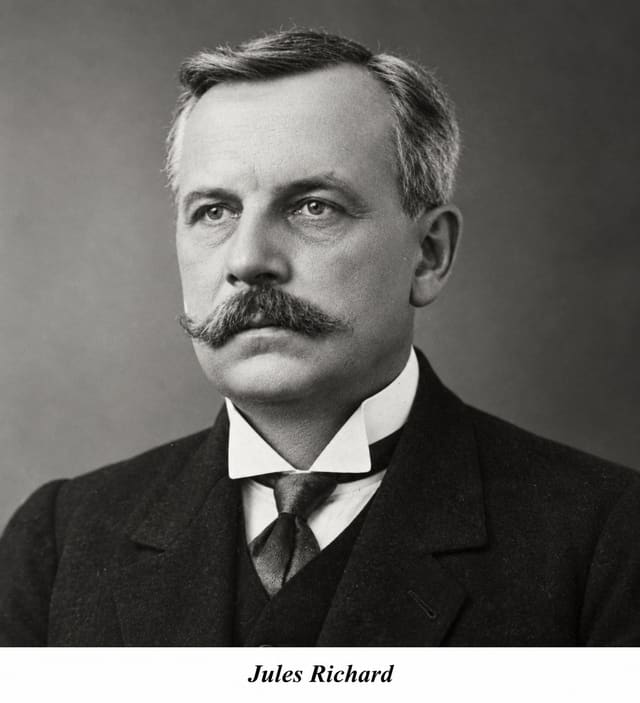
Jules Richard was born on 19 December 1848 in Lyon and died on 18 June 1930 in Saint-Mandé. He was the second of the four sons. The family had moved to Paris before 1856, and Jules grew up in his father’s workshop, learning mechanics and instrument-making from an early age. From 1863 he spent three years as an apprentice to a watchmaker named Collin; in 1866 he left the family business and joined the telegraph administration as a technician. During the 1870s he worked outside the family firm, making telegraph equipment. It is to this early period that his collaboration with the physiologist Étienne-Jules Marey (1830–1904) is attributed—a pioneer of the graphic method of recording movement and of chronophotography, whose methods of electrical and photographic recording influenced Richard’s future specialization in recording instruments.
After his father’s death in 1876, Jules returned to the family enterprise to save it. (The French Wikipedia dates his “succession” to 1871, but most sources, including the Smithsonian Institution and the Science Museum in London, give 1876—the year of Félix’s death; the discrepancy is probably due to the fact that Jules was already drawn into the business while his ailing father, who had withdrawn from management, was still alive.) In less than ten years, Jules fully restored the firm, making it the national leader in its field.
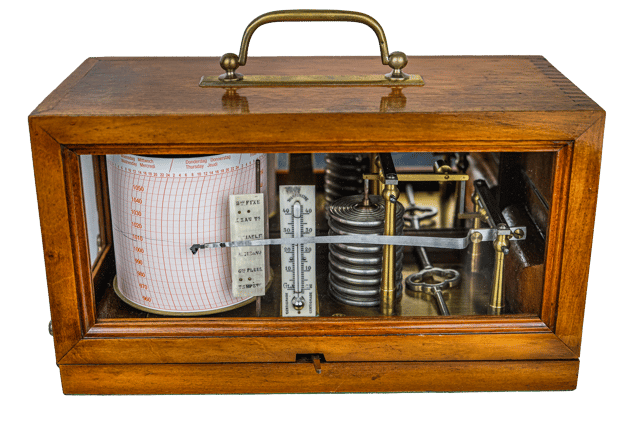
The turning point came in 1880, when Jules Richard patented the first reliable self-registering barometer (baromètre enregistreur), capable of continuously recording atmospheric pressure: an inked pen periodically traced the pressure values onto a rotating cylinder. The instrument was an enormous success, and the firm at 25 Rue Mélingue began to grow rapidly.
The “Richard Frères” partnership was formed in 1882 by Jules and his younger brother Félix-Maxime (1856–c. 1949), a graduate of the École Centrale. A third brother, Georges (1863–1922), also joined the family business. During the 1880s the brothers earned the firm its reputation as a maker of scientific barometers and of other instruments for recording environmental parameters—anemometers, pyrometers, aneroid barographs, and dynamometers.
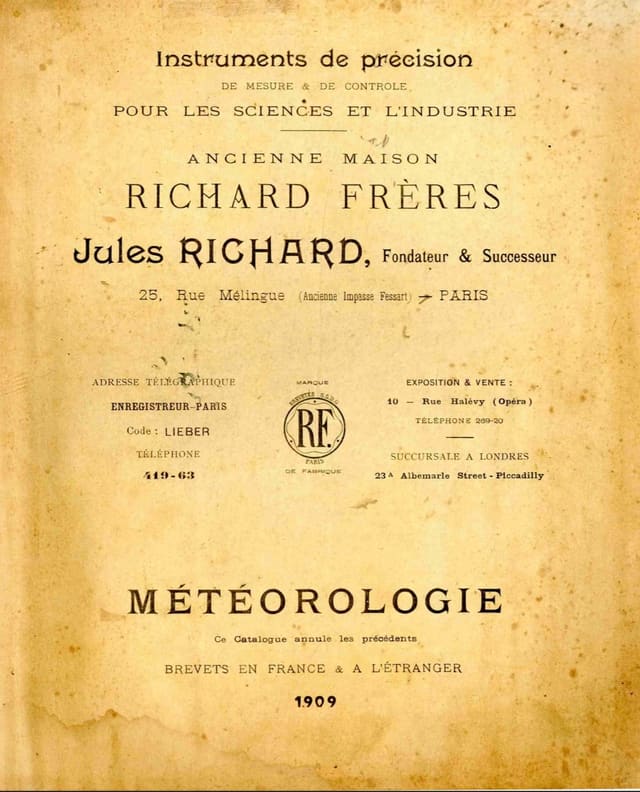
In 1891, owing to mutual disagreements, the partnership broke up, and the brothers became embroiled in litigation. Jules became the sole owner, and the firm took the name “Jules Richard” (with the full signboard: “Ancienne maison Richard Frères, Jules Richard Successeur Constructeur”). Notably, the name “Richard Frères” and the “RF” monogram remained in use for a long time after the split—a fact that creates the characteristic difficulty in dating the instruments.
The rift between the brothers had far-reaching consequences. The separation agreement contained a non-competition clause forbidding Félix-Max from manufacturing and selling competing precision instruments; this indirectly pushed him toward the photographic trade (he acquired the “Comptoir Général de Photographie”) and, further, into partnership with the cinema pioneer Léon Gaumont, whose firm became one of Jules’s chief competitors. Meanwhile, brother Georges Richard, together with Max, had already turned in the early 1890s to the bicycle business, founding the “Société des Cycles Georges Richard” in 1893, and then to automobiles: in 1897 the brothers created the “Société des Anciens Établissements Georges Richard,” in 1901 the “Richard-Brasier” marque, and in 1905 Georges, with the support of Baron Henri de Rothschild, founded the automobile company UNIC in Puteaux. Thus, from a single instrument-making family there grew several important industrial enterprises of France.
Jules Richard never married and left no direct heirs. By his will he bequeathed the enterprise to his chief associate, Léon Henrard, director from 1930 to 1953; the firm was then briefly headed by Henrard’s son Roger Henrard, a leading specialist in aerial photography, who developed the “Planiphote” and “Altiphote” series of aerial cameras.
Relations with Eugène Bourdon
Eugène Bourdon (born in Paris on 8 April 1808, died there on 29 September 1884) was a French watchmaker and engineer who, on 18 June 1849, patented the metallic pressure gauge with a curved tube (the “Bourdon tube”). The son of a silk merchant, he showed a bent for mechanics from childhood, spent two years in Germany (Nuremberg) to complete his education, worked in the design office of Jecker and Calla, and then opened his own workshop of scientific instruments and model steam engines. While seeking a way to measure boiler pressure without a mercury manometer, he hit upon the idea of using the elastic deformation of a curved metal tube.
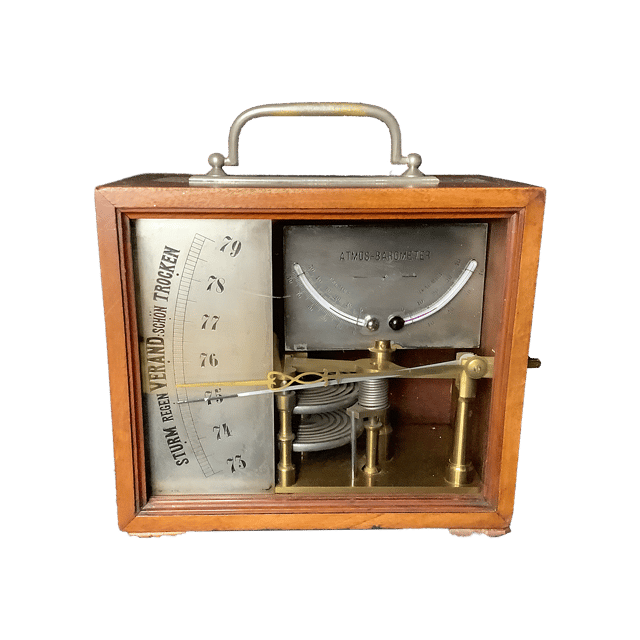
Bourdon’s invention was manufactured under licence, first in the workshops of Félix Richard and later by the firms of Léon Arrouit and E. Hüe. The barometers made by the House of Richard bore the marks of both names (Richard and Bourdon)—often with the inscription “Baromètre Métallique” and two medallions: “E. Bourdon and Richard’s Patent” (Gold Medal of the 1849 Exhibition) and “Council Medal” (Great Exhibition, London, 1851). The Bourdon construction was distinguished by a characteristic crescent-shaped (semicircular) flattened tube, acting through a system of levers and a toothed rack upon the needle. The invention earned Bourdon the Grand Gold Medal at the 1849 exhibition, and at the London exhibition of 1851 the Council Medal and the rank of Chevalier of the Legion of Honour.
After Félix’s death, the production of Bourdon mechanisms was continued by his son Jules (instruments of this period bear the “JR” mark) and then by the “Richard Frères” partnership. Bourdon barometers remained a staple catalogue item of the firm at least until the end of the nineteenth century.
Bourdon’s own line developed separately: he founded his own firm (Bourdon Sedeme) to make pressure gauges. In time this company became Bourdon-Sedeme and, in the early twenty-first century, Baumer Bourdon-Haenni (Vendôme, France), part of the Baumer group; the Bourdon-Sedeme brand and the Swiss Haenni were brought together under the Bourdon-Haenni holding in 2000, and the present structure took shape in 2005. Thus both the Richard line and the Bourdon line have survived to the present day as functioning instrument-making enterprises.
The Recording Instruments: “enregistreurs Richard”
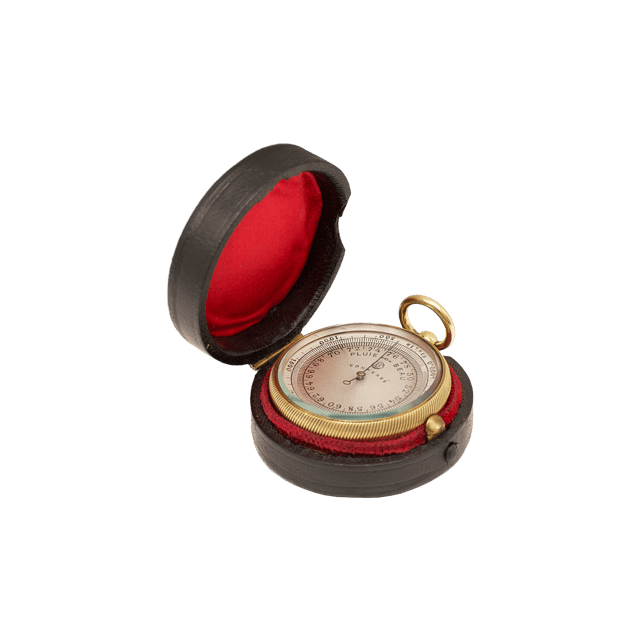
It was the broad range of self-registering instruments that brought the firm worldwide renown. The technical basis was the Vidie aneroid capsule (Lucien Vidie, patented 1844): a set of evacuated metal cells (usually five to eight, and in deluxe models up to ten) that expand and contract as pressure changes; their movement was greatly amplified through a system of levers and transmitted to an inked pen, which traced a curve on paper wrapped around a drum rotated by clockwork. The standard drum made one revolution per week (daily models also existed).
The self-registering barograph of Jules Richard (patented in 1880) became standard issue aboard the vessels of the French state navy. Surviving early examples bearing the “RICHARD FRÈRES” mark date from 1882–1890. Nicknamed “the sorcerer” (le sorcier) by sailors, the aneroid barograph was indispensable on board: less accurate than the mercury barometer, it was compact, sturdy, and easily portable.
The success of the barograph led to the rapid extension of the same idea to other quantities. The French tradition lists a whole family of “Richard recorders”:
To these were added instruments for science and industry: the anemo-cinemograph (anémo-cinémographe)—a device for recording wind speed, consisting of a transmitting anemometer and a recording cinemograph with electrical transmission; a high-precision planimeter for the mechanical calculation of areas under curves; aspiration psychrometers; pyrometers; dynamometers; recording manometers and indicators for industry. The Science Museum in London holds, among other items, a brontometer by Jules Richard (for measuring the characteristics of thunderstorms, c. 1890) and a set of aeronautical instruments (an air-meter, a stopwatch, and a distance counter). These instruments are documented in the firm’s catalogues, in particular in the catalogue “Instruments de précision de mesure et de contrôle pour les sciences et l’industrie. Météorologie” (Paris: J. Richard, 1912) and in the “Enregistreurs Richard” catalogue.
A special place is held by the meteorographs—portable “weather stations” combining a hygrometer, a bimetallic thermometer, and an aneroid capsule for pressure, designed to be sent aloft into the atmosphere. This line linked the Richard firm with the history of aeronautics and aerology.
Awards, Exhibitions, and Collaborations
The Richard firm was a constant and highly decorated participant in the World’s Fairs. The culmination was the Paris Universal Exposition of 1900: according to an essay from the Météo-France library, Jules Richard received there no fewer than three Grands Prix (in the categories “Precision Instruments,” “Aeronautics,” and “Art of War”) and three gold medals (in the categories “Photography,” “Mechanics,” and “Electricity”). After the exposition, Richard printed the list of these awards on the covers of his instrument catalogues (as confirmed by the 1906 Jules Richard catalogue in the Météo-France library).
At the Universal Exposition of 1889 in Paris, the firm (then still “Richard Frères”) received a Grand Prix. This success was closely tied to a striking episode in the history of meteorology: in 1888, with the support of Éleuthère Mascart, director of the French weather service, the Richard brothers obtained Gustave Eiffel’s agreement to equip the summit of the newly built Eiffel Tower with a fully fledged meteorological station. There they installed recording hygrometers, thermometers, and an electrical transmitting thermometer of the Richard brothers’ design. This installation, together with a brilliant display in Class 15 (“Precision Instruments”), earned the firm its Grand Prix.
Collaboration with science and aeronautics was constant. Beyond the early influence of Marey, the firm worked with the Central Meteorological Bureau of France and with the pioneers of aerology. Léon Teisserenc de Bort (1855–1913), founder of the observatory of dynamic meteorology at Trappes and discoverer of the stratosphere, used a meteorograph of Jules Richard’s design, modified by himself, in the maritime measurement campaign of the vessel “Otaria” in 1905–1906. Richard’s recording instruments were carried up in the baskets of sounding balloons (ballons-sondes), invented by Gustave Hermite in the early 1890s, recording pressure, temperature, and humidity at great altitudes. The firm’s instruments are held in the world’s major collections, including the National Museum of American History (Smithsonian Institution, to which Richard’s aneroid barographs came in 1910 by way of the U.S. Geological Survey and the Department of the Interior) and the Science Museum in London.
The Jules Richard School
Like his father, Jules Richard attached great importance to vocational training. In 1922 he set aside 5 million francs from his fortune to establish a foundation and a trade school—the “École des Apprentis Mécaniciens Précisionnistes,” opened by agreement with the City of Paris in 1924 in a former school on the Rue Carducci (No. 21), a stone’s throw from the factories. The first class graduated in 1927. Today it is the Lycée Technologique Privé Jules Richard — a private polytechnic lycée specializing in microtechnology. The lycée marked its centenary with celebrations held from 3 to 6 June 2025.
The Present Day
After 1930 the firm continued to produce both scientific instruments and stereoscopic equipment (the latter until about 1957). Production gradually moved out of Paris: in 1972 to Argenteuil, and later to Bezons. Under the name Jules Richard Instruments, the company acquired the firm Maxant Industries in 1999, changed its name to JRI in 2007, and in 2008 JRI and Maxant Berruet merged. Today JRI develops and manufactures systems for measuring and recording physical quantities (temperature, humidity, pressure, levels, CO₂, O₂, wind speed, and others) for industry, healthcare, the agri-food sector, transport, and climate-control technology; more than a hundred people work at its two production sites (Argenteuil and Audincourt) and within the group. In this way the enterprise has returned to its original specialty—the precision measuring and recording instruments first taken up by Félix Richard around 1845.
Sources