Loading
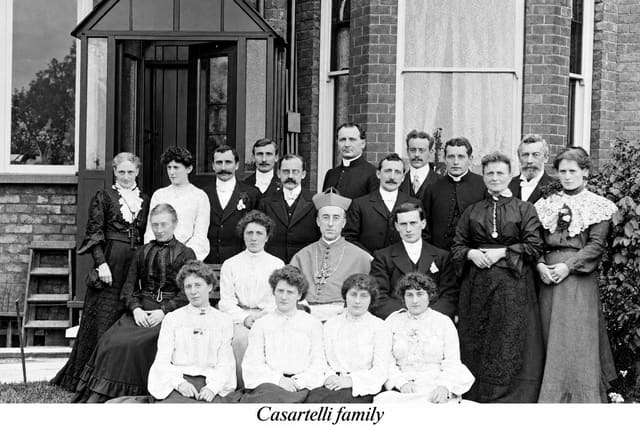
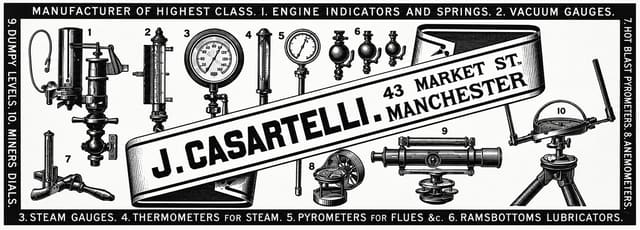
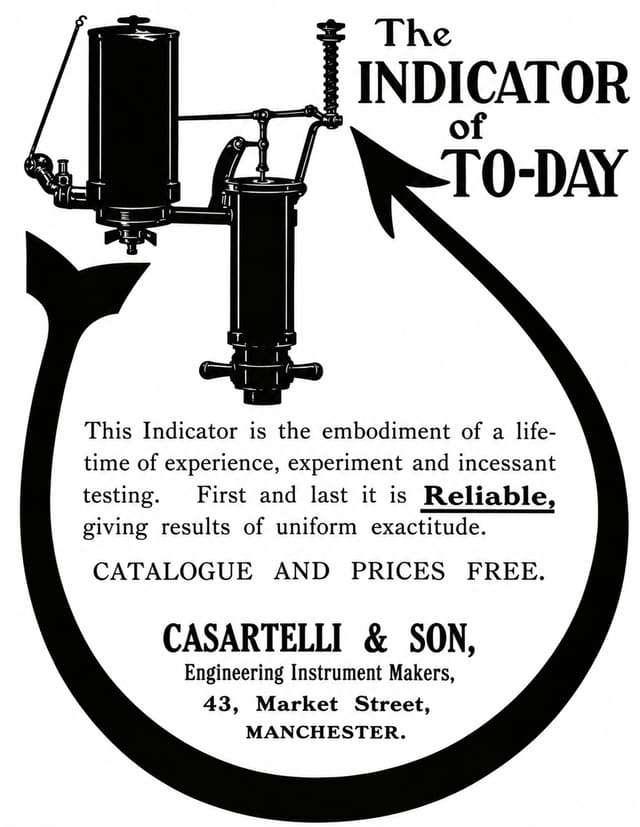
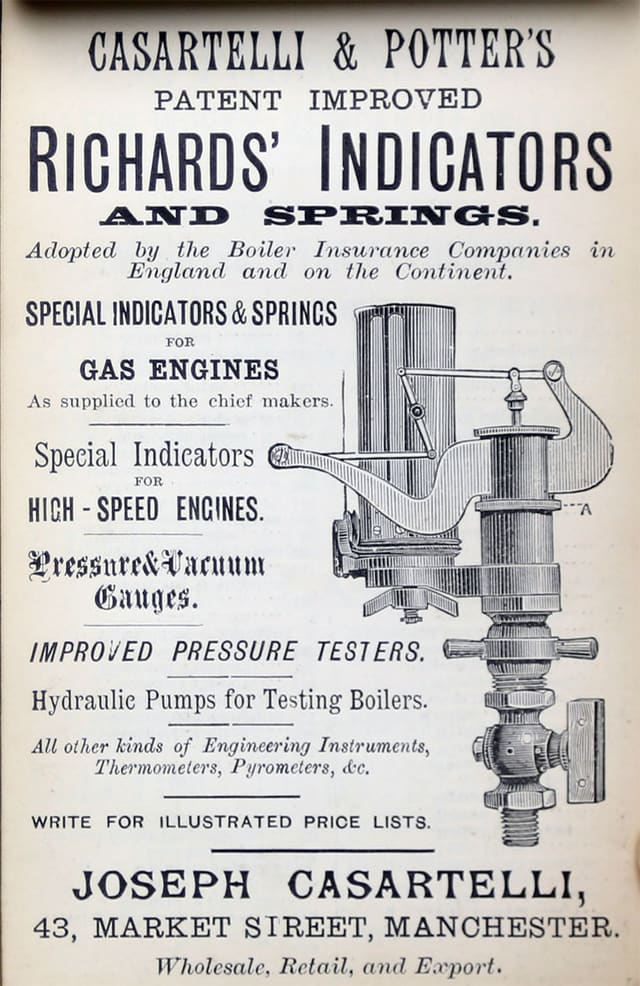
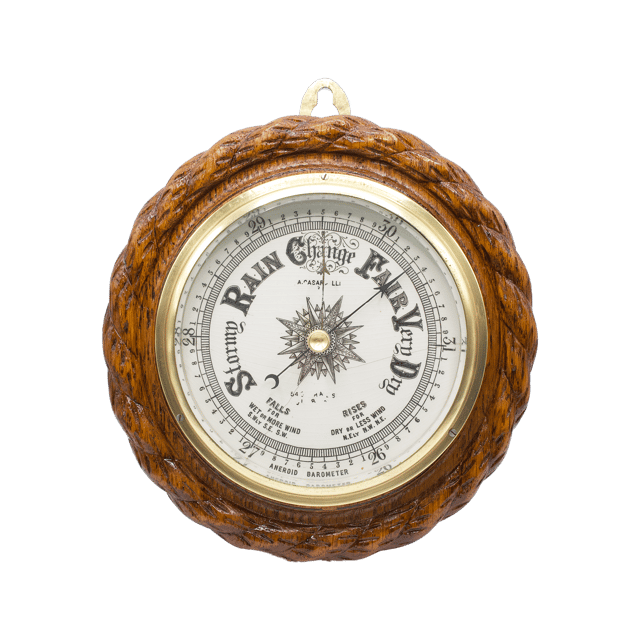
In the early years of the nineteenth century, Manchester was a town where spinning mills went up faster than the streets could be paved. There a young Lombard, Lewis Anthony Casartelli, was carrying out commissions for Dr John Dalton, the Quaker schoolmaster who drew up the first table of atomic weights. Dalton, as the barometer historian Edwin Banfield relates, once told the Italian that he was certain to grow rich if only he learned to speak English properly.
The advice proved prophetic, but it took more than one generation to act on it. The family, which had come from a village above Lake Como with the crafts of the glassblower and the barometer maker, passed through several stages:
This story has no single ending. It is a slow dissolution into liquidations, resales and registry entries. The last of these is dated 1991, almost two centuries after Lewis Anthony first saw the smoke of Manchester.
Tavernerio lies a few miles east of Como, in the hills between the city and the valleys of the Brianza. The Casartelli had long been landowners and property owners there, and at the same time made thermometers and hygrometers. This is an important detail: it shows that the family did not leave to escape poverty, but carried a long-established craft northwards. The Ronchetti came from the same village. The two families intermarried in at least two generations. From the very beginning theirs is the story of one clan under two surnames.
Italian historiography also records the specialisation of emigration from Como. A study in the journal Altreitalie lists carpenters, frame makers and mirror makers among the emigrants from Como. It names separately the makers of thermometers, barometers and other small precision instruments, whose wares were hawked from town to town by itinerant apprentices.
The scale of the phenomenon was modest:
Within this small community the barometer makers from Como formed a professional core. They settled where industry needed measurement: in London, Edinburgh, Liverpool and Manchester.
The first to establish himself in Manchester was Giovanni Battista (Baptist) Ronchetti. The Science Museum Group, in its biographical note on him, gives the year 1790. However, the collection of the Science and Industry Museum holds a wheel barometer of his dated to around 1785, which argues for the earlier date. He worked at 15 High Street until about 1810. He signed his early instruments in partnership with H. Lomas: "Baptist Ronchetti, Lomas & Co.".
Lewis Anthony Casartelli was born in 1784. Around 1805 he arrived in Manchester together with his cousin Charles Joshua Ronchetti, Baptist's son. For several years he worked for various makers. In the sources he appears under three names: Lewis, Louis and Luigi Antonio. Benson gives his working years as 1821–1848, probably from trade directories.
From here the versions diverge, though they may not exclude each other:
The two versions are compatible if Liverpool began in 1812 and the Manchester shop passed to the cousin somewhat later. The Science Museum Group records that Charles Joshua Ronchetti worked with Vittore Zanetti and independently from 1816. This fits well with an exchange around 1815.
Banfield's testimony makes the connection with Dalton a direct one: Lewis carried out work for the scientist. Dalton himself, according to the Science Museum Group, used a siphon barometer made by Ronchetti (c. 1820). Both families were thus involved in equipping one of the founders of chemical atomic theory.
At least one remarkable instrument by Lewis survives, described by Banfield. It is an unusual bow-fronted barometer signed "L. Casartelli, Liverpool":
In 1845, according to Banfield, Lewis retired and returned to Italy.
In 1834, according to Grace's Guide, another group of relatives arrived in Liverpool. Among them was eleven-year-old Giuseppe Luigi, the future Joseph Louis Casartelli. His year of birth is 1823 according to Benson, the Science Museum Group and the Powerhouse Museum, and 1822 according to Grace's Guide and the Oxford Dictionary of National Biography. His age on arrival rather supports 1823. Benson writes that the young man came to join the family business making barometers and thermometers. The Science Museum Group records his Liverpool addresses: 6 South John Street (1849) and 20 Duke Street (1851).
After Lewis's departure the business, according to Banfield, passed to two relatives, Anthony and Joseph. Grace's Guide specifies that Anthony was Antonio Giovanni Casartelli, Joseph's uncle. The firm of Anthony and Joseph Casartelli at 20 Duke Street traded as "opticians and philosophical instrument makers", made barometers and thermometers, and blew its own glass.
The dates of its end differ:
| Source | Dates |
|---|---|
| Benson | active 1845–1849 |
| London Gazette, 24 January 1851 (via Grace's Guide) | notice of dissolution |
| Banfield | the partnership lasted until 1852 |
The discrepancy is explicable: the dissolution of the partnership, the publication of the notice and Joseph's actual departure are three different events.
At least three different men with similar names were active in the Liverpool branch:
Catalogues and auction descriptions often merge them into one person.
Banfield writes that Anthony ran the Liverpool business with other members of the family well into the twentieth century. Issues of the London Gazette, as summarised by Grace's Guide, make it possible to reconstruct his partnerships:
| Years | Firm | Partners | Source |
|---|---|---|---|
| c. 1845 – 1849/1852 | Anthony and Joseph Casartelli | Antonio Giovanni and Joseph | LG 24.01.1851; Benson; Banfield |
| until 1853 | A. and A. Casartelli | Anthony and Anthony the younger | LG 16.09.1853 |
| 1858 | — | Anthony and Louis: patent for improvements in pressure and vacuum gauges | LG 23.04.1858 |
| until 1859 | A. and L. Casartelli | Anthony and Louis; 20 Duke Street | LG 26.08.1859 |
| after 1859 – 1929 | A. Casartelli & Son(s) | Anthony and descendants | Powerhouse Museum |
The 1858 patent for pressure gauges is telling. The Liverpool branch, like the Manchester one, was moving from domestic barometers towards instruments for steam technology.
The family name survives in Liverpool's topography. Casartelli Building is a house of 1760 on the corner of Hanover Street and Duke Street. It was added to the national register of listed buildings at Grade II* on 14 March 1975 and named after the Italian family that made instruments there. In October 2000 the building partially collapsed, and the Liverpool Echo made it the symbol of its "Stop the Rot" campaign against the decay of the historic centre. The house was later dismantled and a replica built in its place.
The official address of the listed building is 1 and 3 Duke Street, whereas the Gazette gives the workshop as number 20. Renumbering of the street or a change of premises remain possible explanations.
In 1851 Joseph married the daughter of Charles Joshua Ronchetti. Her name appears differently in the sources:
Harriet is a common English diminutive of Henrietta, so these refer to one person.
The marriage was both a family and a business affair. Together with his wife, Joseph acquired the Manchester workshop at 43 Market Street. But the sources disagree on from whom exactly he took it over:
| Question | Banfield, Grace's Guide | Benson |
|---|---|---|
| Who handed over the business | the bride's brothers, John Baptist and Joshua Ronchetti | Charles Joshua Ronchetti himself, who retired to Italy |
| Supporting evidence | according to the Science Museum Group, the brothers traded at 43 Market Street as "J. B. & J. Ronchetti" in 1841–1851 | — |
| Year | Banfield: Joseph moved to Manchester in 1852 to marry and take over the business | 1852 |
Perhaps the sons ran the shop while the father remained its formal owner. There is as yet no documentary resolution. Benson's note that Charles Joshua returned to Italy is remarkable: it is the same path as Lewis Anthony's. The masters from Como, it seems, often ended their days in their homeland.
By November 1852 the family was already living in Cheetham Hill: the eldest son was born at 2 Clarence Street. The first shop sign read: "J. Casartelli, Optician, 43 Market Street, Manchester".
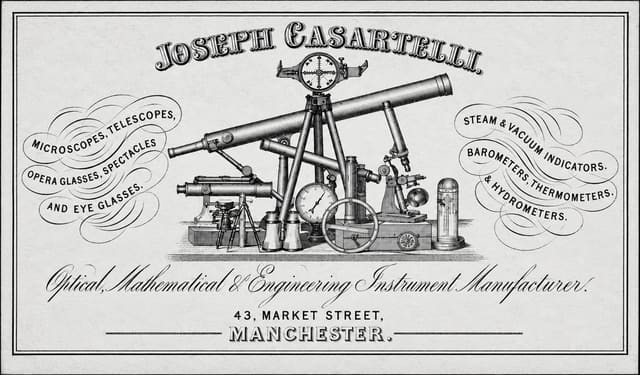
Mid-century Manchester had no need of yet another maker of elegant barometers. It needed instruments for boilers, mines and spinning mills, and Joseph Casartelli understood this. According to Banfield, he turned the business into a maker of optical, mathematical, "philosophical" and engineering instruments, and into a photographic studio as well. Benson lists microscopes, telescopes, cameras and microphotograph slides.
Benson adds a clarification important for collectors. The firm also sold instruments made by others under its own name. A Casartelli signature on an instrument is therefore no guarantee that it was made in the Manchester workshop.
In the late 1850s Casartelli took over the management of the Ronchetti chemical works at Clayton. He ran it until about 1868, when the works passed to Hamor Lockwood.
According to the Science Museum Group, Joseph applied for seven patents in all: for improvements in steam engines, boilers and surveying equipment.
In 1858, as both Banfield and the Powerhouse Museum confirm, Joseph was elected a member of the Manchester Literary and Philosophical Society — the very society that Dalton had led for half a century. The great chemist's advice to the first generation was fulfilled in the second. Following the example of Joshua Ronchetti, Casartelli regularly sent rainfall reports to the local press and continued doing so until 1888.
The occasional claims of a friendship between Joseph and the physicist Joule are not supported by documents. The precision thermometers for Joule's experiments were made by another Mancunian, John Benjamin Dancer.
Around 1875, according to Banfield, the firm advertised:
By the last of these, in Banfield's view, was meant the firm's own modification of the Milne barograph, which the London makers Negretti & Zambra and Casella were producing at the same time. Casartelli's instrument worked as follows:
Around 1885, according to Banfield, a more compact and refined type of barograph appeared. An example signed J. Casartelli & Son survives:
The specialisation that defined the firm's character was mining.
In the 1870s the firm supplied pyrometers and surveying instruments to the government's Department of Science and Art. Grace's Guide writes of trade connections in all the mining and manufacturing districts of the North of England and South Wales, and of exports to all parts of the world.
In 1888, according to Banfield, the firm presented itself as "the oldest and most important firm of its kind in Manchester" and claimed to have no equal outside London. The same text spoke of gold and silver medals for workmanship and accuracy. At which exhibitions they were won has not been established in the available sources.
Participation in the London International Exhibition of 1862 is documented. According to the collector Ian Walker (Micscape, 2007), Casartelli exhibited there among eighteen microscope makers, Ross included, without any particular distinction. Participation in the Great Exhibition of 1851 is not confirmed by verified sources.
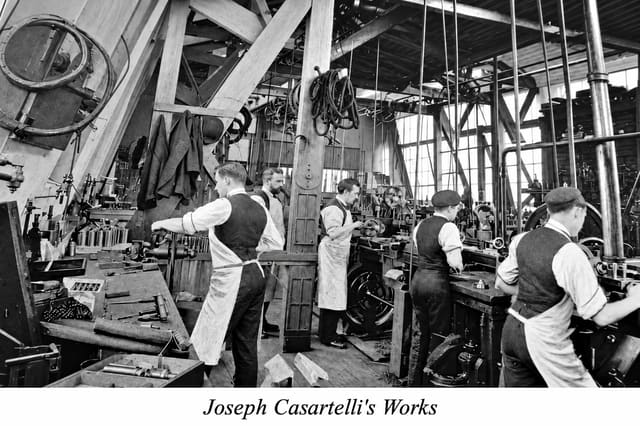
By the end of the century the showroom on Market Street had been supplemented by manufacturing premises in Cheetham. A photograph of "Joseph Casartelli's Works" was published in Manchester Faces & Places in 1894. The firm issued printed catalogues of surveying, mining, engineering, drawing, optical and "philosophical" instruments. The fourth edition is held by the Science Museum Group, and another copy is in the Harvard Collection of Historical Scientific Instruments. The word order of the title faithfully reflects the hierarchy: surveying and mining first, "philosophy" last.
| Period | Address | Function |
|---|---|---|
| 1851/1852 – 1920s | 43 Market Street | shop and office |
| 1852 | 2 Clarence Street, Cheetham Hill | family home |
| 1877 – c. 1882 | Robert Street, Cheetham | small workshop |
| 1880s – 1905 | Clarence Street, Cheetham | works buildings |
| 1905 – 1922 | Hayes Yard, Garrett Street | workshops |
| 1922 – c. 1931 | 18 Brown Street | all departments |
The founder's eldest son, Louis Charles Casartelli, was born on 14 November 1852 at 2 Clarence Street. The website of the Diocese of Salford gives 1851, but Wikipedia, drawing on the diocesan archives, and the Encyclopaedia Iranica agree on 1852.
His path:
He died on 18 January 1925, the same year as his brother, and was buried in St Joseph's Cemetery, Moston. A family that began with mercury and glass gave Manchester an authority on Zoroastrian texts. Such turns are not rare in immigrant dynasties, but they are seldom so sharp.
Joseph Henry Casartelli was born in 1862. He began in a ready-made clothing warehouse and then moved to his father's firm. According to Benson this happened in 1882; Micscape mentions the age of twenty, which agrees with that date. In 1896 he became a partner, and the firm took the name Joseph Casartelli & Son. The form J. Casartelli & Son also appears on instruments. Banfield links the son's entry into the business with 1896, but this probably refers to the partnership rather than his first day at work.
Joseph Louis Casartelli died on 20 March 1900 at Whalley Range. According to Banfield, his son ran the business until his own death in 1925.
To this period belongs one of the firm's most sophisticated known pieces. It is a rare traveller's barometer, described by Banfield, signed "Joseph Casartelli & Son, Manchester. Watkin Patent No. 773":
The industrial line continued:
In 1905 the workshops moved to Garrett Street. In 1922, according to Benson and the Science Museum Group, all departments were brought together at 18 Brown Street.
The First World War cut Britain off from German laboratory glass, and the craft with which the family had begun suddenly became strategic. In 1917 Joseph Henry became one of the founders of the British Lampblown Scientific Glassware Manufacturers' Association. In 1919 Joseph Casartelli & Son, at 43 Market Street, was listed as a member of the British Optical Instrument Manufacturers' Association. The firm joined the elite of its industry at exactly the moment when the industry first recognised itself as one.
After Joseph Henry's death the business passed to his sons. The Powerhouse Museum cautiously names Anthony Francis Casartelli as successor, "most likely" in partnership with his brother Joseph Daniel. In 1929 the Manchester firm took over the management of the Liverpool business of its relatives. The two branches that had parted in 1852 were reunited — a few years before their common misfortune.
The question "when did the Casartelli firm close?" has no single answer. After the Great Depression, as Benson writes, the Casartelli name lived on in three separately owned companies, two in Manchester and one in Liverpool. The last of these, in his words, later became Casartelli Instruments Ltd. This formula explains the spread of dates: each company had its own death.
1929. Manchester takes over the management of the Liverpool branch (Science Museum Group).
1931. According to Grace's Guide, citing the London Gazette of 28 August 1931, the Manchester company J. Casartelli & Son Ltd went into liquidation because of the Depression.
1933. The Science Museum Group and the Powerhouse Museum assign to this year the liquidation of the Liverpool business. The Powerhouse speaks of closure after 88 years of continuous trading, counting from 1845 and Lewis Anthony's departure. The dealer London Fine Antiques attributes 1933 to the Manchester firm. The most likely reading: 1931 for Manchester, 1933 for Liverpool.
Benson's account of the Liverpool company becoming Casartelli Instruments Ltd does not fit the museums' word "closure". Probably what ended in 1933 was the old enterprise, but not the brand and not the legal entity.
After the liquidation. According to the Powerhouse Museum, the liquidator sold part of the Manchester business to William Eagles Ltd, a maker of bottling equipment in Bury Street, Pendleton (Salford). Under its wing the Casartelli successors went on making surveying and textile instruments.
1939. On 16 June John Casartelli (Manchester) Ltd was registered, company No. 00354044. Its instruments of 1950–1966 in the Powerhouse collection are signed with the addresses 87–89 Rochdale Road and 2 Ludgate Hill. This is probably the second of Benson's two Manchester companies, though there is no direct confirmation.
1966. A move to Liverpool Street, Salford (Science Museum Group). In the same year William Eagles Ltd, according to the Powerhouse, decided that demand for surveying and textile instruments no longer justified separate staff and floor space.
1984. J. Casartelli & Son (Liverpool) Ltd was voluntarily wound up: London Gazette, 22 November 1984. The Liverpool legal entity thus outlived the "closure" of 1933 by half a century. This agrees with Benson's version of the long life of the Liverpool line. Whether it is identical with Casartelli Instruments Ltd remains unestablished.
1989. According to the Powerhouse Museum, the Casartelli firm ceased trading after 144 years of continuous operation, again counting from 1845.
1991. According to the British companies register, John Casartelli (Manchester) Ltd still had appointed directors, Kenneth Green and Agnes Green, on 25 November 1991. The company is listed as dissolved, its last office c/o Haines Watts, 76 Cross Street, Manchester. 1989 is better regarded as the end of trading rather than the date of removal from the register.
The conclusion is prosaic, like every ending of an industrial dynasty. The last master named Casartelli to head the business died in 1925. The last enterprise under that name stopped trading in 1989. The last registry entry is dated 1991. Between Lewis Anthony's first Manchester year (around 1805) and that entry lie almost 186 years.
[Tavernerio, east of Como]
Casartelli — landowners, makers of thermometers and hygrometers
Ronchetti — the same village; intermarriage between the families
in at least two generations

Giovanni Battista (Baptist) Ronchetti (in Manchester from c. 1785/1790; retired c. 1810)
 └── Charles Joshua Ronchetti — cousin of Lewis Anthony Casartelli;
       │   independent from c. 1815/1816; retired to Italy (Benson)
       ├── John Baptist Ronchetti ┐ "J. B. & J. Ronchetti", 43 Market St, 1841–1851
       ├── Joshua Ronchetti ──────┘
       └── Jane Henrietta (Harriet) ∞ 1851 Joseph Louis Casartelli

Lewis Anthony (Luigi Antonio, Louis) Casartelli (b. 1784)
   Manchester c. 1805 → Liverpool 1812 / c. 1815 → Italy 1845

Antonio Giovanni (Anthony) Casartelli — Joseph's uncle (Grace's Guide)
   ├── Anthony the younger
   └── Louis (the younger) — co-patentee, 1858
         → "A. Casartelli & Son(s)", Liverpool, until 1929/1933
         → J. Casartelli & Son (Liverpool) Ltd, wound up 1984

[Joseph's father — name not established]
 └── Joseph Louis (Giuseppe Luigi) Casartelli (1823 [or 1822] – 20.03.1900)
       ∞ 1851 Jane Henrietta (Harriet) Ronchetti
       ├── Louis Charles (14.11.1852 – 18.01.1925) — Bishop of Salford, Iranist
       ├── Frances M. (c. 1857)
       ├── Henrietta A. (c. 1858)
       ├── Maria L. (c. 1860)
       ├── Joseph Henry (1862 – 1925) — in the business from 1882, partner from 1896
       │     ├── Anthony Francis — probable successor (Powerhouse)
       │     └── Joseph Daniel — probable partner of his brother (Powerhouse)
       └── "Pecilia" L. (c. 1865; as transcribed in the 1881 census, probably Cecilia)
| Group | Examples |
|---|---|
| Meteorology | carved portable and wheel mercury barometers; Fortin barometers with Kew Observatory certificates; aneroids with altitude scale; registering barometer with clock; aneroid barograph (after c. 1885); traveller's barometer on Watkin's patent; thermometers |
| Mining and surveying | miner's dials on the firm's own patent; clinometers; levels; protractors |
| Mine ventilation | Dickinson anemometer |
| Steam technology and metallurgy | Casartelli & Potter indicators; pressure gauges; steam traps; Hobson's pyrometer |
| Textiles | linen provers (thread counters); balances for sorting yarn and cloth; mill hygrophant |
| Optics and photography | microscopes, telescopes, cameras, microphotograph slides |
| Chemical and analytical | Sikes hydrometer |
| Signature | Probable period |
|---|---|
| "Baptist Ronchetti, Lomas & Co." | c. 1785–1810 (predecessors) |
| "L. Casartelli, Liverpool" | c. 1812–1845 |
| "A. & J. Casartelli", Duke Street, Liverpool | c. 1845–1849/1852 |
| "J. B. & J. Ronchetti, Manchester" | 1841–1851 |
| "J. Casartelli, Optician, 43 Market Street"; "Joseph Casartelli" | 1851/1852–1896 |
| "Casartelli & Potter's Patent" | 1880s – early 1900s |
| "J. Casartelli & Son" / "Joseph Casartelli & Son, Manchester" | 1896–1931 |
| "J. Casartelli & Son (Liverpool)" | 1929–1933 and later |
| "John Casartelli (Manchester) Ltd", Rochdale Road / Ludgate Hill | 1939–1966 |
Since the firm also sold other makers' instruments under its own name, a signature identifies the seller and not necessarily the maker.
| Question | Versions | Assessment |
|---|---|---|
| Joseph's year of birth | 1823 (Benson, Science Museum Group, Powerhouse); 1822 (Grace's Guide/ODNB) | 1823 more likely |
| Baptist Ronchetti's arrival | c. 1785 (dating of his barometer); 1790 (Science Museum Group note) | 1785 more likely |
| Start of Lewis's Liverpool business | 1812 (Banfield); move after the exchange c. 1815 (Benson) | compatible |
| Lewis's retirement | 1845, return to Italy (Banfield); active until 1848 (Benson, probably from directories) | 1845 |
| End of the Anthony & Joseph partnership | 1849 (Benson); notice 24.01.1851 (Gazette); 1852 (Banfield) | different stages of one process |
| Wife's name | Jane Henrietta / Jane Harriet / Harriet | one person |
| Date of marriage | 1851; October 1861 (Find a Grave) | 1861 is an error |
| From whom the Manchester business was acquired | from the Ronchetti brothers (Banfield, Grace's Guide); from Charles Joshua on his retirement (Benson) | unresolved |
| Year of the move to Manchester | 1851; 1852 (Benson, Banfield) | 1851–1852 |
| Joseph Henry's entry into the business | 1882 (Benson); 1896 (Banfield) | 1882 — work, 1896 — partnership |
| The bishop's year of birth | 1852 (Wikipedia, Iranica); 1851 (diocesan website) | 1852 |
| Liquidation | 1931 Manchester (Gazette); 1933 Liverpool (Science Museum Group, Powerhouse) or Manchester (London Fine) | probably different companies |
| Fate of the Liverpool branch | closed in 1933 (museums); became Casartelli Instruments Ltd (Benson); legal entity wound up in 1984 (Gazette) | the enterprise closed, but not the brand |
| End of activity | 1966 (last move); 1989 (Powerhouse); directors in 1991 (register) | 1989 — end of trading |
| Address of the Liverpool workshop | 20 Duke Street (Gazette); 1 and 3 Duke Street (listed-building address) | unresolved |
| Medals | claimed in 1888 advertising (Banfield); exhibitions not identified | the claim itself is confirmed |
Several dates (1931, 1984, the patents) are known from Grace's Guide's summaries of the London Gazette rather than from the texts of the notices themselves. The Powerhouse Museum gives the grandsons' names with the qualification "most likely".