Loading
In the cash book of a London workshop for 1837 there is a modest entry: six pounds, fourteen shillings and fourpence spent on a five-day journey through Leiden, Haarlem, Amsterdam and Rotterdam. The traveller was, in all likelihood, a young employee of the firm, a twenty-five-year-old native of Edinburgh with the Italian surname Casella. The purpose was commercial. Fellow countrymen of his master, craftsmen from Como, had long been at work in Holland: Barella, Valleggia and Grimoldi in Amsterdam, Reballio in Rotterdam, Sala in Leiden. Some of the instruments that the London workshop sold under its own name were bought from them.
That line in an account book is the best key to the history of the house of Casella. It is not the story of a solitary inventor. It is the story of a network: villagers from around Como, scattered across Europe, trading with one another, marrying one another and passing the business from father-in-law to son-in-law.
Within half a century this network produced a firm that supplied the Admiralty and half a dozen foreign governments. Darwin, Livingstone and Galton used its instruments; its deep-sea thermometers went down into the ocean from the deck of the Challenger. Having survived three generations of the family, two world wars, a complete change of product range and four owners in the last quarter-century, the Casella name has reached the twenty-first century. Today it appears on the cases of instruments that measure not air pressure but noise and dust in the workplace.
The founder of the line bore a different surname. Cesare Tagliabue was born in 1767 in the neighbourhood of Como. When he moved to England is unknown. He is first recorded in 1799 at 294 High Holborn. Around 1820 the workshop moved to 23 Hatton Garden. For half a century this address remained the principal sign of the future house of Casella.
Antiquarian attributions record an early signature, "Tagliabue & Torre, 294 Holborn". It is a trace of a partnership with Anthony della Torre in the first years of the nineteenth century.
Tagliabue was a highly successful maker of barometers and scientific instruments. From 1813 he shipped instruments to Rio de Janeiro, Spain and Italy. Half a century later Brazil, Spain and Portugal would appear among the government customers on the title page of the Casella catalogue. The connections laid down by the father-in-law passed to the son-in-law.
According to the Engineering and Technology History Wiki, the London Cesare was the son of a father of the same name, one of the pioneers of serial thermometer production in Italy. His son Giuseppe (1812–1878) carried on the business in Como. One family worked simultaneously on the shores of Lario and the Thames.
The Post Office London Directory for 1841 (via Grace's Guide) shows a branching clan:
Thus, through the Tagliabue family, the genealogy of the house of Casella is interwoven with that of its chief rival.
Louis Pascal (Luigi Pasquale) Casella was born in Edinburgh on 29 February 1812. He spent his childhood and youth in Edinburgh.
The sources speak of his father in different ways.
The two versions agree on the essentials: the father was a man of the arts, not of a trade. The Ramsay maternal line is a detail given only by Banfield and the tradition derived from him. The court tutorship has not yet been documented.
The family's home village is not named in any of the verified sources. The occasional reference to Tavernerio has found no independent confirmation and remains a hypothesis. In the 1871 census Louis is recorded as "born Scotland, Italian parentage": a Scot by birth, an Italian by blood.
Around 1835 the young Casella came to London to join Cesare Tagliabue. Tony Benson in his book and the ODNB speak of employment; Banfield speaks of an apprenticeship.
His fate soon merged with that of his master's family. He married Tagliabue's eldest daughter, Maria Louisa, who worked in her father's office. Banfield dates the marriage to 1837, Benson and the ODNB to 1838; the wedding took place in Bloomsbury. In 1838 the son-in-law became his father-in-law's partner, and the firm took the name Tagliabue & Casella. The Dutch journey of 1837 thus preceded the partnership and was probably part of his training.
Banfield stresses an important point: by no means all the instruments sold by the partnership were made in England. Some were bought from Barella, Valleggia and Grimoldi in Amsterdam, from Reballio in Rotterdam and from Sala in Leiden. Buying and selling trips to the Continent were frequent. An early "Tagliabue & Casella" signature therefore does not guarantee London manufacture.
The partners also took on business outside instrument making. The London Gazette of 20 March 1840 (issue 19837, p. 706) announces the dissolution of a partnership for manufacturing "improved Arnott stoves" in Wardour Street. Its members were William Henry Phillips, Francis Anoni, Cesare Tagliabue and Louis Pascal Casella. The debts were taken on by Tagliabue and Casella, of 23 Hatton Garden.
In 1841 Casella was elected a member of the Meteorological Society of London. This was the first sign of where his main interest lay. According to the Hackney Archives catalogue (collection D/B/CAS), by 1844 the firm described itself as opticians and makers of philosophical and mathematical instruments, drawing instruments, hydrometers, saccharometers, barometers, thermometers and telescopes.
Cesare Tagliabue died in 1844. Casella bought out the share of his sister-in-law, Antonia Marina Tagliabue, and became sole proprietor. The dates of the change of name differ:
Perhaps the new name appeared on the sign in 1844, and the change was completed formally in 1848.
The middle of the century was a time of rapid growth. According to the records of the Harvard Collection of Historical Scientific Instruments and Hackney Archives, the firm became supplier to the Admiralty and to the "Government of North America" in 1856. In 1860 the East India Company and the Board of Trade were added. Grace's Guide adds an appointment as supplier to the Prince of Wales.
Banfield considers that by 1850 Casella was probably the leading maker of meteorological instruments in Europe, if not the world.
The clientele matched the reputation. Banfield names Darwin, Livingstone and Galton among the customers. The firm designed and made equipment for the African explorers Burton and Speke, for Halleur and for Lord Schomberg Kerr. It also supplied medical research: Banfield credits it with the first clinical thermometer, while the ODNB links Casella's name with a clinical thermometer built on the maximum principle.
The Science Museum holds a pocket sundial with compass signed "L. Casella & Co., London", possibly owned by Livingstone, and a sympiesometer of 1858.
An elegant example of marketing ingenuity is the "cottage", or gardener's, barometer of 1857. Banfield describes it as follows:
The press greeted the novelty with enthusiasm. The Cottage Gardener of 27 October 1857 concluded that Casella's name was "a guarantee for the character of any instrument". The Field of 7 November the same year praised the instrument for faithfully recording the recent changes in the weather.
The breadth of the range rested on other workshops. Some instruments were made by R. W. Munro in London and Thomas Cooke in York and engraved with Casella's name. According to the Science Museum, the firm also obtained some of its stock from Negretti & Zambra. For dating and attribution this is the second trap after the Dutch purchases.
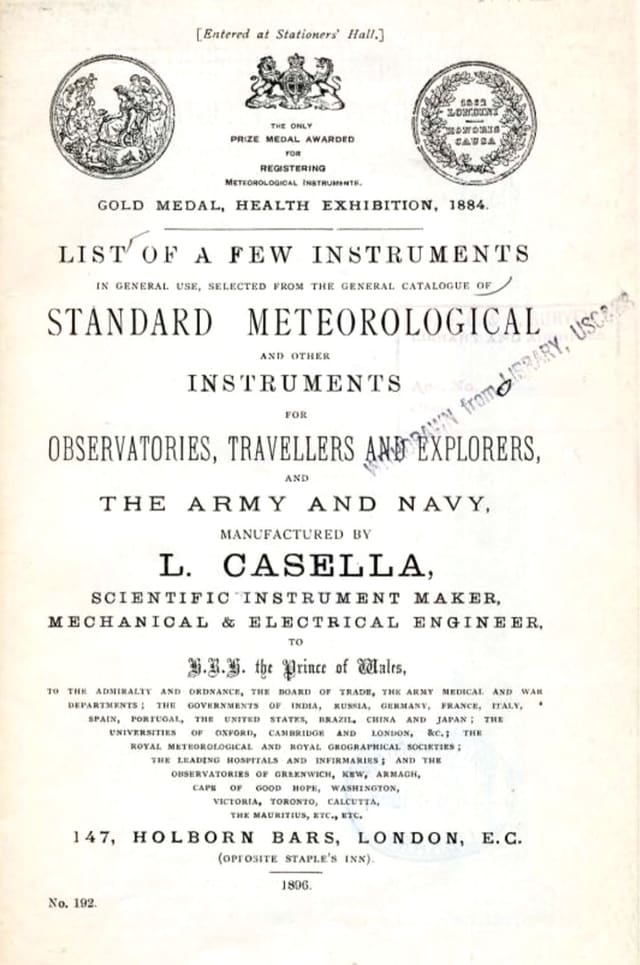
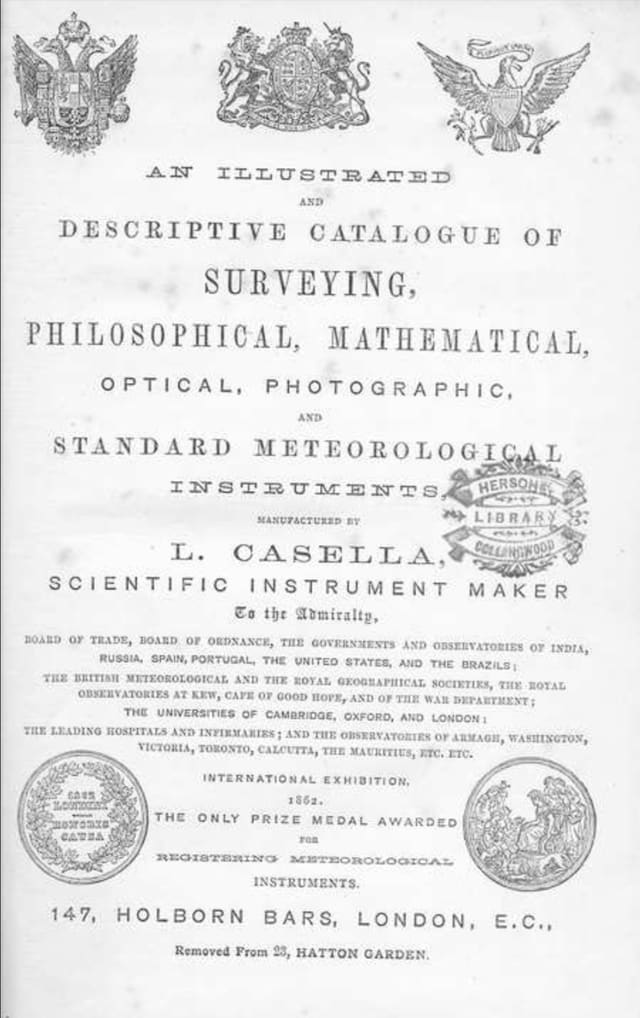
The illustrated catalogue of 1860 (digitised by the Biodiversity Heritage Library) and the 260-page catalogue of 1871 (the Deutsches Museum copy digitised by Google Books) depict a veritable scientific department store. On the 1871 title page the firm is styled maker to the Admiralty, the Board of Trade and the Board of Ordnance; to the governments and observatories of India, Russia, Spain, Portugal, the United States and Brazil; to the British Meteorological and Royal Geographical Societies; and to the observatories at Kew and the Cape of Good Hope. The catalogue's sections cover:
The firm exhibited at the Great Exhibition of 1851. The only medal for meteorological instruments in the British section on that occasion went to Negretti & Zambra. At the International Exhibition of 1862 Casella took part in the "Philosophical Instruments" class. In 1860 Casella became a Fellow of the Royal Astronomical Society, and in 1862 of the Royal Meteorological Society. He was also a member of the Royal Geographical Society.
In 1872 the firm left Hatton Garden and moved to 147 Holborn Bars. By then both sons were working in the business: Louis Marino (1842–1923) and Charles Frederick (1852–1916). According to Banfield, the three Casellas worked together until the father's death.
The fame of the house rested on thermometry. Casella's patent mercurial minimum thermometer is described even in the treatise of his competitors, Negretti & Zambra. The London Gazette of 9 January 1874 (issue 24052, p. 98) records patent No. 4219, granted to Louis Pascal Casella "of Holborn-bars" and his employee Samuel George Denton. The patent concerned an improved mercurial minimum and maximum thermometer.
The ODNB also mentions an adaptation of a pressure gauge for testing deep-sea thermometers. The Miller–Casella deep-sea thermometer was a modification of the Six thermometer protected against pressure. It was made around 1872 for the HMS Challenger expedition. Examples, including some crushed by the weight of the ocean, are held in the Science Museum. Alongside them are a portable marine Dines anemometer (1892) and a minimum thermometer on ebonite (around 1873).
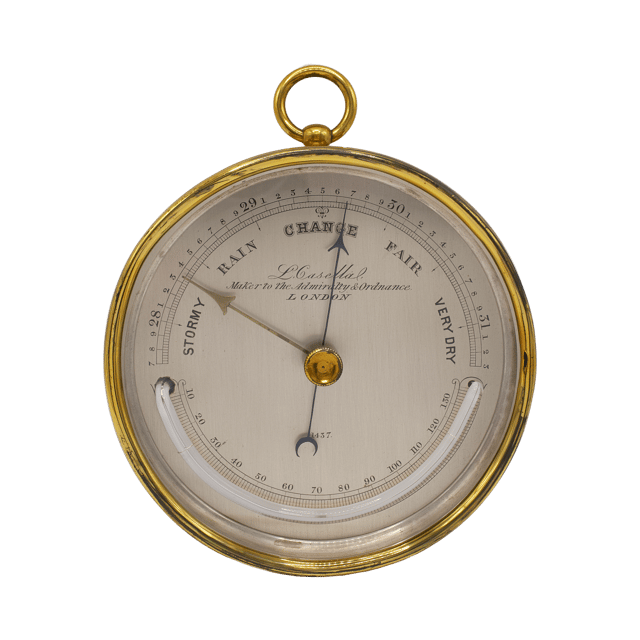
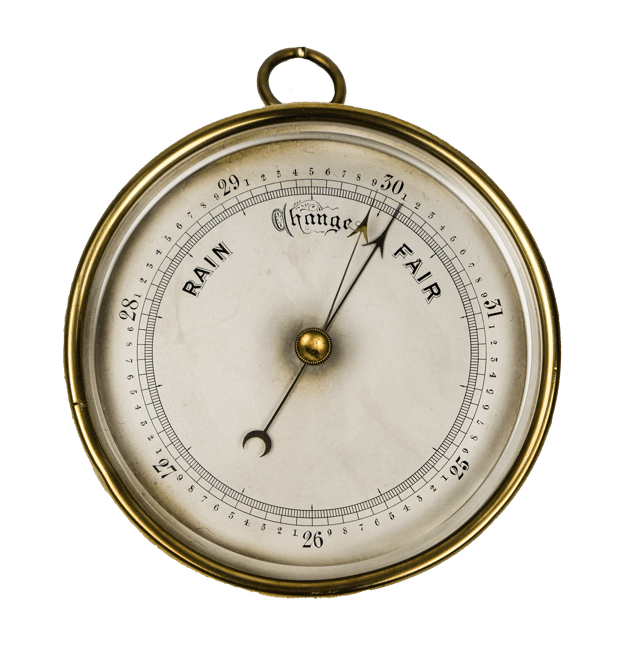
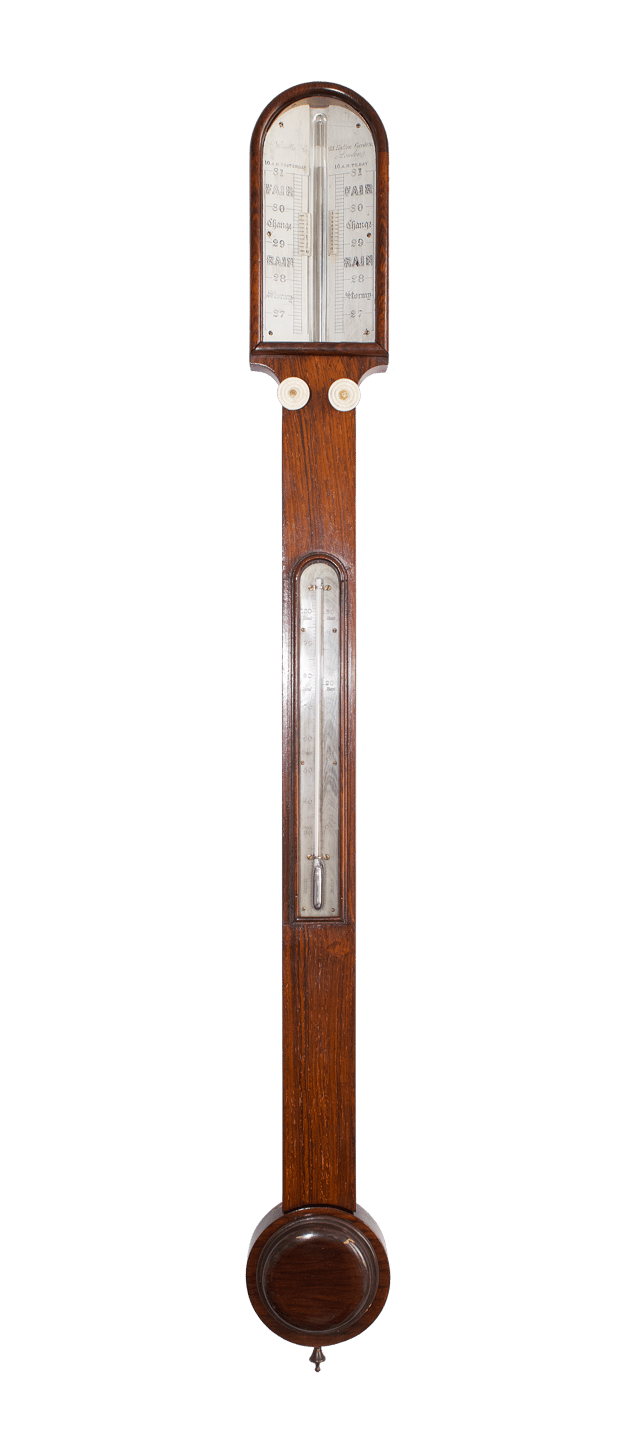
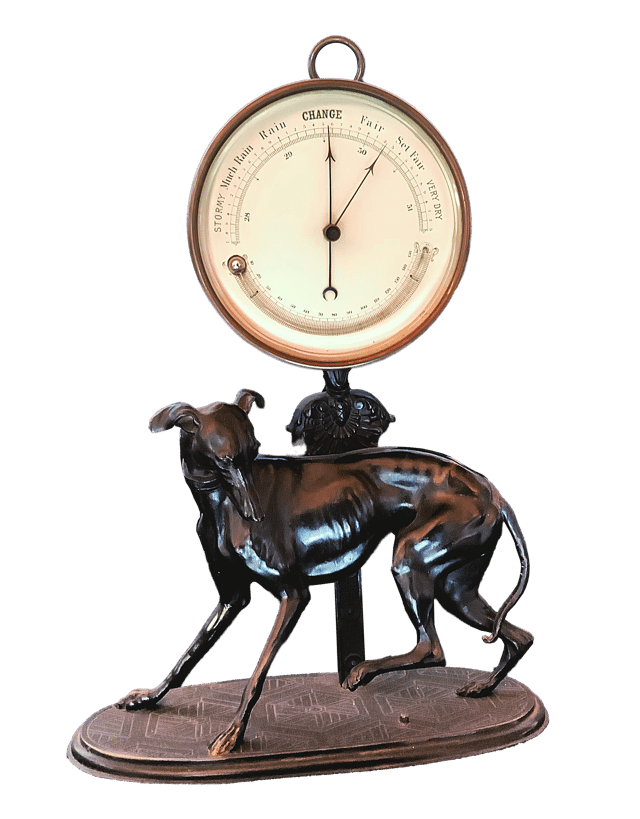
Alongside scientific apparatus the firm made a full line of domestic barometers. The catalogue of around 1875 offered barometers in carved cases, which came into fashion in the 1870s:
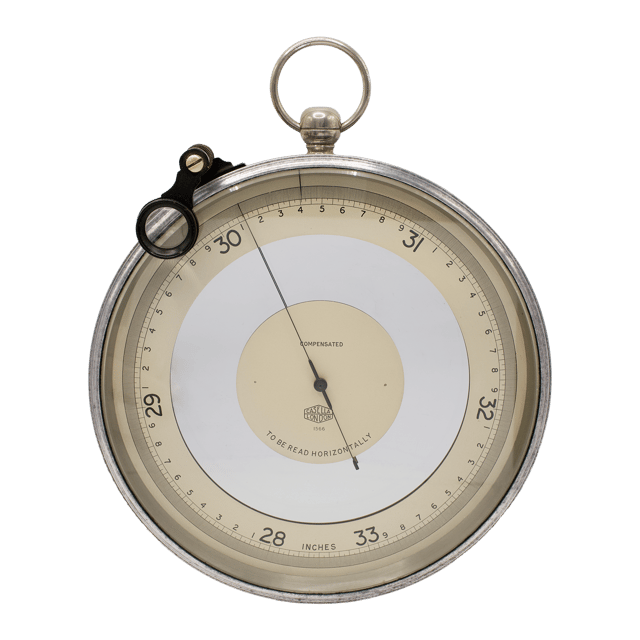
For surveyors and mining engineers there was a special barometer-altimeter:
Banfield notes that from the 1860s L. Casella also competed with Negretti & Zambra in the barograph market.
The 1871 census finds the family at South Grove (St Pancras):
In the mid-1870s Casella built a house, The Lawns, in Highgate.
The final decade proved difficult. Grace's Guide, following the ODNB, attributes the decline in part to the ageing proprietor's reluctance to let go of the reins. In 1896 Robert Stewart Whipple, an assistant at Kew Observatory, became assistant manager. Two years later he left for the Cambridge Scientific Instrument Company, and his collection later became the basis of the Whipple Museum in Cambridge.
Louis Pascal Casella died in Highgate on 23 April 1897. Obituaries appeared in the British Medical Journal and the Monthly Notices of the Royal Astronomical Society.
Charles Frederick Casella was born in London on 25 February 1852. He studied at the Catholic Ushaw College, in Paris and in Bonn, and was a member of the Royal Meteorological and Physical Societies. According to Banfield, the management fell to him because his elder brother had developed other interests.
Benson judges Charles without indulgence: a poor businessman. Despite his genuine interest in instruments, the firm declined under his management.
After the father's death the business took the name C. F. Casella. The Dutch historian Bert Bolle places the renaming in 1892, that is, in the founder's last years, but most sources give 1897. Benson stresses that catalogues and instruments continued to appear under the Louis Casella name for a long time. For dating this is the main trap: an "L. P. Casella" signature does not guarantee manufacture before 1897.
The accounts of the move differ:
Perhaps these are two successive addresses; the question remains open.
Recognising his own weakness, Charles did what saved the firm. He hired an experienced manager, Rowland Miall, and an engineer, Robert Abraham, who invested capital in the business. Between the three of them they brought the enterprise back to life.
In 1910 the firm was registered as a limited company, C. F. Casella & Co. Ltd. The registration number of the present legal entity, 00106869, dates from the same year. In 1911 a catalogue of surveying and drawing instruments was published. In 1912 the firm moved to new premises in south London.
Charles Frederick died in Bournemouth on 24 February 1916. According to the 1911 census he had a wife, Gertrude, and children Charles Cyril, Mary Monica and Cecilia. None of them, as far as is known, headed the firm.
The elder son, Louis Marino Casella, entered his father's business early and kept a stake in it, but made his career elsewhere. He became chairman of D. Gilson & Co., a firm making brass and steel screws, terminals and small repetition parts.
This explains an episode that once looked like coincidence. During the First World War Casella built a new works in Walthamstow next to the Gilson factory. After the war Gilson partly merged with C. F. Casella & Co., which absorbed part of its production capacity. The merger was a family one: the late proprietor's brother joined his two companies. Louis Marino died in 1923, the last of the founder's sons.
In 1919 the firm was listed as a member of the British Optical Instrument Manufacturers' Association. Its optical range included sextants, theodolites and telescopes. Then followed:
A historical note by the distributor Keison states that in both world wars the military made use of Casella's expertise in compasses, optics and photogrammetry.
At the British Industries Fair of 1947 the firm exhibited:
By 1952 the head office was at Regent House, Fitzroy Square, and production at Regent House, Britannia Walk, Hoxton. In 1959 the Casella (Electronics) division was sold to Cooke, Troughton & Simms. The firm remained one of the key suppliers to the Meteorological Office. A tropical Campbell–Stokes sunshine recorder Mk IIIA, numbered MO 479/59, later passed from the Met Office to the Science Museum.
From the 1950s the company developed equipment for dust monitoring in deep mines. By its own chronology, it was responsible for the first personal sampling pump, the first electronic integrating sound level meter (1972) and a microprocessor-based sound level meter (1982–1983). The year of the first pump varies in company material between 1952 and 1961.
Casella employee Justin Stewart, in a publication for the AIHA, gives a more precise picture:
Casella's priority was thus one of commercialisation rather than invention. In 1982 the firm deposited its archive for 1855–1963 with Hackney Archives.
Bert Bolle noted in 1983 that the business still existed as C. F. Casella & Co. Ltd. A year later, according to the 1985 annual report (as summarised by Grace's Guide), a new C. F. Casella & Co. Ltd was formed. It acquired Casella London Ltd, Casella Environmental Ltd and the company that had earlier bought the old firm. Corporate databases list the previous names of the present legal entity as Neatneon Limited, Casella London Limited, C. F. Casella & Co. Limited and Casella Cel Limited.
By the time Banfield's book appeared (1993), the company was called Casella London Ltd and was based in Kempston near Bedford. The new building in Wolseley Road kept the name Regent House. This testimony closes the earlier gap in dating the move.
Banfield witnessed the last chapter of the house's barometer history. Casella was still making:
This is the last evidence that the house of Casella was still making barometers.
At some point in this period the company joined with the sound level meter maker CEL Instruments and became known as Casella CEL. The exact date of the merger has not been found in the available primary sources.
In March 2002 the private equity firm Bowmark Capital invested in Casella. By its account, Casella was then the second-largest UK supplier of environmental services and instruments. It provided consultancy and laboratory testing of air, water, effluent and contaminated land. The fund's strategy was "buy-and-build"; it exited through the separate sale of two divisions in 2005–2006.
In April 2006 the American company IDEAL Industries bought Casella Measurement Ltd. This was a Bedford-based group of 130 employees, comprising:
One IDEAL chronology dates the deal to 2008, but the press release on the sale explicitly gives April 2006.
On 6 October 2022 Casella passed to TSI Instruments Ltd, the UK subsidiary of the American TSI Incorporated. TSI President Tom Kennedy explained the acquisition as broadening the company's offering for the occupational health and industrial hygiene market. IDEAL Senior Vice President Doug Sanford expressed satisfaction that a worthy buyer had been found for Casella.
The headquarters remains in Kempston. The current range includes:
More than two centuries separate the workshop in High Holborn from the plant in Kempston. London addresses followed one another: Hatton Garden, Holborn Bars, Westminster, south London, Fitzroy Square, Hoxton. The owners changed too: father-in-law, son-in-law, son, managers, shareholders, a private equity fund, an Illinois corporation and then a Minnesota one. Mercury gave way to microprocessors, the barometer to the noise dosimeter. One thing remained unchanged: the name that a gardening journal in 1857 called a guarantee of the quality of any instrument.
Cesare Tagliabue the elder (Como; early serial thermometer maker) [ETHW]
└── Cesare (Caesar) Tagliabue (1767 near Como – 1844 London)
    294 High Holborn (1799); 23 Hatton Garden (c. 1820)
    ├── Giuseppe Tagliabue (Como, 1812–1878) [ETHW]
    ├── Antonia Marina Tagliabue (share bought out by L. P. Casella after 1844)
    └── Maria Louisa (Marie Louise) Tagliabue — eldest daughter, worked in her father's office
          ⚭ 1837/1838, Bloomsbury
Pasquale (Pascal) Casella — musician, artist, writer (Banfield) /
  drawing master (ODNB); from the Como area → Edinburgh
  ⚭ Miss Ramsay ("one of the three beautiful Miss Ramsays", Banfield)
└── Louis Pascal (Luigi Pasquale) Casella (29.II.1812 Edinburgh – 23.IV.1897 Highgate)
    ├── daughter, by 1871 the widowed Mrs Colgan (b. c. 1841)
    ├── Louis Marino Casella (1842–1923) — chairman of D. Gilson & Co.
    ├── Josephine J. Casella (b. c. 1849)
    └── Charles Frederick Casella (25.II.1852 London – 24.II.1916 Bournemouth)
          ⚭ Gertrude M. (b. c. 1870)
          ├── Charles Cyril (b. c. 1891)
          ├── Mary Monica (b. c. 1893)
          └── Cecilia M. (b. c. 1901)
Dating rules:
| Signature | Period | Address and features |
|---|
| Tagliabue & Torre | c. 1799–1806 | 294 (High) Holborn |
| C. Tagliabue | c. 1806–1838 | Holborn; from c. 1820, 23 Hatton Garden |
| Tagliabue & Casella | 1838–1844/1848 | 23 Hatton Garden; some instruments bought in Holland |
| L. Casella; L. Casella & Co.; L. P. Casella | 1844/1848–1897, and by inertia later | Hatton Garden until 1872, then 147 Holborn Bars |
| C. F. Casella | 1892/1897–1910 | 11–15 Rochester Row (from 1898, Bolle) or 49–50 Parliament Street (from 1905, Grace's) |
| C. F. Casella & Co. Ltd | from 1910 | south London (1912); Regent House, Fitzroy Square; Britannia Walk |
| CASELLA LONDON; MO numbers | mid-20th century | instruments to Meteorological Office specifications |
| Casella London Ltd; Casella CEL; Casella | from 1984 |
| Question | Versions | Assessment |
|---|
| Birth of L. P. Casella | 1812 (ODNB, Banfield, Benson); 1809 (MNRAS); c. 1815 (Bolle) | 29.II.1812 |
| Death of L. P. Casella | 1897 (ODNB, Banfield, Benson); 1894 (Bolle) | 1897 |
| Father | drawing master (ODNB); musician, artist, writer, tutor to the daughters of George III (Banfield) | partly compatible; court service unconfirmed |
| Start of employment | apprentice (Banfield); employee from c. 1835 (ODNB, Benson) | immaterial |
| Year of marriage | 1837 (Banfield); 1838 (ODNB, Benson) | unresolved |
| Tagliabue in London | from 1799 (Banfield, Grace's); from 1828 (Bolle) | 1799; 1828 probably refers to another event |
| Death of Tagliabue | 1844 (Banfield, Benson, ODNB); c. 1848 (Bolle, by implication) | 1844 |
| Change of name to L. Casella |
| Kempston, Bedford (by 1993 at the latest) |
| 1844 (Banfield); 1848 (Benson, Bolle) |
| 1844 in practice, 1848 formally |
| Renaming as C. F. Casella | 1892 (Bolle); 1897 (Benson, Grace's) | 1897 more likely |
| Westminster address | Rochester Row, from 1898 (Bolle); Parliament Street, from 1905 (Grace's) | possibly two successive addresses |
| Name on incorporation in 1910 | C. F. Casella Ltd (Banfield); C. F. Casella & Co. (Benson) | C. F. Casella & Co. Ltd |
| Move to Kempston | by 1993 at the latest (Banfield) | exact date not found |
| Purchase by IDEAL | April 2006; January 2008 | April 2006 |
| First personal sampling pump | 1952; 1961 | not established |
| Darwin, 1830 | company website | chronologically impossible |
| Tavernerio | unconfirmed | hypothesis |