
Loading

A chronicle: from a workshop in Jena to a divided name
In February 1945 the glow over Dresden could be seen a hundred kilometres away. Below, among the burning streets, stood the workshops of a company that for two decades had been the largest maker of cameras in the world. Within two years part of its machinery, its drawings and its people would end up in Kyiv, part in Leningrad, and part would go west to a quiet Swabian town nobody had heard of. A few years after that, two companies bearing the same name would begin suing each other around the globe for the right to be called the real Zeiss — a fight that would drag on for the better part of half a century.
The story begins ninety-nine years before the Dresden fire, in the university town of Jena, where a thirty-year-old mechanic rented rooms on the Neugasse and borrowed a hundred thalers from his brother. He had no capital, no theory and no glass of his own. All of that would come later — and come so solidly that the mechanic's surname would become shorthand for optical quality, while the foundation created by his successor would outlive two world wars, the Nazi regime, Soviet occupation, the partition of Germany and its reunification.
Along the way this story will take in a physicist who proved that a microscope has a limit of resolution and then calculated that limit; a chemist who melted a glass that had not previously existed; a self-taught young man whose lens made it possible, for the first time, to photograph people by the light of a table lamp; a barometer with no visible mechanism, its scale hanging in the air like a promise; and a camera that became at once the summit of German engineering and a spoil of war.
What follows is the whole chronicle of that optical empire, in order.
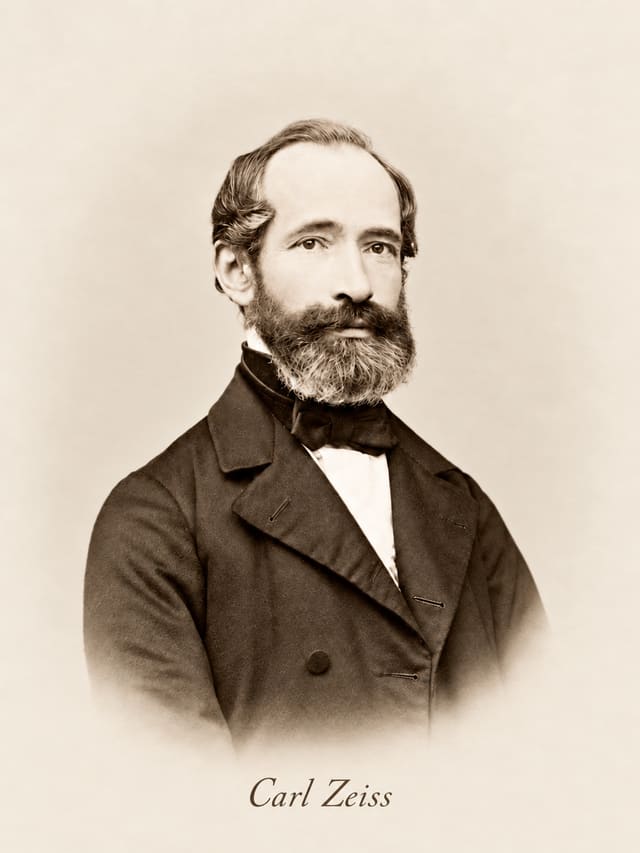
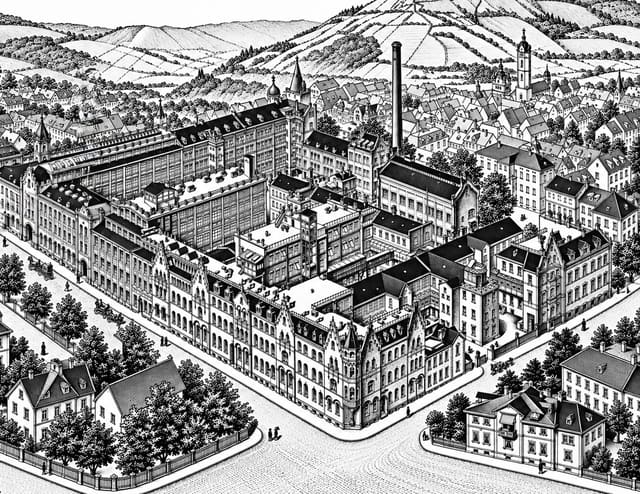
On 17 November 1846 Carl Friedrich Zeiss, born on 11 September 1816 in Weimar, opened a workshop for precision mechanics and optics in Jena at Neugasse 7. His starting capital was roughly a hundred thalers borrowed from his brother Eduard. From 1847 the workshop was turning out simple microscopes — an item for which a university town offered steady demand.
Business went well enough, but it ran into the ceiling every optician of the age knew about: lenses were ground by trial and error. A craftsman would make ten objectives, keep the best and scrap the rest. No theory existed that would let anyone calculate a good lens in advance.
Zeiss solved this in the only way that could work — he hired the man who created such a theory.
In 1866 Ernst Abbe (23 January 1840, Eisenach — 14 January 1905, Jena), a physicist at the University of Jena, became the firm's scientific director. Abbe put lens design on a mathematical footing. He developed the wave theory of microscopic image formation, showing that a microscope's resolving power is fundamentally limited by the wavelength of light; he formulated the Abbe sine condition and introduced the concept of numerical aperture; and in 1868 he created an apochromatic objective system. From 1872 Zeiss microscopes were built not on a craftsman's intuition but on calculation. Abbe's name also attaches to the "Abbe number" — a measure of the dispersion of optical glass — and to the Abbe refractometer. He later became Zeiss's business partner.
A third problem remained: the glass. A calculation might call for a type that industry simply did not make.
On 27 May 1879 Abbe received a letter from a young chemist, Otto Schott (1851–1935), describing a new lithium glass, with samples enclosed. Schott moved to Jena at the end of 1882. In 1884 Carl Zeiss, Abbe, Schott and the founder's son Roderich Zeiss established the Glastechnisches Laboratorium Schott & Genossen, the glass laboratory from which today's SCHOTT AG grew. Schott is credited with inventing borosilicate (Jena) glass and created roughly a hundred new types of optical glass.
So the trio formed that would define world optics for a century: the mechanic, the theorist and the glassmaker. By the late 1880s Zeiss employed around 360 people; in 1886 the ten-thousandth microscope left the works.
On 3 December 1888 Carl Zeiss died.
Abbe faced a question that is rarely put so sharply: who ought to own a company built on knowledge?
His answer was a legal one. On 19 May 1889 the deed establishing the Carl Zeiss Foundation (Carl-Zeiss-Stiftung) was signed; on 21 May the Grand Duchy of Saxe-Weimar-Eisenach confirmed it. The foundation was not charitable in the ordinary sense but entrepreneurial: it owned industrial companies and directed their profits towards science, social purposes and the welfare of the workforce. In 1891 the foundation became sole owner of the Zeiss optical works and part-owner of the Schott glassworks. In 1919 Schott handed over his own share in the glassworks as well, making the foundation the full proprietor of both firms — a transfer finally completed after Schott's death in 1935.
The original 1889 deed ran to seventeen paragraphs. The famous statute of 1896 ran to a hundred and twenty-two. In it Abbe made legally binding a set of provisions that much of Europe still argued about as sedition: profit-sharing, paid holiday, a right to a pension, continued wages during illness, disability and survivors' insurance, a guaranteed minimum income and a consultative works committee. A nine-hour working day came in 1896, an eight-hour day in 1900. Paragraph 56 forbade discrimination on grounds of origin, religion or political conviction. A share of profits went to the University of Jena, and the foundation's grants exceeded the state's subsidies.
Ernst Abbe died on 14 January 1905, leaving behind a structure that nobody managed either to buy out or to dismantle over the following century.
While Jena was building a foundation, Berlin was building a competitor.
In 1886 the merchant Carl Paul Goerz (1854–1923), who had trained with Emil Busch in Rathenow and worked with Eugène Krauss in Paris, set up a business selling school drawing and mathematical instruments. From 1887 he sold cameras; in 1888 he bought F. A. Hintze's workshop and began making them himself; and from 1890 the firm carried the name Optische Anstalt C.P. Goerz (Berlin-Friedenau). In 1888 Goerz hired the engineer Carl Moser and the optician Carl Hertel to design lenses — a good decision.
In 1892/1893 came the Dagor (Doppel-Anastigmat Goerz), a double anastigmat that became one of the most respected lenses of the era; Ross of London licensed it as early as 1893. The ultra-wide Hypergon and the Artar process lenses followed. Around 1896 Goerz acquired rights to the focal-plane shutter patented by Ottomar Anschütz (1846–1907) in 1888 as the Brennebenen-Verschluß, which offered speeds up to 1/1000 second. The first camera to use it was the Anschütz-Moment-Apparat of 1890 for 9×12 cm plates; folding "Goerz-Anschütz" models appeared from 1905 under the abbreviated name "Ango".
Goerz grew fast. In 1895 a New York branch opened (from 1905 the C.P. Goerz American Optical Co., which went on operating independently in the United States right up to 1972). In 1903 the firm became a joint-stock company and opened a military optics department that became the largest in the world. In 1908 the Goerz Photochemisches Werk was founded in Berlin-Zehlendorf — a film plant destined to play an unexpected part in this story. In 1910 Goerz acquired the Sendlinger Optische Glaswerke near Munich. Its factories ran in Berlin-Friedenau, Vienna, Pressburg (Bratislava), New York and Wintergarten-era Winterstein.
One figure explains a good deal of what follows: between 1892 and 1909 Goerz produced more than 200,000 lenses — twice as many as Jena.
Jena, for its part, was hardly idle. Paul Rudolph, a Zeiss physicist, became one of the greatest lens designers in history: 1890 — the Anastigmat (later Protar); 1896 — the Planar, a six-element symmetrical double Gauss; 1899 — the Unar; 1902 — the Tessar, four elements in three groups and arguably the most widely produced lens design in the history of photography. The Tessar f/6.3 appeared in 1902, the f/4.5 in 1907, and Willy Merté computed the f/2.8 version in 1930. After the First World War Rudolph left Zeiss for Hugo Meyer, where he designed the Plasmat lenses.
Zeiss military optics began in the 1890s: the first sights and stereoscopic rangefinders in 1895, along with deliveries of prism binoculars to the Prussian army; a periscope for the experimental submarine Forelle in 1903. In 1917 came the wide-field eyepieces designed by Heinrich Erfle, and in 1920 the eight-power Zeiss Zielacht sight.
Meanwhile Dresden had its own ferment. On 16 November 1889 — the same day as the firm of his rival Emil Wünsche — the Dresdner photographische Apparate-Fabrik Ernemann & Matthias was registered: the merchant Heinrich Ernemann (1850–1928) had bought into Wilhelm Franz Matthias's woodworking camera shop on the Pirnaer Straße. After Matthias left in 1891, Ernemann developed the business alone: in 1898 he moved into a new building on the Schandauer Straße, and in 1899 he turned the business into Heinrich Ernemann AG für Camerafabrikation in Dresden. The firm became famous for its Ernemann-Turm tower (rebuilt after a fire in 1923) and for its cinema projectors; in 1920 the joint venture Ernemann-Krupp Kinoapparate was set up with Krupp.
In 1909 came the first of two great Dresden mergers. With considerable organisational and financial involvement from the Carl Zeiss Foundation, four firms combined: R. Hüttig & Sohn of Dresden (founded 1862, one of the oldest camera makers), Emil Wünsche AG of Reick near Dresden (Wünsche had founded his business in 1887 and took his own life in 1902, after which Louis Lang led the firm), the Frankfurt Kamerawerk Dr. Krügener, and the Carl Zeiss Palmos camera division from Jena, which traced back to Carl Zeiss Palmos AG (1899) with the involvement of Paul Rudolph and Curt Bentzin of Görlitz. The result was ICA AG Dresden, in which the foundation held 25 per cent of the shares from the outset. It was ICA's serial-number system — a letter preceding the number — that grew into the numbering Zeiss Ikon used until 1972.
The First World War turned the whole industry into a war industry. Rangefinders, sights, binoculars, periscopes, aerial cameras. Goerz, with the world's largest military optics department, ran flat out. Contessa under August Nagel made aerial and balloon cameras — for which Nagel received an honorary doctorate from the University of Freiburg in 1918. Ernemann produced "machine-gun" training cameras.
Then the war ended, and under the Treaty of Versailles Goerz lost the right to supply the military. Zeiss eventually got its own right back. That asymmetry would prove decisive.
In 1919 Contessa-Nettel was formed in Stuttgart by the merger of Contessa Camerawerke and Nettel Camerawerk. Behind it stood August Nagel (1882–1943), who in 1908 had founded Drexler & Nagel with Carl Drexler (renamed Contessa Camerawerke in 1909) and in 1919 bought Nettel Kamera-Werke — a firm founded in 1902 by R. E. Mayer and Max Körner as the Süddeutsches Camerawerk Körner und Mayer in Sontheim am Neckar, known for strut-folding cameras with "Deckrullo" focal-plane shutters.
In 1923–1924 something happened in Dresden that changed photography. Ludwig Bertele (1900–1985), a self-taught twenty-three-year-old working for Ernemann, computed the Ernostar f/2 for the Er-Nox (later Ermanox) camera — at the time the fastest lens in series production anywhere; an Ernostar f/1.8 followed. With such a lens the Ermanox could shoot indoors by available light, without magnesium or flash. The press photographer Erich Salomon turned this into a new genre: politicians photographed not posing but alive, in negotiations and at receptions.
Meanwhile Goerz was dying. Stripped of military orders, it never found a new niche — it tried calculating machines — and by the mid-1920s was losing millions. Jena watched closely, because those two hundred thousand Goerz lenses were not an abstraction but competition.
What followed can be reconstructed from German archival research (Beyermann, 2001) and reads like a textbook on hostile takeover. In October 1925 the Goerz family, driven to the wall financially, was forced to sign over nearly 42 per cent of the share capital to Jena; the transaction was disguised as a capital increase with pre-emption rights excluded, in order to hide the real size of the Zeiss stake. In September 1925 Zeiss had already initiated a "free community of interests" (Interessengemeinschaft) between Goerz, ICA and Contessa-Nettel. Goerz and Contessa-Nettel believed they were keeping their independence. For Jena it was an intermediate step.
With Ernemann the manoeuvre was more elegant still. Deutsche Bank passed inside information to the Zeiss negotiator Rudolf Straubel: the controlling stake in Ernemann had long belonged not to the family but to Krupp, with whom Zeiss had secretly and closely cooperated as an armaments supplier during the war. While Heinrich Ernemann believed he was resisting the community of interests as an equal, Jena was buying up his shares through Deutsche Bank until it held 40 per cent. When Ernemann dug in, Zeiss "generously" offered not to stop his lens production and not to transfer his patents — including those for the fast Ernostars — to Jena, but merely to Goerz. Without mentioning that Goerz was already under Zeiss control.
So the familiar legend of Heinrich Ernemann's firmness at the negotiating table does not hold up: he was outplayed by people who had not told him the rules of the game.
On 15 September 1926 Zeiss Ikon AG was founded in Dresden through the merger of ICA, Contessa-Nettel, Ernemann and C.P. Goerz. (Some sources place the completion of the formalities in October.) The name joined "Ica" and "Contessa-Nettel" while echoing the Greek eikon, "image". The logo was the words "ZEISS / IKON" within the outline of an achromatic doublet. Headquarters were in Dresden, with plants also in Stuttgart and Berlin. Dutch capital provided the financing under Deutsche Bank guarantees. The syndicate was soon joined by AG Hahn für Optik und Mechanik of Kassel and Goerz Photochemisches Werk GmbH of Berlin.
The merger terms were eloquent: every firm except Zeiss was obliged to stop making its own lenses, and 80 per cent of cameras were to be fitted with Compur shutters from Deckel, another company in the Zeiss orbit. That was the end of the European Dagor.
Here a point must be settled without which nothing that follows makes sense. Zeiss Ikon was not part of the Carl Zeiss Jena works. Both companies belonged to the same owner, the Carl Zeiss Foundation, but they were separate enterprises with separate management, and at times they competed for resources and influence inside the group. Jena made optics: lenses, microscopes, military instruments. Dresden assembled cameras, cinema projectors and — few people remember this — locks, lighting and meteorological instruments. A Carl Zeiss Jena lens on a Zeiss Ikon camera was a delivery from a related but different company. In the 1926 merger Jena contrived to appear simultaneously as the Zeiss-Stiftung, as Carl Zeiss Jena, as ICA AG and even as Goerz, and also through nominees holding secret Zeiss packets.
The merged firms met different fates. August Nagel became Zeiss Ikon's production director in 1926, but left as early as 1928 to found Nagel-Werke, which he sold to Kodak in 1932; out of that grew the Kodak AG division and, incidentally, the standard 35 mm cassette — the type "135", without which none of the later history of small-format photography would exist. The Ermanox was discontinued in 1931: it could not withstand the Leica and the new Contax. The Vienna arm of C.P. Goerz kept its independence and survived into the 1950s, producing the miniature Minicord reflex camera with its six-element Helgor lens. Goerz product lines continued under the Zeiss Ikon name included the Box Tengor and the Tenax cameras.
Among everything Zeiss Ikon made, there is one line nobody writes about in histories of photography — and it is arguably the most beautiful object the group ever produced.
At the former Berlin Goerz plant — Goerz-Werk, Berlin-Zehlendorf — desk aneroid barometers were made in the late 1920s and through the 1930s. The full factory marking on surviving examples reads: "ZEISS IKON A.G. GOERZ WERK BERLIN ZEHLENDORF — ALLEINVERTRIEB CARL ZEISS-JENA", that is, "sole distributor: Carl Zeiss-Jena". A single line that illustrates the corporate structure perfectly: manufacturer Zeiss Ikon at the old Goerz works, distribution through Jena.
The best-known model is a vertical barometer in which the aneroid mechanism is entirely concealed in the base. The whole measuring assembly sits in a round stepped plinth; from it rises a flat chromed column with geometric tramline fluting that hides the pointer's arbor. The scale seems to float: it is etched on the clear front glass, with a panel of frosted, milky glass set behind it, against which the black figures and lettering appear to hang in mid-air.
The device is the same one used in Art Deco "mystery clocks", where hands move across a transparent disc with no visible connection to any movement. The difference is that here it is not a conjuring trick but an honest demonstration: the instrument shows exactly what is needed and nothing else.
The materials are chromed brass and frosted etched glass. Cases often carry the marking D.R.G.M. — Deutsches Reichs-Gebrauchsmuster, the German registered design — indicating a protected design.
A caution is needed here that dealers rarely observe. These barometers are almost always called "Bauhaus", yet no reliable source names an actual industrial designer. "Bauhaus" in auction and dealer descriptions is a style label, not documented authorship. Designers from the Bauhaus circle did work for Zeiss Ikon: Adolf Meyer, Walter Gropius's partner, designed the Zeiss Ikon Spiegellicht luminaires around 1930, and later Fritz Costabel designed the "Perkeo" slide projectors. But no source connects either of them to the barometers.
Dating deserves the same caution. Dealers offer anything from "circa 1920" to "circa 1934–1935". Since Zeiss Ikon was formed in 1926, any example carrying that mark is post-merger; attributions of "circa 1920" probably belong to pre-merger barometers by C.P. Goerz proper.
The object's aesthetic lineage, however, is not in doubt. Geometric clarity, chrome, the complete refusal of ornament, the floating scale as a gesture of engineering directness — this is the language of Neue Sachlichkeit and late-1920s functionalism, the same language spoken by the industry of Dresden and Berlin under the Weimar Republic.
The Goerz-Werk also made thermometers in the same idiom as the "mystery" Goerz barometers on a brass stand with two round faceted dial glasses — the "Zeiss Ikon Goerz-Werk Berlin Thermometer", for instance, though finished in black oxide on a flaring brass base. German Art Deco desk weather stations combining barometer, thermometer and hygrometer also turn up, although not all of them carry the Zeiss Ikon mark.
Today these barometers are sought after by collectors of scientific instruments and Art Deco. Bonhams sold one for £563.20 including premium; another, in poorer condition, went there for £82.25. Dealer prices tend to sit in the range of roughly €300–775. The model appears in the reference literature: Edwin Banfield, Barometers: Aneroid and Barographs, page 92, and Philip R. Collins, Aneroid Barometers and Their Restoration, page 163. Characteristically, almost all documentation for these instruments comes from the auction and dealer trade rather than from museum collections: museum-digital.de and the Deutsche Fotothek hold extensive records of Zeiss Ikon cameras and projectors, but the barometer is not catalogued there.
By the early 1930s Zeiss Ikon had a problem, and its name was Leica.
The small-format camera built on the 1913 prototype of a former Zeiss employee, Oskar Barnack, and sold by Leitz from 1925, dominated the new 35 mm market. Dresden answered in 1932 with the Contax I.
The patents named Dr Heinz Küppenbender as inventor. The camera's actual designer was Dr Emanuel Goldberg — a fact worth holding on to while reading the next part, since Goldberg was Jewish. The name "Contax" was chosen by polling the staff.
The Contax was conceived as a "super camera", better than the Leica on every point: a cast body, a vertical metal focal-plane shutter with speeds to 1/1000 second, a long-base rangefinder, a bayonet lens mount and a removable back. What emerged was a camera released half-finished and requiring constant revision — six variants between 1932 and 1936.
The optics, on the other hand, were flawless. Ludwig Bertele, who had come across from Ernemann, computed the Sonnar family for the Contax: a seven-element 50 mm f/1.5 (1931) and a six-element, three-group 50 mm f/2 (1932). In the era before lens coating, few glass-to-air surfaces meant less flare and higher contrast — and by that measure the Sonnar beat the many-element Planar.
In 1936, under Hubert Nerwin, came the Contax II and III — mature instruments with a combined rangefinder-viewfinder and a reliable shutter; the Contax III carried a built-in selenium meter in the characteristic hump above the finder. The Zeiss lens range — Tessar, Biotar, Sonnar from 28 to 500 mm — outstripped anything Leitz offered. The Contax II and III were officially in production until 1943.
That same year of 1936 also brought the twin-lens reflex Contaflex, the first camera in the world with a built-in selenium meter.
After 1933 the regime revoked what Abbe had written into the statute as inviolable. The Nazi commissar appointed to the foundation, Julius Dietz, "politically revised" the statute, removing paragraph 56 on non-discrimination by origin and religion. Jewish employees of Zeiss Ikon were dismissed, forced to wear the star and deported. The designer of the Contax, Emanuel Goldberg, was forced to leave Germany.
Production shifted towards military optics: wide-field binoculars, waterproof U.D.F. and U.Z.O. 7×50 binoculars for the Kriegsmarine, periscopic binoculars for tanks, instruments for the Luftwaffe. Zeiss cameras were fitted to V-2 rockets for reconnaissance. Military output was marked with codes — "blc" belonged to Carl Zeiss Jena.
On 1 November 1935 Alexander Smakula, who had worked in Jena since 1934, patented lens coating — the anti-reflection layer, German patent DE-PS 685767 held by Carl Zeiss. Until 1939 the invention remained a military secret.
The hardest part of this story belongs to the last years of the war. Zeiss Ikon AG operated subcamps of Flossenbürg concentration camp in Dresden. On 9 October 1944 a subcamp was established at the Goehle-Werk; another existed at the plant in Reick. In October 1944 around two hundred women arrived from Auschwitz, mostly Polish and Soviet citizens; at the end of February 1945 around two hundred Hungarian, German, French, Greek, Italian and Czech Jewish women and Soviet "civilian workers" arrived from Bergen-Belsen. They produced ammunition at the former ICA works at Mügelner Straße 40.
The scale of workforce replacement is recorded in Victor Klemperer's diary. His entry of 8 September 1942: a year earlier Zeiss Ikon had employed some 7,000 German workers; now about 500 remained, the other 6,500 replaced by foreigners — Russians, Poles, French, Dutch. A separate labour camp run by a Zeiss Ikon subsidiary engaged in ammunition production operated in 1942–1943: about three hundred Jews passed through it before deportation to Auschwitz. Ten survived.
Almost every German company of the period collaborated with the regime in some form. Far from every one of them used slave labour.
On 13–15 February 1945 Dresden was attacked from the air: 772 RAF heavy bombers and 527 USAAF aircraft dropped more than 3,900 tonnes of high-explosive and incendiary bombs. The death toll, as established by the Dresden Historians' Commission in 2010, was between 22,700 and 25,000. The raid was not aimed at Zeiss specifically — the targets were industrial and transport infrastructure — and the outlying plants where the Contax was assembled suffered less than the centre; some equipment survived. Anticipating what was coming, the management had already moved a substantial part of the Contax tooling, drawings and instruments from Dresden to Jena around 1943.
That decision determined where the Contax would end up a few years later.
One detail of the period stands so far outside the general picture that it deserves mention. Germany's relations with Sweden during the war ran differently from its relations with other countries: the Swedes made the world's best ball bearings and held large reserves of iron ore, and trade between the two countries was open. As Peter Hennig notes, a Swedish buyer could purchase a new Contax II with wartime T-coated lenses as late as 1946 — when that production no longer existed in Germany itself.
From April 1945 American troops occupied Thuringia, including Jena with the Zeiss and Schott works. It was already known that under inter-Allied agreements Thuringia would fall to the Soviet zone. The Americans used the time accordingly.
In June 1945 the leading specialists were taken west. The figures in the sources differ, and the discrepancy is worth naming honestly: the official Zeiss history and a number of publications speak of 77 scientists and managers; the Carl Zeiss Foundation's own chronology gives 122 key staff, including the entire board, together with essential documents; another corporate publication says 126 people were moved from Zeiss and Schott to Heidenheim; popular estimates say "120–130". The difference comes down to who is counted: Zeiss scientists only, or everyone removed from both firms. The specialists were interned at Heidenheim an der Brenz and the documents sent to the United States for study.
The Soviet administration proceeded differently: it removed not only people but factories. Estimates of the scale vary. Some sources give roughly 93 per cent of Carl Zeiss Jena's equipment, including fourteen of its sixteen glass-melting furnaces; documents examined in the Jena archive give a harsher figure still — 98 per cent of all production equipment at each site was physically removed to the Soviet Union. What was taken was distributed among enterprises across the USSR. There was also a flow in the other direction: West German Carl Zeiss sent equipment to Jena and Dresden from its plants outside the Soviet zone, chiefly from the Winkel site in Göttingen and the Hensoldt works in Wetzlar.
Here begins the thread that makes it worth going back a little — to the pre-revolutionary and interwar connections.
Carl Zeiss had commercial representation and supplied optics to the Russian Empire before 1917. In the 1920s and 1930s the Soviet leadership, forcing the pace of heavy and military industry and therefore of optics, leaned on German technical assistance. In 1936, under contract with the Soviet government, Carl Zeiss Jena equipped and started up a microscope production facility in Leningrad — the "Progress" works, later absorbed into the combine that became LOMO. The optical-mechanical works founded in Petrograd in 1914, nationalised in 1919 and known from 1932 as GOMZ, became one of the pillars of Soviet optics. There was a Moscow–Podolsk line as well: in 1917 the Main Artillery Directorate's optical works was moved from Petrograd to Podolsk, onto the site of the former Singer factory, and in 1928 folded into the new optical works at Pavshino and Krasnogorsk — the future KMZ.
Now, in 1945, that connection took on an entirely different character. Seventy-nine Zeiss specialists from Jena were sent to GOMZ; the plant's equipment was replaced with machinery dismantled in Jena, and the process was complete by mid-1947.
The Leningrad line had a longer prehistory: GOMZ had made Zeiss binoculars for the Russian army before 1914. Now Carl Zeiss microscope production moved there. Specialists travelled with the equipment, and not for a matter of months. The well-known Zeiss scientist Dr A. Sonnefeld spent five years in the USSR setting up production of astronomical equipment. The Zeiss Ikon photocell specialist Paul Görlich spent the same five years in the Soviet Union and, on his return, went to work in Jena rather than in the Dresden photographic combines. Carl Zeiss reparations deliveries also helped establish Soviet binocular production.
What is not on the list is interesting. No documents have been found on the transfer to the USSR of a Super Ikonta-type camera — the one that became the "Moskva" — although the Reick plant held all the necessary drawings. At the same time Zeiss Ikon Dresden made no post-war attempt at a Super Ikonta copy of its own, which indirectly supports the idea of a tacit demarcation: a conflict of interest with the Soviet side suited nobody.
And camera production went to Kyiv.
The USSR demanded Contax II and III production as reparations. Dresden lay in ruins, and the Soviet military administration dismantled what survived of the Contax equipment and spare parts. In 1947 the machinery, tooling, documentation and a group of German specialists were moved to the Arsenal works in Kyiv — an old precision-mechanics enterprise founded in the eighteenth century, with no previous experience of photographic equipment whatsoever.
Described in outline, the operation looks like a simple removal of machinery. Documents preserved in the Carl Zeiss works archive in Jena (Betrieb Archiv Carl Zeiss) show something far more considered — and explain why the Kyiv camera turned out not to be quite a copy of the Dresden one.
The problem was that there was nothing to remove. Pre-war Contax production had been housed entirely at the former ICA works at Schandauer Straße 76. Raids in the last two years of the war destroyed key sections of that plant; damage to the rangefinder Contax line was such that production could not resume without rebuilding it completely, and the line on the upper floors was never restored. The factory safe in the basement went with the building, and in it were all the models and prototype drawings.
The Soviet side understood this and set terms that departed from ordinary reparations practice. First, complete sets of drawings and technical documentation were required. Second — and this was the crux — a working production line was to be built in East Germany first, an agreed quantity of cameras and accessories produced on it, quality verified, and only then were the tooling and machine tools to be shipped to the plant in the USSR. The camera was to be called "Volga"; the name "Kiev" came later.
The choice of counterparty is telling too. Although the whole technical legacy of the Contax belonged to Zeiss Ikon, the Soviet representatives wanted Carl Zeiss as their contracting party, with Zeiss Ikon supplying the personnel and materials for the work. A formal subsidiary that in practice ran independently found itself in the position of subcontractor to its own parent company.
By November 1945 the requirements had been made specific: production in Kyiv was to be sized for 5,000 cameras a month; eight complete sets of drawings were to be handed over, along with an agreed number of fully finished samples — of the camera itself, of every lens and of every accessory. The list of lenses earmarked for production comprised the Biogon 2.8/35, Sonnar 2/50, Sonnar 1.5/50, Sonnar 2/85, Sonnar 4/135, Sonnar 2.8/180, Sonnar 4/300, the long-focus Fernobjektiv 8/500 and the Tessar 8/28. Not all of them went into series, but drawings for all of them were handed over. The rare Carl Zeiss Herar, according to Charles Barringer's research, either went east with these materials or was sold almost exclusively in Eastern Bloc countries; there was evidently no interest in producing it there.
Kyiv also asked for the universal finder, the Flektoskop, most Contax accessories, reproduction apparatus, cine cameras and projectors, darkroom equipment and slide-projection gear. Much of this never reached production. A Soviet officer, Major Trutrigin, oversaw the process.
The production line was set up not in Jena but in Saalfeld, about an hour away, on the site where VEB Carl Zeiss Jena would later make the Werra cameras. It was there that the cameras collectors know as the Jena Contax were built: a pre-Kyiv batch assembled under Soviet supervision as proof that the line worked. Kurt Jüttner compiled a table of every example observed over the years, and it shows that these cameras came in nearly as many variants as the Contax I itself.
An internal memorandum of 26 February 1946 sets out the schedule in entirely matter-of-fact terms: 300 cameras each in September and October, 500 each in November and December 1946, then 700 in January, 800 in February and 600 in March 1947. The total comes to 3,800 cameras; actual output may have fallen somewhat short or run over. The same memorandum lists which machine tools, by type and quantity, were to be shipped to Kyiv.
The volume of drawings preserved in the Jena archive also explains why the Kyiv camera is not identical to the Dresden one. The drawings are dated; most belong to the first post-war years, some to the pre-war and wartime period. Most sheets carry the Carl Zeiss Jena designation, a few Zeiss Ikon Dresden. There is no bezel design in the collection and no trademark artwork for either "Kiev" or "Volga" — the accompanying documents make clear that the intended brand was "Volga".
The familiar stories of reparations equipment rusting at railway stations across Russia and Poland have nothing to do with this particular operation: on the evidence of the documents, everything ran to plan and to schedule.
The west knew what was happening. A telegram from Heinz Küppenbender survives in Oberkochen concerning the so-called "Kontaxgruppe": it states plainly that other Zeiss products should be supported and rangefinder Contax production in Dresden forgotten. Another notable figure in the process was Dr Hemscheidt, formally the head of the Zeiss Ikon plant on the old Goerz sites in what was then West Berlin.
Finally, people went to Kyiv: a considerable number of Carl Zeiss and Zeiss Ikon technicians and managers, to train Soviet workers. A stock of finished parts sufficient for many cameras travelled with the tooling. That is why early "Kievs" so often turn out to be assembled from German components: the parts had been prepared for assembly in advance, and it was Soviet apprentices under German supervision who put them together. Many early Kiev lenses carry serial numbers from the same series as Carl Zeiss Jena lenses. Dresden parts were still being used up in 1948 — by analogy with Peter Hennig's term, these cameras might be called "Dresden Kievs".
Official production began in Kyiv at the end of 1947. The Kiev-2 continued the Contax II, the Kiev-3 the Contax III with its meter. Early cameras were assembled from original German parts; early front plates had originally been stamped "Contax" and were restamped with Russian lettering — the traces can still be read on the reverse. The "Jupiter" lenses copied the Zeiss Sonnar and Biotar.
The Kiev range — models 2, 3, 4, 4A and the rare 5 (1968–1973) — was produced with minimal changes into the mid- and late 1980s, more than a million examples in total. It is not a clone or a copy: it is the direct continuation of the pre-war Contax on the original tooling. One technical detail does betray a loss of precision, however: Kyiv cameras almost always have a slightly greater flange focal distance than Contax specifications called for. A side effect is the abundance of "fake Contaxes" on the market, which are in fact reworked Kievs.
In 1948 the Jena works was nationalised and became VEB Carl Zeiss Jena. Zeiss Ikon in Dresden became VEB Zeiss Ikon Dresden, later absorbed into VEB Pentacon.
The people who had made Zeiss optics scattered too. Ludwig Bertele had already left for Steinheil in 1943, and in 1945 left Germany for Wild in Switzerland. Robert Richter and Willy Merté ended up in Heidenheim with the US Army; soon afterwards Merté and several more junior designers took American military contracts and went to the United States. Ernst Wandersleb, by then a very old man, had been forced out of the Jena works before the war — his wife was Jewish. In West Germany the leading designer became Hans Sauer, with whom a new era in Zeiss lens design began. In East Germany that role was held for many years by Harry Zöllner, Zeiss-trained, who returned to Jena from the Vogtland after the war ended.
On 30 October 1946 the specialists taken to Heidenheim, led by the forty-five-year-old Heinz Küppenbender — one of the fathers of the Contax — founded the firm "Opton Optische Werke" in Oberkochen, Baden-Württemberg. Formally it was a wholly owned subsidiary of the Jena works. On 3 March 1947 it was renamed "Zeiss-Opton", and from 1951 simply "Carl Zeiss". Since Oberkochen initially had no production capacity, lens manufacture began in November 1945 in Coburg, at the Kollmorgen firm which had been connected with Zeiss before the war, and continued there until June 1951.
The situation that arose had no legal way out: two companies with the same name, the same history and the same rights. Cooperation between Jena and Oberkochen ended in 1953, after which litigation over the "Zeiss" and "Contax" marks began around the world.
The first heavy blow fell on the east. A West German court ruling in 1954 stripped Dresden of the right to use the Zeiss Ikon trademark. The reflex Contax, which had initially carried that logo, took on the Ernemann tower emblem with the letters ZI; later the letters were dropped too. The Contax name was lost in the same year of 1954 — in some parts of the world it could still be used, in others not. The replacement was the mark Pentacon, that is Pentaprism Contax: the name under which Dresden's production entered history.
A general compromise came only in 1971, in the form of the London Agreement, which divided use of the marks between the two companies across world markets; the disputes finally subsided around 1989–1990.
The east, meanwhile, achieved a genuine breakthrough. In 1949 VEB Zeiss Ikon Dresden presented the Contax S — the first camera in the world with a pentaprism and an eye-level finder. The "S" stood for Spiegel, mirror. Structurally the vertical Contax shutter had to be replaced with a horizontal one: the prism took the space above. In its consequences this invention defined the shape of all subsequent reflex photography.
The speed with which Dresden fielded a reflex camera is not explained by design talent alone. Wilhelm Winzenburg brought the Contax S to production form, building on work done by Hubert Nerwin and others between 1938 and 1946; Winzenburg himself had not been part of the pre-war camera group — he had led darkroom-equipment development. The decisive factor lay elsewhere: the Reick plant on the edge of Dresden survived, the former Emil Wünsche site where Zeiss Ikon had made virtually all the tooling, jigs and dies for its own assembly lines since before the war. The ability to build a line yourself was worth more than any set of drawings.
That was precisely what Stuttgart lacked. West German Zeiss Ikon began without technical documentation, without Reick and without pre-war small-format experience — before the war Stuttgart had made roll-film Nettars, Ikontas and Super Ikontas. Designing a camera, making the tooling and building a line all had to start from nothing, relying on outside suppliers with no old factory loyalty to the firm, in years when even basic materials were short. Related companies could not help much either: Deckel of Munich, maker of the Compur shutters and an active machine-tool builder, had itself been badly bombed.
The first products out of Stuttgart were therefore not Contaxes but the compact 35 mm Ikonta, Contina and Contessa, designed in detail by Nerwin before his departure for Rochester, New York, in 1947 — and recognisably his: compact, comfortable in the hand, unconventional in solution. The Berlin Zeiss Ikon plants had to be re-equipped from scratch; by the late 1940s they had resumed production of the Box Tengor and the old Ikoflex, and alongside them of lock and security systems and calculating machines.
The west, meanwhile, was rebuilding what it had before. The new Contax IIa and IIIa reached the market in 1950–1951 (some sources place both models in 1951), built on Hubert Nerwin's wartime work: aluminium shutter slats, a shortened rangefinder base, a lighter body and a modified metal shutter — recognisably the pre-war scheme, but improved. They stayed in production until 1961.
Stuttgart then developed two lines. The leaf-shutter reflex Contaflex — the first model in 1953, then the II, III, IV, Super, Prima, Rapid, S and 126, running to 1971. And the flagship: the professional Contarex reflex, developed under the internal name "Contax IV" by the designer Edgar Sauer. It was shown at Photokina in 1958 and deliveries began in 1959–1960. Its round meter "eye" earned it the nicknames "Bullseye" and "Cyclops".
The Contarex was monstrously complex: more than 2,450 drawings and over 25,000 dimensions, and an outfit with the 50 mm f/2 Planar cost around 1,450 marks. The first model was made until 1966, the Special, Professional, Super and Super Electronic variants until the end of the 1960s. It was the summit of German mechanical engineering and, at the same time, its death sentence: a camera that expensive and that labour-intensive could not compete with Japanese reflexes.
The eastern site was living its own life in the meantime: at Reick a line was set up for the Ercona, a folding camera very close to the Ikonta, and production resumed of the pre-war 35 mm Tenax I, now with a 3.5/37.5 mm Tessar.
Besides cameras, Zeiss Ikon made the folding Ikonta and the rangefinder Super Ikonta with its distinctive rangefinder arm, the twin-lens Ikoflex, the plain folding Nettar, the box Box Tengor (a Goerz legacy; the last, model 56/2, was post-war), the Super Nettel based on the Contax I, Movikon cine cameras, the cinema projectors inherited from Ernemann, Compur and Compound shutters and Ikophot exposure meters. And the line of locks, door hardware and cylinders that would outlive everything else.
In 1956 the foundation took control of Voigtländer, Europe's oldest camera firm; in the mid-1960s Zeiss Ikon and Voigtländer were merged, producing the Icarex and SL706 cameras.
In 1972 Zeiss Ikon ceased making cameras. For the German photographic industry it was a shock: a firm that twenty years earlier had built the most advanced cameras in the world admitted it could not compete with Japan. Part of the range passed to Rollei.
The history of the name turned out to be longer than the history of the manufacturing.
In 1973 Carl Zeiss licensed the Contax name to the Japanese firm Yashica for a new line of 35 mm cameras with the C/Y bayonet and Carl Zeiss T* lenses. The project carried the internal name "Top Secret Project 130" and produced, in 1975, the Contax RTS — a camera engineered by Professor Katsuhiko Sugaya with exterior design by Porsche Design. In 1983 Yashica was bought by Kyocera, which carried the Contax brand — including the G1 and G2 rangefinders and digital models, some built by Cosina — until it announced the end of the line in 2005. Rights to the mark remain with Carl Zeiss AG, but it has slept ever since.
The lock business went its own way. In 1991 it was separated out of Zeiss Ikon AG as a distinct company, IKON AG Präzisionstechnik. It was bought by the Finnish Abloy Oy; after the ASSA ABLOY group was formed in 1994, IKON became part of it, and in 2003 it was renamed IKON GmbH Präzisionstechnik. So it happens that the name "Zeiss Ikon" has survived to the present day not on cameras but on door cylinders and +CLIQ mechatronic systems: in Germany IKON remains a respected security brand.
The group itself, meanwhile, was reunited. On the basis of a 1991 memorandum of understanding between the states of Baden-Württemberg and Thuringia, the Treuhand agency and the companies, the optical and glass core of the state-owned Carl Zeiss Jena passed to Carl Zeiss (Oberkochen and Jena) and the glass business to Schott in Mainz; the two foundations merged. Today the Carl Zeiss Foundation remains the sole shareholder of Carl Zeiss AG and Schott AG — Abbe's construction outlasted everything that happened around it. According to ZEISS figures for the financial year ended 30 September 2025, group revenue rose to almost €12 billion and headcount passed 46,600 across roughly fifty countries.
And there was one more turn, rather like an elegant gesture. At Photokina 2004 Carl Zeiss presented a new rangefinder camera under the name Zeiss Ikon — the ZM, with a Leica M mount. Designed in Germany by the Henssler & Schultheiss studio, it was built in Japan by Cosina on the basis of the Voigtländer Bessa line. It had a 0.74× viewfinder with frames for 28, 35, 50 and 85 mm, a 55.5 mm rangefinder base, a vertical metal shutter from 1 to 1/2000 second and aperture priority. There was also a Zeiss Ikon SW — Super Wide, without a rangefinder.
Both models were discontinued after December 2012. With that, seventy-eight years of the name on cameras came to a definitive end.
Almost nothing is left of Zeiss Ikon in Dresden: the buildings have been demolished, and on the corner of Schandauer Straße and Junghansstraße only two blocks of the former Ernemann complex still stand — the main building and the so-called "Building 59". After the war they passed to the enterprises later known as VEB Pentacon, and the new occupants dealt with their inheritance methodically: they stripped all Ernemann and Zeiss Ikon insignia from the façades and coated the interior office walls in white paint nearly a quarter of an inch thick, so that no visual reminder of the capitalist past would remain.
The paint has since been removed. Today the main building houses the Dresden technical museum, which has restored the old administrative rooms almost to their original state: dark green walls with white trim, wooden panelling, the Ernemann trademark set into the marble floor at the entrance and a brass shutter-shaped inlay above every office door. In the lobby stands a bust of Heinrich Ernemann — the man who was outplayed at the negotiating table in 1926 and never found out.
If one tries to gather all of it into a single picture, this is what emerges.
The Jena workshop of 1846 produced a theory of optics, a glass industry and a model of ownership that proved more durable than the states around it. The Dresden merger of 1926 produced the largest camera manufacturer in the world — created, it must be said, by methods that today would be called a hostile takeover on inside information. Between those two points sit the Dagor and the Tessar, the Ermanox and the Contax, a barometer with an invisible mechanism and the first pentaprism reflex camera in the world.
And then all of it was taken apart and carried off — to Heidenheim, to Oberkochen, to Leningrad, to Kyiv. The legacy scattered so widely that it still turns up working in the most unexpected places: in the door cylinder of a German flat, in a Soviet camera pulled down from a cupboard, in an optical formula descended from Paul Rudolph's calculations of 1902.
As for the name itself, it was divided between two countries, litigated over, licensed to the Japanese, sold to a Swedish group and finally returned — briefly — to a camera made in Japan to a German design.
Carl Zeiss, borrowing a hundred thalers from his brother, can hardly have anticipated this turn of the plot.
