Loading
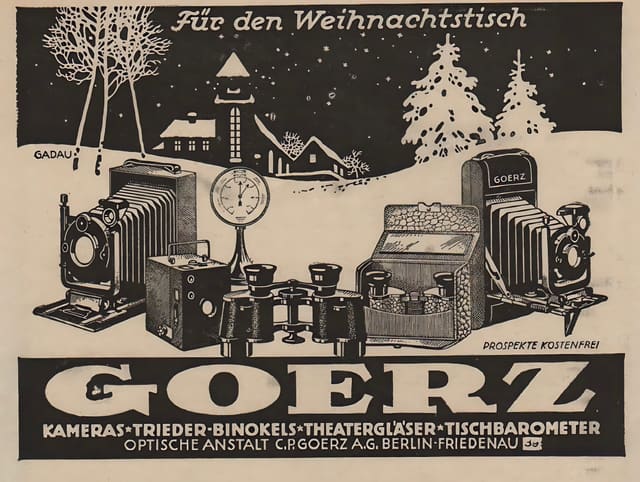
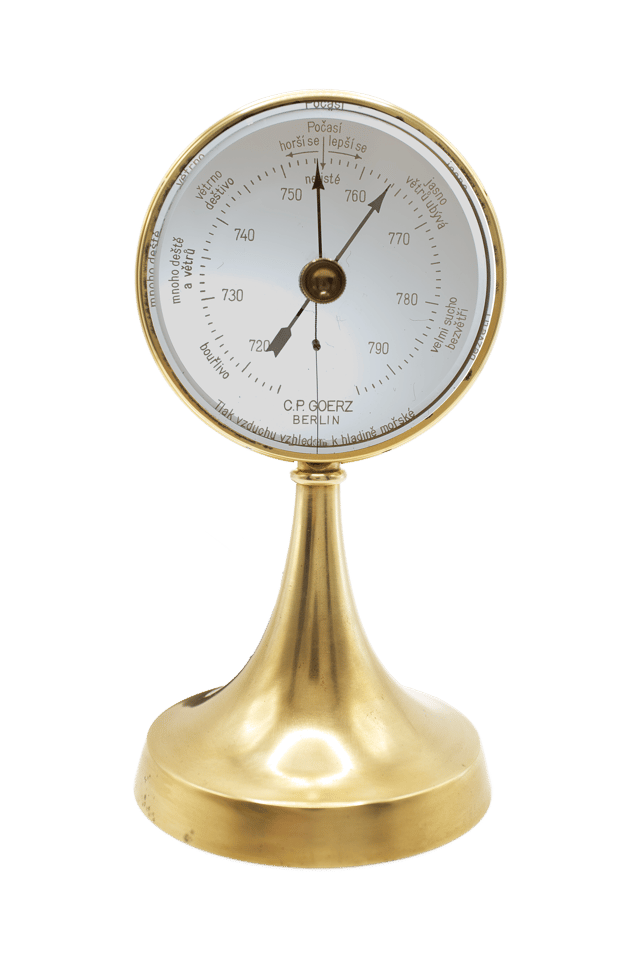
In the very early 1890s a young Silesian walked into the offices of Carl Zeiss in Jena with a roll of drawings under his arm. His name was Emil von Höegh, he was not yet thirty, he worked for the instrument maker Carl Bamberg, and his field was telescope optics. The drawings showed a lens — a symmetrical design built from two cemented triplets — and the young man was convinced he had come up with something that mattered.
Jena heard him out and said no. The refusal was perfectly reasonable: two years earlier Paul Rudolph had already given the firm the Protar, the world's first lens corrected for astigmatism, and Zeiss saw no need for someone else's scheme solving the same problem a different way. Von Höegh was not offered a job either — not as a designer, not as an engineer.
So he went to Berlin, to a small firm on Rheinstrasse in Friedenau, whose owner — a former travelling salesman with no technical education whatsoever — had just lost the only lens designer he had and was close to despair. There, the drawings were accepted.
The lens would be called the Dagor. Within four years it would sell thirty thousand units. The workshop that had made its living posting school protractors would grow into the second-largest optical and precision-mechanical firm in Europe and the largest military optics supplier in the world. And the firm that had turned him away would buy the whole thing thirty-four years later — and promptly order production of that very lens to stop.
This is the story of how that happened.
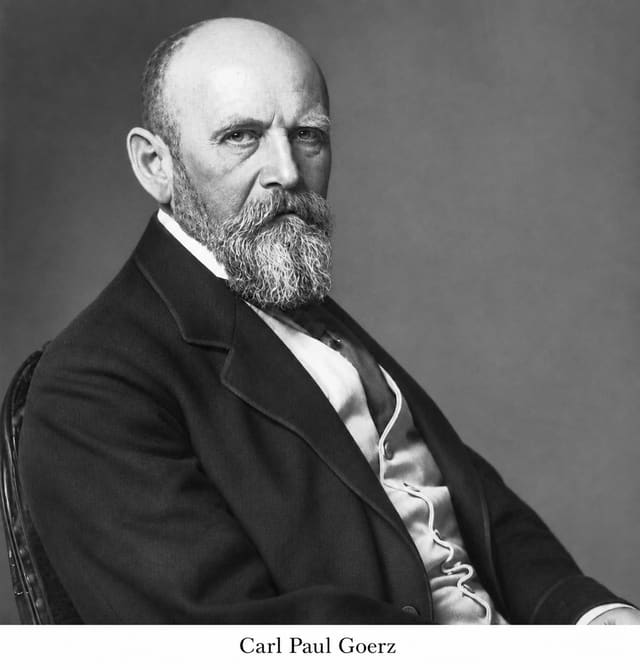
Carl Paul Goerz was born on 21 July 1854 in Brandenburg an der Havel, the son of a minor civil servant. He lost his mother early and grew up with an uncle in Rathenow — a town that had been a miniature German optical capital since the beginning of the century. Ever since the days of Pastor Johann Heinrich August Duncker, spectacle lenses had been ground there; the firm of Emil Busch, one of the oldest in the country, stood there too.
Goerz's early life was unremarkable for a boy from such a place: secondary school, a three-year apprenticeship at Busch completed in 1873, military service. What matters is that the apprenticeship was a commercial one. Goerz never stood at a grinding machine and never sat down to compute a lens. He learned to sell optics — and that decided everything that followed.
Years on the road came next. He worked as a travelling salesman for various precision-mechanics firms, and from 1883 to 1886 he lived in Paris, where he became for a time a partner of Eugen Krauss, a manufacturer producing lenses under licence from Carl Zeiss, and later cameras and binoculars as well. Those three Paris years were worth a university degree. Goerz saw from the inside how the international optics trade worked, how customs tariffs differ from technical advantages, and by exactly what method a firm like Zeiss converts scientific reputation into money. When he came back to Germany he had no patents, no capital and no laboratory. What he had was a precise idea of the business he wanted to build.
The beginning was almost comically modest. In 1886 the thirty-two-year-old Goerz opened a mail-order depot in Berlin for mathematical instruments, drawing sets and protractors, aimed mainly at schools. Posting compasses to grammar schools is not usually the kind of work industrial concerns grow out of.
But within a year photographic goods joined the catalogue, and here Goerz caught the wave. The late 1880s were the moment when photography stopped being the preserve of professionals with heavy boxes and became a middle-class hobby. Demand was outrunning supply, and trade went so briskly that in 1888 Goerz was able to buy the mechanical workshop of F. A. Hintze and start building his own cameras under the sign "C. P. Goerz, Spezialfabrik photograph. Amateur-Apparate."
A camera, however, is worth exactly what its lens is worth. And here Goerz's real gift showed itself: he knew how to find people cleverer than himself, and how to keep them. In September 1888 he hired Carl Moser, an engineer who had previously worked for the same Bamberg and who knew how to compute lens systems; in October the optician Karl Hertel joined him. From that point the firm made its own lenses. The first successful one was the Lynkeioskop — a sound version of the aplanat, nothing revolutionary, but entirely competitive.
In 1890, after the first lens was presented, the business took on a grander name: Optische Anstalt C. P. Goerz — the Goerz Optical Institute. The name was an advance on credit. Within a few years it would stop sounding like one.
In 1889 Goerz heard about an invention by the Berlin photographer Ottomar Anschütz. Anschütz belonged to the obsessive breed: he photographed birds in flight, horses at the gallop, soldiers in motion — and to do it he had built himself a focal-plane shutter capable of a thousandth of a second. He had patented it back in 1883.
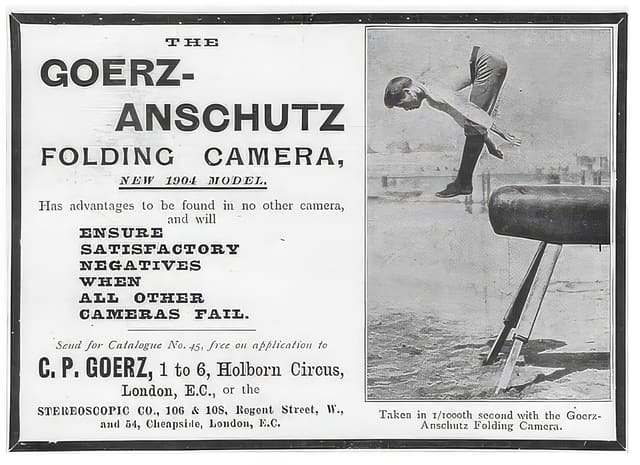
Goerz did what he always did: he did not invent, he bought the exclusive manufacturing rights. In 1890 the Goerz-Anschütz-Moment-Apparat appeared — the world's first production camera with a focal-plane shutter, a box instrument for 9×12 cm plates.
The design then developed for nearly two decades. In 1896 the camera became a strut-folding model, with slit width set by a slider on the blind itself. In 1904 the range was extended to five seconds at one end and 1/1200 at the other, the long exposures handled by a pneumatic retarder. In 1906 the shutter became self-capping, and the slit could be adjusted from outside without opening the camera; the corresponding patent, DRP 25479, was granted on 28 February 1905. Around 1905 the unwieldy name was shortened to Ango — from ANschütz and GOerz.
These cameras became the working tools of the first generation of press photographers. The 18×24 cm model of 1907 was advertised without false modesty as "the largest press camera in the world." The older, non-folding version stayed in production until 1921 — thirty-one years, remarkable longevity for an instrument in an era when camera design changed every season.
In 1892 Carl Moser died suddenly. The firm, having only just learned to make lenses, was left without the one man who could calculate them. It was precisely at this moment that von Höegh arrived with the drawings Jena had rejected.
To understand what his design was, it helps to recall what optics was trying to achieve at the time. The anastigmat — a lens with astigmatism corrected and therefore with a flat image field — only became possible once Otto Schott's glassworks in Jena gave designers genuinely new types of glass, in which refractive index and dispersion were no longer rigidly tied to one another. Zeiss got there first with the Protar. But the Protar was asymmetrical and difficult to make.
Von Höegh took a different route. His lens consisted of two halves arranged as mirror images on either side of the diaphragm; each half was a cemented triplet whose middle element had a refractive index intermediate between those of the two outer ones. Spherical and chromatic aberration, astigmatism and field curvature were all corrected; the field was flat and sharp. One aberration — coma — von Höegh did not eliminate at all. He did something more elegant: he exploited the fact that in a symmetrical system the coma, distortion and lateral chromatic aberration of the two halves cancel each other out by the simple fact of symmetry. Geometry did the work that would otherwise have had to be done with glass.
The perfectionists in Jena considered the approach insufficiently pure. The market took a different view.
German patent DRP 74437 — "A lens corrected spherically, chromatically and astigmatically" — was filed in 1892 and granted to C. P. Goerz in 1894. It described two variants of the scheme: one in which each cemented group consists of a pair of positive elements around a negative one (this is the Dagor proper), and another, its mirror image in principle, with two negative elements around a positive one — a form Steinheil arrived at independently at about the same time with the Orthostigmat, as did Voigtländer with the Collinear.
At first the lens was sold under an unremarkable label: Doppel-Anastigmat, Series III. The trade name Dagor, assembled from Doppel-Anastigmat GOeRz, appeared only in 1904, by which time the lens was already famous. The patent described f/8; production examples were sold as f/6.8 in short focal lengths and f/7.7 in long ones, with focal lengths from 40 to 900 millimetres. Coverage was 72 degrees wide open and up to 90 stopped down — a generosity large-format photographers still appreciate today.
The sales figures speak for themselves. Up to 1891 the firm had produced roughly four thousand lenses of all types. By 1896, thirty thousand. By 1901, a hundred thousand. By 1911, three hundred thousand.
The Dagor was licensed: Ross & Co. made it in England from 1893, and the Viennese optician Carl Fritsch in Austria-Hungary. It was copied without shame: E. Arbeit removed one cemented surface to produce an air-spaced version, which the Potsdam firm Schulz & Billerbeck brought to market in 1903 as the Euryplan. Rival camera makers fitted it: Kodak put it in the No. 3 Folding Pocket Kodak in 1901, Rochester Optical in the Snappa in 1902. It went into photogrammetry and aerial survey, where a flat field and freedom from distortion count for more than speed.
And von Höegh, having arrived as the firm's rescuer, stayed on as its chief designer for ten years.
The Dagor was not the only one. Over a decade von Höegh and his successors created a whole design tradition, recognisable by the character of its solutions: strict symmetry, a minimum of elements, clear mathematics.
The Celor (1898) was an air-spaced symmetrical dialyte of four elements in four groups, initially called simply "Type B." In 1904 the fast f/4.5 version was named Celor and the more modest f/6.3 became the Syntor. Dialytes gave superb sharpness wide open, but carried the congenital flaw of the age: eight glass-to-air surfaces with no coating whatsoever scattered light mercilessly. In an uncoated lens of this type as much as a third of the light could end up as flare. In 1916 the Celor was replaced by the Dogmar — a slight break in symmetry improved the correction, though coma still was not fully eliminated.
The Artar, designed by Walter Zschokke in 1904, may be the firm's longest-lived product. It is a true apochromat of dialyte type, computed for 1:1 and intended for reproduction work — what the printing trade calls process optics. The Artar outlived both the firm and the state that produced it: the American Red Dot Apochromatic Artar series ran from roughly 1953 to 1971. Its short-lived predecessor, the Alethar (1903), in which each inner concave element was cemented from three types of glass, was dropped as soon as the Artar demonstrated that the same result could be had more simply.
The Hypergon (1900) is the most eccentric thing the firm ever built. Two wafer-thin hemispherical meniscus elements facing one another, with not a single cemented surface anywhere. Astigmatism, spherical aberration and field curvature are fully corrected, symmetry disposes of distortion, and the image is sharp right into the corners. Chromatic aberration is not corrected at all — it is simply crushed by the diaphragm: focus at f/22, shoot at f/31. Coverage: 110 degrees.
And here the interesting part begins. Across an ultra-wide field, illumination falls off towards the edges catastrophically — by the fourth power of the cosine — and no optical design cancels that. Goerz solved the problem mechanically. A rotating star-shaped diaphragm was mounted in front of the lens and spun up by a jet of air from a rubber bulb through a tube. At the start of the exposure the star shaded the centre of the frame while letting light through to the edges; it was then dropped out of the way and the rest of the exposure given to the whole frame. The plate came out evenly rendered, and coverage rose to 135 degrees.
This solution — a rubber bulb driving a pinwheel in front of the lens — captures the spirit of the firm rather well: impeccable optical computation combined with a thoroughly unacademic willingness to bolt on any mechanical contrivance at all, so long as it worked. The Hypergon was made in focal lengths from 60 to 200 mm; the 60 mm fully equipped cost about 120 marks in 1910. Its direct descendants, the American Metrogon aerial survey lenses, were mapping the world in the 1940s and 1950s.
The full list of the firm's lenses is much longer: Kalostigmat, Pantar, Tenaxiar, Choroskop, and the plain Frontar achromat for cheap cameras. For cinematography the Kino-Hypar was produced from 1911, along with the Kinor. The quality was recognised across the Atlantic too: in 1939 the Swiss firm Bolex chose the Kino-Hypar for its 16 mm cameras — high quality at a lower price than the competition.
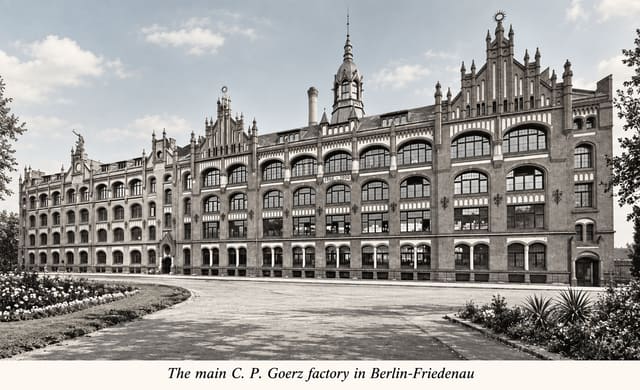
By the turn of the century the firm had stopped being a workshop. Production, which had begun on Hauptstrasse in Schöneberg, moved to Rheinstrasse 44–46 in Berlin-Friedenau; in 1895 a lens-grinding plant opened in Wintersteine in Thuringia, and in 1898, when the old premises finally stopped holding the business, optical production moved into a purpose-built factory in Friedenau.
Headcount grew in leaps. Twenty-five people in 1889. Forty in 1891. Three hundred in 1897. One thousand three hundred and seventy in 1908/09. Two and a half thousand in 1911. A caveat is due here, and it is more honest not to bury it: the sources disagree noticeably on these figures — for some, a thousand workers belongs to 1898–1900, for others to 1908 — and anyone attempting exact statistics on Goerz is condemned either to travel to the Berlin state archive or to accept orders of magnitude and stop insisting on the tens.
In 1903 the business became a joint-stock company, Optische Anstalt C. P. Goerz AG, with capital of 3.5 million marks. The honours followed: on 28 September 1903 Goerz was made Kommerzienrat, and on 14 May 1914 honorary Doctor of Engineering of the Technical University in Charlottenburg. A man who had finished secondary school and sold protractors became a doctor of the very institution whose professors ordered telescopes from him.
Inside the firm there were toolrooms, a forge, engraving, saddlery and lacquering shops, and joinery for camera bodies. From 1898 it ran its own design office for instrument mechanics. In 1909 a department for meteorological and aeronautical instruments was set up, taken over scientifically in 1910 by Arthur Berson — a meteorologist and balloonist who had ridden his own instruments into the stratosphere. In 1911 the firm built its first astronomical instrument, a reflecting telescope for the Technical University; another was made for Adolf Miethe's expedition to observe the solar eclipse of 21 August 1914 at Sandnessjøen in Norway. That telescope stands today in the observatory of the Deutsches Museum in Munich.
Goerz's personnel policy deserves separate mention, being nearly provocative for its time. In the 1890s skilled opticians were desperately scarce in Berlin, so Goerz poached apprentices from other firms and paid them journeyman wages. To keep people, he introduced the eight-hour working day in 1894 and paid holidays in 1897. It is worth remembering that the eight-hour day was at the time the central demand of Social Democracy, and was made law in Germany only in 1918, after the revolution. Goerz beat the legislature by twenty-four years — not out of idealism, but because he considered staff turnover more expensive.
The logic of foreign expansion was above all a customs logic. In an age of high protective tariffs, importing finished instruments was ruinous, while manufacturing them locally through a separately registered company paid twice over: the duties were avoided, and the door opened to military contracts, which no country awards to a foreigner.
A sales branch opened in Paris in 1893, in New York in 1895, in London in 1899. In 1902 the New York operation began manufacturing; in 1905 it took the name C. P. Goerz American Optical Co. and settled on East 34th Street, having moved there from an earlier factory in Harlem. It was run by relatives of the founder — first Wilhelm Goerz, then Otto K. Goerz — and in time the American firm became effectively independent. That circumstance saved its life.
In 1905 a branch opened in St Petersburg, and in 1908 in Pressburg (today's Bratislava), which even ran its own binocular serial numbers separate from Berlin's. In that same year of 1905 a military optics factory started up in Vienna, and the Austro-Hungarian operation was formalised as Oesterr.-Ung. Optische Anstalt C. P. Goerz.
The Russian branch had a fate of its own. Goerz binoculars were made in St Petersburg and Riga with Cyrillic markings — "К. П. Герц." In 1905, in Riga, an enterprise arose out of the optical assembly workshops belonging to Carl Zeiss and C. P. Goerz which would become the foundation of a major optical industry. War and evacuation carried it deep into Russia, and the thread that began in a Riga workshop runs on into Soviet optical instrument-making — the Novosibirsk Instrument-Making Plant, in particular, traces its own descent to precisely those workshops of 1905.
The firm received its first military contracts in 1891 — twenty-three years before Sarajevo. This was neither pacifist foresight nor the cynicism of a merchant of death, but sober calculation: armies pay in advance, order in bulk, and do not haggle over price if the instrument works.
The line then ran unbroken. From 1897 telescopic sights went out in large series. In 1899 Goerz took on the agency for the British firm Barr & Stroud, selling optical rangefinders in Germany — a rare case of a German firm trading English equipment on its own market. In 1903 a dedicated military department was created, and its product list speaks for itself: rangefinders, submarine periscopes, scissor telescopes for trench observation, gunsights.
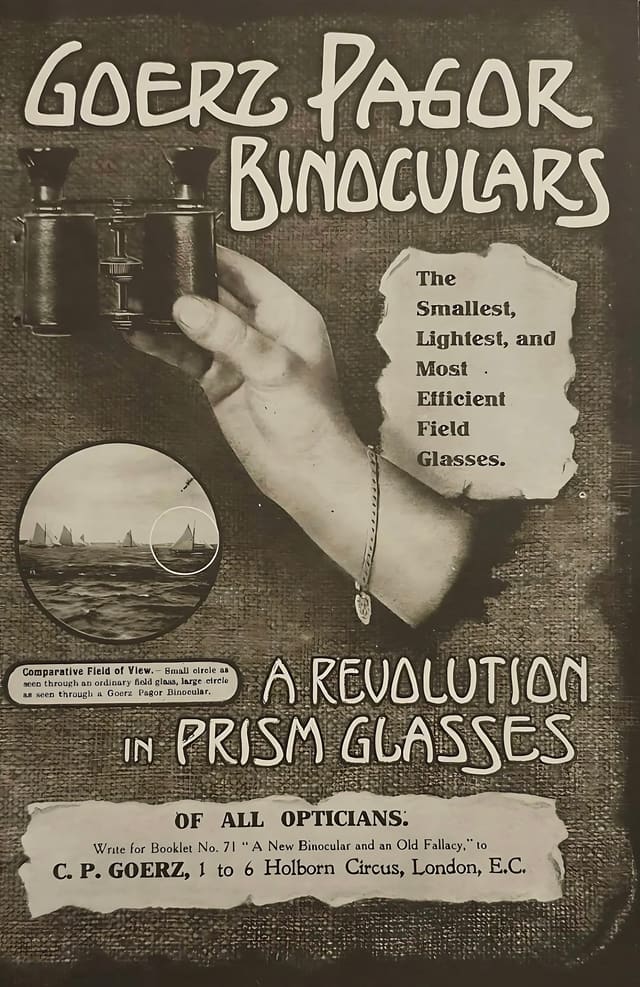
Goerz binoculars became standard issue. The prismatic Trieder Binocle — 3×, 6×, 9× and 12×, in production from 1897 — were formally adopted by the German army under War Ministry orders of 1903 and 1908, and the Galilean 6×30 "Fernglas 08" became standard equipment of the Prussian army in 1909. Goerz optics were bought in more than twenty countries.
By the early 1910s Goerz was the largest manufacturer of military optics in the world. In 1913 Germany became the first country to adopt an aerial camera — and it was a Goerz. Austria-Hungary followed a year later.
When the First World War began, the firm was exceptionally well prepared — and this nearly destroyed it.
Rumpler and Albatros reconnaissance aircraft went out over the front carrying Goerz and Ica cameras with a standard 70-centimetre focal length and 13×18 plates. Over four years aerial photography went from a curiosity to the foundation of staff work: trench warfare was fought from photographs. Telescopic sights the firm had previously built for sporting rifles were rushed to the front — in the first months of the war there were not enough issue sniper rifles, and anything from the hunting trade was pressed into service.
Production swelled monstrously. By various estimates around twelve thousand people worked in Goerz plants — by the American company's own account up to twelve and a half thousand at peak — and what they made was almost exclusively military. During the war years glass production was moved from Munich-Sendling to Schönow near Zehlendorf, where a new "Goerzwerk" rose on the street that today bears the founder's name. The firm took over searchlight production from Körting & Mathiesen of Leipzig — mostly arc lamps with Fresnel lenses.
At the same time the international empire built over two decades was collapsing. The American shares of Goerz were seized under the Trading with the Enemy Act. The English licence faded away, Ross moving in time to designs of its own. Russian production was consumed by mobilisation, evacuation and revolution. What had been created to get around customs barriers turned out to be defenceless against front lines.
And in 1919 came Versailles.
The Treaty of Versailles forbade German firms to manufacture military products. For Goerz — whose organisation, machine tools, engineering staff and order book had been rebuilt almost entirely around the army and navy — this meant reinventing itself from scratch, in a country that had lost its markets, its colonies and its currency.
Conversion went badly. The firm tried calculating machines, saccharimeters for the food industry, civilian instruments of every kind — anything the same hands and the same machines could produce. Not one of these came close to the old military turnover.
Salvation was sought in alliances. Back in 1910 a community of interests had been formed with the Kassel firm Hahn für Optik und Mechanik, in which Goerz played the leading role; that alliance now delivered two things. The first was high-quality cinema projection equipment under the Hahn-Goerz name. The second turned out to matter unexpectedly much: in the mid-1920s a profile cylinder lock was patented, a system destined to become one of the main revenue sources of the entire future concern. A world-class optical firm saved by door locks — a detail with something both sad and very German about it.
The other manoeuvre was strategic. In 1910 Goerz had bought the Sendlinger Optische Glaswerke, a Munich glassworks whose pedigree ran back to Joseph von Fraunhofer and Carl August von Steinheil. The reasoning was transparent: its own optical glass meant independence from Schott, and since Schott and Zeiss were sister companies under the Carl Zeiss Foundation, independence from Zeiss. Allied with the Steinheil tradition, Goerz was building the only real competitor to Jena glass.
The idea was sound; the timing was not. The hyperinflation of the early 1920s destroyed any possibility of planning — the dollar was quoted in trillions of marks and working capital evaporated within weeks. A firm stripped of military orders, burdened with excess capacity and cut off from capital slid towards insolvency. Investors had to be sought wherever they could be found — including, ironically enough, Carl Zeiss itself.
Management had already passed in 1921 to the founder's son, Paul Goerz. And on 14 January 1923 Carl Paul Goerz died in Grunewald at the age of sixty-eight. Nature printed an obituary. At his death the firm he had built was still the second largest in German optics and precision mechanics — and was practically bankrupt.
A way out was looked for in earnest. There was a proposal to sell the firm to Eastman Kodak — the Americans had money nobody in Germany had. The deal did not happen, and the solution was found inside the German industry, under the wing of the Carl Zeiss Foundation.
On 14 and 15 September 1926 the general meetings of four firms — Ica of Dresden, Optische Anstalt C. P. Goerz of Berlin, Contessa-Nettel of Stuttgart and Ernemann of Dresden — approved their merger into Zeiss Ikon AG. The founding agreement had been concluded on 25 August. Of the share capital of 12.5 million reichsmarks, 53 per cent belonged to the Carl Zeiss Foundation, and that share only grew in the years that followed.
The merger saved Goerz from bankruptcy. It also abolished it.
Since control lay with Zeiss, the new concern's cameras were fitted with Carl Zeiss lenses, and the firms brought into it were to wind down lens design of their own. For Goerz this meant the end of the Dagor in Europe — the lens everything had started with, and one collectors would still be hunting for thirty years later. Binocular and telescope production was stopped so as not to compete with Jena. The concern committed to fitting Compur shutters to four-fifths of its cameras.
The assets went off to new owners. The Sendlinger glassworks passed to Schott — that is, to precisely the competitor it had been created against. After the handover, optical glass ceased to be melted there at all: what remained were condensers, searchlight lenses and signal glass for the railways and street traffic lights. Steinheil, for whose independence from Schott the whole thing had been arranged, had to go back to buying its glass from Schott.
The cinema business Goerz had acquired from Hahn was combined with the Ernemann and Ica inheritance; Herman Joachim, Hahn's senior partner in the Goerz management, moved to Dresden to work with Alexander Ernemann. Lock cylinders, film, chemicals and calculating machines all went into the concern, with lock production increasingly concentrated in the former Goerz optical factories in Berlin. The Berlin site changed character for good: cameras, illumination units for cinema projectors, and door cylinders.
The Goerz family kept its block of Zeiss Ikon shares, and held it into the early 1970s, when the concern stopped making cameras. Half a century of dividends instead of the family name on a lens barrel — a bargain the heirs can hardly be blamed for, though it is impossible not to notice exactly what it cost.
Oddly enough, the firm outlived its own death in several places at once.
In New York. C. P. Goerz American Optical Co. had separated from the parent firm long before 1926, and the merger did not touch it. It went on producing Artars and Dagors for decades. In 1942 American Goerz lenses were diverted entirely to defence work and vanished from the civilian market. The trademark was re-registered in 1964. The end came in 1972–73, when Schneider Corporation of America bought the company together with the rights to the Artar and the Dagor; operations were finally wound up by 1975. Eighty years, against forty for the Berlin original.
In Vienna. An Austrian firm operated in the 1950s under the name Optische Anstalt C. P. Goerz, whose connection in terms of ownership with the old German company was, in the view of a number of researchers, nominal rather than legal. Nonetheless it was this firm that produced one of the most elegant cameras of post-war Europe — the subminiature twin-lens reflex Minicord (1951–58), shooting a 10×10 mm frame on 16 mm cine film, with a coated six-element Helgor 25 mm f/2 lens and a metal focal-plane shutter up to 1/400 second. Its inventors were Franz Sochor and Heinrich Tischberger; the first patent was filed in Vienna in 1950 by the firm Istegstahl, and the Goerz name appeared on the camera only later. The related Goerz Electro dealt in instrument transformers and other electrical equipment — an entirely different story under an old family name.
In Berlin. The site at Goerzallee 271 has a page that cannot be passed over: during the Second World War the plant maintained its own forced-labour camp there. This is documented in the camp database of the Berlin Documentation Centre for Nazi Forced Labour, and it is part of the history of the place in exactly the same measure as the telescopes and the lenses.
In Jena, Saalfeld and Kyiv. After 1945 German optics was taken apart by the victors quite literally. Jena was occupied first by the Americans, who removed part of Zeiss to Stuttgart, and then handed to the Soviet zone, where dismantling continued in the other direction. According to material gathered by Larry Gubas from the Carl Zeiss works archive in Jena, the post-war plan of 1946 envisaged building a Soviet version of the Contax: in February 1946 Zeiss workers in Saalfeld were ordered to produce 3,800 cameras between September 1946 and March 1947 — a target met only in small part. Three Contax assembly lines were recreated in Saalfeld under the supervision of Soviet specialists, who then trained personnel in Kyiv; in October 1947 the lines were dismantled and shipped to the Kyiv Arsenal plant, where production of the Kiev cameras began. Declassified CIA documents confirm the transfer of Zeiss Jena specialists to the Kyiv plant and their partial return by 1952. A caveat is necessary here: the exact wording of the internal memorandum of 26 February 1946 and the contents of the volume of technical drawings for the Kyiv project are known only from Gubas's article, available solely as an unrecognised scan, and cannot be verified against independent sources.
Goerz's heirs did not return to optics, but they did not disappear either. From 1929 Paul Goerz headed Fernseh AG, one of the pioneers of German television, housed in the "Goerzwerk" in Zehlendorf; in 1932 Paul Goerz junior took charge of Ideal-Werke, which in December 1938 was renamed Blaupunkt. There is a claim that the founder's grandson took over the American Carl Zeiss, Inc. from Karl Bauer when the Carl Zeiss Foundation bought the company back from the United States government; no documentary confirmation of this appears in the available sources.
Goerz himself lies in the cemetery at Grunewald; since 1978 his grave has been designated an honorary grave of the state of Berlin. In Zehlendorf there is a Goerzallee.
The historical formula normally applied to such lives is familiar: the firm flourished while its founder lived, and the heirs could not hold on to the success. It fits Goerz, but with a substantial qualification. What the heirs inherited was not simply a firm but a firm whose principal competitive advantage — an early and deep specialisation in military optics — had been outlawed overnight by the victorious powers, in a country where money had ceased to be money. It is hard to name the management decision that would have saved Optische Anstalt C. P. Goerz in 1923.
What remains, in substance, is the optics. The firm's place in the history of technology is defined not by turnover or headcount but by the fact that von Höegh's symmetrical double anastigmat set the standard for the general-purpose lens for decades, that the Hypergon opened up ultra-wide-angle photography, and that the Artar remained, to the end of the film era in printing, the yardstick by which reproduction quality was measured. The names Dagor, Hypergon and Artar are still in living use among large-format photographers — which, for designs computed in pencil on paper between 1892 and 1904, is a more than respectable result.
The man who was turned down in Jena turned out to be right after all.
The founder's biography and the history of the firm
Optical designs
Cameras, binoculars, military optics
The Zeiss Ikon merger and the fate of the assets
The post-war legacy