Loading
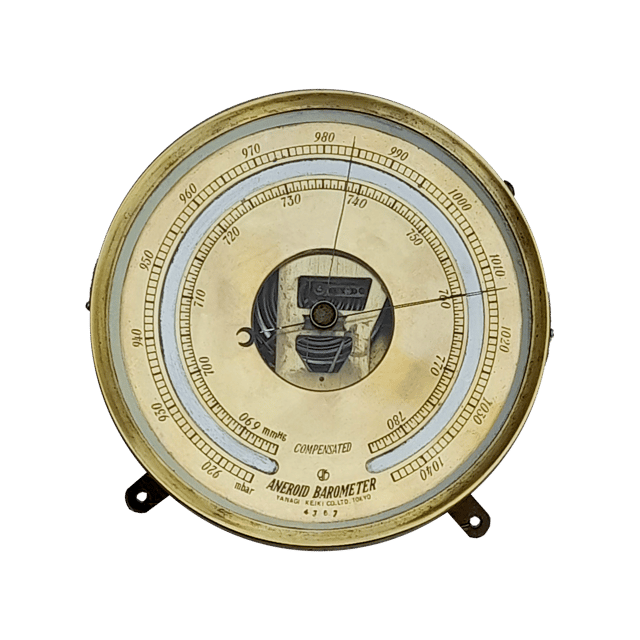
Yanagi Keiki Kabushiki Kaisha — literally “Yanagi Measuring Instruments Joint-Stock Company”—was a Tokyo-based manufacturer of precision measuring instruments. The company evolved from the pre-war workshop Yanagi Seisakusho in Tokyo’s Meguro district before later relocating to Setagaya. It became especially renowned for its marine aneroid barometers (Types 6, 8, and 8A), distinguished by their exceptionally refined mechanical construction.
Yanagi Keiki was one of Japan’s best-known manufacturers of aneroid barometers, altimeters, depth gauges, recording instruments, level gauges, pressure gauges, and a broad range of marine and meteorological instruments.
The company’s entry in the J-GLOBAL database, maintained by the Japan Science and Technology Agency (JST), describes its field of business as the
Yanagi’s place within the Japanese precision instrument industry is best understood against the background of the pioneers who established the field. The pioneer of industrial Bourdon-tube pressure gauges in Japan was Yoshihira Wada. On 1 May 1896 (Meiji 29), he founded Wada Keiki Seisakusho in Tokyo’s Koishikawa district (present-day Bunkyo Ward), the first Japanese company devoted to the manufacture of measuring instruments, initially specializing in pressure gauges.
According to Tokyo Keiki, the successor to Wada’s enterprise, it was Wada himself who coined the Japanese word keiki (計器, “measuring instrument”) as an equivalent of the English term measuring instruments, incorporating it into his company’s name. His business subsequently evolved into Tokyo Keiki and Nagano Keiki, while Wada himself came to be remembered as the “father of the Japanese measuring instrument industry.”
By the 1930s, the number of Japanese pressure-gauge manufacturers had reached approximately one hundred, according to the comprehensive historical survey published by the National Museum of Nature and Science (Kahaku). Yanagi was one of the many specialized firms that emerged during this second and third generation of manufacturers, establishing its own distinctive niche in aneroid technology—particularly barometers and level gauges.
The earliest reliably dated Yanagi instruments belong not to the incorporated company but to the workshop Yanagi Seisakusho, located in Tokyo’s Meguro district. This is confirmed by surviving barometers documented in the Japanese collectors’ archive kodokei.com (“TIMEKEEPER”). Later, operating as Yanagi Keiki Co., Ltd., the company became established in Setagaya. The exact date of the workshop’s foundation, the identity of its founder, and the date of incorporation have not been identified in publicly available sources.
An intriguing international connection also survives. The Yunnan Meteorological Museum in Kunming, China—located atop Mount Taihua in Xishan National Park—preserves a Japanese pocket barometer attributed to Yanagi Manufacturing Co. and dated to approximately the 1930s. The museum description emphasizes its compact size and light weight, making it especially suitable for field surveys.
The War Years
The wartime period constitutes the most substantial and best-documented chapter of Yanagi’s early history. Here, the Japanese collectors’ archive kodokei.com provides remarkably specific evidence.
These surviving instruments provide clear documentary evidence that during the war years Yanagi manufactured both pocket barometer-altimeters and marine aneroid barometers bearing naval markings.
The broader industrial context is equally significant. During the 1930s, Japanese engineering rapidly became militarised, while after Japan’s defeat in 1945 much of the industry was left devastated before being revived through the surge of special procurement contracts associated with the Korean War. This pattern is described by the National Museum of Nature and Science as characteristic of the Japanese precision instrument industry as a whole.
The digital archive of the Showa-kan Museum preserves two engineering papers published in 1944 by Ichiro Tomita of Yanagi Seisakusho:
These publications constitute exceptionally strong evidence that the company participated directly in the manufacture of aircraft instruments or their components for the Japanese wartime aviation industry.
Historical records published by the Nakano City municipal archive concerning the wartime mobilisation of schoolchildren for industrial labour include Yanagi Seisakusho among the factories to which students were assigned. This demonstrates that the company was regarded as part of Japan’s wartime industrial system.
Following Japan’s surrender, the firm did not disappear. The official government gazette Kanpō, dated 8 March 1946, lists Yanagi Seisakusho Co., Ltd., registered at Yōga, Setagaya, Tokyo. This confirms that the legal entity continued to exist immediately after the end of the war.
Material evidence from this transitional period is equally revealing. The collectors’ catalogue Furutokei.com documents the existence of the following instruments:
Although this is a collectors’ source rather than an archival institution, it is of exceptional value because it preserves photographs of original manufacturer’s plates together with factory dates. Taken together, these surviving instruments demonstrate the continuity of Yanagi’s production both during the war and in the immediate post-war years.
Post-war Expansion and Scientific Instrumentation
By the mid-1950s, the company was already operating under its new official name, YANAGI KEIKI CO., LTD. This designation appears on surviving instruments from the period. Particularly well known is a precision aneroid barometer manufactured in November 1955 for the Japan Defense Agency. Its existence demonstrates that, only ten years after the end of the war, Yanagi had once again become a supplier of high-precision instruments to Japanese government institutions.
In 1956, the company appears in the scientific literature. In the paper “On a New Draught Gauge,” the author expresses his gratitude to Mr. Shibata of Yanagi Keiki Seisakusho for his assistance in developing a new marine draught gauge.
A further indication of the company’s technical reputation appears in “On a Precision Mountain Altimeter” (1962), which describes a portable Yanagi altimeter. The author emphasizes that the instrument was developed on the basis of the company’s precision aircraft altimeter, illustrating the direct transfer of aviation technology into civilian scientific instrumentation.
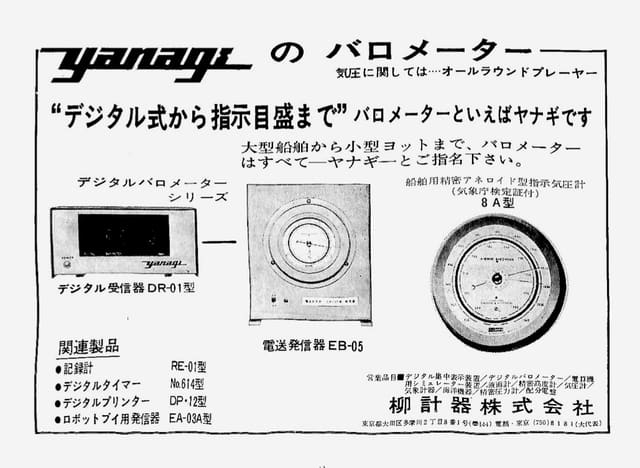
By the early 1970s, Yanagi had evolved into a major manufacturer of specialized measuring systems. According to advertisements published in the journal Fune no Kagaku (Ships of Science), the company’s headquarters were located at 2-8-1 Tamagawa, Ōta-ku, Tokyo, while its factory operated at 2-14-7 Ikegami, Ōta-ku, Tokyo.
The company’s product range included:
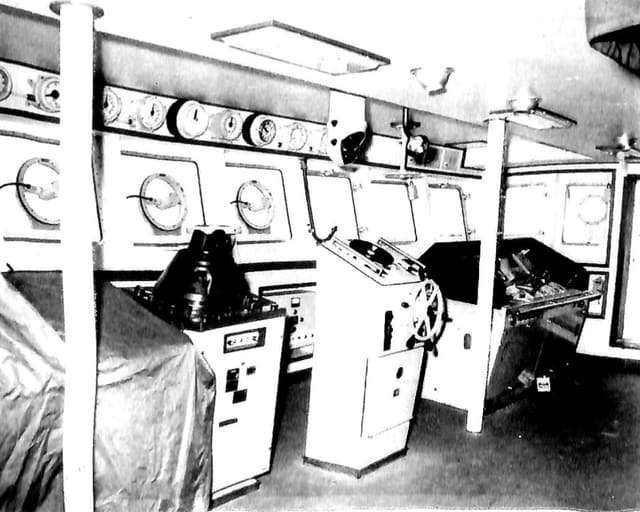
Yanagi achieved international recognition primarily through its large marine aneroid barometers of several types, which were widely installed aboard merchant vessels throughout the 1970s and 1980s. After these ships were eventually scrapped—particularly in India—the instruments entered the international collectors’ market in large numbers. It is these marine barometers that largely account for the company’s present-day reputation among collectors.
Auction catalogues and dealers’ descriptions provide valuable additional information concerning their mechanical construction. The large marine Yanagi barometer is described as incorporating a jewelled lever transmission with twin drums, while the entire movement is isolated from shock by tension springs.
It is precisely this construction—the combination of jewelled lever pivots, paired aneroid capsules, and a spring-suspended movement—that explains both the elegance and the remarkable reliability for which Yanagi instruments are renowned. The symmetrically arranged twin capsules balance the system about its axis of rotation, while the spring suspension and bimetallic temperature compensation reduce vibration and thermal drift aboard a moving vessel.
Yanagi cases are encountered in several versions, including lacquered polished brass, stainless steel, and the company’s characteristic painted marine housings, most commonly finished in pale green or green. The front diameter typically ranges from approximately 17 to 24 centimetres.
The operating principle of the aneroid barometer, invented by Lucien Vidie in 1843 (patented in 1844), is fundamentally identical regardless of manufacturer. A sealed evacuated metallic capsule expands and contracts in response to changes in atmospheric pressure, and its microscopic movement is amplified through a system of levers and gears before being transmitted to the indicating pointer.
The difference between an ordinary aneroid and an exceptional one lies almost entirely in the quality of its transmission mechanism and in the effectiveness of its compensation systems. Yanagi instruments embody virtually every hallmark of first-class engineering, forming a distinctive mechanical language of their own:
It is this engineering culture that makes Yanagi mechanisms appear remarkably elegant even by modern standards.
Scientific Instruments Beyond Barometers
During the second half of the twentieth century, Yanagi manufactured far more than barometers alone. Scientific publications regularly refer to the company’s:
These instruments were employed by:
Particularly noteworthy was the company’s contribution to the development of biological logging. According to publications issued by the National Institute of Polar Research and the Yamashina Institute, Yanagi engineer Shinzaburo Shibata participated in the development of one of the world’s earliest miniature analogue depth recorders for the study of diving birds and marine animals.
This work represented an important milestone in the evolution of biologging technology, allowing researchers, for the first time, to record the diving behaviour of free-ranging animals using compact mechanical recording instruments.
The Company’s Final Years
Today, Yanagi no longer appears to be engaged in active manufacturing. Its instruments are encountered primarily as objects requiring calibration or on the secondary collectors’ market. The precise date of the company’s foundation, the identity of its founder, and the date on which production finally ceased have not been documented in publicly available sources.
According to Wikipedia, Osaki Electric Co., Ltd. acquired Yanagi Keiki in 1993. In 2000, the company was absorbed by Osaki Estate Co., Ltd. Nevertheless, the company’s ultimate legal fate has yet to be established conclusively and remains a subject requiring further archival research.
Even so, the surviving historical evidence allows the broad outline of Yanagi’s development to be reconstructed with considerable confidence. Emerging from a small pre-war Tokyo workshop, the company evolved into one of Japan’s leading manufacturers of precision aneroid instruments. It survived wartime mobilization, supplied equipment to government agencies during Japan’s post-war reconstruction, contributed to scientific instrumentation, and ultimately gained an international reputation through its exceptionally engineered marine barometers.
Although many aspects of its corporate history remain obscure, the instruments themselves continue to testify to a distinctive engineering philosophy—one founded upon precision mechanics, careful temperature compensation, low-friction jewelled movements, and an uncompromising attention to reliability. It is this engineering tradition, embodied most clearly in the company’s celebrated marine aneroid barometers, that secures Yanagi Keiki a respected place in the history of Japanese scientific instrument making.
Sources: