Loading
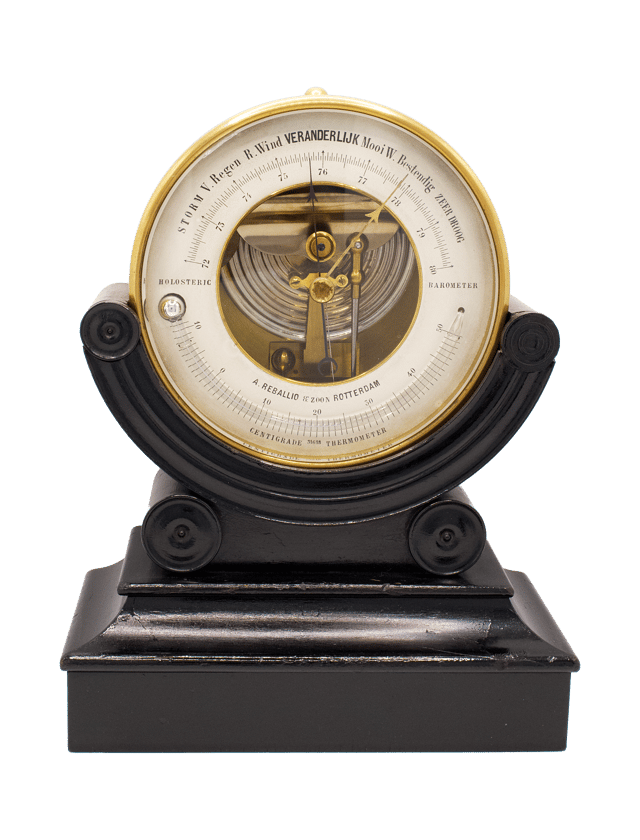
In May 1790 the Hague newspaper 's-Gravenhaagse Courant carried an advertisement that today reads almost like an elegy. A certain Reballio, "maker of barometers," informed the public that he would remain in The Hague a few days longer to repair barometers; and that he did so "for the pleasure of his old customers of twenty and thirty years," who were welcome to bring him their instruments from their country estates. His address, per his last advertisement: at the house called "The King of Prussia" on Bagijnestraat — and during fair week, in his booth.
The man who signed that notice was about seventy. Thirty years of clientele means he had been repairing barometers for these same people back in the 1760s. More than forty years earlier he had arrived here from Milan. He traded at fairs, changed partners, went broke alongside his son, fought a running battle with swindlers using his own name — and all the while made instruments of such quality that two and a half centuries later they hang in the Rijksmuseum Boerhaave and come under the hammer at Bonhams.
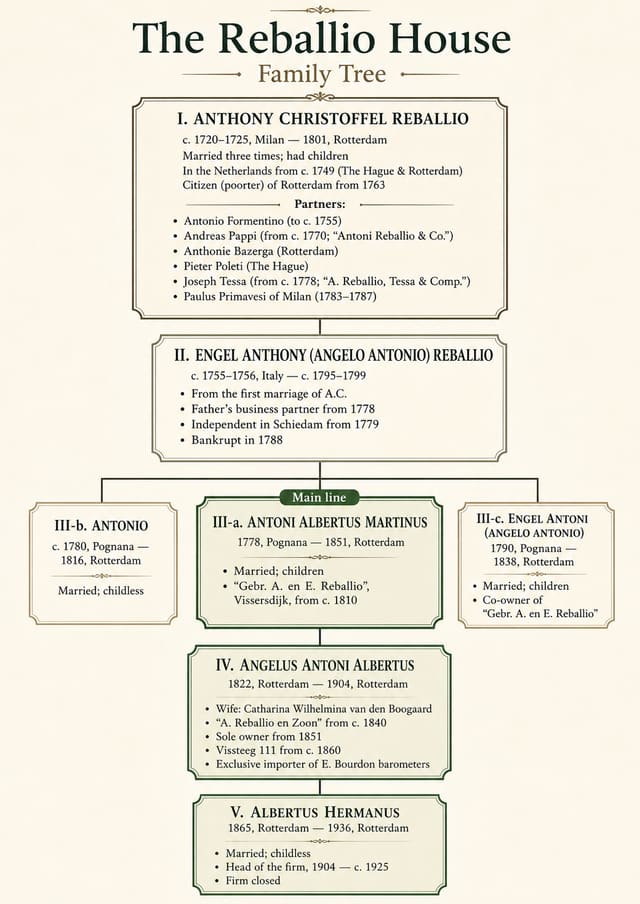
His name was Anthony Christoffel Reballio. From him would come a dynasty that lasted a hundred and seventy-five years in Rotterdam and ended in 1925 — with a childless great-great-grandson who wound up the firm, and a trading house whose sign there was no longer anyone to inherit.
This is its story.
To understand how the name Reballio ended up in Rotterdam, you first have to climb into the mountains above Lake Como.
The Lombard pre-Alps are beautiful and poor. Narrow valleys, stony slopes, short summers. From the sixteenth century onward, men left the villages around the Lario — from the Val d'Intelvi, from Val Veddasca, from Val Cavargna, from lakeside parishes such as Pognana, Nesso and Tremezzo — to find work elsewhere. They did not leave for good: this was seasonal, and later cyclical, migration, in which family, house and parish stayed in Italy while the money was earned beyond the Alps.
The trades of this diaspora are well known: masons and plasterers (the legendary maestri comacini), craftsmen in artificial marble, or scagliola; chimney sweeps; cooks; sellers of prints and mirrors. And — from roughly the last third of the seventeenth century — barometrai, the traders and makers of meteorological instruments.
Why instruments in particular? There are several reasons, and all of them are mundane.
First, the craft required glassblowing skill, and Lombards traditionally learned it in Venice, and later in Como itself, where local legend credits Alessandro Volta with a hand in the matter. Second, the goods were light, expensive relative to their weight, and sold at a markup unthinkable for, say, combs. Third — and this is the main point — in the eighteenth century a barometer was at once a scientific object, a practical tool and a status symbol. The merchant wanted to know whether there would be a storm. The landowner wanted to know whether to cut hay tomorrow. And everyone wanted a handsome thing in a mahogany case hanging in the parlour, testifying that the householder was a man of the Enlightenment.
There is a well-known anecdote about the street cry of these traders — "thermometri, barometri, miriametri, kilometri" — where the last two words were added purely for the sound of it. What they were selling, in essence, was a miracle: a sealed glass tube in which mercury, entirely unaided, predicted the weather.
The route of the diaspora ran through Switzerland and up the Rhine — and ended in the two countries where demand was highest: England and the Netherlands. Both maritime, both commercial, both with a climate in which the question "what is the weather going to do" had a direct cash value.
The London branch of the diaspora had, by the mid-nineteenth century, effectively taken over the British instrument trade. The Italians settled close together — Clerkenwell, Hatton Garden, Holborn, the future "Little Italy" — and their surnames today make up half the directory of English barometer makers:
The Dutch branch was smaller and settled differently: not in one quarter of one city, but scattered across ports and provincial centres. Its composition is less well documented, which is precisely what makes it interesting:
And here begins what makes the Dutch branch a story in its own right rather than a provincial franchise of the London one.
From the 1750s to the 1860s the Netherlands saw the flowering of its own instrument type — the bakbarometer, a wall barometer with a box, in which the mercury cistern is enclosed by a decorative trough at the base of the case. And its luxurious subtype, the contra-bakbarometer, has no direct parallel anywhere.
The idea of the counter-tube goes back to Christiaan Huygens. Next to the ordinary Torricellian tube stands a second one — the counter-tube, or opposing tube (contrabuis, sometimes labelled Kontraluer on the plates) — filled not with mercury but with coloured oil, and open at the top. The two tubes were joined in the manner of a siphon tube, where the two liquids, mercury and oil, met without mixing in a small reservoir formed by a widening of the tube walls. Air pressure acts on the oil column directly: as pressure rises the column falls, as pressure drops it rises. Since oil is an order of magnitude lighter than mercury, the travel of the column is multiplied many times over — on Reballio's instruments the scale magnification is more than tenfold. What fits into a single inch on an ordinary barometer is stretched here across the width of a hand.
The Dutch, in other words, solved the problem of precision not through mechanical finesse, as the English did with their verniers, but through direct physical travel. It is a very characteristic solution: practical, slightly excessive, and handsome.
To this are added two local scales — the thermometric La Court and the barometric "36-schaal" — each of which gets its own chapter below. Both appear on Reballio instruments, and both are, in effect, fossil traces of the moment when European metrology had not yet come to an agreement with itself.
It was into this world — of contra-bakbarometers, Rhineland inches and Dutch inscriptions reading HEEL VOGTIG — that a man from Milan arrived around 1749.
Anthony Christoffel Reballio was born in Milan around 1720–1725. He married three times, had children, and appears in Dutch sources from about 1749, working — and this matters — not in one city but in The Hague and Rotterdam at once, which for a travelling barometer maker was entirely normal. His first partner was Antonio Formentino; the partnership lasted until roughly 1755.
The earliest known advertisement is dated 24 April 1749 (Rotterdamse Courant, no. 50), and it reads like pure entrepreneurship. The partners, the paper reports, "make and sell all sorts of barometers and thermometers, a quarter of a year on trial," and moreover "likewise make barometers that go in the manner of a clock." The last phrase means wheel mercury barometers (wielkwikbarometer) — instruments with a hand and a dial: a complex, expensive and, for the period, spectacular piece of work.
Note that "a quarter of a year on trial." A warranty. In 1749. The man had barely arrived — and was already selling not an instrument but trust.
The same advertisement mentions "the wondrous Work of Electricity" (het wonder Werkstuk van de Electriciteyt). From the very beginning Reballio dealt not only in barometers but in novelties — what today would be called gadgets of the Enlightenment.
From here he can be tracked quite literally by his shop signs, which is a pleasure in itself, because houses in the cities of the period were named rather than numbered.
That change of sign — from Münster Cathedral to Milan Cathedral — is worth a chapter of its own. A man who has just been granted Rotterdam citizenship hangs an image of his native city's cathedral over his workshop. Not nostalgia but marketing: an Italian works here, and Italians make the best barometers. And also, of course, nostalgia.
This is worth pausing over, because it demolishes the cosy image of a craftsman who spent his life at a bench.
Reballio and his partners travelled from city to city to sell barometers "and many other things" at the kermis — the annual fair. Advertisements in the Hague paper for 1775, 1776, 1777, 1788 and 1790 record this nomadic cycle. He had a booth (Kraam). He would arrive for fair week, set up his stall, sell, repair — and move on.
Which is to say: a man whose barometers now sit in museums as specimens of Louis XVI decorative art earned his living in roughly the same place as the jugglers and the gingerbread sellers. There is nothing demeaning in that — it is simply how the eighteenth-century market worked. But the contrast with the museum case is a good one.
The most eloquent document in Anthony Christoffel's entire biography is an advertisement in Rotterdamse Courant no. 137 for 1773. Reballio complains that certain people are selling and repairing barometers under his name, deceiving the public, who then come to him complaining about shoddy goods. And he proposes a remedy:
from now on every barometer he sells will come with a printed slip explaining the construction and use of the instrument — and, "to prevent all misleading by means of his name," signed by him in his own hand.
This is, in essence, the invention of the certificate of authenticity. A printed manual plus autograph verification — in 1773, in a city where most buyers could barely read.
Twenty-one years later, in Rotterdamse Courant no. 53 for 1794, he complains about exactly the same thing. So it did not work. So they were forging it. So the name was worth forging.
Besides making, selling and repairing instruments, Anthony Christoffel offered:
opregte Venetiaansche Lampen);In other words, this was no narrow artisan but a general supplier of the optical, the glazed and the spectacular. An Italian bringing a little Venetian light into a Calvinist port.
Anthony Christoffel worked until roughly 1795–1800 and died in Rotterdam in 1801, having lived some eighty years. Half of them in the Netherlands.
By that point his eldest son was already dead, and the business had effectively been interrupted. The dynasty was hanging by a thread.
The second generation is the darkest and most dramatic page in the story.
Engel Anthony Reballio, also known as Angelo Antonio, was born around 1755–1756 in Italy, from Anthony Christoffel's first marriage. Which is to say: he was born precisely in the years when his father was, in all likelihood, back home.
From 1778 he is the "& Comp." in the name of the firm "A. Reballio, Tessa & Comp." His father's partner, then, was his own son.
From 1779 Engel Anthony works on his own account — in Schiedam, "on the Dam" (op den Dam). Schiedam in those years was a town of gin and shipping, half an hour from Rotterdam. A sensible choice: not to compete with his father head-on, but to stay within his orbit.
In 1788 he goes bankrupt. The failure in Schiedam is recorded plainly.
He died around 1795–1799, that is, before his father, in his early forties.
Were the story to end here, we would have a sad and thoroughly typical arc: a gifted first-generation migrant, an unlucky son, a name that fades out. But Engel Anthony had three sons — and it was they who turned the Reballios into a dynasty.
All three of Engel Anthony's sons were born not in the Netherlands but in a place Bert Bolle renders as "Pognano" — almost certainly Pognana on Lake Como (today Pognana Lario, a comune in the province of Como, some ten kilometres northeast of the city of Como, in the old stonecutting and artisan country).
This is an extraordinarily telling detail. A family that had already worked in Holland for two generations went on having its children in the ancestral Lombard village. The wives stayed in Italy, or returned there to give birth; the men shuttled back and forth. Exactly the cyclical rhythm of Lombard migration described in the first chapter — only seen not in the statistics but in one specific family, thirty years after the grandfather had become a citizen of Rotterdam.
All three brothers are described in the documents as weerglazenmakers — "makers of weather glasses." The profession was inherited entire.
Antoni Albertus Martinus — born 1778 in Pognana, died 1851 in Rotterdam; married, with children. Antonio — born c. 1780 in Pognana, died 1816 in Rotterdam; married, childless. Engel Antoni (Angelo Antonio) — born 1790 in Pognana, died 1838 in Rotterdam; married, with children.
The middle brother, Antonio, died young and childless — in 1816, at about thirty-six. We know almost nothing else about him.
From around 1810 the eldest and the youngest — Antoni Albertus Martinus and Engel Antoni — work together under the sign "Gebr. A. en E. Reballio" ("A. and E. Reballio Brothers") on the Vissersdijk, the very address where their grandfather had settled thirty years earlier.
The firm's advertising appears in Rotterdamse Courant in 1815 (no. 27), 1826 (no. 96a) and 1829 (no. 21a).
This is the second period in the history of the house: no longer fairground trade but a settled urban workshop, operating for a decade and a half under the brothers' name. It is instruments from this period that most often turn up signed "Geb. Reballio, Rotterdam."
When the younger brother dies in 1838, Antoni Albertus Martinus carries the business on alone. He is sixty. And he has a sixteen-year-old son.
Around 1840 Antoni Albertus Martinus takes his son into the business — Angelus Antoni Albertus Reballio, born in Rotterdam in 1822. From this moment the firm acquires the name under which it will enter history:
A. REBALLIO EN ZOON
A word of explanation about generation-counting is in order here, because the sources diverge — and this is not an error but a question of how you count.
Counting generations of the family, Angelus is the fourth in line (Anthony Christoffel → Engel Anthony → Antoni Albertus Martinus → Angelus). Counting eras of the firm, however — and this, apparently, is how the family itself thought about it — everything falls neatly into place:
A. Reballio & Co., A. Reballio, Tessa & Comp.);Hence the traditional formulation, "the third generation of a renowned family": what is meant is the third sign over the door, not the third generation of blood.
In 1851 Antoni Albertus Martinus dies at seventy-three, after some forty years in the trade. His son carries the business on alone, keeping the old name: "A. Reballio en Zoon." A name in which "Zoon" no longer refers to anybody in particular — the sign outlived the relationship it described. That is what happens to all good signs.
Around 1860 the firm moves from the Vissersdijk to Vissteeg 111.
(A note on the address: the Rotterdam city archive holds the notarial deed founding the partnership "Fa. A. Reballio en Zoon," drawn up before the Rotterdam notary mr. T. M. T. Rietstap, in which the premises are given as standing on the corner of Wijnstraat and Vischsteeg 11, cadastral section G, no. 213, and the participants named as, besides Angelus, Adèle Gertrude Marie Reballio and Hermanus Martinus Albertus Angelo Reballio. The discrepancy between "Vissteeg 111" and "Vischsteeg 11" is most likely explained by a change of numbering or by different house-counting systems; the form Vissteeg 111 is the one that stuck on the instruments and in the literature. Who Adèle Gertrude and Hermanus Martinus were to Angelus remains an open question: probably a sister and a brother, or other relatives brought into the partnership as shareholders.)
And here comes the commercial drama of the generation.
Angelus Reballio becomes the sole importer of Eugène Bourdon's metal barometers from Paris.
To appreciate the decision you have to understand what had happened to the trade. Eugène Bourdon (1808–1884) patented in Paris, on 18 June 1849, his famous curved tube, which under pressure tends to straighten — the principle underlying pressure gauges and aneroid barometers, and still at work today in every industrial manometer in the world. That same year he took a gold medal at the World Exhibition.
It was the end of an era. The mercury contra-bakbarometer — a metre-high edifice of mahogany and glass tubing that cannot be tilted, transported or hung aboard a ship — was giving way to a compact metal box that works in any position.
And the heir to a dynasty of mercury makers, instead of digging in, takes the exclusive agency for the very instrument that is killing his own craft. This is arguably the single cleverest decision in the whole history of the house. The workshop becomes a trading house; manufacture gives way to import and representation. The firm will live another sixty-five years on the strength of it.
The material proof is a specimen in the Rijksmuseum Boerhaave: "Aneroïde metaal barometer, A. Reballio & Zoon, Rotterdam," nineteenth century, inv. V14018. Beside it in the same collection stands his great-grandfather's mercury barometer, "A. Reballio fec. Rotterd.," inv. V28739. A century and a half of instrument evolution, filed under two inventory numbers bearing one surname.
Angelus Antoni Albertus was married — the Dutch death index gives his wife as Catharina Wilhelmina van den Boogaard, who died in Rotterdam sometime between 1900 and 1950 — had children, and died in Rotterdam in 1904, aged eighty-two. He had headed the firm for fifty-three years.
Albertus Hermanus Reballio was born in Rotterdam in 1865. After his father's death in 1904 he took over the business and ran it alone — until roughly 1925, when the firm was wound up. He was married and childless. He died in Rotterdam in 1936.
The childlessness here is not a biographical footnote but a cause. A dynasty in which the craft passed from father to son across five generations and a century and a half ended in exactly the way such dynasties do: there was no one to pass it to.
There is a tempting, though not strictly proven, continuation of this story.
The Dutch Wikipedia article on the opera singer Annie Reballio-Siewe reports that she married Albertus Hermanus Johannes ("Albert") Reballio — "an art lover and dealer, secretary of the Rotterdamse Kunstvereniging and proprietor of Kunsthandel Arti at Kneuterdijk 16." And it adds: the marriage remained childless. It is also known that Piet Mondrian corresponded with "the art dealer Albert Reballio" — the RKD holds a postcard from Laren dated 24 February 1915.
The coincidences pile up: the name, the city, the dates, the childless marriage. If this is the same man, the picture becomes almost literary: the last barometer maker of the line goes into the picture trade, corresponds with Mondrian, closes the family firm in 1925 — and dies in 1936, leaving behind not a successor but a collection.
There is no firm proof of the identification: Bolle calls him "Albertus Hermanus," Wikipedia "Albertus Hermanus Johannes." A one-name discrepancy is ordinary enough for the nineteenth century, but it is still not an identity. Let it stand as a probable hypothesis requiring verification against the Rotterdam civil registers.
On several Reballio instruments — notably the bakbarometer from the Van Rijckevorsel collection in Museum Rotterdam — the thermometer carries scales marked "La Court en Fahrenheit." The second needs no introduction. The first is known to almost nobody, and it deserves better, because it is one of the very few temperature scales in European history that was invented not to describe nature but to grow a specific fruit.
Pieter de la Court van der Voort was baptised in Leiden on 25 May 1664 (born on the 21st) and died there on 12 September 1739; he is buried in the Pieterskerk. He belonged to the celebrated Leiden family of the De la Courts — French-speaking Protestant cloth-workers who had fled Flanders and whose grandfather bought Leiden citizenship in 1618. His father, Pieter de la Court (1618–1685), was both one of the most successful cloth manufacturers in the Republic and an influential republican pamphleteer, author of the bestselling Interest van Holland (1662) and a man close to the circle of Grand Pensionary Johan de Witt. Our Pieter combined his parents' names, inheriting "van der Voort" from his mother Catharina's side.
He married his cousin Sara Poelaert in 1686, ran the family cloth business, and was reckoned among the wealthiest men in the Netherlands. Around 1710, at forty-six, he handed the business to his son Allard and devoted himself entirely to two passions: collecting paintings — Rembrandt, Rubens, Van Dyck, Potter — and growing exotic fruit. In 1728, as the Leiden cloth trade collapsed, he closed the factory altogether and lived as a cautious rentier with a preference for English securities.
He owned two country estates: Meerburg near Zoeterwoude and Allemansgeest at Voorschoten, the latter now known as Berbice, where around 1696 he built his celebrated orangery and began experimenting with angled and niched fruit walls, hunting for the optimum incidence of sunlight. In 1700 he travelled to France and inspected Versailles, whose orangery he dismissed as dark and damp; in the same year he bought a house on the Rapenburg at number 65, the most patrician canal in Leiden, a few steps from the university, with a garden backing directly onto the Hortus Botanicus. In 1716 he sold both estates and concentrated everything in a pleasure garden (speeltuin) outside the Rijnsburg gate, with heated glasshouses, hotbeds and two garden houses.
A word of caution about a claim that circulates widely. The Oxford Companion to the Garden states that the father, Pieter de la Court the Elder, "grew the first pineapple in the Netherlands at Meerburg in 1658." This does not survive scrutiny: consistent ripening of pineapples only became possible after the first heated glasshouses appeared in the 1680s. Amsterdam's Hortus sent two pineapples to Louis XIV in 1682, and Agneta Block struck a commemorative medal for her own fruiting plant in 1700. Isolated successes therefore preceded our man. His achievement was something else, and larger: as the garden historian Lisa Johnson puts it, he "was the first in Europe to raise consistently several hundreds of these exotic and desirable fruit each year."
His garden was a European attraction. Ambassadors, princes and monarchs came to see it, and the family archives preserve fifty-seven letters from 1712 to 1732 — from Emperor Charles VI, from Cosimo III de' Medici and others — thanking him for pineapples. The painter-biographer Johan van Gool recorded that "the tsar came to see De la Court several times, where they spoke on familiar terms." He supplied pineapples and plants to the French court for Louis XV's wedding in 1725, to English grandees such as Sir Matthew Decker and the Duke of Chandos, and to Peter the Great in Russia.
A pineapple in Holland is not a fruit but an engineering problem, and — crucially for our subject — a problem stretched over three years.
The plant is propagated from a sucker or a crown, spends its first season building roots and leaves, its second growing to full size, and only in the third does it flower and set fruit. Each of those stages wants a different temperature, and each season within each stage wants a different one again. The apparatus was correspondingly elaborate: in summer the plants stood in hotbeds heated by fermenting horse dung capped with a layer of spent tanbark (run), which gave a slower, steadier, longer-lasting heat; in winter they moved into the heated glasshouse (stookkas) with a flue-fed stove. Underheat and the plant stalled or died; overheat and it burned. Three years of investment could be lost in an afternoon.
The difficulty was that around 1710–1717, when de la Court was working this out, no generally accepted thermometry existed. Fahrenheit's scale dates from 1714 and was not published until 1724; Réaumur would appear in 1731, Celsius in 1742. Thermometers were made one at a time, each with its own arbitrary graduation, and a reading on one instrument meant nothing on another. A gardener could not write down "keep it at this heat" in any form that would survive being handed to his successor — or posted to a correspondent in Saint Petersburg.
De la Court set out fifty years of accumulated practice in a large quarto published in Leiden in 1737 by Kallewier, the Verbeek brothers and Van der Eyk: Byzondere Aenmerkingen over het aenleggen van pragtige en gemeene Landhuizen, Lusthoven, Plantagien en aenklevende Cieraeden — 412 pages with fifteen folding engraved plates, published anonymously, at (he says) the insistence of a person of rank.
It is not a book of aesthetics. It contains drawings of heated glasshouses and hotbeds, notes on timbers and glass, six kinds of canvas and reed covering, and channels (damp-tregters) to carry off condensation. The title of the second edition advertises its real selling point: how to raise and propagate pineapples, lemons, limes and orange trees "unfailingly" under the cold Dutch sky — together with an account of how to make the weather glasses needed for the purpose.
That account occupies pages 247–256, and it is the founding document of the La Court scale. The book was successful enough to be translated into French in 1750 and German in 1758, and reissued in an enlarged Dutch second edition in 1763, this time under the author's name.
De la Court proceeded as a practical man, not a physicist. His anchor was the one thermostatted object always to hand:
Within that frame he specified particular temperatures for particular moments — the first fourteen days in the summer hotbed, the winter house up to 20 January, and so on. The scale was, in effect, a written form of the three-year growing schedule.
Two things are worth noticing about the design. First, zero sits below freezing, so a gardener never has to deal with negative numbers — a small mercy, but the sort of thing that matters when a half-frozen man is reading a scale by lantern light in February. Second, the choice of body heat as the reference is not merely convenient but self-verifying: any gardener can check any thermometer at any moment, with no apparatus at all, by putting it in his mouth.
If the ≈15° figure is right, the arithmetic runs as follows — this is a reconstruction, not a historical formula. Thirty La Court degrees span from freezing to blood heat, that is roughly 0 °C to 37 °C, giving about 1.23 °C to one La Court degree. On that basis the winter minimum of 19° is about 5 °C, comfortably above frost, and the summer maximum of 50° about 43 °C, which is exactly what a tanbark hotbed produces. The internal consistency is reassuring, but it is not evidence.
The liquid. De la Court conceded that mercury was in general the better thermometric fluid, but for garden work he preferred spirit of wine, because it could be dyed and read from outside without opening the house — a real consideration when opening the door costs you several degrees. For a good strong red he recommended dried elderberries steeped in brandy. He kept thermometers at several points in both the winter and the summer houses, and for more than twenty years personally logged the weather, the temperatures and their effect on the fruit.
There is no documentary evidence that de la Court ever met Daniel Gabriel Fahrenheit. But the world in question is very small. Fahrenheit settled in Amsterdam in 1716 and in 1718 presented Herman Boerhaave with a set of his alcohol and mercury thermometers, going on to run experiments with them at Boerhaave's request. Boerhaave — the man who brought the thermometer into medicine and chemistry — was de la Court's friend and near neighbour. When de la Court credits "a very experienced natural philosopher" with the idea of anchoring a scale to body temperature, Boerhaave is almost certainly who he means. Both men knew the Musschenbroek family, whose workshop At the Sign of the Oriental Lamp stood at Rapenburg 66, directly opposite the university, and made air pumps, microscopes, barometers and thermometers — including instruments for Peter the Great.
The La Court scale, in short, is not a derivative of Fahrenheit's. It is an independent, practical scale that grew up in the same Leiden street.
The scale's primary users were de la Court himself and his gardener Willem Arentsz de Vinck of Rijnsburg, who married in 1698 and ran the daily regime. But it travelled. De la Court sent weather glasses out with his meteorological notes: on 18 July 1723 he despatched one to be handed to the tsar in person, together with his records and observations.
Why this mattered is best explained by the tsar's own librarian, Johann Schumacher, writing in March 1724: "It is true we have a skilled gardener, but he doesn't have the observations and doesn't know the exact degrees of heat necessary for each exotic plant." That sentence is the whole justification of the La Court scale in one line. Skill was not the scarce commodity. Numbers were.
The English botanist Richard Bradley, who spent several months in the Netherlands in 1714 and met "Mr. Le Cour of Leyden," described him in his General Treatise of Husbandry and Gardening (1721) as "a gentleman of extraordinary skill in the affair of gardening… he resolved to spare no pains or expense to bring this delicious fruit to perfection," and confirmed that he "at length had the Happiness of producing and ripening several hundred Fruit in a year." Through Bradley, and then through the book and its translations, the method — and with it, at second hand, the scale — spread among Dutch and English owners of orangeries and country estates.
The La Court scale is a rare specimen of applied, industry-specific thermometry: a link between the arbitrary thermoscopes of the seventeenth century and the standardised scales of the eighteenth. It never claimed universality, and it never entered the canon — W. E. Knowles Middleton's standard History of the Thermometer (1966) does not mention it. It served one community: Dutch gardeners, botanists and owners of orangeries. Within that community it worked better than any general scale, because it was cut to fit.
Its appearance on Reballio barometers has a simple explanation: the clientele. A luxurious contra-bakbarometer was bought by a well-off Rotterdam burgher who had a country estate (Buitenplaats — recall the advertisement of 1790!) and, on that estate, an orangery, and in that orangery a gardener. What the owner needed on his parlour wall was not a "scientific" degree but the one his gardener spoke in. A thermometer plate carrying La Court alongside Fahrenheit is, in that sense, a piece of social documentation: it tells you the buyer had glass to heat.
The scale fell out of use across the eighteenth century's closing decades, displaced first by Fahrenheit and Réaumur and, on continental barometers from the later nineteenth century, by Celsius. Dutch sources on antique instruments now file "la Court" among the "very early" graduations, alongside the Florentine and Delisle scales.
Nothing else survives. There is no plaque and no portrait of the pineapple grower; his house on the Rapenburg is occupied by an international tax institute and his pleasure garden has been swallowed by the university medical centre. What is left of Pieter de la Court van der Voort is a number engraved on the thermometer plates of Rotterdam barometers, put there by an Italian who almost certainly had no idea whose scale he was cutting.
The second local scale, invariably present on Reballio instruments, is even more elegant — and its origin is not obvious even to people who have been looking at it for years.
On a Dutch bakbarometer, alongside the scales in English and Rhineland inches, runs a curious ruler graduated from 0 in both directions and covering 36 divisions in total. At the centre, at zero, stands the word VERANDERLIJK — "Changeable." Above and below it spread the familiar weather predictions: MOOI WEER, BESTENDIG, REGEN, STORM.
The barometric pressure range characteristic of the region is thus divided into thirty-six steps, each corresponding to a specific change in pressure.
The connection does not leap out at you, but it is there, and it is pure arithmetic.
The 36-scale derives from the English inch system, in which each inch is divided into twelve so-called "lines" (lijnen). The numbers on the 36-scale are twelfths of an English inch.
The key anchor: 0 ("Veranderlijk") corresponds to a level of 29 ⁸⁄₁₂ English inches — that is, 29 inches and 8 lines, about 754 mm of mercury.
Everything else follows. Thirty-six twelfths is exactly three English inches. The range from roughly 28 to 31 inches is precisely the interval within which, in the North Sea and along the Dutch coast, virtually the entire annual swing of pressure takes place, from a deep storm to a settled anticyclone.
So what the Dutch maker did was this: he took an English unit (because English barometers were the benchmark), dropped down to the line (because the inch is too coarse a step for reading weather), cropped the scale to the range that actually occurs (because why graduate pressures that never happen here), and moved the zero to "changeable" (because what the customer cares about is not absolute pressure but the deviation: rising or falling).
The result is a scale you can read without thinking. The tendency index pointer to one side of zero means good; to the other, bad. No arithmetic at all. A perfect interface.
With Reballio the 36-scale appears in several variants, and this is itself material for dating and attribution:
Like La Court, the 36-scale is a marker: its presence means Dutch work, almost without exception.
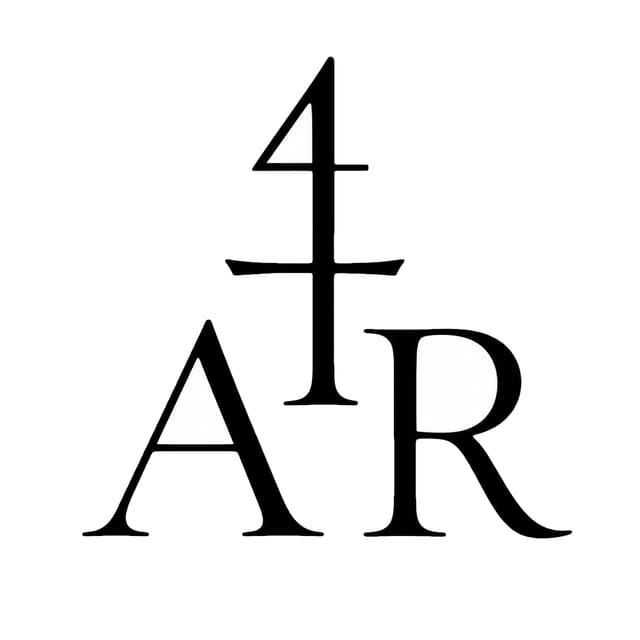
The chief attributional feature of the house of Reballio is the house monogram, which the maker placed at the top of every one of the scale plates. Bolle calls it "a known phenomenon on the barometers of A. Reballio" and returns to it in the description of very nearly every specimen.
Visually it is a mark resembling the figure "4" with a cross, above the letters A and R. Museum catalogues describe it in exactly those terms — "4 with cross and AR."
The sign belongs to the tradition of merchants' house marks, which reach back into the Middle Ages: a crossed "four" was a common element of trade marks throughout northern Europe. Reballio, in effect, put a logo on his goods — and did so in the 1770s, a century before that became standard practice. Given his running battle with counterfeiters (see the advertisements of 1773 and 1794), the motive is obvious: a monogram cast into a pewter plate is harder to fake than a scratched signature.
A. REBALLIO Fecit Rotterdam — c. 1770–1785 — Anthony Christoffel.
A. Reballio Rotterdam — c. 1776–1800 — the same.
Geb. Reballio, Rotterdam — c. 1810–1838 — the brothers A. and E.
A. Reballio & Zoon / Reballio & Son — from 1840 — Angelus and his descendants.
1. The calibration date on the plates. Several Reballio barometers of roughly the same period carry the inscription "Rotterd. 27 Jan. 1776." Bolle notes that on the specimens known to him this date is cast into the pewter plates rather than engraved — meaning a casting mould existed and was in use for some time. Accordingly, the absence of the date on an instrument whose plates are engraved by hand may indicate that the piece is older than 1776.
2. The latest year on the thermometer. Dutch thermometer plates often carried marks for extreme temperatures recorded in various cities and years ("Paris 1743," "Batavia 1753," and so on). The latest year shown gives a lower bound for the instrument's date.
3. The material of the plates. Pewter (tinnen) plates are the earlier and more common practice; silvered brass (verzilverde messing) is the more expensive execution, characteristic of the late eighteenth and early nineteenth centuries.
4. The glazed door. Early contra-bakbarometers as a rule had no glazed door: the plates were left open. Doors were often added later, in a different stylistic period — and, as Bolle acidly observes, "the barometer was usually none the handsomer for it." A door on an instrument of the 1776 type is grounds to suspect later intervention.
5. The address. Vissersdijk → Vissteeg 111 (c. 1860) is the line dividing the eras.
A particular pleasure is the orthography. The Reballios were Italians writing in Dutch, and their plates report the fact honestly. One instrument has MIDDELMATIG with a single "a"; a nearly identical neighbour has MIDDELMAATIG with two. One has HIJGROMETER, the other HYGROMËTER — and with a diaeresis, which turns up just as inexplicably in BAROMËTER and VERÄNDERLIJK. There is also the magnificent Kontraluer for Contraleur.
Bolle concludes outright that the engraving on two nearly identical instruments is "most probably not by the same hand." Which means the workshop put the engraving of its plates out to contract, to different craftsmen — and that the spelling inconsistencies let us tell those hands apart today.
A hundred and seventy-five years. Five generations. Six or seven addresses in two cities. At least eight partners, of whom at least three were Italians and one was his own son. One bankruptcy. Three children born in a Lombard village to craftsmen whose grandfather was already a citizen of Rotterdam. One monogram, two local scales, and a complaint about counterfeiters repeated at twenty-one years' interval.
What makes the history of the house of Reballio interesting is that there is not a single heroic moment in it. Nobody invented a fundamentally new instrument, received a royal patent or outfitted an expedition. This is a history of competence: five generations in a row doing one thing well, changing address at the right moment, taking on the exclusive agency for the instrument that makes your own craft obsolete at the right moment — and stopping when it is time to stop.
In 1925 Albertus Hermanus Reballio closed the firm. He was sixty, he had no children, nobody had been buying mercury barometers for a long time, and aneroids were made in factories. He lived another eleven years.
The instruments are still hanging. Some of them still work.
Principal source
Archival
Eighteenth-century newspapers (cited after Bolle)
Rotterdamse Courant: nos. 50 (1749), 100 (1765), 9 and 16 (1766), 94 (1767), 157 (1768), 112 (1770), 137 (1773), 130 (1779), 134 (1780), 53 (1794), 27 (1815), 96a (1826), 21a (1829).'s-Gravenhaagse Courant: nos. 139 (1753), 139 (1764), 10 (1766), 100 (1767), 54 (1775), 55 (1776), 53 (1777), 56 (1778), 140 (1780), 45 and 124 (1781), 36 (1783), 57 (1784), 55 (1786), 1 and 74 (1787), 25, 55, 73, 89 (1788), 57 (1790), and the issue of 19 May 1790.Museums
Literature and reference resources
's-Grav. Crt. no. 139).'s-Grav. Crt. no. 139).'s-Grav. Crt. no. 10 for 1766 and no. 100 for 1767).