Loading
Origins and Legacy
Félix Lion. Relatively little is known about Félix Lion’s biography prior to the formation of the partnership. He was presumably connected with the manufacture of scientific instruments and appears to have been a Parisian maker of measuring instruments in the third quarter of the nineteenth century, working at 146, Faubourg Saint-Denis, Paris.
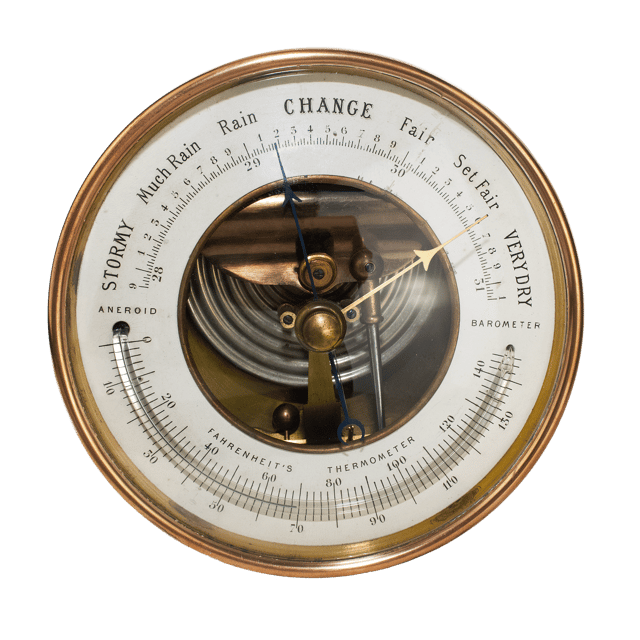
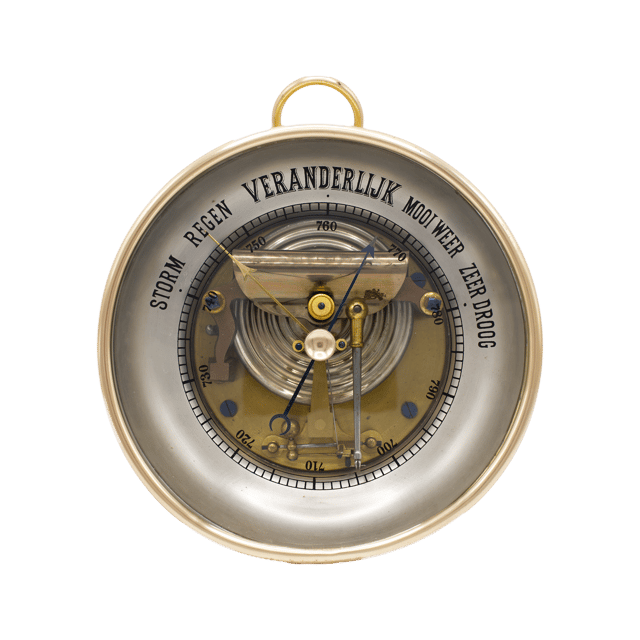
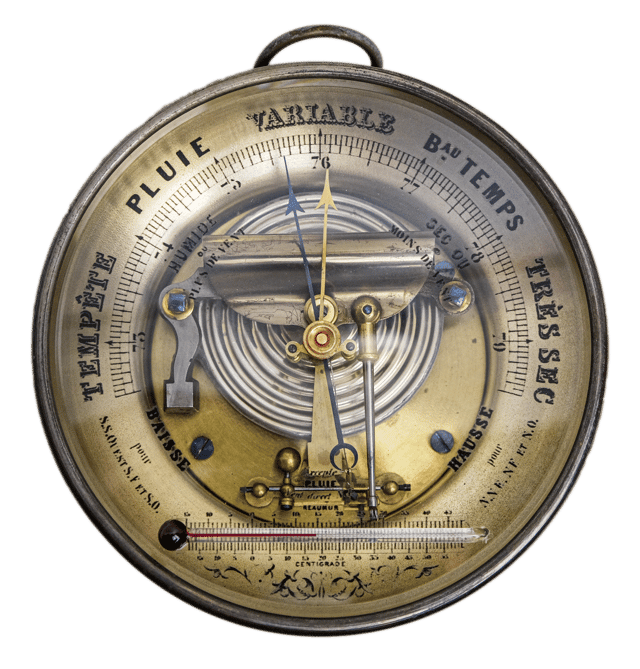
Simon Guichard. Guichard’s activity probably began soon after the expiry of Vidié’s patent in 1859, when several French makers entered the market for liquid-free barometers. One example was the Parisian firm Dubois & Casse, which established serial production of aneroid barometers in the early 1860s. The experience accumulated by Guichard by the late 1860s would later prove highly significant when he joined forces with Félix Lion.
The company Lion et Guichard emerged around 1870, when Félix Lion and Simon Guichard jointly acquired the barometer division of the famous firm Breguet. This division traced its origins directly to Lucien Vidié (1805–1866), the inventor of the aneroid barometer. After patenting the aneroid barometer in 1844, Vidié held exclusive rights for many years. After 1859, however, when the patent expired, other makers entered the market for liquid-free barometers.
In the 1860s, Vidié himself began looking for a successor to his business and regarded the renowned company Breguet as a suitable candidate. In January 1863, he transferred to Louis-Clément-François Breguet his workshop at 8, rue de Rocroy, Paris, together with all tools and equipment, new patent rights, and permission to use the name “aneroid.” In effect, Vidié’s workshop on rue de Rocroy became the production base for the continued manufacture of aneroids under Breguet’s direction. Over several years, from 1863 to about 1870, Breguet produced around 10,000 barometers, but then decided to abandon this line of business.
In 1870, Breguet sold its barometer division to Félix Lion and Simon Guichard. Thus, Lion et Guichard inherited not only Vidié’s manufacturing equipment, but also his know-how, patent developments, and the right to present itself as the continuation of the great inventor’s work.
The new company established itself at the same address where Vidié had once worked: 8, rue de Rocroy, Paris. In advertisements of the 1870s, Lion et Guichard openly described itself as “successeurs de Lucien Vidié.” In doing so, Lion and Guichard emphasised their connection with Vidié’s name and with a tradition associated with high quality. Their enterprise truly became a bridge of continuity: from Vidié, through Breguet, to a new independent firm.
In its first years of operation, in the early 1870s, Lion et Guichard launched large-scale production of aneroid barometers. It is reported that during the 1870s alone the company manufactured thousands of barometers, and that its products circulated not only in France but also abroad; for example, special batches of aneroids were ordered for Russia by the firm F. Schwabe in Saint Petersburg.
In the article published in Portefeuille économique des machines, de l’outillage et du matériel, 20th year, no. 230, February 1875, Paris, plates 9–10, the designers Lion et Guichard described the emergence of the aneroid barometer:
“The fragility of the mercury column barometer, the difficulties of transporting it during travel, and the impossibility of using it at sea, where observations are of the greatest interest for predicting winds, prompted the search for a less fragile barometer containing no liquid. Lucien Vidié, predecessor of Lion et Guichard, after long and serious research, taking as his basis the principle of the equilibrium of atmospheric pressure, created the aneroid barometer.
This instrument consists of a metal vessel, or flattened sphere, formed by two very thin diaphragms hermetically soldered together, between which a vacuum has been created. The walls of this vessel move closer together or farther apart depending on the density of the external air.
A system of levers and clockwork serves, by amplifying these movements, to indicate by means of a pointer on a divided dial the smallest displacements of the vessel walls caused by atmospheric pressure.
Such is the aneroid barometer, whose applications are the same as those of the mercury column barometer. Owing to its very convenient portability, it is used to advantage in travel and for measuring altitudes.”
Further in the article, Lion et Guichard described their own invention: a barometer with a movable legend:
“Since barometric pressure is not the same at different altitudes, it has until now been necessary to adjust aneroids, that is, to set the pointer of the instrument precisely to the pressure mark corresponding to the altitude for which it was intended. This adjustment was carried out by means of a screw that moved the pointer to the right or to the left. This very delicate manipulation often resulted in damage to the instrument, while at the same time disturbing the graduation of the barometer.
The ingenious arrangement of the new Lion et Guichard case completely eliminates these inconveniences; its construction makes it possible to place, without touching the pointer, the word variable at the point on the barometric indicator where it ought to be located… To adjust the barometer is to place the word Variable on the division of the dial indicating the barometric altitude of the place for which the instrument is intended.”
Products and Technical Developments
The firm’s principal products were, of course, aneroid barometers — metal barometers without liquid. Lion and Guichard succeeded in significantly reducing production costs compared with earlier makers. One contemporary review noted that their rationalised methods allowed aneroids to be sold even more cheaply than mercury barometers.
Prices for small pocket aneroids by Lion & Guichard began at 50 francs; at the same time, the meteorologists Hervé-Mangon and E. Renou noted at a meeting of the scientific association that such aneroids were “much more sensitive than mercury barometers costing 40 francs and were not inferior to mercury instruments priced at 80 francs”. In other words, a well-made mid-range metal barometer could surpass a much more expensive liquid instrument in sensitivity. As a result, Lion & Guichard aneroids quickly entered practical use among engineers and travellers.
The company produced models of every size, from miniature pocket barometers to giant public barometers up to one metre in diameter. Special altimetric barometers, or altimeters, by Lion & Guichard earned recognition among surveyors and mountaineers for their reliability and accuracy.
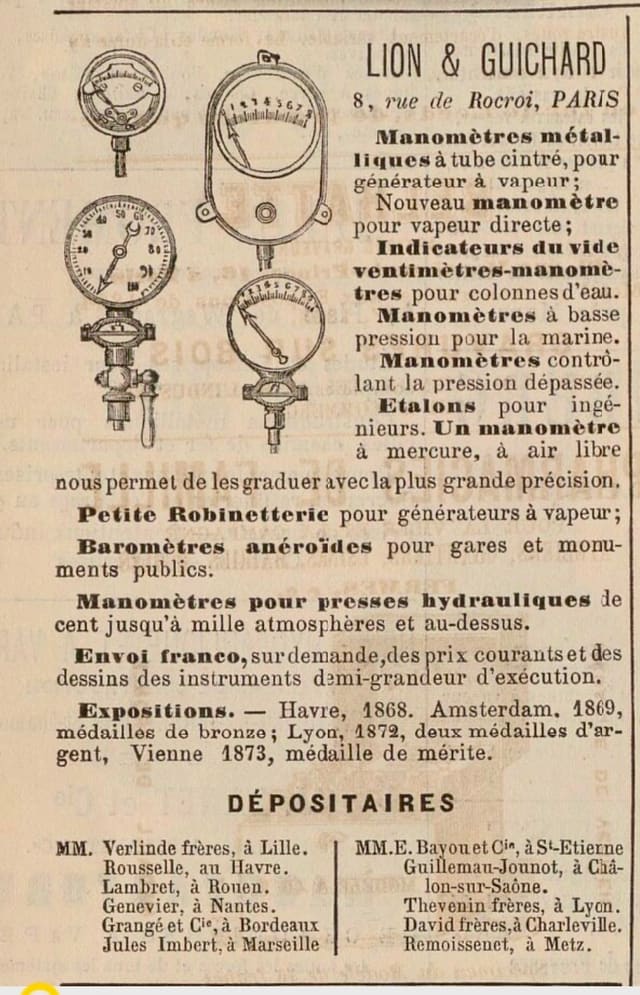
One of the most revealing surviving advertisements of the firm was published in the industrial journal Revue Industrielle on 5 August 1874. In this publication the company appears under the name Lion & Guichard, at 8, rue de Rocroy, Paris, and is presented not as a small workshop for scientific instruments, but as a fully fledged industrial manufacturer of pressure-measuring equipment intended for steam and heavy industry. This advertisement is especially important because it demonstrates the extremely wide range of the company’s products by the mid-1870s. Among the instruments listed are: *metal pressure gauges with curved Bourdon tubes for steam boilers; *a “new direct-steam pressure gauge”; *vacuum indicators and ventimètres-manomètres for water columns; *low-pressure gauges for marine use; *instruments for monitoring excess pressure; *standards for engineers; *pressure gauges for hydraulic presses, designed for pressures from one hundred to more than one thousand atmospheres.
Particularly noteworthy is the phrase: “The mercury manometer with free air enables us to graduate them with the greatest accuracy.” From a technical standpoint, this is an extremely important statement. It shows that Lion & Guichard possessed its own mercury standards for calibrating instruments — an essential condition for any serious nineteenth-century manufacturer of manometric equipment. In other words, the firm did not merely assemble commercial instruments, but had a full metrological base and was able to produce calibrated engineering instruments for industrial use.
The advertisement also mentions: -small fittings and valve equipment for steam generators; -aneroid barometers for railway stations and public buildings; -a network of official representatives throughout France; -awards from industrial exhibitions in Le Havre (1868), Amsterdam (1869), Lyon (1872), and Vienna (1873).
The combination of industrial pressure gauges, public barometers, exhibition awards, and a network of regional representatives clearly illustrates the dual nature of the firm. Lion & Guichard worked simultaneously in the markets for scientific instruments, industrial metrology, steam machinery, architectural barometers, and public measuring devices.
No less important is the context in which the advertisement appeared. Unlike later advertising campaigns in the provincial press, aimed at a mass consumer audience, the publication in Revue Industrielle was addressed to engineers, manufacturers, owners of steam installations, and municipal bodies. It reflects the company at a moment of maximum industrial and technical orientation.
It is important to note that, in addition to the standard constructions inherited from Vidié, the firm continued to innovate. Lion and Guichard worked on improving aneroid mechanisms and collaborated with inventors. In particular, they worked closely with the engineer Tremeschini, a well-known innovator of the 1870s. Tremeschini developed improved instruments; in 1877, he and Félix Lion jointly filed a patent for a new barometer design. In 1878, at the World’s Fair, an “improved aneroid” of their development was exhibited, for which Guichard & Cie received an award, a silver medal.
In addition to barometers, as already mentioned, Lion & Guichard produced a wide range of pressure instruments: Bourdon-tube pressure gauges for steam engines, hydraulic presses, and similar applications, as well as vacuum gauges and control manometers. High manufacturing quality combined with moderate prices earned the firm the highest award, a gold medal, at the International Exhibition in Le Havre in 1875.
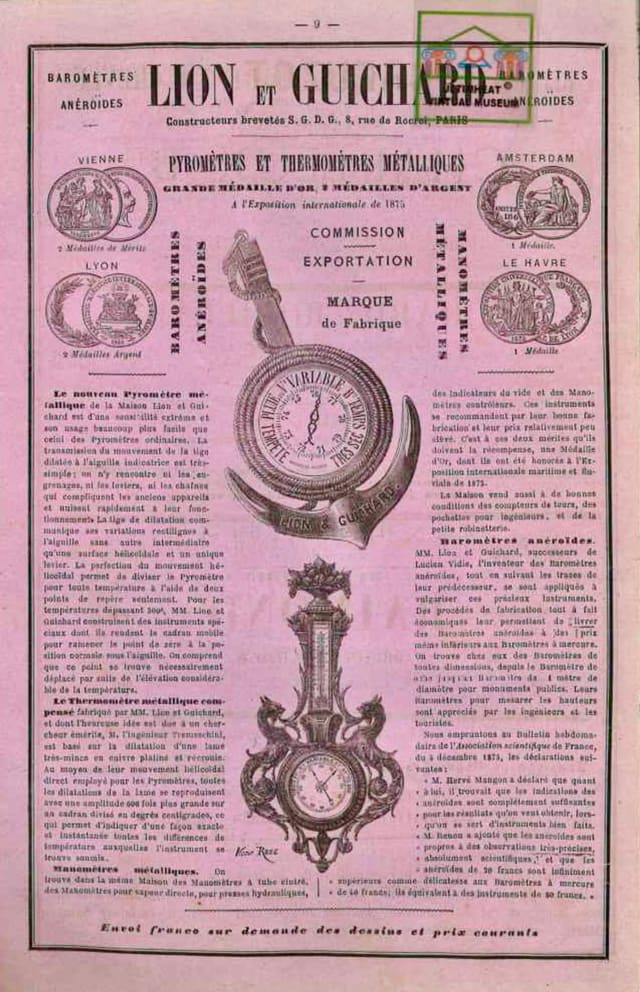
New Designs: Pyrometers and Metal Thermometers
One important line of development involved metal thermometers and pyrometers — instruments for measuring high temperatures without the use of liquids. In the 1870s, Lion and Guichard introduced into production original designs developed by Tremeschini.
In particular, the firm produced a “new metal pyrometer,” described in the press around 1875–1876. This pyrometer was distinguished by exceptional sensitivity and ease of use, surpassing “ordinary pyrometers”. It dispensed with traditional transmissions — gears, levers, or chains — which complicated older instruments and wore out quickly. Instead, it employed an original transmission: the linear expansion of a sensitive rod under heat was transmitted to the pointer by means of a single curved lever and a helicoidal, or screw-like, surface. This screw transmission converted linear motion into rotation of the pointer without a conventional gear train.
Thanks to this system, the pyrometer scale could be calibrated using two reference points, making it possible to cover any chosen temperature range. For very high temperatures, above 300°C, Lion & Guichard produced special variants with a movable dial, so that after strong heating the zero mark could be returned to its normal position relative to the pointer.
Following the pyrometer, a compensated metal thermometer was created — essentially a sensitive thermometer without liquid. The concept belonged to Tremeschini, and the instrument itself was realised at the Lion & Guichard factory around 1878. Its operating principle was based on an extremely thin elastic plate made of a special alloy, for example platinum-plated hardened copper, replacing the liquid. With a change in temperature, the plate slightly lengthened or shortened, and these microscopic changes were transmitted through the same helicoidal mechanism with very strong amplification.
Publications reported that all elongations of the plate were reproduced by the pointer with an amplification factor of around 600, ensuring an immediate and precise response to the slightest temperature fluctuations. Contemporary observers believed that such a metal thermometer reached thermal equilibrium with the surrounding air very quickly and could theoretically surpass ordinary mercury thermometers both in speed of response and in accuracy.
At the Paris World’s Fair of 1878, this thermometer was displayed at the company’s stand and attracted the attention of specialists. The firm emphasised that its factory produced Tremeschini’s experimental prototypes — both the pyrometer and the thermometer.
Thus, by the end of the 1870s, Lion et Guichard not only continued the traditional manufacture of aneroid barometers, but also moved into the avant-garde of scientific instrument making, offering simplified and more sensitive mechanisms for measuring pressure and temperature. This secured recognition in scientific circles: Lion & Guichard instruments were mentioned in technical bulletins and at meetings of meteorologists.
In December 1875, the Bulletin de l’Association scientifique de France gave a particularly high appraisal: “aneroids, if well made, are entirely sufficient for precise scientific observations”, while specifically stressing the superiority of inexpensive aneroids over more inert mercury barometers. These words, attributed to Hervé-Mangon and Émile Renou, were immediately used by the company in its advertising materials, strengthening the reputation of its barometers among potential buyers.
In 1876, the ownership structure of the firm Lion et Guichard changed. Félix Lion withdrew from the business, and the enterprise remained under the control of Simon Guichard, becoming known as S. Guichard & Cie. This name can be found in all subsequent advertisements of the firm, as well as in other press references and company catalogues.
Exhibitions, Awards, and References
As one of the notable French manufacturers of scientific instruments, Lion et Guichard actively participated in industrial and world exhibitions of the 1870s and 1880s, repeatedly receiving high awards. Below is a chronological overview of the firm’s known exhibitions and achievements.
1873, Vienna — World Exhibition (Weltausstellung 1873 Wien). At the Vienna World Exhibition, the company appeared as an official French exhibitor. The catalogue of the French section contains the following entry:
“2476. Lion et Guichard, Paris, rue de Rocroi, 8 — aneroid barometers, manometers”.
The firm received awards for the instruments exhibited. According to later advertising, at the Vienna exhibition of 1873 Lion & Guichard obtained two silver medals, possibly in different subcategories — for example, separately for barometers and manometers. In the official Viennese award system there were “progress medals” and “merit medals”; both Lion & Guichard awards probably corresponded to the second category, the silver level. The diplomas and medals received in Vienna confirmed the high international standing of the young firm.
1875, Le Havre — International Maritime Exhibition. In 1875, the French port of Le Havre hosted an international exhibition devoted to maritime affairs and navigation. Lion et Guichard presented its pressure instruments there — probably marine barometers, pressure gauges for steamship engines, and similar devices. For outstanding quality and affordability, the firm received the exhibition’s gold medal.
In the company’s own accounts, it was emphasised that precisely the combination of high-quality workmanship and moderate price had brought it this highest award: “for these two qualities the firm was awarded the gold medal at the International Maritime and River Exhibition of 1875.” This victory considerably strengthened the firm’s reputation, especially among naval and military customers.
1876, Philadelphia — Centennial Exposition. At the Centennial Exposition of 1876 in Philadelphia, France was also widely represented. The exhibitors’ catalogue mentions Lion et Guichard, Paris, in the category of “metal manometers,” that is, aneroid-type instruments. It is possible that the firm showed both standard aneroids and new developments — pyrometers and improved thermometers — to an American audience.
No definite information about awards in Philadelphia has yet been found, but participation itself demonstrates the company’s export ambitions and its desire for worldwide recognition. Presenting instruments overseas required coordination through the French export exhibition commission of 1876, and Lion & Guichard evidently managed this successfully.
The firm’s barometers attracted attention abroad, which subsequently led to foreign orders. It is known, for example, that the Moscow shop of F. Schwabe was already selling Lion & Guichard aneroids in the 1870s.
1878, Paris — World Exhibition (Exposition Universelle 1878). This exhibition was a triumph for many French scientific-instrument makers, and Guichard & Cie was no exception. In 1878, the firm displayed a wide range of products — from pocket travelling barometers to large public instruments, as well as its new pyrometers and thermometers.
The jury awarded the firm several distinctions, including a silver medal for barometers. There are also indications that Guichard received a bronze medal in another category at the same exhibition, possibly for related instruments. One international catalogue states:
“Guichard (Simon) & Co., Paris — 1878, Paris: silver and bronze medals; barometers, manometers, hydrometers, etc.”
Thus, on the principal world exhibition stage, the firm consolidated its position with medals of different ranks.
In addition, the improved aneroid by Tremeschini, manufactured by Lion & Guichard, was displayed at the Paris exhibition of 1878, received a separate silver medal, and was widely covered in the press. Guichard’s name appears in the official list of prize-winners in the category of meteorological instruments.
1879, Sydney — Sydney International Exhibition. After its European successes, Guichard & Cie turned toward other continents. The firm is known to have had an agent in Australia; documents mention a representative, Mr L. Moonen, in Sydney. It is likely that the company’s products were presented at the Sydney exhibition of 1879 through this agent.
The exhibitors’ catalogues contain a profile of the firm listing its medals, including the awards from the Paris exhibition of 1878, silver and bronze. No direct record of a new Sydney medal has been found, but the participation itself testifies to the global presence of the brand.
The Australian market showed interest in French instruments; Lion & Guichard barometers may have been used in agriculture and meteorology in the colonies. The presence of a local agent confirms an established export system.
1881, Paris — International Exhibition of Electricity. In the early 1880s, Guichard’s firm remained active. It participated in the Exposition Internationale d’Électricité in Paris in 1881, presenting developments at the intersection of meteorology and new technologies.
According to the catalogue, Guichard et Cie exhibited manometers, hydrometers, and barometers for buildings with electric lighting. These were instruments intended for installation in public spaces and fitted with electric illumination — for example, large wall barometers with illuminated dials for railway stations, exhibition halls, and similar locations.
Such devices served the popularisation of science. At that time, public barometers were installed in streets and gardens in Paris; it is possible that Lion & Guichard products were also used in combination with electric lamps.
The awards at the exhibition were mainly in the form of special diplomas; whether the firm received such a mention is not known with certainty. In any case, its participation underlines the company’s ability to adapt to new trends, combining the traditional barometer with advanced electrical technology.
^1883, Amsterdam — International Colonial and Export Exhibition.* In 1883, Amsterdam hosted a major international exhibition devoted to industry and colonial trade. France presented leading exhibits there. Although no direct archival references to Guichard have been found, the firm’s advertising materials include Amsterdam among the cities where awards were received.
It may be assumed that Guichard’s products were recognised at the Amsterdam exhibition, perhaps with a medal of merit or an equivalent award, potentially corresponding to a silver level. Some French sources mention “2 médailles de mérite” received by the firm — perhaps referring precisely to Amsterdam 1883 and another congress.
In any case, Guichard & Cie continued its international activity in the 1880s and was no longer limited to France.
Apart from exhibitions, Lion et Guichard was regularly mentioned in directories and the press. Paris commercial yearbooks, such as Didot-Bottin, for the 1870s and 1880s list the address 8, rue de Rocroy under “physical and meteorological instruments,” naming the firm’s specialities: barometers, manometers, thermometers, and so on.
Trade journals published reviews of new instruments; La Nature and other publications probably covered improvements to aneroids. Scientific endorsements, such as the above quotation from the bulletin of the scientific association, became a valuable advertising tool, and the firm actively used them in its promotion.
Printed advertising leaflets by Lion & Guichard are known, listing awards by city: Paris, Vienna, Amsterdam, Le Havre, and others. One such leaflet, dated to around 1876, contains product descriptions in three languages — French, English, and Chinese — with the phrase:
“Baromètres anéroïdes, Pyromètres et thermomètres métalliques. Successeurs de Lucien Vidié…”
This indicates the firm’s orientation toward export to East Asia. Indeed, some Lion & Guichard aneroid barometers reached China and Japan through trading houses.
Legal Reorganisation of the Company after 1876
In 1876, an important and documentarily recorded change occurred in the history of the firm. Evidence of this has survived in the section Ventes de fonds de commerce de Paris et de la Seine (“Sales of Commercial Businesses in Paris and the Seine Department”), published in Archives commerciales de la France, 3rd year, no. 69, Sunday, 27 August 1876.
Archives commerciales de la France was a French commercial and legal periodical that published information on trading partnerships, bankruptcies, divisions of property, judicial notices, and sales of fonds de commerce in Paris and the departments of France.
The lists of sales of commercial businesses in Paris were printed as official notification to creditors and business partners concerning the sale of a business. In nineteenth-century France, the sale of a fonds de commerce — a commercial enterprise, clientele, workshop, shop, lease rights, and so forth — required public announcement, so that any potential creditors could submit claims.
The publication contains the following entry:
“Lion — Guichard et Cie, Droits soc. Lion et Guichard, rue Rocroy, 8.”
This refers not to the transfer or liquidation of rights within the partnership itself. The abbreviation droits soc. means droits sociaux — that is, the shares and rights of the company’s participants.
In essence, the document shows that one of the original partners, Félix Lion, left the business, while Guichard either bought out his share or continued the activity within a new legal structure.
This interpretation is strongly confirmed by subsequent advertising publications. If in advertisements of the first half of the 1870s the firm consistently appears as Lion & Guichard, then in advertisements of 1879–1880 other designations begin to appear: -Maison S. Guichard & Cie; -or simply Guichard & Cie.
At the same time, the formula “successeurs de Lucien Vidie, inventeur du baromètre anéroïde” (“successors of Lucien Vidié, inventor of the aneroid barometer”) is systematically emphasised.
Thus, the disappearance of Lion’s name from advertising after 1876 is almost certainly directly connected with the legal reorganisation of the firm recorded in the judicial publication.
The designation Guichard & Cie is also important from the standpoint of business history. In nineteenth-century French commercial practice, such a formula usually meant that the enterprise continued to exist with the participation of other associates, investors, or silent partners, but was publicly associated with one principal owner — in this case, S. Guichard.
By the end of the 1870s, the company had finally transformed from the engineering partnership Lion & Guichard into the commercial house Maison S. Guichard & Cie, actively engaged in the mass distribution of aneroid barometers through the regional press, subscription campaigns, and provincial retail networks. This transition reflects an important historical shift: from a specialised manufacturer of engineering instruments to a major commercial supplier of domestic aneroids for the bourgeois market of Third Republic France.
By the late 1870s, the Guichard company had already moved far beyond the narrow circle of scientific-instrument makers and was actively using the regional press as a channel for the mass distribution of aneroid barometers. Particularly revealing are the advertisements published in the French provincial newspapers Le Patriote Albigeois on 31 December 1879, Journal de l’Ariège on 18 January 1880, and Courrier de Narbonne on 29 January 1880. These publications show how the aneroid barometer was finally being transformed from a specialised scientific instrument into a mass bourgeois commodity.
This was not merely advertising in the modern sense, but an entire system of subscription “premiums” (primes), extremely popular in France in the second half of the nineteenth century. Newspapers offered subscribers preferentially priced goods — watches, books, household objects, and also scientific instruments. To do this, editorial offices concluded agreements with manufacturers and effectively acted as intermediaries between the factory and the reader.
Thus, in the Courrier de Narbonne of 29 January 1880, a notice appeared under the heading Nos primes (“Our Premiums”), offering subscribers American clocks, pocket watches in nickel-plated and gilt cases, and also “a fine collection of aneroid barometers” priced from 14 to 30 francs. The advertisement stated directly: “These magnificent instruments are manufactured by the house of Guichard of Paris, successor of Lucien Vidié, inventor of the aneroid barometer.”
This kind of wording appeared systematically and formed a crucial part of the company’s marketing. Guichard promoted not so much his own name as his connection with Lucien Vidié, the creator of the aneroid. For the public of the 1870s and 1880s, Vidié’s name was still associated with scientific authenticity and the original invention, so the phrase successeurs de Lucien Vidié effectively functioned as a guarantee mark.
An even more extensive advertisement appeared in Le Patriote Albigeois on 31 December 1879. It stated that an agreement concluded with the house of S. Guichard & Cie, successeurs de Lucien Vidié, of Paris, made it possible to offer subscribers a collection of “aneroid barometers of various forms and sizes” at “exceptionally reduced prices, considerably lower than in ordinary trade.” Readers were promised the publication of a complete list of seven models in the next issue, and the instruments themselves could already be seen at the newspaper’s office.
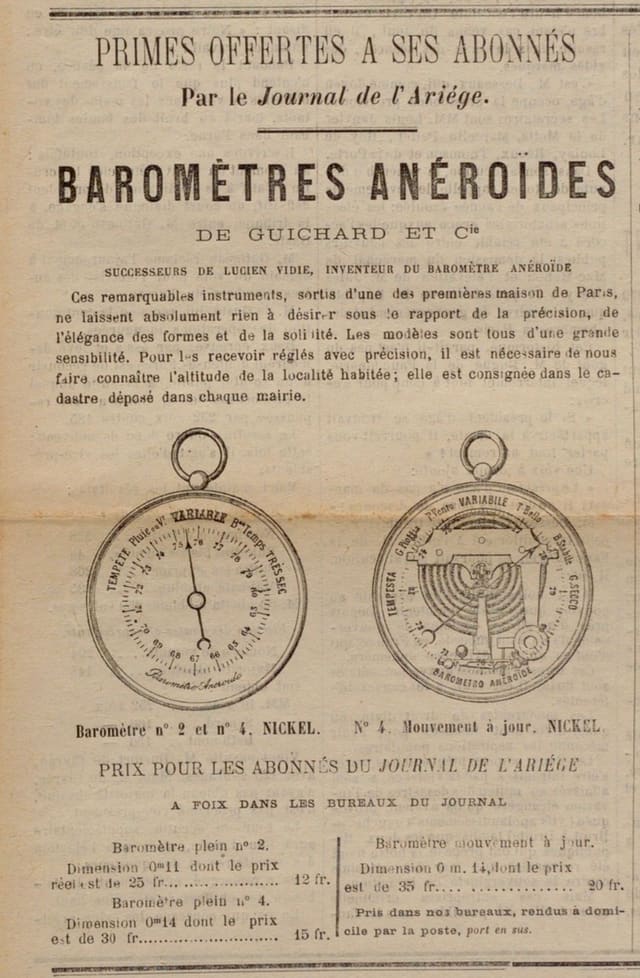
An almost identical advertising campaign was also launched in the Journal de l’Ariège on 18 January 1880. Here Guichard aneroids were again offered as premium goods for subscribers, but the advertisement was noticeably more detailed and technically specific. It stressed that the instruments “leave nothing to be desired either in respect of accuracy, elegance of form, or solidity,” and that all models possessed “high sensitivity.” A particularly interesting practical detail was that buyers were invited to indicate the altitude of their locality above sea level, so that the barometers could be precisely calibrated in advance. The text stated directly that the relevant data could be obtained from the cadastral records of each mairie. This shows that even Guichard’s mass-produced goods retained a claim to scientific accuracy and to individual adjustment of the instrument.
The advertisement in the Journal de l’Ariège also provides a rare insight into the company’s pricing policy. Subscribers were offered nickel-plated aneroids with diameters of 11 and 14 centimetres at 12 and 15 francs instead of the usual 25 and 30 francs respectively, while a model with an “open movement” (mouvement à jour) was sold for 20 francs instead of 35. Thus, the discounts reached almost half of the market price. In effect, newspapers became a kind of catalogue-based distance-trading system, while editorial offices became points for displaying and distributing the instruments.
It is especially noteworthy that the illustrations in these advertisements show several directions in Guichard’s production at once: from compact pocket aneroids to richly decorated wall-mounted models in the Second Empire style, with ornamental cases and decorative elements. This demonstrates that the company was oriented not only toward the scientific use of instruments, but also toward the market for interior objects intended for bourgeois homes.
Such collaboration with the press became one of the key factors in the mass dissemination of aneroids in France. Regional newspapers possessed wide subscription networks and reached far beyond Paris, allowing Guichard barometers to find their way into provincial towns and rural areas. In effect, the company used an early form of catalogue trade and distance selling long before the rise of the department stores and mail-order catalogues of the twentieth century.
These advertisements also demonstrate an important historical shift: by 1880, the aneroid barometer was no longer perceived as a rare laboratory instrument, but as a modern domestic object — useful, decorative, and prestigious at the same time. It was precisely through such advertising campaigns that the house of Guichard played a notable role in transforming the aneroid from a scientific novelty of the mid-nineteenth century into a mass object of European bourgeois culture.
Later Years and Cessation of Activity
In the 1880s, a partner named Bisson joined the business, which is reflected in the name Guichard, Bisson et Cie by 1889. This period was accompanied by an expansion of the product range: instruments for new fields of application were added, such as steam regulators, counters, and other industrial devices. Bisson may have brought engineering expertise in the fields of steam machinery or electrical technology.
Nevertheless, the end of the nineteenth century brought new difficulties. Competition in the market for scientific instruments increased sharply. Larger specialised firms appeared — for example, the well-known Parisian workshop PHBN, which produced high-quality aneroids in large quantities, or the Jules Richard works, with their serially produced barographs. Gradually, Lion & Guichard lost its leading position.
Simon Guichard belonged to the mid-nineteenth-century generation and probably withdrew from active business by the 1890s.
The precise date of the firm’s liquidation has not yet been established. Indirectly, it may be observed that after the 1890s the name Lion & Guichard virtually disappears from references. One dictionary of scientific-instrument makers states that S. Guichard & Cie existed until approximately 1900.
Most likely, the firm ceased activity around this time as a result of a combination of factors: the departure of its founders, the absence of successors, and severe competition from larger factories using newer technologies.