Loading
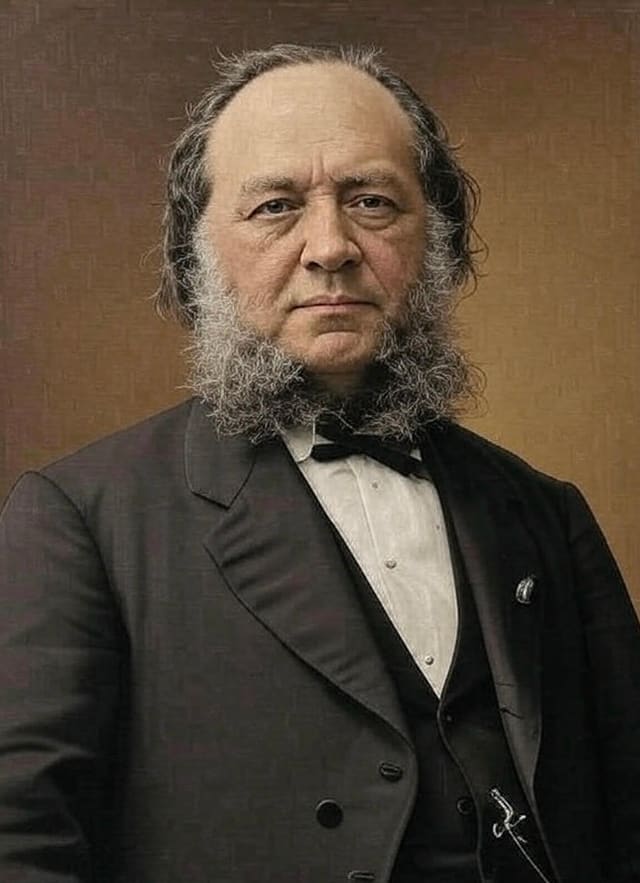
Louis-Clément-François Breguet (1804–1883) was the nephew and successor of Antoine-Louis Breguet (1776–1858) and the great-grandson of the founder of the family company, Abraham-Louis Breguet (1747–1823). The Breguet family dynasty is renowned for its outstanding achievements in horology and science. Abraham-Louis Breguet, Swiss by origin, established his workshop on the famous Quai de l’Horloge (39 Quai de l’Horloge, Île de la Cité, Paris) in 1775 and created numerous groundbreaking inventions, including the tourbillon, minute repeater, and many others. His eldest son, Antoine-Louis Breguet (1776–1858), after working with John Arnold in London, inherited the workshop in 1823 and soon transferred it to his nephew Louis-Clément. Louis-Clément Breguet continued the family enterprise, transforming it from a purely horological workshop into a manufacturer of scientific instruments and electrical devices characteristic of the second half of the nineteenth century.
Louis-Clément Breguet was born on 22 December 1804 in Paris, in the very house on Quai de l’Horloge where his famous grandfather had also lived. Part of his education was received in Switzerland: from the age of eight to sixteen he studied under the care of his godfather in Neuchâtel, after which he trained in the Breguet workshops in Paris. From 1824 onward he apprenticed with watchmakers in Versailles, later working with the watchmaker Barral in Geneva until 1827, before returning to Paris. There he assumed responsibility for the firm’s marine chronometers, improved precision instruments, and attended physics lectures at the École Polytechnique under François Arago. In 1833 Breguet married Caroline Lascieux, niece of Abraham Breguet; they had two daughters and a son, Antoine (1851–1882). In the same year, his father Antoine-Louis Breguet retired and transferred the family business to Louis-Clément, selling the company (then operating as “Bréguet et fils”) for 270,000 francs to a new partnership, “Bréguet Père et Cie,” led by Louis and his relative Lucien Lascieux. From this moment onward, the firm began to transform: Breguet concentrated increasingly on scientific research, while serial production of precision watches and chronometers was delegated to experienced workshop masters.
Activities
Under the direction of L.-C. Breguet, the company gradually shifted its focus from luxury horology toward scientific instruments and electrical engineering. Already in the 1840s and 1850s Breguet was developing highly advanced apparatus. In 1841 he introduced a thermometrograph — an automatic recording thermometer based on a tri-metallic strip. In the same year, together with Doctor Antoine Masson, he developed the first French induction coil, a predecessor of the Ruhmkorff coil, capable of generating high-voltage electrical discharges.
In 1844 Breguet, together with engineer Alphonse Foy, created the electric telegraph with pointer carriage (“Foy–Breguet telegraph”), improving upon the English Wheatstone–Cooke system. The apparatus was rapidly adopted by railway companies and exhibited at the Paris Exhibition of 1844. Breguet also developed portable and printing telegraphs: by 1846 his firm was manufacturing printing telegraphs, lightning-protection devices for telegraph lines, and other electrical instruments for telecommunications. In 1851 he published Manuel de télégraphie, one of the earliest French manuals devoted to telegraphy.
Alongside telegraphy, Breguet produced scientific instruments. According to the 1877 catalogue, the company issued brochures and catalogues advertising apparatus for astronomy, physics, chemistry, meteorology, and related disciplines — ranging from electromagnetic indicators and electrical measuring devices to physiological instruments. Breguet modernized the metallic thermometer originally proposed by his grandfather Abraham, whose sensing element consisted of a thin tri-metallic spiral combining gold, platinum, and silver, and incorporated it into clocks and watches. Under his direction, the firm also constructed the rotating mirror used in the Foucault–Fizeau experiment for measuring the speed of light in 1850.
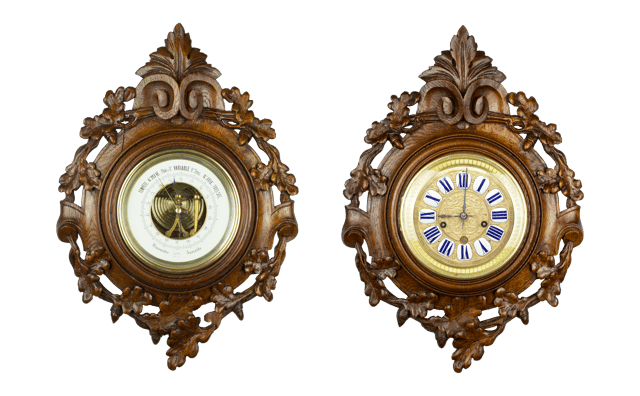
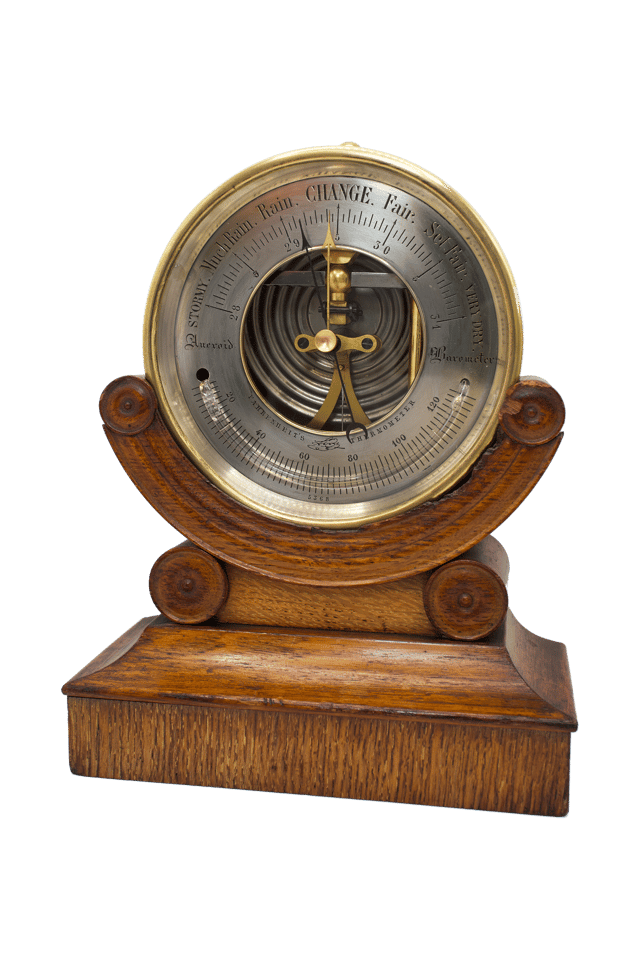
The Aneroid Barometer Line
Louis-Clément Breguet became the successor of Lucien Vidie, the inventor of the aneroid barometer. Vidie’s mercury-free aneroid barometer was patented in 1844, though the patent rights expired in the mid-1850s. In a letter to Breguet, Vidie wrote:
“I transfer to you the rights to the term ‘anéroïde’ from the moment it entered public use. I also transfer my latest patents. … I shall hand over to you all premises, equipment, and tools necessary for manufacture.”
Vidie granted Louis-Clément Breguet the exclusive right, beginning on 1 January 1863, to manufacture aneroid barometers in France based upon the patent of 18 August 1858, known as the “bielle oblique” (“oblique connecting rod”) patent. The transfer included all property, equipment, tools — including specialized tooling — materials, and all finished and unfinished instruments at the workshop. The essential feature of the 1858 patent was the so-called bielle oblique mechanism.
Breguet himself emphasized that he had done nothing to deserve such generosity. In a letter dated 2 December 1862 he stated that he had never personally known Vidie. The inventor knew him only by reputation and chose him as a trustworthy man worthy of inheriting the invention.
For Vidie, the transfer of his life’s work to the House of Breguet was not merely a business transaction. It represented the culmination of a lifelong struggle. His patents had expired, former students and workmen had opened their own workshops, and aneroid barometers were appearing on the market in large numbers — most of them no longer connected with him in any way. Vidie made a conscious decision: if the device was destined to live its own independent life, then it should at least remain in reliable hands. He transferred his entire enterprise — “the whole laboratory,” as he described it — into Breguet’s care. More than two hundred pages of sketches, dozens of engineering solutions, tools, mechanisms, unfinished cases and corrugated capsules, temperature-compensation systems, drawings of gears and springs… all of this passed into a new era. “The word ‘anéroïde,’” stated the notarial deed, “has become inseparable from the inventor himself. From this moment onward it is transferred as part of the gift, though without any guarantee.”
Thus Maison Breguet opened a completely new field of activity: the manufacture of barometers for the continental European market. The agreement permitted the company to use the designation “Baromètre anéroïde” on dials in the corresponding national language and to add the “Breguet” signature or trademark.
At first, production followed Vidie’s own models and in part even his original drawings, but over time Breguet established an independent manufacturing base.
In 1864 Eugène Bourdon’s patent on the famous Bourdon tube expired, and Breguet likewise began employing tubular pressure elements. However, he promoted shortened Bourdon tubes — half and quarter-circle forms — which never achieved widespread success.
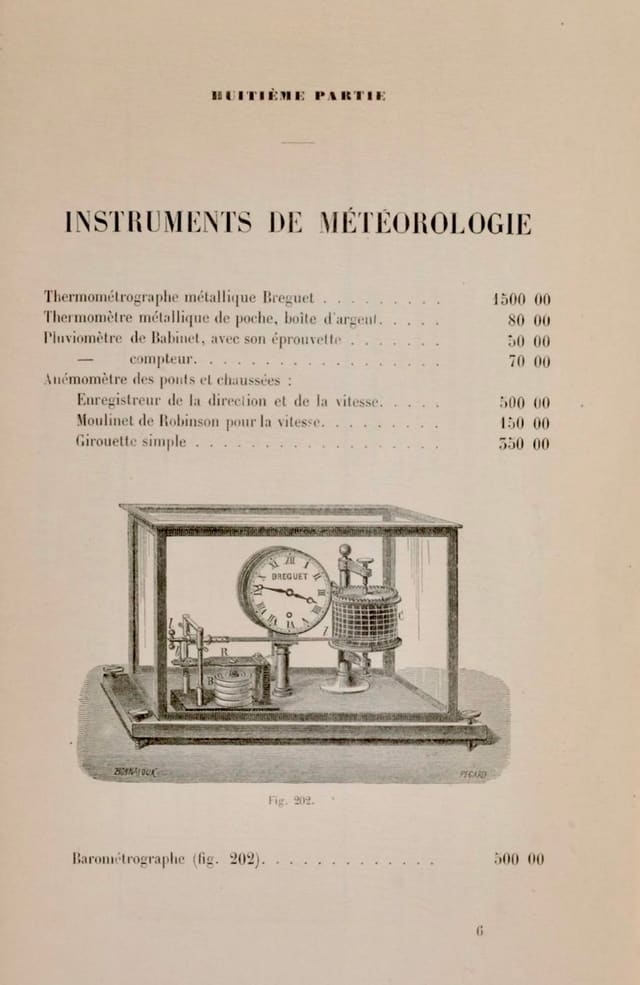
Breguet is also associated with the earliest known recording aneroid barometer. It was exhibited at the Paris International Exhibition of 1867. The instrument incorporated a separate clock movement independent of the recording drum, itself displaying the time, while the recording stylus traced its line upon smoked paper. The barograph continuously recorded the indications of an aneroid assembly composed of four corrugated metallic capsules from which the air had been evacuated. The indicating lever was connected to a flexible pen drawing upon a cylinder driven by a clockwork mechanism making one complete revolution per week. The cylinder was covered with glossy paper coated with soot varnish.
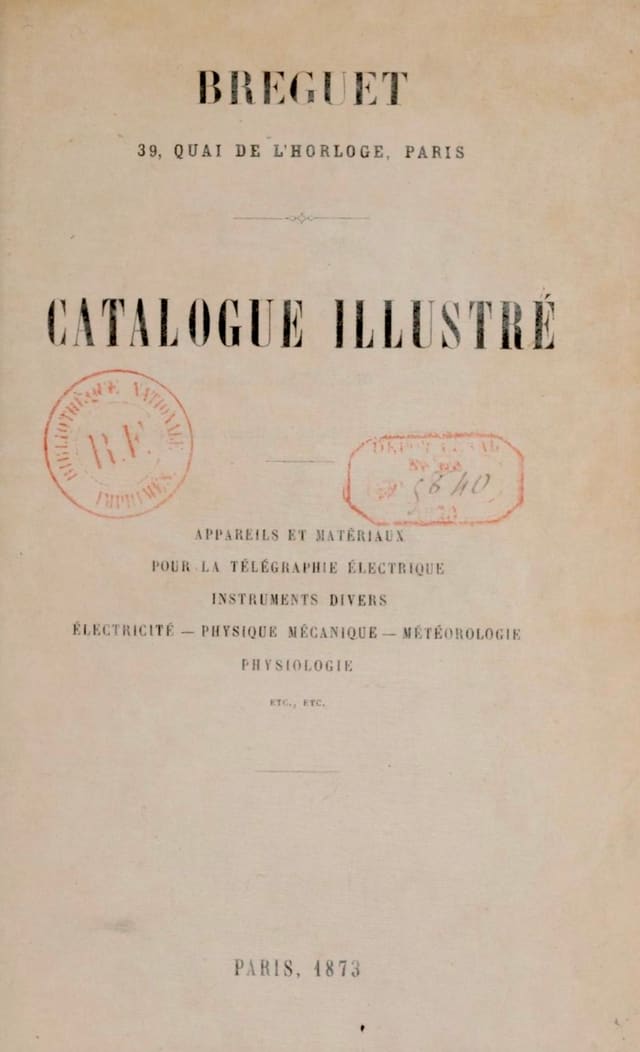
The Breguet catalogue published in Paris in 1873, Catalogue illustré. Appareils et matériaux pour la télégraphie électrique, instruments divers, électricité, physique, mécanique, météorologie, physiologie etc., demonstrates the extraordinary breadth of the company’s activities. The section Instruments de météorologie occupied a dedicated portion of the catalogue and presented the following instruments:
The catalogue also listed wind-measuring and civil-engineering meteorological instruments:
Particularly significant is the inclusion of the:
Even more important is a separate section titled Baromètres anéroïdes pour l’usage civil (“Aneroid Barometers for Civil Use”). Here the company offered a broad assortment of domestic and travel aneroids of various diameters and finishes. The table lists decorative variants including:
The catalogue demonstrates not only the scientific but also the decorative aspect of Breguet aneroids. Many models were clearly aimed at the bourgeois market of the Second Empire and early Third Republic, where the aneroid barometer had become simultaneously a technical and status object.
Of particular interest are the following listings:
This demonstrates that Breguet was also actively engaged in altimetry, an important field for geodesy, travel, and early mountaineering practice in the nineteenth century.
Thus, the 1873 catalogue presents Maison Breguet as a universal scientific and engineering enterprise situated at the intersection of the old world of precision instrument making and the new era of electrical engineering.
In 1870 Louis-Clément Breguet abandoned horology, selling the watchmaking branch to his workshop manager Edward Brown. The heirs of Edward Brown later sold the trademark in 1970 to the Parisian jeweller Chaumet, who subsequently revived the brand. Around the same time, Louis also sold the barometer division of Maison Breguet to the firm Lion & Guichard, who continued the production of aneroid barometers while presenting themselves as successors to Lucien Vidie himself.
After the death of L.-C. Breguet in 1883, successive ownership changes and shifting industrial priorities led the company away from both watches and barometers toward engineering and aviation. Surviving Breguet aneroid barometers are today museum rarities. For example, a late-1860s “Breguet–Vidie system” barometer survives in the collection of the CNAM, donated by the company in 1893. In private collections, Breguet meteorological instruments remain extremely rare and are regarded as highly desirable by collectors and historians alike.
Transition from Horology to Scientific Instruments
The second half of the nineteenth century marked a profound transformation in the profile of the family business. Historians note that the Breguet family evolved from a traditional artisanal workshop into an industrial producer of scientific and electrical apparatus. Both market and technological factors contributed to this transition: demand for telegraphic, navigational, and industrial instruments grew far more rapidly than demand for expensive pocket watches, while the technical talents of L.-C. Breguet increasingly lay in the fields of physics and electricity.
Already in the 1830s and 1840s Breguet collaborated with scientists such as Arago, Foy, and Masson in electrical research. In 1843 he became an adjunct member of the Bureau des Longitudes in Paris, and in 1847 a full member, succeeding Gambey. Scientific recognition contributed to a strategic change within the company: precision clocks became secondary products, while advanced scientific apparatus became central. According to biographers, Louis-Clément’s “curiosity and fascination with electricity” encouraged him to devote himself increasingly to physical and electrical instruments, while chronometer production remained under workshop supervision.
Legal barriers that had once restricted production under eighteenth-century guild systems no longer hindered industrial development after the French Revolution. At the same time, the precision-instrument industry increasingly required substantial investment and factory-scale organization — something Breguet successfully established. By the 1880s Maison Breguet operated several factories in Paris and its suburbs, equipped with large steam engines and powerful dynamos producing electrical equipment including generators, telegraph and telephone apparatus.
In a broader sense, this transformation reflected both Breguet’s exceptional inventive energy and the changing industrial priorities of the nineteenth century. Luxury watches gradually gave way to laboratory instruments, yet the family tradition of precision craftsmanship survived in new forms: through electrical engineering and aneroid instruments, the Breguet legacy ultimately extended into turbines and aviation.
Products and Achievements of Louis-Clément Breguet
The results of Breguet’s work included hundreds of instruments and devices: metallic thermometers and thermographs, aneroid barometers, hygrometers and meteorological sensors, chronoscopes for velocity measurement, tonometers, and photoelectric apparatus.
Among his principal achievements were:
Generational Transition
Louis-Clément Breguet died on 27 October 1883 at the age of seventy-eight in the same house on Quai de l’Horloge where his grandfather’s workshop had once stood. He was buried at Père-Lachaise Cemetery beside Abraham-Louis and other members of the family. By that time Maison Breguet, under the leadership of his son Antoine, had already become a joint-stock company under the name SA Maison Breguet.
Of Breguet’s three children, the most active was his son Antoine (1851–1882), who inherited the enterprise. He supervised the construction of new factories and the company’s participation in electrical exhibitions but died prematurely of tuberculosis in 1882. Breguet’s daughters, one of whom became the great-grandmother of Sophie Berthelot, wife of the famous scientist Marcellin Berthelot, devoted themselves to science and education rather than business. After the deaths of Antoine and Louis-Clément, the family experienced a difficult period: production temporarily contracted, and during the 1880s and 1890s the company concentrated primarily on electrical engineering, lighting equipment, generators, steam machinery, and power plants.
Antoine Breguet’s only son, Louis-Charles Breguet (1880–1955), would become the famous aircraft constructor and founder of the aviation company Société d’Aviation Louis Breguet. Educated at the École Polytechnique, he devoted himself to aircraft and helicopter design and in 1912 established an aviation engineering bureau that later produced record-breaking aircraft and became one of the founding components of Air France. Thus the aviation branch of the Breguet family represented the continuation of the same technological lineage.
Later History of the Company
After the death of Louis-Clément Breguet, the company definitively abandoned horology. Shareholders and new directors increasingly invested in electrical engineering and industrial machinery. By the end of the nineteenth century Maison Breguet had become one of the leading electrical and engineering firms in France, manufacturing generators, lighting systems, and telecommunication equipment. Watch production nearly disappeared, surviving only as servicing work and rare exceptional creations, while meteorological instruments became part of the company’s historical legacy. When the firm later became associated with Schneider and subsequently Alsthom, the Breguet name became firmly linked with aviation.
The barometer line appears to have been discontinued by the beginning of the twentieth century, although no exact date survives in the sources. By the 1900s and 1910s the company no longer advertised meteorological instruments. Existing examples survive almost exclusively in museum collections and private holdings. The CNAM museum in Paris preserves an aneroid barometer of the “Vidie system” donated by Maison Breguet in 1893, while certain maritime museums retain shipboard Breguet barometers, such as the example from the vessel Johannes Kepler displayed in Warnemünde.
Inventions and Distinctions
Louis-Clément Breguet personally held several patents, preserved today in the archives of the French INPI, covering electrical and scientific apparatus from the 1840s through the 1870s. He published extensively: besides Manuel de télégraphie (1851), he authored papers on electrical engineering and scientific instrumentation. During the 1840s and 1850s he regularly presented innovations at scientific congresses and international exhibitions, from the Paris Exhibition of 1844 to the Great Exhibition of London in 1851. Contemporary journals such as La Nature and Comptes rendus frequently discussed Breguet apparatus. The Annuaire scientifique of 1868, for example, described his aneroid barometer employing four superposed capsules.
Breguet received major state honours, including appointment as Officer of the Legion of Honour for his contributions to science and industry. In 1877 he became a full member of the French Academy of Sciences in the section of mechanics and electricity, following in the intellectual tradition of both his grandfather and many colleagues from the École Polytechnique. During the 1880s he was enthusiastically invited to serve as an external professor at the École Normale and the Conservatoire des Arts et Métiers.
In summary, Louis-Clément Breguet stands as one of the major scientific-industrial figures of nineteenth-century France. His inventions — from induction coils and telegraphs to meteorological and military instruments — earned him a reputation as a true “scientist-industrialist.” The history of Maison Breguet reflects this transformation: from precision watchmaking to scientific instrumentation, electrical engineering, and ultimately the aviation industry of the twentieth century.
Bibliography and Sources