Loading
Late in the evening of 8 March 1943, British bombers appeared over Nuremberg. The raid began at 11 p.m. with 335 four-engined Royal Air Force aircraft. Among the targets hit were the southern part of the Old Town with the Mauthalle, the Imperial Castle, the Siemens transformer works and the marshalling yard. The Mauthalle is a huge late-Gothic granary that later served as a customs house. It stands on Königstraße, the main shopping street, which runs from the railway station to St Lorenz Church.
That same night the shop at Königstraße 25–27, where the court optician Leidig had been trading for twelve years, was badly damaged. Babette Leidig, widow of Georg Leidig, was killed. Later accounts call her the head of the firm at the time.
The firm was ninety years old that year. It had outlived the Bavarian kings and the Prince Regent, the First World War and the fall of the monarchy, whose title had long remained on its cases and labels. It might have seemed that the story ended under the rubble. Yet it goes on to this day. To understand what burned that March night, one has to go back ninety years, to a workshop where lorgnettes were made.
Nuremberg took up spectacle-making long before Leidig. By the end of the fifteenth century the city, close to the glassworks of the Bavarian and Bohemian Forests, had become the most important centre of the spectacle-makers' craft. According to the Opticians' Guild of Middle and Lower Franconia, twelve "Parillenmacher", as spectacle-makers were called, were already registered in the city in 1478. In 1535 the city council issued the spectacle-makers' ordinance (Parillenmacherordnung). It regulated training, quality control, the origin of materials and the methods of working them. Today's guild opticians call it the birth certificate of the organised German optician's craft.
An old saying, "Nürnberger Tand geht durch alle Land" ("Nuremberg trinkets travel through every land"), speaks of a city of small, precise and ingenious things, and spectacles were among its best-known wares. By the nineteenth century, mass production of frames had moved to neighbouring Fürth and into factories. The city optician of the new age had to become craftsman, shopkeeper and adviser in one.
Carl Leidig was born in 1828. The sources are silent on where exactly, on who trained him, and on whether he was a guild master optician or a mechanic. But the firm's tradition has kept one detail that explains a great deal: the founder's father-in-law was already a lorgnette maker. In the nineteenth century the lorgnette, a pair of folding spectacles on a handle, was more an accessory of society life than a medical instrument. Making one called for skill with glass, metal, horn and mother-of-pearl. Most likely Leidig entered the craft through his wife's family. The father-in-law's name has not survived.
Even the founder's own name is not straightforward. The firm calls him Carl Friedrich. Some versions of the German Wikipedia, and the reference works that repeat them, name Georg Friedrich as the founder. An American microscope collector also writes that the firm was founded in 1853 by Georg Friedrich Leidig. But the gravestone, the stereo cards signed "Carl Leidig, Hofoptiker" and the firm's very name all point to Carl. The most plausible explanation is that Georg Friedrich was his son, who later carried on the business.
In 1853 Carl Leidig opened his own business at Obere Wörthstraße 22 in the Old Town, in the quarter around Unschlittplatz. In the workshop, spectacle frames and lorgnettes were made by hand. No signboards or inventories from those years survive. What is known about the firm's first two decades is the main thing: it held its ground and grew enough to move to a more prominent site.
The street, it seems, has a weakness for optics in general: today a Leica store stands at Obere Wörthstraße 8.
Around 1870–1871, roughly when the German Empire was being proclaimed at Versailles, the firm moved to Kaiserstraße 16. The firm itself gives 1871. According to the American collector, the move took place in 1870 under Carl and Georg Leidig, and the firm stayed at the new address until 1930. A one-year discrepancy is normal in family chronicles. For six decades this address was the firm's calling card. Labels read "16 Kaiserstrasse 16", with the number printed on both sides, apparently just to be sure.
In 1882 Nuremberg hosted the Bavarian State Industrial, Trade and Art Exhibition. Its catalogue index contains the line "Leidig, Carl, Nürnberg. 706". What Leidig exhibited, and whether he won an award, has not yet been established. Only a search snippet of the index, with the name and number, has been found; the catalogue itself could not be read.
In the Kingdom of Bavaria, the title of purveyor to the court was a strictly regulated institution. King Maximilian II laid down the procedure in 1851–1852, and applications were handled by the Office of the Lord High Steward (Obersthofmeisterstab). A candidate had to be a Bavarian subject aged at least thirty who had run his business for about six years. Officials checked his business reputation, credit, financial and family circumstances, and even his "loyalty to the Crown". The fee ranged from 75 to 3,000 marks. Joint-stock companies and limited liability companies were not eligible: the title was given to a person, not to capital.
The historian Marita Krauss devoted a monograph to this institution, "Die königlich bayerischen Hoflieferanten" (Munich: Volk Verlag, 2009; 335 pages). By her count, between 1806 and 1918 the Bavarian kings and the Prince Regent honoured 1,699 people. Of these, 1,150 became purveyors to the court, and 549 received a court title of the "Hof-…" type: court photographer, court jeweller, court optician. In the number of people honoured, Nuremberg was second only to Munich, followed by Würzburg, Bamberg and Regensburg. Selection was strict: more than a thousand applications were submitted before 1899, and only 395 were granted. For a merchant or craftsman, such an appointment was the equivalent of being raised to the nobility. But only figuratively: the title was personal, it was not inherited, and heirs had to apply for it again.
There was a subtle difference between the two kinds of distinction. Purveyor to the court remained an honorary title and guaranteed no orders. A title placed in front of a profession, as in "Hofoptiker", usually meant actual work for the court, according to Krauss. The title of court optician itself long predates Leidig. The Munich optician Georg Merz received it on 13 November 1851. Merz was the successor to Fraunhofer's famous workshop, and his appointment came at the very time when Maximilian II was putting the system of court titles in order.
When Carl Leidig received his title is not known exactly. The firm says he was court optician from the 1890s. If so, the title was granted by Prince Regent Luitpold, who ruled from 1886 to 1912; court titles were awarded both by the Bavarian kings and by the Prince Regent. Leidig met the age and experience requirements by a wide margin: in 1890 he was over sixty, and the firm was nearly forty years old. Neither the decree of appointment nor a file in the archives of the Lord High Steward's office has been found yet. What the court optician supplied to the court remains a mystery. There is, however, one clue, and it is the subject of the next chapter.
On 9 May 1890 the founder's son, Georg Leidig, was admitted to the Pegnesian Order of Flowers (Pegnesischer Blumenorden) as member number 799. The society was founded in Nuremberg in 1644 by Georg Philipp Harsdörffer and Johann Klaj to cultivate the purity of the German language, above all in poetry. The Order is the oldest literary society in Germany still in existence, and a meeting place for Nuremberg's patricians and educated middle class. It has its own grove, the Irrhain near Kraftshof, where its 150th anniversary was celebrated with illuminations in 1794.
In the Order's register, Georg Leidig is entered as "Hofoptiker". The same entry records that he died on 1 September 1934, that his widow Babette continued the membership after him, and that she was killed in the air raid of 8–9 March 1943. Membership of the Order says a great deal about the family's standing: the optician from Kaiserstraße was accepted into a circle that valued both words and lineage. According to the Order's list of members, Felix Dahn, Marie von Ebner-Eschenbach, Theodor Fontane and Wilhelm Raabe joined in the same decade. That is company no court title could guarantee.
This is the promised clue. If the title "Hofoptiker" already stood in the entry in 1890, the title may date from earlier than is usually assumed. If it was added later, the entry simply confirms that the title existed. The answer may lie in the Order's jubilee volume, published in Nuremberg in 1894 with a list of members.
The 1890s were the firm's heyday. The sons, Georg and Carl junior, joined the business. From 1890 the firm sold cameras, and it went on offering photographic equipment, plates, film and developing for almost a century, until 1985.
An advertisement from around 1899 describes a real shop of wonders: spectacles and binoculars "of our own manufacture", cameras marked "C. Leidig", and stereoscopic views with the proud note "Nur bei mir zu haben" ("available only from me"). On offer were stereo views of the collections of the Germanisches Nationalmuseum, architectural views of Nuremberg, pictures of the Bavarian State Exhibition (probably that of 1896) and thousands of stereo cards from all over the world. According to Wikipedia, the court optician took some of the pictures himself and published them through his own imprint. Postcards also appeared under the name "C. Leidig, Nürnberg".
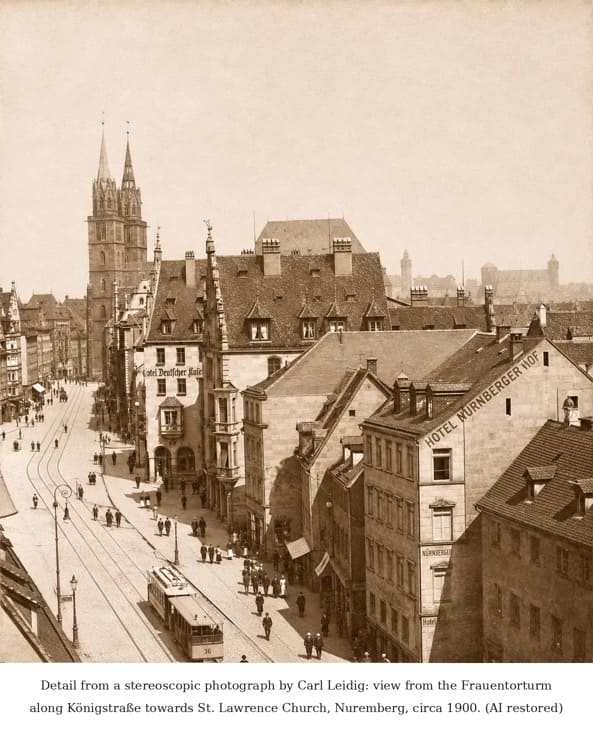
One of these stereo pairs is held in the Lachmund Collection (Sammlung Lachmund) on Wikimedia Commons. Around 1900 the stereo camera looked down on Königstraße from above: one caption says from the roof of the Mauthalle, another from the Frauentorturm tower. The view runs along the street to the twin towers of St Lorenz Church. The caption on the card leaves no doubt: "Carl Leidig, Hofoptiker, Nürnberg". Thirty years later the firm would move to this very street, and some forty years after that, bombs would hit this very Mauthalle.
The word "Fabrikation" in the advertising of the time should not be taken literally. The firm itself admits that with industrialisation more and more optical goods were made by outside factories, and the craftsman optician was turning into a retailer with a workshop. Objects scattered among museums, auctions and private collections show this transformation clearly.
One advertising stamp carries two names side by side: "Goerz Trieder Binocles" and "Hofoptiker Leidig Nürnberg". Prism binoculars from the Berlin firm C. P. Goerz were sold here under the patronage of the court title. Mother-of-pearl opera glasses also bore Leidig's name. One pair, in honey-pink, is held by the Mother-of-Pearl and Local History Museum in Adorf (Lehmann Collection, inv. PM 0895, dated by the museum to 1900–1950). Another sold at the Franke auction house for 45 euros. Its description gives the address "Kaiserstraße 10": the cataloguer apparently misread the six.
Around 1915 the firm sold pocket microscopes of the "Algensucher" type ("alga finder"). These were self-contained instruments for detecting diatoms and similar microscopic organisms in a water sample, for example from a pond. The example in an American collector's hands is a simple microscope with a heavy base finished in black crinkle enamel and a lacquered brass upper part. Its wooden case held interchangeable attachments for 50, 75 and 100 times magnification, a dissecting needle, tweezers and prepared slides. The case is signed "Hofoptiker Leidig, 16 Kaiserstrasse 16, Nurnberg" and the slides "C. Leidig, Nurnberg"; among them are bumble-bee hairs and a cicada's foot. Many German firms sold similar sets, such as Paul Waechter of Berlin. But the owner knows of no other firm that put its name even on the slides. Among the instruments in his collection, he considers those by Waechter, and especially Leidig, the best candidates for a true Algensucher. The microscopy historian Timo Mappes helped to date the set.
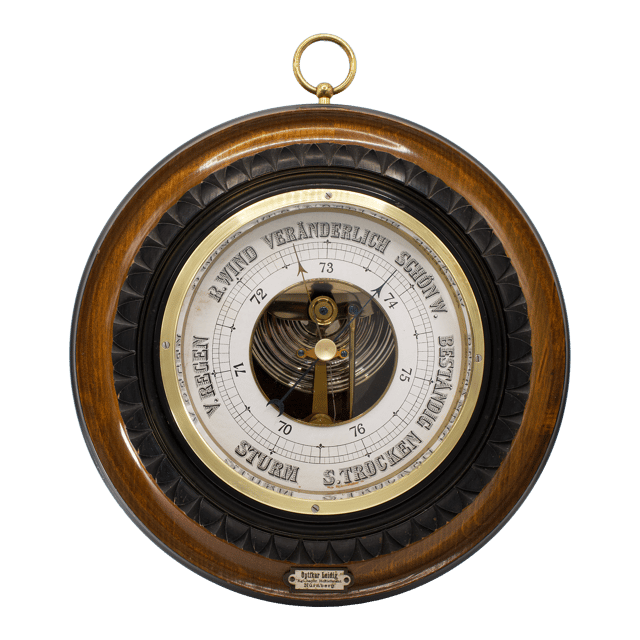
The range went far beyond optics: magic lanterns and toy steam engines, laboratory and school glassware for chemistry lessons, gramophones and records. Customers were apparently given pocket mirrors inscribed "Kgl. bayr. Hofoptiker C. Leidig Nürnberg": advertising small enough for a lady's reticule. In the 1920s a "Janulus" epidiascope was sold under the name "Hofoptiker Leidig"; its maker has not been identified. The firm also sold weather instruments, but there are no records of it making them itself. Most likely they, like the binoculars, were bought from specialist factories.
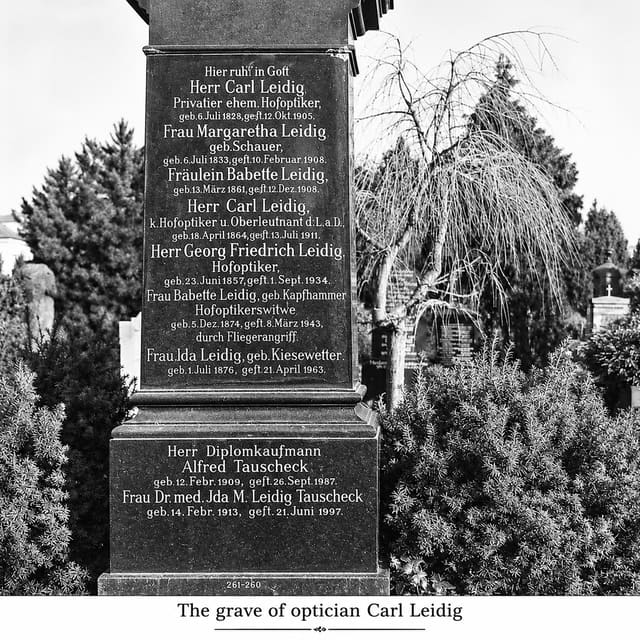
Carl Leidig senior died in 1905. He was buried in St John's Cemetery (Johannisfriedhof), where Albrecht Dürer also lies. In lists of notable burials he appears as "Königlich Bayerischer Hofoptiker", and Wikimedia Commons has a photograph of the back of the Leidig family gravestone.
The business passed to the sons. Formally, their father's personal title died with him, and the heirs had to apply for it again. Whether they did is not known. But in the Pegnesian Order's register Georg himself is called court optician, and the inscription "Hofoptiker Leidig" appears on objects from around 1915. It seems the title was kept or re-granted, and it lasted until November 1918, when the official title of purveyor to the court vanished along with the Bavarian monarchy. Many firms then took down the royal coats of arms. To this day, only firms that held the title before 1918 may use the formula "vormals k. b. Hoflieferant" ("former Royal Bavarian Purveyor to the Court").
In 1921 Bertha Leidig, Georg's daughter, married Dr Heinrich Richter, and from the 1930s he ran the firm. In 1931, after sixty years on Kaiserstraße, the firm moved to Königstraße 25–27, the very street it had photographed for the stereoscope thirty years earlier. Georg Leidig died on 1 September 1934.
The night of 9 March 1943 is described in the prologue: the shop was badly damaged and Babette Leidig was killed. Wikipedia calls her the head of the firm, which does not necessarily contradict reports that Dr Richter was running it. The widow may have remained the owner while her son-in-law managed the business. Exactly how the roles were divided is not known.
The shop was repaired, but not for long. On 2 January 1945 Nuremberg suffered the most devastating raid of the entire war: in the third wave a million incendiary bombs fell on the city, starting an inferno. More than 1,800 people were killed and about 100,000 were left homeless; by the end of the war the Old Town was 95 per cent destroyed. The Leidig shop was completely destroyed.
In 1945 Dr Richter and his daughter Ilse started again from scratch in Hersbruck, a small town east of Nuremberg. The Hersbruck branch outlasted the return to Nuremberg and operated until 2008. In 1951 the firm reopened in Nuremberg, in the rebuilt building on the same Königstraße.
In 1952 Ilse Richter married Wolfgang Zschau. He qualified as a master optician and in the late 1950s (in 1960, according to Wikipedia) opened a contact lens department, something the firm's founder could never have imagined. After her husband's death in 1975, Ilse Zschau took charge of the firm, assisted from 1981 by her son Fritz. Ilse Zschau died in 2020. The firm is now run by her sons Fritz and Ulrich, the fifth generation counting from Carl Leidig.
Today the firm is Carl Leidig GmbH, registered at the Nuremberg District Court (HRB 3394) and a member of the Chamber of Crafts for Middle Franconia. Its business is trading in optical instruments of all kinds, and making and fitting vision aids. As over a century ago, it sells binoculars and weather instruments. In 2016 the firm adopted the slogan "Königlich sehen seit 1853" ("Seeing royally since 1853"). There is a quiet historical irony in it: under the monarchy a limited liability company could never have received a court title, and now it is a GmbH that keeps the memory of that title alive.
Carl Leidig GmbH
Encyclopedias and authority data
The Pegnesian Order of Flowers
Purveyors to the court and court titles
Nuremberg's optical tradition
The 1882 exhibition
Objects bearing the firm's name
Streets and places
The air war
No direct link (used in the original research; links not preserved)