Loading
In April 1844 the front page of the Preston Pilot carried an advertisement placed by two optician brothers. They kept a shop on Church Street in Preston, next door to the Bull Inn; they lectured publicly on the anatomy and physiology of the human eye, ground Brazilian pebbles into lenses, and asked the public to bear in mind that they employed no travelling salesmen — spectacles of their own manufacture could be bought only from them, in their own premises.
Eighty-three years later, a shop window on Market Street in Manchester bearing the same surname showed the city its first television picture, received "by wireless". Three years after that, you could buy the television set itself in that shop — for twenty-five guineas.
Between the Brazilian pebble and the television set lies very nearly the whole history of the British optical trade in the nineteenth and early twentieth centuries, and the Franks family lived through all of it: from a craft workshop where lenses were ground by hand, through a respectable scientific-instrument shop selling microscopes, telescopes, barometers and magic lanterns, to an electrical-age business selling wireless sets. And it ended as most family businesses on the high street ended in those years: the last proprietor had no children, and a national chain bought the firm.
What follows is what the documents allow us to reconstruct — and what must honestly be left in the category of the probable.
The family's early history belongs not to Manchester but to Preston, and to the Lancashire Jewish community, in which optics was one of the few accessible craft-and-trade occupations. According to John Cowell's history of the Preston Jewish community, the Preston Chronicle of 13 January 1844 shows "Messrs B & J Franks" in partnership next door to the Bull Inn on Church Street; advertisements through 1844, 1845 and into 1846 keep them at the same address, sometimes giving the number as 142 Church Street.
The partners were Baron Lyon Franks and Joseph Franks. The advertisement in the Preston Pilot of Saturday 13 April 1844 is worth quoting in full — it is the most detailed surviving self-portrait of the business, and in effect its manifesto:
"Messrs Franks, Opticians, next door to the Bull Inn, Church St, Preston. Lecturers on the anatomy and physiology of the human eye. Manufacturers of all kinds of spectacles, optical and mathematical instruments, grinders of Brazilian pebbles, lenses for optical purposes, glasses etc., beg leave to state that they have taken the above shop, for a term of years, and trust that strict attention, combined with punctuality and moderate prices, will merit public patronage……spectacles and optical instruments repaired. N.B. No connection with any travellers and the public can only be supplied with spectacles etc of Messrs Franks' own manufacture at their establishment, next door to the Bull Inn, Church St and at Mr J. Franks's, next door to the Star Hotel, Deansgate, Manchester."
Every part of this matters. First, the brothers call themselves manufacturers — makers, not merely sellers — and back the claim with the grinding: "grinders of Brazilian pebbles" means working natural rock crystal, from which the finest spectacle lenses were made before optical glass became widely available. Second, the disclaimer "No connection with any travellers" is a direct thrust at the itinerant spectacle-sellers who traded under borrowed names; the firm insists that its goods are sold only within its own walls. Third — and for our purposes this is the crucial point — the advertisement gives a second address: "Mr J. Franks's, next door to the Star Hotel, Deansgate, Manchester."
So as early as 1844 a Franks was keeping an establishment on Deansgate — the very street where A. Franks Ltd. would stand several decades later. It is tempting to close the circle and declare this J. Franks to be the same Joseph Franks whose Market Street business his son Aubrey would later inherit. Chronologically it is entirely possible, but there is no direct documentary proof of the identification, and it should be held as a plausible hypothesis rather than an established fact: the surname Franks appears more than once in the nineteenth-century British optical trade (Herbert Franks in Leeds, among others), and the initial "J." proves nothing on its own.
The brothers' partnership did not last long. The Preston Guardian of Saturday 11 July 1846 advertises the dissolution of the partnership between Baron Franks and Joseph Franks, the latter retaining the Preston business. Baron appears to have moved to Nottingham, where he married in 1847.
By the 1880s Joseph Franks was running an optical business in Manchester at 44 Market Street. Surviving objects confirm that he signed his goods with his own name: a telescope is known engraved "J. Franks, Optician, 44 Market St". By this date the phrase "Manufacturers of all kinds of…" from the Preston advertisement was, in all likelihood, running well ahead of reality — as with most high-street opticians, the share of goods made in-house was steadily giving way to bought-in stock.
On 21 April 1882 the London Gazette recorded Joseph Franks's bankruptcy. Six years later, the Market Street business would pass to his son.
Louis Aubrey Franks was born in 1854 and was known all his life simply as Aubrey. According to material assembled from the London Gazette and the census returns, he was married to a woman named Fanny; his younger brother Benjamin was born in 1862 and married Helena Mindelsohn.
His independent career began unpromisingly. Around 1878 Aubrey set up as an optician and fine art dealer on King Street, trading as "L. A. Franks" from 95 Deansgate and 2–4 King Street. On 7 March 1879 the London Gazette announced his bankruptcy. The compiler of the early-photography directory who worked through these records adds a characteristic caveat — "He (unless there was a second person of that name) was at 95 Deansgate (and 2,4 King St.) trading as L.A. Franks when made bankrupt in 1879" — and that caution is worth inheriting.
Soon after the bankruptcy a new firm appeared at the same 95 Deansgate: "A. Franks, optician". It is from this moment, 1879, that the company's history is usually dated. It would not stumble again for nearly seventy years.
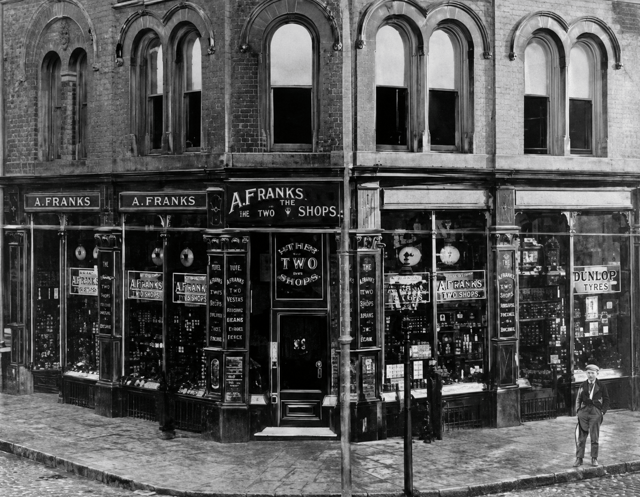
The chronology of addresses reads like the methodical capture of one of Manchester's best retail corners:
Spectacles were the speciality of the early years, but Aubrey soon began making and selling other optical instruments — microscopes, telescopes, magic lanterns. By the 1890s the firm was dealing in the full range of optical and mathematical instruments, and in photographic and electrical equipment.
In 1897 the brothers' partnership was dissolved — "A & B Franks" at 95 Deansgate (London Gazette, 19 January 1897). A curious symmetry: half a century earlier Baron and Joseph had parted in exactly the same way. In the same year the firm gave the first demonstration of Edison's cinematograph in the north of England — a gesture that says a good deal about Aubrey's commercial temperament: an optician on Deansgate showing the public moving pictures within months of their appearance.
Aubrey Franks died on 7 December 1918.
The range of goods offered by A. Franks can be reconstructed from surviving objects and museum records, and it was wide even by the standards of the period.
Ophthalmic optics remained the foundation: spectacles, lenses, sight-testing and repairs.
Instruments: microscopes — an example of the "Society of Arts" type is known, the standard inexpensive teaching model of its day; telescopes, from pocket instruments to multi-draw refractors, including the "Officer of the Watch" type; pocket compasses in brass boxes with folding sights, paper cards and English bar needles — on one of them, dated to about 1890–1900, the remains of a paper label reading "A. Franks, 97 Deansgate, Manchester" survive, while the instrument itself is signed "A. Franks, Optician, Manchester"; binoculars and opera glasses; mathematical and drawing instruments; barometers and thermometers. Magic lanterns with limelight illumination likewise carry the engraving "A Franks, Manchester".
Photography. Here the firm achieved genuine commercial success with the Presto camera — very simple and fairly cheap. The museum record puts the outcome plainly: "Aubrey had sold more than 28,000 in 10 years, some of which were sold in Europe." Twenty-eight thousand units in ten years, for a Manchester optician, is a figure that explains where the money for the branches came from. Lenses of the Rapid Aplanat type are also known under the firm's name.
Which of this was made on the premises? The answer evidently changed over time. In the 1840s the Franks family in Preston really did grind lenses. By the end of the century the picture is mixed: the engraving "A. Franks, Manchester" on telescopes, lanterns and microscopes indicates in-house assembly and finishing, and at the very least a repair workshop — yet at the same time the firm was confidently rebadging bought-in goods, as with the folding binoculars of the German firm Busch, model "Wimett", issued under the name "A. Franks Ltd Manchester". In the 1920s the firm acquired its own wholesale department at 3 South King Street, which settled its position for good within the chain of distribution rather than manufacture.
The question of the firm's relationship to barometers deserves separate treatment.
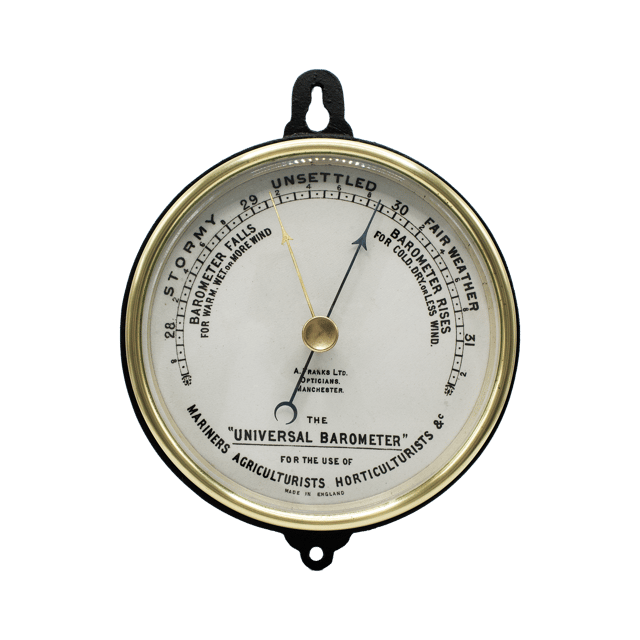
That barometers were sold under its name is firmly established. The Science Museum Group collection holds an object with the museum number Y1987.247, described as "Aneroid barometer by Aubrey Franks Ltd, Manchester, c.1910", measuring 295 × 300 × 35 mm. Wall barometers in turned mahogany cases signed "A. Franks Ltd, Manchester" are also encountered.
That the firm manufactured aneroid movements is supported by nothing at all. No patents, no registered designs and no trade marks in the name of A. Franks or A. Franks Ltd. could be found, and there is no reference to any barometer-making capacity of its own. Everything known about the structure of the British trade of the period points to the ordinary arrangement: a retail optician ordered a batch of instruments from a wholesale manufacturer with dials bearing his own name. Hundreds of firms across the country worked this way, and it is precisely for this reason that names on the dials of late nineteenth- and early twentieth-century aneroids must be read as shop signs rather than as makers' marks.
In other words, where barometers are concerned, A. Franks Ltd. should be regarded as a retailer. This is no diminishment of the firm; it simply places it where it belongs in the chain — between an English wholesale manufacturer and a customer on Deansgate.
Around 1917 the business passed to Aubrey's son-in-law, Maurice Saffer, who kept the name A. Franks Ltd. By the museum's account Saffer was an astute and enterprising businessman, and he expanded the concern considerably.
The firm's geography in the 1920s:
Saffer's principal achievement, however, lay outside traditional optics: under his management A. Franks Ltd. became the first firm to bring wireless and television to the Manchester area. In 1927 Manchester's first television picture was received "by wireless" at the Market Street shop, and three years later television sets were on sale there at twenty-five guineas. The optician who showed the city Edison's cinematograph in 1897 built a firm that showed the city television thirty years later — a rare case of a family business standing twice at the leading edge.
Maurice Saffer died in 1947. He had no children. For three years the firm was managed by his secretary — a detail so spare, and so eloquent, that there is almost nothing to add to it. In 1950 the business was sold to the national optical chain Dollond & Aitchison.
The museum's account of the ending is entirely dry: "As he had no children, his secretary managed the business for three years and then sold it to the opticians Dollond & Aitchison in 1950."
The exact date of incorporation as a limited company, and its registration number, could not be established from the available sources; the form "A. Franks Ltd" is securely attested by about 1910. No evidence was found of the firm exhibiting, of any awards, or of membership of professional bodies — which, for a retail business of this scale, is to be expected rather than surprising.
The Franks story is, in miniature, the story of an entire class of British opticians, and its value lies precisely in how typical it is.
It begins where optics was still a craft: two brothers grinding rock crystal in a shop beside a coaching inn and lecturing on the structure of the eye, because learning was part of commercial standing. It passes through the era in which craft turns into trade: in-house making gives way to buying in, the engraving "A. Franks, Manchester" on a telescope comes to mean a brand rather than a workshop, and the optician's name on a barometer dial says only where the instrument was bought. And it ends where almost every family business on the high street ended in those years — absorbed by a chain.
Twice in this history the name Franks stood at the edge of technical novelty: Edison's cinematograph in 1897, television in 1927. Twice a family partnership broke up between relatives — in 1846 and in 1897. And twice the business passed sideways rather than down the direct line: from father to son by way of a bankruptcy, from father-in-law to son-in-law, and then to no one at all.
The name on the dial, which is what draws one to such a firm in the first place, turns out in the end not to be a maker's signature but an address. Yet that address leads to a very particular corner of King Street and Deansgate, where for seventy years people bought spectacles, microscopes, compasses, cameras, barometers and — at the last — television sets. In that sense the signature on the instrument is honest: it tells you not who made it, but who it was for, and out of which door it came.
Sources are grouped by type. Each entry notes what it contributed and how far it can be relied upon. Where a primary document has been used at second hand — that is, cited by a secondary author rather than consulted directly — this is stated explicitly.
1.1 The London Gazette, 7 March 1879, p. 1998 Bankruptcy of Louis Aubrey Franks, trading as L. A. Franks at 95 Deansgate (and 2 & 4 King Street), Manchester. Establishes the collapse of the first venture and, by implication, the 1879 date for the refounded firm. Cited via Early Photography (§3.2). Not verified against the original. Searchable at: https://www.thegazette.co.uk/
1.2 The London Gazette, 21 April 1882 Bankruptcy of Joseph Franks, optician, 44 Market Street, Manchester — Aubrey's father. Explains how the Market Street business came to pass to the son in 1888. Cited via Early Photography (§3.2). Page number not recorded by that source. Searchable at: https://www.thegazette.co.uk/
1.3 The London Gazette, 19 January 1897, p. 363 Dissolution of the partnership between Aubrey and Benjamin Franks, trading as A & B Franks at 95 Deansgate. Cited via Early Photography (§3.2). Not verified against the original. Searchable at: https://www.thegazette.co.uk/
1.4 Preston Pilot, Saturday 13 April 1844 — advertisement, p. 1 The full "Messrs Franks, Opticians" advertisement quoted in the article: manufacture of spectacles and optical and mathematical instruments, grinding of Brazilian pebbles, public lectures on the eye, the disclaimer regarding travelling salesmen, and — crucially — the second address, "Mr J. Franks's, next door to the Star Hotel, Deansgate, Manchester." The single most informative document about the family's early trade. Quoted in Cowell (§3.1), whose footnote 62 gives the accompanying news item at p. 2 of the same issue. Not verified against the original. Original available through the British Newspaper Archive: https://www.britishnewspaperarchive.co.uk/
1.5 Preston Chronicle, Saturday 13 January 1844 Shows Messrs B & J Franks in partnership next to the Bull Inn, Church Street, Preston. Establishes the partnership of Baron Lyon Franks and Joseph Franks and its address; later advertisements through 1844–1846 give the number as 142 Church Street. Cited in Cowell, footnote 65 (§3.1). Not verified against the original. https://www.britishnewspaperarchive.co.uk/
1.6 Preston Guardian, Saturday 11 July 1846 Advertises the dissolution of the partnership between Baron Franks and Joseph Franks, the latter retaining the Preston business. Fixes the terminal date of the Preston partnership. Cited in Cowell, footnote 65 (§3.1). Not verified against the original. https://www.britishnewspaperarchive.co.uk/
1.7 Trade directories and registers used by Cowell (footnote 61) Baines's History, Directory and Gazetteer of the County Palatine of Lancaster, 1825, vol. 2; Whittle's Commercial Directory of Preston, 1841; Liverpool Old Hebrew Congregation, Birth Register. Underpin Cowell's account of the family's Lancashire origins. Not consulted directly. Many nineteenth-century directories are available at: https://specialcollections.le.ac.uk/digital/collection/p16445coll4
1.8 FreeBMD; census returns; GRO indexes Used by both Cowell and Early Photography for dates of birth, marriage and death (Louis Aubrey Franks b. 1854, d. 7 December 1918; Benjamin Franks b. 1862; Baron L. Franks married in the September quarter of 1847). Not consulted directly. https://www.freebmd.org.uk/
2.1 The National Archives, Discovery — "A. Franks Ltd. 95/97 Deansgate, 2/4 King Street and 46 Market Street, Manchester" Confirms the firm's principal addresses in official record, including the Market Street number as 46 (elsewhere given as 44). A starting point for any further documentary work. https://discovery.nationalarchives.gov.uk/details/r/dff28891-28d4-498c-b9a3-31ea1d101cb8
2.2 Museum of Science and Industry, Manchester — "The Franks Family" (PDF) Cited in Cowell's footnote 64 as a document held by MSIM. Potentially the richest single source on the family, but the URL given by Cowell no longer resolves following the museum's absorption into the Science Museum Group; the document could not be retrieved. Worth requesting directly from the museum's archive. Former URL: http://www.msim.org.uk/uploadedDocs/Document_Depository_01/The%20Franks%20Family.pdf
3.1 Cowell, John, Furriers, Glaziers, Doctors and Others — A History of the Preston Jewish Community (JCR-UK / JewishGen) The foundation of everything in this article before 1878: the Preston partnership, the Bull Inn premises, the 1844 advertisement in full, the 1846 dissolution, and Baron Franks's move to Nottingham. A carefully footnoted piece of local scholarship with references to named newspaper issues; reliable, though its subject is the community rather than the firm, so the optical business appears only in passing. https://www.jewishgen.org/jcr-uk/community/preston/cowell-john-preston-jewish-community.pdf
3.2 Early Photography — Company and Photographer Details (earlyphotography.co.uk) The best genealogical and legal skeleton for the Manchester firm: dates for Louis Aubrey Franks, his wife Fanny, his brother Benjamin and Benjamin's wife Helena Mindelsohn, his father Joseph, and the three London Gazette citations. Compiled from gazette notices and census returns, and commendably explicit about its own uncertainties ("unless there was a second person of that name"). Also flags a possible link to an earlier Franks via Early Photography in Leeds. http://www.earlyphotography.co.uk/site/companies1.html
3.3 Williams, Bill, The Making of Manchester Jewry, 1740–1875 (Manchester University Press, 1976), p. 393, note 74 to chapter 5 The standard scholarly work on the Manchester Jewish community; cited by Cowell for the Franks family's Manchester context. Not consulted directly.
3.4 Leeds Art Galleries, Early Photography in Leeds (1981) Referenced by Early Photography as bearing on "a possible connection with an earlier Franks." Unexamined; a live lead if the Preston–Manchester line is ever to be closed documentarily.
3.5 Banfield, Edwin, Barometer Makers and Retailers 1660–1900 (Baros Books) The standard directory of British barometer makers and retailers, which includes retailers as well as makers. Consulted for an entry under "Franks, Manchester"; the presence of such an entry could not be confirmed from the material available and remains to be checked against a printed copy. ISBN 978-0-948382-06-2
4.1 Science Museum Group Collection — "Aubrey Franks Ltd" (person record) The single most complete connected narrative of the firm: foundation on King Street c. 1878; the shift from spectacles into microscopes, telescopes and magic lanterns; the Presto camera and its sales figure; the 1897 cinematograph demonstration; the succession of Maurice Saffer c. 1917; the branch network of the 1920s; the 1927 television reception; and the 1950 sale to Dollond & Aitchison. Authoritative in origin but written without source citations, and its dates are approximate ("about 1878", "about 1917"). https://collection.sciencemuseumgroup.org.uk/people/ap16991/aubrey-franks-ltd
4.2 Science Museum Group Collection — "Aubrey Franks Limited" (organisation record) The detailed address chronology: 2 & 4 King Street c. 1879; 95 Deansgate and 2 King Street 1881; 95 and 97 Deansgate 1887; 44 Market Street 1888; and the 1920s branches at 73 Oxford Street, 12 Victoria Street, 3 South King Street (wholesale) and 20 Bradshaw Gate, Bolton. https://collection.sciencemuseumgroup.org.uk/people/cp156327/aubrey-franks-limited
4.3 Science Museum Group Collection — Aneroid barometer, Aubrey Franks Ltd, Manchester, c. 1910; museum number Y1987.247 (object ID co8406495); 295 × 300 × 35 mm The key object for the barometer question: proves both that barometers were sold under the firm's name and that the "Ltd" form was in use by about 1910. https://collection.sciencemuseumgroup.org.uk/objects/co8406495
4.4 Science Museum Group Collection — Aneroid barometer probably made by Aaron Aronsberg, Manchester, c. 1910 Useful context for the Manchester optical trade and for the firm from which Franks took over the Victoria Street branch in 1923. Searchable at: https://collection.sciencemuseumgroup.org.uk/
These establish the range of goods sold and the wording of the firm's signatures. Dealer descriptions are generally reliable as to inscriptions and addresses, and should be treated with caution as to dating and attribution.
5.1 Compass Library — "Aubrey Franks, Manchester, Pocket Compass c. 1900" Brass box compass with folding sights and English bar needle, signed "A. Franks, Optician, Manchester", with remains of the paper label "A. Franks, 97 Deansgate, Manchester" inside the lid. Notes an almost identical unsigned card design illustrated in Kornelia Takacs, Compass Chronicles, p. 26 — a small but telling indication of bought-in stock. https://www.compasslibrary.com/en-us/products/a-franks-manchester-brass-box-pocket-compass
5.2 London Fine Antiques — "A. Franks Ltd, Manchester" A dealer's reference page giving the working range 1879–1950, the founder's full name, the 1879 bankruptcy and the 1897 dissolution, and describing the firm as "manufacturer of photographic apparatus, optician and scientific instrument maker." Secondary and uncited, but consistent with the gazette record. https://www.londonfine.co.uk/pages/a-franks-ltd-manchester
5.3 eBay (UK) — antique wall barometer in turned mahogany, signed A. Franks Ltd, Manchester Evidence that domestic wall barometers were also sold under the firm's name. Marketplace listing; no independent verification of dating. https://www.ebay.co.uk/itm/204572345604
5.4 Further dealer and auction listings consulted A Society of Arts-type microscope (Le Compendium, https://www.lecompendium.com); a limelight magic lantern engraved "A Franks, Manchester"; a Victorian telescope of c. 1890 engraved "A Franks, Manchester"; a telescope signed "J. Franks, Optician, 44 Market St" — the father's signature; and Busch "Wimett" folding binoculars rebadged "A. Franks Ltd Manchester", which document the practice of retailing bought-in goods under the firm's name.