Loading
In the mid-1970s, in the upper floor of a factory building on rue des Billodes in Le Locle, a man named Charles Vermot was hiding away the things he had been ordered to destroy.
The order had come from Chicago. The new owners — an American corporation that made radios and televisions — had decided that mechanical watches were finished. The future belonged to quartz, which meant that the presses, dies, cams, cutting tools and technical drawings were to be sold for scrap. Among them was the tooling for a calibre that had been announced six years earlier as the world's first automatic chronograph.
Vermot, head of the chronograph atelier and one of the men who had created that calibre, disobeyed. He hauled up to the attic some hundred and fifty presses weighing more than a tonne in total, added the tools and the complete technical documentation, carefully entering every item into a register binder, and sealed the room behind a false wall. The work took roughly six months; his brother helped him. He told no one — neither colleagues nor family.
More than ten years later, everything needed to restart production of El Primero was found behind that wall. A few years after that, the calibre that was supposed to have gone to the furnace began ticking inside an automatic Rolex Daytona.
This story is unquestionably part of Zenith's corporate mythology, and its more dramatic particulars should be treated with caution. The fact that the tooling and drawings were preserved, however, and Vermot's role in preserving them, are confirmed by several independent publications and by the brand itself.
It is the best-known episode in Zenith's history — and far from the most surprising. Because the firm whose tooling was hidden in an attic also produced, at various points in its life, marine chronometers in cases of exotic wood, aviation altimeters for the Royal Flying Corps, aneroid barometers, automobile speedometers, magnetos for racing engines, telephonometers, oil lamps, cinema projectors and sewing machines. And it all began with a nine-year-old boy who was taken out of school.
To understand Le Locle, one has to picture the geography. It is a narrow valley at a thousand metres of altitude, a few kilometres from the French border, wedged between the ridges of the Jura. The soil is poor, the winter long, the snow lies for months. In the eighteenth century the peasants of these valleys found a way to survive the season when there was nothing to do in the fields: they sat down at the workbench.
So was born what would later be called établissage — the dispersed manufacture. One household turned pivots, another cut wheels, a third made springs, a fourth painted dials. Every few weeks an établisseur drove through the valley, bought up the parts, carried them to his counting house (comptoir) and assembled the watches. The system was cheap, flexible and in its own way ingenious: it required no capital, no factories and no discipline. And that was also its curse — quality depended on how a particular outworker in a particular village had happened to work that season.
By the middle of the nineteenth century, almost the entire population of Le Locle and neighbouring La Chaux-de-Fonds worked on watches in one way or another. The towns were so completely single-industry that their layout eventually submitted to the craft: long parallel streets, buildings oriented east and west so that even daylight would fall into the workshops on the upper floors. A century and a half later, in 2009, UNESCO would inscribe that layout on the World Heritage List under the heading "watchmaking town planning."
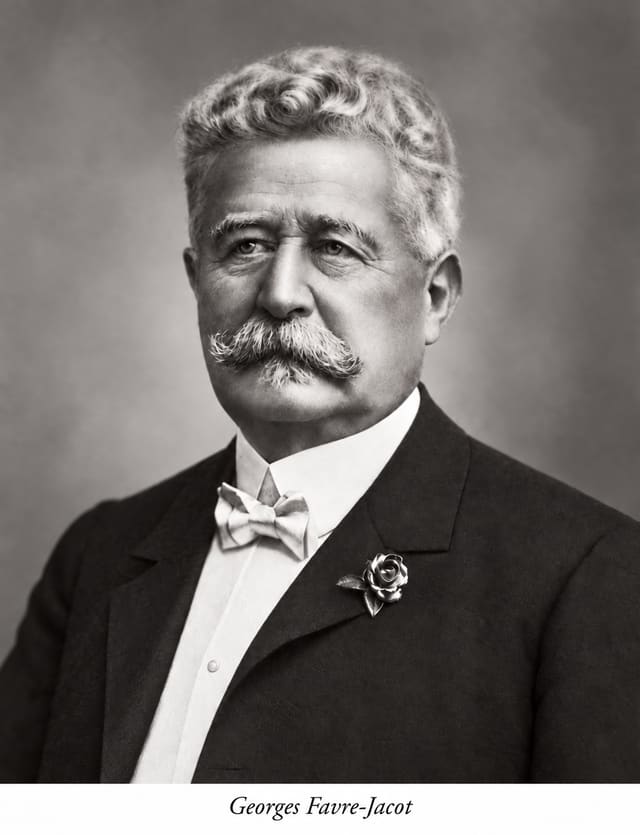
It was in this valley, on 12 December 1843, that Georges-Émile Favre-Bulle was born.
He left school at nine and was apprenticed to a watchmaker — by some accounts a pivoteur, a specialist in turning pivots. It was one of dozens of narrow trades into which watchmaking was divided: a man could spend his whole life performing a single operation and never assemble a complete watch.
In 1863, aged twenty and still a minor by the standards of the time, he married Louise-Philippine Jacot-Descombes — a watchmaker's daughter who was herself a watchmaker. They would have six children: five girls and one boy. Following local custom he added his wife's name to his own and became Georges Favre-Jacot.
Louise-Philippine's dowry gave him his starting capital. In 1865, at the age of twenty-two, he opened his own movement-making workshop under his own name in the Les Billodes quarter, west of the town.
Four years later the workshop was already spreading into the neighbouring buildings.
What struck those who knew Favre-Jacot was a combination of qualities that do not usually coexist.
A true master of the old kind — solid, somewhat rough, self-taught; contemporaries described him as a force of nature with an iron will. And at the same time a commercial instinct verging on the supernatural: he knew how to adapt, anticipated the movement of markets, threw himself at emerging opportunities, and was driven, as his biographer notes, above all by a fear of crisis and a determination to protect himself from it in advance.
He had a breadth of view rare even in his milieu, and he grasped, far earlier than most, ideas that today would be called geopolitical. Hence his ventures were by no means always connected with watches. He took an interest in the sciences, invested in forges, owned a cement-slab factory and a sawmill — sometimes built to drawings he had made himself. He acquired a printing house that produced the brand's brochures and advertising.
Le Locle could not accommodate all the influential guests he invited to inspect his workshops and sign contracts — so Favre-Jacot built a hotel and restaurant on the road to the Col-des-Roches, on the very site where he had previously quarried stone, the quarry having been bought at auction. He invested in a large high-class hotel complex at Grand-Sommartel. He bought land: the estates of Petit-Sommartel, Grand-Sommartel and Grande-Cœudre — hundreds of hectares.
At the same time he built rental housing for his workers in the Éroges and Molière quarters and, for all his firmness of character, was a man open to conversation. He was seen as a patriarch with a large heart — and a heavy hand. When his workers tried to extend their Sunday outing by taking what was known as a "blue Monday," that is, simply not turning up for work, he would go after them in person, armed with his sabre.
His central idea was not about watches but about organisation.
Favre-Jacot was fascinated by the American model of production — the one the Swiss saw en masse at the 1876 World's Fair in Philadelphia and after which a quiet panic spread through the valleys of the Jura. Waltham and Elgin made watches from interchangeable parts, on machines, in series, with predictable quality and at a price that turned the établisseurs cold.
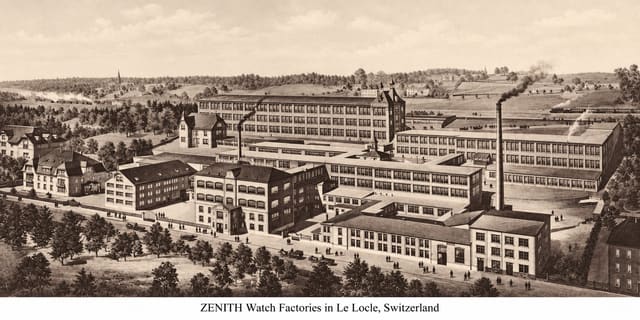
He wanted to build a factory according to his own ideas — but the first genuinely new building had to wait until 1881. In time there would be more than twenty. The complex would grow to some seventeen thousand square metres and acquire its own spur line to the Le Locle railway station for direct delivery of raw materials.
The idea was simple: gather under one roof everyone involved in creating the finished article. So the region acquired its first industrial watchmaking Manufacture — a French term that would later attach itself specifically to enterprises combining the entire production cycle.
Which is why the workshops in Le Locle made not only watch movements but also enamelled and painted dials, cases, gold and silver castings, stamped cases — and even the tools needed to produce individual components.
Favre-Jacot conceived the manufacture's organisation as a system. Watchmakers and workers were not supposed to think about anything other than the work itself: they were given comfortable, clean, well-lit premises. In return they were required to hold strictly to the set pace; productivity was monitored continuously, and quality and precision were raised without interruption. The principles of rationalisation were applied down to the smallest detail.
There was a financial aspect to this as well, eccentric for its time. In an era when the bank was becoming an inevitable part of business life, Favre-Jacot preferred self-financing — so as not to share control of the production process with anyone.
Less than ten years after starting out he was employing more than ten per cent of the working population of Le Locle and was the canton's largest employer. In the best years of the early twentieth century up to two thousand people worked at the manufacture — the factory was nicknamed "the manufacture with two thousand golden and silver hands." By 1925 about a thousand would remain.
And one more thing. Deliberate diversification — a word that would accompany this firm throughout its entire course — took it from the very beginning far beyond wrist and pocket time. Besides alarm clocks, onboard clocks and chronometers of various kinds, the manufacture produced telephone dials, barometers, automobile tachometers, precision instruments for military use, oil lamps and much else.
The breadth of that list is not a curiosity. It is the answer to the question of how a firm from a mountain valley survived a hundred and sixty years.
Swiss industrialists were only able to register what were then called trademarks from about 1880 onwards. Favre-Jacot took up the possibility earlier and more thoroughly than almost anyone — and left behind an entire gallery of marks in which the firm's history can be read like growth rings.
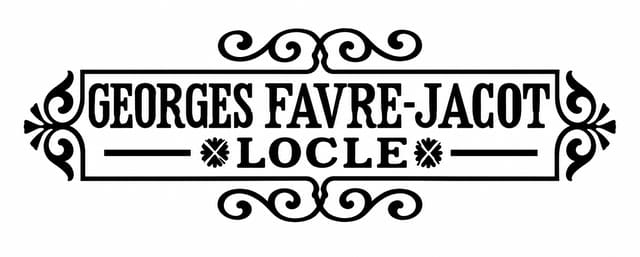
27 December 1880, 6 p.m. The first mark registered by him personally: name and place framed by a lavish scroll entirely in the taste of the period. In 1896, when the firm changed its status and became Georges Favre-Jacot et Cie, the mark was adapted accordingly.
21 January 1881, 4 p.m. The mark GFJ-Locle — sober, clean graphics, prefiguring the initials GFJ that would be carved on the main building of the manufacture some twenty years later.
18 April 1884, 9 a.m. The Billodes escutcheon. At the end of the nineteenth century many firms took their own address as a mark — the name of a hamlet or a street — and some kept it as their official company name. Zenith has sat on rue des Billodes since 1865, and the appearance of this coat of arms is logical. The logo survived the entire evolution of the company and was still in use in the 1950s; at times it was framed by a ribbon and applied to the firm's other marks.
October 1895. Another version of the Billodes mark: a panorama of the manufacture with two smoking chimneys — depicting the production site as a way of introducing oneself. To show the scale, to impress client and commercial partner. Beside it, a pocket watch in cutaway and the Billodes escutcheon registered six months earlier.
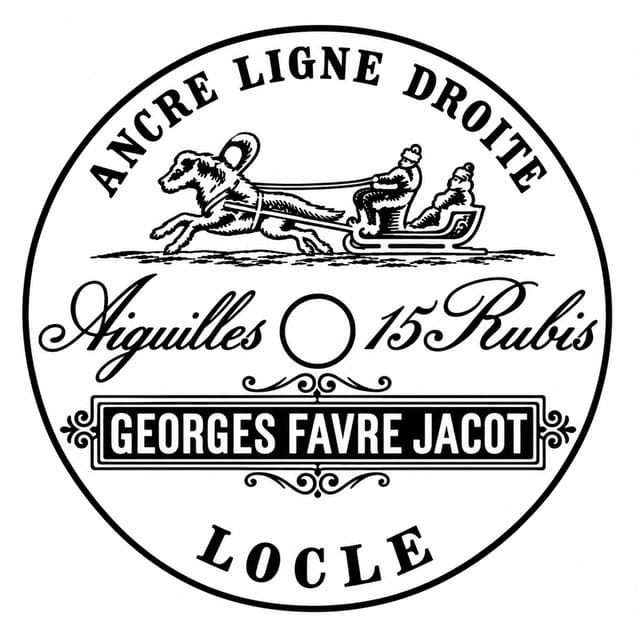
10 December 1885, 10 p.m. A mark intended specifically for Russia: a horse-drawn troika with a sleigh carrying two passengers, set above the 1880 logo, with the inscriptions "Ancre ligne droite," "Aiguilles," "15 rubis." The image would be used repeatedly — notably in the multilingual catalogue of 1900, which devoted a special page to the Russian market.
23 May 1888, 5 p.m. The mark Pilote. Here it is important not to misread: this is not about aviation — the Wright brothers' first flight was still fifteen years away. Pilote means a helmsman, the hero capable of steering a vessel through a storm on Lake Lucerne, that is, William Tell. Favre-Jacot was deeply attached to the Swiss character of his enterprise, and the legend of Tell, widely circulated in the years when the Confederation was taking shape, meant a great deal to him; Jämes Favre, his nephew and son-in-law, carried a favourite watch bearing an image of the Tell chapel, erected on the spot where he leapt ashore. On 28 December 1904 the spelling was changed to Pilot. Thanks to that far-sighted registration, Zenith remains to this day the only brand entitled to write the word Pilot on a dial, and the Pilot collection is one of the key lines in its range.
16 March 1897, 11 a.m. The Zenith mark together with an image of the starry sky. According to tradition, the name came to the founder as he contemplated the countless stars and wished to take his enterprise to such heights. At first it was the name of a new calibre. The calibres proved so successful that the name was transferred to the whole of the production, and then to the company itself — a decision that took effect in 1911. (Different publications give the registration date as either 16 or 12 March.)
28 December 1903, 8 a.m. A mark devoted to precision: that was the year the first prizes of the Neuchâtel Observatory were won. The mark testifies to something else as well — Zenith was already being perceived as the company name. It was still in use in the 1920s.
May 1904. A mark with graphics extremely modern for its day: two magnetic poles touching, striking lightning and a fiery arc above the clouds. The iconography of electricity, which was entering daily life and production with ever greater confidence. It too survived into the 1920s.
11 January 1910. The mark "Zénith" is registered in Switzerland under number 26,690, and on 12 April of the same year at the International Bureau in Berne under number 9125, extending protection to the countries of the Madrid Union: Austria, Belgium, Brazil, Cuba, Spain, France, Hungary, Italy, Mexico, the Netherlands, Portugal, Switzerland and Tunisia.
The applicant is Georges Favre-Jacot & Cie, fabrication, Locle (Suisse). The essential thing in this entry, however, is not only the name but the list of goods specified: "Montres et parties de montres, tous instruments ou appareils de mesure, d'alarme ou de contrôle, mécaniques ou électriques" — watches and watch parts, all instruments or apparatus for measurement, alarm or control, mechanical or electrical.
The wording was chosen with room to spare and plainly on purpose. In January 1910 the firm legally staked out for the name Zenith precisely the territory it would enter over the following decade: altimeters, barometers, tachometers, telephonometers, electric clocks. The diversification usually described as a forced reaction to stagnation was planned and formalised in advance.
And one further detail of the calendar: on 11 January the name is secured as property, and on 14 January, three days later, it becomes the name of the company itself — Fabriques des Montres Zénith, Georges Favre-Jacot et Co. The sequence is not accidental.
29 June 1912, 8 a.m. A personalised mark for another national market — as previously for Russia. Reproduced in colour on the back cover of the Leipzig Illustrierte Zeitung of 21 November 1912.
1940. For its 75th anniversary the firm registers a mark that gathers its historical codes: the Billodes escutcheon and the starry sky of the first Zenith mark of 1897. That mark remains one of the company's active logos today.
Besides the above, the portfolio included Diogenes (1885), Sentinelle, Marguerite, Terminus (1894 — the name of the calibre that preceded the "Zenith"), Defi (1902, later Defy), the names of precious stones, and marks registered in Russian, Chinese, Arabic and Finnish.
For this firm, precision was never a marketing argument. It was a method of proof.
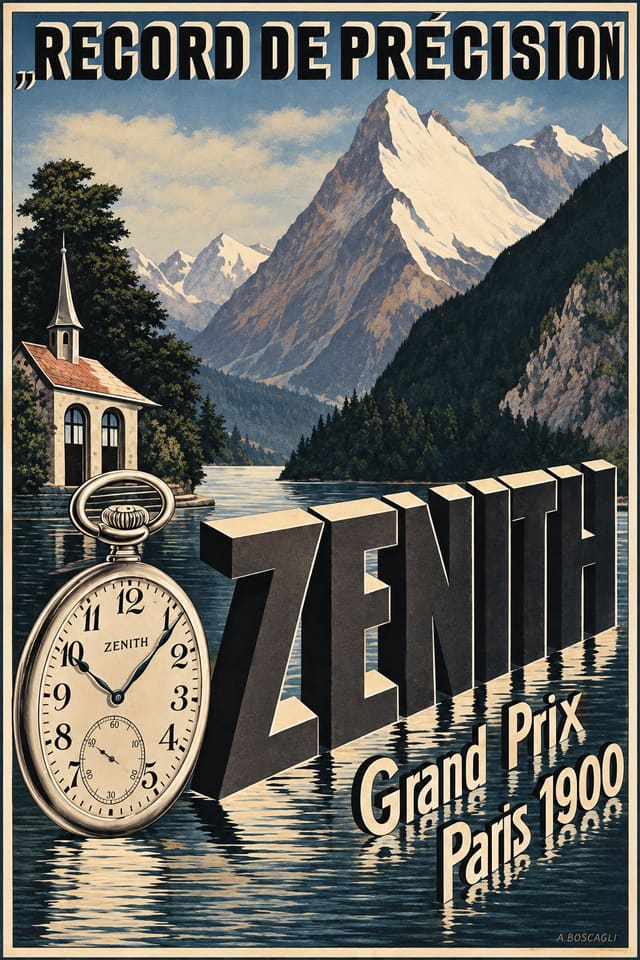
In 1896 Zenith received a gold medal in Geneva. In 1900, at the Paris World's Fair, the precision calibre "Zenith" took the Grand Prix — an event that made such an impression on the public that for many years the firm engraved "Grand Prix de Paris 1900" on the inner dust cover of its pocket watches.
In 1903 came the first prizes from the Neuchâtel Observatory.
The observatory competitions were, for Swiss watchmaking, something between a world championship and a doctoral defence. Watches were submitted to weeks-long trials in five positions and at different temperatures; results were published to hundredths of a second. What won were not models but individual specimens, brought to their peak over years by régleurs — regulators whose names meant no less in this world than those of the designers.
Besides Neuchâtel and Geneva, Swiss brands especially valued the English observatory at Kew-Teddington, for its international authority. Between 1923 and 1939 Zenith won there six times and set a world precision record on three occasions. In 1929 came the result that would be quoted for decades: out of 19,835 watches from around the world, a Zenith showed a daily deviation of 0.6 seconds.
Awards were an occasion for press coverage, and their impact was so strong that results were sometimes engraved on the watches themselves — opening the back cover, a buyer could read the service record.
The final tally across the whole history is more than 2,333 prizes, more than any other watch house. Two of Zenith's regulator units were chosen by the Neuchâtel Observatory to set the official time.
The Russian Empire was one of the most important markets for the Favre-Jacot firm, and by some assessments the most important of all. The troika mark registered in December 1885 did not appear out of a taste for the exotic: it appeared because that was where the watches sold.
From the 1870s the founder travelled to sell them himself. From the turn of the century this was handled by Jämes Favre, who sold "in North and South America, Russia, India, China and Japan." In 1902 Favre-Jacot registered, in Russian, the mark "Raduga" (Радуга — Rainbow) — a name that would return sixty years later in an entirely different context. In 1908 a Moscow branch opened; the mark was officially registered in Russian script. A telling detail: in 1909 a Russian subject, Ossip ("Osher") Cheifetz of Warsaw, became one of the directors of Zenith SA.
What is absent from the documents is equally telling. When in 1910 the "Zénith" mark was extended through the Berne Bureau to the countries of the Madrid Union, Russia was not on the list — the empire never acceded to the agreement. That is precisely why marks for the Russian market had to be registered separately and in Russian: the troika of 1885, the "Raduga" of 1902, the very spelling "Зенитъ." The firm's most important market required a legal procedure of its own.
Pre-revolutionary pocket watches by Zenith, Billodes and G.F.J. made for the Russian market form a distinct collecting category today. Among the documented examples:
Zenith had no direct links with Soviet industry. An echo of the brand is nonetheless audible in the region to this day: a stream of fakes "in the Zenith manner" circulates across the post-Soviet space, including counterfeit "calibre 135s." There are also claims of Soviet attempts at copying — references, for instance, to Vostok watches supposedly using movements derived from calibre 135; no documentary confirmation exists. The coincidence with the name of the Soviet Zenit camera is purely nominal.
In the first years of the new century the world market was in decline, and the manufacture diversified — this time not so much in movements, where pocket watches still had priority, as in cases. These were engraved and stamped by the finest medallists of the era. The Huguenin brothers' firm, a maker of medals and cases, supplied magnificent cases, predominantly in silver, with decoration for every taste — from hunting scenes to Art Nouveau ornament. The variety was hugely successful with sellers and buyers alike.
And then came 1906.
Accelerating the firm's transformation from a comptoir into a full manufacture, Favre-Jacot spent a little over three quarters of the annual budget on new buildings — without obtaining prior approval. From that moment relations between the founder and the other shareholders went downhill.
More serious still was his collision with his nephew. Jämes Favre insisted on the priority of commercial development; his uncle was thinking about production. That family quarrel would have consequences reaching far beyond the family.
The year was difficult in labour relations too. The workers, who until then had made almost no demands — wages being relatively high — decided to organise a union within the company. The board opposed it. Favre-Jacot had his way and signed an agreement with the workers providing for a wage increase.
That agreement was a landmark in the history of the industry. It protected the company from crises that other producers did not escape. But by choosing a path opposed to that of most employers — who were banding together into a federation to resist the labour movement — Favre-Jacot brought down the criticism of his peers and was obliged to bury another of his ideas: a federation of Swiss firms to resist foreign competition jointly.
As usual, he was ahead of his time: the Statut Horloger, the law introducing that kind of regulation to the industry, would arrive almost twenty years later.
The conflict with the shareholders ended predictably. The 1911 reorganisation into a joint-stock company left Favre-Jacot outside the management of his own company — by tradition, he lost even his desk. The name Zenith, which he had invented as the name of a calibre, became in that same year the official name of a firm that no longer belonged to him.
In February 1912 he commissioned a house for himself from a young compatriot — Charles-Édouard Jeanneret, not yet Le Corbusier. The Villa Favre-Jacot in Le Locle became the future master's first major independent work. The industrialist client dictated the materials: brick, cement lintels, iron beams, Eternit fibre cement. The house was completed in September 1913. Favre-Jacot was drawn to architecture generally and worked extensively with the architect Alphonse Laverrière.
He died in 1917 (according to some sources in 1918), having lived to see the collapse of the Russian market he had spent forty years building.
On 25 July 1909 Louis Blériot became the first man to fly across the English Channel — from Les Baraques near Calais to Dover, about forty kilometres. According to the Smithsonian National Air and Space Museum, the crossing took 36 minutes 30 seconds. On his wrist Blériot wore a Zenith.
On 19 March 1912 he wrote to the firm:
"Je suis très satisfait de ma montre Zenith, je l'utilise régulièrement et je ne saurais trop la recommander aux personnes qui ont le souci de l'exactitude."
"I am very satisfied with my Zenith watch, I use it regularly and cannot recommend it too highly to anyone who cares about accuracy."
But the important thing was not on the wrist. It was on the instrument panel.
Before 1914 Zenith, already experienced in automobile onboard clocks, was brought in to develop aircraft panel instruments together with French military aviation. So civil and military aviation received panels fitted with Zenith onboard clocks: black dials, numerals and hands coated with radium.
Later, bombers began to be equipped with chronographs featuring the famous flyback function, also known as Taylor or retour en vol: it allowed the counters to be reset to zero and the chronograph restarted instantly, without passing through a stop. In the arithmetic of bombing, this saved precisely the seconds the function had been created for.
But there is another indispensable instrument on an aircraft panel — the altimeter — and it too came off the production lines of the manufacture in Le Locle. From this grows an entire branch of the firm's output about which the brand's modern press releases say almost nothing.
In the early 1910s the watch market began to stagnate. Sales were difficult, and two thousand people worked at the factory who had to be given something to do. Favre-Jacot acted as an industrialist acts, not a craftsman: he widened the range.
The key testimony about this period belongs to Joël Duval — a man known throughout the French-speaking watch world simply as ZEN.
The nickname came from Zenith, and not by chance. Duval, a senior official of territorial administration in provincial France by profession, began by collecting silver, moved logically from silver to pocket watches in silver cases, from those to the fine mechanics of the past, and finally found what he himself called his road to Damascus: a passionate and, by the account of those who knew him, hopeless love for one single manufacture. He became its historian — vigilant and uncompromising.
From 2005 Duval was the creator, administrator and animating soul of ForumAMontres, the principal online meeting place of the French-speaking watch community, numbering today a hundred thousand registered members, five million messages and millions of images. He ran the forum, in the phrase of one obituary, with an iron hand in a steel glove. Besides his posts there and his articles for La Revue des montres, his knowledge went into his history of the Le Locle house (Zenith, la saga d'une manufacture horlogère étoilée, Albin Michel, 2015; in the English edition, The Story of a Watch Manufacture Under a Guiding Star), and into a final manuscript on Omega that he finished but did not live to publish.
He died suddenly in January 2021, at his desk at home. The first surprise for those close to him was that almost no watches were found in the flat — only those he had worn in his last days. The collection turned up in a dozen safe-deposit boxes in a Reims bank, packed so densely that the bailiff who opened them nearly went under an avalanche of little boxes — from sweets, medicines, baby wipes and samples — in which Duval stored his finds, stacking them geometrically as in a game of Tetris. The expert Alexandre Léger needed an industrial strongroom to house what he brought back, and the labour of a Benedictine to sort it: out of twelve hundred objects he assembled eight hundred horological lots.
The dispersal, which began in Reims on 14 November 2021, was the largest auction ever devoted to this one manufacture. The first session, of 225 lots, included the "Four Seasons" pocket watches after the graphic work of Alphonse Mucha — never before had those four pieces been brought together at auction; the silver pocket watches that Duval himself called the Grail of his collection; original Defy models in octagonal cases with magnificent smoked dials; railway pocket watches and several Rainbows, some new old stock.
In the opening post of the thread "Le baromètre Zenith, une pièce de haute précision," dated 13 August 2015, he writes:
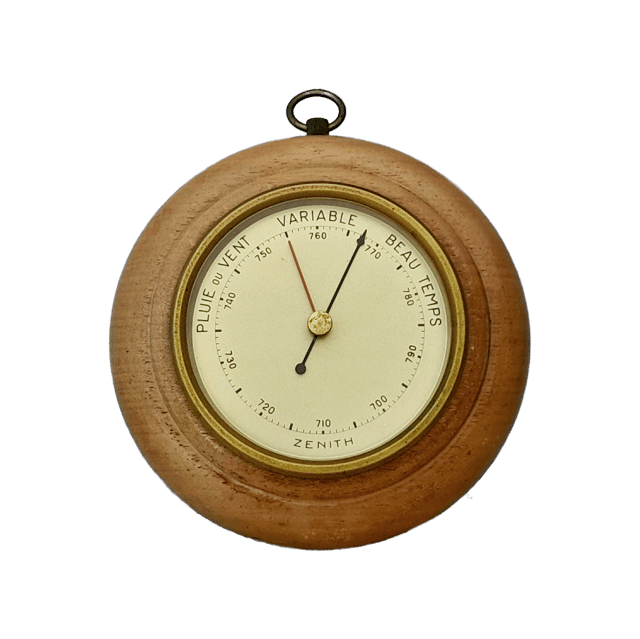
"Dans le début des années 1910, l'horlogerie tend à stagner et les ventes sont difficiles. Georges Favre Jacot diversifie les activités et fabrique un Altimètre essentiellement destiné aux militaires. De l'altimètre au baromètre, il n'y a qu'un pas…"
"In the early 1910s watchmaking tends towards stagnation and sales are difficult. Georges Favre-Jacot diversifies his activities and manufactures an altimeter intended essentially for the military. And from the altimeter to the barometer is but a single step…"
The logic here is impeccably engineering. An aneroid altimeter and an aneroid barometer are the same instrument, differing in scale and calibration. A firm that already knew how to transmit the microscopic movements of a diaphragm capsule to a pointer with watchmaking precision was getting a second product line almost for nothing.
This line also has documentary confirmation independent of both the book and the surviving examples. The Swiss registration of the "Zénith" mark on 11 January 1910 and the international registration No. 9125 that followed on 12 April 1910 extend the name not only to watches but to "all instruments or apparatus for measurement, alarm or control, mechanical or electrical." This is an official record of the Berne Bureau, made several years before Zenith instruments appeared on aircraft panels and on the walls of private houses. The firm secured in advance the right to produce under its own name exactly what it then went on to produce.
The principal monument of this line is the Royal Flying Corps instrument, to which Duval devotes a section headed "The Birth of a Legend": Zenith Royal Flying Corps, 30 Hours, Non Luminous, Mark V. Zenith instruments are held in the collection of the Smithsonian National Air and Space Museum — among them the Simple Altimeter Type 05B and the British Mark V-A of about 1917. In the chapter devoted to aviation, Duval states it plainly: pilots trusted the reliable and precise altimeters of Zenith.
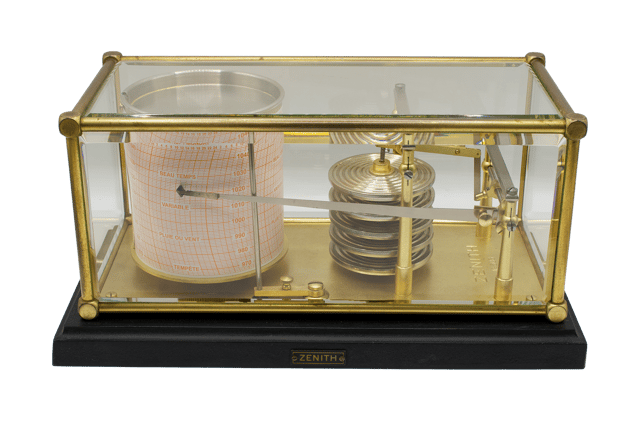
The cases of Zenith barometers are for the most part ordinary for their time. All the distinctiveness is inside. The defining feature of the Zenith movement is its watchmaker-level construction and finish. A nickel-plated decorative plate with a scalloped edge. A sculptural bridge for the pointer shaft of a characteristic asymmetrical, almost axe-like form: a broad arched plate raised on several pillars above the baseplate. Motion is transmitted to the pointer shaft by a fusee chain — a device taken directly from high watchmaking.
It is this architecture, rather than the case, that makes a Zenith movement recognisable at a glance and distinguishes it from the output of the instrument-making houses, which worked to an entirely different logic. A curious rhyme: the chain-and-fusee transmission, used for constant force, would be employed by the firm again a century later — in the ultra-complicated Christophe Colomb Hurricane.
Production of the instruments is documented up to the 1930s, after which they vanished from the manufacture's catalogue — despite, as Duval remarks, their international success.
The list of what came out of the gates on rue des Billodes in the interwar decades reads like the inventory of a technical museum.
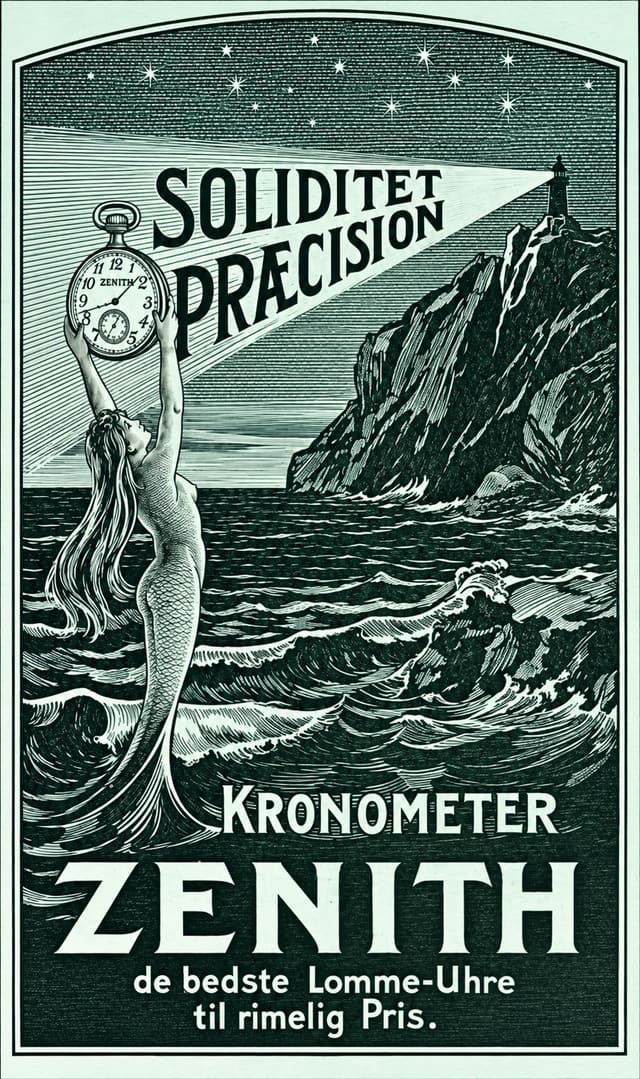
Marine chronometers. The merchant fleet could be equipped with very precise Zenith onboard chronometers, delivered in cases often made of exotic woods. Duval calls this line the emblem of successful diversification — and it also fed the competition programme: the large chronometer calibres were proved there as much as in the observatory trials.
The automobile. The sector surged ahead in the 1920s, and Jämes Favre, unwilling to miss a single opportunity, opened a dedicated workshop. Besides speedometers and onboard clocks for cars, taxis and buses, on 29 December 1919 the manufacture registered a patent for its own magneto, intended mainly for engine ignition. It was fitted, among other applications, to racing cars.
Cinema projectors and sewing machines. In the 1920s Zenith began producing cinema apparatus and sewing machines under its own name, under an agreement with a manufacturer across the border in Morteau. An unexpected direction, but an explicable one: watch sales were falling, and retail watchmakers — strategically vital points of sale — needed something to live on. The brand simply gave its sellers goods to sell.
Telephonometer and telephonograph. There were two instruments, and the difference between them lies in the suffix: one measures, the other writes. The Zenith telephonometer looked like a large pocket chronometer — a round case, two buttons on the sides, a handle below, a dial with a small counter at the top and the signature "Georges Favre-Jacot & Cie, Le Locle." It timed the duration of a call and accumulated the number of connections made. The telephonograph solved the same problem differently: a flat case with a hinged lid and a paper tape inside on which the readings were recorded. Both were mounted on a common desk stand beside the telephone. The purpose was strictly bookkeeping. Tariffs in those years were counted by the minute, the bill was issued by the telephone company, and the subscriber had nothing to set against its arithmetic — except a count of his own. The patents on the instruments date from 1908 and were filed in two countries: French No. 373533 and German DRP No. 104961. It is telling where this output surfaces. In June 1913 a photograph of both instruments on their stand filled the entire cover of the monthly bulletin of the Association of Telephone Subscribers and Customers of Public Services — the journal of organised consumers waging war on monopolies for transparent billing. Zenith appeared there not as a supplier of prestige goods but as a supplier of evidence. And one more point of chronology: that cover appeared three years after the "Zénith" mark had been registered for "all instruments or apparatus for measurement, alarm or control, mechanical or electrical." Here is one of them — in series production, with patents in two powers, in the hands of the people who needed it.
Electricity. The brand's first electric clocks bore the name Calora. Then came "master clocks," setting the time for entire buildings and enterprises.
"Insurance watches." A separate episode that Duval calls a social revolution: watches sold under a scheme tied to an insurance premium — a way of giving the working man access to accurate time.
Neuchâtel clocks. Longcase and wall neuchâteloises with an eight-day carillon and, to order, a quarter repeater: an ancient craft preserved inside an industrial enterprise.
Oil lamps, cement slabs, sawn timber — from the founder's other holdings, but under the same management.
Watches by which trains run are a genre of their own, with their own standards: large numerals, a clear dial, a strict regulation on daily rate and compulsory periodic inspection.
Zenith supplied watches to the Turkish railways, to the Canadian railways with the RR56 model, to the French SNCF and, finally, became the official supplier to the Swiss railways. Duval describes a separate episode in which the manufacture played its principal trump card — independence — in the service of a European contract.
There was also a line for the postal service: watches that, in the book's formulation, almost never needed re-regulating.
The military contracts form a register of their own:
To these should be added the trench watches of the First World War and the Land & Water model of 1915, made exclusively for the London jeweller Birch & Gaydon.
Industrial logic did not hinder aesthetics — rather, it financed them.
Zenith worked with Alphonse Mucha: the master of Art Nouveau who defined the visual language of the era had a hand in the brand's imagery. Art Nouveau also brought the firm together with the artist Frenay. A separate page belongs to Lalique: amber and light, glass as a material for a watch case.
To the same series belong the cases made by the Huguenin brothers and commissions of the highest order — for example, the watch made for King Alexander I of Yugoslavia. In modern times the line was continued by the skeletonised work of Kurt and Christophe Schaffo.
Any study of Zenith's history must take account of another substantial industrial company with practically the same name — the Société du Carburateur Zénith of Lyon. Despite the coincidence of name and even a partial overlap in fields of activity, that firm had no corporate connection with the watch manufacture of Le Locle.
The French Zénith began with the inventor François Baverey. In 1903 he acquired a Lorraine-Dietrich automobile and found himself dissatisfied with the operation of its carburettor. The cause lay in the incorrect ratio of air to fuel at different engine speeds. Baverey, who was keen on mathematics, physics and astronomy, developed his own system with two jets, one of which performed a compensating function and made it possible to maintain the mixture far more accurately. In 1907 he named his device Zénith, evidently using the astronomical term as a symbol of the highest point, of perfection.
The industrial potential of the invention was quickly noticed by the Lyon automobile firm Rochet-Schneider. As early as 1906 Baverey was given access to its laboratories and workshops, and he subsequently transferred the rights to his French and foreign patents to the firm in exchange for payments on each carburettor produced and a share of licensing income. By 1908 all Rochet-Schneider automobiles were fitted with Zénith carburettors, and other manufacturers began acquiring licences, among them Cottin & Desgouttes, De Dion-Bouton and Peugeot.
The success was so considerable that on 30 July 1909 an independent Société du Carburateur Zénith was established. Of the initial capital of 50,000 francs, Rochet-Schneider contributed 44,000, thus controlling 88 per cent of the company. Amédée Boulade became its head, with Baverey as consulting engineer. The new firm's first model of its own was the Type D carburettor.
The company very rapidly turned into an international industrial group. In 1910 a German structure appeared in Berlin, in 1911 the Zenith Carburetor Company in Detroit, in 1912 the British Zenith Carburettor Company with its own production in the London area, and in 1916 an Italian division in Turin. The company's advertising also listed representations in Paris, London, Berlin, Brussels, New York, The Hague, Milan and Detroit.
During the First World War Zénith became an important supplier of aviation and military carburettors. In the United States its products were used, among other applications, on Liberty L-12 aero engines. This brought the field of the French Zénith still closer to the activity of the Swiss Zenith, which in those same decades was producing aviation clocks, altimeters and other onboard instruments.
The French firm's range was not confined to carburettors as such. According to official industrial directories, the objects of the Société du Carburateur Zénith included the manufacture and sale of engines, carburettors, parts and ancillary devices for the automotive and mechanical industries. In the interwar period the company also produced fuel and air filters, mixture pre-heating devices and a variety of fuel-system equipment.
The scale of production was enormous. In 1924 approximately half the cars exhibited at the Lyon motor show were fitted with Zénith carburettors. In 1928 the Lyon factory alone was producing some 100,000 to 110,000 carburettors a month, and the Detroit plant had comparable volumes; in that period the entire Ford range was equipped with Zénith products.
During the Second World War the shortage of petrol forced the company to adapt engines to alternative fuels — alcohol, acetylene and producer gas. After the war normal production was restored. In 1959 Rochet-Schneider passed to Berliet, and in 1963 the old Lyon Zénith factory was also sold to Berliet; automotive production moved to the Troyes area.
In 1970 the automotive branch of Zénith was acquired by the German DVG — Deutsche Vergaser Gesellschaft, the future Pierburg. Since DVG already controlled Solex, the activities were combined into the SEDEC structure. The aviation branch survived separately as Zénith Aéronautique and in 1986 became part of Intertechnique; through subsequent corporate transformations it came to be associated with the Zodiac Aerospace group and then Safran.
Individual branches of the marque outlived the original French company. In Britain the Zenith Carburettor Company later merged with Solex, and the Zenith name remains well known through the Zenith-Stromberg carburettors used on Jaguar, Triumph, MG, Volvo, Saab and other cars. Today the British firm Burlen describes itself as the sole manufacturer of Zenith carburettors and spare parts for them.
The American line survived as well: the Zenith Carburetor Company, founded in Detroit in 1911, became in time Zenith Fuel Systems. The company states that it continues to produce original and replacement carburettors, repair kits and fuel-system components for industrial engines, agricultural machinery, marine installations and other applications.
Thus the twentieth century contained two significant Zeniths that should not be confused. The Swiss Zenith of Le Locle grew out of the watch manufacture of Georges Favre-Jacot and specialised in watches, chronometers and precision measuring instruments. The French Société du Carburateur Zénith grew out of the invention of François Baverey and became one of the largest producers of carburettors and fuel-system components.
The Russian Revolution destroyed the firm's most important market overnight.
Compounded by the post-war crisis, this forced the company to introduce short-time working and lay off part of its staff — which caused smouldering resentment among workers, many of whom had given the factory decades and remembered the master who had signed an agreement with them in 1906.
The figures speak for themselves: annual revenue collapsed from 800,000 francs to 37,000 francs over the period 1922–1924.
The board accused Jämes Favre of unsatisfactory management. He was squeezed out gradually from 1923 and removed definitively in 1925. With that, the dynasty ended. Management passed to Ernst Strahm, who came from Vulcain, and to the technical director Fritz Cosandier.
In 1933 the machine-tool maker Dixi of Le Locle entered Zenith's capital — a firm destined to play one further, decisive part in the brand's fate half a century later. In this period the company was run by managers under the control of the Neuchâtel Cantonal Bank and Universal Genève, with Edgar Bichsel at their head.
And in 1935 the French army, following other clients, approached Zenith with a request for special onboard clocks built to a very precise technical specification.
So there appeared first the Type 10, then the Type B, and in 1939 the Type 20, refined according to the clients' wishes.
These instruments, known as montres d'aéronef, had an overall diameter of 65 millimetres. A matte black dial, Arabic numerals coated with radium compound for night legibility, broad radium hands, a seconds hand at the six o'clock position. The caseback carried the type, the serial number and the date of manufacture.
Handling them was thought through down to the gesture. As part of the pre-flight check the pilot wound the movement by turning the knurled bezel clockwise, then lifted the bezel and set the time, carefully aligning the marker beneath the glass with the moment of departure. This made it possible to track the duration of the flight and not exceed the aircraft's calculated range. The movements were accurate enough for chronometer certification — but no one cluttered the dial with superfluous inscriptions.
The testing was carried out in earnest:
Type 20 clocks were fitted to French bombers and to Dewoitine aircraft. Their pilots were additionally issued with flyback chronographs strapped to the knee by a double leather strap: with these they timed the interval from the release of a bomb to its detonation.
As Duval remarks: "This instrument, for all its apparent simplicity, was extremely thoughtfully designed with the pilots' handling of it in mind."
At the beginning of the Second World War the Le Locle industrialist Georges Perrenoud, the owner of Dixi, acquired Zenith — primarily for its production capacity. Zenith and Dixi produced time fuzes for munitions and other war materiel. Free trade with Germany led to sanctions and to the firm's inclusion on the Allied blacklist, and Perrenoud was compelled to sell his shares to the private bank Dupasquier & de Montmollin.
At the turn of the forties and fifties Zenith ran a campaign in the trade press under the heading "The daily struggle for precision." The subject was thoroughly prosaic: dust and damp. They are, the advertisement explained to retail watchmakers, enemies of the rate — they impair the working of the movement — and enemies of beauty: they dull the freshness of a dial and the transparency of a bevelled crystal. They generally get in by one route, through the crown, and that is why every Zenith watch is fitted with a device closing as hermetically as possible the aperture in the case through which the winding stem passes. Beside the text ran three cutaway diagrams showing exactly how that route was barred. The caption declared that more than eighty years of daily struggle for precision had taught the firm to neglect no means of increasing the reliability of its watches' rate.
In those same years the competition was selling the sealed case as adventure — through swimmers, divers and records. Zenith sold the same thing as a continuation of its own obsession: not water resistance for the sake of feats, but protection of the rate for the sake of seconds. The argument of the observatory competitions, translated into domestic terms.
An amusing rhyme: the tropical chamber and the water spray through which the Type 20 onboard clocks had been put on the French army's specification in the late thirties had become, by the end of the forties, a selling point for the buyer of an ordinary wristwatch. The requirements of a military contract settled into civilian production — as they usually do.
In 1949 Jean-Pierre de Montmollin took charge of the company, and the following two decades were the best in its history.
Calibre 133 (1948) — Zenith's first automatic calibre and an important contribution to the development of the centre seconds hand.
Calibre 135 — presented in 1948 and produced from 1949 to 1962. It was designed by Ephrem Jobin to a brief from the technical director Charles Ziegler, and its entire construction is subordinated to a single aim. Thirteen lignes (30 mm) in diameter and 5 mm high; a large 14 mm balance; a big barrel; an offset centre wheel, which freed space for balance and barrel simultaneously; a frequency of 18,000 vibrations per hour; a Breguet overcoil; swan-neck regulation. Some 11,000 examples were produced, most of them with a chronometer certificate.
Calibre 135-O — the racing, observatory version, never sold. It was campaigned by the legendary régleurs Charles Fleck and René Gygax. The result: about 235 prizes, an absolute record among observatory calibres, and five consecutive first places in the wristwatch category at the Neuchâtel Observatory from 1950 to 1954 — an achievement unbeaten to this day.
Beside them stands an entire competition line to which Duval devotes a separate chapter in his book: the observatory calibres of 20½ lignes, the long career of calibre 261, the "pure" observatory calibre 707, and 5011-O, which set a world record in 1967. The production version, 5011K, is a large chronometer calibre for marine chronometers and pocket watches, also fitted into wristwatch cases. A distinct figure in this story is Charles Rosat, one of the founders of the manufacture's chronometry school; the firm was, in the book's phrase, home to the greatest Swiss chronometry masters.
Chronographs. Zenith took its blanks from Valjoux and Excelsior Park, and on 2 May 1960 formally acquired the Martel Watch Co. factory — an enterprise specialising in chronographs and previously linked to Universal Genève. (Some sources date the deal to 1959.) The former Martel facilities produced calibres 146 and 146 DP, on which, among others, the Cronometro Tipo CP-2 military chronographs for the Italian Air Force of the early 1960s were built.
It was Martel's expertise that made possible what happened in 1969.
Work had begun in 1962.
The brief was stated boldly: not a module on top of an existing calibre but an integrated automatic chronograph designed as a single whole — and at a frequency of 36,000 vibrations per hour, five times a second, which yields measurement to tenths.
Zenith announced calibre 3019 PHC on 10 January 1969. A column wheel, integrated construction, a height of 6.5 mm, counters for 30 minutes and 12 hours. The name was chosen without false modesty — El Primero, "the first."
The competition was neck and neck. The Chronomatic consortium — Breitling, Heuer-Leonidas, Hamilton-Büren and Dubois-Dépraz — presented Calibre 11 on 3 March 1969 simultaneously in Geneva, New York, Hong Kong and Beirut: modular construction, a micro-rotor, 19,800 vibrations. Seiko showed calibre 6139 on the Japanese market in May: column wheel, vertical clutch, 21,600 vibrations.
The dispute over primacy is unresolved and will probably remain so: working prototypes matured at roughly the same time in all three places, while the dates of announcement, serial production and release in particular markets differed. It is more accurate to put it differently: Zenith was the first to show publicly a working integrated high-frequency automatic chronograph, and it was so far ahead of its rivals in construction that it outlived them all — El Primero remains in production to this day.
That same year of 1969 saw another long-lived idea: the sporting, water-resistant Defy with its distinctive fourteen-sided bezel.
The irony of the moment is devastating: the most accomplished mechanical chronograph in the history of the industry appeared at precisely the moment when the industry was preparing to abandon mechanics.
Because of naming disputes with the Chicago Zenith Radio Company, the Swiss could not trade properly in the United States. A solution was found in 1968: a merger with Movado of La Chaux-de-Fonds, so as to sell to the Americans under a brand they respected. Mondia was added later, and the Movado-Zenith-Mondia holding was formed. Within it Zenith held 40 per cent of the shares, Movado 16 and Mondia 15; Zenith was the largest participant. El Primero was sold under the Movado name as the Datron HS 360.
And then the Americans bought the holding themselves. Zenith Radio Corporation, the largest American electronics manufacturer, acquired it for the coincidence of name and for a bet on quartz. The dating diverges: some sources place the transfer of the controlling stake in 1971, while the announcement of the deal and most French-language sources place it in June 1972. After the deal the holding was renamed Zenith Time SA. Jean-Pierre de Montmollin left his post in 1972.
The order to halt production of El Primero dates from 1975; the sale and scrapping went on in the following years, and the definitive abandonment of mechanics is associated with 1978.
It was to that order that Charles Vermot replied with his false wall. Duval titles the corresponding section of his book simply: "A quiet hero resists the advance of quartz."
At the end of 1978 the Swiss firm Dixi, led by Paul Castella, who had already bought up many local companies, purchased Movado-Zenith-Mondia from Zenith Radio. Zenith and Movado were combined into Zenith Movado Le Locle SA, and Mondia was integrated into Dixi. Michel Manfredini was placed at the head of Zenith. By then about a hundred and fifty people remained of the workforce of two thousand. Movado was handed over to the North American Watch Company in 1983.
The revival began from outside: Pierre-Alain Blum of Ebel placed the first modern order for El Primero in 1984, using it under his own designation 134. From that same year of 1984 Zenith was again producing its own watches on the revived calibre.
And in the early 1980s Rolex approached Zenith: Geneva needed an engine for its new automatic Daytona. A ten-year contract was signed in 1984 and deliveries began in 1988. Rolex reworked the calibre radically, naming the result 4030: the frequency was lowered from 36,000 to 28,800 vibrations, a Breguet overcoil was added, the calendar was removed and more than half the parts were replaced. The partnership ended in 2000, when Rolex introduced its own calibre 4130. Watches of that period — reference 16520 — are still called the "Zenith Daytona" by collectors.
It is hard to imagine a fuller vindication of the man who had single-handedly hauled presses up to an attic.
Rainbow (1992) — a return to the roots through technical virtuosity: a bright, legible, shock-resistant chronograph which in the Rainbow Flyback version received the very return-in-flight function the firm had fitted to bomber instruments half a century earlier. The model was supplied to the French army and became one of the decade's principal commercial successes.
Elite (1994) — an ultra-thin automatic calibre, the first in the firm's history developed with computer-aided design. The specialist press awarded it the title of best calibre of the year.
Chronomaster (1994) — the collection that became the brand's calling card: the tricolour El Primero counters on a light dial, recognisable from across a room. Duval calls it the firm's most timeless model.
The catalogue of the same period brings in Class, the classical line; De Luca, the return of the steel chronograph on a bracelet; the Thomas Engel collection with its return to tradition; and, carried over from the earlier quartz period, the Port Royal line.
For the firm's 125th anniversary in 1990 a series of four models with COSC certificates appeared, and for the 700th anniversary of the Confederation in 1991, series built on calibres 400 and 410.
In November 1999 LVMH acquired Zenith from Paul Castella. The terms were not officially disclosed, but the WWD article of 16 November 1999 gives figures: around 50,000 watches a year, sales of some $38.7 million, supplies of calibres to outside clients including Rolex and Concord; the presumed price of the deal about $48.4 million.
Zenith entered LVMH's new watch and jewellery division together with TAG Heuer, Ebel (quickly resold to the Movado Group), Chaumet, Fred and others. Duval sums up the meaning of the deal in a single phrase: the group provided the resources for the pursuit of excellence.
LVMH's watch division — TAG Heuer, Hublot, Zenith — has been headed since 2024 by Frédéric Arnault.
The El Primero family acquired variations: a big date and a jumping seconds hand; Open versions; a tourbillon; calibre 4231, the El Primero of the third millennium; El Primero Lightweight in new materials; a tourbillon with perpetual calendar; a tourbillon with moon phase and day/night indication; a retrograde date; and Zero-G, a system holding the regulating assembly horizontal regardless of the watch's inclination.
Christophe Colomb (2010) — the summit of that line: the gyroscopic Gravity Control module, the equation of time, and, in the Hurricane version, a chain-and-fusee transmission for constant force. The circle closes: the chain that pulled the pointer of an aneroid barometer a century earlier returned in an ultra-complicated watch.
Defy Lab (September 2017) — the ZO 342 oscillator, a monolithic regulator of monocrystalline silicon 0.5 mm thick, replacing some thirty components of the traditional balance-and-hairspring assembly and running at 15 Hz (108,000 vibrations per hour). Ten examples were made.
Defy Inventor (2019) — the serial development of the idea: calibre 9100, 18 Hz, 129,600 vibrations, a titanium case with a bezel of the light composite Aeronith.
Defy El Primero 21 — a chronograph with two independent oscillators (36,000 and 360,000 vibrations) measuring hundredths of a second; then Defy Extreme on calibre 9004.
Chronomaster Sport (2021) — calibre El Primero 3600: 5 Hz, the central chronograph hand completing a revolution in ten seconds, a scale marked to tenths, a 60-hour power reserve.
Defy Skyline (2022–2023) — calibres 3620 and 3600.
The aviation line returned as well: the Montre d'Aéronef Type 20 (2012, 57.5 mm), a direct descendant of the onboard clocks of the 1930s, released for the centenary of aviation; the Stratos Striking 10th, linked to Felix Baumgartner's stratospheric jump of 2012; New Vintage 1955; Academy, a family of complicated movements; Respirator; and the diving Defy and Plongeur 1000, which withstood a hundred atmospheres.
The last of these appeared in 2025 for the manufacture's 160th anniversary and is named with the founder's initials — the very ones Favre-Jacot registered as a trademark on 21 January 1881 at four in the afternoon: a 39 mm platinum case, a lapis lazuli dial, a guilloché "brickwork" motif taken from the factory façade, a 72-hour power reserve, a Breguet overcoil, stop-seconds, a COSC certificate. The edition runs to 160 pieces.
Zenith watches were worn by Roald Amundsen, Edmond Rostand, Prince Albert I of Monaco, King Alexander I of Yugoslavia and Mahatma Gandhi — for the last of these, a silver pocket watch with an alarm was one of his few possessions and marked the hours of prayer. The watch was stolen from him on a train on the way to Kanpur; a repentant thief returned it six months later. In 2009 at Antiquorum a lot of Gandhi's personal effects — watch, sandals, bowl, spectacles — sold for a record $1.8 million. Duval unites this gallery in a single formula: "To dare everything — from Amundsen to Baumgartner."
In 2009 Le Locle and La Chaux-de-Fonds were inscribed on the UNESCO World Heritage List as "watchmaking town planning" — a unique example of towns laid out around a single craft. Zenith's contribution as the town's largest employer is part of that heritage. The manufacture's main building was restored in 2012. Vermot's attic has been preserved and forms part of the tour route.
Formally, Zenith exists as a division of LVMH Swiss Manufactures S.A. at 34, rue des Billodes, Le Locle — exactly where Favre-Jacot put up his first building.
In practice it is a working manufacture of the full cycle: all the brand's modern watches are fitted with mechanical calibres developed and produced in-house, the company is present in more than fifty countries and works with some six hundred calibre variations.
A hundred and sixty years after a twenty-two-year-old pivoteur's apprentice invested his wife's dowry in a patch of land in the Billodes quarter, his factory still does what it was built to do: it measures — time, altitude, pressure, speed — more precisely than is strictly necessary.
| Date | Name |
|---|
| 1865 | Fabrique des Billodes |
| 27 January 1883 | Maison Georges Favre-Jacot (Billodes) |
| 16 July 1896 | Georges Favre-Jacot et Cie, capital 1.25 million francs |
| 24 July 1900 | registration of the stylised "Zenit" |
| 3 October 1900 | registration of the "Zenith" mark |
| 14 January 1910 | Fabriques des Montres Zénith, Georges Favre-Jacot et Co |
| 1911 | joint-stock company; Zenith becomes the company's name |
| 1912 | the "Zenith" mark definitively transferred to the successor company |