Loading
Weather Trends, Inc. was a New York–based private firm operating at least from the mid-1950s, specializing in long-range forecasting, weather-marketing research, and the commercial use of climate data. During the 1960s–1970s the company sold forecasts to businesses, published monthly bulletins and climatological reference materials, and also licensed or packaged its content for publishers.
Weather Trends, Inc. was founded by Barry Schilit; by 1954 the company already existed and appeared in professional industry directories. Available open sources provide two complementary “anchors” for the emergence of the company.
The first is family-biographical: in the obituary of Henrietta Schilit (published in The New York Times via Legacy), it is stated that the day after their wedding her husband founded his own business, Weather Trends, and that she “substantially assisted” in the enterprise. The husband is explicitly identified as Barry Schilit, who therefore appears as the founder of the company.
The second anchor is institutional/industry-based: already by the mid-1950s Weather Trends, Inc. is recorded in a professional directory of private meteorological organizations published under the auspices of the American Meteorological Society. In early issues the company is listed at 550 Fifth Avenue, New York 36, N.Y. (telephone Circle 7-2816).
Beginning in the 1950s Weather Trends, Inc. positioned itself specifically as a long-range forecasting and applied meteorological organization for business clients. This is evident from the wording used in professional directories, where the company is repeatedly accompanied by descriptions such as “Specializing in Long-Range Forecasts” together with “Weather/Marketing Research and Promotional…” (that is, research into the influence of weather on demand and marketing, as well as weather-based promotional services).
By the mid-1960s the contact information had also changed: directories list the address 565 Fifth Ave., New York, N.Y. 10017, telephone MU 2-4280, and the specialization is firmly described as “Long-Range Forecasts” plus “Weather/Marketing.”
Independent media references illustrate how the company was perceived in the marketplace. In a United Press International report discussing criticism of popular weather almanacs, the journalist noted that he “contacted Weather Trends Inc. of New York,” which described itself as “the oldest and largest long-range forecasting company in the United States,” with Barry Schilit named as president. In the same article Weather Trends is presented as a contrast to The Old Farmer’s Almanac—that is, as a more professional commercial forecasting service.
Another indirect confirmation of the company’s role in the market appears in an agricultural context: industry publications cite Weather Trends as a source of long-range forecasts that readers and practitioners actually used in planning. In the March 1960 issue of The Progressive Farmer it is stated that one farmer “studies three long-range weather forecasts, including Barry Schilit’s column,” in order to be ready for a potential “window of good weather.”
The company’s history can be traced not only through descriptions of its services but also through the types of products it issued—ranging from bulletins and climatological atlases to mass-market forecasting tools. In 1966 the company registered the trademark WEATHER TRENDS, describing the product as a “monthly bulletin containing monthly weather forecasts.”
In the mid-1960s Weather Trends, Inc. also produced specialized climatological materials. A NASA document (1977) cites a company publication in its bibliography: “Climatological Atlas Of The Continental United States: Precipitation, New York 1966.” This indicates that Weather Trends worked not only in the genre of forecasts but also in the production of cartographically organized climatological reference material (in this case, precipitation maps)—a type of product useful for engineering calculations and planning.
By the late 1960s the company was also publishing popular applied books: a Google Books entry records the publication Weather Outlook for Spring and Summer of 1969, credited to Weather Trends, Inc.
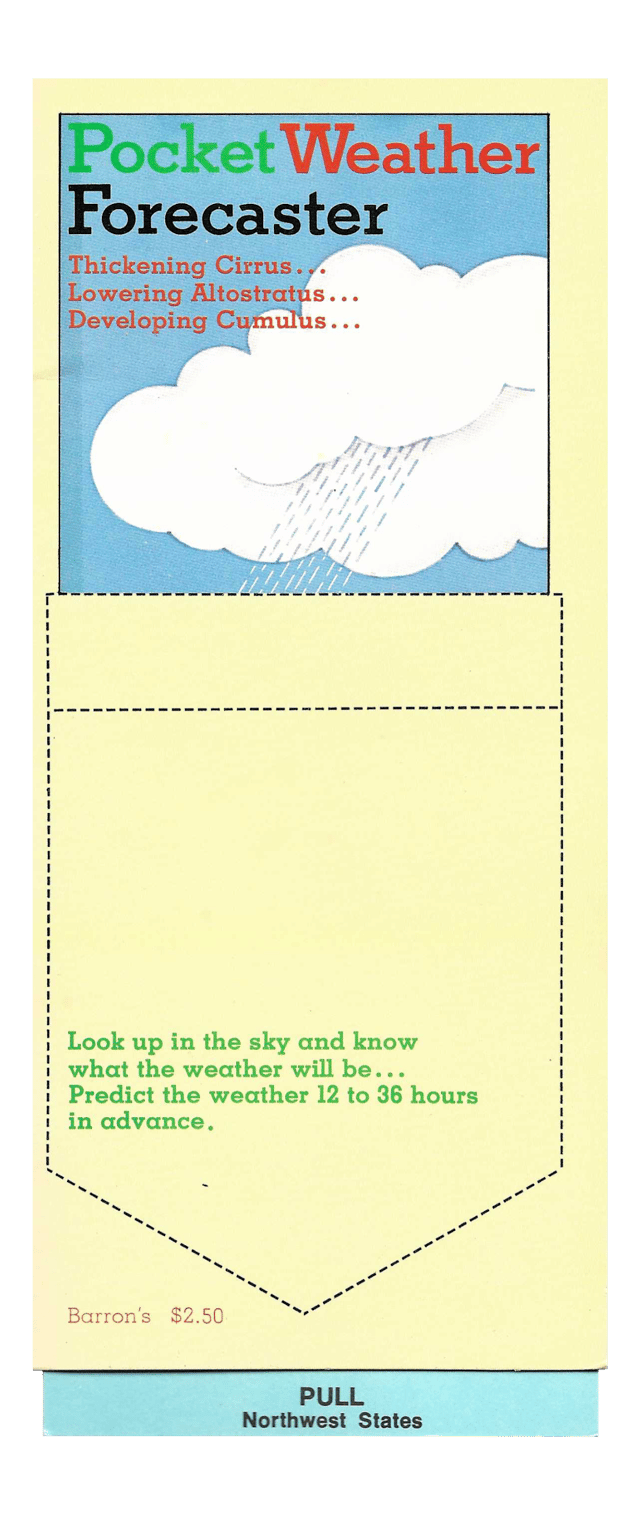
Finally, in the 1970s a mass-market product appeared in the form of a “pocket weather forecaster” based on cloud observation. In reviews describing the Pocket Weather Forecaster, the device is explicitly identified as a product of Weather Trends Inc. and described as a kind of slide rule, requiring the user to identify the basic cloud type and wind conditions.
Another line of activity was the syndication of forecasts in periodicals. Digitized sources (Internet Archive) contain spreads titled “Barry Schilit’s Weather Trends,” where diagrams and estimates of temperature and precipitation for the coming month were published. Together with the Progressive Farmer reference, this creates a consistent picture: Weather Trends sold and distributed long-range forecasts as an informational product, both directly to the public (through the press) and as a B2B consulting service.
Beginning in the 1970s professional directories also mention a similarly named entity, Weather Trends International, Ltd., again emphasizing specialization in long-range forecasts and listing a “European HQ: London.” Geographically the organizational hub remained tied to New York City (the Fifth Avenue address still appearing as the base), while the European presence was located in London.
The most clearly documented bridge between the historical Weather Trends and the later corporate structure runs through the chain Surveillance Data, Inc. → SDI/Weather Trends → Weather Trends International.
Records in the United States Patent and Trademark Office Assignment Center show entries for the assignee SDI/WEATHER TRENDS, INC., where Surveillance Data, Inc. appears among the parties and assignment dates (for example June 2006) are recorded. This is significant in practical terms: SDI was known as a data provider (including pollen and weather data), as seen in clinical reports where SDI coordinated monitoring and used SDI/Weather Trends as a source of weather series.
In the applied business context of the 2000s SDI/Weather Trends functioned as a provider of weather statistics for economic and retail analysis. For example, the quarterly report of Rollins, Inc. (Form 10-Q) explicitly states: “As reported by SDI/Weather Trends Inc.” and proceeds to give comparative figures such as “the coldest April in five years,” demonstrating that SDI/Weather Trends served as an external analytical reference on the impact of weather on sales and demand. Industry media similarly cited SDI/Weather Trends data when discussing retail performance and monthly anomalies.
The human transitional element in this transformation was Bill Kirk. In public professional profiles he lists positions such as Vice President Weather Operations, SDI/Weather Trends Inc. (2003–2006) and earlier roles connected with Weather Trends Inc. At the same time, professional materials from Rutgers University mention SDI Weather Trends Inc. as a typical employer for meteorology graduates, indicating that the company was perceived as a real participant in the private weather sector in the 2000s.
Furthermore, trademark records (via aggregators) show that SDI/Weather Trends, Inc. appeared as the original registrant, while ownership later passed to Weather Trends International, Inc. in the ownership history of specific trademark applications and serial numbers. This represents a near-direct legal trace: part of the brand’s intellectual-property portfolio moved to Weather Trends International, Inc.
Today a private company operating under the name Weather Trends International sells year-ahead forecasts and analytics to businesses, publicly presenting itself as a team of statisticians and meteorologists with a commercial focus on retail, seasonal categories, and financial analysis. This model is described on the company’s corporate website and in its promotional materials.
Public references indicate that the company was founded by Jack Grum and Bill Kirk in the early 2000s, with headquarters in Pennsylvania, as reflected in encyclopedic aggregators and corporate descriptions.
The most careful conclusion regarding the relationship between the old Weather Trends, Inc. (New York, 1950s–1980s) and the modern Weather Trends International is therefore as follows:
Conclusion
Weather Trends, Inc. emerged no later than the mid-1950s in New York as a commercial meteorological firm. From the outset its orientation was applied: long-range forecasts, weather-marketing research, and possibly promotional and consulting products for industries sensitive to weather conditions. By the 1960s the company was already issuing its own monthly forecasting bulletins and climatological publications, while also distributing content through external publishers. During the 1970s the firm actively worked with corporate clients and the general public, and the cardboard Pocket Weather Forecaster is a highly characteristic artifact of precisely this phase: the popularization of commercial meteorology in the form of an inexpensive mass-produced object. By 1980 the company still positioned itself as a major player in long-range forecasting. After that point the trail of the original New York company becomes fragmentary; in the 2000s the line SDI/Weather Trends → Weather Trends International appears, representing either the modern business successor of the brand or at least its brand continuation, though without fully documented legal continuity from the 1950s firm.