Loading
The Instrument Branch of Valmet: From an Aircraft Factory's Precision-Mechanics Department to Valmet Automation
A Note on the Name
"Valmet" is a name that has meant several different things, and it is worth untangling them before the story begins. It originated in 1946 as (the State Metal Works — abbreviated , formalised as in 1951): a state-owned metal-industry conglomerate that pooled the government's arms, ammunition and aircraft factories together with a shipyard. Over the following decades this conglomerate branched out in many directions — tractors (later the Valtra marque, today owned by AGCO), automobiles (Saab-Valmet and later Valmet Automotive), shipbuilding, paper machines, and instrument-making. In 1999 Valmet merged with Rauma to form ; in 2013 the pulp, paper and energy business was demerged into the present-day .
This account follows just one of those threads — the instrument-making branch — from its wartime origins in aircraft altimeters, aneroid barometers and gyrocompasses to its modern descendant in process automation.
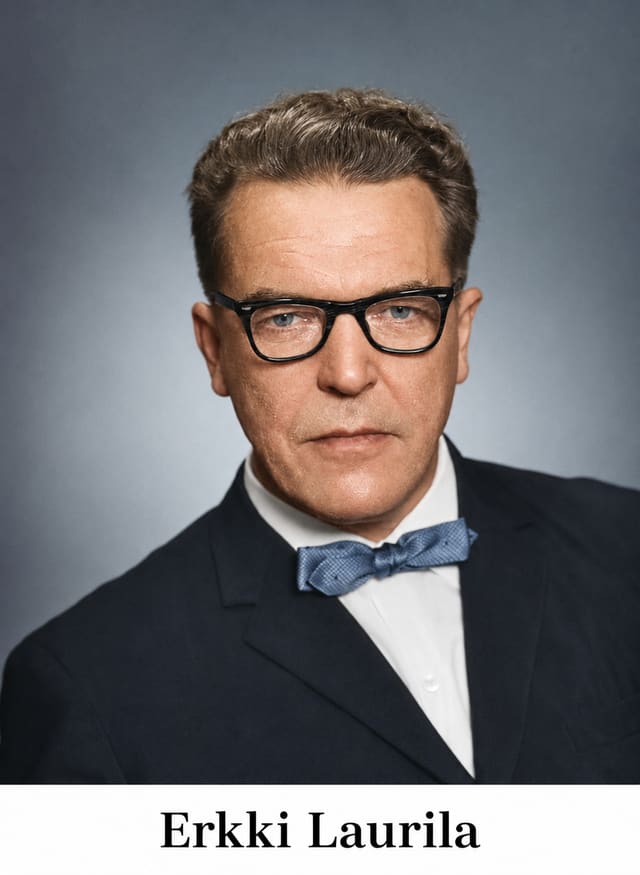
The instrument-making line of Valmet grew out of the precision-mechanics department (hienomekaaninen osasto) of the state aircraft factory Valtion lentokonetehdas at Tampere-Härmälä, which the physicist Erkki Laurila created and led in 1942–1946. His "brain trust" mastered the domestic manufacture of aneroids and Bourdon tubes, precision altimeters, artificial horizons and analogue integrators — and, as its principal invention, the "Pertti" remote gyrocompass (Swiss patent CH241227, granted 28 February 1946).
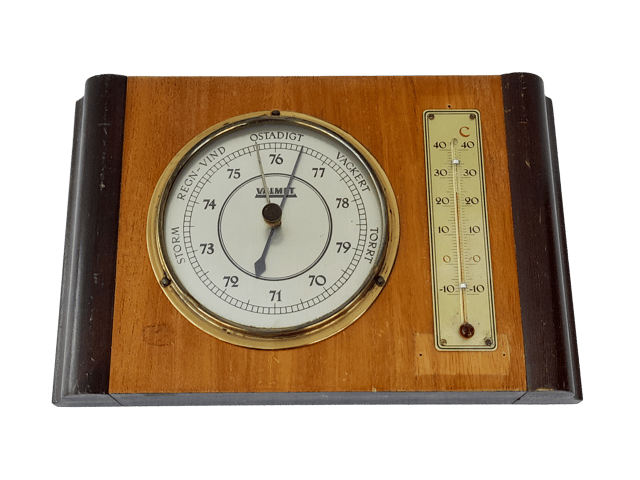
After the aircraft factory was absorbed into Valtion Metallitehtaat (1945/1946), the branch became Valmet Oy Instrumenttitehdas (an independent unit from 1973 under Veijo Hietala), which in the 1950s–1970s produced industrial instrumentation, ship's compasses, Tempex/Pyrtex remote thermometers, voltmeters/ammeters/kWh meters, and also wall clocks, domestic barometers (ilmapuntari) and sauna thermometers (löylymittari).
Process automation grew out of this industrial instrument-making (the digital Damatic system, 1979); the line ran the path Valmet Automation → Metso Automation → (after the split of Metso and Outotec in 2020) partly Neles, and today lives on within Valmet Oyj as the Automation Systems business line (the Valmet DNA/DNAe platform). The barometric/aviation-instrument "trace" survives mainly in museums and among collectors.
Origins: the aircraft factory's precision-mechanics department (1942–1944)
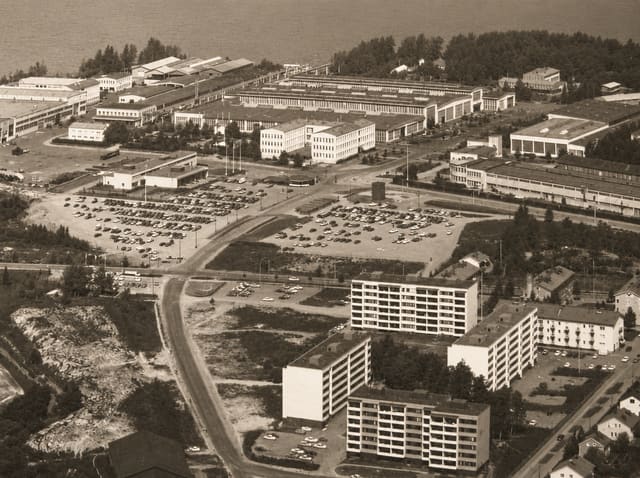
The state aircraft factory Valtion lentokonetehdas (founded in 1921 as an air-force works, placed under the Ministry of Defence from 1928, product prefix "VL") moved in 1936 from Helsinki to the Härmälä district in southern Tampere. By 1944 around 4,000 people worked at the factory in Tampere and its surroundings.
In the summer of 1942 the physicist Erkki Laurila — a reserve captain, seconded from the front in East Karelia — was directed to Härmälä to develop precision mechanics. The reason was strategic: the air-force staff feared complete dependence on Germany (the firms Askania, Fuess, Gossen) for aircraft instrument supplies, while German reverses on the Eastern Front foreshadowed a situation in which Finland would once again have to manage on its own. The task was to achieve technical self-sufficiency — the manufacture of its own instruments, gyrocompasses and other casings.
Laurila, in his own words, turned "from a physicist into a technician." He first asked the long-serving master watchmaker Erkki Aroheimo to teach him the repair of the most important instrument types; he then rose to head of department. The repair work rested on Aroheimo's skill. The young doctor flew with the factory's test pilots "to see what the instruments actually do."
The department's key early achievements (per Rissanen and Paju):
Half a year later, graduate engineers and the Master of Science Uljas Attila were transferred and hired to support Laurila, forming an "effective brain trust" (tehokas aivotrusti). In June 1943 General Leonard Grandell ordered the precision-mechanics activity expanded to cover the needs of the whole of defence and, in perspective, the whole country. In the summer of 1943 Laurila went on a study trip to precision-mechanics factories in Germany and Sweden.
By the summer of 1943 the department's design office employed 15 designers, and its workshops over 60 people; in 1943 the office produced 497 numbered drawings and 130 sketches. In March 1944 the department was hived off into a separate "sub-factory" (hienomekaaninen tehdas), and Laurila became its director; his closest subordinates were the graduate engineers Osmo E. Huhtamo and Veijo Hietala.
Instruments and inventions developed
Domestically produced aircraft instruments. According to the VL Myrsky restoration project, the following were domestically made (produced by the precision-mechanics department, designation 6VL): the airspeed indicator (nopeusmittari), the variometer / vertical-speed indicator (pystynopeusmittari), the compass, the fuel-quantity indicator (polttoainemäärämittari), the Pitot tube (pitotputki), the ammunition counter and a number of electrical devices. Some instruments remained German (the clocks were Swiss); captured instruments were also used, including as blanks.
The department also developed a precision altimeter (tarkkuuskorkeusmittari) and a fuel indicator. For the factory's mathematical office an integraph was built (tulointegrafi; Laurila described it in the paper "Ein Produktintegraph") — an analogue computing machine about 80×200 cm, operating mechanically, by hand. It greatly eased the laborious flutter calculations, led by the mathematician Pentti Laasonen, in rescuing the VL Myrsky fighter from destructive vibrations. In 1944 fixed vibration-measuring apparatus was also installed in the Myrsky; the recorder that logged the behaviour of test flights (an early "black box") named Mata Hari, developed by Veijo Hietala, registered a dive speed of 855 km/h during the fatal dive of MY-3 (19 November 1943). Together with Professor Yrjö Väisälä the department produced a reflector bombsight (heijastinpommitähtäin).
The "Pertti" remote gyrocompass (kaukokompassi / kaukohyrräkompassi). Developed in Laurila's department in the autumn of 1943. The device consisted of a "mother compass" (emokompassi) in an undisturbed location and a "daughter compass" (tytärkompassi) — a display in the cockpit; the mother compass weighed 1.75 kg, the daughter 200 g. The mother compass was a magnetically controlled gyrocompass with a pneumatically driven gyroscope; readings were transmitted by a simple direct-current system to one or more daughter compasses. Laurila published the fundamentals in Swedish in the journal Tekniska föreningen i Finland in early 1945, calling the device "the lightest and most compact remote gyrocompass in the world" (in the journal Tehostaja 7/1946). The name "Pertti" coincided with the name of Laurila's eldest son (b. 1939); correspondence used "VL kaukokompassi 'Pertti'."
The patent is confirmed: CH241227, German title "Fernmessaggregat, das einen Mutterkompass und mindestens einen Tochterkompass aufweist," applicant Valtion lentokonetehdas, filed 10 August 1944, granted 28 February 1946; the Finnish priority application (26 February 1944, inventor "tohtori E. Laurila") was withdrawn, as was the application in Sweden. The Swiss document itself does not name the inventor. Negotiations were conducted over licensed/export production through the Finnish legation in Bern (agent Jaakko Hallama) with the Swiss firms Peravia AG and the well-known instrument factory Hasler AG; in spring 1945 General Grandell asked for negotiations with Hasler AG to begin. According to archival data a few examples were probably sold to Switzerland, but the product was no great commercial success; not a single example of Laurila's compass has survived in Finland, according to Paju's enquiries.
Laurila filed other Finnish applications in 1944 as well (for instance, for instruments using rotating permanent magnets — kiertomagneettimittari, 23–25 May 1944), which were withdrawn in the summer of 1946.
The turn to peacetime products (1945–1946)
After the armistice was concluded, the defence establishment cancelled its orders, and the factory rapidly turned into a huge repair-design-mechanical combine for war reparations to the USSR. Laurila made an extensive tour of forestry-industry plants to understand what instruments they needed, and in 1945 the production programme of his factory became "control and measuring instruments for industry, in part also regulators."
The civilian output of 1945 included: 500 blood-pressure gauges (verenpainemittari), 5,000 gears, two Mata Hari units, 2,000 volt- and ammeters, and the repair of 520 assorted instruments. In 1946 the precision-mechanics factory produced 43 items, many of them new — in particular ship's compasses (laivakompassit; 70 compasses had already been produced in 1944), made according to aviation principles. The remote thermometers for district heating were given the trade names Tempex and Pyrtex.
In the autumn of 1945 Valtion lentokonetehdas was absorbed into the combined Valtion Metallitehtaat (later Valmet). In a catalogue of civilian products circulated to the legations, the instruments of Laurila's factory were listed — from the Mata Hari measuring devices to general and draught gauges, the blood-pressure gauge and the ship's compass; notably, the gyrocompass was absent from the catalogue, indirectly indicating an anticipated licensing deal.
A change of course and a "missed start" (1946)
At the end of 1945 Laurila was chosen as the first professor of technical physics at the Technical University (TKK), to which he moved in 1946. His successor at the head of the precision-mechanics factory made development and production less ambitious: the programme came to include wall clocks (seinäkelloja), barometers (ilmapuntareita) and sauna thermometers (löylymittareita). As Laurila himself noted, this cost the head start gained immediately after the war on the international market for pneumatic regulators: Veijo Hietala, with Laurila's sanction, had brought a pneumatic regulator to prototype stage, but it "remained on the shelf." The real roll-out of Valmet's instrument production came only in the 1950s.
Clocks, barometers and household instruments (1949–1976)
According to the Finnish Clock Museum (Suomen Kellomuseo), Valmet Instrumenttitehdas Oy operated in 1949–1976 in Tampere (Härmälä). The ability to begin clock production rested on the instrument competence of the former aircraft factory; at first the clock manufacturer was given in advertisements as "Lentokonetehdas, Hienomekaaninen osasto." Clock production began in the early 1950s: at first only wall clocks, about ten models; by 1954 there were 18 clock models in production — wall and table — as well as barometers (ilmapuntarit). The movements were mostly made in Tampere, partly imported. Cases were made of birch, fine woods, faience and plastic; the models bore Finnish names — Olli, Matti, Antti, Jussi, Iisakki, Aino, Aila, Rauni. In 1969 Pentti Kiuru obtained exclusive sales rights to Valmet clocks, and in 1970 part of the production passed to him; in 1976 Valmet exited the clock business for good. Valmet's ceramic/faience sauna thermometers (löylymittari), whose porcelain parts were made by Arabia, are still commonly found among Finnish collectors as a nostalgic item.
Industrial instrumentation and the birth of automation
Veijo Hietala made the development of instrument-making at Valmet his life's work. According to Paju's book chapter (2017), in 1955 Hietala was placed at the head of Valmet's instrument production, where he remained to the end of his career; in 1973 he took charge of the newly independent Valmet Oy Instrumenttitehdas, which subsequently operated under the name Metso Automation Oy. In 1976 Hietala, on Valmet's behalf, donated the wartime "black box" Mata Hari to the Technical Museum in Tampere (now the Vapriikki museum centre). Hietala and Laurila took part together in creating a professional circle that began as informal contact in 1953 and was formally constituted five years later under the name Suomen säätöteknillinen seura (today Suomen automaatioseura).
Engineers travelled to learn from the United States, where the manufacture of instruments and the application of measurement and control technique to process automation was at the cutting edge; the knowledge gained was quickly applied in the Finnish forest industry. The instrument factory expanded its activity to whole automation systems. The appearance in 1976 of Honeywell's first microprocessor-based automation system marked a technological watershed from analogue to digital technique; Valmet managed to keep pace and, with the help of VTT (the State Technical Research Centre), developed its own digital Damatic system in the late 1970s. Introduced in 1979, Damatic Classic became Valmet's first digital automation system; in the company's own words (Sakari Ruotsalainen, president of the Automation business), by launching it in 1979 "we made a giant leap forward, becoming the second company in the world to release a distributed control system" (DCS). It became an export success measured in billions of markka. It was followed by Damatic XD (1988) and Damatic XDi (1996), which, according to Valmet, "further developed process control by combining machine, drive and plant-wide control into a single system"; then came Metso DNA and Valmet DNA.
The range of industrial instruments of this branch (per the Virtuaalinen Automaatiomuseo collection and others) included pneumatic regulators and transmitters, electronic pressure/differential-pressure converters, pulp consistency sensors (Pulp-Air — a pneumatic consistency transmitter), flow meters, PID controllers, and also — as a separate mass-market success of the 1960s — electricity meters (kWh-mittari) and water meters (vesimittari).
The fate of the instrument factory: a chain of mergers
Present state (2024–2026)
Today the legacy of the instrument-making branch lives on within Valmet Oyj (headquartered in Espoo, listed on Nasdaq Helsinki). The legal entity Valmet Automation Oy (founded 1999, registered in Helsinki; head office in Espoo, sites including Tampere and Pietarsaari) had a turnover of about EUR 413 million and over 1,100 employees in 2023. In 2024 Valmet introduced a new generation of DCS — the fully web-based Valmet DNAe system; according to the company, this is "the world's first fully web-based system to receive the ISASecure System Security Assurance (SSA) Security Level 1 certificate" and meets the strict requirements of the ISA/IEC 62443-3-3 standard (the assessment was carried out by the independent company exida). From 1 July 2025 Valmet moved to a new operating model of five business areas: Automation Solutions, Flow Control, Pulp/Energy/Circularity, Packaging and Paper, Tissue. The first two belong to the Process Performance Solutions segment. The president of the Automation Systems business line is Emilia Torttila-Miettinen. The direct corporate "successor" to the instrument factory of Laurila and Hietala is thus Valmet's automation business, whereas the original barometric/aviation-instrument profile ended long ago and survives only in museum and collector pieces.
Biography: Erkki Laurila (1913–1998)
Erkki Aukusti Laurila was born on 20 August 1913 in Hämeenlinna, the second son of a merchant; from 1920 the family ran a large farm. He acquired technical handicraft skills from his maternal grandfather — a carpenter and self-taught mechanic. From 1932 he studied natural sciences (astronomy, mathematics, physics, chemistry) at the University of Helsinki, taking his Master's degree in four years. He took part in the Winter War; at the end of 1940, aged 27, he defended his doctoral dissertation in physics, "Die Streuung der Röntgenstrahlen an Edelgasen" (on the structure of the electron shells of noble gases from the scattering of X-rays), having performed the measurements on a home-made X-ray spectrograph — for which he received particular commendation. In 1942 he became a docent at the University of Helsinki.
In the summer of 1942 he was seconded to Valtion lentokonetehdas, where in 1942–1946 he led the precision-mechanics department (later factory) that he had created. In 1945/1946 he was elected the first professor of technical physics at TKK (a post he held until 1963). He later became a pioneer of Finnish nuclear energy: in 1955 the government appointed him to head the Energy Committee assessing the country's need for nuclear power; he was repeatedly a member of the IAEA Board of Governors, seeking to conduct nuclear matters primarily through the IAEA in order to counter Soviet influence. He was a member of the Academy of Finland (Suomen Akatemia) in 1963–1983 (the so-called "old" Academy). From the early 1950s his own field became instruments for mining and especially magnetic separation: the most successful was the "Laurila Separator," created in 1952 for the Swedish Höganäs AB. He was the author of the popular-science books "Atomienergian tekniikka ja politiikka" (1967) and "Ydinenergiapolitiikan harhailut" (1978), and of the memoir "Muistinvaraisia tarinoita" (1982). He died on 22 December 1998 in Porvoo. A biography of Laurila is being prepared by the historian Petri Paju.
Biography: Veijo Hietala (instrument engineer)
The instrument engineer Veijo Hietala came to the aircraft factory's precision-mechanics department during the Continuation War, where he developed test-flight recording apparatus — the early "black box" Mata Hari. Laurila immediately recognised his abilities and lured him from the factory's wind tunnel into his own department. After Laurila's departure in 1946, Hietala continued instrument development at the aircraft factory (later Valmet Oy Instrumenttitehdas), including bringing a pneumatic regulator to prototype stage. In 1955 he was placed at the head of Valmet's instrument production; in 1973 he took charge of the independent Valmet Oy Instrumenttitehdas and remained in that role to the end of his career. (Note: not to be confused with the namesake Veijo Hietala, a professor of media studies at the University of Turku; these are different people.)
Other figures of the "brain trust"
The link to meteorology and Vaisala
Although both lines grew out of the Finnish tradition of precision mechanics and pressure measurement (the aneroid being a basic element of both aircraft altimeters and barometers), meteorological instrument-making and radiosondes in Finland were developed not by Valmet's instrument branch but by a separate company, Vaisala. Its founder, Professor Vilho Väisälä, invented the basic operating principles of the radiosonde and launched the first Finnish radiosonde in December 1931; the company Mittari Oy was registered on 4 August 1936 in Helsinki (from 1955, Vaisala Oy) and began deliveries in 1936 (the first delivery being 20 radiosondes to MIT in the USA; the radiosonde won a gold medal at the 1937 Paris World's Fair). The company worked closely with Ilmatieteen laitos (the Finnish Meteorological Institute). No direct evidence has been found in reliable sources that Valmet's instrument branch produced radiosondes or meteorological systems for Ilmatieteen laitos; Valmet made "meteorological instruments" only in the household sense (barometers — ilmapuntari — and thermometers). The aircraft instruments of the precision-mechanics department were intended for the wartime Finnish Air Force (the Myrsky fighter and others), but post-war serial production of aircraft instrument panels for the air force / civil aviation is not confirmed in the sources — Valmet's aviation line went into aircraft construction (Kuorevesi; in 1996, Patria Finavitec).
Other branches of Valmet (background context)
Valmet arose in 1946 as Valtion Metallitehtaat (VMT, "ValMet"), which combined the state arms, ammunition and aircraft factories and a shipyard; the name Valmet was introduced in 1951. Besides instrument-making, the following grew out of this conglomerate: Valmet tractors (later the Valtra marque, now with AGCO); automobile manufacture (Saab-Valmet from 1968 in Uusikaupunki, assembling Saab, Talbot, Opel, Lada, Porsche Boxster/Cayman; Valmet Automotive from 1995); shipbuilding; paper machines (the first deliveries from Tampere going to the USSR as reparations, then export). In 1999 Valmet merged with Rauma to form Metso; in 2013 the pulp, paper and energy business was demerged into the new Valmet Oyj (listed 2 January 2014), which today is a global supplier of technologies and services for the pulp-and-paper and energy industries, as well as automation and flow control.
Sources