Loading

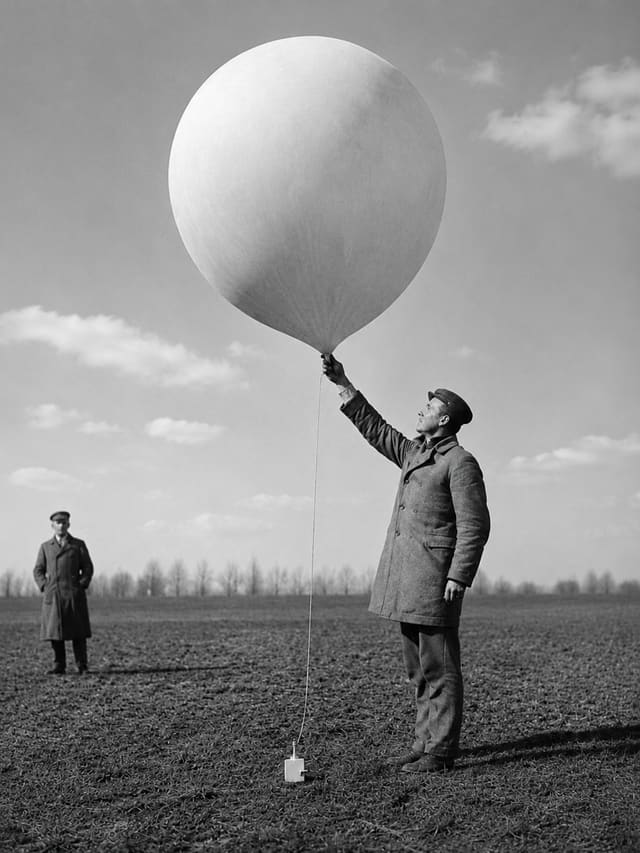
There is a ritual that humanity performs with almost liturgical precision, and almost no one thinks about it. Twice a day — at 00:00 and 12:00 Coordinated Universal Time, simultaneously, from Svalbard to Antarctica, from the Azores to Ulaanbaatar — balloons rise into the sky from roughly eight hundred sites.
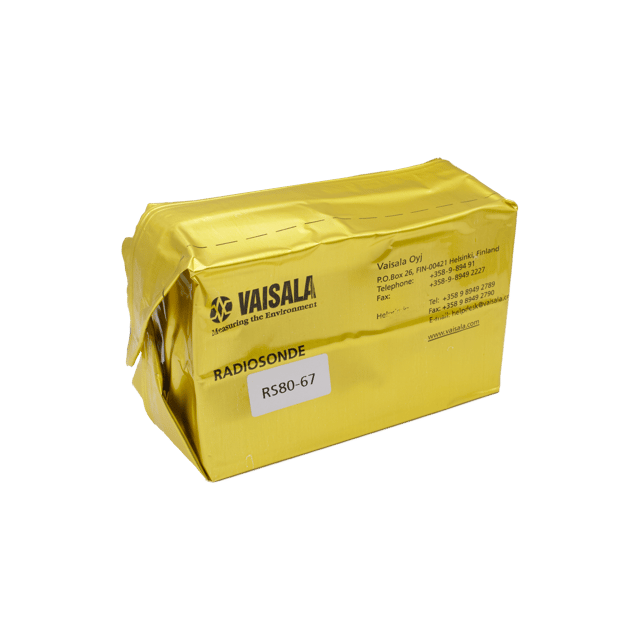
Not "roughly" simultaneously, but genuinely so: the synchronicity is the whole point. Meteorologists around the world agreed to take a vertical slice of the atmosphere at the same instant, because otherwise the result is not a picture but a collection of incomparable fragments. A latex envelope filled with hydrogen or helium rises at about five metres per second. Beneath it, on a line tens of metres long, dangles a white box the size of a packet of biscuits. It measures temperature, pressure and humidity, picks up GPS for wind computation, and once a second throws all of it into the air on a frequency around 403 megahertz.
An hour and a half or two later, the balloon — swollen from two metres to eight and having lost all sense of proportion — bursts somewhere around thirty kilometres up, in the stratosphere, where pressure is about one per cent of what it is at the surface. The box falls. A parachute slows it a little. It lands two or three hundred kilometres from the launch site: in a field, in a forest, on a shed roof, in the sea. Most of the time nobody finds it.
This is how all operational meteorology works. The forecast people check in the morning rests on this foundation — a network of point vertical soundings around which satellite data and model fields are assimilated. Remove the sondes and the models drift.
Roughly four out of every ten boxes rising at that moment were made by a single Finnish company. Estimates of its share of the radiosonde market vary: commercial analysts give anywhere from 28 to 42 per cent depending on how one counts, while a peer-reviewed estimate for the previous RS92 generation put it at about 30 per cent globally. However one counts, the leader has been the same for ninety years.
The company is called Vaisala. And it began because a fallen Soviet instrument was found in a Finnish field, and one professor judged it technically clumsy.
The village of Utra near Joensuu, northern Karelia, at the end of the nineteenth century. In a family that spoke Swedish and bore a Swedish surname, three brothers were growing up. In 1906, on the centenary of Snellman, when tens of thousands of Finns were exchanging Swedish surnames for Finnish ones, the brothers took the name of the ancestral farmstead at Kiuruvesi: Väisälä.
What follows is a plot no fiction editor would accept. All three went to study in Helsinki. All three became professors. And all three left a mark on science that will outlive them by centuries.
Kalle became a mathematician — and, according to family lore, was the best student of the three.
Yrjö (1891–1971) became an astronomer and optician, known in Finland as the wizard of Tuorla. He independently designed an anastigmatic reflecting telescope — essentially the same scheme as Bernhard Schmidt's, but published later, which is why the design survives in the literature as the Schmidt–Väisälä camera. He founded two observatories in Turku: Iso-Heikkilä in the 1930s and Tuorla in 1952. His group discovered 807 minor planets and seven comets. And in 1927 he devised an interferometric method for measuring long geodetic baselines; the Nummela baseline built on that principle, 864 metres long, remains to this day the world's reference standard in geodetic metrology, with a relative standard uncertainty on the order of 10⁻⁸ maintained for more than seventy years. It is the only baseline of its kind on the planet.
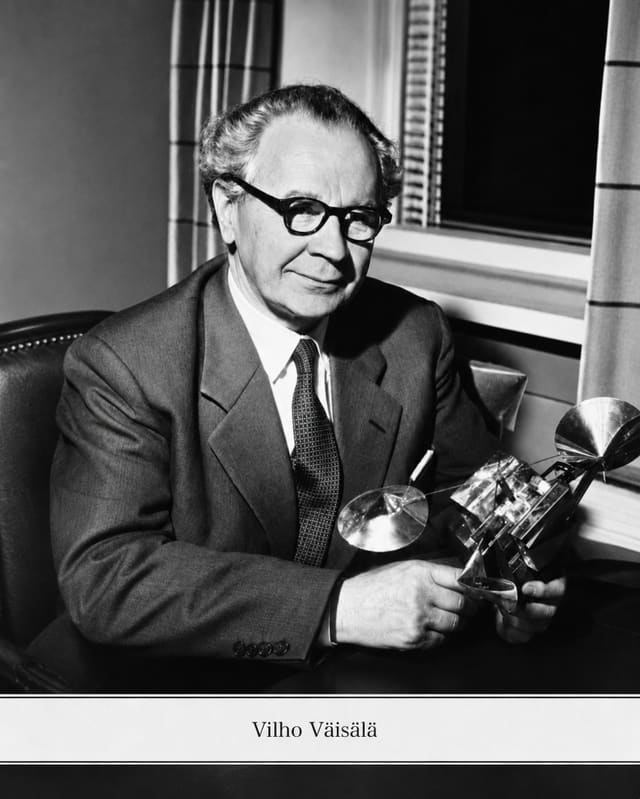
Vilho (1889–1969), the youngest, defended a dissertation in mathematics — on the uniqueness of the inverse function of the elliptic integral of the first kind — and then went into meteorology. From 1912 to 1948 he worked at the Finnish Central Meteorological Institute, later becoming professor of meteorology at the University of Helsinki. His name is attached to the Brunt–Väisälä frequency: the buoyancy frequency at which a vertically displaced parcel oscillates in a stably stratified medium. It belongs to the foundations of dynamic meteorology, physical oceanography and — unexpectedly — the theory of semiconvection in stars. Anyone who has computed a Richardson number or worked with internal gravity waves has already met it.
It was the youngest of the brothers who built the company.
In the winter of 1931, a strange apparatus was found in a Finnish field. It was a Soviet radiosonde, the design of Pavel Molchanov, who a year earlier, on 30 January 1930, had successfully launched his instrument and entered history as the inventor of the radiosonde. Molchanov's device transmitted temperature and pressure in Morse code. On 22 May of the same year the German Duckert independently flew his own construction, which could also measure humidity.
The find was brought to a meeting of the Geophysical Society of Finland. Väisälä examined it and delivered a verdict that would be retold in the company for decades: a brilliant idea, clumsily, heavily and far too elaborately executed.
What came next is the moment that separates an inventor from an entrepreneur. Väisälä did not set out to build "the same thing, only better." He reframed the problem: the instrument had to be light, small and cheap. The logic is almost embarrassingly simple. A radiosonde is disposable. It would be bought by national weather services with public money, thousands of units a year, indefinitely. The winner, therefore, would not be whoever's instrument was most accurate in the laboratory, but whoever's instrument a country could afford to launch every day for half a century.
On 30 December 1931 he launched the first Finnish radiosonde.
The technical principle laid down then proved so sound that it runs through the entire history of the company. The sensors were capacitive: the measured quantity changed a capacitance, the capacitance sat in the tank circuit of an oscillator, and the oscillator's frequency modulated the transmitter. Everything is measured the same way — through capacitance. This sharply simplifies the electronics and makes them cheap. Half a century later, BAROCAP, THERMOCAP and HUMICAP would be built on exactly this philosophy, and thirty years after that, sensors that would fly to Mars.
Väisälä himself later said that the radiosonde had not been a single invention but a series of inventions. That is a rare kind of honesty in an engineer.
Five years of refinement. On 30 July 1936 the first batch of twenty RS11 radiosondes went out to its customer: the Massachusetts Institute of Technology.
The geography of that first sale is worth noting. Not the Finnish weather service, not neighbouring Sweden, but straight across the ocean to MIT. Vaisala was an export company from day one; up to ninety-five per cent of production has always gone abroad. A domestic Finnish market for such a product simply does not exist: the country is small and the number of soundings is small with it.
In 1937 the radiosonde won a gold medal at the Paris World's Fair.
They were soldered together — if corporate legend and common sense are to be believed — in the basement of an apartment building on Mannerheimintie in Helsinki, with the family taking part. The name, incidentally, lost its umlauts fairly early: Väisälä became Vaisala for the sake of international pronunciation, a reflex entirely recognisable in today's technology start-ups.
The Winter War, then the Continuation War. International deliveries collapsed and the country had other concerns.
In 1936 Väisälä established the company Mittari Oy — "Gauge Incorporated," a name so blunt it is almost elegant.
The first complete sounding system included more than the sonde itself: a semi-automatic receiver, a calibration device and a ground check set. This matters. From the very beginning Väisälä was selling not an instrument but an entire measurement system, from the sensor to the data on the forecaster's desk. Eighty years later the same principle would turn into an API subscription, but that comes later.
At the time the company employed thirteen people.
By the end of 1954 there were sixty, and production moved to Vantaa, to Vanha Nurmijärventie, where the headquarters still stands today. In 1955 Mittari was renamed Vaisala.
In the early 1950s came the Väisälä radiotheodolite for wind measurement at 25 megahertz, and the professor himself devised the "Väisälä aerogram," a graphical instrument for deriving hydrostatic height from pressure levels. The aerogram would remain in service for about fifty years — an almost indecent result for a nomographic method in the age of advancing computers.
Vaisala spent the 1950s and 1960s methodically electronifying everything within reach. The first automatic radiosonde receiver appeared. In 1965 the RS13 — the world's first fully transistorised radiosonde — went into production. In the same period the company built its first receiver for images from meteorological satellites: the future was being watched attentively here.
The product line was numbered without flourish: RS11, RS13, RS15, RS18, RS21.
In April 1963 Vilho transferred three thousand of the company's shares to the Finnish Academy of Science and Letters, establishing a foundation in the name of Vilho, Yrjö and Kalle Väisälä. Since 1964 the foundation has awarded grants in mathematics and the natural sciences — three brothers from Utra continuing to fund Finnish science sixty years after the last of them stopped practising it.
One further detail for the portrait: Väisälä was a committed Esperantist. At the 1969 World Esperanto Congress in Helsinki, months before his death, he served as rector of the "International Congress University." A man who devoted his life to making weather data comparable between countries took a logical interest in the language those countries might use to talk to one another.
He died in 1969. Yrjö Toivola became managing director. The family retained control — and retains it still.
The early 1970s. Humidity in radiosondes the world over was measured with hair hygrometers. Literally: a degreased human hair lengthens as it takes up moisture. The method had been known since the eighteenth century — sluggish, temperamental, unreliable, especially in the cold — and there was nothing else.
Vaisala approached the problem from another direction, through thin-film technology. In 1973, at the CIMO VI congress, the company presented HUMICAP, the world's first thin-film capacitive humidity sensor.
The construction is deceptively simple. A thin polymer film is deposited between two electrodes, the upper of which is permeable to water vapour. The polymer absorbs and releases water, the dielectric permittivity changes, the capacitance changes, and the capacitance is measured. No moving parts. Tiny, fast, linear, with low hysteresis and weak temperature dependence.
The sensor had been developed for a new radiosonde. Then something unplanned happened: industrial customers began knocking at the door. It turned out that accurate humidity measurement was wanted by everyone — drying plants, warehouses, greenhouses, pharmaceutical manufacturers, electronics producers. Out of a by-product of a meteorological instrument grew an entire second business, one that today accounts for roughly half of the company's revenue and grows faster than the meteorological side.
HUMICAP became the de facto industry standard.
The 1980s. Two relatives joined HUMICAP: BAROCAP, a capacitive silicon barometric sensor — an aneroid capsule with its transducer in vacuum — and THERMOCAP, a ceramic temperature sensor.
Here the philosophy of 1931 paid off in full. All three sensors are capacitive, with compatible dynamic ranges. That means one transducer suffices. That means a single reference capacitor is enough to cancel drift. That means the electronics get cheaper and simpler while reliability rises.
In 1981 the RS80 family was released.
The numbers: a body of 55 × 147 × 90 mm without the antenna, mass with an activated battery around 220 grams. Power came from a water-activated 19-volt battery: near-eternal shelf life, limited operating time after activation, zero maintenance. The transducer measured capacitance with a resolution of one femtofarad — Vaisala took out worldwide patents on methods for measuring such small capacitances and on the electronic switch. The transmitter operated at 403 MHz or 1680 MHz. Wind was derived from LORAN-C, from the Omega system, and from the mid-1990s onward from GPS.
Variants were coded by suffixes, and the marking can be read directly: the digits give the frequency sub-band (for example, "15" for the 405 MHz region, "67" for 1680 MHz), "G" indicates an onboard GPS receiver, "H" and "A" the HUMICAP type, and "N" and "F" other configurations.
One detail gives a modern engineer pause: on early versions the individual calibration coefficients of the sensors were supplied on punched tape. Before launch it was read by a ground computer of the 386 or first-Pentium class, which cross-checked the telemetry against the ground check set. A medium from the age of Hollerith, servicing an instrument that would be in the stratosphere ninety minutes later.
The RS80 proved so consistent that it became a transfer standard in the intercomparison campaigns of the World Meteorological Organization: the instrument against which comparisons of all the others were calibrated. It stayed in production until 2008 — twenty-seven years.
The ground segment. This has a genealogy of its own. In 1975 came CORA, which computed wind from Omega. In 1981, the celebrated MicroCORA, which outlived the closure of the Omega network in 1997. Then the digital DigiCORA line: MW11 (around 1985, with self-testing and backup power), the portable MW15, MW21 (1999 — data transfer over the internet, a graphical interface, and BUFR coding added in 2001), MW31 (2003), MW41 (2012–2013) and finally Cirrus MW51 (2022).
And in 1994 came AUTOSONDE, a robot that prepares and launches a sonde with no human present. The first version managed up to twenty-four launches between operator visits. The current AS41, announced in October 2018, carries sixty sondes on board: at two soundings a day, a person visits the station once a month. For Arctic and island stations that is the difference between having data and not having it.
This is perhaps the most instructive episode in the company's entire history, and the best illustration of why measurement is harder than it looks.
The HUMICAP in the RS80 was produced in two versions, "A" and "H," differing in the polymer. In time it emerged that both systematically understated humidity — and for two independent reasons.
The first is thermal. For the A type the correction multiplier applied to relative humidity grows as the temperature falls: roughly ×1.3 at −35 °C, ×1.6 at −50 °C, ×2.0 at −60 °C and ×2.4 at −70 °C. In the upper troposphere, in other words, the instrument was reading half of what it should have.
The second is chemical contamination. The sonde was sealed into a Mylar bag. The packaging outgassed molecules that occupied binding sites in the polymer intended for water. The longer the sonde sat in storage, the drier it lied. The H polymer proved more susceptible than the A, which has higher selectivity for water. The effect was studied at the Helsinki factory on a sample of ninety-four sondes.
None of this was discovered at once. It emerged from discrepancies with independent methods: in the TOGA COARE campaign, in the ARM programme, and in comparisons with ground-based GPS measurements of precipitable water and with microwave radiometers. The typical understatement of precipitable water was three to four millimetres, around four to six per cent.
Then comes the most interesting part. Correction algorithms were developed — by Miloshevich, Wang, Turner, Leiterer and others. Yet even after nonlinear temperature correction, the residual dry bias of the H type ran to about 4 per cent at −40 °C, 13 per cent at −60 °C and 32 per cent at −80 °C.
Consider now the position of a climatologist. There is a forty-year record of upper-tropospheric humidity from a given station. In 1985 the station switched from one sonde type to another; in 2005, to a third. Every transition is a jump in the data with no relation whatsoever to climate. This is the problem of record homogeneity, and it is precisely why the World Meteorological Organization runs intercomparison campaigns and why the GRUAN network exists as a separate institution.
The moral reaches beyond meteorology: a systematic error that is stable in time is harmless, because it can be subtracted. What is fatal is not the error but its change. Anyone who has swapped out a metrics logging system in the middle of a service's operational life knows the feeling.
RS90 (late 1990s) was a marked leap. Temperature was measured by an F-THERMOCAP on a platinum wire 25 microns in diameter: thinner than a hair, which meant both the radiation error and the response lag fell sharply. Humidity was handled by two H-HUMICAP sensors, half the size of their predecessors, working in alternation: while one measures, the other is heated, shedding ice and contamination. Wind came from GPS, which Vaisala introduced for wind measurement in 1996.
RS92 (2003, operational standard from around 2005) brought the scheme to maturity: a capacitive wire temperature sensor and a twin pulse-heated HUMICAP.
Its finest hour was the eighth WMO intercomparison of high-quality radiosonde systems at Yangjiang, China, from 13 July to 3 August 2010. It was the largest ever held: eleven manufacturers and seventy-two successful multi-sonde flights, in which competitors' instruments are hung from a single balloon to see what each reports under identical conditions. The report was merciless towards some participants. The RS92-SGP, together with the DigiCORA MW31, delivered a practically flawless result across every parameter and was the only sonde with working protection against evaporative cooling — the effect in which a sensor wetted inside a cloud cools by evaporation on emerging into a dry layer and reads falsely. Production of the RS92 ended in August 2017.
RS41 (2013–2014) is the current, fourth generation. The temperature sensor became a resistive platinum element: slightly slower in response, but with better resolution and lower total uncertainty. The humidity sensor is a thin-film capacitor with an integrated temperature sensor and controlled heating. It is less sensitive to solar heating and behaves better on emerging from cloud. Ground preparation was reduced to the RI41 unit, which heats the sensor to drive off accumulated contamination — a direct answer to the lessons of the RS80.
Features appeared that nobody was thinking about in 1981: support for several satellite constellations at once, giving roughly 60 per cent better resistance to GPS interference, and cryptographic authentication of telemetry, because even weather data must now be protected against forgery.
This deserves a pause, because the subject is a fine one.
The atmosphere of another planet is measured on exactly the same principles as the atmosphere over Helsinki. Capacitance changes; read the capacitance. Mars, of course, differs: surface pressure is about six millibars, less than one per cent of Earth's; temperature swings from −120 °C to above freezing at midday on the equator; the atmosphere is almost entirely carbon dioxide, with only trace water vapour. But the physics of a thin-film capacitor does not change for any of that.
BAROCAP pressure sensors and HUMICAP humidity sensors have worked and continue to work on Mars inside instruments built by the Finnish Meteorological Institute:
The wording is worth keeping strict: the instruments were built by FMI, and Vaisala supplied the sensor technology. Not "a rover with a Finnish instrument," but "Finnish sensor technology inside an FMI instrument." The company has taken part in space programmes for some sixty years and is careful on this point.
One and the same physical principle, devised so that a cheap cardboard box over Karelia could report humidity in Morse code, now works in Jezero crater, two hundred million kilometres away, describing how frost forms on Mars. Ninety years separate those two events, with no break in the lineage.
While the radiosondes flew, Vaisala methodically expanded into adjacent fields. The logic was always the same: if the company can measure a physical quantity accurately and sell the whole system around it, where else is that needed?
Lightning. In March 2002 the American firm Global Atmospherics of Tucson, Arizona was acquired, and with it the United States NLDN national lightning detection network, with a median location accuracy of 84 metres. Since 2009 the global GLD360 network has been operating, catching the very-low-frequency emission of discharges from as far as ten thousand kilometres away with an accuracy of about a kilometre. For scale: in 2019 GLD360 recorded 2,353,476,704 discharges. More than two billion lightning strokes in a year. In August of that year the network detected a discharge 52 kilometres from the North Pole — the northernmost lightning ever recorded.
Optics and radar. Ceilometers, the lidars that measure cloud height: the CT25K, the CL31, and the current CL61, which performs depolarisation measurement and can therefore distinguish droplets, snow, dust and volcanic ash. Weather radar arrived with the acquisition of Sigmet in January 2006, together with its IRIS software. WindCube wind lidars came with the purchase of the French company Leosphere in October 2018.
Roads and airports. AviMet systems for airports, and road meteorology with pavement condition sensors — a direction strengthened by the acquisitions of Thermal Mapping International in 1989 and Quixote Transportation Technologies in 2009.
Industry. The descendants of HUMICAP: humidity and dew-point sensors (DRYCAP), CO₂ measurement by silicon NDIR technology (CARBOCAP), moisture monitoring in transformer oil, and monitoring for pharmaceuticals and data centres. The purchase of K-Patents in December 2018 added in-line refractometers for liquids; Veriteq, acquired in 2010, brought biopharmaceutical monitoring (viewLinc). In February 2026 the modular Origo platform for microclimate monitoring in data centres was launched.
The list of acquisitions is long and reads as a chronicle of methodical collecting: Tycho Technologies (1987), Artais Weather Check (1996), AIR Inc. (1999), Handar (1999), Dimension SA (2000), Jenoptik Impulsphysik (2000), ASMI (2009), Second Wind Systems (2013), 3TIER (2013), Vionice (2017), the weather B2B business of Foreca (2019), AerisWeather (2022), the British firm Speedwell Climate (November 2024), Maxar's WeatherDesk (December 2024, for 70 million dollars) and the British company Quanterra (September 2025, CO₂ flux monitoring).
In 1994 the series A shares were listed on the Helsinki exchange, with the first trading day on 20 April.
The ownership structure deserves a paragraph of its own, because it explains the company's character. There are two share series: K carries twenty votes, A carries one. The dividend is identical for both. Of roughly 36.4 million shares, about 3.09 million are series K. By available estimates, series K represents around 8.5 per cent of the capital and around 65 per cent of the votes. It is held by the founder's descendants, now under the name Voipio; the chairman of the board is Ville Voipio.
The mechanism is straightforward: the public market supplies capital while the family retains control. This is what allows the company to behave less like a quarterly report and more like a dynasty — to invest in development with a twenty-year payback horizon and not to panic over a bad half-year. A product with a twenty-five-year life cycle cannot be built if the board changes strategy every eighteen months.
The managing directors: after the founder, who led until 1969, Yrjö Toivola; Pekka Ketonen, from 1992 to October 2006; Kjell Forsén, from September 2006, previously head of Ericsson in Finland; and since October 2020, Kai Öistämö.
Headcount: thirteen people in 1944, sixty in 1954, over two hundred by 1975, more than six hundred at the time of the listing, and over 2,400 today.
A side plot nobody at Vaisala planned.
A radiosonde after landing belongs to no one. It falls in a field, nobody looks for it, and there it lies. Yet inside a modern RS41 there is an STM32 microcontroller, a Ublox GPS chip and a 70-centimetre transmitter. In other words, a perfectly decent tracker is lying in a field for nothing.
An entire subculture grew up. Twenty-five dollars buys an RTL-SDR dongle; add an antenna and a Raspberry Pi. Install radiosonde_auto_rx — or RS41 Tracker on Windows, or plug-ins for SDR++ — which decodes the telemetry, GFSK at typically 4800 bits per second, and uploads the tracks to the SondeHub Radiosonde Tracker and to radiosondy.info. From there one can see where it will land and go and collect it. People do.
Recovered sondes get reflashed. The RS41ng project provides custom firmware for the RS41 and the German Graw DFM-17, capable of APRS, Horus 4FSK, WSPR, FT8 and Morse code, flashed through a browser over WebUSB. The sonde then departs on a flight of its own, this time in the amateur bands. That, naturally, requires an amateur radio licence.
Vaisala takes a calm view of all this: its website has a dedicated page for anyone who has found a weather balloon, with instructions to follow the markings on the housing, remove and dispose of the battery properly, and the reassurance that the instrument itself poses no danger.
The company has also taken up the other side of the question. RS41 E models appeared with the biodegradable BioCover casing and the cellulose-based BioTwine unwinder line, free of microplastics — a claimed 66 per cent reduction in plastic waste. The technology was piloted by the Norwegian meteorological service from the Ekofisk platform in the North Sea starting in 2022, after which the service switched to it entirely. Which is logical: when your sondes fall predominantly into the sea, the question of what they are made of stops being abstract.
A company that began with a cardboard box now sells, for the most part, data.
In September 2022 Xweather was launched — a data and API platform, weather as a service. In 2025 the Xweather subscription business grew by 50 per cent, with organic growth in constant currencies of 11 per cent. From 1 January 2026 the reporting structure was rebuilt around three segments: Industrial Measurements, Xweather, and Weather, Energy and Environment. The very fact that the digital business has been carved out as a segment of its own states the shift in the company's centre of gravity more plainly than any press release.
The 2025 figures: revenue of 596.9 million euros, up 6 per cent from 564.6 million in 2024 and 7.4 per cent in constant currencies; operating profit of 85.1 million; net profit of 59.8 million; EBITA of 94 million. The guidance for 2026, issued on 12 February, was revenue of 600–630 million and EBITA of 95–110 million. The named growth drivers are data centres and the semiconductor industry, life sciences and energy. Wind resource assessment declined, costing around 20 million euros in revenue as that market contracted.
The company positions itself as a global leader in measurement instruments and data for climate action. Among recent developments: the DA10 DIAL lidar for continuous water vapour monitoring, and the acquisition of Quanterra for CO₂ flux monitoring.
The competitors have not gone anywhere: the German firm GRAW, Japan's Meisei, Lockheed Martin Sippican (strong in the military segment, with the LMS6 used by the United States weather service), the French Meteomodem, the Swiss Meteolabor, the American InterMet, and a growing field of Chinese manufacturers. The top three, by analysts' estimates, together hold 62–68 per cent of market revenue.
The principal barrier to entry, however, is not technological but systemic — the very one Väisälä established in 1944 when he began selling not a sonde but a system. A sonde requires a compatible ground station and software. A weather service that has bought AUTOSONDE and MW41 cannot begin launching someone else's instruments tomorrow; that means replacing the whole infrastructure. The installed base holds the market more securely than any patent.
Viewed across ninety years, Vaisala's history turns out to be remarkably consistent — and its consistency lies not in any single device but in a handful of decisions taken early and never revoked.
The first was the choice of what to optimise. In 1931 the competition was over accuracy; Väisälä chose to compete over cost per launch, because he understood the economics of a disposable instrument bought perpetually by state budgets. The second was the choice of what to sell. From the outset the product was not the sonde but the measuring system — sensor, receiver, calibration, ground check, and later the software and the data format. That decision is the source of the company's durability: it built switching costs into the customer's infrastructure decades before anyone had a term for it. The third was the choice of a physical principle. Measure everything through capacitance, and the electronics stay simple, cheap and reliable — a constraint that turned out to be productive rather than limiting, and that carried unchanged from a wooden-cased sonde over Karelia to an instrument in Jezero crater.
The fourth decision was structural rather than technical. Two classes of shares, twenty votes against one, kept the founder's family in control after the public listing, and with it a time horizon that a purely quarterly-driven owner could not have sustained. A product line whose generations are measured in decades — RS11 to RS13 to RS80 to RS90 to RS92 to RS41 — requires exactly that kind of patience.
What makes the story worth telling, though, is not only the corporate arithmetic. It is that a small company in a small country came to underpin a piece of global scientific infrastructure that almost nobody notices. The synchronised twice-daily sounding of the atmosphere is one of humanity's oldest and least celebrated acts of international cooperation; it has continued through wars, through the collapse of states, through the entire transformation of the technology that serves it. Vaisala did not create that system, but it has supplied a large share of its instruments for most of its existence, and in doing so has helped make the measurements comparable — which, in the end, is the whole point.
The RS80 dry bias episode is instructive precisely here. The company's most successful instrument also introduced a systematic error that took years to characterise and that complicated the climate record for a generation of researchers. The lesson is not that the instrument was poor — it was, by the standards of its time, excellent — but that in measurement, honesty about limitations is part of the product. The response, working with the scientific community on correction algorithms and designing the next generations explicitly to remove the flaw, says as much about the company as any of its patents.
Vaisala today sells subscriptions and APIs, detects lightning across the planet, monitors greenhouse gas fluxes and measures the atmosphere of another world. But every one of those businesses traces back through an unbroken line to a professor who looked at a fallen Soviet instrument and concluded that the idea was right and the execution could be simpler. That, in the end, is what an engineering company is: a long argument, sustained across generations, about how to do something well enough that it can be done every day, everywhere, forever.
Official Vaisala materials
Scientific publications and WMO documents
The Väisälä brothers, observatories, geodesy
Corporate information and finance
Radiosonde market
Lightning, optics, products
Amateur community and sonde reception
Other