Loading
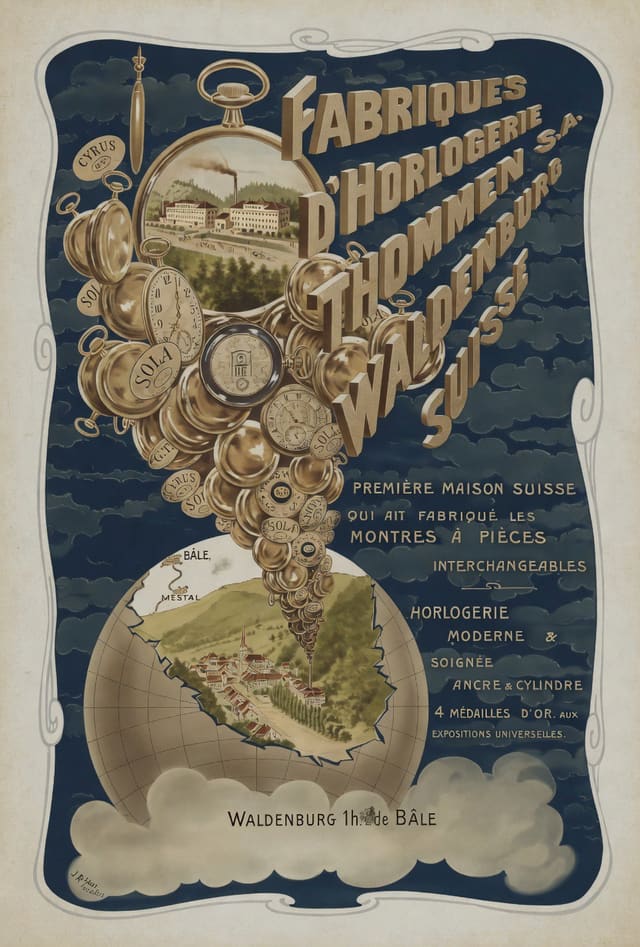
Thommen (Revue Thommen / THOMMEN AIRCRAFT EQUIPMENT Ltd.) is a Swiss manufacturer with a remarkably rich history, founded in 1853 in the small town of Waldenburg in the canton of Basel-Landschaft. The company began as a watchmaking enterprise, but over time evolved into a leading producer of precision aviation instruments, meteorological devices, and sporting altimeters. Its identity has long been built around Swiss precision, reliability, and innovation, combining the traditions of fine horology with advanced engineering technologies. Today, Thommen specializes in avionics for both civil and military aviation, while still preserving the legacy of its mechanical instruments.
The history of Thommen is not merely the history of a watch brand, but the history of the Swiss school of precision mechanics itself — a tradition that gradually expanded into barometric instruments, sporting altimeters, aviation watches, onboard chronographs, and eventually modern digital avionics. Today, this heritage survives through two independent companies: in Baar, continuing the watchmaking line, and in Muttenz, developing aviation instruments, air-data systems, display solutions, and maintenance services for aircraft fleets. For this reason, it is difficult to speak of Thommen as “a single company” in the narrow legal sense. It is more accurate to describe it as a long industrial lineage that began in Waldenburg, survived multiple reorganizations and ownership changes, passed through holding structures, divided into separate branches, and yet never lost its core identity: the measurement of time, pressure, altitude, and reliability under extreme conditions. The official chronologies of both modern companies emphasize continuity from 1853 to the present-day watches and aviation instruments; the aviation branch explicitly traces its origins to Revue Thommen AG, while the watch division presents itself as the heir to nearly 170 years of tradition.
Waldenburg, the Crisis of the Valley, and the Men Who Created the Firm
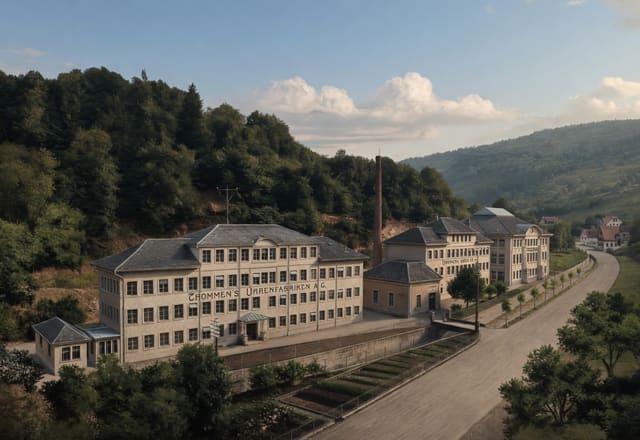
The origins of this story are connected not with luxury or fashion, but with the economic survival of a small valley. In the mid-nineteenth century, when a new railway route bypassed Waldenburg, the local community began searching for ways to halt economic decline and population loss. Thus, in 1853, the municipality of Waldenburg founded the Société d’Horlogerie à Waldenbourg — a watchmaking enterprise intended to create employment opportunities. Thommen’s official corporate memory regards this moment as the true beginning of the company.
In 1859, the enterprise passed into private hands when it was acquired by Gedeon Thommen, an entrepreneur from Waldenburg, together with Louis Chopp, a watchmaker from Biel/Bienne. Around 1869–1870, Chopp withdrew from the business, and Gedeon Thommen, now sole owner, transformed the factory into a more industrially organized operation. This explains why the dates 1853, 1859, and 1870 all appear in the company’s history without contradiction: they represent three successive stages of the same industrial lineage — municipal foundation, private acquisition, and industrial consolidation.
The biography of Gedeon Thommen explains why the factory quickly became something greater than an ordinary watch workshop. The archives of Basel-Landschaft and the Historical Dictionary of Switzerland describe him as a native of Waldenburg, the son of a rope maker, a man educated commercially in Geneva, an artillery officer, entrepreneur, and politician. He acquired the company, renamed it “Gédéon Thommen’s Uhrenfabriken,” and introduced principles of industrial mass production based on interchangeable parts. In 1870 he patented both a system of interchangeable components and a remontoire mechanism. Annual production grew from approximately 4,000 watches to 13,000 by 1890.
Gedeon Thommen also played a central role in the creation and promotion of the Waldenburgerbahn, the steam railway that connected the villages of the valley and stimulated regional development. He did not simply rescue a struggling watch factory; he built an entire local industrial ecosystem around it. He became co-founder of a regional newspaper, initiator and later president of the Waldenburgerbahn, a member of the cantonal parliament, and a representative in the Swiss National Council. In other words, Thommen emerged from the efforts of a regional “system builder” for whom industry, transport, finance, and politics were interconnected parts of a single project.
Far less is recorded about Louis Chopp, yet in both corporate and cantonal memory he remains an important co-founder of the company’s private phase. As a professional watchmaker from Biel, he brought the practical horological expertise that the municipal enterprise had lacked. After Gedeon’s death in 1890, leadership passed to his son Paul-Alphonse Thommen. Alphonse was not merely a nominal heir, but a technically trained mechanician. He studied in Môtiers, worked as chief mechanic at his father’s factory, and not only continued watch production but also founded, in 1892, a separate company manufacturing watch components and screws — the future Tschudin & Heid AG. In 1905 he formalized the transformation of the family workshop into the joint-stock company Thommens Uhrenfabrik AG and remained one of its principal leaders until the 1940s.
How a Watch Factory Became an Engineering School
In its early decades, Thommen developed not as a “display-window brand,” but as a technological factory. The official chronology notes that as early as 1870 Gedeon Thommen patented a system of interchangeable components and filed a patent application for a remontoire mechanism; at that time approximately 4,000 watches per year were already being produced under the G.T. (Gédéon Thommen) name. By 1890 production had reached around 13,000 units annually. This growth is important not merely in itself, but because it demonstrates the company’s early transition from artisanal assembly to industrial serial production with increasing in-house manufacture of components.
During the same era, one of the company’s most intriguing early creations appeared: the “jump-hour” pocket watch later known as the GT 1885 or Springeruhr. Sources date it to the late 1880s and regard it as an original contribution from Waldenburg to the history of mechanical time display.
At the beginning of the twentieth century the firm expanded both geographically and commercially. In 1910 the Revue trademark appeared in the company chronology, followed a year later by Blériot. In 1915 a second manufacturing site was opened in Gelterkinden, later followed by a branch in La Chaux-de-Fonds and a third factory in Langenbruck. During the 1920s Revue Thommen was already active on the American market through importers such as Majestic Watch Co. This expansion shows that by the time of the First World War the firm had evolved far beyond a local factory into an internationally ambitious horological and engineering enterprise.
A decisive role in transforming Thommen into a true engineering school was played by the Straumann family. Hermann Straumann — physician, politician, and son-in-law of the Thommen family — served on the company’s boards for decades and assumed leadership during the 1930s. His relative Reinhard Straumann, born in 1892, represented a new generation entirely: a watch technician, engineer, air-force officer, and from 1916 onward a designer and later technical director at Thommen. It was Reinhard who brought the company not only its aviation connections but also a scientific and materials-engineering perspective. Archival biographies record that in 1934 he founded Nivarox SA to industrialize his research into materials for watch springs, later followed by Nivaflex SA; the future Straumann research enterprise also emerged from this laboratory tradition. For the history of Thommen, this is crucial: the company became one of the places where Swiss watchmaking intersected with twentieth-century materials science and precision engineering.
The third important figure in this transition was Roland Straumann — physician and entrepreneur, representing the next generation of the family. He joined the board in 1938 and later remained chairman for decades. Sources from Basel-Landschaft emphasize that he and his relatives consolidated control of the factory’s shares and maintained family influence over the company until the late twentieth century. This continuity explains why Thommen was able for so long to function simultaneously as both a watch factory and a producer of complex precision instruments: the company retained a stable local nucleus rather than dissolving entirely into anonymous corporate ownership.
After the Second World War the watchmaking division continued to expand and grow more sophisticated. By the 1950s the company had developed an entire series of proprietary calibres and, according to official history, achieved near-total industrial independence: watches, movements, tools, and even manufacturing machines could all be designed and produced internally. In 1961 Thommens Uhrenfabrik AG joined the MSR holding group alongside Vulcain, Buser, Phénix, and Marvin. Independent historian Joël Pynson notes that the group employed around 760 workers and was capable of producing more than 600,000 watches annually. Within this structure Revue Thommen remained the dominant participant, introducing such lines as Exactomatic, early diver’s watches, chronographs, “open-heart” models, and later reissues of the Cricket as well as Landmark, Saltarello, Nautical, and other collections. Yet during these same decades the company was moving ever deeper into the field of instrument engineering.
Barometry, Meteorological Instruments, and the Aviation Division
Thommen’s aviation story began remarkably early. The company’s official history states that already in 1915–1916 the Swiss military commissioned the firm to develop and supply the first onboard clocks and chronographs for the young Swiss Air Force, and in 1916 Thommen delivered its first aviation watches. The true turning point, however, came with the major military program of 1936–1943: for the multi-role C-35 biplane, the company developed and supplied altimeters, airspeed indicators, variometers, clocks, and even landing gear components. To fulfill this program, a separate division known as Thommen Flight Instruments was created. According to historical reconstructions by Pynson, by the late 1940s Thommen had become the largest producer of aviation instruments in Switzerland.
It is important to understand that Thommen’s barometric and meteorological expertise did not emerge merely as a byproduct of aviation. It developed as an independent engineering line in its own right. Official histories from both the watchmaking and aviation branches agree that before 1943 the company had already been conducting research into pressure measuring and testing devices for industrial applications, while in 1945 it introduced the THOMMEN pocket barometric altimeter specifically intended for mountaineers. At the same time, to reduce dependence on external suppliers, the company established an Apparatus Engineering / Machine Tools department. Independent histories of Revue Thommen add that diversification intensified during the quartz crisis: by 1980 aviation instruments and machine-tool engineering accounted for approximately half of the company’s total turnover.
Later, however, this industrial spectrum narrowed again. The official aviation website states that the industrial measuring equipment line was discontinued in 2010, and in 2016 the production and support of mechanical aviation instruments together with mechanical and quartz chronographs were sold to the French SATHOM/SATORI group in order to focus on digital solutions.
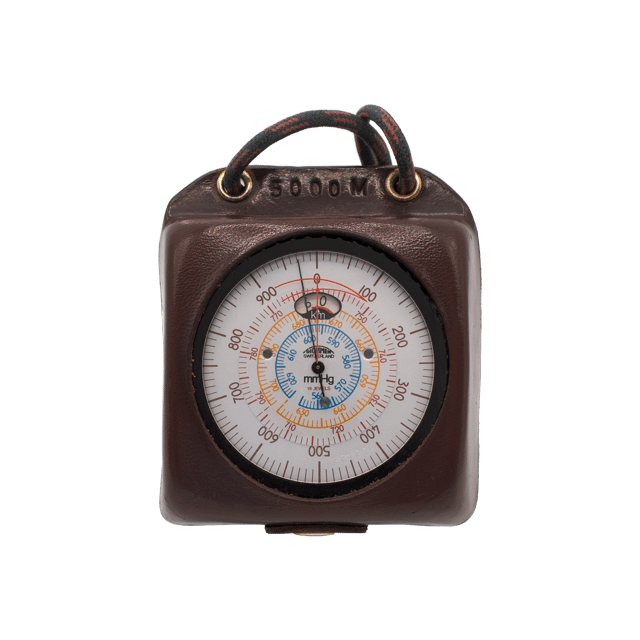
Within the culture of this company, the altimeter and the barometer are almost the same object placed into different contexts: mountaineering, meteorology, surveying, military service, or aviation. On the official Altimark page, the company itself explains the principle of its pocket altimeter: it is an aneroid barometer that does not display atmospheric pressure directly, but converts pressure into altitude above sea level; once calibrated at the starting point, it also functions as a barometer whenever atmospheric conditions change. In other words, the Thommen sporting altimeter is not merely a “height gadget,” but rather a compact interface into the science of barometry itself.
The traces of this engineering lineage are clearly visible in technical and scientific literature. In a 2009 geodetic study involving leveling and gravimetric measurements along the Sava River, atmospheric pressure was recorded using a Meteo Station HM30 manufactured by Revue Thommen AG with a resolution of 0.1 hPa. A field handbook on development engineering distributed through European humanitarian organizations specifically mentioned the Thommen Altitronic Traveller and stated an accuracy limit of ±10 meters excluding meteorological variations. Ecological studies in the Eastern Arc Mountains of Tanzania measured altitude using a Thommen aneroid altimeter calibrated daily against topographic maps. A classic physiological study concerning barometric pressure on Mount Everest reported the use of a “high precision aneroid barometer Revue Thommen, Switzerland” in a high-altitude camp. Thus, Thommen appears in literature not only as a watch brand, but also as a genuine field instrument used in science, cartography, and environmental research.
The modern aviation branch of the company continues this tradition in digital form. According to its own website, Thommen Aircraft Equipment Ltd. manufactures air-data computers, air-data displays, digital altimeters, onboard clocks and chronographs, display modules, replacement display systems, and MRO services. Installed platforms include Airbus and Boeing aircraft, AW189 helicopters, C-130 transport aircraft, Rafale and Gripen fighters, Tornado aircraft, MiG-21/23/29 series, Mi-8/17 helicopters, ATR aircraft, Saab 340/2000, and even SpaceShipOne.
Operating from Muttenz, the company holds EASA Part-21G, Part-145, and ADOA approvals together with ETSO/TSO authorizations and EN 9100 / AS 9100 certification. In 2018 it launched an ISO 5 clean room and its own aviation display production line. All of this demonstrates that today’s Thommen is no longer merely a workshop producing aneroid instruments in small cases, but a mature manufacturer of air-data systems and cockpit display infrastructure — still rooted, however, in the same culture of precision pressure measurement.
Sporting Altimeters and Watches as a Special Language of Thommen
If aviation instruments brought Thommen engineering prestige, sporting altimeters made the company recognizable far beyond the cockpit. The official corporate history directly describes the 1945 launch of the pocket altimeter as “a milestone for the Sports & Leisure sector” and emphasizes that THOMMEN touring, skiing, and parachuting altimeters became widely known. The company’s own descriptions add that such instruments were warmly embraced by mountaineers, while Swiss military parachutists also used them operationally. For this reason, no pocket Thommen altimeter can be regarded merely as a “hiking accessory”: it belongs to a long engineering lineage in which mountains, barometry, and aviation constantly exchanged technologies.
During the 1980s and 1990s this sporting line gradually migrated into wristwatches. The company already possessed a reputation for robust watches: the official Revue Sport page notes that in the late 1930s Thommen developed a particularly shock-resistant model demonstrated by being dropped from an aircraft and remaining functional after impact. Later came the Landmark watches with solar compass and 24-hour indication, followed in 1992 by the Altimark line, which explicitly combined the company’s experience in altimeter production with watchmaking. This was perhaps one of the clearest examples of Thommen transforming pure instrument-making expertise into horological identity: the wristwatch ceased to be merely a carrier of time and became instead an interpretation of the altimeter, barometer, and navigational instrument worn on the wrist.
The most expressive culmination of this logic was the Airspeed series. Corporate memory links it to nearly a century of onboard and pilot’s watches; during the 2000s and 2010s Airspeed became one of Revue Thommen’s most successful iconic lines. Particular fame surrounded the Airspeed Altimeter produced for the Swiss Alps Challenge 1998: according to Europa Star, its mechanical altimeter measured altitude from 0 to 4,500 meters, while the rotating bezel allowed barometric pressure readings between 750 and 1050 hPa.
At the same time, during the late 1980s and early 1990s Revue Thommen actively associated itself with the imagery of extreme sports and expeditions. Independent histories of the brand mention sponsorship of a Himalayan expedition and the Paris–Dakar Rally, while the official watch website even incorporates into its own mythology the statement that weather forecasting during the 1978 Everest expedition was carried out using a Thommen altimeter. Even if this detail belongs more to corporate memory than to rigorously proven academic history, it accurately reflects the self-image of the brand: Thommen perceived itself not as a jewelry house, but as a manufacturer of instruments for “people of altitude.”
Exhibitions, Press Coverage, and Presence in Specialized Literature
The history of Thommen can also be traced through exhibition catalogues. In the horological press Europa Star, the company regularly appeared at the European Watch Clock and Jewellery Fair: in 1986 with a non-magnetic compass watch design; in 1988 with the Landmark; in 1990 with further developments of that concept; in 1991 with the GT 1885 model reviving Gedeon Thommen’s jumping-hour display; in 1992 with the unusual Greenmark golf model; and in 1998 with the already mentioned Airspeed Altimeter. For the modern watch division, Baselworld 2015 became a major milestone, marking another relaunch of Revue Thommen following a new licensing restructuring.
The aviation branch, in turn, is visible through a different exhibition geography entirely: company news records activity at EBACE in Geneva and participation in the AEA International Convention & Trade Show 2023 in Orlando.
At the same time, Thommen is documented not only in exhibition records but also extensively in research literature. Perhaps the richest modern reconstruction of the brand’s history belongs to Joël Pynson, whose large studies of 2024–2025 are based upon sources such as FOSC, Journal Suisse d’Horlogerie, La Suisse Horlogère, and Europa Star — genuine Swiss trade periodicals and commercial archives. Yet it is equally significant that the name Thommen appears far beyond watchmaking literature: in ecological studies of tropical forests, in engineering field manuals, in military medicine, in geodesy, and in gravimetry. This is a rare case in which the same manufacturer occupies a place both in horological historiography and within scientific literature as a supplier of precision measuring instruments.
Thommen Today
In its present configuration, the watchmaking side of the brand survives as GT Thommen Watch AG. The official website places the company in Baar and emphasizes that it is co-owned and managed by the Thommen family, while Andreas Thommen is presented as a representative of the fifth generation and co-owner of the company. The current collection focuses on revivals of the brand’s most recognizable late twentieth-century models, above all the REVUE THOMMEN Airspeed and REVUE THOMMEN Diver lines. The company describes its watches as Swiss Made instruments intended for aviation, sports, military environments, and mountaineering. The watchmaking branch does not appear as a dormant historical relic: it maintains an active catalogue, a repair service, a company blog, and its own “next generation” program.
The aviation branch, by contrast, is now a fully modern mid-sized high-technology enterprise. According to the official website, it is led by a management team headed by CEO Daniel Grosch together with Andreas Liechti and Gino Schaffner. After relocating from Waldenburg to Muttenz in 2016, the company consolidated its departments onto a single site and subsequently invested heavily in research and development, display manufacturing, and LCD technologies. Its news during the 2020s revolves around digital cockpit upgrades, North American partnerships, new AC32 configuration tools, and replacement programs for obsolete CRT and legacy systems.
Even as the company moves away from older electromechanical products, it remains faithful to its historical core: the measurement of air-data parameters, the relationship between altitude, speed, and time, and the maintenance of aircraft platforms for which precision is not a decorative quality but a condition of survival.
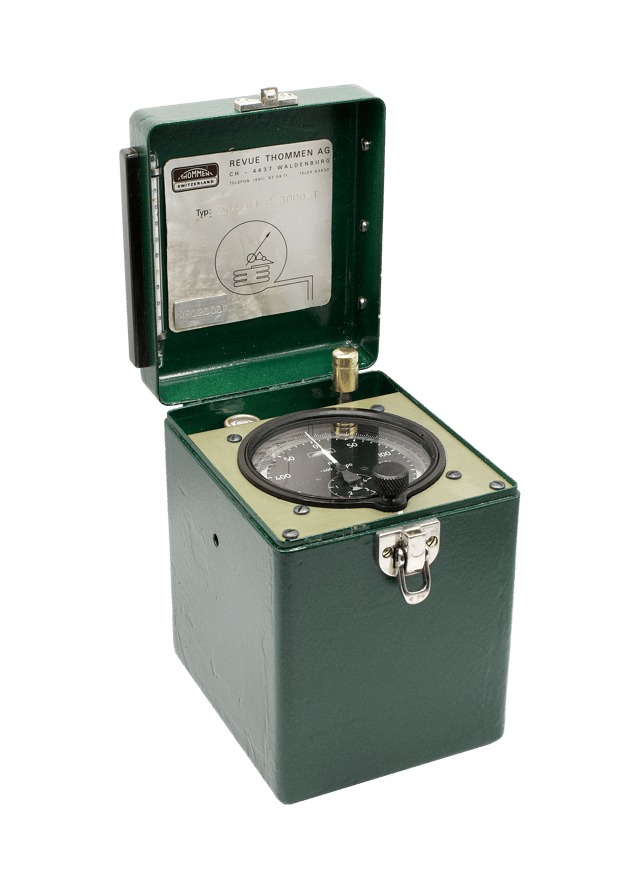
If one attempts to summarize the importance of Thommen, it lies precisely in the unusual coherence of its Swiss history of precision. Within this single industrial lineage coexist elements that are often separated among entirely different companies: an early municipal social factory, a dynasty of regional entrepreneurs, the political and railway activism of Gedeon Thommen, the industrialization of watch production, advanced materials such as Nivarox, shock-resistant sporting watches, pocket altimeters for mountaineers, aviation chronographs, barometric and meteorological instruments, machine-tool diversification, and finally the transition into the world of digital air-data systems and cockpit displays. Few Swiss manufacturers have united horology, barometry, and aviation into such a continuous and convincing narrative. For this reason, any mechanical Thommen altimeter — whether a pocket mountain instrument or an onboard aircraft altimeter housed in a green transport case — is perceived not as an isolated object, but as a fragment of a vast and remarkably consistent industrial culture.
List of Sources
THOMMEN’s History | Swiss made avionics since 1916 — https://thommen.aero/company/history/
Official company history page detailing timeline from 1853 founding to modern developments, including key milestones in watches and aviation.
Management Team / About Us — https://thommen.aero/company/about-us/
Official overview of the company’s heritage, transition from watches to aircraft equipment, and current focus.
Revue Thommen — https://en.wikipedia.org/wiki/Revue_Thommen
Wikipedia article covering full company history, aviation involvement, rebranding, and key facts about founders and products.
Thommen Aircraft Equipment Official Site — https://thommen.aero/
Main corporate website describing current products (air data systems, altimeters, displays) and Swiss-made avionics expertise.
Gedeon Thommen - Grail Watch Wiki — https://wiki.grail-watch.com/index.php/Gedeon_Thommen
Detailed biography of founder Gédéon Thommen, his role in watchmaking and local community development.
The true story of Revue-Thommen watches - Time2Tell — https://www.time2tell.com/en/history-of-the-brands/479-the-true-story-of-revue-thommen-watches.html
In-depth article on brand history, Gédéon Thommen’s contributions, and aviation instrument development.
Thommen Classic Altimeter — https://sklcolorado.wordpress.com/2018/04/04/thommen-classic-altimeter/
Personal blog post reviewing the Thommen Classic pocket altimeter for hiking and its practical use as a barometer.
Thommen Watches Milestones — https://www.thommenwatches.com/chronological-thommen-watches-milestones/
Chronological history of Thommen watches and company evolution, including separation of watch and aircraft businesses.
Revue Thommen outlines plans for business aviation (AINonline) — https://www.ainonline.com/aviation-news/business-aviation/2006-11-30/revue-thommen-outlines-plans-business-aviation
2006 article on the company’s aviation strategy and historical background in aircraft instruments.
Gédéon Thommen – Revue - Time Worn Watches — https://www.timewornwatches.co.uk/manufacturers/gedeon-thommen-revue/
Article focusing on founder Gédéon Thommen, early company restructuring, and watch production techniques.
Gedeon Thommen – Personenlexikon BL — https://personenlexikon.bl.ch/Gedeon_Thommen
Detailed biographical entry on founder Gédéon Thommen, his life, business achievements and political activity.
Reinhard Straumann – Personenlexikon BL — https://personenlexikon.bl.ch/Reinhard_Straumann
Biography of engineer Reinhard Straumann, who worked at Thommen and made significant contributions to materials and watch technology.
Hermann Straumann – Personenlexikon BL — https://personenlexikon.bl.ch/Hermann_Straumann
Biography of Hermann Straumann, long-time board member of Thommen Uhrenfabriken and relative of the family.
Scientific Article on Gravimetric Survey (Vilnius Tech) — https://journals.vilniustech.lt/index.php/GAC/article/download/10866/9190
Academic paper mentioning the use of REVUE THOMMEN AG meteorological station (HM 30) for precise air pressure measurements in a gravimetric survey.