Loading
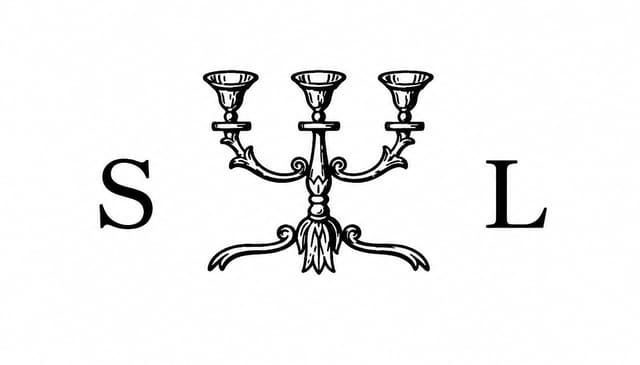
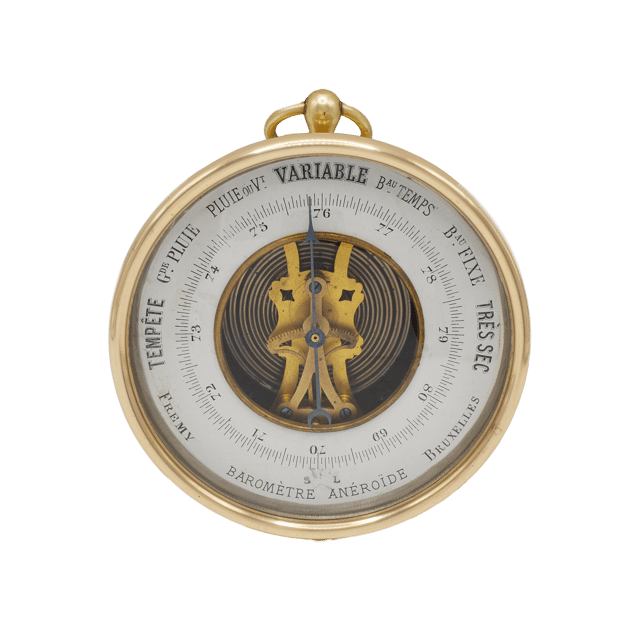
There is a particular pleasure in studying an old maker's mark. A small stamp on a dial, on the brass plate of a theodolite, on the temple of a pair of spectacles: two letters — S and L — and between them a three-branched candelabrum. A restrained mark, almost modest, with no heraldic pretensions. It was applied to instruments that travelled across Europe, the Middle East and both Americas; they were held by surveyors, physicians, navigators, and by ordinary people who simply wanted to know whether it would rain tomorrow.
Behind that candelabrum lies a story that would be hard to invent. It begins in August 1849, in the Marais quarter of Paris, with thirteen spectacle-makers who had just lived through a revolution and a hungry winter. It runs through the Second Empire, two world wars, and the invention of a lens that changed the eyesight of half the ageing population of the planet — and it ends (or rather, does not end) in a transnational corporation whose market capitalisation runs to tens of billions of euros.
Thirteen men who pooled their savings to buy out someone else's workbench founded the company known today as EssilorLuxottica. Here is how it happened.
At the beginning of 1848, the Parisian spectacle trade was respectable but small. The largest enterprise in the sector employed fewer than fifteen wage-earners; everything else was workshops of two or three pairs of hands, where lenses were ground, temples bent, and the goods sold on to a wholesaler who took the greater part of the profit. Spectacle-makers earned more than many other craftsmen, but dependence on the middleman rankled: the man who made the object decided neither its price nor its fate.
The February Revolution of 1848, having overthrown Louis-Philippe and proclaimed the Second Republic, released an idea that had been in the air since the 1830s: association. Not charity, not a trade union, not a riot — but collective ownership of production. Workers join together, contribute their savings and part of their wages, buy their own tools, sell what they make, and share the proceeds. The ideas of Saint-Simon, Fourier and Proudhon were by then not academic exotica but the stuff of workshop conversation; the newspaper l'Atelier, written by working men themselves, served as their platform. In the summer of 1848 the National Assembly went so far as to open a three-million-franc credit in support of such associations — the first time in European history that a state financed workers' self-management.
Thirteen Parisian lunetiers decided to try. They bought out, on credit, the equipment of two master craftsmen, took premises on the rue Saint-Martin, and on 6 August 1849 founded the Association fraternelle des ouvriers lunetiers — the Fraternal Association of Spectacle-Making Workers. Notably, they took no state subsidy: the capital was their own. For an emblem they chose a mason's level — the symbol of equality — with the motto Solidarité entre les travailleurs.
History then performed its customary trick. Of the fifty-six associations that received republican money, nine survived to 1857. The spectacle-makers' association, which had taken none, was among the survivors — and it did not merely survive, it became one of the very few genuine commercial successes of the whole movement.
Success, admittedly, cost them their signboard. After Louis-Napoleon's coup, the word "fraternal" in the name became awkward: it recalled the Revolution rather too clearly. In 1852 the society amended its statutes and its title, becoming the Société industrielle et commerciale des ouvriers lunetiers — the Industrial and Commercial Society of Spectacle-Making Workers. In commercial usage it settled into something shorter: Société des Lunetiers, or simply SL.
The economic mechanics of the enterprise deserve a discussion of their own, because they explain both the ascent and the later difficulties.
Capital was formed from within, and only from within. Each worker contributed a portion of his wages to the common fund; the fund was continually topped up by a fixed share of profits. There were no outside investors — as a matter of principle. Affairs were run by gérants elected by the general assembly of sociétaires, and by the commercial custom of the age the firm bore their names: "Delabre, Muneaux, Videpied et Cie", later "Muneaux, Videpied, Trumet", then "Muneaux, Videpied, Delafond", "Muneaux, Videpied, Okermans" and finally, from 1881, "Videpied, Okermans, Poircuitte". Changing the signboard every few years was a side effect of democracy.
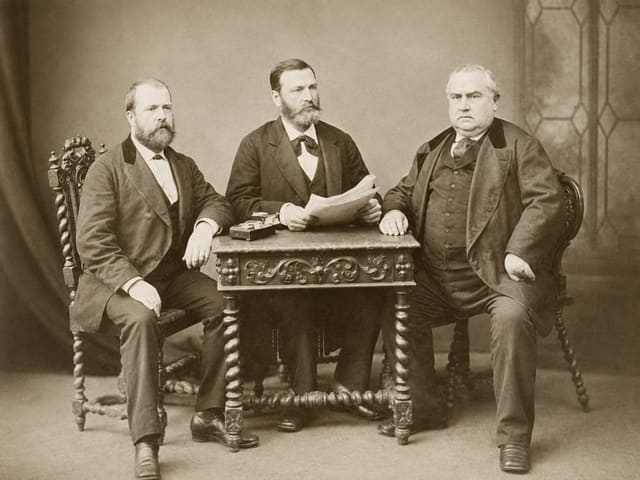
In 1864 there were twenty-four sociétaires. Among the figures of that generation were François Blaize (1824–1900), one of the thirteen founders and later a municipal councillor and philanthropist in Joinville; Eugène Videpied (1834–1900), a committed Fourierist and future radical socialist, who became a gérant in January 1864 and remained at the helm for some twenty years; and Jules Tireau (1829–1900), a freethinker and one of the pillars of the emerging republican radicalism in the suburbs. In the autumn of 1870, during the siege of Paris, twenty-seven members of the society subscribed to a fund to present the Republic with a battery of cannon. The cooperative was not only a productive enterprise but a political biography of its members.
The historian François Faraut gave this construction its exact name: the "collective employer" (patron collectif). The society combined an assembly regime remarkable for an industrial firm with promotion strictly from within — up to and including the highest offices — and with an equally internal transmission of capital. A man who began at a grinding wheel could in time become a shareholder, and then a manager. It worked for decades and produced an unusually durable corporate culture.
There was another side to the coin, and it showed itself later. A closed system of reproduction cut the firm off from outside capital and outside talent alike. By the beginning of the twentieth century this translated into technological lag behind its competitors. The cooperative that had won the nineteenth century through cohesion very nearly lost the twentieth through the same quality.
The mason's level with its motto of solidarity was the emblem of an association — political in essence. The mark under which the enterprise went out into the world was something else: a stylised three-branched candelabrum set between the letters S and L, often accompanied by the words "Société des Lunetiers — Paris", and later "Paris-London".
The symbolism reads without effort. Optics is the craft of light: the candelabrum is light, and its three branches are stability, three points of support. For a firm that made lenses so that people could see better, the choice was apt, and the mark outlived every change of name, of management and of legal form.
Next to the candelabrum, on articles of the early twentieth century, another small device often appears — "Unis France". This is not a company mark but a collective indication of French manufacture, instituted in 1916 by an inter-union body of collective trademarks; it is found on the products of a great many French firms and says nothing more than where the goods were made.
The next half-century is a steady climb up the value chain. First the society freed itself from the wholesaler by selling its own goods. Then it set about making what it had previously bought.
1861 — the firm takes up glassmaking, setting itself the goal of ranking among the principal Parisian manufacturers of corrective lenses. An immodest ambition for a former cooperative, and one it fulfilled.
1867 — the purchase of the "Les Battants" glassworks at Ligny-en-Barrois, in the Meuse. This is the turning point: the society acquires its own production of optical glass and lenses, and with it an industrial scale.
1868 — a first presence in London and the beginning of systematic exports: Europe, the Middle East, North and Latin America. From 1881 a permanent London office operates in Hatton Garden, in the heart of the jewellery and watchmaking quarter.
1876 — participation in the Philadelphia World's Fair with a broad range of products. The international exhibitions of this era bring the society awards and, more importantly, an international clientele.
1877 — establishment in Morez, the Jura capital of the spectacle trade; a factory of its own is built there in 1896.
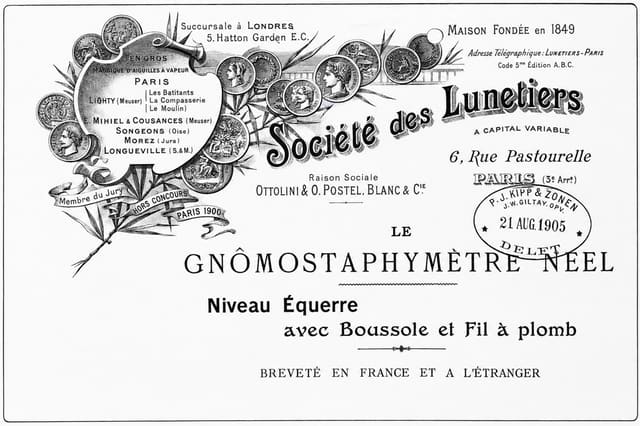
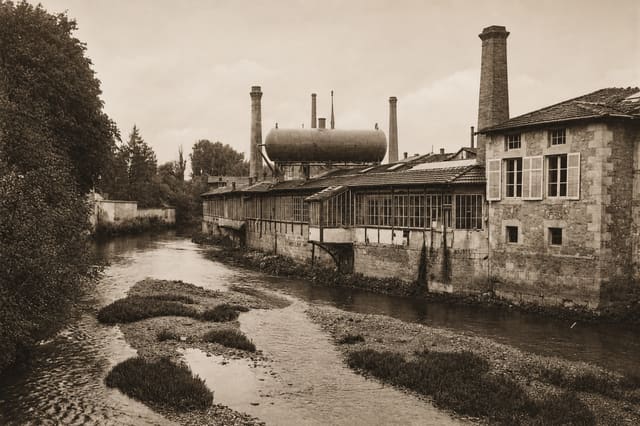
By the turn of the century the picture is this: head office in Paris at 6 rue Pastourelle, in the third arrondissement; Parisian spectacle manufacture at 21 rue Charlot; factories in the Meuse (Ligny-en-Barrois, Saint-Mihiel, Cousances), in the Jura (Morez), in the Oise (Songeons) and in Seine-et-Marne (Longueville). The sites are specialised: at Ligny, "Les Battants" melts glass and grinds lenses, "La Compasserie" makes compasses, theodolites and surveying instruments, and "Le Moulin" produces drawing and office equipment.
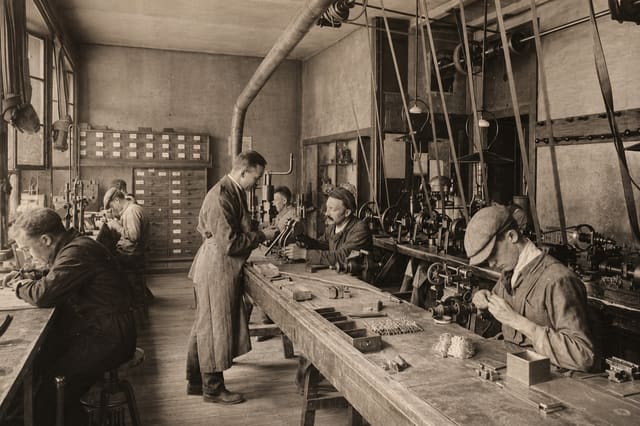
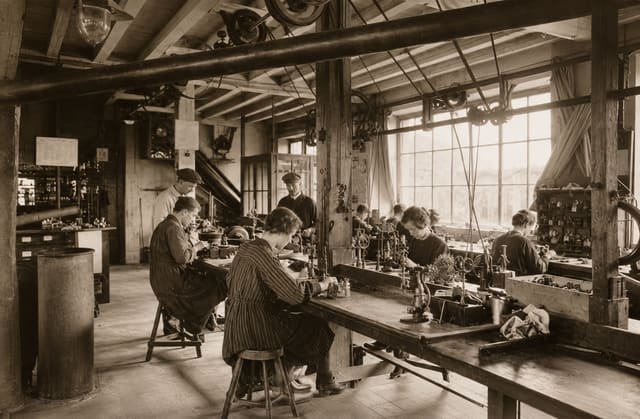
Around 1900 this amounts to five factories and something over a thousand employees. By 1914 the society is producing 7.8 million pairs of spectacles a year and expanding confidently into precision instruments. The thirteen men of 1849 had become an industrial group of European significance — and, curiously, had done so without ever going beyond their own capital.
The best portrait of the firm in this period is its trade catalogue. The editions of 1899, 1908 and 1922 are volumes of six hundred-odd illustrated pages, bound in cloth with gilt lettering; as late as 1960 the catalogue still existed as a tabbed binder. This was not advertising material but a wholesale instrument addressed to professionals.
The contents are striking in their breadth.
Spectacles and frames — metal, tortoiseshell, rolled gold; pince-nez, lorgnettes, face-à-main, temples of every conceivable construction. In Paris, dedicated workshops were given over to them: Fabrication des Pince-nez, Atelier de doublé or, and others.
Lenses and optical glass — spherical and cylindrical, meniscus, proprietary series ("Stigmal", later "Sylphos").
Ophthalmic instrumentation — trial lens sets for refraction, optometric apparatus, ophthalmoscopes.
General optics — magnifiers, microscopes, binoculars and opera glasses, spyglasses and telescopes, stereoscopes, cameras and objectives, magic lanterns.
Precision and surveying instruments — compasses, theodolites, pantometers (also called pantoclisimètres), levels, planimeters, drawing sets.
And finally the section that at first glance seems out of place in an optical catalogue — "Météorologie": barometers, thermometers, hygrometers, manometers, hydrometers. Plus the scattering of everything else a large Parisian house dealt in: telephones, Geissler tubes, medical electrical apparatus, model steam engines, scales, board games.
The meteorological section is easily explained if one remembers what the Société des Lunetiers was by commercial nature.
The society was born from the workers' wish to sell their own goods themselves — that is, from a commercial idea no less than a productive one. In time it acquired factories, but factories of a very particular profile: glass and lenses, frames, compasses and precision instruments, drawing equipment. Barometer workshops were not among them and never became so.
Yet its customers were precisely the people who buy barometers: the optician in a provincial town, the dealer in scientific apparatus, the school physics cabinet, the ship's chandler. Carrying a full range of observing instruments for them was a natural thing to do — and the society did, buying aneroids, thermometers and hygrometers from specialist workshops and selling them under its own name. The practice was entirely ordinary for the period: a maker of movements would supply dozens of trading houses at once, while the name on the dial was that of the seller.
Hence a simple conclusion for anyone who comes across the SL candelabrum on a meteorological instrument: it is the mark of a trading house, not of a manufacturer. Here the society acted as wholesaler and distributor — the very figure of the middleman from whose power its founders had once wished to escape. An elegant irony, as history goes.
The First World War turned the optical industry, for a time, into a military one: binoculars, rangefinders, sights, compasses. The society worked for the army and emerged from the war with a broadened instrument specialisation. The interwar decades passed under the sign of concentrating production in the Meuse and the Jura.
And then came the development that carried the firm from a national to a global scale.
1955 — the Nylor frame system, in which the lens is held by a fine nylon thread in place of the lower rim. The design proved so successful that it remains in use to this day.
1959 — the engineer Bernard Maitenaz, a graduate of the Arts & Métiers and the École Supérieure d'Optique and technical director of the society since 1953, brings to market Varilux, the world's first progressive ophthalmic lens. Before it, anyone with presbyopia was condemned to bifocals with a visible boundary between zones: the eye, moving downward, stumbled over a step. Varilux removed that step, replacing it with a smooth vertical change of optical power. This was not a cosmetic novelty but a change of paradigm, and the global presbyopia market is still built around it.
1962 — the society changes its name to Essel. The name reads as a phonetic rendering of the old initials: S-L, "ess-ell". The cooperative of thirteen spectacle-makers had become a modern industrial company, but it carried its name along with it in the form of a sound.
Meanwhile a second player was growing in France. In 1931 the Lissac brothers opened an optical retail business; out of their firms and related ventures — Sil (Société industrielle de lunetterie, 1946) and Lor (Lentilles ophtalmiques rationnelles, 1960) — came Silor, the Société Industrielle de Lunetterie et d'Optique Rationnelle. In the same year as Varilux, 1959, Silor released Orma 1000, an organic lens made of CR-39, light and shatter-resistant. Two French houses, independently of one another, carried out the two great optical revolutions of the century: one in geometry, the other in materials.
Logic suggested joining them, and on 1 January 1972 Essel and Silor merged. The deal was led on Essel's side by Anatole Temkine and on Silor's by René Grandperret. The new company took a portmanteau name: Essilor. At birth it was the world's third-largest firm in ophthalmic optics.
What followed was rapid expansion. 1974 — the subsidiary lens brand BBGR. 1975 — listing on the Paris stock exchange and the creation of Valoptec, an association of employee shareholders: a direct continuation of the cooperative tradition, in joint-stock packaging. 1990 — Transitions photochromic lenses, in partnership with PPG. Then Crizal anti-reflective coatings, successive generations of Varilux, and factories and laboratories on every continent.
2018 — the latest act to date. Essilor merges with the Italian Luxottica, the world's largest frame manufacturer and owner of retail chains. The European Commission clears the deal without conditions; EssilorLuxottica comes into being — a company that unites both halves of a pair of spectacles: glass and frame, manufacture and retail.
The story of the Société des Lunetiers is valuable precisely because it resists convenient morals.
It can be told as a triumph of workers' self-management: thirteen men, without a centime of state support, built an industrial group that outlived every regime from the Second Republic to the Fifth and grew into a world leader. And that would be true — the more remarkable in that nearly all the other associations of 1848 had crumbled within a decade.
It can equally be told as a story of quiet transformation: a fraternal association becomes a society, the society becomes a "collective employer", the labour elite becomes shareholders, the shareholders become investors, and a trading house born of resentment against middlemen ends up selling other people's instruments under its own name. And that would also be true.
Most likely both narratives are one and the same. The insularity that guaranteed independence from outside capital later cost the firm its pace; the cohesion that allowed it to survive turned into inertia; and it took an engineer with an idea about smoothly varying curvature to put the old house back in front. Enterprises do not live in straight lines.
What remains is the candelabrum. It was applied without ceremony, a small stamp wherever it fitted — on a temple, on brass, on a paper dial. The mark belonged to an enterprise that never much went in for self-promotion, having been founded by people accustomed to answering for their work with their hands. Today the direct heir of that enterprise is a global corporation with a turnover in the billions, and its logo looks nothing like the old one. But should you come across an old instrument with three branches between an S and an L, know that you are holding an echo of August 1849, of the Paris Marais, and of thirteen men who decided they could do without a master.