Loading

Short & Mason is one of the key English firms in the history of the aneroid barometer and of self-recording meteorological instruments. It is also one of the worst documented. The early period — the very years in which everything was actually decided — is known so poorly that the surviving information is not merely fragmentary: it contradicts itself. The founding date wanders from 1845 to 1875 depending on which source you open. The nature of the transaction with the American Taylor firm is described variously as a purchase, a partnership or a merger, and dated to 1900, 1904 or 1907. Addresses in the trade directories fail to match the addresses on the dials. Even the founders occasionally swap roles in dealers' descriptions: the optician is turned into a businessman, the engineer into a mechanic.
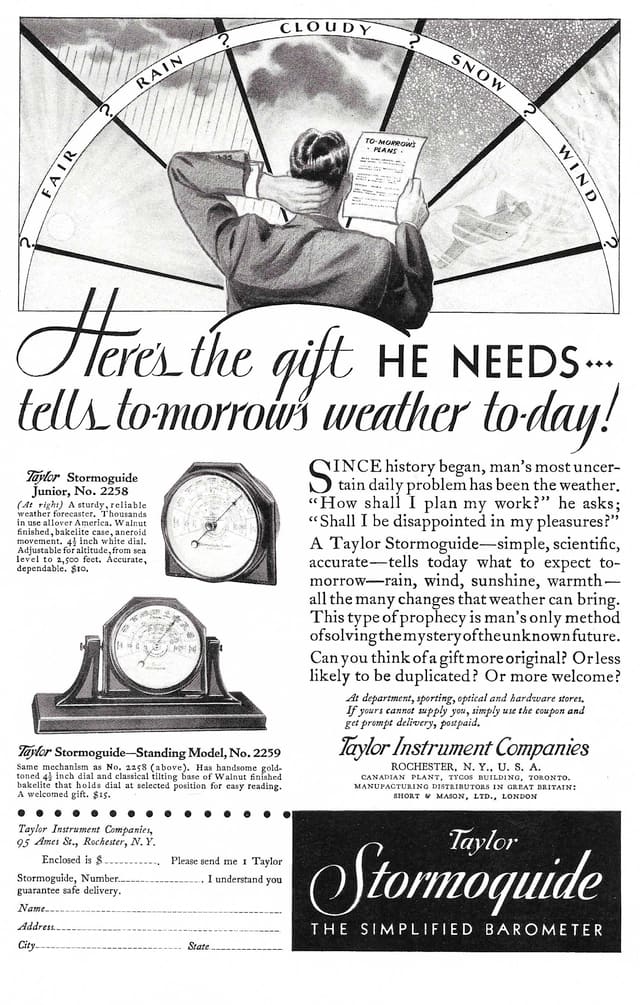
The paradox is all the sharper because the instruments themselves are still everywhere. Take almost any English aneroid made between 1880 and 1960, lift off the back cover, and there is a fair chance you will find a Short & Mason movement. The dial, meanwhile, may carry any name at all — or none whatsoever. A Short & Mason barograph traced the pressure curve at Sydney Observatory. A Short & Mason altimeter hung in front of an RFC pilot over Flanders. A Short & Mason aneroid stood in Shackleton's own cabin aboard the Quest, his last ship. A Stormoguide in a Bakelite case sat on mantelpieces in the suburbs of London and of Rochester, New York, promising its owner the weather sixteen hours ahead.
The gap between this ubiquity and the historiographical emptiness is partly explained by the business model itself: for decades the firm made movements for other people's dials and had no need of fame of its own. It is partly explained by the fact that almost nothing survives on paper. There is no anniversary volume, no corporate archive in public hands, no biography of the founders. What there is, is scattered: a few lines in reference works, isolated museum catalogue entries, fragments of trade catalogues, patents — and, above all, the dry notices in The London Gazette, where partnerships are never born but only die. English law required the dissolution of a partnership to be published, but not its formation; and so the history of Short & Mason, like that of most Victorian workshops, is documented from the end rather than from the beginning. It makes the work rather like reconstructing a skeleton from a handful of vertebrae — though fortunately the bones that survive are distinctive ones.
What follows is an attempt to build a continuous chronology, and so far as possible to separate genuine divergences between the sources from later misunderstandings: from a young London optician who by the age of thirty had contrived to be in three partnerships at once, to the day the firm's name was quietly extinguished by an American corporation.
Thomas Watling Short (1833–1906) was born in Lambeth; the censuses, as censuses will, disagree slightly and allow the birth year to be read as 1834 as well. He began not as an "instrument maker" in the broad sense but as an optician — that is precisely how the 1861 census records him, and only from the 1871 census onwards is his trade given as "scientific instrument maker." This change of self-description is no bureaucratic accident but an exact record of a professional shift: in ten years the man moved from selling and grinding lenses to the mechanics of measuring instruments.
Short's first known venture was a partnership with John Symonds Marratt, begun, according to Tony Benson, in about 1859. The firm traded as Marratt & Short and was situated in the City, at 63 King William Street — a few steps from the Monument and London Bridge. Its formal self-definition was Opticians and Mathematical Instrument Makers: optics and mathematical instruments, in other words the classic mid-century City retail-and-workshop business.
The partnership ended in 1867, and here at last we have a document. The London Gazette, 19 March 1867, issue 23231, p. 1811:
"NOTICE is hereby given, that the Partnership heretofore existing between us the undersigned, John Symonds Marratt and Thomas Watling Short, at No. 63, King William-street, in the city of London, as Opticians and Mathematical Instrument Makers, under the firm of Marratt and Short, was this day dissolved by mutual consent, as from the 11th day of February last.—Dated this 16th day of March, 1867. John S. Marratt. Thomas Watling Short."
Note the legal detail that is usually swallowed whole: the dissolution is declared "as from the 11th day of February last" — that is, retroactively. Marratt & Short in fact ceased to exist on 11 February 1867; the notice was signed on 16 March and printed on the 19th. This is the first of several places where dates in the sources diverge not because anyone has blundered, but because the event and its publication are two different things.
If Marratt & Short means the City, the shop window and optics, the next episode means Clerkenwell — workshops, clockmakers, electroplating and the whole artisan underworld out of which London instruments came.
James Pitkin (c. 1828–1912) was born in Bethnal Green, son of James and Elizabeth Pitkin, weaver; baptised in 1830. The 1851 census finds the family in Mile End: the father James (51), the mother Elizabeth (47), the son James (23) — a plater and gilder — his brother Henry (15) in the same trade, and the younger boys John (8) and Edward (6). This is a family of craftsmen working in metal and finishing. By 1861 James is recorded as a hydrometer maker; his brother Henry T. as a surgical instrument maker. In other words, by the age of thirty Pitkin was already a fully fledged master of precision instrument work.
It was with him that Short entered his second partnership. Pitkin & Short traded from 56 Red Lion Street, Clerkenwell, and its official description could hardly be more telling: Aneroid Barometer and Philosophical and Mathematical Instrument Manufacturers. This is the first documented appearance of the aneroid in Short's biography — and probably the moment at which he gained access to the technology that would define the rest of his life. In the 1860s the aneroid was still a comparatively new thing (Vidie's patent dates from 1844) and demanded a particular production culture: a thin corrugated capsule, soldering, evacuation, temperature compensation, a delicate train of levers. That is not learned behind a counter in King William Street; that is learned in Clerkenwell.
The end of the partnership is again documented. The London Gazette, 30 December 1870, issue 23692, p. 5975:
"NOTICE is hereby given, that the Partnership heretofore subsisting between us the undersigned, James Pitkin and Thomas Watling Short, carrying on business as Aneroid Barometer and Philosophical and Mathematical Instrument Manufacturers, at No. 56, Red Lion-street, Clerkenwell, in the county of Middlesex, has been this day dissolved by mutual consent. All debts due to or from the late firm will be received and paid by the said James Pitkin.—As witness our hands this 24th day of December, 1870. James Pitkin. Thomas Watling Short."
The date of dissolution is 24 December 1870, Christmas Eve itself, which lends the affair a faintly Dickensian colouring. Legally, something else matters more: the firm's debts are assumed by Pitkin. This is the standard formula, and it means that the business — premises, plant, obligations, clientele — stayed with him, while the departing partner left travelling light. Short left travelling light, but not empty-handed: he took the craft of the aneroid with him.
When did the Pitkin partnership begin? There is no direct document — the formation of partnerships was not published. But the boundaries can be fixed fairly tightly. The upper limit is 24 December 1870. The lower limit lies somewhere in the 1860s. The most plausible window is 1867–1868, immediately after the February break with Marratt: that is precisely when Short was released from his City obligations, and in the 1871 census he is for the first time recorded as a "scientific instrument maker," which it is natural to read as a trace of the Clerkenwell years. It is not impossible, however, that Pitkin & Short came into being earlier and for a time ran in parallel with Marratt & Short — Short, as we shall shortly see, was not given to monogamy in business.
Pitkin's own fate, incidentally, is a small epic of professional longevity. In 1871 he is living in Clerkenwell with his brother Henry; in 1891 he is recorded as an electric instrument maker; in 1911, at the age of eighty-three, he is still listed as a maker of aneroid barometers and of portable electric lamps, working on his own account. He died in Clerkenwell in 1912. The man from whom Short in all probability learned to make aneroids outlived the partnership and the whole Victorian age, and went on soldering capsules when his former associate had been six years in the ground and his former associate's firm was supplying altimeters for aeroplanes.
In 1864 Thomas Watling Short entered into partnership with the engineer William James Mason (c. 1840 – after 1911), and the firm acquired the name it would carry for exactly one hundred and five years: Short & Mason.
The founding date is 1864. It rests on Benson and on a sound reconstruction of Short's biography, and the dealers' "circa 1845," which circulates in antique descriptions, is no competition for it. The 1875 given by the Science Museum Group, the Powerhouse in Sydney and the Compass Museum deserves a separate explanation. It is not an alternative version of the founding but, to all appearances, the date of the firm's first secure appearance in the sources — the trade directories and address books. Benson's list of addresses suggests the mechanism of the error: the firm is documented at 62 Hatton Garden from 1873 to 1875, and museum cataloguers working from directories naturally arrived at the mid-1870s. The correct formulation is this: the partnership was formed in 1864, while independent premises in Hatton Garden can be traced from the early 1870s.
Who was Mason? Not a "businessman," as he is sometimes called out of habit, but precisely an engineer. The 1871 census records him in Paddington as "Engineer, employing 6 men" — a man with his own workshop and hired hands. In 1881 he is still an engineer; in 1911, by then retired, he is recorded as a retired gas engineer. The gas trade means pressure, gauges, regulators, gas-tightness: a set of skills that coincides almost indecently well with what an aneroid requires, and later with the gas pressure gauges and temperature regulators for which the firm would become known.
So two men came together: an optician who had mastered the aneroid in Clerkenwell, and an engineer with a production base. The division of labour suggests itself — and it is precisely this that explains why Short & Mason became, almost at once, not a shop but a factory, supplying movements to other firms to be sold under other names.
And one further detail, which emerges only when the three documents are set side by side. 1864 falls within the life of Marratt & Short (which ran to February 1867) and, in all likelihood, close to the beginning of Pitkin & Short (which ran to December 1870). Between 1864 and 1867 Short was a member of at least two partnerships simultaneously, and for a time possibly three. This was not carelessness but a perfectly ordinary Victorian London strategy: hold a share in City retail optics, a manufacturing share in Clerkenwell, and build a new venture with an engineer at the same time. By the end of 1870 Short had withdrawn from the first two in turn and remained in the third — the one that would outlive him.
Addresses of the firm:
Where the firm worked during its first decade, from 1864 to 1873, is unknown. The reasonable candidates are Mason's premises in Paddington or the same Clerkenwell workshop.
Hatton Garden, incidentally, was no accidental choice: by the 1870s it was already the jewellery and clock quarter, with a dense network of subcontractors — enamellers, dial makers, engravers, suppliers of brass and glass. A firm intending to make thousands of aneroids a year settled where that infrastructure already existed.
By the 1880s Short & Mason had become what they would remain for good: a maker of aneroids and barographs working to a large extent for other people's retail trade. Their movements were sold under the names of Negretti & Zambra, the Army & Navy Co-operative Society (for whom the firm was the principal supplier of barometers around the turn of the century), Harrods, J. Lizars, J. C. Vickery, and a multitude of provincial clockmakers and opticians.
The range of the Victorian and Edwardian period:
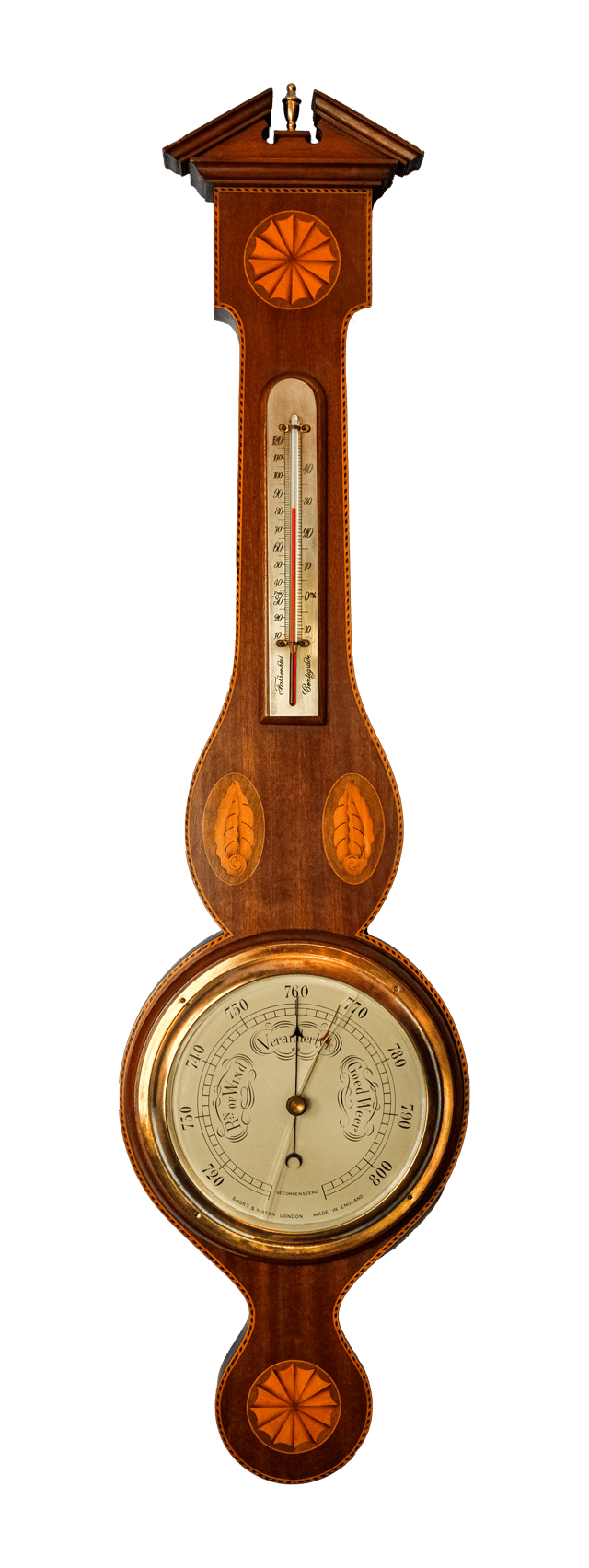
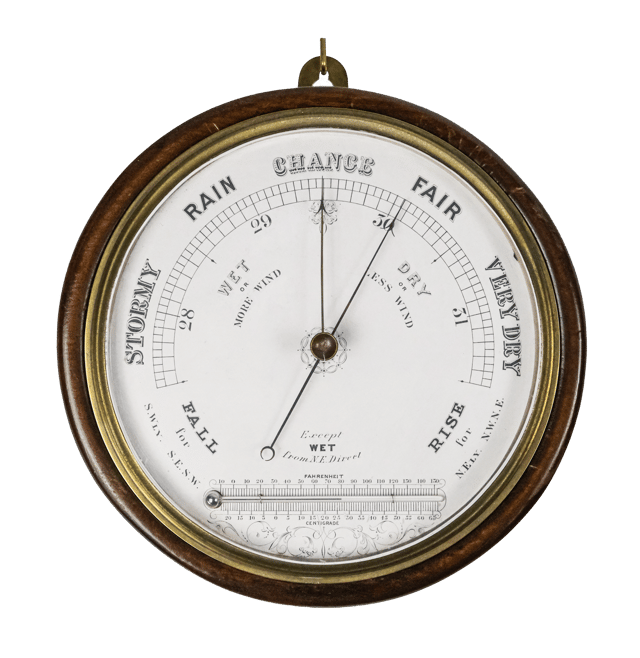
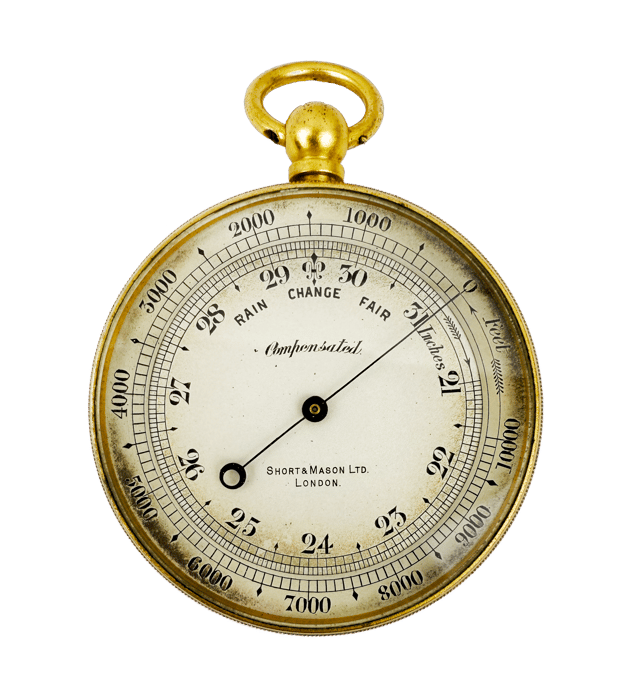
Aneroids of every conceivable type. Compensated pocket instruments with a rotating altitude scale to 10,000 feet, for mountaineers and travellers; wall instruments in oak, walnut and mahogany; banjo cases; marine bulkhead patterns; ship's wheel barometers; the temperature-compensated Surveying Aneroid for mining and survey work; and altimeters proper.
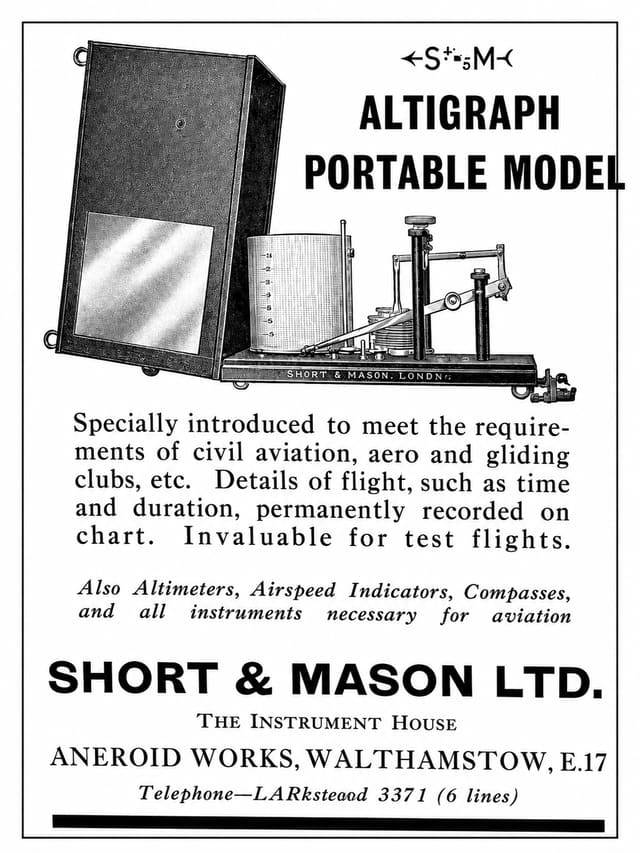
Barographs. Here the firm developed the arrangement that became its signature: the aneroid stack mounted beneath the base plate rather than above it. The corresponding patent dates from 1904; the top plates of early instruments sometimes carry the engraving "Pat. 3715.02," referring to a 1902 patent covering the raised clock movement and glued-on charts; the dial registration number is 428606 (1904). The name Cyclo-Stormograph was secured by the firm for this model in 1915. The clock movement is generally an eight-day one. Thermographs (including marine patterns in brass), hygrographs, open-scale micro-barographs and meteorographs were later added to the family.
The printed word. In 1903 a house pamphlet appeared under Short's name — Aneroid Barometers: A Description of the Construction and Various Uses Explained, thirty-two pages. A curious detail: Short had by then already retired from the business, but his name went on working as both authority and brand.
At the turn of the century the firm's history takes a turn that is usually recounted incorrectly, so let us set it out step by step.
1900: Short & Mason is bought by the American Taylor company of Rochester, New York. The corporate records of Taylor held in the archives of the University of Rochester say so directly: the acquisition of the Hohmann & Maurer Mfg. Co. was followed by the purchase of Short & Mason Co., Ltd. of London — makers of high-grade barometers, compasses and other meteorological instruments.
In the same year the founders' personal partnership was dissolved. Tony Benson dates the dissolution of Short & Mason as a partnership to 1900, while citing the notice in The London Gazette no. 27328, p. 4351 — an issue dated 28 June 1901. There is no contradiction here: as with Marratt in 1867, publication follows the event, sometimes at a considerable interval. The event belongs to 1900, the publication to 1901. The text of the notice:
"...the Partnership heretofore subsisting between us the undersigned, Thomas Watling Short and William James Mason, carrying on business as Aneroid Barometer Makers and Manufacturers of other Scientific Instruments, at 40, Hatton-garden, in the county of London, under the style or firm of Short and Mason, has been dissolved by mutual consent. All debts due to and owing by the said late firm will be received and paid by the said Thomas Watling Short..."
Note that the debts are assumed by Short, not by Mason. By the same logic as in 1870, this means the business remained with Short — and that it was therefore he who negotiated with the Americans. Mason thereafter vanishes from the commercial record: in the censuses he is "living on own means," and by 1911 a "retired gas engineer" in Paddington.
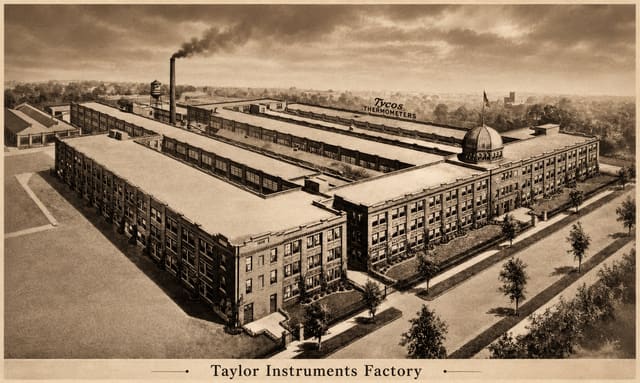
And — crucially — the purchase did not mean disappearance. Short & Mason continued to exist in England as a separate manufacturing company under its own name, with its own factory, its own patents and its own mark on the dials. This is why instruments of the 1900s–1960s carry dual markings of the form "Short & Mason, London — Tycos — Made in England," and sometimes an explicit reference to Rochester. To the purchaser it looked like a single firm on both sides of the Atlantic; legally these were two companies linked by ownership.
What was happening on the American side. Taylor traces its origins to a Rochester business of 1851 (George Taylor and David Kendall), known from 1872 as Taylor Brothers and incorporated in 1890. In the 1900s the divisions were combined and reorganised: the name Taylor Instrument Companies came into use in that decade (the Smithsonian indicates that the company operated under that name from 1904; a number of sources place the final reorganisation in 1907). The Tycos trade mark was introduced, according to the Smithsonian, in 1908, and was in active use until roughly the early 1930s, after which the Taylor name itself took precedence.
The personal outcome for Short. Having retired in 1900, he lived another six years and died in 1906 at Barnet. His will was proved in favour of his son, Henry William Short, also a "scientific instrument maker": in the 1881 census the sixteen-year-old Henry William is recorded as an apprentice to his father, then living at Waggon Road, South Mimms, with one servant in the house — modest but unmistakable prosperity.
In 1910 the firm left Hatton Garden for Walthamstow, into premises it named without false modesty: the Aneroid Works, Macdonald Road. The name states the firm's self-identification more precisely than any advertising copy: not an "optical workshop," not "scientific instruments in general," but the aneroid as the foundation of everything. The telegraphic address was "Aneroid, 'Phone, London"; the telephone number, Larkswood 3371-6.
The move was well timed. An age was arriving in which the aneroid ceased to be a drawing-room ornament and became a vital instrument: aviation.
The first trace is a patent. The application was filed on 16 October 1911 and US patent 1,107,496, "Barometer," was granted on 18 August 1914; the inventor was Francis E. Collinson of Walthamstow, London, with one half of the rights assigned to Taylor Instrument Companies. Walthamstow in the inventor's address means exactly what it appears to mean: this is a Short & Mason man, and his patent is a joint asset of the Anglo-American connection. It describes an aneroid with a rotating base plate, altitude adjustment and a worded forecast scale allowing the weather to be judged, as the specification puts it, some thirty-six hours ahead "without any mathematical calculations." This patent would become the foundation of the Stormoguide.
The First World War. The firm went over to military contracts, and here its role proved disproportionate to its size. The principal products were aircraft altimeters for the RFC, the RNAS and later the RAF (Mark V, VB and related patterns), airship altimeters (the Airship Altimeter Mark 1, bearing the War Department broad arrow), and military compasses — prismatic Mark V patterns, the marching Magnapole and the Aurapole (1915). Some of the compasses, it should be said, Short & Mason simply resold under their own name, buying them from F. Barker & Son — a common practice of the period, and one worth remembering when attributing instruments.
The American side judged its English acquisition chiefly by this account: Taylor's corporate history states plainly that the large government orders for aircraft altimeters were possible only because of the purchase of Short & Mason and the experience of aneroid manufacture in its London factories that came with it. To put it another way, in 1917 the London workshop repaid the transaction of 1900.
The post-war epilogue to the war is a story collectors are fond of: surplus military altimeter parts were converted into domestic barometers. The characteristic signs of such instruments are an aluminium case and, on the reverse of the dial, the surviving words Height and Luminous. If you are holding a Short & Mason aneroid whose movement has a suspiciously aeronautical character, you are most likely holding a demobilised altimeter.
The twenties and thirties were the period in which Short & Mason came out to the mass buyer under their own name, and the chief instrument of that emergence was the Stormoguide.
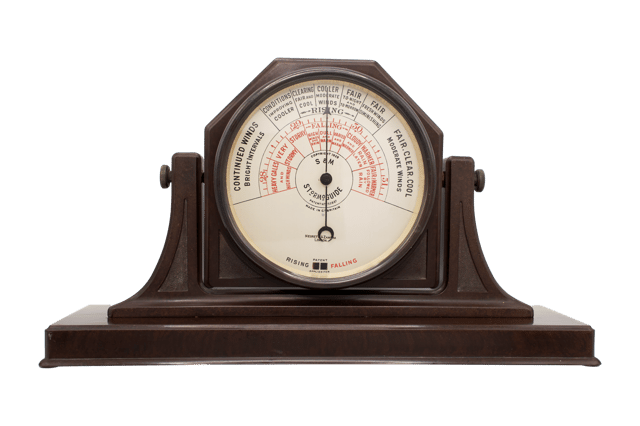
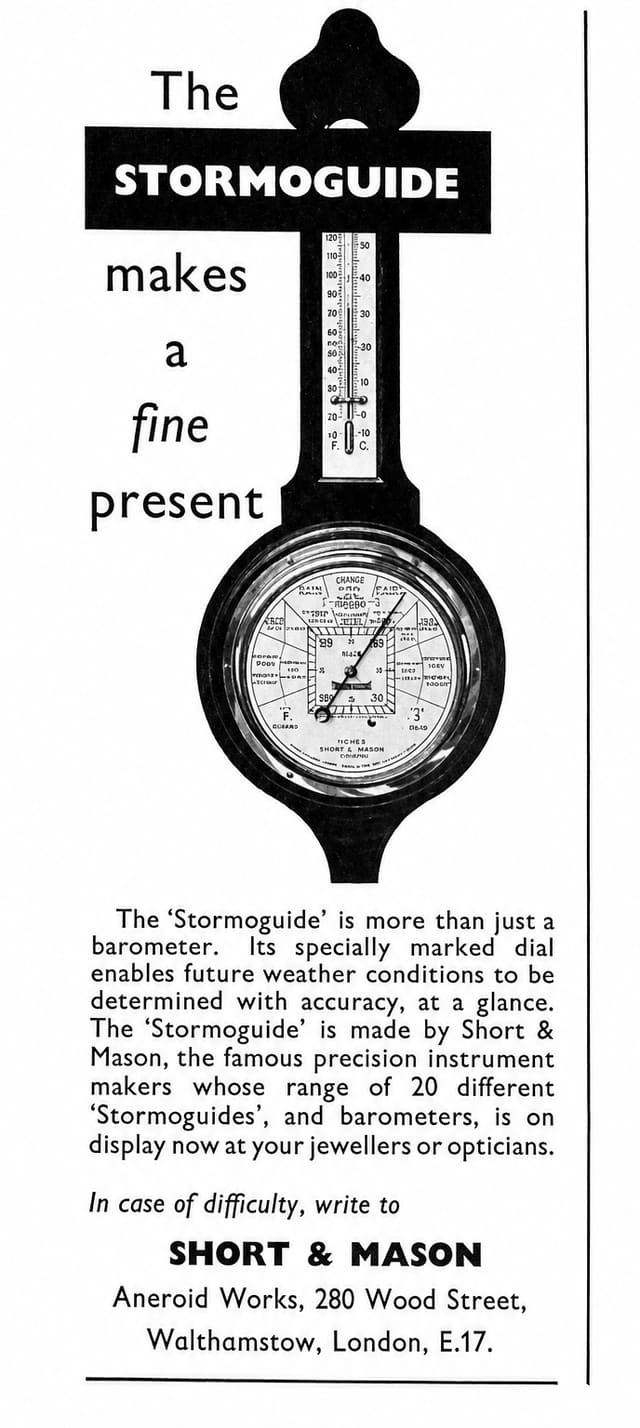
The idea is simple and commercially impeccable. An ordinary barometer demands interpretation from its owner: one must know not only the current pressure but the tendency, the season and the locality. The Stormoguide took that work upon itself: two scales — one for rising and one for falling pressure — and an indicator with apertures showing which of them to read. All that remained for the owner was to read off the worded forecast. The instruction plate put it thus:
"To read the Stormoguide — Observe the red signal. When appearing in the rising aperture the outer circle of the forecast should be observed. When appearing in the falling aperture the inner circle should be observed. Forecasts sixteen to eighteen hours in advance."
It was a direct answer to the forecasting barometers of Negretti & Zambra — and, it must be admitted, a more elegant one.
The chronology of the Stormoguide runs as follows. The patent foundation is the Collinson patent already mentioned (1911/1914). Short & Mason took out copyright on the form of the forecast in 1921; the American Taylor used copyright in the word Stormoguide from 1922, selling the instrument under the Tycos mark and promising the purchaser probable weather 12 to 24 hours ahead (more modest in the advertising than in the patent, which does credit to the lawyers). Early American examples bear the 1914 patent date and the legend "UNITED STATES COPYRIGHT 1922 TAYLOR INSTRUMENT COMPANIES, ROCHESTER, N.Y."
The English line developed in parallel and received protection of its own: GB 407451, applied for on 7 November 1932 and published on 22 March 1934; the applicants were Short & Mason, Ltd. and Edward Jordan. It is the number 407451 that appears on British dials alongside copyright dates of 1927, 1930 or 1932. The mechanical side is also associated with a patent of Rowland Arnison (US 1,612,344, 1926, assigned to Taylor); the Neuwirth patent that appears in the literature (c. 1930, assigned to Taylor), covering the double scale and the flag indicator, is so far confirmed only by secondary sources and requires checking against the original.
These names are worth remembering: Jordan and Arnison turn up twenty years later on the firm's list of directors. The engineers who devised the instrument rose to the board — a rare case in which corporate history reads as the history of a technology.
The forms of the Stormoguide cover the entire social range of the interwar home: round brass instruments of 5¼ inches; wall models in carved oak and walnut; banjo cases in the Sheraton manner with shell inlay and a spirit thermometer; desk models in a case the firm itself described as a "walnut finished Bakelite case" — Bakelite finished as walnut, the perfect formula for the age; and, finally, rare shop-display examples with dials of 12 to 12½ inches.
The fairs. The firm exhibited regularly at the British Industries Fair: 1922 (stand G.3), 1929 (Scientific Section, stand O.6) and 1947 (Olympia, stand D.1688). The 1929 catalogue entry is the best "snapshot" of the range available to us: the firm appears under the heading of optical, scientific and photographic exhibitors, describes itself as a specialist in temperature regulators, and lists what it makes — aeronautical, medical, meteorological and surveying instruments; barographs; thermographs; rain gauges; pocket and military compasses; prismatic and reflecting levels; gas pressure gauges; Tycos sphygmomanometers. A range in which the domestic barometer sits next to an instrument for measuring blood pressure is an exact portrait of the firm: it sold not a subject but a technology of the elastic sensing element, applied to everything it could be applied to.
Science and expeditions. The firm's instruments served far beyond the drawing room. A late nineteenth-century Short & Mason barograph worked at Sydney Observatory. Grace's Guide reports supplies of instruments for the polar expeditions of Scott and Shackleton and for climbers on Everest; at least one object is documented — the aneroid from Shackleton's own cabin aboard the Quest (Shackleton–Rowett Antarctic Expedition, 1921–22), accompanied by a letter from the ship's surgeon, Dr L. D. A. Hussey. The Meteorological Office holds instruments by the firm from the later years too, including a micro-barograph bearing the "MO" logo with its calibration certificate.
Benson's list of addresses contains a clue that is easily missed: from 1937 to 1945 the firm is recorded at The Instrument House, Walthamstow. The years coincide with rearmament and the war too precisely to be accidental; most probably this represents an expansion or a re-purposing of the site for war work. Direct documentation of bombing, of the evacuation of production, or of the composition of the workforce in the war years has not, however, yet been found.
What is known for certain is that the firm supplied the Air Ministry with instruments carrying the characteristic group index 6A/ (altimeters and related instruments) and barometers for the Meteorological Office. The Met Office collection includes a Short & Mason barometer of 1943 — a Kew MK2 station pattern, serial number S2654/43/60, in which "43" encodes the year of manufacture. The firm's advertising duly appears in The Aeroplane in February, April and May 1943 and in January 1945: aircraft instrument production continued throughout the war.
After the war came a return to the civil range and participation in the British Industries Fair of 1947. By 1954 the board of the company looked like this: R. Arnison; C. M. V. Benwell; E. J. Jordan; G. Paxton; D. B. Pinkney. As already noted, two of the five names are those of the Stormoguide patentees of a generation earlier: engineering continuity was preserved even as the market began to give way beneath the firm's feet.
And give way it did. The domestic barometer as an article of furniture was gradually displaced by the wireless forecast; aircraft instrumentation moved into electronics and into the hands of giants; the meteorological services went over to other technologies. The addresses of the late period — Hale End Road (in the 1954 listings) and 280 Wood Street, Walthamstow (1957; the Science Museum Group gives Wood Street until roughly the mid-1960s) — are already the addresses of a contracting enterprise.
The denouement came at the end of the sixties, and it was a thoroughly corporate one.
1968. Taylor discontinued production of Short & Mason instruments: demand for expensive mechanical instruments had been falling for years, and maintaining a separate English line for them had ceased to make sense. In the same year Taylor Instrument Companies itself merged with the Pfaudler Company and the Ritter Company to form Sybron Corporation.
1969. The final corporate merger took place: Short & Mason merged with Taylor Instrument Companies (Europe) Ltd. of Leighton Buzzard, Bedfordshire, and the name Short & Mason ceased to be used. Both Benson and the Science Museum Group confirm this, the latter's record for the firm closing it explicitly at 1969.
The subsequent fate of the owner is a chain of takeovers in which the London aneroid is no longer distinguishable: Sybron (1968) → Combustion Engineering (1983) → ABB (after 1989) → ABB Kent-Taylor (1990) → ABB Instrumentation (1996). Somewhere within those reorganisations the drawings, the tooling and, to all appearances, the archive of the Walthamstow works dissolved without trace. Not one substantial corporate holding of Short & Mason material has so far been identified in public hands — which is precisely why this history has to be assembled out of notices of dissolved partnerships.
The history of Short & Mason is a history of what success looks like when it leaves no traces.
The firm lived one hundred and five years and throughout that time did exactly one thing: it turned an elastic evacuated capsule into a pointer on a scale. Out of that single idea it derived the mountaineer's pocket barometer, the surveyor's mining aneroid, the observatory barograph, the aeroplane altimeter, the gas fitter's pressure gauge, the physician's sphygmomanometer and the housewife's Bakelite Stormoguide. It survived the deaths of both founders, purchase by foreign capital, two world wars and the passage from the drawing room to the cockpit — and it died not of any catastrophe but of the thing all good mechanical firms die of: people stopped buying mechanisms.
Its central paradox is that fame and obscurity here turned out to be two sides of a single business model. Short & Mason deliberately made movements for other people's dials, for hundreds of provincial shopkeepers, and later for the American Tycos. Working under other names, the firm captured the market and simultaneously erased itself from history: no archive of its own, no anniversary book, no biographies. What remains are the instruments — and a few lines in The London Gazette, saying only that on such and such a day a partnership was dissolved by mutual consent.
And yet from those lines the biography can be recovered — and proves unexpectedly alive. A young optician from Lambeth holding a share in three ventures at once by the age of thirty. The Clerkenwell master Pitkin, who taught him the aneroid and went on soldering capsules at eighty-three. The gas engineer Mason with his six workmen in Paddington, who gave the firm its manufacturing muscle and his own name — and then quietly withdrew to "live on own means" in 1900. The engineers Collinson, Jordan and Arnison, out of whose patents grew an instrument that stood on mantelpieces on two continents. All of them men nobody set out to remember; they are remembered by the brass movements found under the back cover.
For an instrument-making firm, that is perhaps not the worst form of afterlife.
Primary documents
Reference literature
Supplementary material (used only for the physical features of objects — markings, serial numbers, patent engravings; no dating or corporate assertions are taken from it): dealer and auction descriptions from Charles Edwin Inc., Sellingantiques, Vavasseur Antiques, Charles Miller Ltd, Denhams, Jason Clarke Antiques, The Weather Store and 1stDibs.