Loading
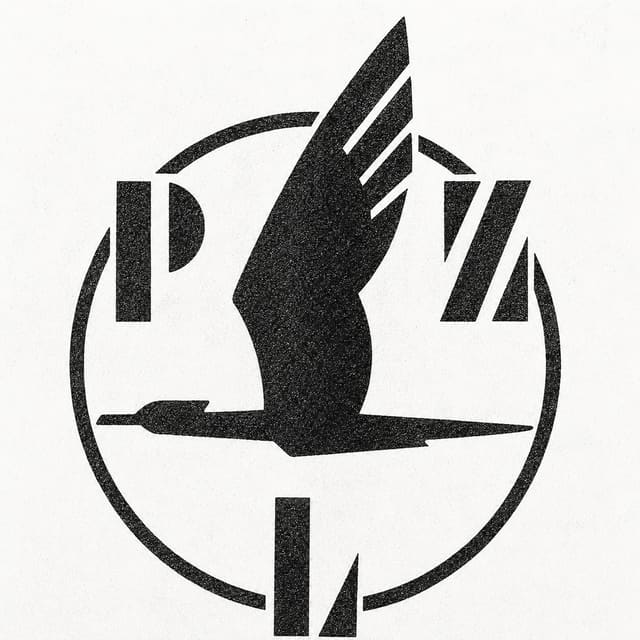
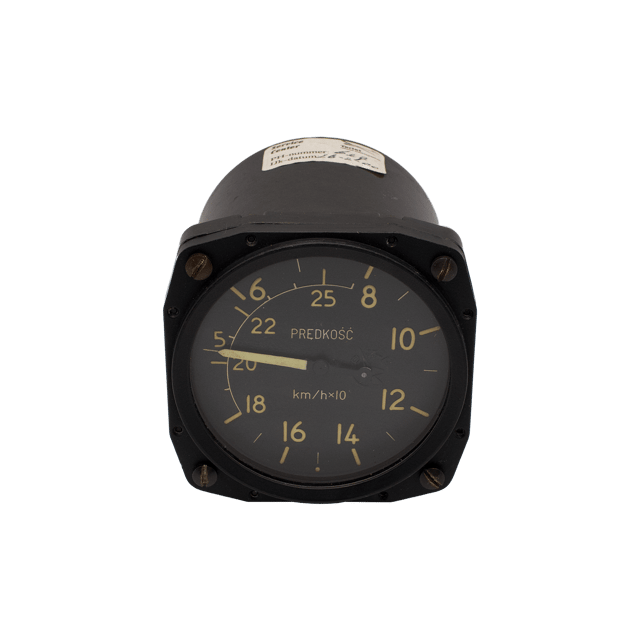
On thousands of instruments scattered across airfields from the Baltic to Central Asia, you will find the same mark: three letters and a stylised emblem. No city, no street, no factory name — only "PZL" and the terse addendum "MADE IN POLAND". The mark is deceptive: it names not a factory but an entire industry, and behind it lies a century of history — a designer who died at thirty-three, bombers destroyed by Polish workers with their own hands so the Germans would not get them, a lift factory turned instrument works, gyroscopes, missile guidance units and marine autopilots. And an address in Warsaw's Praga district where today nothing remains.
It begins in November 1918, in the very weeks when Poland returns to the map of Europe. At the Mokotów airfield in Warsaw, at 2a Puławska Street, the — the Central Aviation Workshops — are established. At first they are a repair base, patching up captured and Allied machines; then they assemble Hanriot and SPAD fighters under French licence. The first aircraft of their own design is the D-1 "Cykacz" sports biplane by Jerzy Dąbrowski — a name that will return.
The workshops outgrow their status faster than the paperwork allows. By a decree of the Council of Ministers of 21 December 1927, signed by Treasury Minister Gabriel Czechowicz, they are spun off into an independent state enterprise: Państwowe Zakłady Lotnicze, the State Aviation Works, abbreviated P.Z.L. Operations under that name begin in 1928. The first director is engineer Witold Rumbowicz.
What follows is something that happens rarely in the history of technology: for a decade, a small country finds itself ahead of everyone.
A young engineer, Zygmunt Puławski, proposes an all-metal monoplane fighter with a high-mounted wing cranked at the fuselage so that it does not obstruct the pilot's upward view. The world will come to call this arrangement the "Polish wing" — płat polski, the gull wing. From it grow the PZL P.1, P.6, P.7 and finally the P.11 — from 1933 the standard fighter of the Polish Air Force and, at the moment of its appearance, one of the finest fighters in the world.
Puławski does not live to see the triumph: on 21 March 1931 he is killed testing his own PZL.12 amphibian. Wsiewołod Jakimiuk takes over the development of the P.7 and P.11.
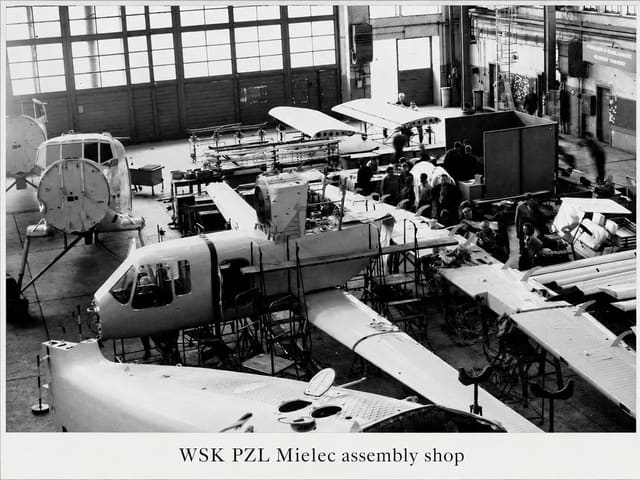
By the late 1930s PZL is an industrial empire. In 1934 the main production moves to Warsaw's Okęcie (the WP-1 plant); in 1938–1939 a second aircraft factory, WP-2 at Mielec, is under construction; engine works operate at WS-1 in Warsaw (the former Polskie Zakłady Skody, nationalised and renamed in 1936) and WS-2 in Rzeszów; and the Podlaska Wytwórnia Samolotów joins the group.
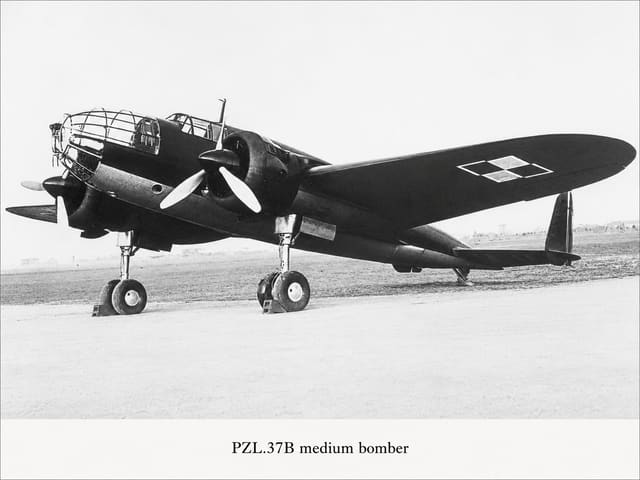
The design office shines. The export P.24 serves four Balkan air forces: Bulgaria takes twelve machines, Turkey around forty plus a licence, Romania five complete aircraft and twenty-five under licence, Greece some thirty-six. Jerzy Dąbrowski — the author of that pre-war "Cykacz" — designs the PZL.37 Łoś medium bomber, a machine good enough to attract foreign purchasing commissions. Stanisław Prauss creates the PZL.23 Karaś light bomber and reconnaissance aircraft. Alongside them work Franciszek Misztal and a very young Tadeusz Sołtyk, whose career will continue in a rather different Poland. The engines for the Łoś are built under British Bristol Pegasus licence — Western licences were routine at pre-war PZL, and nobody was embarrassed by them.
While fighters are being assembled at Okęcie, a far more prosaic story unfolds on the right bank of the Vistula — the one from which the instrument works will eventually grow.
Warsaw by then has solid traditions in precision mechanics. Here, since the nineteenth century, G. Gerlach has operated — the oldest Polish maker of surveying and drawing instruments, whose theodolites were ranked alongside Zeiss; here too works the Wytwórnia Instrumentów Precyzyjnych. That is a school, a pool of skilled labour, a culture of hundredth-of-a-millimetre tolerances.
And in Praga, in the Kamionek and Grochów neighbourhoods, stand perfectly ordinary urban factories. At 32/34 Podskarbińska Street, buildings go up in 1937–1938 for the Fabryka Dźwigów "Bracia Jenike" — a lift factory. At 306/310 Grochowska Street operate the Zakłady Elektrotechniczne "Bracia Borkowscy", a substantial electrotechnical enterprise. Neither has anything to do with aviation. Yet.
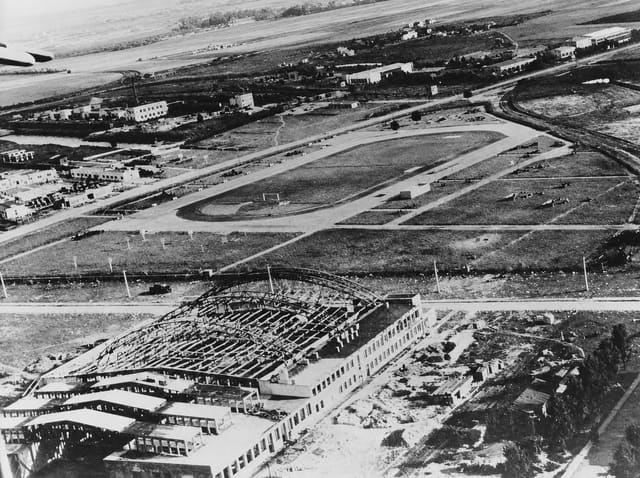
September 1939 cuts everything short. At Okęcie and Mielec, Polish workers manage to destroy some thirty unfinished Łoś bombers while pretending merely to tidy up the premises — until the Germans work out exactly what is disappearing under their noses. The Mielec factory is absorbed by the Heinkel concern. The main Warsaw plant, WP-1, is destroyed, largely during the German evacuation of 1944.
The Praga factories fare better. The buildings on Podskarbińska survive September 1939 undamaged; under the occupation they house a Wehrmacht vehicle repair shop, and that function persists until 1950. The "Bracia Borkowscy" halls on Grochowska also survive — but as they withdraw, the Germans remove everything of value, leaving empty shops.
Empty shops with an intact roof: by the standards of 1945, that is close to wealth.
The new authorities accept the pre-war inheritance selectively. The name PZL — too closely tied to the old regime, too redolent of pre-war Poland — disappears from use. Aviation factories are given a deliberately opaque common designation: WSK, Wytwórnia Sprzętu Komunikacyjnego, "Transport Equipment Works". Precisely what equipment, and for which transport, outsiders are not meant to know.
At the same time a governing superstructure is built. As early as 1945 a branch association (zjednoczenie) is created, seated at Włochy near Warsaw. The word itself requires explanation: a zjednoczenie in the planned economy of the Polish People's Republic was not a corporation or a holding company but an organ of industrial administration, an intermediate tier between the ministry and the factories. The closest analogue is the Soviet glavk. The plants remained legally separate enterprises, but plans, allocation of resources, sub-contracting and foreign trade were decided above their heads.
It is within this framework that "our" factory is born.
On 16 February 1952, by decree of the Minister of Heavy Industry, the Wytwórnia Sprzętu Komunikacyjnego "Warszawa II" is created from the remains of three small neighbouring factories on Podskarbińska Street. The three enterprises from which it was assembled read like an entry in a trade directory rather than the pedigree of an aviation works:
There is almost no equipment. There are buildings, there is a state assignment, and there are people: the core of the engineering staff comes over from PZL Okęcie. They begin with what lies closest to the future specialisation — elastic elements: bellows and diaphragms, the heart of any aneroid instrument. Everything else will grow out of that modest theme.
That same year, 1952, a second site starts up five hundred metres away, in the former "Bracia Borkowscy" halls on Grochowska Street. Its post-war life had begun even more prosaically: the Zakłady Wytwórcze Urządzeń i Aparatury Grzejnej made hotplates, immersion heaters and flat-irons.
But in 1951–1953 the profile changes abruptly. The plant switches to aviation equipment: electrical converters, aircraft compasses, gyromagnetic compasses, artificial horizons. In 1959 the site receives a name of its own — WSK "Grochów" — and with it the newly mastered gyroscopic compass.
From there the specialisations of the two sites diverge neatly and logically, on the principle that where there is a gyroscope, there is stabilisation.
At Grochowska they take on the gun stabilisation system for the T-55 tank, remote control systems for shipboard surface-to-surface missile launchers, and from 1964 marine autopilots. The very first model, the TS-1, is judged by a Lloyd's Register of Shipping surveyor to be a world-class instrument, and over the following decades the plant sells more than fifteen hundred such systems. Marine automation proves a surprisingly durable line: by the mid-1980s it will produce the digital "TRAJEKTORIA 207" system.
At Podskarbińska, missile guidance units go into production from 1962. In 1964 the Warsaw Fabryka Sprzętu Ratunkowego from the Wola district is absorbed — and oxygen and survival equipment joins the product range.
Keeping two factories half a kilometre apart, working for the same industry and constantly sub-contracting to each other, becomes pointless. By decrees of the Ministry of Machine Industry and of the Aviation Industry Association dated 28 December 1965 the enterprises are merged; the merger takes full effect on 1 January 1966. The older name is retained: WSK "Warszawa II".
From this point on it is a single works on two sites: instruments and elastic elements, gyroscopy and electrical automation, missile guidance units and marine autopilots.
The industry itself is being assembled in parallel. In 1957 the glider equipment factories are brought into the association; in 1958 the central administration once again takes the name Zjednoczenie Przemysłu Lotniczego; in 1965 the diesel engine plants are added, and shortly afterwards the Instytut Lotnictwa, the research base with its aerodynamics, structural test rigs and flight testing. From 1978 the association carries its final name: Zjednoczenie Przemysłu Lotniczego i Silnikowego "PZL" — nineteen factories, thirteen of them aviation plants, and some hundred thousand employees.
Over the years the structure looked roughly like this:
Here lies the answer to those three letters on dials and nameplates.
First, "PZL" was a common mark for the whole industry, not the name of an enterprise. From 1973 the association used the PZL symbol, and from 1975 it was adopted by every factory within it. The mark became the single designation of the Polish aviation industry as a whole. "PZL" on an instrument says not "made at a factory called PZL" but "made by the Polish aviation industry" — much as "Made in USSR" on Soviet hardware said rather more than a post-box number ever would.
Second, exports. Individual factories were not permitted to conduct foreign trade: everything went through foreign trade centrals, above all PEZETEL (the name is simply the Polish pronunciation of the letters P-Z-L). For a buyer in India, Egypt or East Germany, the counterparty was Pezetel, selling "the Polish aviation industry" as a single supplier. Splitting that into two dozen obscure factories with unpronounceable names would have been commercial suicide. Hence the formula on the nameplate: the PZL logo, the type designation, the serial number, "MADE IN POLAND" — and not a word about which shop floor it came from.
Third, standardisation. A single mark implied a single presentation standard. The nameplates of instruments from different plants within the association look like siblings — which is precisely why the maker cannot be identified from the plate alone: one has to know which factory in the industry was responsible for that class of product.
The return of the historic name had a second aspect, too. By the mid-1970s "PZL" was no longer politically awkward and had become an asset: a brand with an international reputation, backed by the P.11 and the Łoś, sold far better than an anonymous "WSK".
The move to a single mark came in two stages, and the first was a false start.
In 1970 the industry tries out a neutral umbrella brand — the Greek letter "Delta". Factories are renamed accordingly: "Delta-Kalisz", "Delta-Rzeszów", "Delta-Hydral" — and, naturally, WSK "Delta-Warszawa II". For a time the association itself is styled ZPLiS "Delta".
The brand does not last long. On 14 January 1975 the "Delta" in the Warsaw instrument works' name is replaced by "PZL", and the enterprise acquires the name under which it will enter history: Wytwórnia Sprzętu Komunikacyjnego "PZL-Warszawa II". The same thing happens across the industry in those years.
By its mature period, the product range of the works on Grochowska and Podskarbińska was impressive even by the standards of a large country:
An instrument works, a missile design office and marine automation under one sign — a combination that looks eccentric today, but was entirely natural in a planned economy: if you have gyroscopes, precision mechanics and servo drives, then you can handle anything built upon them.
The question of where the technology came from is a story in itself.
The post-war Polish aviation industry grew above all on Soviet licences. From 1952 Mielec builds the Lim-1 — the MiG-15 (initially with Soviet VK-1 engines, later with Polish Lis-2 units from Rzeszów) — followed by the Lim-2, five hundred aircraft in nineteen production batches. On 28 November 1956 the same plant completes the first Lim-5, the MiG-17, of which 477 will be built by 1960. Mielec also produces the An-2 and the Il-14; Świdnik builds the SM-1 (Mi-1) and Mi-2 helicopters.
A licence in this system meant a complete technology package: design drawings, manufacturing processes, tooling drawings, technical conditions and standards — all of it translated and adapted locally. That is how, within a decade, a new engineering school arose in a country that had lost its entire pre-war aviation industry.
Then came specialisation within Comecon. Each country was assigned its niche; Poland's were light helicopters, agricultural aviation and aircraft instrument-making. The Mi-2 was transferred to Poland in its entirety — it was never series-built in the USSR at all — and Świdnik became the socialist bloc's largest producer of agricultural helicopters, whose principal customer was the Soviet Union. At the turn of the 1970s and 1980s Poland was among the world's leading suppliers of agricultural aircraft.
Instrument-making followed the same logic. Some of the Warsaw plant's products were built under licence — the gyroscopic compass, for instance, was mastered that way. Others were developed independently: glider instrumentation, with its variometers and compensators, consisted of thoroughly Polish designs with Polish type designations, backed by the Instytut Lotnictwa, which tested all series-built Polish gliders.
The West, meanwhile, never quite vanished from the picture. Pre-war PZL had built under French and British licence; the post-war industry returned to the practice in the 1970s: in 1976 Rzeszów takes up Pratt & Whitney Canada engines, the French Socata Rallye gives rise to the PZL-110 Koliber, and Mielec sets up assembly of Piper aircraft. For a Warsaw Pact country, an unusually broad technological appetite.
The works survived the change of political system; the market it did not.
On 26 October 1994 the enterprise is converted into a joint-stock company: WSK "PZL-Warszawa II" S.A., still at 306/310 Grochowska Street. In 2002 it joins the Bumar defence group.
What follows is a consolidation in which there is no longer room for standalone factories. On 1 June 2012 WSK "PZL-Warszawa II" S.A. is merged into Bumar Amunicja S.A. of Skarżysko-Kamienna, and yesterday's independent enterprise becomes a branch of it; former shareholders receive shares in MESKO S.A. In 2013 production on Grochowska ceases, and the site and buildings are soon sold. By then the Polish defence industry is being gathered into the Polska Grupa Zbrojeniowa, and through MESKO whatever remained of the Warsaw instrument works goes with it.
Sixty-one years — from a lift factory to a branch of an ammunition plant.
This is a history in which the name and the thing keep getting confused.
The name "PZL" was born in Warsaw in 1928, denoted a combine that built fighters with cranked wings, died with it in 1939 — and was resurrected thirty-six years later in an entirely different capacity: not as the name of an enterprise but as the common mark of an entire industry, one uniting nineteen factories and a hundred thousand people. That is precisely why an instrument carries "PZL" rather than the name of its maker: the mark was not a craftsman's signature but a token of belonging to a system.
The thing itself — the Warsaw works in Praga — lived a life of its own, one with almost no connection to the famous names. Three small factories that made lifts, boiler fittings and motor car bodies. A neighbouring workshop turning out flat-irons and immersion heaters. Engineers arriving from Okęcie into empty halls from which the Germans had removed even the machine tools. Bellows and diaphragms as the first product — and gyroscopes, artificial horizons, missile guidance units and marine autopilots as the last. Four changes of name in twenty-three years: "Warszawa II", "Grochów", "Delta-Warszawa II", "PZL-Warszawa II".
The factory is gone: the site was closed in 2013 and sold. But the instruments that left its shops still sit in gliders, lie in museums and surface at auction — bearing that same mark, which names neither a city nor a street. Three letters that turn out to contain a whole industry at once: a convenient marketing abstraction that has accidentally become the only surviving monument to one very specific factory at 306/310 Grochowska Street.