Loading
Pieterman—Van Baaren was a Dutch company active from the 1920s to the 1970s, engaged in the trade, assembly, and partial manufacture of laboratory glassware and precision measuring instruments. Its history represents a classic case of interwar and postwar family enterprises: two independent businesses—one rooted in glass trade, the other in laboratory instrumentation—merged after the war, left a distinct mark on the instrument-making industry, and ultimately gave rise to a modern technological lineage.
The story begins in 1920 in Rotterdam. Johann Pieterman, an entrepreneur of German origin, together with his partner H.C. Brinkers, established a small glass trading business (glashandel). This was an import-oriented firm supplying laboratory glassware and scientific instruments, primarily of German manufacture. It is reliably documented that Pieterman died on 26 February 1961 in Schiedam; civil records identify his place of birth as the region of present-day Duisburg, while cemetery records provide an exact birth date of 31 October 1880. Genealogical and burial sources associate him with his wife Hillechiena Stemmer and their son Joost Pieterman, born in 1916 in Rotterdam.
A museum record attributes the founding of the glass trade with Brinkers around 1920 directly to Pieterman. In other words, the name Pieterman in the later brand reflects a specific individual—an entrepreneur of German origin who became integrated into the Dutch glass and scientific instrument milieu of the interwar period.
In parallel, a second branch developed: M. van Baaren. Its founder, Meijer van Baaren (according to Open Archieven, born 16 June 1887 in The Hague), came from a Jewish family: his father Jacob was a tailor, and his mother was Esther van Zuiden. Meijer himself worked as an instrument maker (instrumentenmaker) and led a firm described in museum and archival sources as a “fabriek en groothandel in laboratoriuminstrumenten”—a factory and wholesale business in laboratory instruments. By 1941, the company was already under the supervision of an external manager, J.R. Kessler.
The memorial database Joods Monument records that during the war van Baaren lived at Bosschestraat 110 in Scheveningen with his wife Sara Gazan; family records confirm the presence of their daughters Bella and Hetty. According to Oorlogsbronnen, in May 1943 he was deported to the transit camp Westerbork and subsequently murdered in Sobibor on 28 May 1943. This fact is crucial: it explains why the van Baaren firm was already under external administration by 1941 and why the postwar development of the brand proceeded without its founder.
After the war, the two companies converged. In 1954, Pieterman and Van Baaren were formally merged in The Hague. This merger is documented in the archives of the Rijksmuseum Boerhaave (the Dutch national museum of the history of science and medicine in Leiden), via a museum object record aggregated through Europeana. From that point onward, the firm operated under combined names such as Glasindustrie Pieterman N.V. / Afdeling M. van Baaren or PIETERMAN—VAN BAAREN N.V., with two addresses in The Hague: Prinsengracht 67 and Fannius Scholtenstraat 11–13.
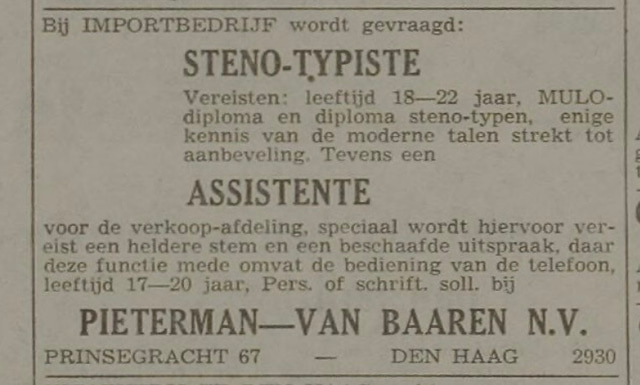
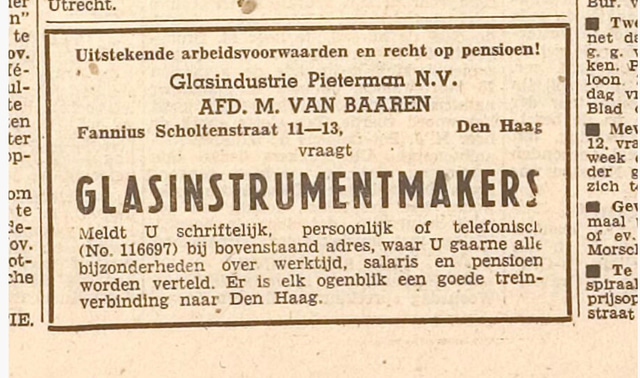
During this period (1947–1953), the company actively expanded its workforce. On 10 November 1947, the newspaper Leidsch Dagblad published a job advertisement in which Glasindustrie Pieterman N.V., Afdeling M. van Baaren (Fannius Scholtenstraat 11–13, The Hague) sought skilled glass instrument makers (glasinstrumentenmakers), offering excellent working conditions and pension benefits. A similar recruitment notice appeared again in 1953. That same year, PIETERMAN—VAN BAAREN N.V. (Prinsengracht 67) placed an advertisement seeking a stenotypist (aged 18–22) and a sales assistant. These notices vividly illustrate the company’s postwar growth and its specialization in laboratory glassware.
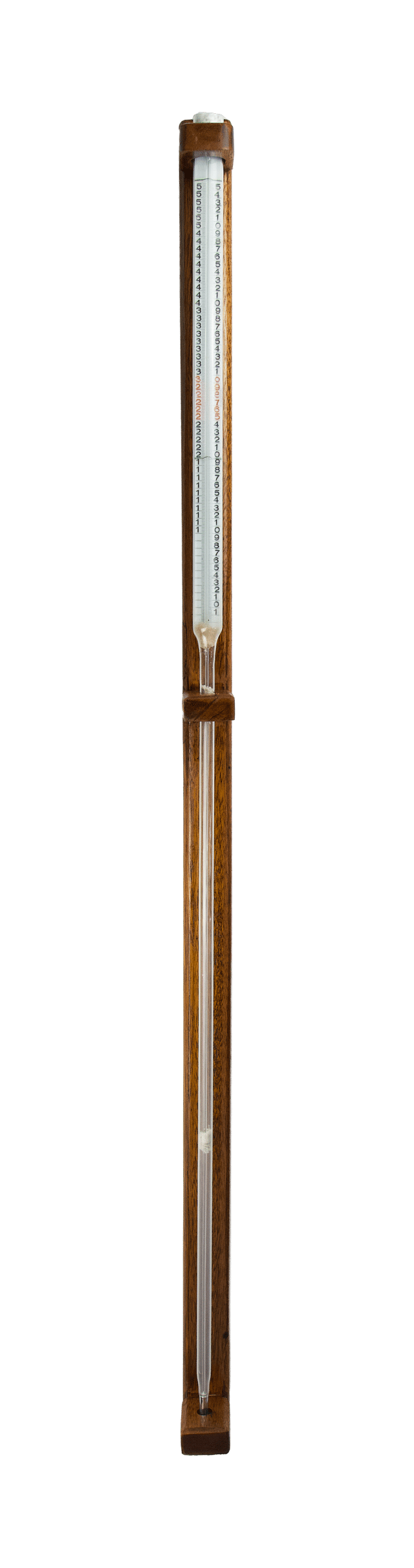
The firm’s products were highly specialized and precise. The Rijksmuseum Boerhaave holds a mercury thermometer (kwikthermometer) by Pieterman—Van Baaren designed for determining the freezing and boiling points of water—a typical laboratory reference instrument. The collection of the Het Scheepvaartmuseum (National Maritime Museum) includes a marine or service mercury thermometer by M. van Baaren (The Hague, circa 1950) with a scale from −6 to +104 °F. In addition, the company commissioned enameled psychrometric tables from the Langcat factory for humidity calculations. As noted by Museum Boerhaave, many of the instruments exhibit clear signs of German manufacture: capillaries made of “Normalglas”, ultra-pure “fein gekühlt” mercury, and metrological inscriptions such as “Fadentemperatur 20 °C” and “Bis zur Skala eintauchend justiert”. Pieterman—Van Baaren functioned primarily as a trading house and assembler, combining German components with their own opaline scales bearing the company mark and wooden cases.
In 1973, the company took a decisive next step. According to Museum Boerhaave archives citing Dr. J. Mooij, a Dutch historian specializing in scientific instruments, a spin-off company—Applikon Biotechnology B.V.—was established at that time, initially based in the Schiedam/Vlaardingen area (later Delft). Applikon focused on bioprocess equipment and upstream technologies for biotechnology and pharmaceuticals. The company rapidly became a global leader in its field, employing around 180 people worldwide by 2019–2020 and operating through an international distribution network.
On 19 December 2019, the Swedish medical company Getinge announced the acquisition of 100% of Applikon Biotechnology B.V. The transaction was completed on 3 January 2020 (valued at approximately SEK 840 million). Since then, the brand has continued under the name Getinge Applikon, further developing its technological product line.
It is also worth noting a documented contemporary bearer of the Pieterman name within the glass-technical sector: Pieterman Glas- en Steentechniek in Vlaardingen. This company traces its origins to 1953, when Jan Pieterman founded CV Glasindustrie Vlaardingen. Industry sources indicate that two independent Pieterman branches existed within the Dutch glass sector, and that the Vlaardingen line emerged from a family division within Glasindustrie Pieterman. This suggests that while a familial and sectoral continuity of the Pieterman name exists, there is no conclusive evidence that the modern Vlaardingen company is a direct legal successor to the Hague-based instrument firm Pieterman—Van Baaren. Most likely, no strict corporate continuity exists.
Today, a clear line can be traced from a modest glass trading business in Rotterdam in 1920 and a laboratory thermometer workshop in The Hague in the 1950s to a modern technological brand. Pieterman—Van Baaren, having survived war, merger, and generational change, left behind not only rare museum objects preserved in the Rijksmuseum Boerhaave, but also a tangible contribution to the development of precision instrumentation in the twentieth century. It stands as a rare example of how a Dutch interwar family enterprise evolved into a component of a global high-technology industry.
Sources:
Wikidata / Scheepvaartmuseum — organizational record. Used for information on M. van Baaren as a manufacturer and wholesaler of laboratory instruments, and for evidence of the later merger with Pieterman. Link
Joods Monument — Meijer van Baaren. Biographical record confirming identity, profession (instrument maker), and wartime fate. Link
Europeana / Museum Boerhaave — Pieterman van Baaren object. Key source confirming the post-war combined brand and supporting dating after 1954. Link
Het Scheepvaartmuseum — thermometer by M. van Baaren. Museum collection record confirming product line and existence of service/marine thermometers. Link
Open Archieven — birth record of Meijer van Baaren. Archival source confirming birth date, parents, and place of origin. Link
Schiedam civil registry — Johann Pieterman. Civil record confirming death date and personal data of Johann Pieterman. Link
Glas in Beeld — article on Pieterman. Industry article used for later history of the Pieterman name and discussion of possible lineage in the Dutch glass sector. Link