Loading

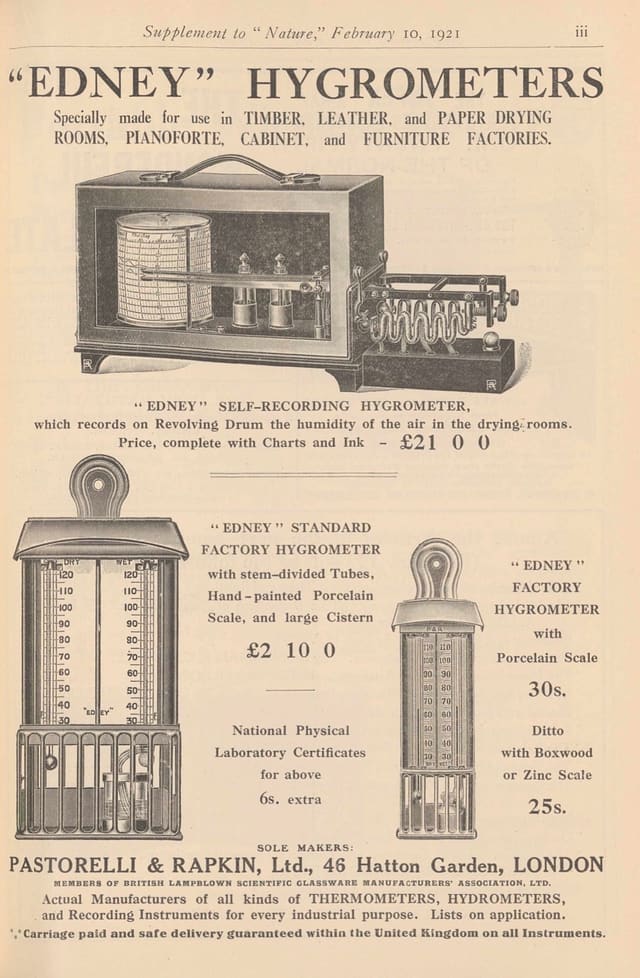
On 1 September 1876, at No. 46 Hatton Garden, in the heart of London's quarter of watchmakers, jewellers and opticians, two men signed a short document. Francis John Pastorelli and Alfred Thomas Rapkin announced that the partnership in which they had been making barometers and thermometers "was this day dissolved by mutual consent". A week later, on 8 September, the notice appeared in the London Gazette on page 4935, among notices from silk merchants, hatters and Carmarthen innkeepers.
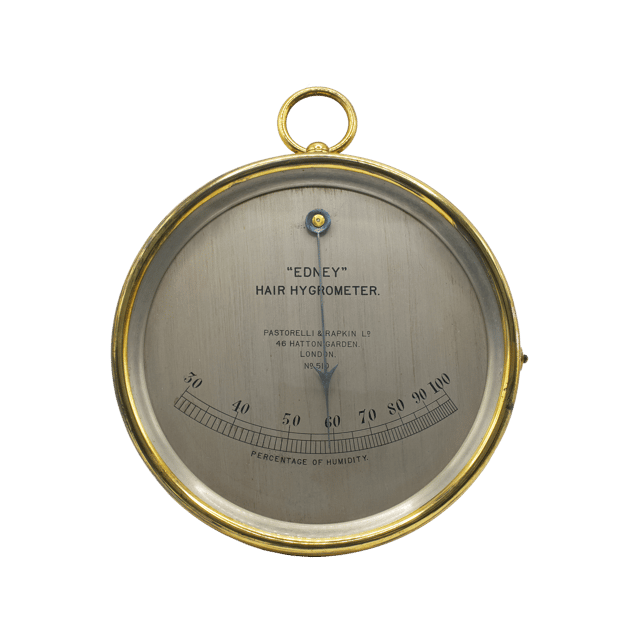
The partnership lasted only four years. But the name it left behind outlived both founders by more than a century: Pastorelli & Rapkin traded in instruments until 1988. Its thermometers were used at the Cavendish Laboratory, its recording instruments went up in aircraft, and its hygrometers bearing the "Edney" mark made their way into laboratories across Britain and the Dominions under other firms' names.
Behind this name lies the history of an Italian family that apparently came from the area around Lake Como. Its first members were selling barometers, mirrors and engravings in Liverpool as early as the eighteenth century. The family then settled in Hatton Garden and, over several generations, rose from a workshop in Cross Street to showrooms in Piccadilly and New Bond Street, winning a prize medal at the 1862 International Exhibition and a patent for a surveyor's level.
In the late eighteenth century a steady stream of craftsmen made their way from the villages around Lake Como to England: makers of barometers, thermometers, mirrors and frames. From this region came the Zambras (from the lakeside village of Careno), the Cettis, the Casartellis and many other families who later became well known in London and provincial instrument making.
The exact birthplace of the Pastorellis is not documented. It is known, however, that the Pastorellis were related by marriage to the Casartellis, and that the Casartellis came from Tavernerio, a few miles east of Como. It may therefore be assumed that Tavernerio was, in all probability, also the home of the Pastorelli family.
The earliest known document relating to the family in England comes not from London but from Liverpool. On 8 May 1800 the firm of Joseph Pastorelli & Co., of 43 Atherton Street, announced that it was closing down its business:
"Joseph Pastorelli and Co. respectfully inform their friends and the public, that as they mean to decline business, they have now selling at their shop, No. 43 Atherton-Street, Liverpool, a large quantity of picture frames, and engravings, prints, drawing books, weather-glasses, barometers, thermometers, looking-glasses, &c. which they intend to dispose of at various reduced prices."
The list of goods neatly sums up the early Italian craft in England: the barometer and thermometer stood side by side with the mirror, the frame and the engraving. The notice itself shows that the shop was already trading in the eighteenth century.
Joseph (Josh.) Pastorelli came to Liverpool from Italy with his uncle around 1800; the uncle later moved to London. The timing coincides strikingly with the appearance of Fortunato Pastorelli in London around 1805, but no document confirms a connection. Nor is it entirely clear whether this is the same Joseph who closed the shop in May 1800.
According to a family tradition recorded by E. Banfield in his book, Joseph trained Lewis Casartelli in barometer making. In 1812 Casartelli set up his own business in Liverpool, founding what became a well-known firm.
In 1837 Joseph was succeeded at Cable Street by his son John. T. Benson in his book gives the addresses of John Pastorelli, optician, barometer maker and mathematical instrument maker:
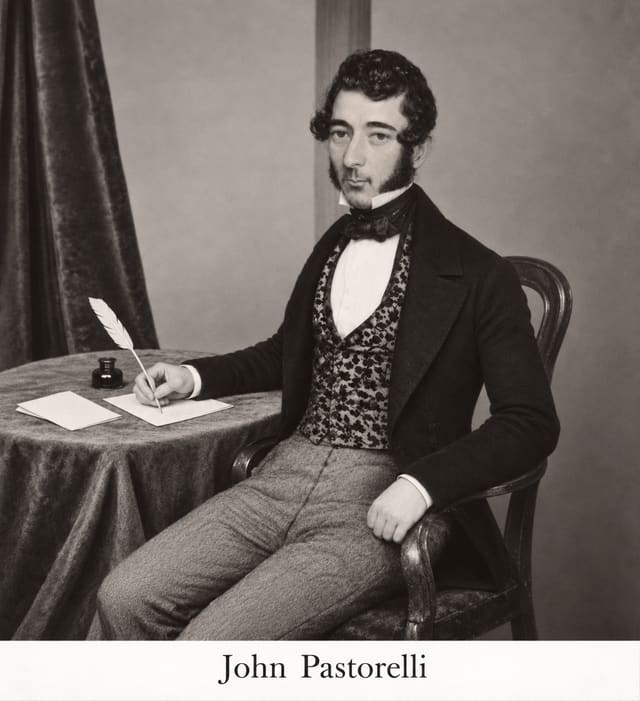
John worked in Liverpool for about twenty years. He made stick and wheel barometers, and some directories list him as an optical instrument maker. Portraits of John and his wife Sarah, who was a Scot, have survived; Banfield reproduces them in his book. At this point the Liverpool line disappears from the records.
The London line of the family begins with Fortunato Pastorelli. Banfield describes him as the first member of the family to arrive in Britain and places him in the Hatton Garden area between 1805 and 1830. The Science Museum Group, in its biographical note on the firm, gives a more detailed picture:
Banfield and the Dutch collector and author of books on barometers B. Bolle describe the succession differently: Fortunato worked until 1830, after which the business passed to his son Anthony (Antonio). Bolle, in "Barometers in beeld" (1983), states briefly that Anthony Pastorelli worked in London from about 1830 at 4 Cross Street, Hatton Garden, "succeeded Fortunato Pastorelli", and around 1850 handed the business to his son Francis. Most probably both versions describe a single family workshop in which father and son worked for some time in parallel and under different names.
4 Cross Street became the family's ancestral address. Banfield illustrates a barometer by Fortunato bearing this address: a mahogany case with kingwood banding, 46 inches (about 117 cm) high and 13 inches wide. Built into the case are a pendulum clock and a detachable thermometer and hygrometer. Wheel barometers of this compendium type represented the height of Italian craftsmanship in London in the early nineteenth century.
Under Anthony the workshop began receiving orders from the state. The Science Museum holds a marine barometer signed A. Pastorelli and dated 1838–1849. It came to the museum from the Meteorological Office, which means that an instrument of this make was used by the national weather service.
In 1848 Anthony took his son Francis into the business. In 1848–1849 the firm traded as A. & F. Pastorelli (according to Bolle, Francis "worked from 1848 as his father's partner"). Around 1849–1850 Anthony left the business; the sources do not say clearly whether he died in those years or retired.
Another branch of the family was working in London at the same time. Banfield illustrates a 10-inch wheel barometer with a scroll pediment signed "Joseph Pastorelli, London" and describes its maker as "an important maker" whose son followed him in the business. Whether this Joseph is connected with the "J. Pastorelli" of 1805 in the Science Museum's note or with the Liverpool Joseph has not yet been established.
Francis John Pastorelli is the central figure of the whole story. T. Benson describes him as an optical, surveying, mathematical, philosophical and meteorological instrument maker and a wholesale optician, active 1851–1880, died 1897. Under him the family workshop became a business with a West End shopfront, a medal and a patent.
Francis's addresses according to Benson:
| Years | Address |
|---|
From 1851 until at least 1871 he traded as Francis Pastorelli & Co. This arrangement was typical of the leading London instrument makers: manufacturing in Hatton Garden, a shop for a wealthy clientele in the West End.
Francis readily entered into partnerships, and nearly every one of them left a trace in the London Gazette.
The move to 208 Piccadilly placed the firm among the leading opticians of the capital. In 1858 "Pastorelli and Co of Piccadilly" was mentioned in The Engineer, and an advertisement for "Pastorelli's Level", the firm's own surveying level, dates from the same period. It was surveying instruments that brought the firm its greatest recognition. At the 1862 International Exhibition in South Kensington it was awarded a prize medal "for good levels and general excellence of surveying instruments".
In 1863 Francis was granted a patent for "improvements in the construction of surveyors' levels, and other surveying instruments". The patent was short-lived: in 1866 it was declared void for non-payment of the fee (London Gazette, no. 23182, p. 5910).
The Piccadilly range was wide. Benson lists among instruments bearing Francis's name a Brewster stereoscope and a brass astronomical telescope on a tripod, 110 cm long. Banfield illustrates a stick barometer in a solid walnut case made at 208 Piccadilly. Gothic Revival barometers of this kind were fashionable in the last quarter of the nineteenth century; their cases were carved in oak, walnut, mahogany or rosewood. The Science Museum holds a Six's thermometer and a minimum alcohol thermometer in an oak frame, both of 1875, presented to the museum by the firm of Pastorelli & Co. of Piccadilly itself.
By 1870 manufacturing had moved to 7 Great Warner Street in Clerkenwell (according to the Science Museum; Benson gives simply "Hatton Garden" for 1869). Two years later this address would become one half of a new firm.
In 1872 Francis John Pastorelli combined the manufacturing side of his business with the workshop of Alfred Thomas Rapkin. According to Banfield, the firm of Pastorelli & Rapkin was formed "by the amalgamation of two businesses": Francis Pastorelli & Co. of 7 Great Warner Street and Alfred Thomas Rapkin of 61 Hatton Garden. Benson confirms the partners: a partnership between Francis John Pastorelli and Alfred Thomas Rapkin, manufacturing barometers and thermometers.
In 1873 the two businesses were brought under one roof, in larger premises at 46 Hatton Garden. The firm kept this address for almost a century. The shop at 208 Piccadilly was not part of the merger: Banfield stresses that Francis's West End business remained a separate concern.
Little is known about Rapkin himself. It is clear that by 1872 he already ran his own workshop in Hatton Garden and was an independent instrument maker rather than a junior partner. London records mention an Alfred Thomas Rapkin (1841–1905), son of the cartographer and engraver John Rapkin, who engraved the maps for Tallis's atlas of 1851; according to the map dealer Geographicus, John's sons became engravers. Engraving scales and dials is part of the instrument maker's craft, and the identification seems plausible. However, no document has yet been found linking this man to the workshop at 61 Hatton Garden.
The partnership proved short-lived. On 1 September 1876 the partners signed a notice that was published in the London Gazette on 8 September:
"Notice is hereby given, that the Partnership which has for some time past subsisted between us the undersigned, Francis John Pastorelli and Alfred Thomas Rapkin, in the trade or business of Barometer and Thermometer Manufacturers, carried on by us at No. 46, Hatton-garden, in the county of Middlesex, was this day dissolved by mutual consent.—Dated the 1st day of September, 1876. Francis John Pastorelli. Alfred Thomas Rapkin."
Besides the date on which the partnership ended, the document confirms that by 1876 the firm was already working at 46 Hatton Garden, and it defines the nature of the business: barometers and thermometers. The notice does not, however, say who was to carry on the business. Later events supply the answer: it was Rapkin.
The dissolution of the partnership did not destroy the firm. According to Benson, the business continued under the same name, Pastorelli & Rapkin, but with a new profile: it now traded as wholesalers of optical and mathematical instruments. The workshop at 46 Hatton Garden stayed with Rapkin; by the mid-twentieth century the firm's telegraphic address would be "Rapkin, London", and two Rapkins would sit on its board. The Italian name in the title survived as a brand with a reputation.
Francis John Pastorelli returned to his West End trade. In 1878 he moved his shop from 208 Piccadilly to 10 New Bond Street. Banfield believes he worked there until 1897; Benson records the address only for 1879–1880. A large wall thermometer inscribed "F. Pastorelli, 10 New Bond Street", with an unusually wide scale, dates from this period. Francis died in 1897. His death brought to an end almost a century of the family's London business that had begun in Cross Street.
The family did not leave Hatton Garden for good, however. Banfield records that Alfred Pastorelli, another member of the family, who had worked as a barometer and thermometer maker from 1884, joined the partnership of Pastorelli & Rapkin in 1894. So, eighteen years after the split, a Pastorelli in person was back in the firm. The sources do not say how he was related to Francis.
At the end of the century the firm worked in two registers: mass wholesale and prestige. Benson lists the following instruments bearing the name Pastorelli & Rapkin:
A fine example of the prestige style is a large oak barometer in a Gothic Revival case: a colonnade, bronze griffins, frogs, masks and silvered scales signed "Pastorelli & Rapkin, Opticians, 46 Hatton Garden, London". It stands 155 cm high. In 2012 it sold at Woolley & Wallis for £7,500 against an estimate of £1,500–2,000. The word "Opticians" shows how the firm presented itself to the public in those years.
In 1901 the partnership was converted into a limited company, Pastorelli & Rapkin Ltd, company number 00069769. The new form coincided with a change of era: the twentieth century demanded from instrument makers not so much prestige barometers as precise laboratory thermometers, hydrometers and recording instruments, and the firm adapted to this demand.
As early as 1902 the firm produced a standard mercury thermometer with a two-foot scale of 50–220 °F (no. 17030); it is now in the Science Museum. The Whipple Museum of the History of Science in Cambridge holds a standard thermometer reading −5 to +55 °C, divided to 0.1 °C and inscribed "Edney Pastorelli + Rapkin Std 46 Hatton Garden London". It is dated 1900–1925 and came to the museum in 1974 from the Cavendish Laboratory, one of the world's leading physics laboratories.
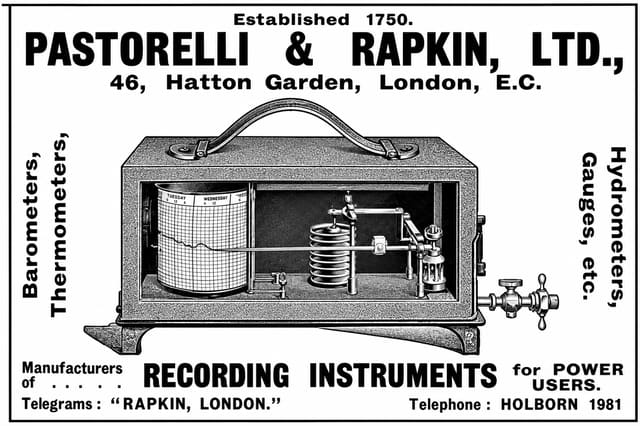
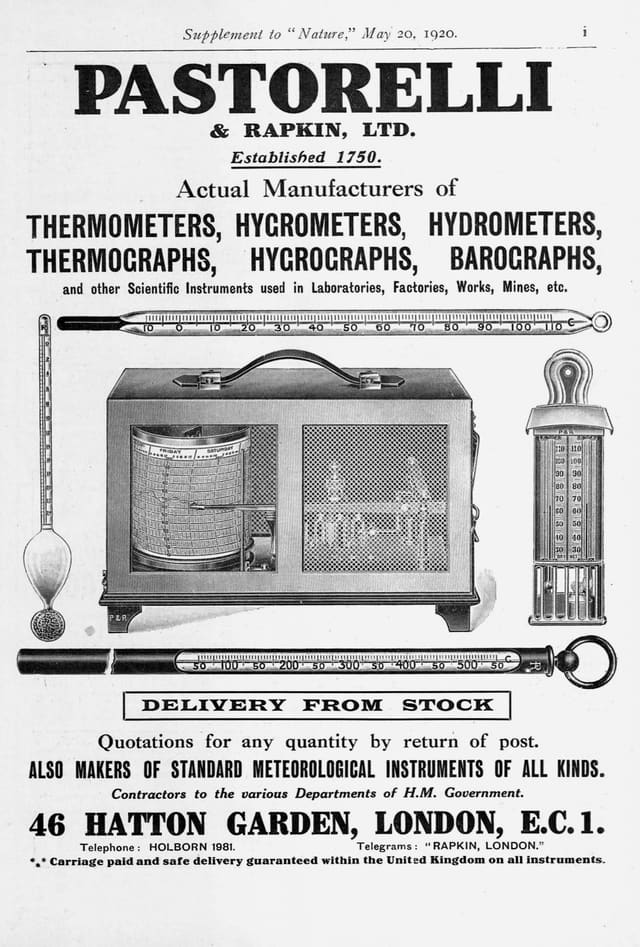
In September 1915, at the height of the First World War, the firm was advertising "Recording Instruments". Around 1920 it produced an aircraft thermograph of the "Simplex" type; the Science Museum holds this instrument together with a "Simplex" wet and dry bulb hygrograph. The firm's barographs of the early 1920s carried a paper label reading "Pastorelli and Rapkin Ltd, Meteorological and Scientific Instrument Manufacturers". The firm also made Fortin station barometers, mountain barometers and stick barometers with millibar scales.
The most detailed portrait of the firm at mid-century is given by the 1951 "Directory for the British Glass Industry":
The same directory, as well as a number of advertisements, gives "Established 1750". However, no known document confirms this date: the earliest evidence of the Pastorellis in England is the Liverpool notice of 1800. It is probably a family tradition or an advertising formula.
In 1964–1965 the firm itself presented an "Edney" paper hygrometer to the Science Museum, the gesture of a company conscious of its own history. In 1965 it left No. 46, after more than ninety years there, from 1873. In 1972 the firm was still listed in Hatton Garden; it later moved to 287 Green Lanes, Palmers Green, in north London. According to one barograph dealer, in the 1970s some instruments sold under its name were made by Casella; this has not been confirmed by documents. In 1988 Pastorelli & Rapkin Ltd was dissolved.
In the twentieth century the firm sold a large share of its products under two trade names, listed in the 1951 directory. A telling notice in Nature of 8 July 1922 describes a Pastorelli & Rapkin catalogue and states plainly that the firm offered two patterns, the Peandar and the Edney: "Two patterns are recommended—the Peandar and the Edney."
Peandar almost certainly stands for "P and R", that is, Pastorelli and Rapkin, spelt as it is pronounced. Phonetic wordplay of this kind was a common device for word marks of the period.
One of the London Post Office Directories contains a separate entry: "Edney J. M., scientific instrument maker, 46 Hatton Garden E.C." So a certain J. M. Edney, a maker of scientific instruments, was registered at exactly the address where Pastorelli & Rapkin Ltd worked for decades, 46 Hatton Garden. No other information about this person has been found, and it is more likely that the Edney mark was named after David James Reginald Edney (1875–1964), a member of staff at the Royal Observatory, Greenwich. He worked for many years in the Magnetical and Meteorological Department and later became one of the administrative heads of the Greenwich Observatory.
In 1905 he was elected a Fellow of the Royal Astronomical Society. For about twenty years Edney's professional life was directly bound up with magnetic and meteorological observation: barometric pressure, air temperature, humidity, rainfall, wind, atmospheric electricity and geomagnetic measurements. The official volume of Greenwich Magnetical and Meteorological Observations for 1909 names "David J. R. Edney — Established Computer" and explains that the routine magnetical and meteorological observations were carried out by the staff of this department.
The Edney name appeared on the "Edney Pastorelli + Rapkin Std" standard thermometer from the Cavendish Laboratory, on hair and paper hygrometers, on "Edney Dial Thermo Hygrometer" dial thermo-hygrometers and on "Edney Swing Hygrometer" sling psychrometers. The "Edney" paper hygrometer in the Science Museum is dated 1964, so the mark lasted at least six decades.
"Edney" instruments also occur signed by other firms:
This is consistent with Benson's account: after 1876 Pastorelli & Rapkin operated as a wholesale firm. It supplied finished instruments to dealers in Britain and the Dominions, who sold them under their own names while keeping the Edney mark as a sign of quality.
The history of Pastorelli & Rapkin spans almost two centuries. It begins with a Liverpool shop where, in May 1800, barometers were being sold off together with engravings and mirrors, and it ends with the dissolution of the company in 1988. It reflects the whole course of Italian instrument making in England. Craftsmen from the shores of Lake Como arrived in the country as sellers of "weather-glasses". Within two or three generations their instruments were serving the Meteorological Office, and they themselves had won a medal at an International Exhibition and a patent. The family then merged into British industry, leaving it their name.
The firm's destiny was decided in four years, from 1872 to 1876. The partnership of Francis John Pastorelli and Alfred Thomas Rapkin was brief, but it produced a name that outlived both the partnership and its founders. Francis returned to his West End trade and died in 1897. Rapkin and his successors kept the Italian name over the door for another century, and in 1894, with Alfred Pastorelli, the family itself briefly returned to the firm.
The twentieth century turned a workshop of prestige barometers into a wholesale supplier of precision instruments. Pastorelli & Rapkin standard thermometers served at the Cavendish Laboratory, and "Simplex" recorders went up in aircraft. "Edney" hygrometers, under the names of Gallenkamp, John Davis and Canadian dealers, found their way into laboratories across Britain and the Dominions. The anonymity of these later products was the other side of their success: the maker's name gave way to the brand.
| Years | Address in Liverpool |
|---|
| 1834–1837 | 28 Cable Street |
| 1839–1847 | 55 Cable Street |
| 1848–1853 | 61 Cable Street |
| 1855 | 49 Pitt Street |
| 1857–1860 | 10 South Castle Street |
| 1849–1869 | 4 Cross Street, Hatton Garden |
| 1869 | Hatton Garden |
| 1856–1878 | 208 Piccadilly |
| 1879–1880 | 10 New Bond Street |