Loading

Japanese personal names are given in the Japanese order, family name first.
July 1943. Japan has been at war with Britain and the United States for a year and a half. The City of Tokyo has just become the Tokyo Metropolis (Tōkyō-to). That month a company with a pointedly national name is founded in Ginza: 日本氣象測器株式會社 (Nihon Kisho Sokki), "Japan Meteorological Instruments".
The paperwork shows this was no casual venture. The company's address is the annex of the Hattori clock house, which at the time housed the Japanese watchmakers' associations. It is headed by Hattori's general manager. On its board sit a director of the old trading house of Tamaya and the owners of two small Tokyo workshops that had made recording instruments and meteorological apparatus for many years. Born in the middle of the war, the firm would outlive it and go on for another quarter of a century making barometers and altimeters for the shop windows of Ginza and for Japanese ships.
By the early 1940s the leading clock and watch firm in Japan was 株式会社服部時計店 (K. Hattori & Co., Ltd., the forerunner of Seiko). It was founded by Hattori Kintarō in 1881, and its clocks and watches were made in its own Seikosha (精工舎) factories. The president was Hattori Genzō; the general manager (支配人, shihainin) was Hijikata Shōgo.
The head office stood in Ginza 4-chōme. Nearby, at Ginza-nishi 4-chōme 5, was the Hattori Annex (服部別館, Hattori Bekkan). Directories of the period place at this address the Hattori Hōkōkai research foundation (財団法人服部報公会, Hattori Hokokai Foundation), the Central Clock Industry Association (中央時計工業組合, Chūō Tokei Kōgyō Kumiai) and the National Federation of Clock Industry Associations (全国時計工業組合聯合会, Zenkoku Tokei Kōgyō Kumiai Rengōkai). The annex was the headquarters of the Japanese clock trade during the war years. Hattori sold more than clocks: under its brand it sold, for example, barometers made in England by Short & Mason.
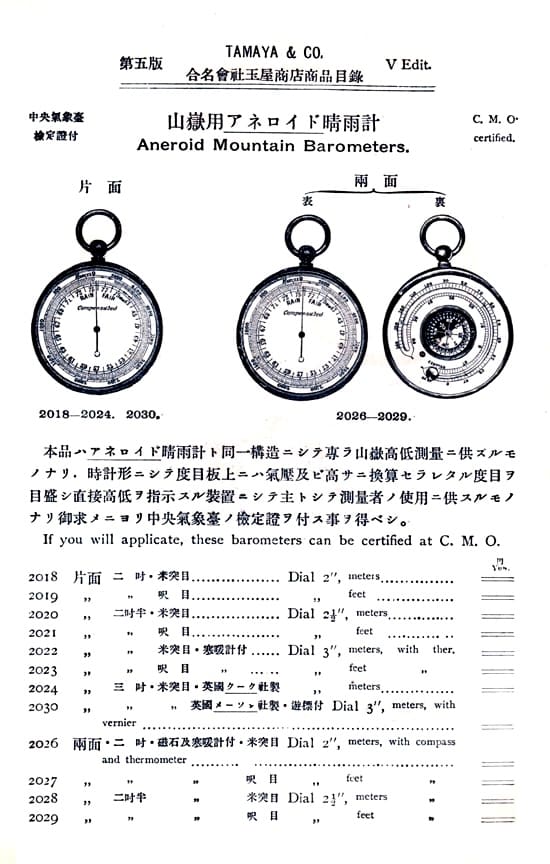
Two blocks away, at Ginza 3-chōme 2, stood the shop of 玉屋商店 (Tamaya & Co., Tamaya Shōten). A 1940 directory traces its history back to the 3rd year of Enpō (1675). At that time, according to the directory, the shop traded in precious trinkets under the Tamaya sign. Today's Tamaya Technics dates the opening of an eyeglass shop to the same year.
After the Meiji Restoration, Tamaya began importing Western clocks and watches, jewellery, and the best European and American surveying instruments. It filled orders from government offices:
In 1922 Tamaya made the first Japanese sextant, and in 1932 the firm became a joint-stock company. According to a 1941 directory, it manufactured and sold:
The staff list even included a head of an Army and Navy department. The president was Miyata Jōnosuke; the board included Miyata Kin'ichirō and Hatta Kentarō. A group of subsidiaries was forming around the shop, among them the sales company 玉屋計器販売 (Tamaya Keiki Hanbai, "Tamaya Instrument Sales", 1941). Hatta's name appears on the boards of several of them as well.
Both houses had sold European instruments for decades. But from December 1941 Britain was an enemy, and English aneroids, including the Short & Mason instruments sold under the Hattori brand, no longer reached Japan.
The workshop 羽田製作所 (Haneda Seisakusho, "Haneda Works") opened in May 1926 in Nishigahara, in Tokyo's Takinogawa ward. The 1934 national directory of factories lists two products: planimeters and clockwork for recording instruments (自記用時計, jiki-yō tokei), the drive mechanisms that turn the drums of barographs and thermographs. By 1941 the workshop is listed simply as a manufacturer of meteorological instruments (気象観測器製作). Its owner was Haneda Torizō (羽田酉造).
The workshop 昭和計器製作所 (Shōwa Keiki Seisakusho, "Showa Instrument Works") in Naka-Meguro was founded in 1936 by the Ishishio brothers from Takaoka (Toyama Prefecture), sons of Ishishio Jinkichi. The elder, Jinjirō (石鹽甚二郎, born 23 March 1885), served for almost two decades at the Imperial Fisheries Institute of the Ministry of Agriculture and Forestry (水産講習所, Suisan Kōshūjo) and rose to head of its accounts department. The younger, Tahachi (石鹽他八), was born on 19 July 1901. In 1940 the workshop produced:
Directories also list it as a maker of electrical measuring instruments. (The readings of 石鹽 as "Ishishio" and of 酉造 as "Torizō" are conventional.)
The 31st edition of the directory 『帝国銀行会社要録』 (Teikoku Ginkō Kaisha Yōroku, "Directory of Banks and Companies of the Empire"), compiled by the credit agency 帝国興信所 (Teikoku Kōshinjo, forerunner of Teikoku Databank), appeared in 1943. In its section on companies of Tokyo-to it contains the entry:
「日本氣象測器株式會社 京橋區銀座西四ノ五 設立 昭和十八年七月」 ("Nihon Kisho Sokki joint-stock company [Japan Meteorological Instruments Co., Ltd.]. Kyōbashi, Ginza-nishi 4-5. Established July of Shōwa 18 [1943].")
Share capital was 800,000 yen, fully paid up: 16,000 shares of 50 yen each. The board:
The address Ginza-nishi 4-chōme 5 is the address of the Hattori Annex. The composition of the board reads like a division of roles. Hattori supplied the head and the premises; Tamaya supplied one of its directors. Haneda and Ishishio brought what "meteorological instruments" would otherwise have lacked beyond the name: experience in making recording instruments, clockwork drives and thermometers.
The head of the new firm was a notable figure. Hijikata Shōgo was born in January 1888 in Hokkaido, the eldest son of Hijikata Sōtarō. In 1909 he graduated from the Tokyo Higher Commercial School (東京高等商業学校, today Hitotsubashi University) and went on to serve for many years as Hattori's general manager. He also sat on the boards of the trading firm 服部貿易 (Hattori Bōeki, "Hattori Trading") and several other companies, and was auditor of the Daini Seikosha (第二精工舎) factory. In 1940 the Ministry of Commerce and Industry appointed him, as Hattori's director and general manager, to its expert committee on prices for machinery and instruments. The first meeting of the clock subcommittee took place on 27 December 1940 in that same Hattori Annex. From 1941 Hijikata chaired the Tokyo Clock Wholesalers' Commercial Association (東京時計卸商業組合), whose office was also in the annex. A 1948 directory lists him as a director of Hattori.
The company was registered in Ginza, but it had its own production. In 2015 the Japan Pension Service (日本年金機構, Nihon Nenkin Kikō) published, prefecture by prefecture, lists of employers in whose Employees' Pension Insurance (厚生年金, kōsei nenkin) records there remained contributions whose owners had not been identified. Nihon Kisho Sokki appears in these lists three times:
The Kawasaki factory explains the word KANAGAWA placed beneath the company mark on some dials. The mark itself is a ring with a small circle at its centre, crossed by two parallel lines. It makes it possible to identify the company's products even when a dial carries another firm's brand.
After the war the company went on working for the same trading houses that had founded it. The kodokei website describes a wall aneroid branded TAMAYA & CO., LTD. GINZA, TOKYO. Its owner dates it to around 1955. The outer diameter is 16.7 cm. Beneath the letters TA of TAMAYA is the Nihon Kisho Sokki mark, and beneath the mark the word KANAGAWA. In the owner's view, Tamaya itself did not manufacture instruments, and this one was made to order (OEM). A version of this barometer with a thermometer is also known.
A three-inch surveying altimeter branded K. Hattori & Co., Ltd. is explicitly identified on the same website as a Nihon Kisho Sokki product. It copies the three-inch Short & Mason instrument and is close to it in size and appearance. The scale reads to 1,000 metres. Loosening a small screw at the upper left of the case lets the outer altitude ring be turned to set the zero mark. Inside is a pair of aneroid capsules, which is rare for an instrument of this size. The same altimeter was issued under the TAMAYA & CO. TOKYO brand. Its movement is the same, the case differs slightly, and in the author's estimate this example is a little older.
History took a neat turn here. Hattori had once sold English Short & Mason instruments under its own brand; now it sold a Japanese copy of them, made by a firm it had itself founded.
The company also made pocket altimeters: about 7 cm in diameter and 2.5 cm thick, with a scale to 4,500 metres.
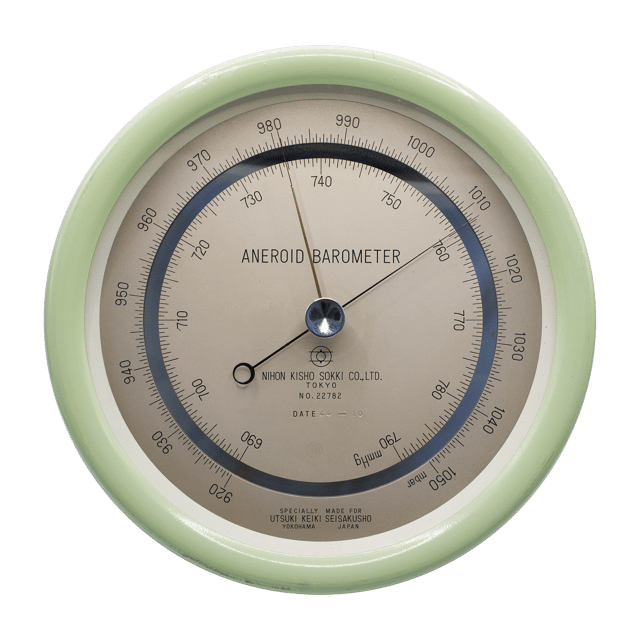
The most numerous known group of products is ship's barometers. Their dials carry a dual scale, in millibars and in millimetres of mercury. The cases come in two kinds:
The dial inscriptions are austere: ANEROID BAROMETER, NIHON KISHO SOKKI CO., LTD., TOKYO, a serial number and a DATE field. The date was punched into this field in years of the Shōwa era:
Serial numbers 21774 and 22729 have also appeared on the market. Between September 1962 and October 1969 the serial number rose by only 667. If the numbering was continuous, that is about a hundred marine barometers a year. Production was thus small, almost made to order.
The firm for which Nihon Kisho Sokki made marine barometers to order began with clocks. The founder, great-grandfather of the present owners, learned his trade at an old watch shop in Ginza and set up on his own as a watch repairer. He then mastered ships' precision mechanical timekeepers, the pinnacle of the technology of his day. The rest of the business grew out of repairing them. The firm regards 1905, the 38th year of Meiji, as its founding year (創業, sōgyō). At Utsuki, chronometers are still described as the company's roots. In a 2023 interview the firm was presented as craftsmen who had served Japanese seafaring in the Meiji era.
Legal incorporation came after the war. On 20 December 1948 the limited partnership 有限会社宇津木航海計器製作所 (Yūgen-gaisha Utsuki Kōkai Keiki Seisakusho, "Utsuki Nautical Instrument Works") was established. According to the company history, it employed just five people. This name survives in the Kanagawa Prefecture pension lists. In 1958 (Shōwa 33) the word "nautical" was dropped from the name, and the firm became 有限会社宇津木計器製作所, Utsuki Keiki Seisakusho. This is the name that appears on Nihon Kisho Sokki barometers of the 1960s. An instrument inscribed Utsuki Keiki Seisakusho therefore cannot be older than 1958. In 1973 (Shōwa 48) the partnership was converted into a joint-stock company, which later took its present name, 株式会社宇津木計器, Utsuki Keiki Co., Ltd.
Under its own brand Utsuki sold ship's inclinometers and barometers.
The firm then moved into electronics. In 1993 it developed a touch-panel remote ballast control system, fitted to coastal vessels, large merchant ships, work and special-purpose vessels, and offshore installations. Its instruments include pressure-type and air-purge level gauges, draught gauges, electronic inclinometers meeting IMO standards and ISO 19697, and water ingress alarms meeting SOLAS requirements. Later came a sales base in Shanghai and spare-parts depots in the Netherlands, China and Singapore.
According to the company itself, its instruments are installed on more than three thousand large ships, and it holds one of the largest shares of the Japanese market for marine sensors. The firm is headed by Utsuki Satoshi; its capital is 15 million yen, and it has 44 employees (as of July 2026). Its present address is Kamiyabe-chō 3530, Totsuka, Yokohama.
The story has one more detail that closes the circle. Today Utsuki Keiki is Seiko's general agent for marine quartz clocks. And Seiko grew out of that very house of Hattori whose general manager in 1943 became head of "Japan Meteorological Instruments".
The history of Nihon Kisho Sokki is the history of Ginza told through aneroids. The company appeared in July 1943, when English instruments had become unobtainable. It was founded by two old trading houses, one in clocks and one in instruments, together with two workshops that knew how to make recording instruments. It ran a factory in Kawasaki and an establishment in Niigata, and for decades worked under other firms' brands: in the windows of Hattori and Tamaya its altimeters repeated English models. In the 1960s its marine barometers, dated in Shōwa years, went to sea through a Yokohama firm that had grown out of chronometer repair. The firm to which Nihon Kisho Sokki supplied barometers eventually came to represent, at sea, the clocks of Hattori's successor, the very house that had once given it its head and its address.
Archival directories (National Diet Library of Japan, Digital Collections; located via the full-text search of the NDL Next Digital Library (次世代デジタルライブラリー))
Japan Pension Service (日本年金機構), lists of employers with records of unidentified owners, 2015
Instruments
Utsuki Keiki