Loading
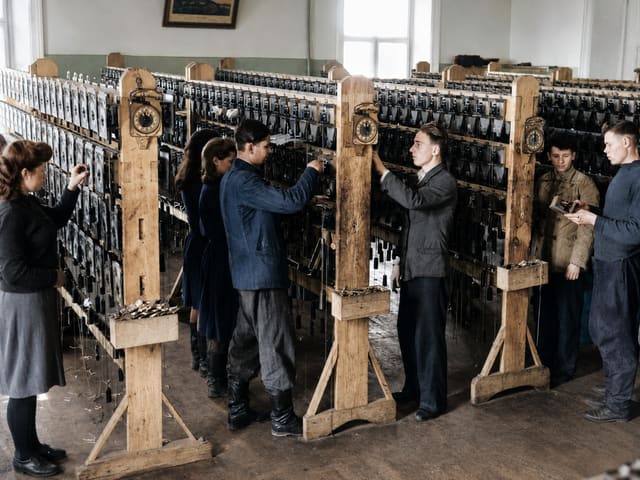
Mayak was the general trademark of the Serdobsk Clock Factory in Penza Oblast, Soviet Russia — officially Serdobsky chasovoy zavod / Сердобский часовой завод. In Soviet industrial terminology, chasovoy zavod was a broad designation covering the clock-and-watch industry as a whole, rather than a precise distinction between factories producing wristwatches and those producing clocks. In the specific case of Serdobsk, however, the English term “Clock Factory” is more accurate, since the enterprise became known primarily for large-format domestic interior clocks: weight-driven wall clocks, cuckoo clocks, balance-driven wall and table clocks, and later electro-mechanical and quartz clocks.
Mayak was both a brand name and, in practice, a model designation for a broad line of household interior clocks. Within the Soviet clock-and-watch industry, the Serdobsk Clock Factory was one of the principal manufacturers of large-format domestic timepieces. It was not a prestige watch manufactory, but rather a factory of everyday Soviet time — the kind of enterprise that placed a clock in every kitchen, hallway, school classroom, and rural home.
The history of the Serdobsk Clock Factory began at the height of the Second World War. On 17 November 1943, Order No. 404 was issued by the People’s Commissar of Mortar Armament of the USSR. It prescribed that “a factory for the production of alarm clocks and table clocks be organised in the town of Serdobsk, Penza Oblast, under the name ‘State Serdobsk Clock Factory No. 5’” — in Russian, Gosudarstvenny Serdobsky chasovoy zavod No. 5 / Государственный Сердобский часовой завод № 5. The same order set the planned capacity of the enterprise: 400,000 miniature alarm clocks and 100,000 table clocks based on the miniature alarm-clock movement per year, with production to begin in the second quarter of 1945, according to materials from ussr-watch.com and watch-wiki.org, citing the Penza Encyclopaedia of 2001.
It is worth noting that the People’s Commissariat of Mortar Armament — Narodny komissariat minomyotnogo vooruzheniya / Народный комиссариат миномётного вооружения — was, during the war, a strictly defence-related government body. Yet the Serdobsk factory, unlike most enterprises created on the basis of evacuated clock-and-watch factories, was from the outset oriented toward civilian production, as noted by the local-history portal historical-baggage.ru. Equipment evacuated from the Second Moscow Clock Factory — 2-y Moskovsky chasovoy zavod / 2-й Московский часовой завод — was allocated for the new plant.
Construction began as early as September 1943. The recollections of veterans, preserved in the factory’s own mass-circulation newspaper and later published on the local-history portal oldserdobsk.ru, convey the harshness of the circumstances. The setter S. I. Alferov recalled: “When we arrived in Serdobsk, on the site of the present factory we saw, among thickets of trees and bushes, two houses with sheds… The factory workforce then consisted of only one and a half to two dozen people.” The machine tools were warmed with blowtorches, electricity was supplied by an engine from an STZ tractor, and firewood was transported on sledges from eight kilometres away. The factory was built by soldiers’ wives and by teenagers aged thirteen to sixteen — pupils of Vocational School No. 2, Remeslennoye uchilishche No. 2 / Ремесленное училище № 2.
A direct testimony to the connection with the Moscow factory was preserved in an essay written for the fifteenth anniversary of the enterprise. The same setter, S. I. Alferov, recalled: “The workers of the Second Moscow Clock Factory were instructed to select a certain quantity of equipment necessary for starting work and to send it to Serdobsk together with thirteen specialists of various trades… This was in the spring of 1944.”
Despite the extremely difficult conditions, the first products were manufactured in 1944: weight-driven wall clocks, known in Russian as khodiki / ходики. Sources differ as to the exact number produced. The factory newspaper gives the figure of 6,481 units, according to materials prepared for the fortieth anniversary of the factory, while V. D. Mordasov, head of Shop No. 4, recalled a figure of 7,000 khodiki. In 1945, production had already reached 35,000 units. According to the chief designer V. D. Andreyev, these were “weight-driven clocks of the ‘ChG’ type, with a square case and square dial.”
The Serdobsk factory was born out of the logic of the late-war period: the state was already thinking not only about the front, but also about the post-war domestic market, where household timekeeping was to become almost as important a component of “peaceful life” as shoes or tableware.
Post-War Consolidation, 1945–1955
After the war, the factory rapidly expanded its product range. In 1947, it mastered production of the Extra weight-driven wall clock, with an improved movement, a metal case, and a round dial. That year, 315 khodiki and 2,000 striking clocks made from the factory’s own components reached the retail market. In 1952, the factory began mastering the assembly of wall clocks of the “MCh” type, and in 1952–1954 it also assembled Zvezda wristwatches and “NCh-9” table clocks from components supplied through inter-factory cooperation.
Over seven years, from 1948 to 1955, the main factory building was constructed, housing Shops Nos. 1, 2, 4, 5, 7, and 8, along with a boiler house, a diesel power station, warehouses, a stadium, a nursery, a kindergarten, a canteen, six eight-apartment residential buildings, and a workers’ dormitory. By 1954, the factory already had eight shops. In the same year, 1954, it mastered an original type of khodiki with moving eyes on a painted cat, as well as the children’s construction toy Young Clockmaker — Yuny chasovshchik / Юный часовщик — a set of assemblies and parts from which a schoolchild could put together a functioning timekeeping device.
The Birth of a Legend: The Cuckoo Clock, 1950–1955
The idea of producing a cuckoo clock arose almost anecdotally. The factory’s first director, I. S. Belyakov, who at the time headed NIIchasProm — Nauchno-issledovatelsky institut chasovoy promyshlennosti / НИИчаспром, the Scientific Research Institute of the Clock-and-Watch Industry — recalled how, shortly after the war, Minister P. I. Parshin showed a unique clock at a meeting. It had been a gift from relatives of the traveller Miklouho-Maclay and took the form of a birdcage with a mechanical nightingale. A discussion began about whether something similar could be mass-produced, and Parshin suggested launching the production of clocks “with a cuckoo”. Belyakov remembered that the institute had Swiss examples and proposed that they be developed for production in Serdobsk.
In May 1950, the factory received an assignment from GlavchasProm — Glavnoye upravleniye chasovoy promyshlennosti / Главчаспром, the Main Administration of the Clock-and-Watch Industry — to master the production of wall clocks with a cuckoo and strike. The designers A. V. Yudin, P. K. Mochalin, M. K. Tomashevsky, A. N. Volodin, and E. G. Kolesnikova, under the leadership of K. I. Kitayev, head of the technical department, used the khodiki movement as their basis. On 3 November 1950, a certificate was drawn up for the production of an experimental batch of fifteen cuckoo clocks. In 1954, the first pilot batches of the striking clock “12-ChG” and the striking cuckoo clock “11-ChG” were produced. A decisive role was played by a new lever system proposed in 1955 by the designer V. D. Andreyev: stamped sheet-steel levers replaced wire levers, after which mass production could be properly organised. It is 1955 that is regarded as the beginning of mass production of the Serdobsk cuckoo clock.
The abbreviation “ChG” or “ЧГ” stood for chasy girevye / часы гиревые — weight-driven clocks. The number preceding it denoted the specific model. Thus, 11-ChG referred to a weight-driven striking cuckoo clock; 12-ChG to a weight-driven pendulum wall clock with strike, produced according to TU 14-154-56; 13-ChG to a children’s clock introduced in 1954; and 21-ChG, 25-ChG, and 33-ChG to later cuckoo-clock models, including those of the 1970s.
The Period of Expansion: The Mayak Brand, Balance Clocks, and Electronic Clocks, 1957–1985
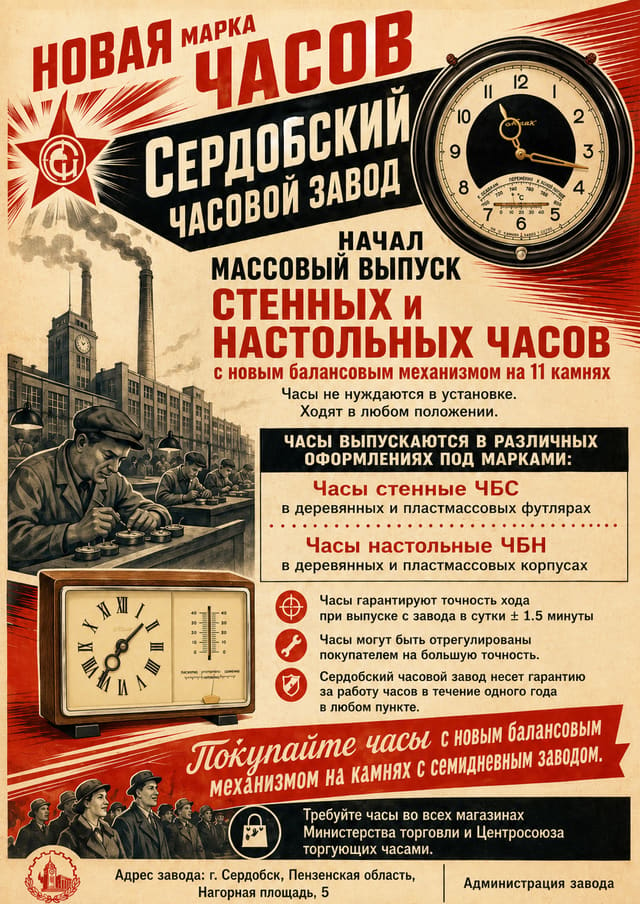
From 1955 to 1977, the factory was headed by Viktor Dmitrievich Besov, one of its most effective organisers and a holder of the Orders of the Red Banner of Labour and the Badge of Honour. Under his leadership, the enterprise reached maturity. From 1957, according to a new design scheme developed by NIIchasProm, the factory began mastering fundamentally new balance-driven clocks with a seven-day power reserve and an auxiliary lever escapement on eleven ruby jewels: table clocks, designated ChBN, and wall clocks, designated ChBS. The auxiliary escapement units were supplied by the Chistopol Clock-and-Watch Factory — Chistopolsky chasovoy zavod / Чистопольский часовой завод.
In 1964, the Mayak trademark appeared, under which the factory’s interior clocks were marketed. The name was typical of Soviet household branding: short, euphonious, and free of negative associations.
In 1963, the factory became the first enterprise in the Soviet clock-and-watch industry to begin developing wall and table electro-mechanical clocks. The first 100 units were assembled by the end of 1965, and until 1988 they were produced in quantities of 500,000 to 600,000 units per year. In 1969, the more reliable electronic movement 59186 was mastered, followed later by the 65181 movement. In 1983, the factory began producing quartz clocks with a stepper motor. In 1981, a new assembly building of 10,000 square metres was commissioned, housing Shops Nos. 5 and 13.
The factory also developed a broad social infrastructure. In 1958, a House of Culture with 420 seats was built. The enterprise operated a Young Pioneer camp, a tourist base, a ski base, and the Trud stadium. The factory published its own mass-circulation newspaper, first titled Chasovshchik — “The Clockmaker” — and later Znamya truda — “Banner of Labour”. An evening department of the Penza Mechanical Engineering Technical School operated at the factory; its first graduation took place in 1959.
Production Records and Export
The figures are impressive. In 1973, the 77-millionth clock was assembled. In 1975, clocks from Serdobsk were sold in forty-four countries, including the United States, Canada, Sweden, Brazil, Mexico, Mongolia, as well as countries in Australia and Africa. Between 1971 and 1975, the factory exported 1,311,000 clocks, 62 percent of which were cuckoo clocks. In 1981, the 100-millionth clock came off the production line. By 1993, total production of cuckoo clocks had reached 15 million units, of which more than one million had been exported.
The cumulative figures for the factory’s first fifty years, published in the factory newspaper Znamya truda, No. 34 of 20 September 1993, were as follows: 19,540 Zvezda wristwatches; 72,107,496 weight-driven clocks, including Young Clockmaker sets; 15,425,367 cuckoo clocks; 32,867,396 balance-driven clocks; 8,062,670 electronic clocks; and 9,950,300 quartz clocks — a total of 138,432,778 timekeeping devices. Over forty years, by 1983, the factory had generated 80.2 million roubles in profit, paying for itself seven times over.
The factory also received official distinctions. In 1978, one model of weight-driven cuckoo clock was awarded the state Quality Mark — Znak kachestva / Знак качества — and in 1980 the Quality Mark was awarded to the Shalash cuckoo clock. Its creators were the artist-designer E. N. Lyulyakina and the designers G. V. Panova and G. P. Yemelyanova. Shalash was selected for the international exhibition Design — USSR in India in 1981 and was also exhibited at a trade fair in Czechoslovakia. The labour of the Serdobsk workers was recognised with high state awards: two factory employees became holders of the Order of Lenin, three received the Order of the October Revolution, twenty-one the Order of the Red Banner of Labour, and thirty-eight the Order of the Badge of Honour.
In 1963, on the factory’s twentieth anniversary, a congratulatory telegram was sent by the first cosmonaut, Yuri Gagarin. According to the E. D. Felitsyn Krasnodar Museum, “the first cosmonaut Yuri Gagarin left his autograph and a note of gratitude for the director of the Mayak factory. In the cosmonaut’s office, now a museum, there is a clock on the desk bearing the proud inscription Serdobsk Clock Factory.”
The Mayak Brand
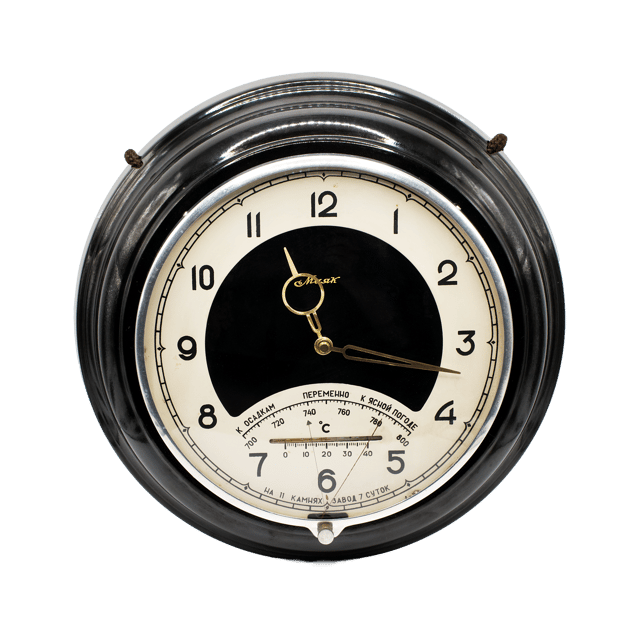
Under the Mayak brand, the Serdobsk factory produced a wide range of domestic interior clocks. The main categories were as follows.
The khodiki, designated ChKh, were simple weight-driven pendulum wall clocks with a recoil anchor escapement, produced according to GOST 720-41 and GOST 720-50. Their running duration from a fully raised weight was not less than twenty-six hours, with an accuracy of ±3 minutes per day. The movement had a calibre of 93 mm, the chain was made of steel, and the weights were made of cast iron. Their dials were decorated with various subjects, including the well-known khodiki with the moving eyes of a cat.
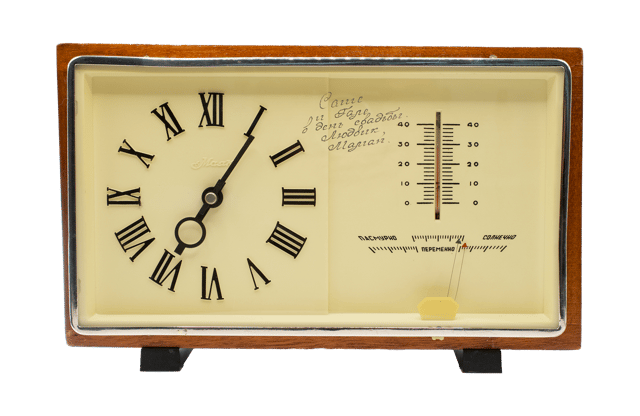
The balance-driven wall clocks, ChBS, and balance-driven table clocks, ChBN, appeared from 1957–1958 onwards. They used a balance mechanism with an auxiliary lever escapement on eleven ruby jewels, had a seven-day power reserve, and guaranteed an accuracy of ±1.5 minutes per day, later improved to ±1 minute. The table models included 263-ChBN, 266-ChBN, 266-ChBN/1 with Roman numerals, 268-ChBN, 269-ChBN, 270-ChBN and 271-ChBN Kristall, 272-ChBN Serdobsk, 274-ChBN Rubin, and 275-ChBN Rossiya. The wall models included 85-ChBS, 86-ChBS in anodised aluminium, 87-ChBS in pressed wood particles, 88-ChBS, 89-ChBS, 91-ChBS, 93-ChBS, 94-ChBS, 95-ChBS, and 96-ChBS.
The striking and cuckoo clocks belonged to the ChG category. These included 11-ChG, with strike and cuckoo; 12-ChG and 20-ChG, with strike; and the later 21-ChG, 25-ChG, and 33-ChG. The case was a wooden teremok or shalash type, with carved decoration; the weights were shaped like fir or pine cones and suspended on a steel chain. The sound was produced by two whistles with paper bellows forcing air through them, and the cuckoo appeared every half-hour. The famous Shalash model received the Soviet Quality Mark.
The case variants were also diverse. Mayak table clocks were produced in wooden, usually beech, plastic, stone, and crystal cases. Crystal and stone models were often commissioned as presentation pieces, with engraving on the chromed rear cover. A representative example is the export crystal table clock Mayak of 1965, a second-class accuracy clock produced according to GOST 3309-65, with a seven-day power reserve. Its retail price in 1965 was about 28 roubles — roughly one third of an average monthly Soviet salary.
The electro-mechanical and quartz Mayak clocks formed the later stage of the brand’s development. From 1965, the factory produced wall electro-mechanical clocks, and from 1983 quartz clocks with a stepper motor.
An important distinction must be made regarding wristwatches. Although Wikipedia and a number of websites state that wristwatches were also produced in Serdobsk under the Mayak brand, primary factory sources do not confirm this. The Serdobsk wristwatches were produced only under the Zvezda brand and only through inter-factory cooperation. They were women’s wristwatches with fifteen ruby jewels, in case designs 18K and 153K, with a total production of only 19,540 units over the factory’s entire history. Wristwatches bearing the Mayak name — for example, the calibre 2603 shock-resistant version of the Pobeda — were products of the Petrodvorets Watch Factory and the First Moscow Watch Factory. This was a namesake brand, discontinued around 1962 when Petrodvorets shifted to the Raketa trademark. Thus, Serdobsk Mayak should be understood exclusively as a brand of interior clocks.
Perestroika, Privatisation, and Decline, 1987–2004
From 1 January 1987, the factory switched to full khozraschyot — economic accountability — and self-financing. In 1990, it became a joint-stock enterprise and joined the joint-stock company ChasProm. In 1992, the first shareholders’ conference was held. The last notable production milestone was the 14-millionth cuckoo clock, produced in 1992.
The 1990s, however, proved catastrophic. By the late 1990s and early 2000s, wage arrears had begun, and workers were later paid in the factory’s own products. In June 2001, the resonant article “The Extinguished Light of the Native Mayak” — Potukhshy svet rodnogo “Mayaka” / «Потухший свет родного „Маяка“» — reported that “wall clocks of the Mayak trademark were disappearing in entire batches.” The closed joint-stock company ZAO Serdobsky Chasovoy Zavod — ЗАО «Сердобский часовой завод», CJSC Serdobsk Clock Factory — was liquidated in 2004. It was then that the factory “released the last cuckoo from its long-inhabited nest and closed forever.” Bankruptcy administration was carried out by V. M. Druzhinin from 15 November 2002.
What Remains on the Factory Site Today, 2004–2026
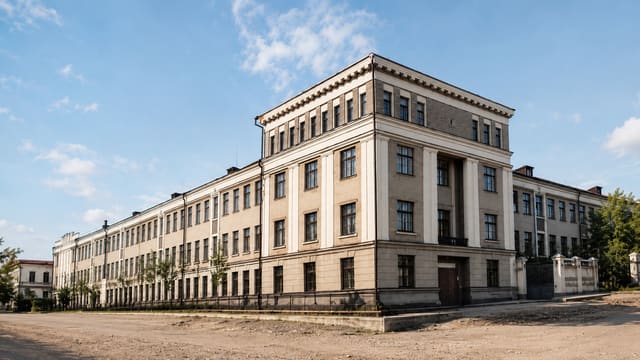
After liquidation, the territory was sold off. A shopping centre named Mayak was opened in the former production buildings; the factory administration building came to house a business incubator, as well as a number of organisations of various profiles. The factory House of Culture, one of the most beautiful buildings in the town, now stands abandoned.
An attempt at revival was made in 2012. In the Serdobsk business incubator, an investor from Samara launched the production of striking clocks, but only a few batches were made, using entirely Chinese “innards”, and the project failed. According to the Ministry of Economic Development and Industry of Penza Oblast, wall striking clocks are no longer produced in the region today.
The memory of the cuckoo clock, however, remains alive. Stylised cuckoo clocks are mounted on the façade of the Serdobsk railway station, built in 1986. In 2019, on the initiative of the public organisation Naslediye — “Heritage” — a stele dedicated to the cuckoo clock was unveiled in the centre of the town. In December 2023, for the eightieth anniversary of the factory, a memorial stand was installed near the former workshops, initiated by the factory veteran Vera Krasnova and the editorial staff of the newspaper Serdobskiye novosti, as part of the project The Cuckoo’s Nest — Gnezdo kukushki / «Гнездо кукушки».
Sources: