Loading
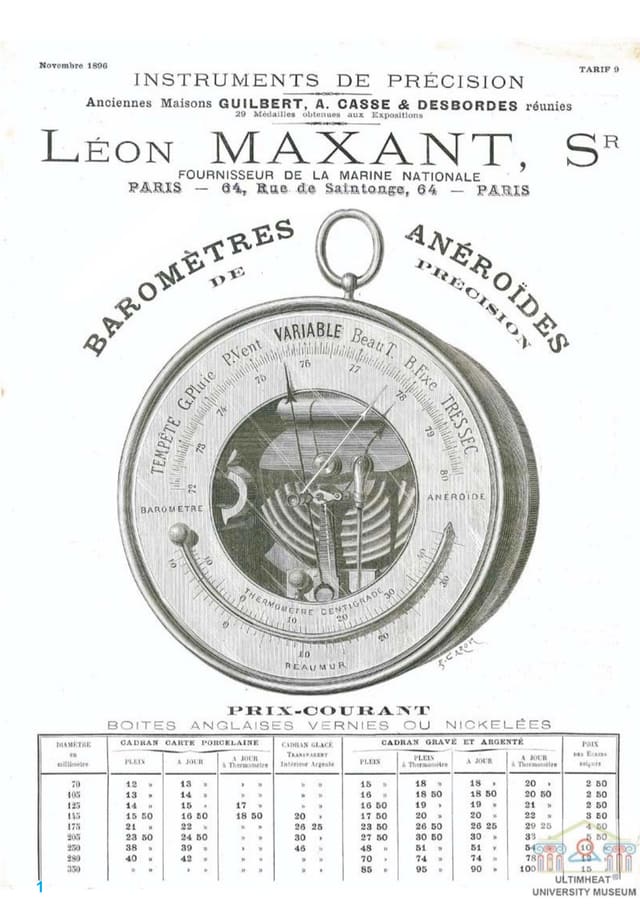
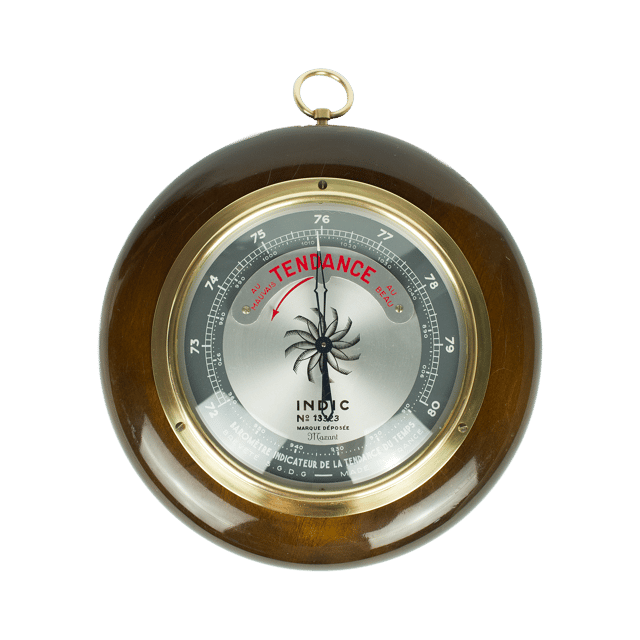
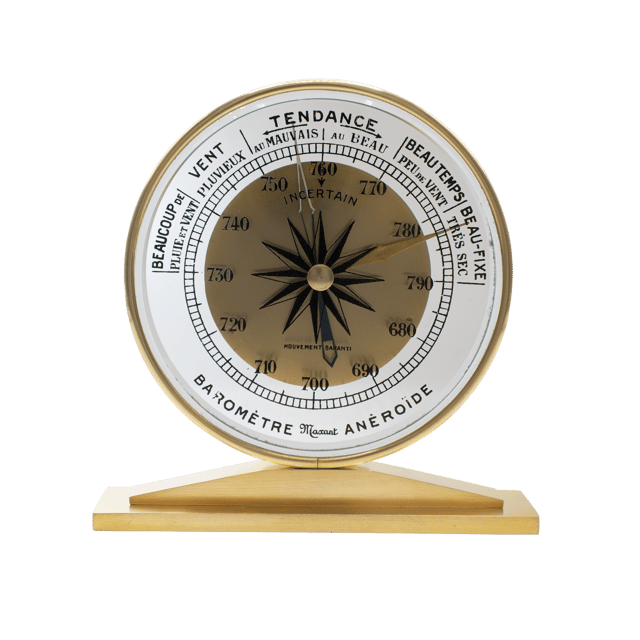
The history of Maxant is the story of a Parisian house of precision instruments that grew out of the watchmaking practice of Léon Maxant and gradually transformed into a true “consortium of traditions” through the absorption of older French makers of measuring instruments—first Desbordes, and later Alfred Casse and Rédier.
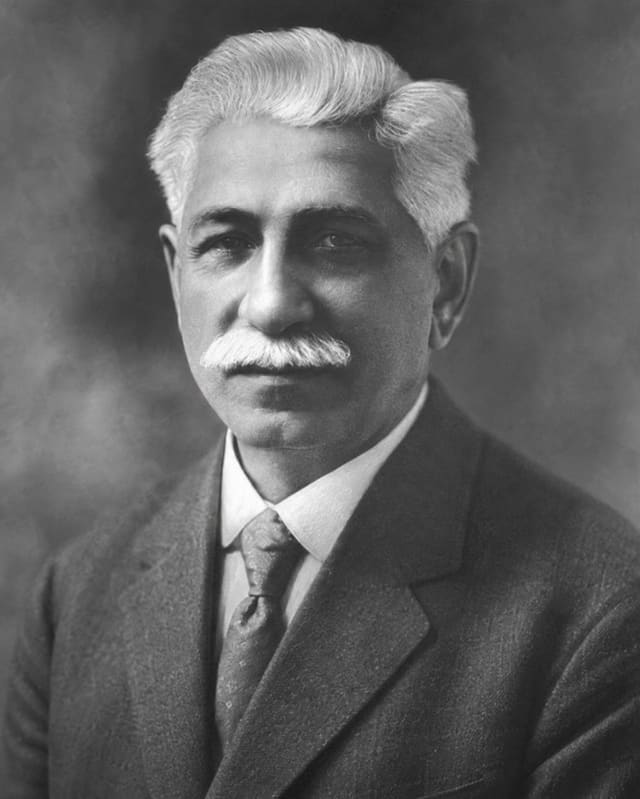
Léon-Charles Maxant (1856–1936) began his career in 1879 with the production of watch movements. In 1887, he acquired Maison Desbordes, a long-established firm founded in 1824, which had been located at 20 Rue Saint Pierre Popincourt until 1865 and subsequently at 26 Rue des Fossés du Temple. This house is well documented in primary sources: in INPI/FranceArchives patent records, Desbordes appears explicitly as a manufacturer of instruments. Its successive relocations are also recorded in nineteenth-century scientific and technical publications, including industrial bulletins and directories.
Desbordes produced physical, mathematical, optical, and nautical instruments, as well as manometers for steam engines. This specialization was directly shaped by legislation introduced a year earlier, which made the installation of manometers mandatory on all high-pressure steam engines. In addition, the firm manufactured metallic barometers, thermometers, dynamometers, and pyrometers. In 1877, production was relocated to 64 Rue de Saintonge. In 1890, the company merged with Guibert — A. Casse & Cie, which was subsequently also absorbed by Léon Maxant.
Maxant clearly capitalized on the prestige of the Desbordes acquisition, which provided his entry into the mature market of pressure and control instruments. He continued operations under the name: Instruments de Précision Léon Maxant Sr. — 64 Rue de Saintonge — Paris.
From this point onward, the sequence of acquisitions becomes clearly datable and is corroborated by independent museum and inventory sources. In 1902, Maxant acquired the firm Alfred Casse, noted as a specialist in aneroid barometers. In 1905, he purchased the company Antoine Rédier from its then-owners. This latter acquisition is particularly significant: Rédier was not merely another barometer maker, but represented a distinct school of recording instruments. Regional inventory descriptions emphasize that Rédier developed a line of self-recording devices and employed a specific combination of weights and gearing (a “train différentiel”). After Rédier’s death, the business passed through several hands; in 1904 it was absorbed by Grivolas, and in 1905 it came under Maxant’s control.
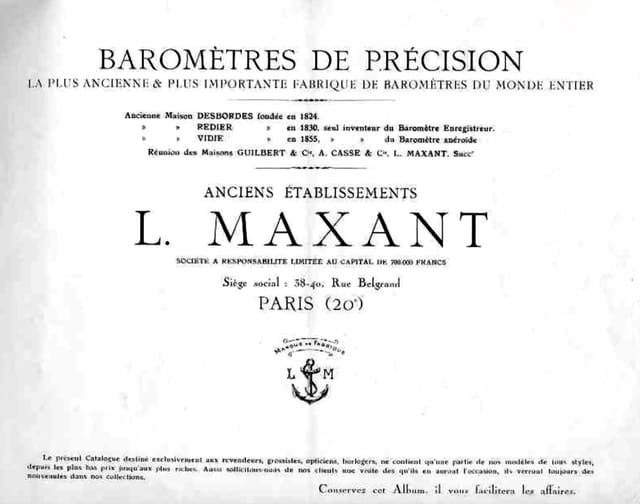
It is precisely this sequence of acquisitions between 1902 and 1905 that explains why company catalogues, trade cards, and title pages (including those you provided) consistently emphasize the formula “anciennes maisons … réunies.” The brand was consciously constructing a narrative of continuity—manometric (Desbordes), aneroid (Casse), and recording (Rédier).
By the 1920s, the firm operated under the name: Instruments de Précision et de Contrôle, Léon Maxant Successeur — 38 + 40 Rue Belgrand — Paris.
A contemporary company catalogue summarized this lineage explicitly as:
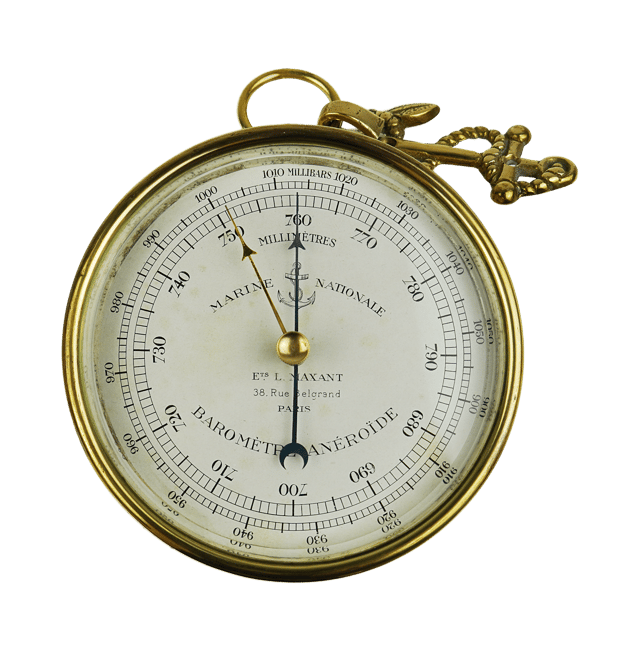
Anciens Établissements L. MAXANT Successeurs des Maisons Guilbert & Co, A. Casse & Desbordes, Vidie & Redier réunies.
In doing so, Maxant set a notably high bar by including Lucien Vidie among its predecessors, thereby aligning itself symbolically with one of the foundational figures of aneroid barometry.
In documented references and museum annotations, Léon Maxant is described as a watchmaker and instrument manufacturer who began as an independent producer of timepieces before expanding into “precision instruments” and pressure-measuring devices. In late nineteenth-century Paris, the professions of watchmaker and instrument mechanic were not separate but formed adjacent artisanal ecosystems. This proximity explains how Maxant was able to transition naturally from clockwork mechanisms to the mechanics of recording instruments and the delicate elastic systems of barometers and manometers. The market increasingly demanded devices that did not merely indicate a value but recorded it over time—self-recording instruments—which would become one of the defining signatures of the firm.
The clearest way to understand how the company saw itself is to examine its representation in official exhibition catalogues. In the Catalogue général officiel of the Brussels exhibition of 1897, Maxant is listed as a participant from Paris at 64 Rue de Saintonge, with a product range that reads almost like a manifesto: barometers, dynamometers, manometers, thermometers, and “enregistreurs” (recording instruments). This is significant: as early as 1897, recording technology was publicly presented as a standard component of the firm’s output.
By 1908, the company’s exhibition presence had expanded geographically. In the catalogue of the French section of the Franco-British Exhibition (London, 1908), Maxant appears with the address 38 Rue Belgrand and is described as a manufacturer of barometers, dynamometers, and thermometers. This confirms that by that time Rue Belgrand had become an official commercial and exhibition address, not merely an internal branch.
The same exhibition is reflected in official reports and award lists, where Maxant is mentioned among the recipients of gold medals. Even without detailed attribution to specific instruments, this establishes the firm’s high level of recognition in an international context at the turn of the century.
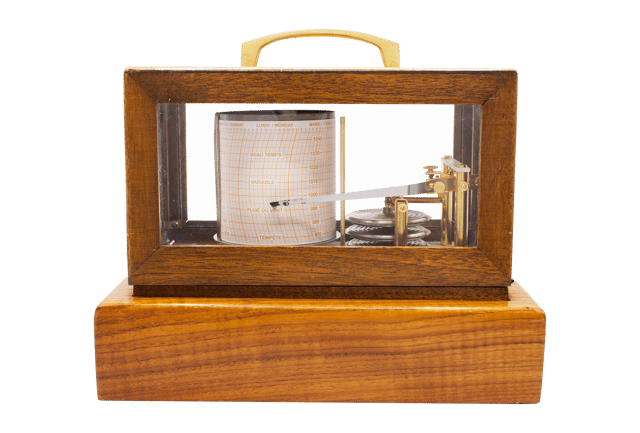
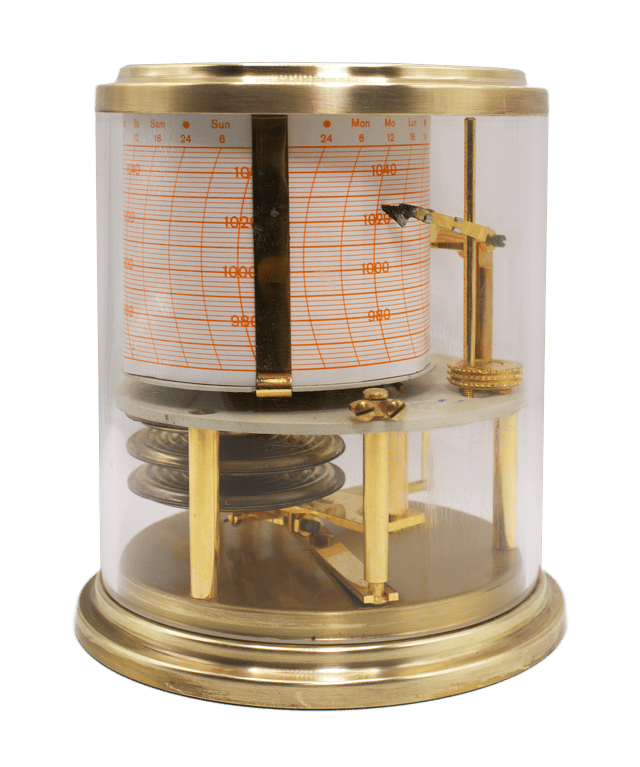
As for production during its mature period, independent regional inventories consistently describe a broad range: barometers, barographs, manometers, as well as recording instruments and various associated measuring devices (thermometers, thermographs, laboratory instruments, and more).
Léon Maxant died in 1936, but his death did not interrupt the continuity of the firm. Independent archival sources explicitly record that the company was then managed by his sons:
Bernard Maxant (d. 2009), the founder’s grandson, later served as General Director of MAXANT S.A. until 1986. The firm’s internal historical memory was subsequently formalized in his publication Le petit Maxant illustré. L’histoire du baromètre (2000), described as an illustrated history of the barometer and of French manufacturers.
For a long time, the company retained a distinctly Parisian identity, both in its addresses and its institutional presence. Only decades later does Montreuil appear as an industrial location. A methodological document on the preservation of collections and the measurement of temperature and humidity (editorially dated to the end of 1981) lists “Établissements MAXANT, 41 avenue Émile Zola, 93100 Montreuil” among suppliers of recording thermo-hygrometers. This indicates that by the early 1980s, the firm was already operating under a Montreuil address. Commercial registries confirm the same address (sometimes listed as 41 rue Émile Zola), along with SIRET identifiers; however, for historical dating, the independent 1981 reference remains the most reliable anchor.
The formal transition into a new corporate phase is clearly dated: regional inventories and the French state platform POP indicate that the company was acquired by Jules Richard Industries in 1999, leading to the emergence of the JRI Maxant structure. This marks a fitting conclusion to the “classical” narrative of Maxant as an independent house—from a watchmaker in 1879 to integration into a major instrument group at the end of the twentieth century.
In the twenty-first century, the name JRI Maxant continues to appear in the market, particularly in the field of recording instruments and environmental monitoring. This represents not so much a continuation of the collectible legacy as an industrial “second life” of the brand.