Loading
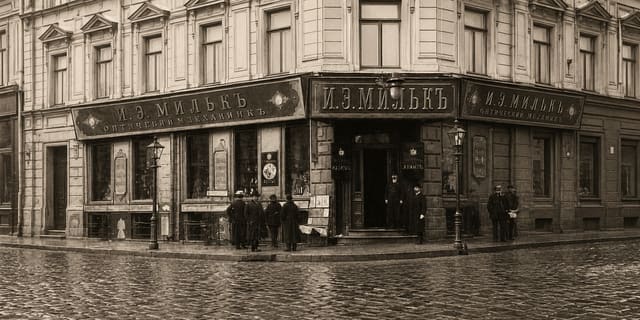
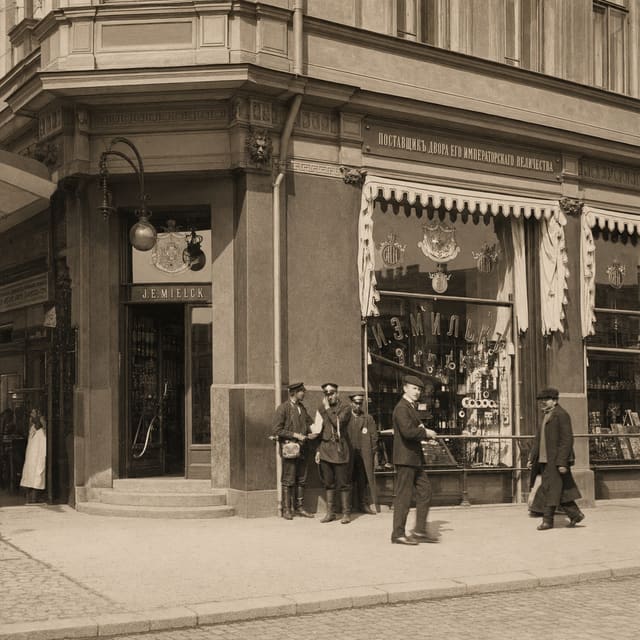
Had you walked down Bolshaya Morskaya Street in St. Petersburg in the late nineteenth century — past the banks, the jewellers and the insurance houses, along the most respectable commercial artery of the empire — you would surely have noticed, at number 35, a shop window crowded with objects in which metal and glass met in an almost jeweller’s union: binoculars and lorgnettes, microscopes and cases of drawing instruments, thermometers in enamel mounts and round brass barometers with snow-white dials. Above the entrance hung a name that had a German ring to it but had long since become Petersburgian — И.Э. Мильк (J.E. Mielck). Under this mark, for more than seventy years, worked one of the most renowned optical firms of the Russian Empire — a family enterprise spanning three generations, which rose to the rank of Purveyor to the Imperial Court and vanished together with the world that had given it birth.
The Lens Grinder
It all began in 1840, when a thirty-three-year-old German optician and mechanic, Johann Emil Mielck, arrived in St. Petersburg — in Russia he would become Ivan Ivanovich Mielck. Little is known of his early years: born in 1807, he learned the optical and mechanical trades in Germany. The surname Mielck is well known in northern Germany — in Hamburg and Lübeck it belonged to apothecaries, scholars and merchants — and although no direct documentary thread has been found linking the Petersburg optician to the Hanseatic Mielcks, the family’s North German origin is beyond doubt: Ivan Ivanovich’s sons were registered as Holstein and Prussian subjects, and the family itself belonged to the Lutheran community of St. Petersburg — that very “German Petersburg” which gave Russia its apothecaries, physicians, engineers and precision mechanics.
Mielck began with what he did best: he opened a workshop for grinding optical glass. The business took hold. In 1849, at the Manufactures Exhibition in St. Petersburg, his work was awarded a small silver medal — serious recognition for a workshop not yet ten years old. In 1859 Mielck expanded production, adding a mechanical workshop alongside the grinding shop: here they made metal instruments, small machines, locksmith’s tools and plumbing fittings. By 1861 he employed some twenty people — by the standards of the precision-instrument trade of the day, this was no longer a workshop but a small factory. The social ladder was working as it should: in 1860 Mielck enrolled as a merchant of the third guild (that is, he formally entered the merchant estate by paying an annual fee for the right to trade; the third guild was the lowest of the three, meant for small retail trade), and a year later he moved up to the second (for larger commerce, including wholesale), while the Manufactures Exhibition of 1861 honoured him with public commendation.
Mielck died in 1866, having accomplished the essential thing: he had turned a craft into a firm, and his own name into a brand. The initials “И.Э.”or “J.E.” would remain on the sign to the very end.
The Family Partnership
The business passed to the eldest son — Fyodor Ivanovich Mielck, christened Friedrich Wilhelm Bernhard, born in 1839, before the family’s move to Russia. A Holstein subject, he would take Russian citizenship only in 1873, yet he had already become a St. Petersburg merchant of the second guild in 1867. Fyodor proved to be not merely an heir but a true builder: in 1869, together with his younger brother Adolf — Adolf Emil Casimir, born in 1848 — and his brother-in-law, the Hesse-Darmstadt subject Maximilian Bergsträsser, he founded the trading house “J.E. Mielck” as a general partnership, with a pooled capital of twenty-eight thousand roubles. The family character of the enterprise was secured in law: two brothers and a brother-in-law, three German surnames under one Russian sign.
It was under Fyodor Ivanovich that the firm acquired the form in which Petersburg would remember it. The main shop established itself at Bolshaya Morskaya 35; later a branch opened on Nevsky Prospect 46 — in the shop windows captured by pre-revolutionary photographers crowded spectacles and pince-nez, lorgnettes and binoculars “of every system,” microscopes, barometers, thermometers, drawing instruments, instruments for examining the eyes, and apothecary’s and commercial scales with their weights. The firm was at once a manufacturer and a trader: its own grinding and mechanical workshop stood side by side with a broad import trade. Like all the great optical houses of Europe in that age, Mielck did not hesitate to put its own name on others’ mechanisms — this was a common and entirely respectable practice. The customer paid not for Mielck having turned every cog himself, but for the firm vouching, with its name, for the quality of the instrument. In just the same way the German master Georg Heinrich Sichler cast apothecary’s weights for Mielck, on which, beside his own stamp, stood the words “J.E. Mielck, St. Petersburg.”
The reputation grew. In 1870 Fyodor Ivanovich made spectacles and lorgnettes for the Empress Maria Alexandrovna, and in 1877 for Alexander II himself. From 1873 the firm served as commission agent to the St. Petersburg Eye Infirmary — that is, the official supplier of spectacles and ophthalmic instruments to the capital’s largest eye institution. In 1882 the Mielcks stepped into Moscow: the branch on Bolshaya Dmitrovka 13, at the corner of Stoleshnikov Lane, was led by the younger brother Adolf, and the Moscow shop soon became commission agent to Moscow University. A branch opened in Odessa as well. The Moscow shop acquired a legend of its own: it was said that here Anton Chekhov ordered his pince-nez — and even if this is folklore, it captures the firm’s standing precisely: all of reading Russia had its eyes fitted at Mielck’s.
The 1890s brought international recognition: the firm’s wares won awards at exhibitions, including the World’s Columbian Exposition in Chicago in 1893 and the All-Russian Industrial and Art Exhibition in Nizhny Novgorod in 1896. Fyodor Ivanovich, meanwhile, was building another reputation — that of a philanthropist: an honorary member of the committee of the St. Petersburg Eye Infirmary and of the Prince Peter of Oldenburg Asylum, he received in 1889 the title of personal, and in 1896 of hereditary, honorary citizen. For the grandson of a German lens-grinder, this was the summit of the social ladder available to a merchant. And in 1902 came the commercial summit too: the firm “J.E. Mielck” was granted the title of Purveyor to the Imperial Court. On its papers and signs appeared the double-headed eagle and a title in which few could take pride: “Optician to the Court of His Majesty and of Her Royal Majesty the Queen of the Hellenes.”
The Third Generation and the First Crack
The drama came from within. In 1906 the St. Petersburg Orphans’ Court restricted Fyodor Ivanovich’s legal capacity: the sixty-seven-year-old head of the firm had developed senile dementia. The man who had spent half a century building the business was no longer capable of running it. The family responded swiftly and in a businesslike way: Fyodor’s son, Fyodor Fyodorovich Mielck — christened Friedrich Albrecht Joseph, born in 1883 — together with his uncle Adolf and Nikolai Maximilianovich Bergsträsser, son of that same co-founding brother-in-law, reorganised the firm into a share partnership under the old name, with a pooled capital of thirty thousand roubles. The sign did not so much as flicker; behind it, a generation had changed.
But the family enterprise did not remain united for long. In 1910 Adolf Ivanovich, who had governed the Moscow branch for nearly three decades, withdrew from the partnership and, together with his son Georgy, founded his own trading house in Moscow — “A.I. Mielck and Son,” with a capital of twenty-five thousand roubles. The Mielck empire split into a Petersburg and a Moscow branch. The remaining co-owners — the twenty-seven-year-old Fyodor Fyodorovich and Nikolai Bergsträsser — re-registered the Petersburg firm in their own names in 1911 and raised the capital to forty thousand roubles. The young generation clearly intended to work in earnest, and for the long haul.
The Climax: the City Changes Its Name
History granted them six more years. First came August 1914: war with Germany, and St. Petersburg, in a surge of patriotism, became Petrograd. For a firm with a German surname on its sign, with co-owners whose fathers and grandfathers had been Holstein, Prussian and Hessian subjects, uneasy times had arrived: a wave of anti-German feeling swept the country, and in 1915 in Moscow it erupted into the wrecking of German shops and offices. The very words “St. Pétersbourg” on the dials had turned into an anachronism — a city by that name no longer existed.
And then came 1917, and on it the documentary trail of the Mielck family breaks off. The archival sources that follow the fates of Adolf Ivanovich and Fyodor Fyodorovich end in the same blank formula: “after 1917.” No direct act of the firm’s liquidation or nationalisation has been found — but, in truth, none is needed. In 1918–1920 the Soviet authorities nationalised private trade and industry wholesale; private optical houses that had supplied the imperial court could not, by definition, exist in the new country. The shop on Bolshaya Morskaya, the branch on Nevsky, the Moscow and Odessa premises — all of it vanished together with the estate to which it belonged. Whether the Mielcks fled to Germany, back to their roots, dissolved into Petrograd, or shared the fate of those who could not flee — we do not know. We know only that after the revolution the firm “J.E. Mielck” was no more — not in the directories, not in the address books, nowhere.
Epilogue
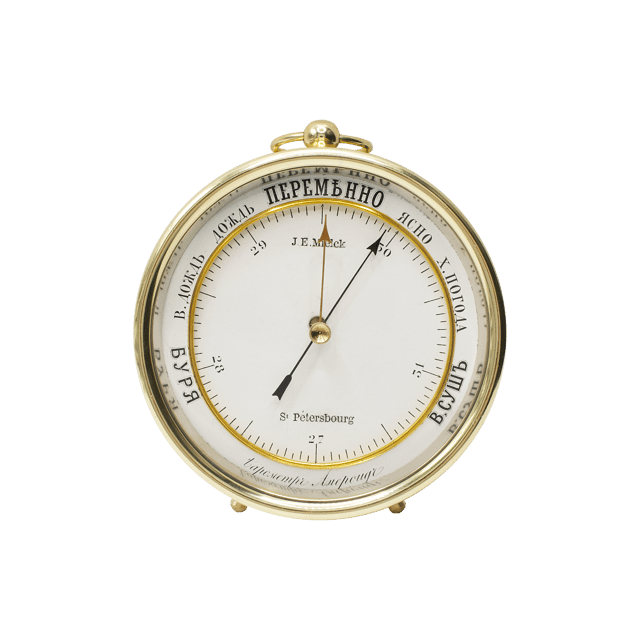
And yet the mark outlived its owners — in a way they could scarcely have imagined. Brass barometers with their pre-reform orthography on the scale, thermometers in enamel, binoculars engraved J.E. Mielck Opticien still surface at auctions and stand on museum shelves, dutifully showing the pressure and bringing the distant near. Each such instrument is a small surviving shard of that very shop window on Bolshaya Morskaya: eighty years of family labour, three generations, two capitals, the small silver medal of 1849, the double-headed eagle of 1902 — and a needle still trembling between Storm and Fair. In 1917 it swung toward Storm — and never came back.
Sources
"Funtofiliya" (a blog about collecting scales and weights), funtofil.livejournal.com — detailed biographical summary of the Milk family.
https://funtofil.livejournal.com/59062.html
"Walks through Old Moscow" (blog by il-ducess), il-ducess.livejournal.com — information on the Moscow branch of the firm located on Bolshaya Dmitrovka Street.
https://il-ducess.livejournal.com/198901.html
Wikipedia — "House of the Russia Insurance Company" — the building that housed Milk's principal store.
https://ru.wikipedia.org/wiki/Дом_страхового_общества_«Россия»_(Большая_Морская_улица,_35)
St. Michael's Lutheran Church Website (St. Petersburg) — "Conrad Kurz" — biography of the optician Conrad Kurz, who worked for the Milk firm.
https://spbstmihail.ru/kurz
Youla Antique Marketplace Listing — "Antique Aneroid Barometer. I.E. Milk".
https://youla.ru/moskva/hobbi-razvlecheniya/kollekcionirovanie/antikvarnyi-baromietr-anieroid-i-e-milk-5c067037f695766aa50e8a55
Chervyakov. Guide to St. Petersburg, 1865 — reference to Milk's workshops and commercial establishment, including the year of his arrival and the founding of the business.
A. S. Shustov. St. Petersburg Merchant Class and the City's Commercial and Industrial Enterprises on the Occasion of the 200th Anniversary of the Capital, St. Petersburg, 1903 — principal source of biographical information on the Milk merchant family (citizenship, guild membership, awards, and succession).