Loading
Look inside the most celebrated names of the Swiss "holy trinity" — Patek Philippe, Audemars Piguet, Vacheron Constantin — and you will find that the heart of their three iconic sports watches, the Patek Philippe Nautilus, the Audemars Piguet Royal Oak and the Vacheron Constantin 222, is one and the same ultra-thin automatic movement: a calibre designed, engineered and manufactured by another firm. Jaeger-LeCoultre. It called the movement the 920, supplied it to clients as an ébauche, and left them to finish and engrave it each in their own manner. On the manufacture's own original technical sheets the calibre 920 is listed as a "base"; its descendants were given the names AP 2120/2121/2122, Patek 28-255, and Vacheron 1120/1121/1122. JLC itself barely used the movement in its own watches.
And that is only one chapter of a very long story. By the end of the nineteenth century the catalogue of the manufacture at Le Sentier ran to more than 350 calibres, including 128 with chronographs and 99 with repeating mechanisms, and "LeCoultre movements" had become almost a byword for the highest quality the valley could produce. Until roughly 1910 Patek obtained most of its calibres from LeCoultre, before building the infrastructure for its own base movements. From the late 1920s Vacheron fitted LeCoultre ébauches into series production models. The chronograph calibre 23, created in 1916, found its way into chronographs by Patek Philippe, Audemars Piguet, Rolex and Vacheron. From 1908 to 1934 LeCoultre & Cie even ran a separate "ébauches et finissages" workshop in Geneva at 41 Rue du Rhône — the very address where Patek Philippe had previously worked.
A second thread runs through Paris, to Cartier. Early Cartier watches, among them the Santos-Dumont — that "first men's wristwatch" of the turn of the 1900s — ran on movements designed by Edmond Jaeger and largely built by the LeCoultre manufacture. Later Cartier and Jaeger would jointly establish the European Watch & Clock Co. And Jaeger himself, according to Hans Nadelhoffer's book Cartier, had worked for the illustrious Parisian house of Breguet before setting up on his own. In other words, we are talking about the very heart of high luxury — a firm standing behind the backs of those who today sell the dream.
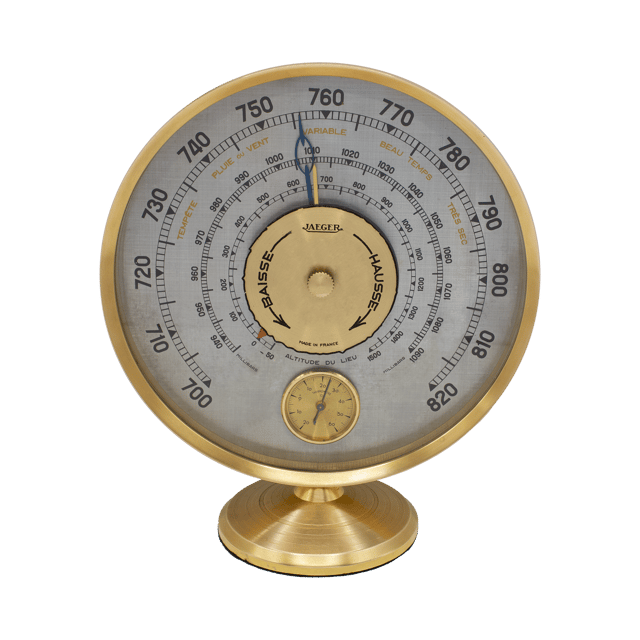
And here is the paradox this whole account is built around. The same firm that made the thinnest pocket watch movement in the world (the 1907 calibre 145 "Couteau", 1.38 mm high — a record still unbeaten) and the smallest series-produced mechanical calibre in the world (the 101 of 1929, weighing about a gram) also made desk barometers. Brass, glass, Art Deco instruments that today turn up at antique dealers for roughly 300–450 euros for a recognisable model — and an ordinary example for a couple of hundred. How does one and the same engineering tradition produce both a watch costing hundreds of thousands and a barometer costing about as much as a good dinner for two? The answer lies in this story. It is a story about vertical integration, about an obsession with precision and miniaturisation, and about how easily corporate myth takes the place of documentary evidence. We will try to keep the two apart throughout.
The story begins not with a watchmaker but with a refugee. Pierre Le Coultre (c. 1530 – c. 1602) was a schoolmaster from Lizy-sur-Ourcq in Seine-et-Marne — a French Protestant, a Huguenot, fleeing religious persecution. In 1558 he was granted the status of habitant in Geneva; in 1559 his name is first associated with the valley (through the so-called "Journal de Pierre Le Coultre"); around 1560 he settled in the district of Le Chenit, then part of the commune of Le Lieu. The building of the first church at Le Chenit and the family's acquisition of burgher rights in Le Lieu are dated to 1612.
An honest marker is worth planting right here. The romantic version — "Pierre settled in 1559, cleared the forest, founded Le Sentier" — is a straightening of the record. Settling the valley was the work of several generations, not the heroic gesture of one man. The dates of "settled" and "founded" are decades apart, and it is more accurate to speak of a process than of a moment.
The place the Huguenots washed up in was harsh to the point of cruelty. The Vallée de Joux lies at about a thousand metres, in the coldest pocket of the Jura; it was not called "the Vaudois Siberia" for nothing. Farming was unreliable, but there was local iron ore underfoot, and the long winter drove people indoors. So a winter craft was born: peasant-mechanics who made components through the dark months and sold them on through Geneva and Neuchâtel négociants. The result was the system of établissage — a division of labour scattered across households, each with its own operation and its own secret.
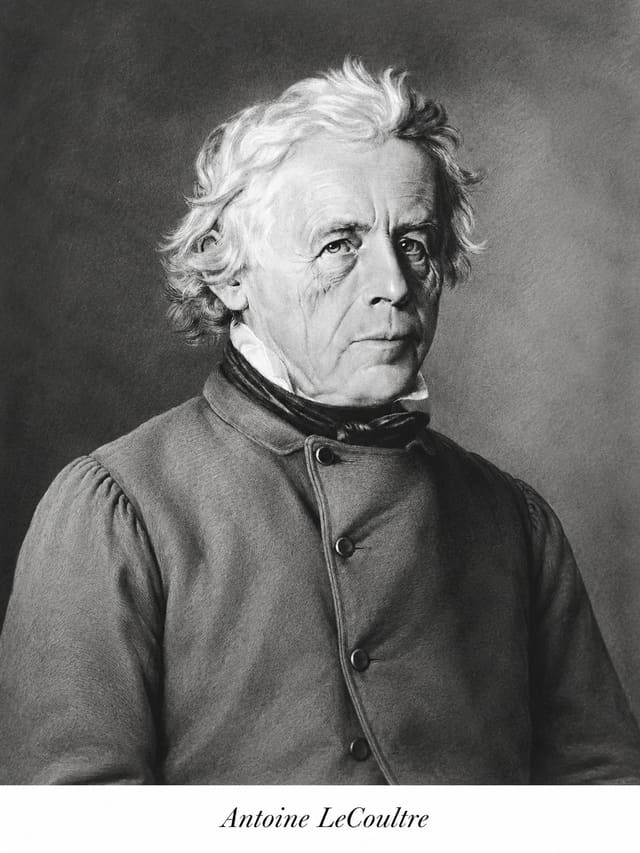
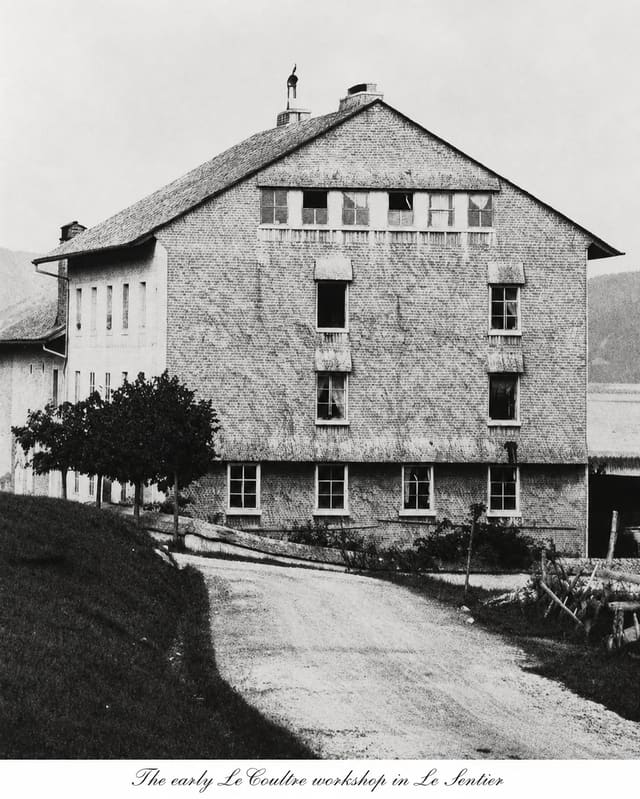
Into this world, in 1803, Antoine LeCoultre was born. He did not begin with watches at all: from 1823 he made combs for music boxes and keyboards for musical instruments — significant industries in their day. In 1828 he spent time working in Geneva; in 1830 he returned to Le Sentier to set up in business with his father. In 1832 he built a machine that cut metal more accurately than anything before it, and a year later, in 1833, he opened a workshop for cutting watch pinions. That date — 1833 — is the one now declared the year of the company's founding. Then came the inventions that made his name: in 1844 the "Millionomètre", the first instrument capable of measuring a micron (in an era when pinions were finished by eye); in 1847 the keyless winding and setting mechanism; in 1851 a gold medal at the first World's Fair in London for precision and mechanisation.
The researcher Stephen Foskett (Grail Watch), working from primary sources — the Indicateur Davoine directory and the trade paper La Fédération Horlogère — shows that 1833 is the date of Antoine's start as an individual craftsman. The legal entity that is the direct predecessor of today's firm, the joint-stock partnership LeCoultre, Borgeaud & Cie, came into being only in 1860. The name LeCoultre & Cie took hold after Borgeaud's departure, in 1877. And the Jaeger-LeCoultre brand itself would come together organisationally only in 1937. In other words, "1833" is the truth about a man, not about a company. Foskett even notes that a primary account of the twenty-fifth wedding anniversary of Benjamin LeCoultre (1904) gives the founding year as 1826.
In 1866 Antoine, together with his son Élie LeCoultre (1842–1917), did the thing that turned a workshop into a legend: he gathered the scattered household craftsmen under one roof. This gave rise to the valley's first true manufacture — the "Grande Maison", where, in the company's own formula, "180 crafts" came together.
By 1900 the catalogue had passed 350 calibres (128 chronograph, 99 repeating). The volumes are striking: between 1900 and 1919 the manufacture turned out some 40,000 ébauche movements — around 2,100 a year. In 1907 the calibre 145 "Couteau" ("knife") was born here: a movement 1.38 mm high, the thinnest pocket watch in the world, still the record in its category.
Legally, however, until 1922 LeCoultre & Cie remained a maker of mouvements en blanc — ébauches; it acquired the status of Fabrique d'Horlogerie in 1923, and registered as a commercial watch brand in its own right only in 1930. The manufacture of manufactures went a long time without signing finished watches with its own name — it made what others signed with theirs.
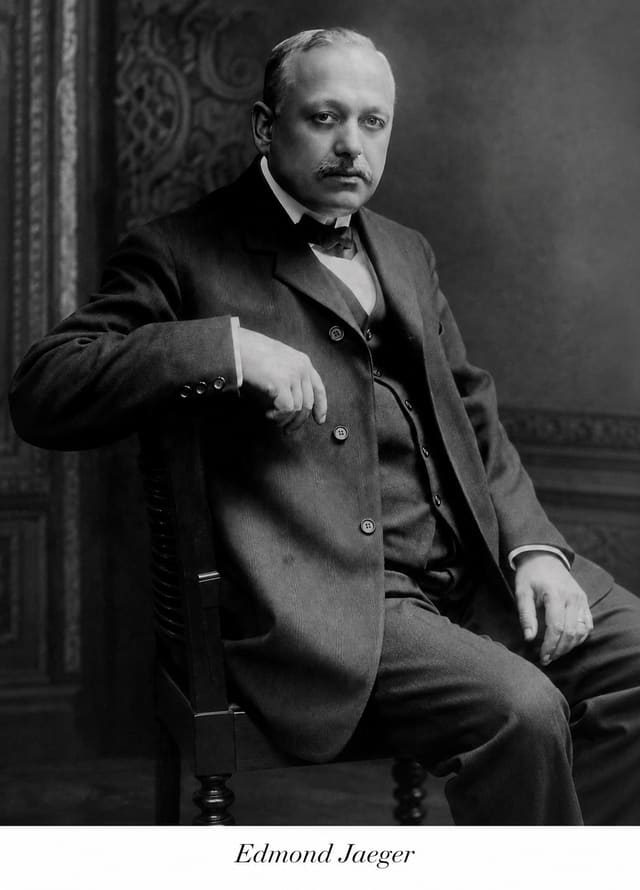
Now to Paris. Edmond Jaeger (1858–1922) is a figure about whom, despite his weight in the industry, remarkably little is known, and around whom a great deal of folklore has accumulated.
His obituary in the Journal Suisse d'Horlogerie et de Bijouterie (1922) notes that Jaeger was an Alsatian ("né en Alsace"). Judging by the dates, this family of modest artisans moved to Paris in all likelihood before Bismarck's annexation of Alsace in 1871 — most Alsatian emigrants of the German period went to Algeria rather than to France — so the move probably happened earlier.
In 1886 Pierre Gabriel and Edmond Jaeger, both of Paris, patented a power reserve indicator — an invention noted that same year by both the Journal Suisse d'Horlogerie and the Revue Chronométrique, which means it attracted attention. Jaeger worked for Parisian masters: in 1889, when he won a silver medal at the Paris Exhibition, he is listed as an employee of Ed. Lefèvre. According to Nadelhoffer's Cartier, earlier still he had served the house of Breguet (then in the hands of the English Brown family) — and only afterwards set up on his own.
There is some confusion about the founding date of that business of his own. The FHH gives 1880, but, as Grail Watch honestly points out, this date is not supported by primary sources and even contradicts them; Nadelhoffer gives 1905. From 1890, according to the FHH, Jaeger supplied deck chronometers to the French Navy (horloger de la Marine) — plausible, though possibly not under his own name at first.
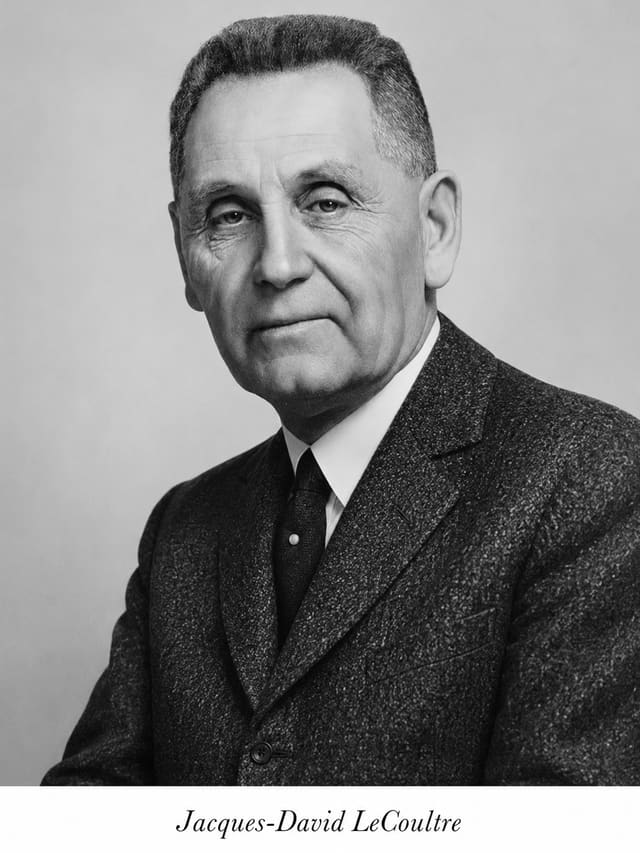
The turning point came around 1903. Jaeger threw down a "challenge" to the Swiss manufactures: to build the ultra-thin movements he had designed. The challenge was answered by Jacques-David LeCoultre (1875–1948), Antoine's grandson and the future builder of the brand. Here legend treads on the documentary record. The picturesque details — twenty kilometres by bicycle to the nearest telephone, thin watches glimpsed by chance in a shop window — are folklore. The prosaic version is more plausible: Jaeger went straight to the valley's best-known manufacture because he knew where to go. On 1 September 1906 Jacques-David succeeded his uncle Benjamin as managing director of LeCoultre & Cie — and the partnership got down to business.
Around 1905–1907 the famous link with Cartier was formed. Here again care is needed. The classic formula — "an exclusive fifteen-year contract under which all of Jaeger's movements went to Cartier alone" — is repeated everywhere. But Nadelhoffer describes the arrangement rather as a one-sided undertaking: Cartier committed to buying Jaeger's entire output provided the annual order was no less than 250,000 francs. A three-way mechanism emerged: Cartier ordered, Jaeger designed, LeCoultre built. That is how the movements of the early Cartiers were born — the Santos-Dumont, and later the Tank. Louis Cartier worked on the Santos with Jaeger; Cartier introduced the folding déployante clasp around 1909–1910; and in 1918 a Tank prototype was presented to the American general John Pershing.
The First World War overturned the business model. Demand for thin, complicated watches collapsed, and the partners switched to instruments. Together with the aircraft designer Gustave Delage and the Swiss aviator Edmond Audemars, they set up production of instruments for aviation and motor cars: dashboard clocks, tachometers, barometers, pressure gauges. A group of French aviators — among them Léon Morane, Laurent Seguin and Gabriel Voisin — invested more than 2.5 million francs in Ed. Jaeger SA and LeCoultre & Cie; the agreements were concluded in 1916 and 1917. LeCoultre's eight-day desk and automobile clocks were reworked for aircraft cockpits — and the result was the prototype of the onboard chronometer for the whole of the twentieth century.
The British chapter: in 1921 Ed. Jaeger (London) Ltd was established. In 1927 S. Smith & Sons (Smiths) bought a large stake — some 75 per cent — knowing that its rival Lucas had its eye on Jaeger. Then came the renaming to British Jaeger Instruments Ltd: Wikipedia dates this to 1937, other sources to 1931. The widespread claim that Smiths' watch movements were JLC designs is considered mistaken by specialists (Chronopedia).
Jaeger instruments were fitted to Bentley, Jaguar, MG, Citroën, Renault and Aston Martin. The first instrument on an Aston Martin dates from 1922; the first series-production illuminated dashboard was for the Citroën B12 in 1926. The automotive instrument business eventually passed to Magneti Marelli and Veglia-Borletti (the reorganisation is dated 1986 or 1987 depending on the source).
The end of the French branch is a sad one. In 1921 Jaeger was felled by serious illness and withdrew from the business; technical management passed to Jacques Lebet, commercial management to Audemars, Delage and Jacques-David LeCoultre. Jaeger died in 1922, never knowing how famous his name would become.
By the mid-1920s the two branches had already grown together in practice; it remained for them to grow together in name. The intervening years produced two legendary movements and one iconic watch.
1925 — the Duoplan. A "two-storey" movement: to fit a large and therefore reliable balance into a small case, the components were spread across two levels. The winding crown was moved to the case back. The watches came with a two-year Lloyd's insurance policy and the concept of swapping out the entire movement quickly; from 1929 they had sapphire crystals.
1929 — the calibre 101. A direct descendant of the Duoplan, taken to the limit of miniaturisation. Length 14 mm, width 4.8 mm, height 3.4 mm, weight exactly one gram. Originally 74 components, today 98; 19 jewels, 21,600 vibrations per hour, a power reserve of around 33 hours. From 1929 to this day it is the smallest series-produced mechanical calibre in the world — a record still unbeaten; it is made in tiny batches, some fifty movements a year, and only three of the manufacture's watchmakers know how to assemble it.
1931 — the Reverso. A watch that flips over, hiding its dial behind a steel back. Everyone knows the legend: in the winter of 1930–31 the Swiss dealer and collector César de Trey was in British India at a polo match at a British officers' club, one of the players smashed his watch crystal on a mallet or the ball and jokingly issued a challenge — make a watch that can survive polo.
What is documented is that on 4 March 1931 at 1.15 p.m., at the Institut National de la Propriété Industrielle in Paris, the French engineer René-Alfred Chauvot filed a patent application for "a watch capable of sliding in its support and turning completely over on itself" — application no. 712,868, published in October 1931. In July de Trey bought from Chauvot the rights to the 23-part case, and in November registered the name Reverso (from the Latin "I turn over"). The movement and production were provided by Jacques-David LeCoultre; the casemaker Wenger refined the case into its streamlined form. The first watches went on sale less than nine months after the application was filed.
The whole polo-related part of the story rests almost entirely on the company's own version. There is no order book from the regimental club and no signed order — the patent itself says not a word about polo or India. What is documented are the roles of three men: de Trey (capital and the idea), Chauvot (the case patent) and Jacques-David LeCoultre (the movement and manufacture). And one more detail the brand is not fond of stressing: in the 1930s the Reverso case was fitted not only by LeCoultre — the arrangement, made through a company created for the purpose, faced outwards, and the same cases housed watches by Patek Philippe, Vacheron Constantin and Cartier. After the Second World War the fashion for rectangular watches passed and the Reverso was all but forgotten — so thoroughly that for some thirty years the firm itself believed nobody wanted it. Its revival came only in the 1970s and 1980s.
The corporate side ran in parallel. In November 1931 Jacques-David LeCoultre and César de Trey established the sales company Spécialités Horlogères SA in Lausanne. And here is the birth date of the name: on 30 November 1937 Spécialités Horlogères SA was renamed La Société de vente des Produits Jaeger-LeCoultre SA. This is the birth date of the NAME, not of the manufacturing. Production had existed for nearly a century; "Jaeger-LeCoultre" as a brand dates from the end of 1937.
In 1938 the circle closed a second time: LeCoultre invested in a struggling Vacheron & Constantin. By then Jacques-David was a one-man network: he built up Ed. Jaeger SA in Geneva, sat on the Chambre Suisse de l'Horlogerie, was a director of the young brand Oris and an investor in Patek Philippe and Vacheron & Constantin. The manufacture of manufactures was accumulating stakes in the loudest houses of all.
1948 — the Mark XI. A wristwatch for the British and Australian air forces to specification 6B/346. Two houses made it — JLC and IWC — between 1948 and 1953. Inside was the calibre 488/SBr (12.5 lignes, 16 jewels, Glucydur balance, Breguet-type Nivarox hairspring), with hacking (a stop-seconds function). The key trick was a soft-iron inner shield, a "Faraday cage", which made the watch antimagnetic; in effect these were the first wristwatches designed to be antimagnetic from the ground up. Around 2,950 examples of the Mark XI from both makers were produced between 1948 and 1953, of which only some 600 went to the RAAF; the watches stayed in service until the mid-to-late 1970s.
1950 — the Memovox ("voice of memory"), an alarm watch. In 1956 came the calibre 815 — the first self-winding alarm; in the United States the model was sold as the "Wrist-Alarm". In 1959 came the Memovox Deep Sea, the first diver's watch with an alarm.
1953 — the calibre 101 at the coronation. On 2 June 1953, at the coronation in Westminster Abbey, the twenty-five-year-old Elizabeth II wore an exceptionally slim bracelet watch on a calibre 101 — a gift from the French, chosen, by common account, for its discretion: the movement hid between two rows of diamonds and drew no attention away from the regalia. There are two discrepancies here worth noting. First, the date: the coronation took place on 2 June 1953, but "1952" also crops up — because the princess had owned such a watch earlier (the Calibre 101 Reine model with 110 diamonds, measuring 18.35 × 6.80 × 5.47 mm). Second, the giver: some sources mistakenly name "Lebrun" — a president who had left office back in 1940. The correct version involves Vincent Auriol, President of France from 1947 to 1954, who gave the watch to the then princess. The fate of the watch itself is unknown; in 2012, for the Diamond Jubilee, JLC presented the Queen with a new 101 in white gold.
1958 — the Geophysic, made for the International Geophysical Year. One example was presented to the commander of the nuclear submarine USS Nautilus.
1968 — the Memovox Polaris: 42 mm, alarm, water resistance, and a triple case back with sixteen openings so that the alarm could be heard underwater. Since 2018 Polaris has been a collection in its own right.
1992 — the Master Control and the famous "1000 Hours Control" protocol — an in-house testing programme that became the marketing banner of the mechanical revival.
The twenty-first century brought a parade of haute horlogerie: the Gyrotourbillon 1 (2004, a spherical tourbillon); the Duomètre with its Dual-Wing concept (from 2007); the Hybris Mechanica line (from 2003), and within it the Hybris Mechanica à Grande Sonnerie (2009, calibre 182, more than 1,300 components). Today the house has eight collections: Reverso, Rendez-Vous, Master, Polaris, Geophysic, Duomètre, Atmos and Hybris Mechanica. Over its history the manufacture has developed more than 1,200 calibres and around 400 patents (the marketing also cites "more than 200" — the counting methodology is not disclosed, so both figures should be treated as orders of magnitude). Turnover for 2024 was estimated at CHF 524 million in the annual Morgan Stanley report (with LuxeConsult), on 79,000 units sold — a marked fall from 97,000 the year before. In 2007 a Heritage Gallery with more than 500 exhibits opened at the manufacture itself.
A curious chapter of its own is the "American" LeCoultre. Because of the high Smoot-Hawley tariff it was cheaper to assemble and case watches for the United States locally, so from roughly 1932 to 1985 they were sold there under the name "LeCoultre", without "Jaeger", through Longines-Wittnauer distribution (the "Vacheron & Constantin–LeCoultre" structure). The last movements left Le Sentier around 1976, and the trademark lapsed in 1985. Hence the confusion among collectors: "LeCoultre" and "Jaeger-LeCoultre" on the dial are often the same firm, simply on opposite sides of the Atlantic.
Ownership. Family control ran through the Favre family's SAPHIR Group. In 1978 the German company VDO acquired 55 per cent (out of the SAPHIR Group, which also included Favre-Leuba). The engineer Günter Blümlein, who took the brand under his wing from 1980, carried out a refinancing: he bought out the local bank's 20 per cent and Vacheron Constantin's 25 per cent, and sold 40 per cent to Audemars Piguet (1986). In 1991 the LMH holding was formed — IWC, Jaeger-LeCoultre and the revived A. Lange & Söhne; by then VDO had become part of Mannesmann. In 1999 Vodafone absorbed Mannesmann and put LMH up for sale. A battle broke out: Gucci/PPR, LVMH and Richemont (in alliance with Audemars Piguet). Richemont won. According to Richemont's press release, the total debt-free value of the transaction was CHF 3,080 million in cash — CHF 2,800 million for LMH and CHF 280 million for the 40 per cent stake in Jaeger-LeCoultre bought back from Audemars Piguet. The deal closed in 2000 (announced on 22 July), and 100 per cent of the firm passed to Richemont.
If there is one object in which the firm's engineering soul and its instrument-making soul meet at a single point, it is the Atmos — a table clock that needs no winding because the air winds it.
It was not invented by a watchmaker. Jean-Léon Reutter (1899–1971) was a Swiss engineer from Neuchâtel who lived in France and worked as a radiology engineer at the Compagnie Générale de Radiologie (CGR). Patents from 1926 laid the groundwork. In 1928 came the prototype now unofficially known as the "Atmos 0": a glass bulb with mercury, an assembly built on aneroid capsules, and a going train driven purely by fluctuations in the air temperature under its dome. A change of a single degree was enough to keep the clock running for a day. The sensation was loud: more than a hundred newspapers, from America to South Africa, wrote about the "perpetual clock".
From 1 June 1929 CGR in France began production of the first commercial model (now known as the "Atmos I"): a U-shaped tube filled with a mercury and ammonia mixture, the so-called Cluses mechanism. Reutter was put in charge of this small production line. The clocks were temperamental, mercury was dangerous, and by 1933 the movements for CGR were already being supplied by LeCoultre. On 27 July 1935 production and the rights passed entirely to Jaeger-LeCoultre, along with the stock of parts and work in progress. Reutter came to work at Le Sentier under Jacques-David LeCoultre.
Then came the engineering revolution. On 15 January 1936 the new Atmos II was announced: instead of the mercury-and-ammonia bellows, a hermetically sealed capsule filled with ethyl chloride. Development took another three years; the Atmos II was launched commercially in 1939 on the calibre 519.
The principle, in JLC's official formulation, is beautiful to the point of implausibility. Inside a sealed bellows capsule, a gas-liquid mixture of ethyl chloride expands when warmed and contracts when cooled, "breathing" like the bellows of an accordion and winding the mainspring; a variation of just one degree Celsius is enough for 48 hours of running. To consume as much energy as a 15-watt light bulb, an Atmos would have to run for some 60 million hours. Timekeeping is regulated not by an ordinary pendulum but by a torsion pendulum with a period of exactly one minute — thirty seconds one way, thirty back — suspended on the finest of Elinvar wires.
From 1950 the Atmos became the official gift of the Swiss Confederation to distinguished guests — "the president's clock". By 1951 output had reached 10,000 a year; in 1979 the 500,000th example was completed; total production runs well beyond 750,000 (more than half a million by 1983 alone).
The model range grew into a world of its own: the Atmos Classique, the Vendôme, the Atmos du Millénaire Atlantis (calibre 555 with a perpetual calendar running to the year 3000), the Atmos Mystérieuse, the Atmos Régulateur, the Marqueterie series (including the 2015 Marqueterie Céleste with straw marquetry and a perpetual calendar good to 3861), and the anniversary "Jubilé" of 1979 on the calibre 550 (1,500 examples, for the fiftieth anniversary). The collaborations with the designer Marc Newson stand apart: the Atmos 561 (2008, for the model's eightieth anniversary, a cube of Baccarat crystal, 888 examples) and the Atmos 566 (2010). The patent on the original technology expired long ago — yet JLC remains the only firm in the world that uses it.
Now to the subject for which it was worth laying out the whole map in the first place. Why did a watch company make barometers? The answer is technical and rather elegant, and it has to be told starting not with the barometer but with the altimeter.
The mercury-free barometer was invented by the Frenchman Lucien Vidie (1805–1866). He presented the first satisfactory aneroid in 1843 and took out his first patent in 1844. The heart of the instrument is the "Vidie box": a sealed, evacuated corrugated metal capsule that deforms very slightly as atmospheric pressure changes, while a lever transmission amplifies these micron-scale movements into the turn of a hand.
As is well known, atmospheric pressure falls with altitude. The higher you climb above sea level, the shorter the column of air above you, and so the less its weight and the pressure it exerts. Near the Earth's surface pressure changes fairly quickly; as you ascend, the fall becomes more gradual, so the relationship between pressure and altitude is non-linear. But it is well established and described by the standard atmosphere, which means every pressure value can be matched to a particular altitude. That is exactly what made it possible to turn an ordinary aneroid barometer into an altimeter: the mechanism still measures the same atmospheric pressure — all that changes is what is written on its scale.
An aircraft altimeter is therefore the very same aneroid barometer, with the scale graduated not in units of pressure (inches or millimetres of mercury) but in units of altitude (feet or metres). This is not a metaphor but a textbook definition. AeroToolbox: "An altimeter is essentially an aneroid barometer calibrated to measure altitude rather than pressure." Britannica calls the barometric altimeter outright a "pressure altimeter, or aneroid barometer". NOAA's glossary: "an aneroid barometer calibrated to indicate altitude in feet instead of pressure units". In other words, a Jaeger household barometer and a Jaeger aircraft altimeter use the same sensing element — the Vidie box. That is the whole answer: a firm making altimeters, variometers and pressure gauges for aircraft moved quite naturally into desk barometers — they are neighbouring branches of one technical line.
Barometers are a far less studied part of the Jaeger-LeCoultre legacy than the watches. As is unfortunately often the case with legendary watch houses, the available official company history contains no separate chapter on barometers; there is no complete range published by the firm, no serial ranges, no annual output figures and no technical description of its own production of barometric capsules. JLC's official 2026 press release only mentions that the company's historic desk and travel timekeepers frequently combined barometers and thermometers. The existence of this line is confirmed far more vividly by surviving objects and auction catalogues.
The earliest well-documented example found is the Jaeger ref. 6345, dated by Christie's to around 1935 — that is, before the name Jaeger-LeCoultre even existed. It is a desk instrument in a brass case about 180 mm across, combining a barometric scale with circular weather indications and a temperature display. The Jaeger signature and the pre-war dating fit neatly with the profile of the French firm Edmond Jaeger as a maker not only of watches but of precision instruments.
The most characteristic post-war family is the Jaeger Baromètre 7 A.B. The best-known desk model has a round case on a lacquered base, with a brass bezel holding two parallel mineral glass discs bearing the scales, supplemented by a bimetallic thermometer. This is the legendary "mystery" barometer style, which came into barometers straight from watchmaking — from the pendules mystérieuses of Antoine Rédier, whose hands likewise appear to have no connection to any mechanism.
The defining feature of the design is a pair of transparent parallel glass plates, usually with facetted edges: one carries the barometric scale, while the indicating hand seems to hang in mid-air between them and the mechanism itself is entirely hidden from view. The trick is achieved like this: the sensing capsule is concealed in the instrument's base, and its movement is carried upwards to the "floating" hand by the finest of wires and a chain. The effect is a hand that appears to move of its own accord. Jaeger used a simplified variant, hiding the mechanism not in the base but in a compact cylinder directly behind the centre of the glass dial, simply creating the illusion that there was none.
A whole series of European makers worked in this style. C. P. Goerz — a Berlin firm founded in 1886 as an optical manufacturer; after the founder's death in 1926 it was absorbed into the Zeiss-Ikon combine. The English firm Short & Mason (founded in 1864 by Thomas Watling Short and William James Mason, Hatton Garden, London) also produced a mystery barometer model. The German firm Lufft belongs in the same row. And among them, Jaeger and Jaeger-LeCoultre: a watch company could afford a construction like this precisely because a "floating hand" is, in essence, watch mechanics transplanted into meteorology.
In 2017 a barometer in this design by Jaeger, serial number 6345, sold for $750. Another example: Antiquorum, 2011 sale, sold for $1,063. Earlier still, at an Antiquorum sale in 2000, a Jaeger barometer went for HKD 5,750 (roughly €730). A Jaeger-LeCoultre barometer/weather station has also appeared at Bonhams. Jaeger barometers and weather stations pass regularly through French regional houses (Lucien Paris, Lombrail-Teucquam, Gros & Delettrez) and through Monaco Legend Auctions (an Ados in lizard skin, lot 203, 2018).
Chronologically the barometer line runs from roughly the 1920s to the early 1970s. Some instruments are signed simply "Jaeger" (pieces made before the 1937 merger, or products of the instrument branch), others "Jaeger-LeCoultre".
Standing right beside the barometers on the same technical line are Jaeger's aircraft altimeters (part no. 511900, for instance), variometers and pressure gauges; automotive tachometers and speedometers; while the ancestor of the entire measuring branch might be considered Antoine LeCoultre's Millionomètre of 1844 and the industrial comparators. From an instrument that measured the micron to an instrument that measured the atmosphere — the same obsession with precision throughout.
This story began with a map of high luxury — with the fact that behind the backs of Patek Philippe, Audemars Piguet, Vacheron Constantin and Cartier there stood, for decades, one and the same workshop in a cold Jura valley. Having travelled almost two centuries, it is worth returning to that map and looking at it from the other end.
Luxury usually sells itself as a result: a name on the dial, a shop window, a heritage bound in leather. What makes the history of Jaeger-LeCoultre interesting is that it shows luxury as a process — and a fairly prosaic one at that. A Huguenot fleeing persecution who settled where the wheat grew badly. Peasants for whom the long winter left no occupation but metalwork. A self-taught man who realised the micron could be measured. A Parisian from Alsace who traded in precision as confidently as others traded in jewellery. Nothing of that radiant inevitability painted by the anniversary brochures — but a great deal of stubbornness, calculation and a knack for doing someone else's job better than the client would have done it himself.
Hence the firm's central paradox, which became its calling card. For a long time it was the most invisible of the greats: it did not sign finished watches with its own name but supplied ébauches and calibres to those who did. The vertical integration devised here in 1866, long before the term entered business vocabulary, worked not for its own shop window but for other people's. It was this position as a first-rank supplier — not any advertising rhetoric — that made Jaeger-LeCoultre a house with more calibres than some brands have models.
Luxury lives on legends, and Jaeger-LeCoultre is no exception, though there is no ill intent in this — legends are simply more convenient than documents. But a firm whose real achievement lies in its ability to measure a micron deserves a history told with the same precision it brought to cutting its pinions. And without the myths this biography does not lose — it gains.
And one last thing, closing the circle. A Jaeger barometer for 450 euros is not a curiosity on the margins of a great horological saga. It is a fragment of exactly the same engineering world as a watch costing hundreds of thousands: the same Vidie box that turns into an altimeter; the same "mystery" mechanics that came from the pendule mystérieuse; the same firm that made other people's fame. Only this time it measures not time but air. Buying such a barometer, you are in effect holding an inexpensive entry into a very expensive tradition — and in that, perhaps, lies the genuine, unmanufactured singularity of Jaeger-LeCoultre.