Loading
It would be hard to find a more contradictory figure in twentieth-century meteorology than Irving Parkhurst Krick. He was at once a doctor of science from one of the world's finest technical institutes and a carnival barker; a man whose name is permanently attached to the Normandy landings, and a man his own profession came close to expelling in disgrace; a scientist who seriously promised forecasts two years ahead, and an entrepreneur who sold rain to farmers and a metal disc printed with pictures of clouds to housewives. "A brilliant American salesman" was the historian John Cox's rather barbed summary — and it is the key to Krick. His product was the weather. But his main product, as with every great salesman, was himself.
Irving Krick was born on 20 December 1906 in San Francisco. His first calling was not science but music, and it was a serious one. Taught by his mother, he became, in the words of his biographer Justin Libby, "a pianist prodigy of some significance": at thirteen he was giving Sunday recitals at the open-air Greek Theatre in Berkeley. In 1928 he graduated in physics from the University of California, Berkeley (where he belonged to the Tau Kappa Epsilon fraternity) and toured the United States and Asia as accompanist to the university's glee club — only to conclude that music paid badly. In his early twenties he worked at a radio station and then at a brokerage house, until the Wall Street crash of 1929 swept that world away. Chance decided the rest: a job with an airline, and advice from his brother-in-law Horace Byers — an MIT graduate and future major meteorologist — pointed him toward the weather.
The story of how he entered aviation meteorology is telling. Hired as a freight clerk at Western Air Express for $110 a month, Krick was granted a condescending dispensation by the station manager, Jimmy James: "You can draw your funny maps just as long as you get your paper work done." The funny maps turned out to be accurate. His storm warnings and tailwind advice so impressed the pilots that, according to Justin Libby's magazine biography, "using Krick's weather forecasting methods the accuracy of those reports rose from 61 percent to 96.1 percent. Eventually, the carrier's flight schedules were coordinated with Krick's projections, which saved the airline over time nearly $35,000." The advertising department came up with a slogan: "Western Express planes always have tail winds."
Around 1930 Krick entered the California Institute of Technology, in the aeronautics department, where meteorology existed only as a handful of courses. What brought the subject to life at Caltech was a disaster: the crash of the airship USS Akron on 3 April 1933. The young graduate student came to Theodore von Kármán with a set of charts and explained the loss in terms of Norwegian air-mass analysis — a collision of two opposing flows over the New Jersey coast. Von Kármán was impressed and persuaded Caltech's president, Robert Millikan, to start teaching what he called sensible meteorology. Krick took his master's degree in 1933 and his doctorate in 1934; the latter included the Akron analysis and a study of Southern California's föhn winds, the Santa Anas. The Akron work, which contained an implicit rebuke to the Weather Bureau, made Krick's name — and earned him his first powerful enemy, Francis Reichelderfer, the future chief of the Weather Bureau.
Decisive for his career was the influence of the Norwegian, or Bergen, school. On a trip to Europe he studied under Jacob Bjerknes — son of the school's founder, Vilhelm Bjerknes — and absorbed the theory of fronts and air masses, along with the concept of occlusion developed by the Swede Tor Bergeron. He then went on to Germany, where, by his own account, he particularly valued the company of Ludwig Weickmann in Leipzig, who was experimenting with long-range forecasting based on periodicities: "I wanted to try these ideas back in California." It was from this alloy — Norwegian synoptics plus a German faith in recurrence — that Krick's "analogue" method would later grow.
Krick rose fast at Caltech: assistant professor around 1935, and by the end of the decade head of a new meteorology department. Some caution with dates is required here. The booklet that came with the Weather Guide — the celebrated cloud-reading forecaster Krick designed for the general public, and the subject of a later section of this article — states that Krick was "for 17 years the active head of the Meteorology Department at the world famous California Institute of Technology." Different sources give different starting points: Wikipedia dates the department's founding and his leadership to 1937, Justin Libby's article to 1938, while Krick's presence at Caltech as a teacher dates from 1933 and the department's closure from 1948. The "seventeen years" is probably counted from his arrival at the institute in 1933; strictly speaking, his formal headship lasted about a decade. It is the kind of case where advertising copy rounds reality in its own favour.
Krick's department was unusual for its frankly commercial orientation. It served not only aviation but anyone willing to pay — Hollywood included. The most famous episode: in 1938–39 Krick forecast clear weather for the filming of the burning of Atlanta in Gone with the Wind, where old sets were set alight and there could be no second take. "Weather forecasting was his product line, although, like many a great salesman, his number one product was himself," was John Cox's summary of the approach. In 1938 (some sources say 1936) Krick founded the first private meteorological firm in the United States.
When the Second World War began, General Henry "Hap" Arnold, head of the U.S. Army Air Forces and a friend of Krick's since the 1930s, recruited him into the military weather service. There were objections: the head of the Weather Bureau, Reichelderfer, warned Arnold that Krick's ideas amounted to "gambling on an unproved theory," to which Arnold is said to have replied, "War is a gamble." Krick rose from major and chief of the long-range forecast section at Weather Central in Washington to deputy director of weather services in the European Theater of Operations and chief of the weather information section of the U.S. Strategic Air Forces, reporting to Eisenhower's headquarters. He ended the war a colonel, holding the Legion of Merit, two Bronze Stars and the French Croix de Guerre.
No less important was his role as a teacher of military forecasters: the meteorology training programme at Caltech supplied the cadres for a rapidly expanding Air Force weather service. His posthumous notice in the American Meteorological Society observed that his influence "directly and indirectly initiated many productive and often outstanding careers in meteorology."
The 6th of June 1944 is a date historians still argue over — and Krick was at the centre of it.
The Allied weather organisation was cumbersome. Formally everything converged on the chief meteorologist at Supreme Headquarters (SHAEF), James Stagg, and his deputy, the American Donald Yates, a former student of Krick's. Forecasts were prepared by three centres: the Americans Krick and Ben Holzman at Widewing (Bushey Park); the Admiralty (Wolfe and Hogben, responsible for sea and surf); and Dunstable, where the Briton C. K. M. Douglas and the Norwegian Sverre Petterssen worked. (The oceanographer Harald Sverdrup, often mentioned in this connection, was not part of that group of six forecasters, though the Sverdrup–Munk wave method was used in preparing amphibious operations.)
The disagreement was fundamental. Krick, relying on the analogue method and on fifty years of records, was confident that the Azores High would shield the Channel and that a landing on 5 June was possible. Petterssen and Douglas, applying Norwegian dynamic analysis, saw a series of storms approaching. On 4 June the forecast of bad weather led to a postponement; on the night of 5 June Stagg told Eisenhower that a brief window would open on the 6th. The landing took place on the 6th, in barely acceptable but sufficient conditions. In substance, Petterssen's judgement prevailed; the twenty-four-hour delay saved the landing force from catastrophe, since on 5 June the Channel saw winds of force 6–7, while landing craft would already have been swamped at force 4.
Then the war of memoirs began. For the rest of his life Krick credited the success of the forecast to the American team and to his analogue method. As early as 1954, in Sun, Sea and Sky, he wrote that had the forecasters not spotted the "tiny chinks opening in the... weather of 1944 in western Europe," then "all the mighty preparations for D-Day might have gone for naught, and the war in Europe might have gone on for years." As late as 1984 Krick was still insisting the landing could have gone ahead on 5 June. Petterssen, deeply offended by these claims and by Stagg's 1971 book, set out his own version in memoirs published in English only in 2001, edited by the historian James Rodger Fleming as Weathering the Storm. Petterssen noted acidly that the American "heroic" version — according to which "the British teams had failed in their predictions for D-Day, and Overlord had been saved by the U.S. Army Air Corps team, using Krick's 'analog' techniques" — was spread by the newspapers, and that "unlike old soldiers, these rumors never faded away," to no small promotional benefit for Dr. Krick personally.
Fleming draws the sober conclusion: only three things are beyond dispute — the landing was postponed from 5 June, it took place on the 6th in marginal conditions, and German meteorologists judged the weather unfit for an invasion and were caught off guard. Everything else is contested. Tellingly, part of Krick's case is documented in his own citations: the recommendation for his Bronze Star stated that "Colonel Krick and his associates permitted the selection of the only date available which allowed the successful landing." But it is equally documented that Krick's optimistic forecast for 5 June would have ended in a rout. The honest picture is this: the American team pushed for the earliest window and was right in the broad sense, but wrong on 5 June specifically, and the decisive postponement to the 6th was the achievement of the British and Norwegian side.
Later popular culture has locked in the British version: David Haig's play Pressure (2014) and the film based on the same story (Pressure, 2026, directed by Anthony Maras, with Chris Messina as Krick) make the unbending Stagg the hero and Krick his overconfident antagonist.
Krick's other wartime episodes are less well documented and rest largely on his own accounts and friendly sources: he is credited with accurate forecasts for the Battle of the Bulge, for the Rhine crossing of 25 March 1945 and, by some claims, for the bombing of Japan in August 1945. These assertions — the atomic ones especially — should be treated with caution.
The scientific core of Krick's work was his "analogue" method of long-range forecasting. The atmosphere, in his view, was "orderly, deterministic and repetitive." He described the procedure like this: "First, type the current weather at the point of interest... Second, machine sort the previous forty years of weather types in the analog weather type file to obtain the best match possible. Third, study maps of the matched periods and project the weather conditions by assuming that thereafter patterns will repeat." In other words: classify the current synoptic situation, search an archive of daily Northern Hemisphere charts spanning forty to fifty years for the closest historical analogue, and assume the weather will follow the recorded script. With his colleague Robert D. Elliott, Krick developed this into a system of six-day "weather types." It was this principle, according to its accompanying booklet, that was built into the Weather Guide — the forecasting instrument Krick created for the ordinary buyer: "Forty to fifty years of daily weather charts for the entire Northern Hemisphere were utilized to bring out the relationship between coming weather and each combination of cloud and wind."
The academic community was sceptical, and critics dubbed the method "canned memory." The objections were fundamental. Weather never repeats exactly; no two hemispheric charts are identical, and small differences grow quickly. Petterssen put it this way: reliable long-range forecasting "required a level of scientific knowledge and data analysis that no one had yet managed to achieve." Krick, meanwhile, was publicly promising accuracy of 80 to 95 percent, and forecasts months or even years ahead. Tellingly, almost all the impressive accuracy figures come from Krick himself, his companies or satisfied clients; no independent, methodologically rigorous audit of his forecasting skill appears to have been published, while the hostility of the Weather Bureau and the AMS was qualitative in nature — they simply held that forecasting beyond five days was impossible.
The irony of history is that analogue forecasting as such did not die. It remains one of the classic textbook methods, and it has in a sense been reborn in the machine-learning era, where searching large datasets for historical analogues is fashionable again. But modern ensemble and statistical methods work in probabilities and quantify uncertainty — whereas Krick sold a deterministic certainty the atmosphere does not supply.
The combination of "primitive" methods and aggressive self-promotion made Krick an enemy of the scientific establishment — Carl-Gustaf Rossby, George Cressman and, above all, Weather Bureau chief Francis Reichelderfer, who called him a "smug, supremely self-confident self-promoter." The conflict came to a head in the 1950s. Krick publicly declared that "long range weather forecasting has become established fact," and demanded a commission to review his work, threatening otherwise to resign from the American Meteorological Society. The Society concluded that he had violated its code of ethics. In 1958 Krick resigned — effectively pre-empting an expulsion that would have made him the first person in the Society's history thrown out for an ethics violation. He called his opponents "mossbacks bereft of imagination" and charged that government forecasting "hasn't progressed much since the nineteenth century."
A separate round of hostilities came with the 1960 Winter Olympics at Squaw Valley, where Krick acted as "weather engineer": the local AMS chapter notified the organising committee of its "concern and displeasure," pointing out that, not being a member, Krick was not bound by its ethical standards, and that a forecast issued two years before the Games was a "scientific impossibility."
After leaving Caltech in 1948 — the department was closed, and Krick took most of its staff and very nearly its entire library with him — he built a genuine commercial empire. In time he ran three Denver-based companies (also operating out of Pasadena): Irving P. Krick Associates (industrial weather forecasting), Water Resources Development Corporation (weather modification) and the American Institute of Aerological Research (research), the last of which is the organisation named on the Weather Guide booklet as his presidency.
The client list is remarkably varied. Power utilities (Pacific Power & Light paid $150,000 for a five-year runoff forecast for its hydro plants), department stores, grain brokers in Chicago and New York, Spreckels Sugar and Hawaiian pineapple plantations, oil companies, aircraft manufacturers (Boeing, Lockheed, Douglas, North American, Consolidated Vultee), Coca-Cola, makers of tyre chains, racehorse owners, and even the Brooklyn Dodgers under Larry MacPhail. Hollywood remained a steady customer. A separate line of business was presidential inaugurations: in 1957 Krick predicted clear weather for Eisenhower's second inauguration seventeen days in advance, and in January 1961 he correctly promised that a blizzard would clear in time for Kennedy's swearing-in.
After the war Krick added an even more contentious service to forecasting: making rain. In the summer of 1948 he ran a series of twenty-seven aerial seeding flights over central Arizona, dropping up to 300 pounds of ice particles per sortie. In December 1949 he switched to ground-based generators dispersing silver iodide — a technology descended from the work of Irving Langmuir and Vincent Schaefer at the General Electric laboratory. By 1951 his cloud-seeding firm employed 120 people and, according to Justin Libby's magazine biography, had won contracts "to seed clouds over 330 million acres in the western United States, as well as parts of Mexico and El Salvador." Time christened him the "Milkman of the Skies."
Krick worked abroad as well. In 1952 in Spain he and two assistants installed thirty silver iodide generators around the 1,000-square-mile catchment of the Río Alberche, to fill the reservoirs of the Unión Eléctrica Madrileña hydro scheme; by his account, flow through the turbines rose by 68 percent. He is credited with producing rain in Israel during a drought and with work in many other countries. In the mid-1960s his firm ran a successful hail-suppression operation near Calgary, Alberta, where converted Harvard trainers carried under-wing racks of silver-iodide flares.
The scientific reception was consistently sceptical; his methods were called "bogus." Public resistance could be colourful: in July 1953 in Fort Worth, an opponent of hiring Krick's firm — the publicist O. T. Hampton — told the city council that cloud seeding was an "abortion of natural law," brandishing a placard reading "Rain comes from heaven, not from cricks and cranks" (a pun on Krick's name). The episode survives in the Fort Worth Star-Telegram Collection at the University of Texas at Arlington Special Collections (AR406-6-891, 8 July 1953). It is worth noting that Krick himself acknowledged the limits of the trade: "rainmakers are not miracle workers and cannot produce rain when the sun is shining."
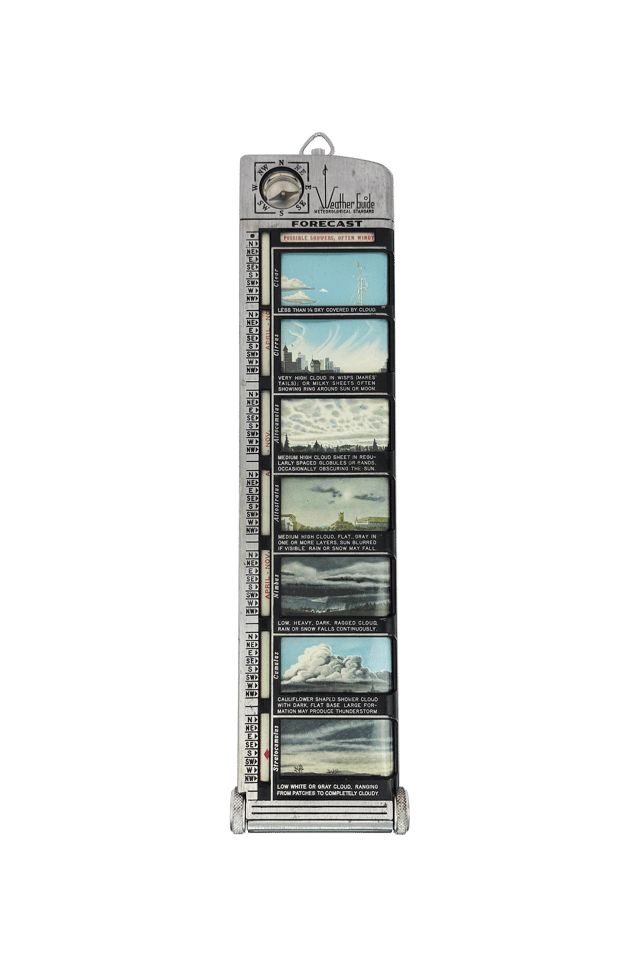
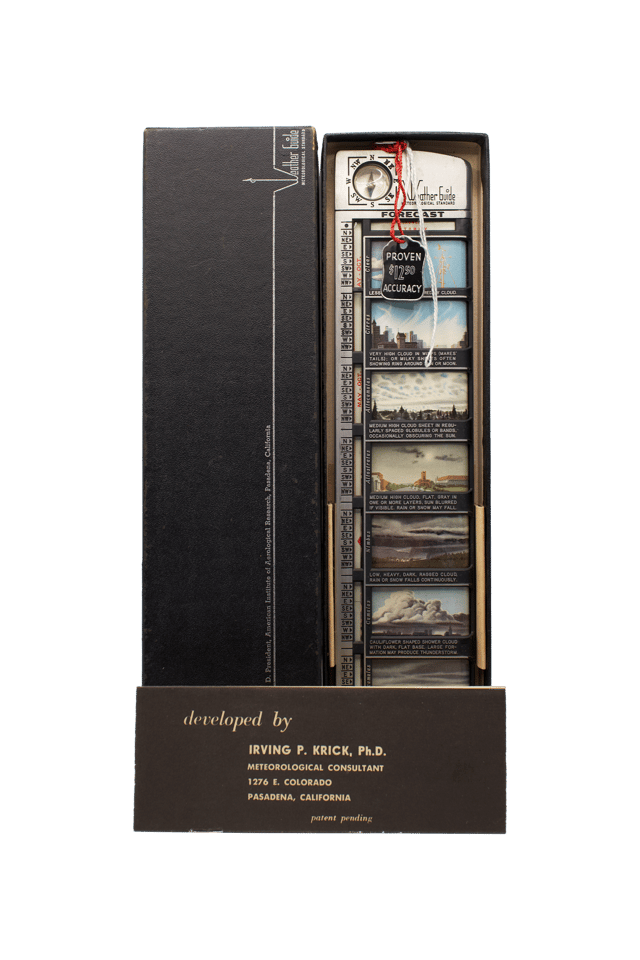
If Krick sold forecasts to the military and to corporations, what he sold to the ordinary American was an instrument. The WEATHER GUIDE is a metal device roughly 10.5 to 11 inches long — in essence an analogue circular calculator, a volvelle. Its face carries sectors with pictures and names of cloud types, with the eight compass points ranged along the edge of each sector; a working compass is built into the assembly. The user rotates the disc, aligning a red pointer with the wind direction for the relevant season, and reads the forecast in a window. The device had a two-part scale — separate settings for summer and winter. It carried a 1949 copyright and the marking "Pat. Pending."
Exactly how Krick's analogue principle was built into the device is explained by the instruction booklet that accompanied every Weather Guide: behind each "cloud plus wind" combination lies a statistical record of what most often happened next when the sky looked like that, derived from forty to fifty years of daily charts. The device, in the booklet's formulation, "classifies and systematizes the weather lore of the ages, combining it with the latest and most modern forecasting techniques in a form so simple that every man may be his own weatherman." In effect, it is folk weather lore, systematised, calibrated against a historical archive and tied to a specific region and season.
That regional tailoring is the instrument's most important feature. Because the relationship between cloud, wind and subsequent weather differs across the country, separate versions were issued for different regions of the United States; collectors report seven of them (for example, versions for the North Central States, the Great Lakes States and the Southeastern U.S.). The instrument identifies Krick as "President, American Institute of Aerological Research, Pasadena, California."
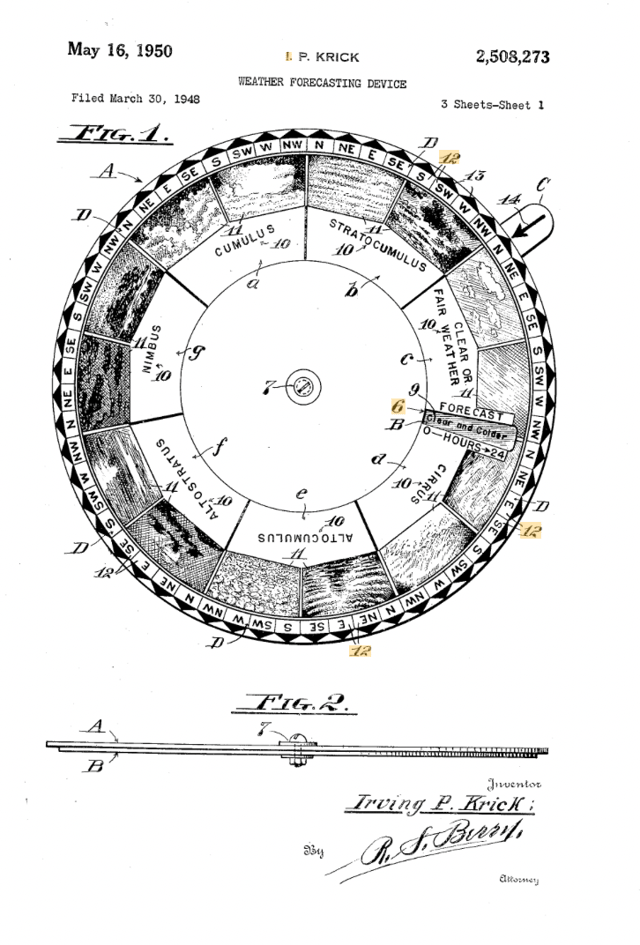
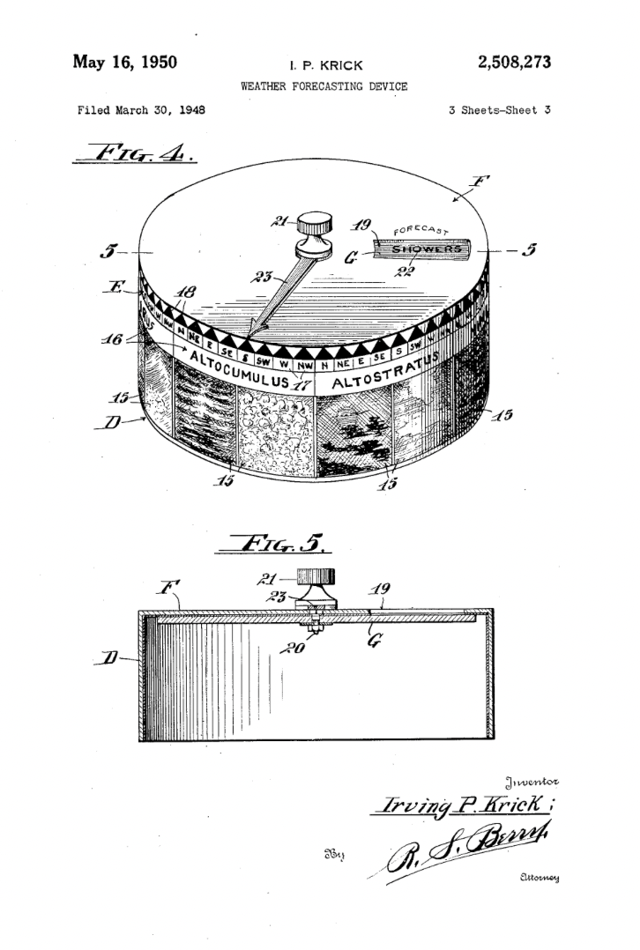
United States Patent No. 2,508,273, "Weather Forecasting Device," in the name of Irving P. Krick of Los Angeles, was filed on 30 March 1948 (Serial No. 18,049) and granted on 16 May 1950. The design copyright is dated 1949, which accounts for the "Pat. Pending" marking on early examples — that is, the instrument went on sale before the patent issued. The patent contains five claims and describes two embodiments: a flat disc version (a volvelle with a window slot and a rotating disc carrying the forecast legends) and a cylindrical one. It lists seven cloud sectors (Cumulus, Stratocumulus, Clear or fair weather, Cirrus, Altocumulus, Altostratus, Nimbus) with brief descriptions, an eight-point wind scale, and sample forecast wordings: "Few showers—Clearing colder," "Little change," "Warmer—Stormy—Slow clearing," "Clear and colder," and so on. As an illustration the patent gives a layout "for use in the central Atlantic States for the seasons extending between December 15 and March 15": with a clear sky and a north wind, the twenty-four-hour reading is "Clear and colder."
Krick's patent cites predecessors — notably a 1915 British patent to Eric Wilfred Kitchin and a 1945 Redding patent ("Barometer interpreter") — and was in turn cited by later products, such as the "Weather forecasting device" of Brown & Bigelow (US2683946A, 1954). This places the Weather Guide in a long tradition of domestic volvelle forecasters, which includes the well-known Negretti & Zambra dial forecaster of 1915 and a host of "weather wheels" and pocket forecast tables.
Beyond the Weather Guide, Krick is remembered chiefly for methods rather than hardware: the analogue system of "weather types" developed with R. D. Elliott; ground-based silver iodide generators for cloud seeding; and a classification of synoptic sequences based on the "dynamics of centers of action" in the Northern Hemisphere circulation. He was an early enthusiast for mechanised data processing, using punched cards and computing equipment to sort his vast archive of historical charts. A separate and often underrated "development" of Krick's was the system of military meteorological training he built at Caltech.
Krick was a public figure to a degree rare among scientists. He courted the press, published year-ahead forecasts in Popular Mechanics as a kind of wager, gave quotable interviews and had no scruples about self-promotion. Assessments of him are polarised — and that is the whole point.
On one side: a genius of applied meteorology and a visionary of commercial forecasting. His former student Loren Crow recalled: "He tried to do things that no one else claims you can do. His idea was you go out there and do it and prove it with the people that count — the people that use it." Krick really did create an industry: his firm, sold in 1990 to Strategic Weather Services (renamed Planalytics in 2000), outlived him and, by the company's own account, still uses some of his ideas and formulas.
On the other: an overconfident promoter who promised the impossible. Several of his Caltech colleagues, according to more recent accounts, prepared a report along the lines of "He claims to do things that he can't do." The New York Times obituary (Henry Fountain, 30 June 1996) noted plainly that the meteorological community regarded his methods as "more showmanship than science." The very title of the summarising article in Weatherwise — "Irving P. Krick: Weather Fraud or Weather Genius?" (Randy Cerveny of Arizona State University and Ron Holle of Holle Meteorology & Photography, Tucson; vol. 61, no. 4, July–August 2008, pp. 20–27) — captures the split, and its authors deliberately decline a verdict, leaning toward the view that Krick's real legacy is not his method but the private weather industry he founded.
How do historians see him now? Mostly as a transitional, ambivalent figure. Kristine Harper in Weather by the Numbers and James Rodger Fleming show that Krick embodied the old, pre-computer paradigm of forecasting at precisely the moment meteorology was turning to numerical methods — and that he lost the argument on the merits while winning commercially. He was not so much a charlatan as a man who took a grain of truth (weather does partly repeat and is partly predictable in a statistical sense), absolutised it, and sold it as certainty.
Irving Krick died on 20 June 1996 in Pasadena of heart failure, aged eighty-nine; his wife Marie died the following month. He left a paradoxical legacy. On the main question, science was not on his side: the atmosphere is neither as obedient nor as "canned" as he wanted to believe. But history has been kinder to his intuition than to his rigour. The idea of private, applied, client-facing forecasting, laughed at in the 1930s, is now the norm; the analogue search for historical likenesses has returned to meteorology's toolkit by way of machine learning; and the commercial forecasting market he created almost single-handedly is now enormous.
As for the small metal Weather Guide with its cloud pictures and built-in compass — it is perhaps the most accurate self-portrait its creator ever produced. Everything is in it: real science (an archive of charts, a classification of clouds, the role of wind), real folk wisdom, a disarming simplicity, and a promise too generous to be entirely true — "every man may be his own weatherman." That promise is what Krick sold all his life. And, like every great salesman, what he sold above all was himself.