Loading
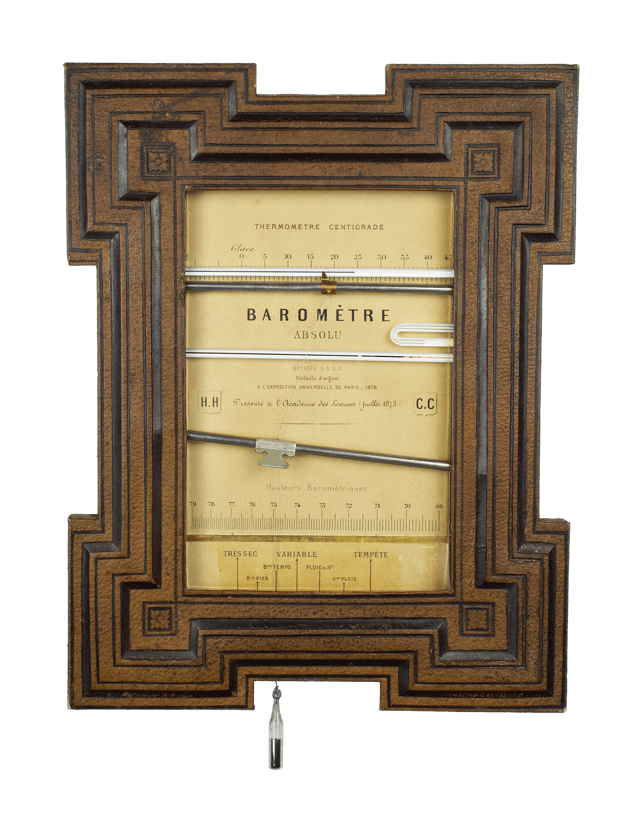
It hangs on the wall in a frame of tooled leather, and the first thing a person understands on seeing it is that he understands nothing. There is no needle. There is no dial in any ordinary sense: instead, a sheet of paper bearing two horizontal scales and two glass tubes laid across it. Beneath the glass tubes run metal ones, carrying sliding cursors joined by a thread that falls away below and ends in a small weight.
To learn the pressure you must walk up to this instrument and use your hands. Bring one cursor to the end of the thermometer column. Bring the second so that the taut thread just meets the end of the liquid in the other tube. Only then look to see where the plumb line crosses the scale. The instrument does not show you the pressure — it lets you construct it.
It is called an absolute barometer. Two thermometers are mounted parallel to one another: an ordinary mercury thermometer and an air thermometer whose capillary is open at the far end. Here the pressure is worked out geometrically, from the disagreement between those two thermometers — and the working-out was done in advance, when the scale was laid down, so that all the owner need do is stretch a thread.
The instrument was patented in 1872. In 1873 its theory was presented to the Académie des Sciences. In 1878 it took a silver medal at the Paris Universal Exhibition. In 1879 the most popular scientific journal in France wrote it up. And then it disappeared so thoroughly that today not a single photograph of a surviving example can be found in any open museum catalogue or auction archive.
It was invented by two men about whom disappointingly little is known. Both were artillery officers. Neither had anything to do with meteorology.
Vincennes in the early 1870s was an army suburb. The eastern edge of Paris, an old royal castle turned into an arsenal, a fort, a broad proving ground, depots, barracks — and artillery, artillery everywhere. An officer living there was almost certainly attached to one of these establishments.
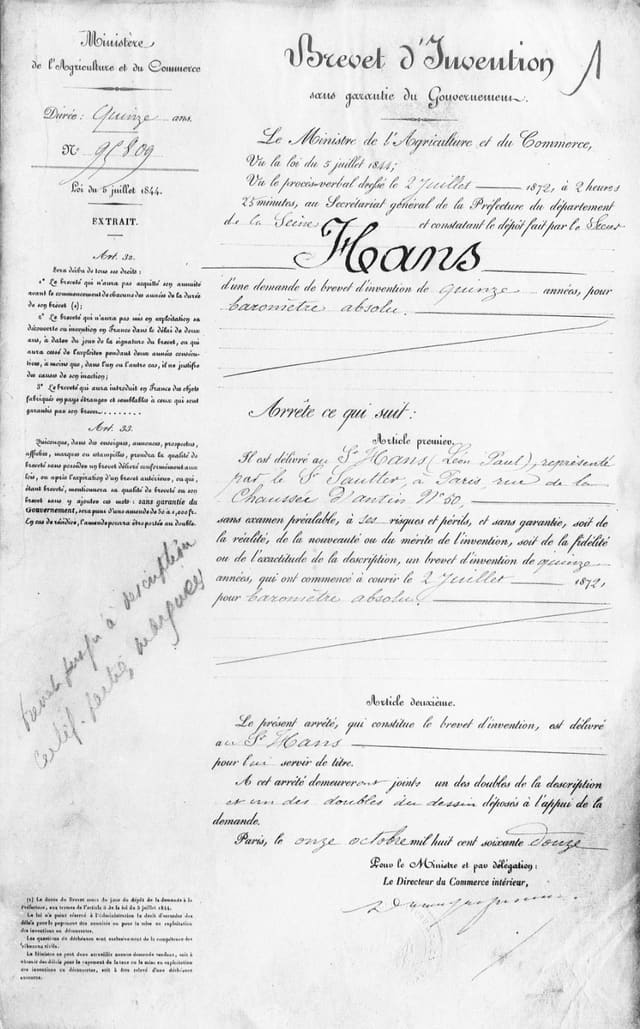
On 2 July 1872, at a quarter past two in the afternoon, an application for a patent was received at the Prefecture of the Seine. The invention was entered under the name of "absolute barometer". The applicant was Léon Paul Hans, squadron commander of artillery, resident at Vincennes.
That rank, chef d'escadron d'artillerie, corresponds to major and tells us that the man was somewhere between thirty-five and forty-five, no longer young and already established. In the papers his name is invariably followed by the same qualification: former student of the École Polytechnique.
That qualification meant a great deal in France. The Polytechnique, founded in the revolutionary years, trained not engineers in general but officers of the artillery and the engineers — the arms in which mathematics is indispensable. Its graduate was a man for whom the differential calculus was not an ornament of his education but a working tool. Poisson, Fresnel, Cauchy and Carnot came out of that school; so did obscure captains who spent their lives computing trajectories on proving grounds.
The date is worth holding in mind. July 1872 is a little more than a year after France lost her war with Prussia, lost Alsace and Lorraine, and lived through the Commune. The defeat of 1870 had been in large part an artillery defeat: the Prussian steel breech-loaders from Krupp proved better than the French bronze pieces. For the next two decades French artillery rebuilt itself entirely — its guns, its tactics, its methods of calculation. The absolute barometer was born in that fever of revision, and hardly by chance.
That, in fact, is everything known about Hans. A name, a rank, an address, a school and a patent. No year of birth, no date of death, no portrait, no letters, no obituary — none of what usually survives a nineteenth-century man. Even his Polytechnique class year, by which the French so love to identify their own, has yet to be found.
The second inventor was named Hermary. In the card index of officers' files at the Historical Service of Defence — still housed, as it happens, at Vincennes — there appears one Hippolyte Alexandre Hyacinthe Hermary, and by every sign he is our man. Also a polytechnicien, also an artilleryman.
His life can be followed a little better, and for an almost accidental reason: Hermary belonged to the French Mathematical Society, and that society printed annually a complete list of its members with their ranks and postings. From the list for 1875–1876 we learn that he was then a captain in the 20th Artillery Regiment, and that the regiment was stationed at Vincennes. From the list for 1890 we learn that he had become a lieutenant-colonel and headed the Experimental Commission at Calais. That commission was the army's establishment for ballistics: there new systems were fired, muzzle velocities measured, firing tables compiled and checked. A place for a man who enjoys calculating.
Membership of the mathematical society is itself an eloquent detail. A line officer is under no obligation to belong to such a body; one joins out of inclination.
Neither Hermary's year of birth nor his date of death has yet been established either.
No document records how they met, but the balance of what is known makes the picture nearly self-evident: both were anciens élèves de l'École polytechnique, both were artillery officers, and both were connected with Vincennes in the first half of the 1870s — Hans lived there in 1872–1873; Hermary served there as a captain of the 20th Artillery Regiment in 1875–1876, and the Vincennes artillery garrison had existed well before that. Vincennes with its proving ground was a natural point of intersection for two polytechnicien officers with a taste for precision instruments.
There is one firm point in this story, and it is not geographical but calendrical. By 14 July 1873 they were already working together: on that day the Académie des Sciences heard a note signed with both their names.
The milieu in which the partnership could have formed is known well enough, and it was a narrow one. The French artillery officer corps did not number so very many men, and those of them who had come out of the Polytechnique all passed afterwards through the School of Application of Artillery and Engineering, and thereafter circulated among the same garrisons, commissions and proving-ground detachments. Hans was the senior in rank and probably in years, so they are unlikely to have overlapped as students. But the artillery Paris of the 1870s was a few hundred men who knew one another by sight, and finding there a fellow enthusiast for air thermometers was a matter of a few conversations.
Vincennes remains the most plausible setting for such a meeting, simply because both men are documented there. Plausibility, however, is not proof, and it is more honest to say plainly: we know that from 1873 they worked together, and we do not know how they found each other.
The roles fell between them as they often do in engineering partnerships. The patent stands in Hans's name alone: he is the applicant, he is the proprietor, he signs the specification. Hermary is nowhere mentioned in the patent papers. Yet the theory of the instrument is his: in August 1878, presenting the barometer to an international gathering of meteorologists, he stated outright that he had set out the full theory shortly before in the physics section of the French Association for the Advancement of Sciences. On the same occasion he described the instrument as conceived jointly with Monsieur Hans.
Publicly they always appear together. From the very first communication to the Académie, the instrument is called in every source by one name and no other: baromètre absolu de MM. Hans et Hermary. On the dial of the example held in our foundation's collection stands a shield-shaped cartouche bearing the monogram H.H — Hans, Hermary.
The likely picture is this: Hans the initiator, author of the original conception and holder of the rights; Hermary the man who gave the idea its rigorous mathematical form, brought it to completion, and took on the business of representing it before the scientific world. The practitioner and the theorist, the senior in rank and the stronger mathematician.
In 1874 the inventors issued a notice — a slim explanatory pamphlet of seven pages, the customary way of introducing an instrument to learned society. Its title was straightforward: "Note on the absolute barometer of MM. Hans and Hermary, former students of the École Polytechnique." One copy survives — not in Paris and not in the military archives, but in the department of the Marne, among the papers of the local Society of Agriculture, Commerce, Sciences and Arts which sat at Châlons-sur-Marne.
To an outsider the connection between a gun and a barometer is not obvious. To a nineteenth-century artilleryman it needed no explaining.
A shell travels through air, and air resists it. The force of that resistance is proportional to the density of the medium, and density depends on pressure and temperature. The thinner the air, the longer the shell holds its velocity and the further it flies. On the plain the correction is small and lost in ordinary dispersion. But take a battery up into the mountains and it becomes decisive: at fifteen hundred or two thousand metres the range grows appreciably, and tables drawn up for the plain begin to lie by hundreds of metres. An overshoot in mountain warfare is not a mere inaccuracy but a direct danger to one's own side, since one's own infantry may be standing behind the ridge.
The firing tables of the later century carried corrections for air density. But to apply a correction you must know the pressure at the position. And to know the pressure you need a barometer.
There was a second connection, more direct still. Barometric levelling — determining differences in height from differences in pressure — has been known since Pascal's day, but it became a field method only with the spread of the aneroid. You cannot take a mercury barometer on campaign: it is long, fragile, must stand vertical and cannot bear jolting. The aneroid fits in a pocket like a watch, fears nothing, and lets one man judge in a minute how much higher one ridge stands than another.
For a reconnaissance officer this was an instrument of the same order as the compass and the field glass. A difference of a hundred and fifty metres between two heights decided from where a road could be swept, where to place a battery and where a picket, and by which way to bring up the train — and the answer was wanted at once, not after a day's work by a survey party. By the end of the century the aneroid formed part of the equipment of mountain troops in France, Italy, Austria-Hungary and Russia, and artillery manuals had acquired sections on the barometric determination of heights.
So the artillery officer was a man for whom atmospheric pressure was a working quantity, entering his calculations alongside the weight of the shell and the angle of elevation. He was used to thinking about air quantitatively. He commanded mathematics at a level beyond most instrument makers. And he understood better than most what an instrument you can carry with you is worth.
Hans, for that matter, set the problem more broadly, and set it out himself in the patent specification. Metal barometers, he writes, are precious in many respects but suffer one great inconvenience — they are very expensive. And the taste for meteorological observation, which appears to be growing, calls for a new instrument: one within everyone's reach, of modest price, easy to transport, simple to set up, and mathematically exact.
Five requirements. The last four read like a specification for a field instrument.
And one further sentence from the same document betrays the cast of the author's mind. Explaining why the air thermometer deserves confidence, Hans invokes Victor Regnault — the foremost French experimenter on heat and gases, whose measurements were the standard of Europe — and recalls that Regnault recommended instruments of this kind to aeronauts as the most apt to give exact results.
To aeronauts. That is, to men for whom a barometer is not a forecaster of weather at all but the only altimeter available. In the addition to the patent, filed a year later, Hans would expressly reserve to himself the rights over the application of his air thermometer to the determination of heights, and not of pressures only.
Nothing surprising, then, in the fact that a strange barometer was invented by artillerymen. The surprise is rather that nobody had invented it earlier.
The application was lodged on 2 July 1872 at twenty-five minutes past two — the clerk entered the time in the record — at the General Secretariat of the Prefecture of the Seine. The business was handled by the patent agency of Maurice Sautter in the rue de la Chaussée d'Antin, in a quarter where such offices stood one beside another. On the eleventh of October the Minister of Agriculture and Commerce signed patent number 95809 for a term of fifteen years.
Across the form, in large letters, ran the formula: sans garantie du gouvernement, without government guarantee. The French law of 1844 granted patents without examination of any kind, at the applicant's own risk and peril, and required him to say so honestly. Hence the celebrated abbreviation S.G.D.G., which still adorns thousands of French instruments, ours among them. The same law provided that it must not be displayed once the patent had lapsed, on pain of a fine.
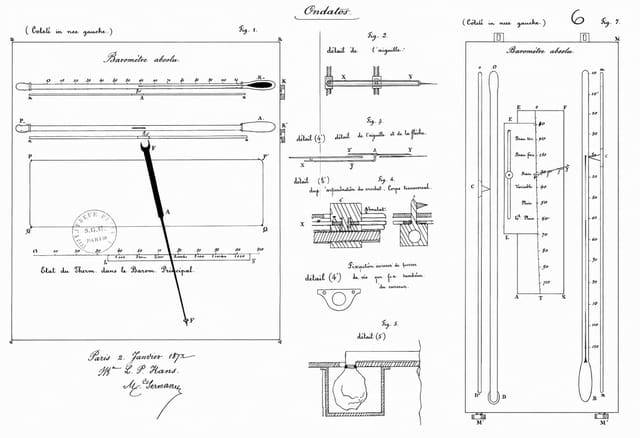
The specification runs to a leaf and a half and a hundred and forty-five lines; the clerk counted them and certified the total in a closing note. It contains three claims, and the second of them tells a story worth telling on its own, because the arrangement it protected lived exactly eleven months.
The heart of the instrument is the air thermometer: a glass tube with a reservoir in which air is confined, its volume varying both with temperature and with the pressure outside. For that volume to be observable the air must be stoppered with something — a liquid plug that slides up and down the tube like a piston.
The choice of liquid proved no trivial matter. It had to remain fluid across the whole range of European temperatures, give off no appreciable vapour, take no chemical action on the air of the reservoir, and produce perfectly constant capillary effects — otherwise the instrument would drift. Concentrated sulphuric acid met every condition, and it was sulphuric acid that Hans chose, colouring it with indigo so that it could be seen.
But sulphuric acid has a property destructive to a measuring instrument: it draws moisture greedily out of the air. Diluted, it changes in density and volume, and the readings wander. Sealing the tube shut is impossible — that would abolish the very influence being measured, since the outside pressure must bear upon the plug.
What was needed was something contradictory: a barrier impermeable to matter and transparent to pressure. And Hans devised such a barrier. He bent the open end of the tube and fitted over it a small sac of india rubber; the sac and the tube-end together were tucked into a recess hollowed in the back of the board, where they lay safe from any touch. The membrane yielded under the outside air and passed the force inward without admitting a single molecule of water.
The inventor thought highly of this arrangement and claimed it as a separate head of his patent. From the little sac he drew a promise which sounds in the specification almost solemn: the working life of the instrument becomes unlimited.
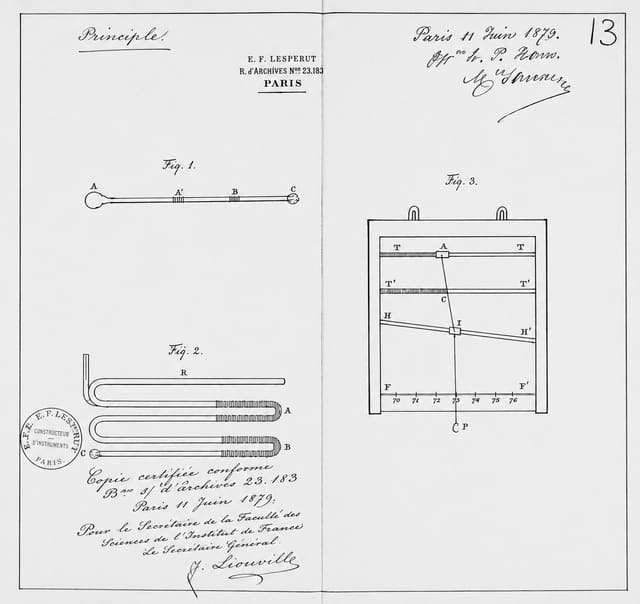
On 14 June 1873 Hans lodged at the same prefecture a certificate of addition — the document by which French law allowed improvements to be written into an existing patent without taking out a new one. And in its very first clause he wrote that the membrane discharged its office imperfectly, and that he was replacing it to advantage with another arrangement: a second liquid index of oil, as little drying as possible — clockmaker's oil, for instance — placed in the tube in front of the sulphuric acid. The oil index itself, he adds, may be protected by a small plug of cotton at the very end of the tube.
Hans does not state the reasons for his disappointment — the businesslike reticence of patent prose does not call for them. But the physics suggests them confidently enough, and they all converge on one point. An elastic membrane transmits pressure honestly only so long as its own stiffness is negligible. India rubber of the 1870s made no such promise: it hardened, lost its elasticity, went to cracks. An ageing sac begins to take part of the pressure upon itself, and the instrument lies the more the older it grows. Worse, the stiffness of rubber depends on temperature: in the cold the sac turns woody, and the error becomes a function of the very quantity the whole design labours to eliminate.
A column of oil removes the difficulty at a stroke. It is a liquid piston: it has no elasticity to lose, nothing to crack and nothing to age. The result was a layered defence — the air of the reservoir sealed by the acid, the acid insulated by the oil, the oil shielded by the cotton. Each layer guards the one before it, and none interferes with the reading.
For a collector one conclusion follows, discouraging and tantalising at once. The scheme with the rubber sac existed between July 1872 and June 1873 and, judging by the silence of every later source, was never put into production at all. Should such an example ever surface, it would be the earliest possible form of the absolute barometer.
The addition of 1873 brought two further changes. Hans directed that the tube of the air thermometer be bent several times, so that the two liquid plugs should each occupy a bend turned the same way: with that arrangement a column that has broken can easily be rejoined by whirling the instrument rapidly, either by hand or on the end of a string — the same trick by which a break is driven out of an ordinary thermometer. And, lastly, he altered the manner of reading — but of that more below.
A month later, on 14 July 1873, the theory of the instrument was laid before the Académie des Sciences.
The whole contrivance rests on a single observation, simple to the point of impudence.
The air thermometer shows the volume of the confined gas. The colder it becomes, the smaller that volume, and at minus two hundred and seventy-three degrees it would fall to nothing. The place on the tube where this would happen is unattainable, yet perfectly definite. And — here is the crux — it does not depend on pressure: nothing remains nothing, however hard the gas is squeezed.
The ordinary thermometer has a corresponding mark of its own. Extend its scale downwards, beyond the engraved divisions, to the same minus two hundred and seventy-three, and you obtain the place where the liquid column would end.
Two imaginary points on two tubes — that is the whole foundation of the design.
Now join, in the mind, the ends of the two columns, the liquid and the gaseous, by a straight line. Let the pressure hold steady while the temperature varies. Both columns lengthen in step, each measuring its own distance from its own absolute zero, and the line joining them does not wander at random — it pivots about a single fixed point. Temperature has no influence whatever on the position of that point; pressure alone determines it.
Let the pressure change, and the point shifts. But not just anywhere: all its possible positions lie on one straight line, and that line passes through both of the imaginary absolute-zero marks.
Hans calls it the line of absolute zeros. It is the pressure scale. To graduate the instrument means to set out the marks along that line; to take a reading means to find where the stretched thread crosses it.
Hence the name. The barometer is absolute because its scale rests physically upon the absolute zero of temperature. Minus two hundred and seventy-three is here no abstraction out of a textbook but a place on a board, between two glass tubes.
Hans's proof of his theorem has an elegance worth repeating. If the laws of expansion of liquids and gases be extended far enough, he writes, one may imagine the straight line joining the ends of the columns at the temperature of absolute zero. That line remains the same at any pressure, since the volume of the air is nil. It therefore passes through all the points sought.
The word "absolute" carries a second and more earthly sense as well, set out on the dial itself: hauteur barométrique absolue — the height a good mercury barometer would give at zero degrees. The reading is already reduced to zero and needs none of the temperature correction obligatory for a true mercury instrument. Both senses work at once, and the author, one supposes, was quite content with that.
The formula by which the scale was laid out appears in the specification and runs thus: the pressure equals seven hundred and sixty multiplied by the ratio of two quantities — two hundred and seventy-three plus the true temperature, to two hundred and seventy-three plus the apparent temperature. The apparent temperature is the one the air thermometer would show if it had been graduated as an ordinary thermometer at normal pressure.
The meaning is simpler than the look of it. The air thermometer by itself cannot distinguish temperature from pressure: it measures their ratio and nothing more. The ordinary thermometer says what the length of the gas column ought to be. The air thermometer shows what it actually is. The whole difference is charged to the atmosphere.
The easiest way to read this is as a measure of the disagreement between two thermometers. The readings coincide — the pressure is exactly seven hundred and sixty millimetres. The air thermometer reads higher — then the gas has expanded more than temperature accounts for, so it is being squeezed less, so the pressure is below normal. The air thermometer reads lower — the gas is compressed more than expected, and the pressure is above.
The instrument, in other words, measures the weather as a quarrel between two thermometers.
The relation is hyperbolic, but across the working stretch from six hundred and ninety to seven hundred and ninety millimetres, that is within some six per cent, the hyperbola is all but indistinguishable from a straight line — which is why the divisions come out practically equal, and why a second, sliding graduation could be set against the first.
And, most important of all: the owner need calculate nothing. The formula served the maker when he laid out the scale. The observer moves two cursors and reads off a figure. The calculation was performed once and for all by whoever drew the line of absolute zeros.
Essentially, Hans and Hermary reinvented the sympiesometer—an air barometer—by placing it in a different form factor. As in a sympiesometer, the effect of temperature is compensated directly when taking a reading.
The line of absolute zeros joins points lying on different tubes, and therefore runs obliquely, crossing the field of the instrument on the diagonal. In the original version of 1872 the reading was taken along it. Geometrically impeccable and practically excruciating: the divisions stand at an angle, the figures must be tilted, the eye interpolates badly along a diagonal, and beside such a scale nothing else can be fitted. The line itself was there made material by a rod of solid glass along which a cursor travelled — a solution as elegant as it was fragile.
In the addition of 1873 Hans made the move that gave the instrument its final appearance: he transferred the reading from the oblique line to its horizontal projection.
It works like this. The upper cursor is set to the end of the ordinary thermometer's column; it carries the thread, tensioned by a small weight. The thread passes through the lower cursor, which is led along the line of pressures until the thread comes level with the end of the liquid in the air thermometer. Then the weight takes over: below the lower cursor the thread hangs strictly vertical and drops the position found down onto the horizontal scale at the foot of the dial. There the reading is taken.
Hans states the outcome dryly and exactly: the pressure is determined by the meeting of two lines at right angles. One of them is the scale; the other is a plumb line.
The projection spoils nothing. All distances are compressed by one and the same factor, the order of the divisions is preserved, equal intervals remain equal — this is a change of coordinates, not an approximation. And the gain is threefold. The scale became a level horizontal band, convenient to print and easy to read. Beneath it room opened up for the verbal legend, and the legend could be made to slide. And the thread became, incidentally, a plumb line testing whether the instrument hangs true — hence the categorical instruction to suspend the barometer strictly vertically: a tilt would ruin the projection itself.
The branches of the tube not needed for the reading are folded back behind the board: the reservoir and the surplus bends go under the rear cover, and only the working stretch remains in front. Which is why the air thermometer, once taken out of its frame, proves far more sinuous than one would guess from looking at the assembled instrument.
So the man standing before the barometer sees an ordinary-looking scale with figures on it. The oblique line of pressures is nowhere on the dial. It stayed behind in the geometry, and what has been brought out onto the paper is only its shadow.
But look closely at the figures and the ordinariness ends. The barometric scale, headed "Hauteurs Barométriques", is marked in centimetres of mercury from seventy-nine at the left to sixty-nine at the right. Larger values to the left, smaller to the right — exactly the reverse of what every European barometer has taught its owner to expect.
The cause lies in the inverse response of the air thermometer: a rise in outside pressure compresses the confined gas and drives the liquid plug the opposite way to the familiar one. The geometry dutifully inherits that direction, and the scale turns about.
The verbal legend turns with it. "Très sec", very dry, stands at the left; "tempête", storm, at the right; and between them, in descending order of optimism, "beau fixe", "beau temps", "variable", "pluie ou vent", "grande pluie". On any aneroid the order is the other way round. To a nineteenth-century owner accustomed to storm at the left and fair at the right, the instrument announced from the threshold that it was built unlike the rest.
That legend is carried on a separate block sliding in the lower part of the case. On the edge of the frame is engraved yet another scale, which has nothing to do with the weather: nought, one hundred, two hundred, three hundred, four hundred, five hundred — metres above sea level, with intermediate strokes every fifty. On the fixed part is a tiny brass pointer. By moving the block until the pointer coincides with the altitude of his own locality, the observer brings the verbal forecast into agreement with local conditions: high up the pressure is lower, and "changeable" must fall against a different figure than it does on the coast.
A separate slip on the back cover states the rule without circumlocution: the barometer is set for a given place when the pointer corresponds on the scale to the height of that place above sea level.
It is curious that Hermary did not approve of this device. Speaking before the meteorologists in 1878, he remarked that reduction to sea level is a constant source of error for many people, and that he described the means of applying it solely for the case where one might think fit to conform to a fairly widespread custom. We did it because everyone does, not because we think it right. For what is essentially promotional copy, a rare piece of candour.
Recognition came by every step that existed in the French science of that day, and all of them are stamped on the instrument itself: three on the front dial, the fourth in the text of the instructions on the back cover.
The first was the Académie des Sciences. On 14 July 1873 its meeting heard the note of MM. Hans and Hermary on a barometer termed absolute. From that day the name of the instrument and the names of its authors are locked together: in every subsequent source it is called that and nothing else.
Then, in 1874, came the seven-page pamphlet whose sole surviving copy now lies in the Châlons archive.
In the summer of 1878 Paris hosted a Universal Exhibition — her third, and the first since the war, conceived as a demonstration that France had recovered. On the hill of Chaillot the Palais du Trocadéro was raised for the occasion, and in the garden before it a meteorological pavilion was set up. There the absolute barometer stood. The exhibition jury awarded it a silver medal — an inscription to that effect Hans and Hermary promptly put on the dial, where it stands to this day.
Congresses ran alongside the exhibition, as was the custom. On 26 August 1878 the International Meteorological Congress assembled at the Palais des Tuileries under the presidency of Domenico Ragona, director of the observatory at Modena. At the morning session Hermary took the floor.
He began with a sentence that says a good deal about the man: the theory of this barometer does not fall within the questions the Congress has to consider, and therefore I shall confine myself to indicating it very briefly. There followed the principle in three sentences and three points of instruction for handling the instrument — move one cursor, move the other, read against the thread.
Then he said something not often said of one's own invention. For regularity of behaviour and instantaneity of indication, Hermary declared, the absolute barometer is superior to all other portable barometers, and it is on that ground that he commends it for observations at stations of secondary importance. But, he added at once, it goes without saying that the mercury barometer must always be used, to the exclusion of every other, as the control instrument and for the principal observations.
A man who understands clearly the difference between a good instrument and a standard, and does not confuse them even in his moment of triumph.
On the same occasion he showed the assembly a new model, differing, in his words, by a single particular: the thread against which the reading is taken, instead of falling vertically, passes through a fixed point, whereby the barometric scale becomes circular. That version was designed for observations aboard ship.
And in July of the following year, 1879, the journal La Nature wrote up the instrument.
The journal deserves a word of explanation, as does the man who founded it. La Nature appeared weekly from 1873 and was the finest popular scientific journal on the continent: superb engravings, a lucid style, a range from palaeontology to electrical engineering, readers all across Europe. It was founded and directed by Gaston Tissandier — chemist, aeronaut and populariser, and in his day a famous figure.
To barometers Tissandier stood in the most personal of relations. During the Prussian siege of Paris in 1870 he flew out of the encircled city by balloon. In April 1875 he took part in the ascent of the balloon Zénith, which reached a height of about eight and a half kilometres; two of his companions, Sivel and Crocé-Spinelli, died of oxygen starvation, while he survived, deafened in one ear. Eight years later, together with his brother Albert, he built an airship driven by an electric motor.
To an aeronaut a barometer is no wall ornament but the sole instrument that reports his height, and Tissandier knew the worth of an exact measurement of pressure not in theory but in his body. His interest in the invention of two artillerymen was thus the interest of a professional.
The article "Baromètre absolu de MM. Hans et Hermary" appeared on 5 July 1879, in number three hundred and eighteen, on pages seventy-one and seventy-two, with an engraving of the instrument and a diagram of the air thermometer. It is precisely this reference that is printed on the back cover of the surviving example — and it gives the lower bound of its dating: the case cannot have been assembled before the summer of 1879.
Later, in another volume of the journal, Tissandier returned to the subject in a short note. There he reported that a skilful constructor, Monsieur Lespérut, had succeeded in completely altering the form of the first instrument of MM. Hans and Hermary and in making it far more practical and far more accurate.
The absolute barometer of the latest model is circular. All its organs are enclosed in a round frame with an internal rebate, which does away with the protective metal box at the back of the case, the effect of which, the author remarks, was most ungraceful. All friction and all lag are reduced in the new instrument to nothing. The cursors are now moved not by finger-tabs but by knobs around the edge of the frame, through a mechanism concealed within; the reading is taken against an index pointer which slides together with the thread. Two further knobs, left and right, hold the inner frame in place: they are unscrewed in order to set the "changeable" division against the altitude of the locality.
It is worth noting that the circular form was not Lespérut's invention — Hermary himself had shown it at the congress of 1878. The constructor's merit lies elsewhere: he brought the idea to a finished, commercially viable state, replacing the hand movement of the cursors with a mechanical one and doing away with friction.
The documents record no formal rupture between the inventors. To all appearances the collaboration simply ran dry at the turn of the seventies and eighties.
The medal of 1878 and the article of 1879 were the summit. Thereafter the paths diverge. Hermary goes over to ballistics: trials, firing tables, muzzle velocities. By 1890 he is a lieutenant-colonel heading the Experimental Commission at Calais — a serious post and, one must suppose, an all-consuming one. By then the instrument is being improved by an outsider. And the traces of Hans vanish altogether: after 1879 nothing about him has been found.
The patent expired on 2 July 1887 — fifteen years from the day of filing. The inscription S.G.D.G. on the dial had meaning only while the patent lived; displaying it afterwards was forbidden by law on pain of a fine. This gives an unexpectedly firm window for dating surviving examples: between 1879, when the article appeared in La Nature whose reference is printed on the back cover, and 1887, when the rights ran out. Eight years, no more.
By the end of the century the absolute barometer had gone out of use. The cause was not quality but economics. The aneroid grew cheaper year by year, grew more reliable, and — above all — asked absolutely nothing of its owner. An instrument whose reading must be built with one's own hands lost to an instrument at which a glance in passing suffices. So it nearly always goes.
Both inventors, one imagines, took it calmly. They were officers, not manufacturers. The barometer remained an episode in their lives — a brilliant one, but an episode.
The absolute barometer is an instrument that need never have existed.
It was invented by men with no professional connection to meteorology whatever. It dispenses with the two technologies on which the whole barometric trade of the nineteenth century rested: the Torricellian mercury tube and the aneroid capsule. It demands action from its owner where every other instrument demands only a glance. Its scale runs from right to left, and its verbal forecast is reversed. And at its foundation lies not a mechanism but a theorem, which the author thought fit to patent on equal terms with the device.
For all that, it works, and works well. Hermary did not overstate the case: the instrument has neither the lag of an aneroid membrane, nor the caprices of a mercury column, nor any need of a temperature correction. It united thermometry, the physics of gases and geometry in an object one hangs in the dining room.
Three pages of handwritten specification and eleven months of refinement separate the absolute zero of temperature from a frame of tooled leather. The instrument never came into wide use and remained a rarity — but every surviving example is a reminder of how, in the century before last, men looked for new ways of measuring atmospheric pressure, striving for accuracy, for simplicity, and for independence from calculation.
And a reminder, too, that the most singular things are often invented by people who came to the subject from outside.