Loading
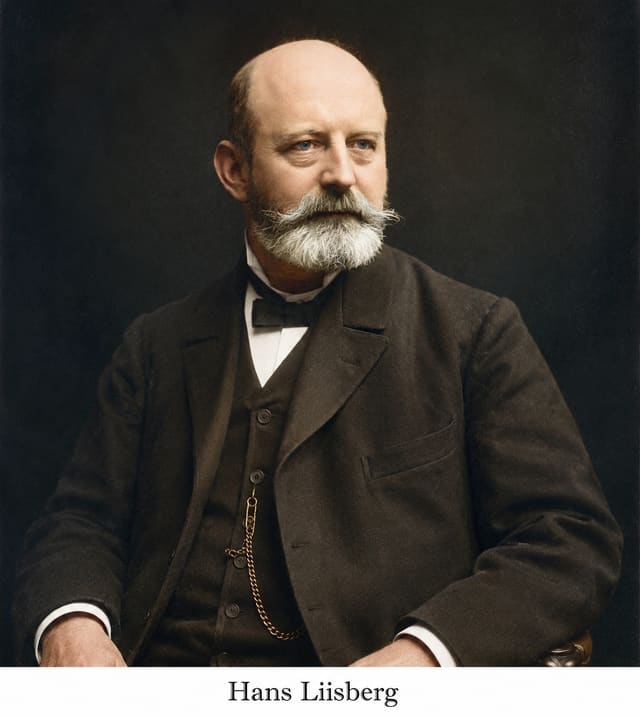
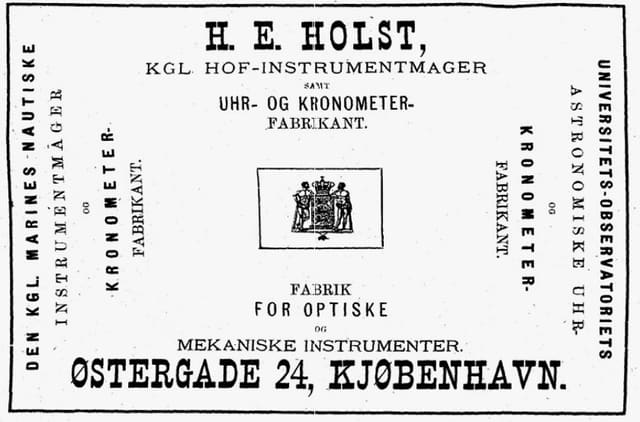
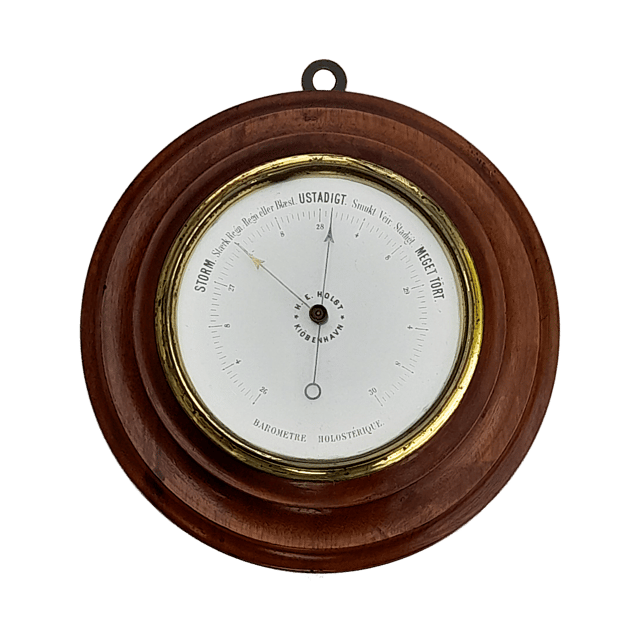
was a Copenhagen firm of Royal Court instrument makers, watchmakers, and chronometer manufacturers, founded in 1859 by (1825–1892) and continued from 1881 by his successor (b. 1860). The company manufactured and stocked a comprehensive range of navigational and scientific instruments, including marine chronometers, compasses, logs and sounding machines, sextants, octants, marine binoculars, barometers, thermometers, and drawing instruments. It served as a supplier to the Royal Danish Navy and acted as watchmaker and chronometer maker to the Copenhagen Observatory.
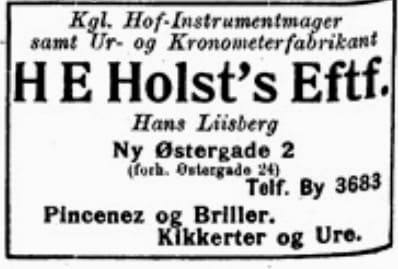
The firm traded from Østergade 24 in central Copenhagen before later relocating to the nearby Ny Østergade 2. Under Liisberg’s ownership it was still active in 1911, styling itself “Kgl. Hof-Ur- og Kronometerfabrikant” (“Royal Court Watch and Chronometer Manufacturer”).
Surviving instruments confirm that the firm both retailed and signed scientific instruments. However, the available evidence does not allow one to determine with certainty whether Holst’s workshop actually manufactured barometers itself, rather than assembling, finishing, or importing them.
The Craft Context: Copenhagen Instrument Makers and the Royal Court Privilege
During the second half of the nineteenth century, Copenhagen functioned simultaneously as the workshop and maritime marketplace of a major seafaring nation. Both the Danish merchant marine and the Royal Danish Navy depended upon a continuous supply of precision instruments: chronometers to carry Greenwich time at sea; sextants and octants to determine the altitude of the Sun and stars; compasses, logs, and sounding machines to monitor course and depth; and barometers and thermometers to interpret the weather. Much of this trade was concentrated in a small number of highly specialized firms clustered along the fashionable commercial streets of the old city, most notably Østergade and Købmagergade.
The best documented of these competitors was the firm of Cornelius Knudsen, established in 1838 on Gråbrødretorv (then Ulfeldtsplads) and later directed by Theodor Cornelius-Knudsen (1844–1920). According to Dansk Biografisk Leksikon, his newly designed navigational and scientific instruments “became world famous” (blev verdenskendte). In 1898 he received the title of Royal Court Instrument Maker, and that same year his firm moved to Købmagergade 15.
Another major establishment grew from the workshop of Edvard Jünger, which was taken over in 1869 by the mechanic Christopher Peter Jürgensen (1838–1911), a former apprentice of Julius Nissen on Købmagergade. From its premises on Sortedam Dossering, Jürgensen developed what Dansk Biografisk Leksikon describes as “the most renowned firm in Scandinavia for the manufacture of optical, surveying and navigational instruments,” supplying equipment to the General Staff’s Topographical Department and to the University’s Astronomical Observatory.
A third prominent house was that of Iver C. Weilbach, whose business had traded in navigational instruments and nautical charts since the eighteenth century.
It was within this highly competitive environment—and against precisely these rivals—that Hans Edvard Holst established, and through his successor Hans Liisberg maintained, a Royal Court instrument-making business for more than half a century.
The title borne by both Holst and Liisberg—“Kgl. Hof-Instrumentmager” (“Royal Court Instrument Maker”)—was not a salaried court office but an honorary distinction granted to approved suppliers of the Royal Household. It served primarily as a mark of quality, prestige, and official recognition.
Even more commercially significant were the firm’s additional claims to be “Den kgl. Marines Leverandeur” (“Supplier to the Royal Danish Navy”) and “Observatoriets Uhr- og Chronometermager” (“Watchmaker and Chronometer Maker to the Observatory”). These titles certified the company as an officially recognised supplier and regulator of chronometers for two Danish institutions whose work depended fundamentally upon precise timekeeping: the Royal Navy and the University Observatory.
Founder: Hans Edvard Holst (1825–1892)
Reference works, most notably Danmarks ældste Forretninger (“Denmark’s Oldest Businesses”), record that the firm was founded in 1859 by Hans Edvard Holst, who was born in 1825 and died in 1892. Beyond these basic facts, however, the founder’s biography remains surprisingly difficult to reconstruct. His place of birth, apprenticeship, professional training, the precise circumstances under which he established the business in 1859, and the exact date on which he received the Royal Court appointment have not been identified in the presently available sources.
Nevertheless, Holst’s standing within Copenhagen society can be glimpsed indirectly through family records. A genealogical publication refers to him as the late “Kgl. Hof-Uhr- og Kronometerfabrikant Hans Edvard Holst paa Østergade” (“Royal Court Watch and Chronometer Manufacturer Hans Edvard Holst of Østergade”), in whose household his niece Agnes Petra Holst was raised. Although this constitutes a secondary rather than a primary historical source, it nevertheless confirms that Holst left behind considerably more than an obscure workshop: he had become a recognised figure within Copenhagen’s commercial and artisanal community.
What the surviving instruments establish with much greater certainty is that Holst signed both watches and larger precision mechanisms under his own name. Among the surviving examples are an 18-carat gold pocket watch bearing the signature “H. E. Holst, Kjøbenhavn”, dating from the mid-nineteenth century, as well as marble-and-bronze mantel clocks and a weight-driven regulator, likewise signed “H. E. Holst” of Copenhagen.
These surviving pieces correspond closely with the dual nature of Holst’s business, which combined the activities of an instrument maker with those of a watchmaker and chronometer manufacturer. They also strongly suggest that Holst’s own technical background lay primarily in horology.
An intriguing contemporary observation further reinforces this impression. Writing about the great Nordic Exhibition of Industry, Agriculture and Art held in Copenhagen in 1888, a local mechanical engineer referred to “Holst, der vel nærmest er Uhrmager”—“Holst, who is, after all, primarily a watchmaker.” Although the passage cannot be attributed with complete certainty to Hans Edvard Holst himself, the description corresponds remarkably well with the firm’s pronounced horological profile and therefore provides valuable contemporary insight into how the business was perceived by fellow craftsmen.
Successor: Hans Liisberg (b. 1860)
The business passed to Hans Liisberg in 1881. Born on 22 April 1860 in Aarhus, he was the son of the city councillor H. Liisberg and Julie, née Lassen. He completed his secondary education in 1877 and obtained the degree of cand. phil. in 1878, a qualification that reflected a broader academic education than was typical for many craftsmen of the period.
Considering Liisberg’s age at the time he assumed control of the firm, together with the established customs of the Danish guild system, the most plausible reconstruction is that he had served his apprenticeship or worked as a journeyman in Holst’s workshop before becoming its proprietor. No direct documentary evidence describing either his apprenticeship or the precise legal circumstances of the 1881 transfer has yet been discovered, and this conclusion therefore remains an informed historical inference rather than a documented fact.
An independent confirmation of Liisberg’s professional standing appears in the German journal Deutsche Uhrmacher-Zeitung, where a contemporary notice refers to him as:
“gegenwärtigen Innungsmeisters, Hofinstrumentenmachers H. J. Liisberg (i. Fa. H. E. Holst’s Eftf., Østergade 24)”
that is,
“the current Master of the Guild, Royal Court Instrument Maker H. J. Liisberg (of the firm H. E. Holst’s Efterfølger, Østergade 24).”
This brief notice is particularly revealing. It demonstrates that under Liisberg the firm represented far more than a respected inherited trade name; it had become one of the recognised centres of Copenhagen’s instrument-making profession, with its proprietor serving as head of the local guild.
Following the transfer of ownership, the business adopted the name H. E. Holst’s Efterfølger (“Successor to H. E. Holst”), retaining the founder’s name as its commercial identity while identifying Liisberg as its proprietor. This was a widespread Danish commercial convention, usually abbreviated “Eftf.”, which enabled a successor to preserve the reputation and goodwill associated with a well-established business.
The fact that this new trading name was already in use by 1884, several years before Holst’s death in 1892, is historically significant. It demonstrates that the transfer of 1881 represented a genuine change of ownership during the founder’s lifetime rather than a posthumous succession.
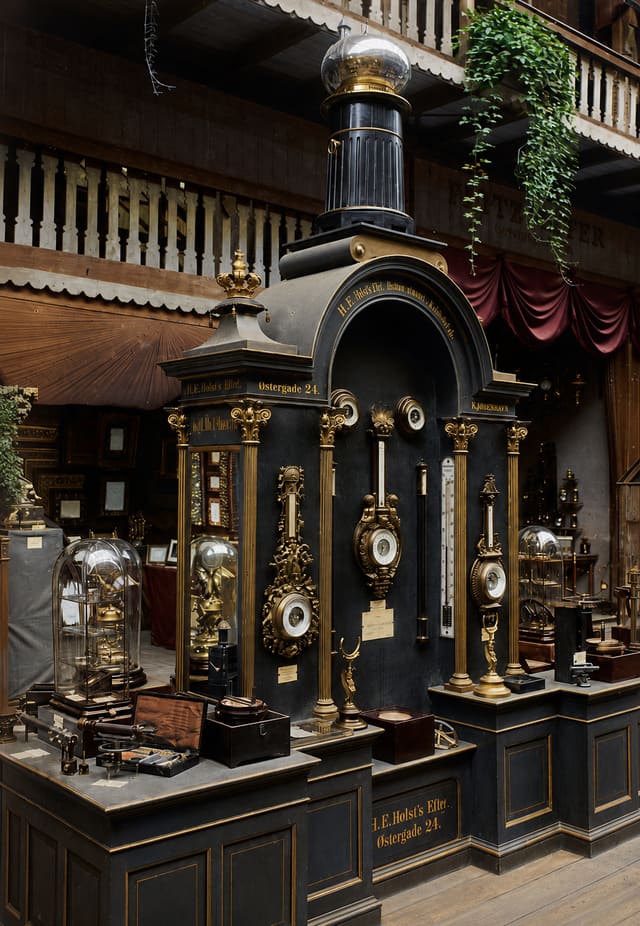
During Liisberg’s tenure the firm was not an isolated workshop but an active participant in Copenhagen’s industrial and commercial life. This is particularly evident at the Nordic Exhibition of Industry, Agriculture and Art held in Copenhagen in 1888. The archive of Danmarks Tekniske Kulturarv preserves at least two separate photographs of the company’s exhibition stand, both entitled “Watchmaker H. E. Holst’s Efterfølger’s Exhibition in the Main Hall” and dated 1888. One photograph is catalogued under the subjects “watchmakers” and “crafts”, while the other is classified under “watchmakers,” “clocks,” and “watchmaking tools.” These images provide rare visual evidence of the firm’s public presence at one of the most important industrial exhibitions in nineteenth-century Scandinavia.
Under Liisberg the company retained both its Royal Court appointment and its institutional connections. It remained in business at least until 1911, by which time it had moved a short distance from Østergade 24 to Ny Østergade 2. Contemporary trade directories continued to describe the firm as “Kgl. Hof-Ur- og Kronometerfabrikant” (“Royal Court Watch and Chronometer Manufacturer”) and even listed its telephone number, By 3683, reflecting its continued position as an established Copenhagen business.
The later career of Hans Liisberg and the ultimate fate of the company remain unresolved. The firm has not been located in the Copenhagen Kraks directories of the mid-1930s, suggesting that it was either dissolved or absorbed by another enterprise sometime between 1911 and the 1930s.
Products
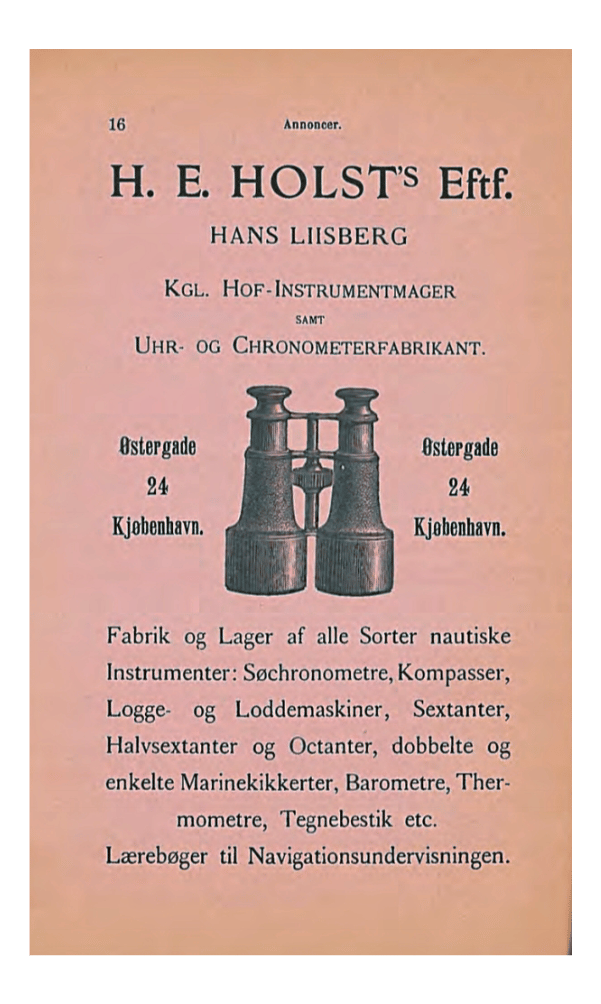
The firm’s surviving advertisements reveal an exceptionally comprehensive catalogue of navigational and scientific instruments, reflecting the full scope of a nineteenth-century marine instrument house. Its range included marine chronometers (), compasses (), logs and sounding machines (), sextants (), half-sextants and octants (), single and binocular marine telescopes (), barometers (), thermometers (), drawing instruments (), and even textbooks for navigational instruction ().
The firm’s advertisement of 1884 expands this picture even further. Besides listing astronomical regulator clocks (Astronomiske Penduluhre), it describes the establishment as a “Fabrik og Lager”—a factory and warehouse—for chronometers, clocks, and navigational, mechanical, and optical instruments, while also explicitly advertising repair services. This wording suggests that the company regarded itself not merely as a retail establishment but as an enterprise combining manufacturing, stockholding, and technical servicing.
Further evidence comes from Tidsskrift for Søvæsen (“Journal of Naval Affairs”) published in 1894, together with contemporary navigational manuals preserved in digital collections. In these advertisements H. E. Holst’s Eftf., Hans Liisberg presents itself as the manufacturer and stockholder of “alle Sorter nautiske Instrumenter”—“all kinds of nautical instruments.” The advertised range again includes marine chronometers, compasses, logs and sounding machines, sextants, half-sextants, octants, marine binoculars, barometers, thermometers, drawing instruments, and textbooks for navigation schools.
Taken together, these advertisements demonstrate that the firm was far more than a manufacturer of clocks or a retailer of barometers. Rather, it occupied a position characteristic of the great maritime capitals of the nineteenth century: a comprehensive nautical instrument house, where timekeeping, navigation, optics, meteorology, and hydrographic measurement formed parts of a single commercial and technical enterprise serving the maritime world.
As the twentieth century approached, however, the firm’s commercial emphasis appears gradually to have shifted toward optics and urban retail trade. In the Elite Vejviser directory of 1907, the company is listed under optical instruments. By the Copenhagen trade directories of 1914, and especially 1916, the title “Kgl. Hof-Instrumentmager samt Ur- og Kronometerfabrikant” remained prominently displayed, but the advertisements increasingly focused on pince-nez, spectacles, binoculars, and watches, suggesting an adaptation to the growing civilian consumer market while continuing to preserve its long-established reputation in precision instrument making.
Whether Holst and later Liisberg actually manufactured barometers and other complex scientific instruments entirely within their own workshops—or instead acted primarily as assemblers, finishers, and retailers using imported mechanisms from England, France, and Germany—cannot be established conclusively from the surviving evidence.
The word “Fabrik” used in the firm’s advertisements certainly implies manufacturing activity, while the company’s production of regulators, astronomical clocks, and chronometers points to genuine workshop capabilities on the horological side of the business. At the same time, it was common practice among nineteenth-century Danish instrumentmagere to combine in-house manufacture and finishing with the importation and retail sale of scientific instruments. Aneroid movements, in particular, were frequently manufactured abroad in large quantities before being cased, fitted with locally produced dials, adjusted, and signed by Danish instrument makers.
This broader pattern is explicitly confirmed by the Danish museum survey “Museumsnumre 25: Barometer”, published by Historie-Online.dk, which states that until around 1900, it was primarily Danish opticians, watchmakers, and instrument makers who were responsible for the production of barometers, before manufacture and distribution gradually became concentrated within larger industrial firms.
Holst and Liisberg fit this pattern remarkably well, as do their principal Copenhagen contemporaries, including Cornelius Knudsen and Iver C. Weilbach. Their business illustrates the characteristic nineteenth-century Scandinavian model in which imported mechanisms, local craftsmanship, precision adjustment, and commercial distribution were combined within a single instrument-making establishment.
The Final Years of the Firm
The last securely datable and readily verifiable references to the company in widely accessible trade directories are those of 1914 and 1916, where the business still appears as H. E. Holst’s Eftf., Hans Liisberg, now operating from Ny Østergade 2. By 1916 the firm continued to retain its prestigious Royal Court title, its established telephone number, and its long-standing commercial identity, although the emphasis of its advertising had shifted increasingly toward spectacles, binoculars, and watches, reflecting the changing demands of the early twentieth-century market.
Beyond this point, the documentary trail grows faint. No reliable public records have yet been identified that clearly document the company’s subsequent history, its closure, or any formal transfer of ownership. Likewise, no evidence has been found to indicate whether the business was dissolved, absorbed into another Copenhagen instrument house, or gradually disappeared as Denmark’s scientific instrument trade underwent industrial consolidation during the interwar period.
Even with these unanswered questions, the overall history of the firm emerges with remarkable clarity. Founded in 1859 by Hans Edvard Holst, the company developed into one of Copenhagen’s recognised Royal Court instrument houses, serving the maritime community, the scientific world, and—at least according to its own advertisements—the Copenhagen Observatory itself. Under Hans Julius Liisberg, the business not only preserved the founder’s reputation but strengthened it through participation in industrial exhibitions, active involvement in Copenhagen’s guild system, extensive advertising in navigational publications, and the maintenance of an exceptionally broad catalogue of precision instruments.
Today, the signature “H. E. Holst’s Efterfølger” found on a barometer dial represents considerably more than a commercial trademark. It reflects the work of one of Copenhagen’s respected Royal Court instrument houses, whose history mirrors the development of Danish scientific craftsmanship during the second half of the nineteenth century. Through its association with navigation, precision timekeeping, meteorology, and the maritime culture of Denmark, H. E. Holst’s Efterfølger deserves to be regarded not as an obscure name surviving on a handful of instruments, but as a significant chapter in the history of Danish scientific instrument making.
Sources
Kraks Vejviser 1884 (Copenhagen trade/address directory), advertisement and business index — the firm's own advertisement ("Østergade 24… Kgl. Hof-Instrumentmager samt Uhr- og Chronometerfabrikant H. E. Holst's Efterfølger, Hans Liisberg. Den kgl. Marines Leverandeur, Observatoriets Uhr- og Chronometermager…"). Digitised scan at user-9y8ca5x.cld.bz.
Kraks Vejviser 1911, part 2 ("Urmagere" trade register), p. 677 — "HOLST's H E EFTF., HANS LIISBERG Ny Østerg. 2… Kgl. Hof-Ur- og Kronometerfabrikant. Forhen Østerg. 24." Digitised scan at user-9y8ca5x.cld.bz.
Copenhagen Address Directories (1907, 1914 and 1916 editions) — documentary evidence for the firm's successive business addresses, its later commercial development, and the gradual expansion of its catalogue towards optical instruments, spectacles, binoculars and watches alongside traditional scientific and nautical instruments.
"Danmarks ældste Forretninger" (Denmark's oldest businesses) directory entry, as supplied — founding in 1859 by Hans Edvard Holst (1825–1892), succession to H. Liisberg in 1881, address Ny Østergade 2 (referenced via coneliand.dk, "Erhvervsdrivende… side 256 Holm–Hols").
Kraks Blå Bog 1910 — principal biographical source for Hans Julius Liisberg, including his date and place of birth, education, succession to the firm in 1881, and his positions within the Copenhagen watchmakers' guild and the national horological association.
Danmarks Tekniske Kulturarv (Danish Technical Heritage) — photographic documentation of the firm's exhibition stand at the Nordic Exhibition of Industry, Agriculture and Art (1888), together with references to the company in contemporary Danish technical literature.
Tidsskrift for Søvæsen and related Danish nautical and navigation journals — contemporary advertisements and commercial notices documenting the firm's range of marine instruments, including barometers, chronometers, compasses, sextants, thermometers and other navigational equipment.
Kongelig Dansk Hof / Hof- og Statskalender (Royal Danish Court Calendar) — official confirmation of the court appointments and honorary titles held by Hans Edvard Holst and later Hans Julius Liisberg as Royal Court instrument and chronometer makers.
Royal Danish Library (Det Kgl. Bibliotek) / LOAR — authority and portrait records identifying Hans Julius Liisberg as an instrumentmager (instrument maker) and urmager (watchmaker), providing biographical and bibliographical metadata.
Advertisement page (page 16) supplied by the commissioning party, with the illustrated marine binoculars and the full Danish product list.
DBA.dk listing of a signed copper barometer, "H.E. Holst's efterfølger, Kjøbenhavn," c. 1900.
Scandinavian auction records (via aggregated listings from Lauritz.com, Sikö Auktioner, Stockholms Auktionsverk, Göteborgs Auktionskammare and Snapphane Auktioner) documenting signed Holst / H. E. Holst's Eftf. clocks, regulators, pocket watches, a surveyor's compass, and other scientific instruments.
Dansk Biografisk Leksikon (biografiskleksikon.lex.dk), articles on Theodor Cornelius-Knudsen (1844–1920) and Christopher Peter Jürgensen (1838–1911) — for the competitive context of the Copenhagen scientific instrument trade.
"Museumsnumre 25: Barometer", historie-online.dk (Dansk Historisk Fællesråd) — on the Danish barometer trade and the role of opticians, watchmakers and instrument-makers in barometer production up to 1900.
The International Rasmus Malling-Hansen Society (malling-hansen.org, "Production places") — for the contemporary reference to "Holst, der vel nærmest er Uhrmager" and for background on the Jünger/Jürgensen and Nissen workshops.
Iver C. Weilbach (weilbach.com) — for the continuing Copenhagen nautical-instrument trade context.