
Loading
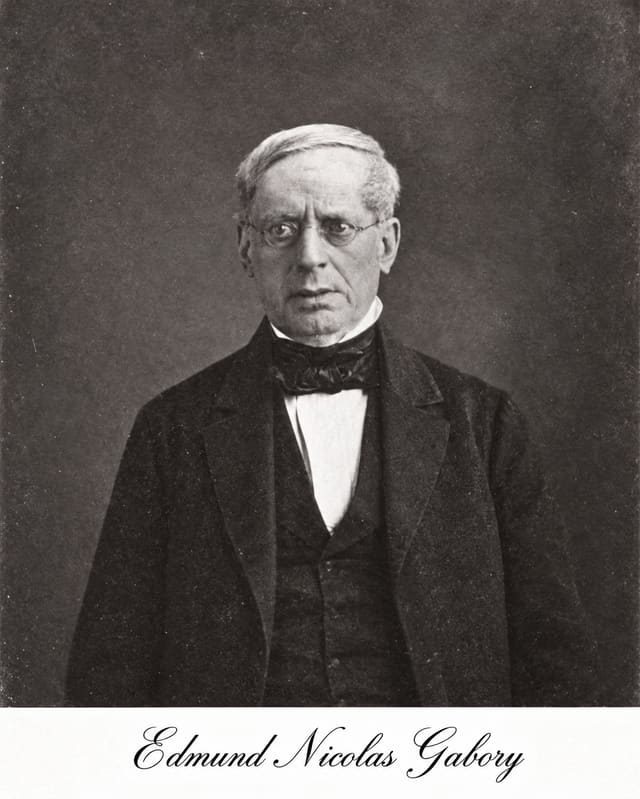
In late November 1839, a few small silvered copper plates from Paris went on display in the window of the optician Edmund Gabory on Neue Burg, a stone's throw from Hamburg's Church of St. Nicholas. A little over three months had passed since the French Academy had made Daguerre's process public. People of Hamburg bent over the plates with a magnifying glass and saw something nobody had seen before: streets, façades and shadows transferred onto metal by light itself, without brush or pencil. On 29 November the wrote that these "light drawings" were more perfect than any image made by human hand: they were nature itself, as far as nature could be contained in a picture at all. Where the eye fell short, the magnifying glass completed the impression, "and precisely therein lies the wondrous and the incomprehensible."
The name above the shop belonged to a man who had died a quarter of a century earlier. Behind the counter stood his son and his son-in-law, a native of Heligoland who, according to family tradition, had run Napoleon's blockade in his youth. Two and a half years later the house would burn down in the Great Fire of Hamburg. A little over three years after that, the firm would split in two. One branch would die out in 1888, leaving behind a two-line entry in the commercial register. The other would survive cholera, two world wars and the destruction of the city, and is still at work in Hamburg today.
In 1914 a contemporary described the site of the house on Neue Burg as lying "roughly where the altar of St. Nicholas's Church now stands." The new church, built on the ashes to a design by George Gilbert Scott, was itself reduced to a ruin in 1943 and became a memorial. The beginning of this story has literally sunk beneath the foundations of the city's memory. It has to be reconstructed from newspaper advertisements, address books, family letters and surviving instruments.
Theobald Edmund Gabory was born in Strasbourg. The German historian of aneroids Gerhard Stöhr gives his dates as 1759–1814; the family chronicle gives no year of birth. As an Alsatian, Gabory spoke both French and German fluently, a circumstance that would later decide his choice of city.
He learned his trade in London, in the finest precision-instrument workshop of the day: that of Jesse Ramsden, creator of the dividing engine of 1776 and son-in-law of the optician John Dollond. Around 1790 Gabory opened his own workshop in Holborn and married an Englishwoman, Mary Olby. On 24 February 1795 their daughter Mary Ann was born and baptised at St Andrew's, Holborn.
In the 1790s, while France and England were at war, the neutral Hanseatic port of Hamburg flourished as never before: trade seeking a way around the conflict flowed through it. For a German-speaking craftsman with English training, the city offered a field free of London competition. In 1796 Gabory moved to the Elbe with his wife and their one-year-old daughter.
Family tradition holds that Gabory bought house No. 14 on Neue Burg as early as 1796. The documents paint a more gradual picture. According to data compiled in 1914 by Wilhelm Weimar, research assistant at the Hamburg Museum of Arts and Crafts, the firm first appears in the Hamburg address book for 1798, at Große Johannisstraße 39. In 1799 it is listed "by the Exchange," and only from 1800 at Neue Burg 14. This is the classic path of a newcomer: rented premises, then a spot closer to the commercial heart of the city, and finally a house of one's own. When the streets were renumbered in 1833, the house became No. 53. Hence the confusion in later literature, where the numbers 4, 14, 53 and 55 all appear.
Gabory set up an observatory on the roof and observed the sky together with his wife. The University of Hamburg's chronology counts it as part of the prehistory of the city's astronomy and notes "an impressive number of telescopes and other scientific instruments." The university chronology dates the observatory to 1796–1806, but if the address books are to be believed, it could only have operated on Neue Burg from 1800.
Gabory was also a popularizer of science. On 23 May 1807 Hamburg newspapers announced his lecture on "experimental physics," featuring two voltaic piles of eighty pairs of plates each. The lecture demonstrated the decomposition of water and "the application of ordinary and galvanic electricity in medicine"; admission was one mark. Less than seven years had passed since the invention of the voltaic pile. The Hamburg optician had his finger on the pulse of European physics.
Then came war. In 1811 Hamburg was incorporated into the French Empire as the capital of the department of Bouches-de-l'Elbe. On 2 November 1811 Gabory received licence No. 851 for the trade of opticier, signed by Mayor Abendroth; the document survives in the family. The Continental Blockade caused direct losses to the workshop: goods of English origin were liable to destruction, and Gabory's London connections made his stock particularly vulnerable. His best telescopes were requisitioned by the French military for observations from the city's towers.
In the winter of 1813/14, Russian troops besieged the city, held by Marshal Davout. It was then, according to Stöhr on 30 March 1814, that Gabory died. The family chronicle attributes his death to an old work injury. Sources give the date variously ("late 1813," "early 1814," "the harsh winter of 1814"), but all versions fall within the months of the siege. The house and the business passed to his children, Edmund Nicolas and Mary Ann.
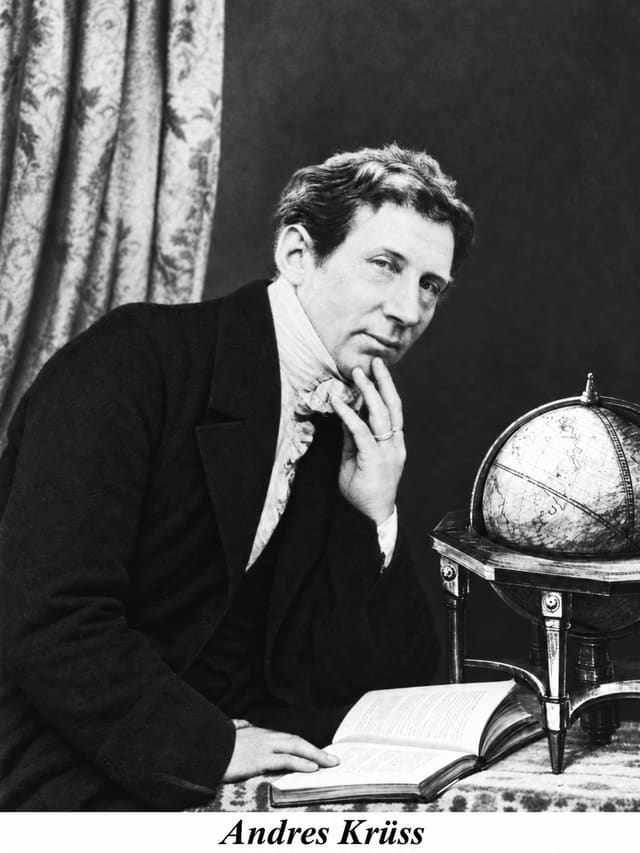
Andres Krüss was born on Heligoland on 21 March 1791 to Peter Krüss and Mike, née Denker. The text of the corporate chronicle gives 1796, but the portrait captions in the same chronicle, Timo Mappes's data and the statement that Andres died "in his 58th year" all point unambiguously to 1791.
The island where he grew up had been in British hands since 1807 and during the blockade served as the main transit base for smuggling onto the continent. The young Krüss worked for a Hamburg merchant who traded via Heligoland. Family tradition tells of coffee carried through French cordons to Bremen hidden in hay wagons; the story is not documented. After the blockade ended, around 1814, Andres settled in Hamburg and opened a cigar factory with his brother.
On 12 October 1823, a week after receiving Hamburg citizenship, he married Mary Ann Gabory. The cigar business was closed, and Andres, together with his brother-in-law Edmund Nicolas, took charge of the firm, which still bore the founder's name. This matters for attribution: everything sold between 1823 and 1845 was sold under the name Gabory, even though one of the owners was Krüss.
According to the family chronicle, the founder's workshop gradually gave way to trade, although Mappes believes that under Andres the firm's own production actually revived. What is beyond dispute is that the firm became a large wholesale depot for optics, nautical instruments and charts, trading with Scandinavia and Latin America. Hamburg lived by the sea, and the shop by the Exchange lived with it.
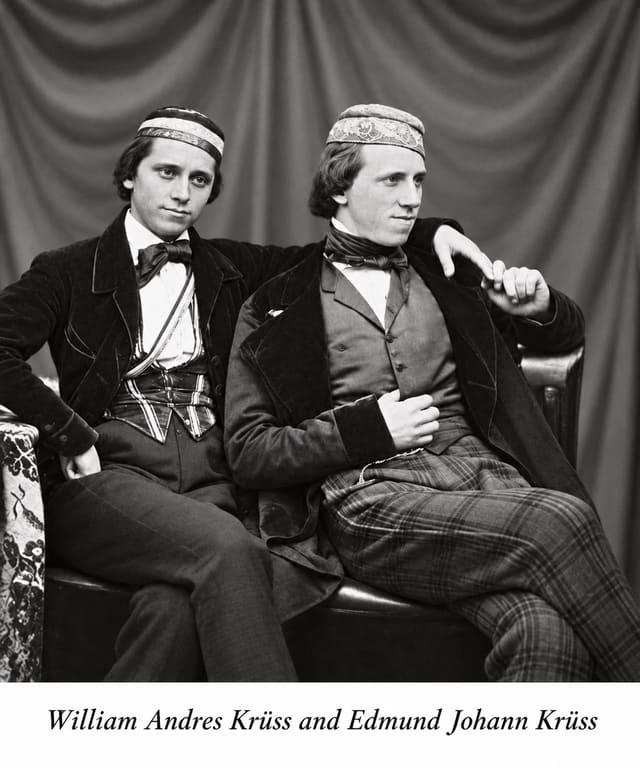
Edmund Johann Krüss was born on 30 July 1824, and his brother William Andres on 28 February 1829; the English name recalled their grandmother. Edmund attended the Hamburg navigation school, and in spring 1841, at the age of seventeen, went to Stuttgart to train under the court mechanic and optician Geiger, after which he graduated from the Stuttgart technical school.
If there was a moment when the house of Gabory stood at the cutting edge of the technology of its time, it was the daguerreotype. Daguerre's process was made public in Paris on 19 August 1839. By late November, Parisian daguerreotypes were already on sale at the Spiro brothers' art shop and at the optician Gabory's in Hamburg.
New consignments followed one after another. On 28 April 1840 the Correspondent reported a fresh shipment from Paris to "Edm. Gabory." Among the pictures was a view of Notre-Dame from the Pont de la Tournelle, as well as images of insects taken through a vertical microscope and magnified "many thousands of times." This is one of the earliest encounters between photography and microscopy in Hamburg.
On 29 June 1840 the paper described a new series taken "on bright days in May and June." What astonished viewers now was speed: even horses and fluttering flags could be made out on the plates. The list included the Place de la Concorde, photographed from the Ministry of the Navy; the Luxembourg Palace, where the numerals and hands of the tower clock were "surprisingly distinct"; the Barrière de la Chapelle, "perhaps the sharpest picture that has yet reached us"; Notre-Dame from the mouth of the Canal Saint-Martin, with barges, masts and a sleeping soldier in the foreground. Smaller plates showed people and animals "who had held their positions for several minutes."
Equipment followed the pictures. An advertisement in the Hamburger Nachrichten of 11 August 1842, published after the fire, offered complete daguerreotype outfits for portraiture by Lerebours at 60 marks and by Buron at 45. A larger outfit with an achromatic double objective, tripod and bromine apparatus cost 160 marks. Also on sale were silvered copper plates at 9, 10½ and 12 marks a dozen, Lerebours's brochure on the daguerreotype (May 1842), bromine, iodine, hyposulphite and tripoli polishing powder.
On 3 March 1843 Gabory announced himself as the Hamburg agent of the Viennese house of Voigtländer & Sohn and reported the first consignment of large portrait cameras "with a large achromatic double objective of 3½ inches in diameter" at 425 marks courant; the objective alone cost 275 marks. This was Joseph Petzval's celebrated portrait lens, the great optical sensation of the decade. Sixteen years later the Krüss workshop in Hamburg would be grinding lenses to Petzval's calculations itself.
On the morning of 5 May 1842, a fire broke out on Deichstraße that was destined to destroy a third of old Hamburg. The Church of St. Nicholas burned down, and with it house No. 53 on Neue Burg, along with the founder's workshop, models and instruments. According to a letter from Andres Krüss, goods worth about 8,000 marks were saved. The stock was insured with the Gothaer Bank for 30,000 banco marks, while losses were estimated at 60,000–70,000.
The firm stopped no longer than it had to. According to Weimar, immediately after the fire it operated at Kleine Reichenstraße 30, in the house of Leinau. It then moved "to the new Exchange, No. 2," that is, Schauenburgerstraße 2: the newly built Exchange building had survived the flames. The address book for 1844 records a curious formula: "Krüss, Andr., Optikus, unter der Firma Edmund Gabory, Geschäft: Schauenburgerstrasse No. 2, Wohnung: Neuerwall 52." Andres Krüss was still an optician "under the firm of Edmund Gabory."
Competition was close at hand. Wm. Campbell & Co., founded in 1816, dealt mainly in mathematical and nautical instruments and was advertising daguerreotype outfits in those same years. The art dealers H. & P. Spiro offered "complete Voigtländer and French patent outfits." The Hamburg optical trade was tight-knit, brisk and very well informed.
The official founding date of the firm A. Krüss is 11 November 1844; it is given by the corporate chronicle and all sources derived from it. Weimar, working from address books and newspapers, says otherwise. According to him, Andres Krüss was his brother-in-law's partner "bis zum 11. November 1845." When the Gabory firm "settled permanently at Adolphsplatz 3 in 1845," Krüss separated and founded his own firm, first at Alter Wall 34, on the corner by the Adolphsbrücke bridge.
The coincidence of day and month with different years suggests a misprint in one of the sources. There are arguments on both sides. In favour of 1845: according to the newspapers, Gabory was already signing with the address Adolphsplatz 3 on 13 October 1845, and Weimar's logic (first Gabory's move, then the separation) is consistent. In favour of 1844: family tradition and, probably, the original of Krüss's first advertisement ("Krüss, Opticus, Alterwall, an der Ecke der Adolphsbrücke"), which the chronicle quotes, though the exact date of its publication is not given in the available account. The 1844 address book entry does not settle the question, since address books were compiled at the beginning of the year. The definitive answer will come from Andres Krüss's first newspaper advertisement.
Either way, by the end of 1845 two shops stood on Adolphsplatz and by the Adolphsbrücke, literally a few dozen paces apart. Both traced their lineage to Ramsden's pupil from Strasbourg, and both were owned by relatives.
Edmund Nicolas Gabory remained faithful to the model established in his father's time: a large trading house and agency for leading manufacturers. The address book describes him as "Opticus u. Niederlage v. optisch., physikal. u. mathematisch. Instrumenten, Adolphsplatz no 3, der Front der Börse gegenüber." The word Niederlage, a warehouse-cum-shop, speaks for itself. Later advertisements add the landmark "neben der Bank," next to the Hamburg Bank.
On 13 October 1845 the Hamburger Nachrichten printed an advertisement from "Edmd. Garbory" (the name mangled by the typesetter) for a "new, most interesting invention in daguerreotypy": the Daguerréotype panoramique. A special mechanism in the camera allowed a small quarter-plate lens to produce pictures 15 inches long and 5 inches wide. A sample picture hung in the shop, and as confirmation an extract was quoted from the report of the Paris Academy of Sciences of 23 June 1845: views 38 centimetres long and 12 wide, sharp across the whole field, covering more than 150 degrees. These figures unmistakably identify Friedrich von Martens's panoramic camera with its swinging lens. Gabory took orders at the factory price of 400 francs for a 5% commission plus packing and carriage. The Hamburg optician was selling a novelty reported to the Academy only four months earlier.
On 9 August 1852 Gabory appears as "Agent für den Norden" for the Berlin daguerreotype-plate maker F. Schneider. Prices ranged from 4 marks 10 shillings to 42 marks 8 shillings a dozen depending on size; for conversion, Weimar gives the rate of 1 mark courant to 1.20 imperial marks. On 14 July 1857, describing himself as "long-standing agent of Messrs Voigtländer & Sohn of Vienna and Brunswick," Gabory announced that Herr Voigtländer himself would be passing through the city for two days. He would show, at the Hotel St. Petersburg, portraits taken with his new five-inch lens in Paris, London and Dresden "without retouching," mornings from half past eight to ten and evenings from five to half past six.
Andres Krüss built his business differently. His very first advertisements speak of "optical, mathematical and physical instruments." Soon the title Opticus gave way to Optiker und Mechaniker, and this shift from dealer to maker determined the firm's fate for a century to come.
The 1849 address book paints a colourful, thoroughly Hamburg picture: "Opticus und Niederlage" of optical, physical, mathematical and nautical instruments; everything needed by dentists and daguerreotypists; filter stones, copying machines, steel pens and patent crayons. The address: Alter Wall 34, corner of the Adolphsbrücke. The entry is in the name of "Krüss, Andr.," although Andres himself was no longer alive.
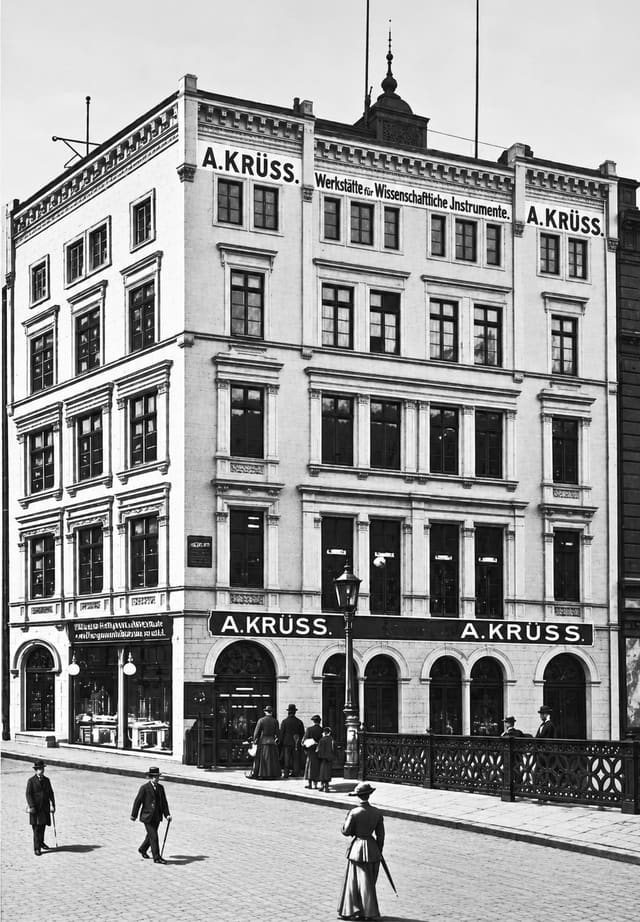
In 1848 cholera struck Hamburg, and on 25 October Andres Krüss died. On 1 November his widow Mary Ann announced that the business would continue under the existing firm name, managed by her elder son Edmund, then in his twenty-fifth year. In 1851 she handed the firm over to both sons. The brothers bought the house at Adolphsbrücke 7 for 66,000 marks; according to Weimar, the move there took place in 1853. This house remained the firm's headquarters for almost seventy years. Mary Ann Krüss, née Gabory, daughter of the founder, wife and mother of the owners of both branches of the family business, died on 28 November 1858.
The 1855 entry shows how far the range had grown. Krüss was now "Optiker und Mechaniker" with sole selling rights for G. Liebig's "gas jugs." Here, too, was a depot of artificial eyes by the Parisian ocularist Boissonneau, an agency for Voigtländer & Sohn daguerreotype apparatus (so by this time Krüss held a Voigtländer agency as well, not only Gabory), supplies for dentists and daguerreotypists, filter stones, copying machines, globes and steel pens.
The two branches were bound not only by a common ancestor but also by marriages. In 1852 Edmund Krüss married Agathe Auguste Bauer (1829–1912). William married her younger sister Constanze, and their cousin Alfred Gabory married the elder sister, Elise. Edmund Nicolas Gabory's son was thus both first cousin and brother-in-law to Edmund Krüss.
Collector literature has long repeated the claim that Gabory and Krüss were among the first in Germany to take up aneroid barometers immediately after their invention. Chronologically the period fits perfectly: in 1844, the year the Hamburg firms separated, Lucien Vidi patented his "barometer without liquid" in England and then in France. The documents, however, paint a more modest picture.
1846. The A.KRÜSS Optronic website states: "Sale of barometers, scales, steam engines." This refers to sales, not necessarily manufacture, and the type of barometer is not specified.
1849. Edmund Krüss ascended in a balloon with the English aeronaut Henry Coxwell from the Dammtor. In a piece for the Oldesloer Wochenblatt he wrote that, judging by the aneroid barometer he had taken along, the balloon rose to 2,500 feet and then to 4,920. This is the earliest reliable evidence of an aneroid in the family's hands, and one of the earliest in Germany generally. Whether the instrument was made in the Krüss workshop or bought, the text does not say.
1850. An article by the German Meteorological Society, based on the books of Stöhr and Bert Bolle, asserts that an aneroid by Krüss from 1850 "demonstrably exists." Neither the specimen nor the basis for the dating is named.
1855. The family chronicle relates that at the Paris Exposition Universelle Edmund Krüss won a first prize for a "large barometer" made in his own workshop. According to the chronicle, the instrument had a "transferring scale" of the most advanced design of the day, and an attached clock made it possible to take readings at set times. The chronicle illustrates the episode with a photograph of a wall aneroid in a cast case decorated with vine leaves and winged female heads. The dial is inscribed "Aneroid Barometer" and "A. Krüss. Hamburg," with a scale in Paris inches, a German weather scale running from "Sturm" to "Beständig," and a thermometer set into its lower part. The caption states that a barometer made by Krüss won first prize at the 1855 Paris Exhibition. By the firm's own tradition, then, the Paris award is linked specifically to an aneroid. Text and image do not match perfectly, however: no clockwork is visible in the photograph, and the caption does not say whether it shows the exhibited instrument itself or a typical Krüss aneroid of the period. Indirect independent confirmation of the award comes from a Krüss microscope advertisement in the Leipzig Illustrirte Zeitung of 1867. Above the text is a row of medals among which those of the Paris Exposition Universelle and the London International Exhibition can be recognised, and on one of the ribbons the words "Honorable mention" can be read. Whether the Paris distinction was a first prize or an honourable mention can only be established from the official 1855 list of awards.
The address books and advertisements of the 1840s and 1850s quoted by Weimar describe the instruments of both firms only in general formulas ("optical, mathematical, physical, nautical").
What is documented is that Edmund Krüss had an aneroid in his hands as early as 1849, that the firm was selling barometers from 1846, and that by mid-century temperature-compensated pocket aneroids were being issued under the A. Krüss name. According to Stöhr, mass production of aneroids as domestic weather instruments in Germany began only around 1880. Hamburg, however, was an early centre of this trade: the Science Museum Group collection holds an aneroid by R. Deutschbein, Hamburg, dated 1876.
A general typology is useful for dating German aneroids of the period. Pierer's Lexicon (1857) states that scales were "usually" graduated in Paris inches divided into 10 or 12 lines, and that mean sea-level pressure was 28 Paris inches, or 760 mm. The weights and measures regulations of the North German Confederation of 1868 made the metric system compulsory from 1872. Thus a scale in Paris inches alone points rather to a date before the 1870s, a dual scale (inches and millimetres) to the transitional period, and a purely millimetre scale rather to a date after 1872.
According to Weimar, a "stereoscope epidemic" broke out in Hamburg in 1855. Until 1860 the Hamburger Nachrichten teemed with advertisements for stereoscopic pictures and the "machines" for viewing them. Sellers vied with one another in offering "the most perfect and newest" views, and opticians displayed the apparatus in street showcases.
On 7 September 1855 a note appeared in the city column of the Hamburger Nachrichten: the optician and mechanic A. Krüss had installed a showcase with three stereoscopes in front of his shop on the Adolphsbrücke, and the day before it had been besieged by crowds all day long. The columnist added with a smile that many an errand boy and servant would, for the time being, need an extra half hour for their errands.
Success had consequences. On 18 December 1855 Krüss advertised "stereoscopes of our own improved construction" with photographs of Italy, the Rhine, Switzerland, Algiers, Paris, England, Saxon Switzerland and Berlin, as well as daguerreotypes of sculpted busts. On 22 December 1856 he was already writing of a "factory and warehouse of stereoscopes"; among the novelties were views of southern Germany and of Hamburg. On 4 May 1859 he recommended "a new improved kind of machine with handle and stand, very convenient and most beneficial to the eyes."
The showcase needed protection, and the solution was entirely in keeping with a firm of physicist-mechanics. On 11 April 1859 the paper reported "an effective Noli me tangere" at the Messrs Krüss's. The spots that young stereoscope enthusiasts grabbed when clambering onto the showcase had been covered with tin and connected to a galvanic battery, so that any hand that touched them was instantly withdrawn by an electric shock. For "our dear youth," the columnist concluded, it became "great sport to test this public electrifying machine diligently." This may well be one of the first electric showcase-protection systems in history.
The house of Gabory did not lag behind in the stereoscope race either, but in its own way, as a wholesaler. On 17 December 1855 it offered glass views of the Paris Exhibition and views of Italy, Switzerland and the Rhine. On 18 May 1857, Duboscq's Stéréoscope cosmoramique, glass views of Tyrol and Bohemia, "dioramic" pictures, English genre scenes and Parisian instantanées, en gros et en détail. On 11 December 1858, views of Saxon Switzerland, Petersburg and Moscow, transparent Parisian views of Versailles and Saint-Cloud, the camp at Châlons, and an offer to those "inclined to found a stereoscope cabinet as a source of income," since the stock was sufficient "for the largest orders." On 12 December 1860, stereoscopes with six views at 2 marks 8 shillings and with twelve at 3 marks 12 shillings, "Debuskope" from 1 mark 8 shillings and improved "Polyskope" by the Berliner Schneider.
The two branches of one family are clearly visible in their advertisements. Gabory was a trading house, agent and importer. Krüss was a maker who built his own instruments and electrified his showcase. The two shops were also linked by a shared city market: in July 1860 the publisher M. Stettenheim, who issued stereoscopic views of Hamburg, announced that they could be bought, besides at his own shop, "at Messrs A. Krüss and Campbell."
Edmund Krüss turned the firm from a shop into a workshop. Here electrostatic machines, air pumps, models of steam engines and locomotives, and calibrated grain and candle scales were made. Around 1859–1860 the firm even produced small steamboats with vertical boilers, built at the Janssen & Schmilinsky shipyard. For more than half a century Edmund was a member of the Patriotic Society of 1765, took part in founding the Museum of Arts and Crafts (opened in 1877), and sat in the Hamburg Bürgerschaft.
The best-preserved independent evidence concerns microscopes. As early as 1857 the Göttingen physiologist Rudolf Wagner noted that Krüss was making microscopes after the pattern of Oberhäuser and Schiek at the "unprecedentedly low price of 20 thalers," quite adequate for teaching histology at 300× magnification. The Dutch microscopist Pieter Harting repeated this assessment in 1866.
Krüss himself readily invoked the authority of "Herr Hofrat Professor Dr. R. Wagner in Göttingen." An advertisement in the Illustrirte Zeitung of 1859 states that the firm's microscopes, "known for their sharpness and brightness," had received "a substantial improvement": a device for oblique illumination. An achromatic microscope with 300× magnification, one eyepiece and one set of lenses cost 20 thalers; with 520× and two sets, 36 thalers; a polarising apparatus cost 6 thalers more.
Eight years later the tone of the advertisement had changed. In the 1860s Germany was shaken by outbreaks of trichinosis; the epidemic at Hedersleben in 1865 claimed about a hundred lives. Inspecting pork under the microscope turned from a scientific procedure into a sanitary obligation. The 1867 advertisement was addressed directly to this new market: for detecting and examining trichinae, "the microscope at 20 thalers is most often used," though a cheaper instrument would also serve, and a description of meat inspection with illustrations was included.
Surviving instruments form a sequence: drum microscopes No. 191 (c. 1858, Mappes collection), Nos. 199 and 247 (c. 1863 and 1865, Pathologisch-anatomisches Bundesmuseum, Vienna), No. 260 (c. 1860), and trichinae microscope No. 1592 (c. 1865). Numbers and dates do not form a strict scale, so the serial number alone cannot serve as a chronometer.
In 1859 a lens-grinding workshop opened on the Adolphsbrücke, producing photographic objectives to Joseph Petzval's calculations. The circle had closed: in 1843 Gabory had been selling Petzval's Viennese lenses to the people of Hamburg as an exotic novelty, and now the founder's grandson was grinding them himself. In 1861 the Patriotic Society awarded the firm a silver medal "for establishing a branch of industry new to Hamburg." At the London International Exhibition of 1862, according to the family chronicle, Krüss lenses won first prize; the medal of that exhibition also appears in the 1867 advertisement.
The firm's most popular products in the 1860s were projection apparatus. Krüss became famous for "dissolving views" lit by oxyhydrogen light and for his own glass lantern slides. In 1865 the "Wunder-Camera" appeared: a magic lantern capable of projecting opaque objects such as photographs, book pages and small items. In essence it was a forerunner of the episcope. The small model cost 6 thalers, the large one 15. The family chronicle speaks of patents in England, France and North America.
A Prussian trace of this invention has been found in the Prussian Privy State Archives (Geheimes Staatsarchiv Preußischer Kulturbesitz) in Berlin. In the records of the Ministry of Trade and Industry, in the file "Verbesserung der optischen Instrumente und Patenterteilung darauf," vol. 2 (I. HA Rep. 120, D XIV 2 Nr. 6 Bd. 2), there is an entry: "A. Krüß; Hamburg: optischer Apparat „Wundercamera" (Anwendung achromatischer Beleuchtungs- und Objektivlinsen), 1868." Three years after the apparatus appeared, then, the firm was also seeking a patent in Prussia, and the essence of the invention was described as the use of achromatic lenses in both the illuminating and the objective parts.
While the Krüss family grew, the house of Gabory aged along with its owner. Its later fate long remained obscure: the Krüss family chronicle said only that in 1886 "Edmund Gabory closed the firm for personal reasons" and that A. Krüss took over his optical business. Mappes named Alfred Gabory in that role.
Two official notices resolve the contradiction. On 5 June 1877 the Deutscher Reichsanzeiger (No. 129, p. 5) published: "Edmd. Gabory. Nach erfolgtem Ableben von Edmund Nicolas Gabory wird das Geschäft von dem bisherigen Theilhaber Edmund Alfred Gabory unter unveränderter Firma fortgesetzt." So the founder's son, Andres Krüss's former partner and long-time Voigtländer agent, died in 1877 or shortly before. The business was continued by his former partner Edmund Alfred Gabory, evidently the same Alfred who was Edmund Krüss's cousin and brother-in-law. The firm kept its old name "Edmd. Gabory," hence the confusion among later authors: in the 1880s "Edmund Gabory" was the name of the firm, while its owner was Alfred.
Weimar dates the "dissolution of the firm Edmund Gabory" to 1886, and the family chronicle places the transfer of the stock to A. Krüss in the same year. The legal end came later. Under the date 5 April 1888, in its section on commercial register entries, a Hamburg newspaper of 9 April 1888 printed: "Edmd. Gabory. Diese Firma, deren Inhaber Edmund Alfred Gabory war, ist aufgehoben." Most likely, trading effectively ceased and the stock passed to the Krüss family in 1886, with the formal deletion from the register following two years later.
Thus, ninety years after the Strasbourg craftsman moved to Hamburg, his name disappeared from the city's shop signs. The business itself was not lost: it merged into the firm of his son-in-law and grandsons.
The new generation brought university science into the firm. Andreas Hugo Krüss (23 February 1853 – 27 April 1925), Edmund's son, trained with Dennert & Pape in Altona, then with C. A. Steinheil Söhne in Munich, and at the Munich Polytechnic and University. In 1873 he defended a dissertation on lens design. In 1876 Hugo joined the firm, in 1880 he bought the house and workshop from his father, and from 1888 (by other accounts from 1886) he was the sole owner. To avoid competing with his former mentors at Steinheil, he abandoned high-aperture photographic lenses and steered the firm towards photometry, spectroscopy and projection.
As early as 1876 the Deutsche Seewarte (German Naval Observatory) commissioned the young Krüss to report on the visibility of navigation lights. Hamburg's maritime meteorology and optics met under one roof once again. A series of designs followed: the prism photometer (1884), the compensation photometer (1885), a stand for testing incandescent lamps (1887), the polarisation photometer (1888), and later the flicker photometer and the spectrophotometer. In 1886 his Handbuch der elektrotechnischen Photometrie appeared. The Krüss photometer was used by the commission of the International Electrical Exhibition in Munich in 1882. Together with his brother Gerhard, Hugo wrote Kolorimetrie und quantitative Spektralanalyse (1891). The range of the firm, which increasingly called itself "Optisches Institut A. Krüss," included Kirchhoff–Bunsen spectroscopes, projection apparatus, X-ray tubes and Edison phonographs.
Hugo Krüss published some 150 works on physics, technology, economic policy and philosophy. From 1892, for more than a quarter of a century, he chaired the Deutsche Gesellschaft für Mechanik und Optik (German Society for Mechanics and Optics), securing the adoption of the standard Löwenherz screw thread and a separate customs classification for scientific instruments. From 1903 he served on the International Commission on Photometry, and in 1905, at the invitation of Wilhelm II, he joined the board of trustees of the Physikalisch-Technische Reichsanstalt. He was a member of the Leopoldina and of the Hamburg school board, and in 1917 the Senate conferred on him the title of professor. The family chronicle adds that this was on Einstein's recommendation, but there is no independent confirmation. Since 1930 his name has been borne by the Krüßweg in Barmbek.
Hugo's younger brother, Gerhard Krüss (1859–1895), a pupil of Bunsen, researched atomic weights and rare-earth elements. In 1892 he founded the Zeitschrift für anorganische Chemie, which is still published today (now ZAAC). Gerhard died at the age of thirty-five.
The firm's awards in this era included Chicago (1893), Kiel (1894), Hamburg (1897), Paris (1900), St. Louis and Rome (1904), and a Grand Prix in Brussels (1910). Edmund Johann Krüss, who had once risen above the Dammtor with an aneroid in his hands, lived until 30 November 1906; his brother William outlived him by three years.
Paul Krüss (1880–1976), Hugo's son, trained with Dennert & Pape and studied at the universities of Göttingen, Munich and Jena. In 1904 he became a partner in the firm, and in 1906 he married the daughter of Max Pauly of the astronomical department of Carl Zeiss Jena. From 1920 Paul ran the firm alone. In 1921 the workshop left the house on the Adolphsbrücke, where it had spent almost seventy years, and moved to Barmbek, to Gertigstraße 31. It remained there until 1980.
Paul led the firm through inflation, the world economic crisis, the Nazi dictatorship and the war. The main line of work became spectral instruments: colorimeters and microcolorimeters, spectrographs, prisms, diffraction gratings, light filters, physics teaching apparatus and microphotometers. According to local sources, tensiometers were already being produced before the Second World War. The house at Adolphsbrücke 7 was destroyed in the war, like most of the old city centre. The fate of the Gertigstraße workshop during the air raids of July 1943, which devastated the eastern districts, is not covered in the available sources.
In 1946 the British military administration granted the firm a production permit. The family chronicle notes, not without pathos, that this came 135 years after Edmund Gabory's French licence No. 851. Paul's son, the engineer Andres Krüss, who had worked during the war at the Deutsche Versuchsanstalt für Luftfahrt (German Aviation Research Institute) in Berlin, became a partner. Microscopes disappeared from the programme. From 1960 gemmological instruments appeared, as well as photometers, tensiometers, cathetometers and erythrocytometers.
In 1980 Andres Krüss handed the business over to his daughters, and for organisational and production reasons it split into two independent Hamburg companies. A century and a half later, the story of 1845 repeated itself in mirror image: one family, two firms, a common ancestor.
A.KRÜSS Optronic GmbH is headed by Martina Krüss-Leibrock, joined since 2005 by her daughter Karin Leibrock, the eighth generation by the company's count. The company makes refractometers, polarimeters, densitometers, spectroscopes, microscopes and gemmological equipment. Its headquarters house the historical collection and the family archive; some items have been donated to the Deutsches Museum in Munich.
KRÜSS GmbH Wissenschaftliche Laborgeräte (entered in the commercial register on 5 February 1980) was run by Cornelius Weser, husband of Marianne Weser, née Krüss, and since 2012 by their son Florian Weser. The company is regarded as the world leader in tensiometers and instruments for measuring contact angle, with representation in nearly thirty countries.
Both companies count their history from 1796. Timo Mappes puts it cautiously: this is "probably one of the oldest optical-mechanical workshops in Germany still in family ownership." Strictly speaking, legal continuity can be traced from the firm A. Krüss of 1844 or 1845. The line from 1796 is a family succession, through the founder's daughter, the pupil of Ramsden, and the stock of his grandson absorbed in 1886.
From the silver plate showing Notre-Dame in a window on Neue Burg to a tensiometer measuring the surface tension of a droplet, almost two centuries have passed. Each generation of this family sold, and then made, whatever was the latest word in science in its day: telescopes and voltaic piles, daguerreotypes and aneroids, stereoscopes and microscopes for hunting trichinae, magic lanterns, photometers, spectroscopes, refractometers. The house of Gabory remained a trading house and faded away with the era of agents and warehouses. The house of Krüss bet on the workshop, and then on the laboratory, and outlived all its Hamburg neighbours.
The signature "Gabory, Hamburg" could appear on products from 1796 to 1886, and between 1823 and 1845 Andres Krüss also stood behind it. The signature "Krüss, Opticus" indicates the early period of A. Krüss; "Optiker und Mechaniker," the period after 1850; "Optisches Institut A. Krüss," the 1860s to 1890s. On aneroids, the word "Compensirt" denotes temperature compensation. A trading house's name on the dial does not prove that the movement was made in Hamburg: look for stamps on the capsule and the movement plate.
Primary: newspapers, address books, registers
Archival
Literature
Museum and research resources
| Period | Firm | Address | Source |
|---|
| 1798 | Gabory | Große Johannisstraße 39 | Hamburger Adreßbuch (after Weimar) |
| 1799 | Gabory | "bei der Börse" | ibid. |
| 1800–1833 | Gabory | Neue Burg (Neueburg) 14 | ibid.; advertisement of 1807 |
| 1833 – 5.5.1842 | Gabory | Neue Burg 53 (renumbering) | ibid. |
| May 1842 | Gabory | Kleine Reichenstraße 30, house of Leinau | ibid. |
| 1842–1845 | Gabory | "bei der neuen Börse 2" = Schauenburgerstraße 2 | advertisements 1842–1843; address book 1844 |
| 1845–1886 (formally until 5.4.1888) | Edmd. Gabory |
| Adolphsplatz 3, opposite the Exchange / next to the Bank |
| advertisements 1845–1857; commercial register |
| 1844/45–1851/53 | A. Krüss | Alter Wall 34, corner of Adolphsbrücke | address book 1849 |
| 1851/53–1920/21 | A. Krüss | Adolphsbrücke 7 | chronicle (1851), Weimar (1853), address book 1855 |
| 1921–1980 | A. Krüss | Gertigstraße 31, Barmbek | chronicle |
| since 1980 | A.KRÜSS Optronic / KRÜSS GmbH | Alsterdorfer Straße 276–278 / Borsteler Chaussee 85 | company data |