Loading
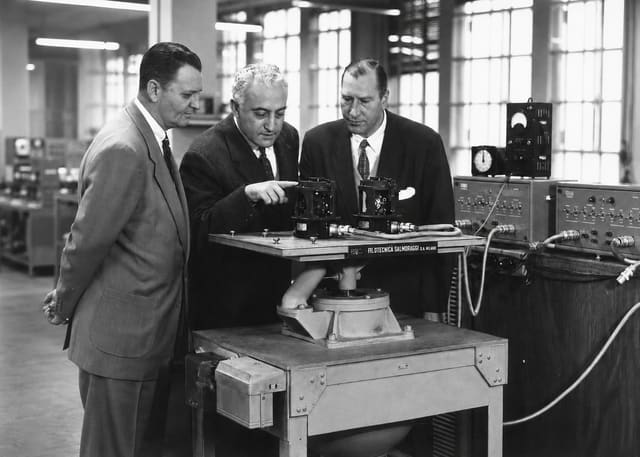
Some firms read less like companies than like biographies of their country. La Filotecnica is one of them. It was founded in Milan in 1865, four years after the proclamation of the Kingdom of Italy, at a moment when the young state discovered that it possessed neither its own maps, nor its own cadastre — the official land register on which taxation and property law depend — nor, most awkwardly of all, its own instruments with which to produce them. Theodolites and levels had to be ordered from England, France and Germany, paid for in hard currency, and waited on for months.
Its founder was a man who had already been a military engineer, a professor, the inventor of the prism that bears his name, and twice the owner of a failed workshop. The man who turned it into an industry was his pupil, a graduate of the Milan Polytechnic who gave up a lucrative railway contract in Turkey for the sake of optics. By the beginning of the twentieth century the firm was supplying instruments to the Italian army, navy, cadastral service, observatories and universities, kept agencies from Mexico City to Montevideo, and issued catalogues running to more than three hundred items. By mid-century it was building aircraft instruments and electronics. By 1971 it had stopped building anything at all.
What survives today is a name over optician's shops in Italian towns — and thousands of instruments in museums and private collections, their brass cases engraved with one of three signatures: La Filotecnica, La Filotecnica Ing. A. Salmoiraghi, or simply Salmoiraghi Milano.
Paolo Ignazio Pietro Porro was born on 25 November 1801 in Pinerolo, into a Piedmontese family. He graduated from the Royal Military Academy in Turin and entered the engineer corps of the army of the Kingdom of Sardinia, serving until 1842 and rising to the rank of major. The service was not a desk job: Porro ran topographic surveys, and it was out of that practice that his central idea grew. Around 1839 he introduced the notion of tachymetry — measuring distance optically rather than by chain — and from it developed what came to be called celerimensura, literally "rapid measurement": a method by which a single instrument and a single sighting yield distance, bearing and difference in height all at once. It became Italy's distinctive contribution to surveying.
In 1842 Porro left the army and opened a precision-instrument workshop in Turin. The logic was sound: he knew what a surveyor needed and could design it. The market was not: in Piedmont there were almost no buyers for such things, and the workshop closed. In the same years he worked on the plans for the Fréjus tunnel through the Alps, where he was the first to propose using compressed air to drive the boring machinery — an idea thought eccentric at the time and adopted some fifteen years later.
In 1847 Porro moved to Paris. There, with financial backing from Count Louis-Gustave Adolphe de Richemont, he founded the Institut Technomatique et Optique, an establishment that combined workshop, laboratory and school. The fourteen Parisian years were the most fruitful of his life. His Tachéométrie appeared in 1850, and in the same period he produced the anallactic telescope — an optical arrangement in which the stadia readings are directly proportional to the distance measured, with no correction or additive constant to apply. Every later tacheometer descends from it. Between about 1850 and 1855 he devised the prism erecting system now universally known as the Porro prism, and in 1855 he presented the longue-vue cornet and the longue-vue Napoléon III. Years afterwards Carl Zeiss of Jena would refine that arrangement into the mass-produced prismatic binocular, and the world would look through Porro's optics, mostly without knowing whose they were.
In August 1861 Porro returned to Italy. He taught celerimensura first in Florence, then in Milan, where in 1863 he became professor at the Higher Technical Institute — the future Polytechnic. In 1864 he helped set up the workshop Il Tecnomasio Italiano, and a year later took the last and most durable step of his career.
In 1865 Porro founded La Filotecnica in Milan — not a factory in the ordinary sense but an officina-scuola, a "workshop-school" intended to train Italian technicians capable of building topographic instruments. By several accounts Alessandro Duroni, one of the pioneers of Italian photography, was involved in its establishment.
The conception was excellent; the execution was not. Porro was past sixty, ill, and entirely unsuited to commercial management: he invented better than he calculated. The workshop turned out experimental and one-off instruments, struggled for orders, and survived more on its founder's reputation than on its books. Porro died in Milan on 8 October 1875. The graveside address was given by a young engineer who had worked at La Filotecnica for the previous five years — Angelo Salmoiraghi; the text was printed in the journal Il Politecnico.
Salmoiraghi was born in Milan on 27 January 1848. At eighteen he volunteered under Garibaldi and fought in the Trentino campaign of the Third War of Independence. In 1870 he graduated in industrial engineering from the Milan Polytechnic and was preparing to leave for Turkey to build railways — a profitable line of work at the time. Before departing he called on Porro. The conversation about optics proved worth more than the Turkish contract: Salmoiraghi stayed.
What follows will be familiar to anyone who has tried to turn a laboratory into a factory. Between 1871 and 1873, supported among others by the mathematician and scientific organiser Francesco Brioschi, Salmoiraghi raised 100,000 lire and in 1873 established the firm Salmoiraghi, Rizzi e C., which bought out La Filotecnica. Business was hard; in 1877 the partnership dissolved and Salmoiraghi was left as sole proprietor — together with all the debts.
His solution was an unexpected one. That same year, 1877, La Filotecnica began manufacturing the first Italian sewing machine. Precision mechanics financed itself with household appliances until it could stand on its own: in 1881 the sewing-machine business was sold to Prinetti Stucchi. From 1879 the firm employed the Polish-Austrian mechanic Franz Koristka, who set up the dividing of graduated circles — the operation on which the accuracy of every angle-measuring instrument depends. In 1881 Koristka left to found his own firm, which became a well-known Italian maker of microscopes; Milan thus acquired two schools of precision mechanics grown from a single root.
By 1890 La Filotecnica was a genuine factory: about a hundred and fifty workers, workshops covering some 1,500 square metres, and a catalogue of more than three hundred instruments for astronomy, optics, geodesy, topography, navigation, photography and draughtsmanship. Its customers were the Ministry of War, the Istituto Geografico Militare (the military survey and mapping institute), observatories, universities and the cadastral service. For export it opened agencies in Europe and Latin America — Mexico City, Buenos Aires, Montevideo.
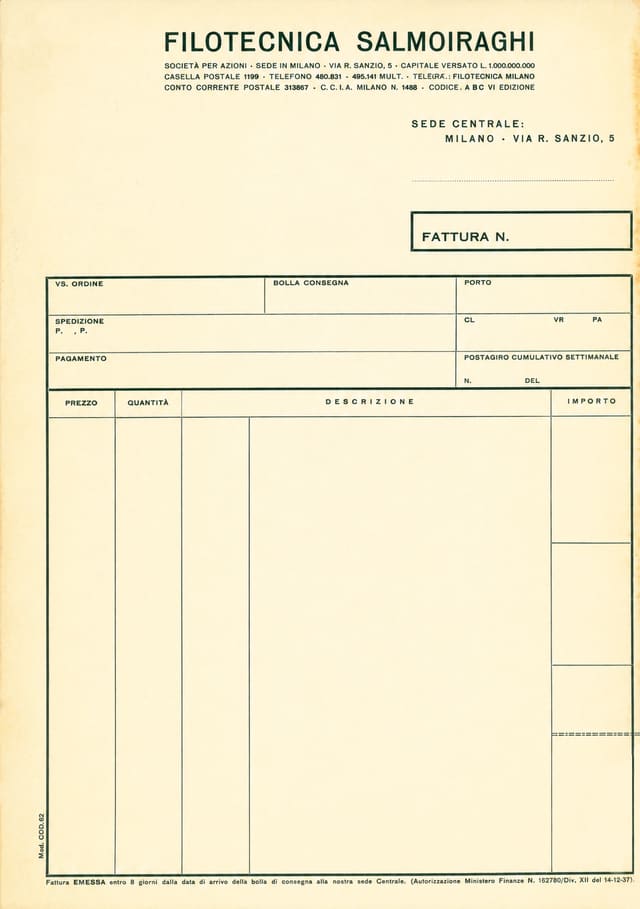
In 1905 the business was reorganised as a società in accomandita per azioni, a limited partnership with share capital, and from 1906 the signature familiar to every collector was fixed: La Filotecnica Ing. A. Salmoiraghi, with its registered three-line trademark.
Salmoiraghi himself had by then become one of the most prominent figures in Italian commercial life: president of the Milan Chamber of Commerce (1900–1924), president of Unioncamere, the national union of chambers of commerce (1901–1917), Cavaliere del Lavoro (1903), Senator of the Kingdom (from 1912), and one of those involved in founding Bocconi University. At the age of eighty, in 1928, he founded a professional school of optics; at eighty-three, in 1931, he launched the bimonthly journal La Filotecnica, to which he contributed in practically every issue. He died on 3 February 1939, a few months short of the war that would cost his workshops dearly.
Over a century the product range grew large enough that the catalogues had to be split by field.
Geodesy and topography remained the core. Theodolites of every class, from pocket models to large universal instruments; tacheometers — instruments that measure distance, direction and elevation in one operation — including the Soldati model and the family built for the Italian cadastre; levels; the tacheometer-cleps with central telescope, to which the firm devoted separate publications; rangefinders, telescopes, levelling staves, and odometers (wheeled distance measurers).
Astronomy and navigation: transit instruments and meridian-circle mountings for observatories, marine instruments, compasses, chronometers, sextants. Marine navigation was later joined by aerial navigation — and it was there that the firm held its strongest position between the wars.
Optics: microscopes, spotting and observation telescopes, prismatic binoculars — the modello Filotecnica was advertised energetically from 1911 — and military optics, on which more below.
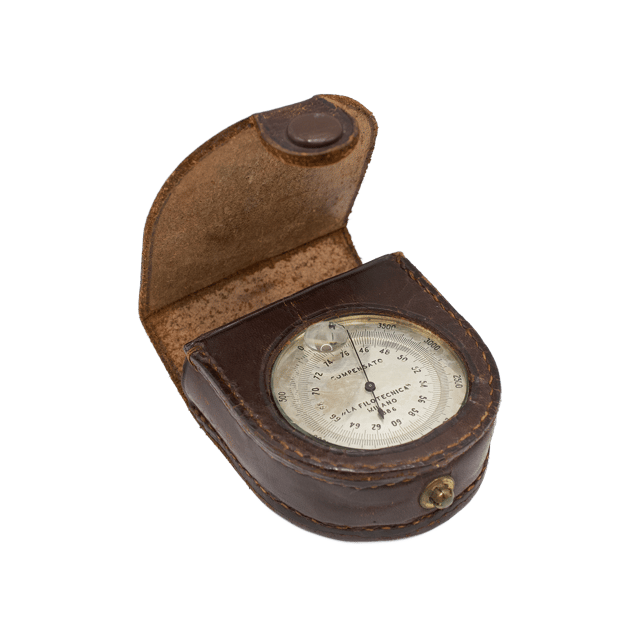
Meteorology and physics: thermometers of every type, mercury barometers, anemometers (wind-speed meters), psychrometers (wet-and-dry-bulb hygrometers for measuring humidity), rain gauges and hygrometers. Mercury barometers of the Fortin type — the laboratory standard, with an adjustable cistern read against a fixed datum point — the firm made itself: an example bought by the Palermo Observatory in 1893 for 180 lire survives in the museum collection there, and ten years later the firm supplied the same observatory with a replacement tube. Alongside this, La Filotecnica was a substantial retailer of aneroid barometers — pocket, wall, marine and altimeter patterns — which feature widely in its catalogues and were sold under the firm's own name.
Drawing and calculation: pantographs (linkages for copying a drawing at an enlarged or reduced scale), planimeters (instruments that measure the area of a plotted figure by tracing its outline), drawing sets, curvimeters — less romantic goods, but the ones that fed the factory most reliably.
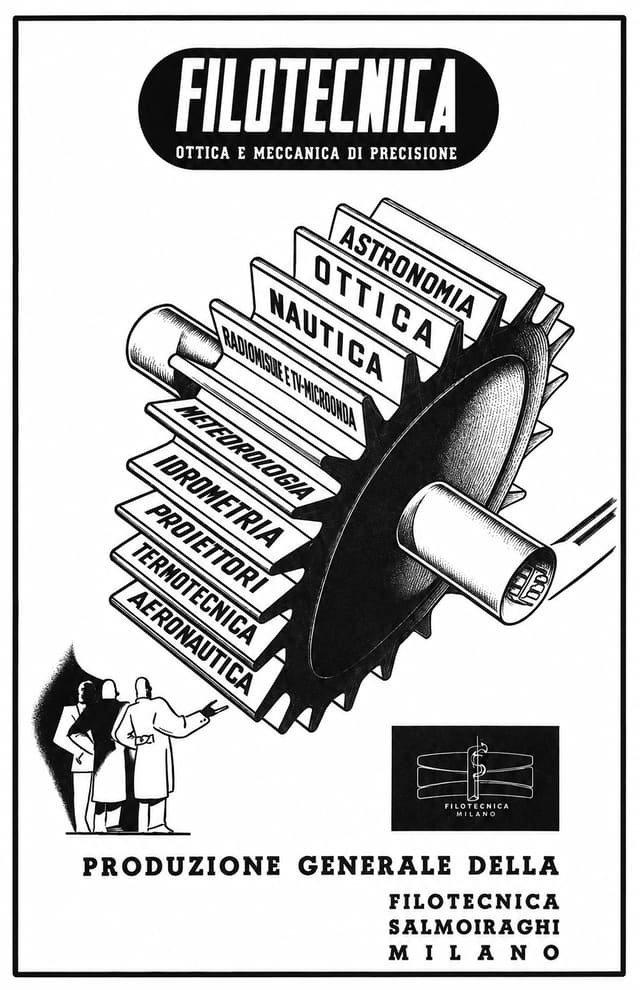
Later lines: photographic and cinematographic apparatus, projectors, aircraft instruments, electronics, hydrometric equipment for measuring river flow, and marine fittings. By the middle of the twentieth century a single company's signboard could cover a sextant, a film projector and an artificial horizon.
The catalogues of La Filotecnica are a monument in their own right. In 1906 came Istrumenti astronomici, geodetici, nautici, magnetici, eighty-five pages of astronomical, geodetic, nautical and magnetic instruments. In 1909 a single-sheet technical publication appeared on the meridian-circle platform — and, in the same year and rather more surprisingly, a Russian edition was printed in Kyiv by the S. P. Yakovlev press: twenty-eight illustrated pages on the new tacheometer-cleps with central telescope. The Milanese firm was working the Russian market in earnest.
Around 1912 the principal volume appeared: catalogue no. 137, Istrumenti per ingegneri e agrimensori ("Instruments for Engineers and Land Surveyors"), 208 pages, roughly 17 × 24.5 cm, printed in Milan by Bertieri e Vanzetti. It listed theodolites, tacheometers with micrometer microscopes and verniers, telescopes, staves, pantographs, odometers, meteorological instruments, thermometers and anemometers.
Meteorology had its own publications: catalogue M.135, Istrumenti di Meteorologia, printed at the Milanese Tipografia La Famigliare di E. Cattaneo; catalogue no. 323 of the 1930s; and the folding sheet Listino dei barometri per ingegneri ("Price List of Barometers for Engineers"), 46 × 59 cm when opened, with eight large illustrations, in which barometers were followed by thermometers, hygrometers and rain gauges — dealers date it to about 1935, though the sheet itself bears no date. In May 1952 came price list no. 525/4, Strumenti per osservazioni meteorologiche; a copy is held in the Boffito pamphlet collection of the Museo Galileo in Florence.
The firm advertised regularly in touring, alpine, photographic and technical magazines: in 1928 it promoted its Milan and Rome branches, and the January 1931 issue of the Italian Alpine Club's journal offered tourists a free binocular catalogue. From 1931 to 1939 the house journal La Filotecnica appeared. And in 1965 came the centenary volume Testimone di un secolo: 1865 Salmoiraghi 1965 ("Witness to a Century"), which fixed 1865 once and for all as the firm's official birth date.
In the First World War La Filotecnica was designated an auxiliary enterprise and worked for the front: submarine periscopes, prismatic binoculars, blind-flying instruments, aerial cameras, sniper sights, and the "revolver" telescopes of variable magnification — 15×, 20× and 40× on an 80 mm objective — delivered to the army in 1917.
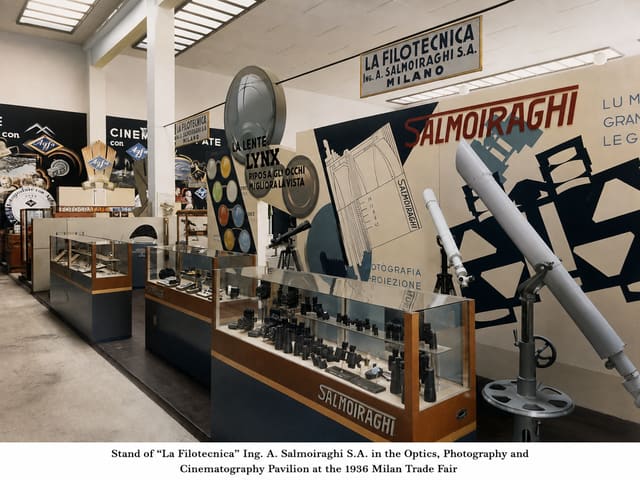
The interwar years belonged to aviation. The firm built compasses, sextants, airspeed indicators and gyroscopic instruments; the Crocco course indicator was shown at the Chicago exhibition of 1933. La Filotecnica advertised at the first and second International Air Shows in Milan (1935 and 1937) and exhibited at the Fiera Campionaria, Milan's great sample fair, in 1936.
One document spoils the idyll: a technical audit conducted in 1934 by the optical physicist Vasco Ronchi, which found La Filotecnica lagging behind its competitors — San Giorgio, Officine Galileo, Koristka. The firm entered the Second World War in poor technical shape, and historians of Italian military optics doubt that the 1940 contract for ten thousand 8×30 binoculars was ever fulfilled. The Milan workshops in via Raffaello Sanzio were destroyed by bombing.
As early as 1935 La Filotecnica was drawn into the orbit of the IRI, the Istituto per la Ricostruzione Industriale — the state holding company created to rescue Italian industry after the crash. In 1948, when the IRI set up the Società Finanziaria Meccanica, the future Finmeccanica, the Milanese firm was among its fourteen founding enterprises, alongside Ansaldo, Alfa Romeo and Officine Galileo: more than ninety thousand employees between them.
The post-war decades are a story of gradual retreat. The firm still produced meteorological instruments and optics; it still commissioned Massimo Vignelli — later a star of international graphic design — to design a barometer brochure around 1954–55; it still celebrated its centenary in 1965. But around 1971 instrument production ceased and the company became a trading business. In 1974 Finmeccanica sold it to the British Dollond International.
In the same years the retail optical chain merged with the Viganò business to form Salmoiraghi & Viganò. Thereafter the brand passed from hand to hand: General Optica, the De Rigo group, Arca Merchant, then from 2002 Dino Tabacchi, and by 2017 Luxottica, today EssilorLuxottica. The name of the Milanese engineer who turned down the Turkish railways still hangs above shop windows full of spectacles. No instruments have been made under it for half a century.
Five things are worth saying about the firm's place in the history of Italian instrument making.
It industrialised Porro's ideas — celerimensura, the anallactic telescope, tacheometric methods — turning elegant theory into serially produced hardware and measurably speeding up topographic work.
It replaced imports: museum descriptions of the cadastral tacheometers connect these models directly with the gradual displacement of English instruments from Italian cadastral practice.
It became one of the foundations of Italian industrial optics — the Dizionario Biografico degli Italiani names Salmoiraghi among the founders of that sector and stresses his decisive contribution to precision instruments for surveying and for marine and aerial navigation.
It combined manufacture, training, scientific publishing and government contracting within a single enterprise — a model rare in late nineteenth-century Italy, and one that goes straight back to Porro's officina-scuola.
And it left a large material legacy: instruments by La Filotecnica are held in Milan's Museo Nazionale della Scienza e della Tecnologia "Leonardo da Vinci", in the collections of the Polytechnic, in the Italian national heritage catalogue (ICCD), in the Museo Michelangelo, in the observatories of the INAF (the national astrophysics institute) and even in the Smithsonian.
The firm never achieved the lasting international reach of Carl Zeiss, Wild, Kern or Hilger & Watts. But in Italy, from the late nineteenth century through the first half of the twentieth, La Filotecnica was one of the central national producers of precision mechanics and optics — the reason a country was finally able to measure itself with instruments of its own.