Loading
Dates. Until February 1918 Russia used the Julian calendar ("Old Style"), which ran behind the Gregorian calendar ("New Style") used in Western Europe — by 12 days during the nineteenth century and by 13 days during the twentieth. Russian documents of the period therefore carry two dates, the second usually in parentheses: "11 (24) January 1915" means 11 January by the Russian calendar, which was 24 January in Berlin or London. In this text, dates before February 1918 are given in Old Style, with the New Style equivalent in parentheses wherever the distinction matters. Dates after February 1918 are New Style throughout.
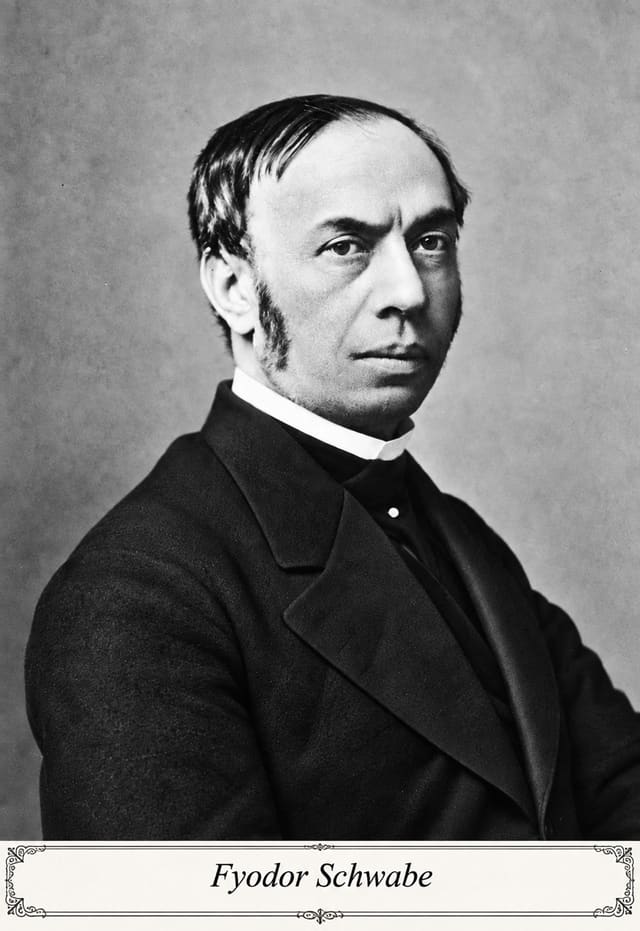
Names. Russian names are transliterated in a readable form, with the Cyrillic original given where the spelling itself carries information. The founder appears in the sources under two forms of the same name: the German Theodor Schwabe and its Russified version Fyodor Borisovich Schwabe (Фёдор Борисович Швабе) — "Borisovich" being a Russian patronymic constructed from his father's name. The firm's own products are stamped Ѳ. Швабе, using the archaic Cyrillic letter fita, abolished in the spelling reform of 1918.
Money and measures. Sums are given in roubles of the period. The Russian pound (фунт) equalled about 409.5 grams; the sazhen about 2.13 metres. Where the sources use pre-metric units, they are kept as written.
Terminology. Instrument names are translated with the standard English equivalents of the period — vernier for нониус, alidade for алидада, plane table for мензула, surveyor's compass for буссоль, level for нивелир, drawing-instrument case for готовальня. Where no clean equivalent exists, the Russian is retained with an explanation.
On 12 April 1961, one hundred and eight minutes into his flight, Yuri Gagarin looked down at the Earth through an instrument with a short name: Vzor (Взор — an archaic Russian word for "gaze"). The device was simple and cunning at once. A system of mirrors and concentric markings let a cosmonaut who had neither horizon nor any familiar point of reference work out how his craft was turned with respect to the planet. It was made in Moscow, at an enterprise then called the Geofizika Central Design Bureau.
That bureau had a pedigree which in 1961 nobody was eager to advertise. Thirty years earlier it had been Factory No. 217. Forty-five years earlier, the Geofizika joint-stock company. And earlier still, until August 1917, the joint-stock company F. Schwabe — and before that a trading house of the same name, and at the very beginning a small shop on the corner of Kuznetsky Most, where a foreigner with an awkward surname sold imported spectacles and pince-nez.
Between the spectacle shop and the round window through which a human being first saw the whole Earth lie almost a hundred and twenty-five years. That is the story.
More is known about most Moscow merchants of the nineteenth century than about the founder of one of Russia's largest instrument-making enterprises. Very little about Fyodor Borisovich Schwabe is firmly established, and nearly every one of those few points is disputed.
Two versions of his origins exist, and both remain in print to this day.
The first is the German version. According to it, Theodor Schwabe was born on 4 December 1813 in the town of Zerbst in the principality of Anhalt-Dessau, and died on 18 December 1880 in Berlin. This is the version the encyclopaedias adopted; German reference literature calls him an "Anhalt-Russian" entrepreneur. It goes back to the archival research of S. G. Morozova and E. N. Tryndin. Amusingly, even within a single encyclopaedia article the birth date manages to split in two: the introductory section gives 4 December, the main text 2 December.
The second is the Swiss version. The same Tryndin, in a local-history account, calls the founder "the Swiss citizen Fyodor Borisovich Schwabe (1814 — after 1879)," born in Switzerland, resident for a time in Berlin, and only then settled in Russia. Popular Moscow publications, following this, write confidently of a Swiss who kept his Swiss citizenship all his life.
The discrepancy is no small matter: a different country of birth, a different year, a different citizenship. Resolving it probably requires nothing more than a simple observation: place of birth and citizenship are different things. Schwabe was entered in the Moscow merchant registers as a foreign subject, and if that subjecthood was indeed Swiss, then in official paperwork he appeared as a "Swiss citizen" while having been born in Anhalt. One generation of copyists is enough for the two attributes to fuse into a single "Swiss from Switzerland."
Where Schwabe learned the optical and mechanical trade is not known at all. Not the name of a master, not a town, not a workshop. The man simply appears in Moscow already knowing how — and that is perhaps the most frustrating gap in the whole history.
The official founding date of the firm is 1837. The basis for it is a notification from the Moscow police chief to the Moscow governor dated 9 May 1853, which names 1837 as the time the Schwabe establishment appeared. Today's holding company dates itself from that year; so did the Geofizika-Kosmos enterprise, which marked its 180th anniversary in 2017.
But there is testimony that disputes the date, and it is first-hand testimony. In the preface to his own catalogue of 1867, Schwabe writes:
"The twenty years of trust shown to me everywhere, and the merit of my products, acknowledged both orally and in writing by the greater part of Russia's educational institutions, impose upon me the obligation to enlarge my establishment and to stock all the newest instruments..."
Twenty years counted back from 1867 gives 1847 — a full decade later than the police report. Two further dates join the pile: 1850, named in the firm's own later documents, and 1852, from its jubilee publication of 1912.
The contradiction dissolves if one distinguishes the start of activity from its formal registration. A foreigner might have worked for years at somebody else's establishment, trading under a power of attorney, without a licence of his own. 1837 may record his arrival in Moscow; 1847 the opening of his own business; the early 1850s his entry into the merchant estate. The first documentary mention of the name falls precisely on that threshold: the Address Calendar of the Inhabitants of Moscow for 1851 records "Schwabe, Theodor, merchant of the 3rd guild, Myasnitskaya district on Kuznetsky Most, house of Prince Golitsyn."
Either way, corporate tradition chose the earlier of the dates — the one written down by a police official, not the one named by the founder himself.
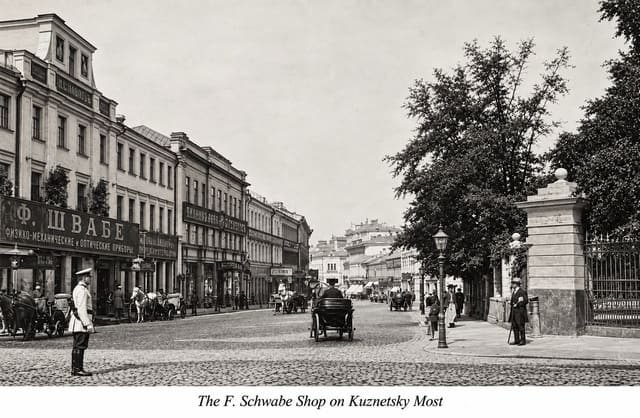
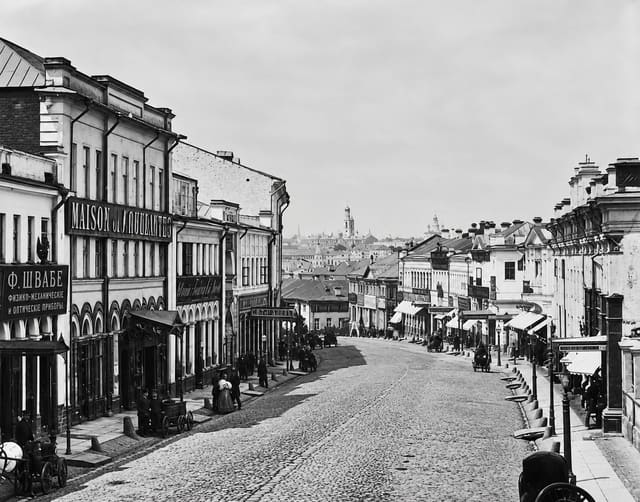
It began with trade in other people's goods: spectacles, pince-nez, small optical items brought in from abroad. The first address was the Myasnitskaya district, 2nd quarter, Shilovsky's house, number 121. Before long the business moved to the corner of Kuznetsky Most and Bolshaya Lubyanka, into Prince Golitsyn's apartment house. That building no longer exists: the site later grew a complex familiar to every Muscovite for quite different reasons.
What appeared in the courtyard mattered more than the address. A workshop. At first for repairs — a bent frame, a knocked-out lens, a draw tube that had stopped sliding. Then for manufacture. By the mid-1850s twelve people worked there with four lathes and one forge, and by the end of the decade they could assemble practically everything then called optics: magnifiers, telescopes, microscopes, binoculars. Schwabe stamped the finished goods with his own mark.
This is the turn that separates a lucky shopkeeper from the founder of an industry. The difference between "I import instruments from Europe" and "I make instruments here" is exactly the difference out of which factories grow.
Formal status followed: in 1853 Schwabe entered the Moscow merchant estate in the 3rd guild, and in 1858 in the 2nd.
By then the family had taken shape. His wife was Henriette-Pauline, born 1829 (German sources give her maiden name as Baumann, of Magdeburg). A son, Gustav-Adolf (1852); daughters Johanna-Amalia-Louise (1854) and Maria-Elisabeth-Gabrielle (1856); and in 1864 a second son, Georg-Fyodor-Karl. The German tradition speaks of six children in all. The family was Lutheran.
Not one of the children appears anywhere in the later history of the firm. Not once. The sources pass over this in silence, and yet it determined everything that followed.
In 1853 the firm made its public debut, at the All-Russian Manufactures Exhibition in Moscow, held in the rooms of the Russian Assembly of the Nobility. On display were a large telescope, several microscopes, a set of scales, and a sundial with a cannon — a device in which a burning glass set off the priming charge of a tiny gun at noon, a thing at once precise and theatrical.
The award was a large silver medal, with a citation worth quoting in full:
"To Fyodor Schwabe (Moscow merchant of the 3rd guild), for the excellent optical, physical and mathematical instruments and apparatus produced at his establishment, which has in a short time gained universal renown and is at present pre-eminent in Moscow."
"In a short time" — a phrase which, incidentally, sits better with 1847 than with 1837.
By this point the firm was already a supplier to the Imperial Kazan University and the Moscow Cadet Corps. Educational institutions would remain its principal market for the next half-century.
The following year brought a story that everyone writing about the firm has retold since. In 1854 the workshop made, as a gift for Emperor Nicholas I, a model of a smoothbore gun — a yedinorog (единорог, "unicorn"), a Russian howitzer type named for the mythical beast cast on its trunnions. The Emperor was pleased, presented Schwabe with a diamond ring set with a ruby, and ordered identical models for every cadet corps in St Petersburg and Moscow.
The episode looks like an anecdote, but it was in substance the firm's first large state order — and its first appearance in the field of vision of the War Ministry. Sixty years later that circumstance would turn against its owners in the most unexpected way.
In 1861, at the All-Russian Manufactures Exhibition in St Petersburg, the firm showed a model of a two-pood bronze mortar, a model of a high-pressure steam engine, and Middeldorpf's galvanocautery apparatus with its battery — an instrument for cauterising tissue with a white-hot platinum loop, the last word in the surgery of the day. Another large silver medal.
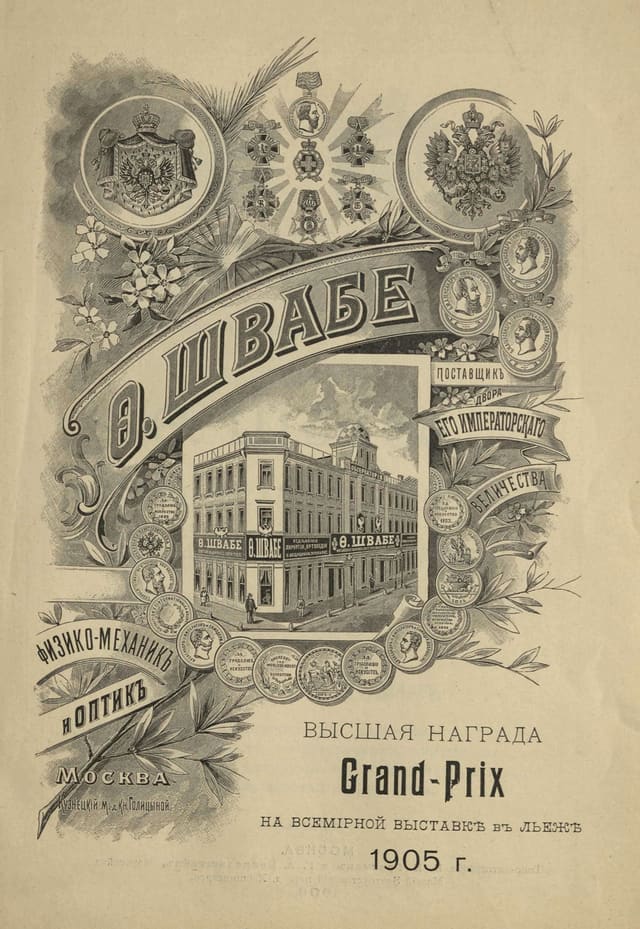
In between, the firm also took part in the exhibitions of the Russian Society of Amateur Horticulturists. The title page of the 1867 catalogue proudly reproduces six medals, and a good half of them come from horticultural societies and from the Imperial Moscow Society of Agriculture. The combination of optics and gardening stops looking odd once one remembers that greenhouses needed thermometers and hygrometers, and aquariums needed glass and soldering.
Real recognition came at the 13th All-Russian Exhibition of Russian Manufactured Products, held in Moscow in 1865. The firm took its first gold medal — the "small gold." The report of the expert commission deserves quoting at length, because it states the essential point:
"...the exhibitors Koni and Schwabe have shops in Moscow and, attached to them, well-appointed workshops, which allows them not to confine themselves to trading in instruments imported from abroad, but on occasion to execute themselves instruments that are quite complex and often demand great care in the work... The instruments exhibited by Messrs Schwabe and Koni must, for quality of execution and cleanness of finish, be assigned to the first class, whereby Mr Schwabe's articles, by reason of their greater variety, have even certain advantages."
The experts singled out a surveying astrolabe of new design with a telescope — an instrument originally made by Schwabe to the order and specifications of the Land Survey Corps. Here, for the first time, the speciality appeared that would become the firm's principal business forty years later: geodesy.
The commission's conclusion: Schwabe's establishment "belongs at present among the pre-eminent establishments of this kind in Moscow," and the man himself "is especially remarkable in that he supplies our educational institutions with his instruments."
To understand what the firm actually was at its thirtieth year, it is enough to open the catalogue published in 1867 by V. Gautier's press on Kuznetsky Most (censor's permission dated 21 October). The title page lists three addresses: Moscow, Kuznetsky Most, house of Prince Golitsyn; the Nizhny Novgorod Fair, Book Row, No. 9; and the Contract Fair in Kyiv, in Podil, Kiselevsky's house.
Inside are roughly two thousand four hundred and forty numbered items in eleven sections. The list is worth running one's eye over, because it is itself a portrait of the age.
Optics: mirrors, prisms, spherical glasses. Microscopes — simple, compound, of the Hartnack (successor to Oberhäuser), Nachet and Chevalier systems, and solar microscopes. Telescopes, spectacles and lorgnettes (of spectacles alone there were about forty models), officers', hunting and marine glasses, draw telescopes, telescopes on stands. Comet-seekers. Reflecting telescopes with Steinheil's silvered-glass mirrors. And a whole subsection of apparatus for theoretical optics: photometry, reflection, light scattering, interference and diffraction, fluorescence, double refraction and polarisation.
Photography: lenses by Hermagis, Voigtländer & Son, and Busch; Steinheil's periscopes; cameras for lockets, for visiting cards, for stereoscopic views, folding cameras, cameras with elastic bellows; plate holders, printing frames, head rests (the devices that immobilised a sitter's skull for the duration of the exposure), and satinising machines.
Caloric (Теплород) — the section is named after the terminology of an age that still considered heat to be a substance. Thermometers, apparatus for demonstrating the expansion of bodies, the properties of vapours, thermal conductivity.
Magnetism, electricity and galvanism: magnets, electrical machines, Leyden jars, dischargers, Lichtenberg figures, galvanic piles, rheostats, voltameters, electromagnetic motors and electric telegraphs. The prices here are concrete: a Holtz influence machine with a fifteen-inch disc cost 80 roubles; eighteen inches, 100; twenty-one inches, 130; twenty-four inches, 150. A Coulomb torsion balance, 40 roubles.
Meteorology: barometers, thermometers, and other apparatus.
Mathematics, geodesy and geography: goniometers, surveyor's compasses, astrolabes, theodolites, plane tables, alidades, levels, drawing-instrument cases and compasses, relief globes with Russian lettering, and tellurions — working models of the Sun–Earth–Moon system, some driven by clockwork.
Mechanics: statics, balances, dynamics, hydrostatics, air pumps, balloons.
Acoustics: tuning forks, sirens, horns.
Chemistry: glass and porcelain vessels, furnaces, Bunsen burners, platinum apparatus, hydrometers, reagents, apparatus for detecting arsenic and phosphorus.
Natural-history preparations and collections: anatomical models of the human body, Dr Auzoux's dissectible animal models, natural skeletons, botanical preparations, and — in a parade of its own — zoological models in papier-mâché, arranged by order: quadrumana, chiroptera, carnivora, marsupials, rodents, edentates, pachyderms, solipeds, ruminants, amphibians, pinnipeds, cetaceans, fish.
Surgery — the largest section, over five hundred and fifty items in forty-four rubrics. Instruments anatomical, for dressings, dental, for trepanation, for operations on the nose, eye and ear; for tracheotomy, hernia surgery, lithotomy, amputation and resection; catheters and bougies; instruments for extracting bullets; obstetric instruments; chloroform apparatus; respirators, ear trumpets, trusses, suspensories, gutta-percha stockings for varicose veins.
Technology: models of steam engines and locomotives, gas engines, apparatus for sugar refineries and distilleries, agricultural and veterinary instruments.
Such a range — from Steinheil prisms to papier-mâché ruminants — is explained by the shape of the market. The principal customer was a gymnasium (a classical secondary school) that needed an entire physics cabinet. And the firm sold entire cabinets, offering state educational institutions payment by annual instalments, taking packing costs on itself, and, for orders above three hundred roubles, shipping costs too, undertaking to repair free of charge any instrument damaged in transit.
The Polytechnic Exhibition of 1872 in Moscow, staged for the bicentenary of Peter the Great, was the firm's grand social appearance. For its exhibits Schwabe built, at his own expense, a separate pavilion number 26 — designed by the architect D. N. Chichagov, later the author of the Moscow City Duma building.
Inside was laid out a collection whose inventory makes for uneasy reading: instruments for anatomical dissection, for dental and eye operations, for extracting bullets, obstetric sets, galvanocautery and electrotherapeutic apparatus, an electric probe for locating bullets in the body, trusses and prostheses. In parallel the firm exhibited in the "Pedagogical" and "Applied Physics and Photography" departments. The result was a string of medals.
And in that same year of 1872, a man joined the office on Kuznetsky Most as an ordinary clerk — a man destined to turn the workshop into a factory.
David Albert Gamburger (Гамбургер — the German surname Hamburger as rendered in Russian), a Bavarian subject born in 1842, was Schwabe's nephew. In Russia he was called in the local manner Albert Ivanovich. Starting as a clerk, he quickly became a partner: on 18 July 1873 the firm was reorganised as the Trading House "F. Schwabe", with F. B. Schwabe and A. I. Gamburger as founding partners. From that year on, the firm advertised systematically in Moscow and St Petersburg address calendars and trade directories.
Seven years later, in 1880, Schwabe withdrew from the business. He handed his nephew all rights and obligations in the trading house — including the right to use the firm's name. He himself left for Germany, where he died (by the prevailing account, on 18 December 1880 in Berlin).
His burial place is unknown. The occasionally encountered suggestion of the Vvedenskoye German Cemetery in Moscow is unsupported and looks unlikely: if his last years were spent in Germany, the grave is more logically sought there. The founder left his own story quietly, leaving a surname on a signboard in his place.
Gamburger had thirty years to give the firm.
In the 1870s Russian medicine was living through its "age of antisepsis." The requirements for instruments changed radically: they had to survive disinfection, which meant nickel plating, smooth handles without crevices, and the abandonment of wood and bone wherever these collected dirt. The single St Petersburg firm producing such instruments could not keep up with demand, and Moscow's doctors went to Schwabe.
By the end of the decade something happened that one does not usually expect of a Russian instrument maker: the firm's medical equipment reached the European market and competed there with Western products. In 1877 it published the Complete Illustrated Systematic Catalogue of Medical, Surgical and Orthopaedic Instruments and Apparatus, and in 1878 veterinary equipment was hived off into a department of its own with its own catalogue.
From the late 1870s came another unexpected line — anthropometry. The firm supplied police stations with portable kits for measuring criminals by the method of Alphonse Bertillon, then the summit of criminological thinking: it was held that a combination of eleven bodily measurements identified a man more reliably than any portrait. Fingerprinting would consign Bertillonage to the scrapheap twenty years later, but for now the kits sold steadily.
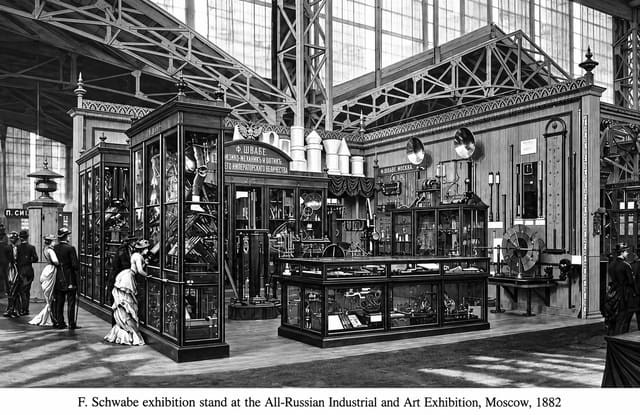
The All-Russian Industrial Exhibition of 1882 in Moscow was the turning point. By then about a hundred people worked at the factory, powered by a four-horsepower gas engine, and annual production reached one hundred and twenty-five thousand roubles.
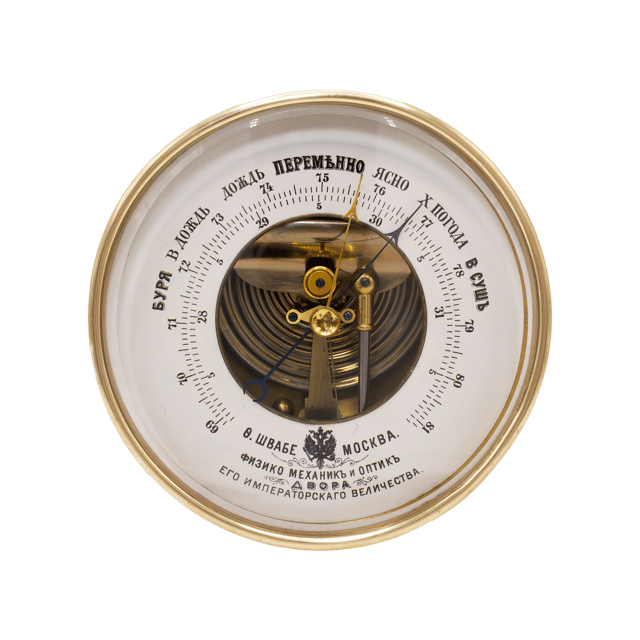
The display was conceived as an argument. A complete collection of barometers — "beginning with the barometer of Torricelli (1643) and ending with the most precise barometer of the present day for meteorological and indoor observation": two and a half centuries of an instrument's history laid out in a row. A complete set of physics apparatus for higher and secondary schools. And a Holtz–Toepler influence machine "of dimensions such as have not yet been produced either here in Russia or abroad."
The expert commission, as it happened, was assessing more than the objects:
"The varied apparatus exhibited in great quantity is prepared with much care. Particular attention is deserved by the firm's extensive workshops, constantly expanding and improving. More than 100 people are employed, of whom some have been with the establishment more than 25 years. As is evident from the list submitted by Mr Gamburger, the majority of those employed are Russians. The joinery finish of the articles leaves nothing to be desired. The workshop has a skilled glass grinder."
Two things were noted specifically: craftsmen stayed a quarter of a century, and the workforce was Russian. For an enterprise with a German surname on its signboard both facts mattered, and Gamburger — who, judging by the fact that he submitted a list of names to the commission — understood this perfectly well.
On 9 September the imperial family visited the exhibition, and Gamburger presented Alexander III with a thermometer of large size. The firm received the highest award of the exhibition: the right to display the State Coat of Arms on its products and signboards. Gamburger himself was decorated with the Order of St Stanislaus, 3rd class.
Two years later, in 1884, came what all the work had been for: the title of "Purveyor to the Court of His Imperial Majesty." From that moment the cases of the firm's instruments carry an inscription familiar to every collector: "Ѳ. Швабе. Москва. Физико-механикъ и оптикъ Двора Его Императорскаго Величества" — "F. Schwabe. Moscow. Physical-Mechanical Instrument Maker and Optician to the Court of His Imperial Majesty."
In 1886 came the highest award at the World's Fair in New Orleans, and the Order of St Anna, 3rd class, for Gamburger.
Not everything was triumph. In 1896 the firm took part in the All-Russian Industrial and Art Exhibition in Nizhny Novgorod half-heartedly and came away without awards — an episode corporate accounts usually skip.
In 1897 Gamburger was granted the title of Commerce Councillor (коммерции советник, a civil rank conferred on merchants). The factory then employed 115 male workers, 4 women and 20 adolescents — one hundred and thirty-nine people.
Albert Ivanovich also had a private passion that left its mark on production. He was a well-known aquarist, and the aquariums made by the firm's workshop were considered the best in Russia and won awards at exhibitions. Hence, probably, the horticultural medals on the title pages, and the firm's general leaning towards objects where glass, metal and precision meet living nature.
On 17 July 1901, while at the spa of Saltsjöbaden near Stockholm, Albert Ivanovich Gamburger died suddenly. He was fifty-nine.
The firm was taken over by his widow, Matilda Yulyevna Gamburger. For the Moscow business world the situation was not unheard of, but neither was it ordinary: a technical enterprise employing three hundred people now had a woman at its head.
Until 1904 her partner remained a long-serving employee, Georgy Vasilyevich Mentsel (Menzel). Then general management passed to Yevgeny Fyodorovich Steiner, a Swiss citizen and engineer-technologist — and under him came what, in hindsight, looks like the most important event in the firm's history since the appearance of the first workshop.
A scientific department was established. It was headed by L. A. Serebryakov, a man with a university degree in mathematics. Designers were hired, and an engineer put in charge of the workshops.
The difference between an enterprise that copies European models and one that carries out its own design work is a difference of kind. This is where the firm crossed it.
How far the enterprise had changed is visible in the catalogue of geodetic, astronomical and drawing instruments published in 1903 by the I. N. Kushnerev & Co. lithographic press (censor's permission dated 8 March). The universal catalogue of 1867 had by now split into seven specialised ones: physics with mechanics and natural history; optics and microscopy; meteorology; magic lanterns; chemistry and technology; railway accessories; surgery. The geodetic volume went out as No. 27 and cost one rouble fifty kopecks.
The preface states the selection principle without circumlocution: the edition is "the result of a thorough reworking of our old catalogue (edition of 1897)"; some previous items have been dropped "either because of their obsolescence or in consequence of an unsatisfactoriness in their construction revealed in practice," and new items introduced in their place — chosen "by theoretical study and also by careful testing in practice." The firm refers explicitly to guidance from "Messrs the professors, the instructors of technical schools, engineers, and land-survey officials." In other words, it had user feedback and it used it.
The instrument descriptions read like technical documentation. The flagship theodolite No. 120 — a small repeating theodolite with a surveyor's compass, 165 roubles — runs to a page and a half: a horizontal circle 16 cm in diameter divided into twentieths of a degree on silver; an alidade circle with two verniers reading to one minute; movable magnifiers at the verniers with cylindrical illuminators of milk-white celluloid; a vertical circle of 10 cm; a telescope 17 cm long with a 27 mm objective and a magnification of twelve.
But the reasoning is more interesting than the figures. The telescope standard has a T-section — "as offering the greatest resistance to bending." The screws fixing it are placed at the ends of a diameter of the alidade circle, "which protects the alidade circle from deflection under one-sided pressure." A stadia reticle with a ratio of 1:100 is cut on glass and provided with correction screws allowing it to be shifted in every direction and rotated about the optical axis. This is written by people who had calculated the deflections themselves.
The outfit included a tripod, plumb bob, magnifier, waterproof cover, keys, and spare reticle, needle and pin; weight with tripod, twenty Russian pounds. Every instrument came with a description and a method for constructing a distance scale from the stadia reticle.
And the closing line of the description, the line the whole thing was for: "This theodolite has been approved by the Commission attached to the Land Survey Chancellery and adopted for use in the Land Survey Department."
Model No. 121, at 175 roubles, was "adapted specially for work in mountainous localities." For seven roubles a level for levelling work could be fitted to the telescope. The range ran on from the small theodolite No. 124 at 155 roubles to No. 128, reading to twenty seconds of arc, at 330.
Barometers: a mercury siphon barometer on the Gay-Lussac system, 30 roubles; a cistern barometer with vernier and micrometer screw reading to 0.1 mm, 72; a Fortin cistern barometer with a tripod for suspension, 100. Aneroids ran from a pocket model shaped like a watch at 16 roubles up to a precise, tested instrument for measuring altitudes to five kilometres at 110. With a characteristic reservation in the terms of trade: the firm accepted no liability for mercury barometers broken in transit — "notwithstanding the most careful packing" — while accepting full liability for everything else.
In the binocular section the firm now acted as distributor for the best European makes. Goerz prismatic binoculars from Berlin ran from 63 to 100 roubles depending on magnification, the catalogue noting that the prices matched those set for Russia by the manufacturer himself. Carl Zeiss prismatic binoculars from Jena, 75 and 100 roubles. Munich telescopes from the Reinfelder & Hertel works, "of which the firm Ѳ. Schwabe is the sole representative for Russia." Its own and other telescopes came cheaper: marine glasses of English pattern with a sunshade, "very luminous, and therefore suitable for night observation," from 16 to 30 roubles.
Certain named items deserve separate mention: Dolinsky's compass, Cherepashinsky's calculating rule, the hatching instruments of Krasovsky and Hasselblat, Velitsky's protractor. The firm was putting the designs of Russian engineers and surveyors into serial production — an altogether different level of relationship with domestic science than reselling German instruments.
And one clause among the "Remarks" overturns a widespread notion about the firm:
"Our firm has nowhere any branches of its shop or any commission agents."
Stated in 1903. Between the Kyiv branch of the 1860s and the Irkutsk branch of 1906 the firm deliberately wound up its agency network and worked directly, explaining that "the commission method of ordering goods has, as experience has shown, not infrequently given occasion for extremely unpleasant misunderstandings." The branch structure did not grow steadily — it pulsed, following calculation.
In 1905 the firm took the Grand Prix at the World's Fair in Liège.
In 1906 came the order that determined its course for the next decade: the Geodetic Administration of the Ministry of Agriculture placed a multi-year contract for instruments for the demarcation of land allotments. The Stolypin land reform had begun, and the country needed theodolites — a great many theodolites.
In August of the same year a branch opened in Irkutsk: orders from Siberia arrived constantly. And in the same year a plot of land was bought in Sokolniki, on Stromynka Street.
On 1 October 1908 a new five-storey factory building opened — with electric drive, electric lighting, running water, and a gas main fed by its own generator. A year later a single-storey forge was added for a mechanical hammer. The workforce was brought up to three hundred.
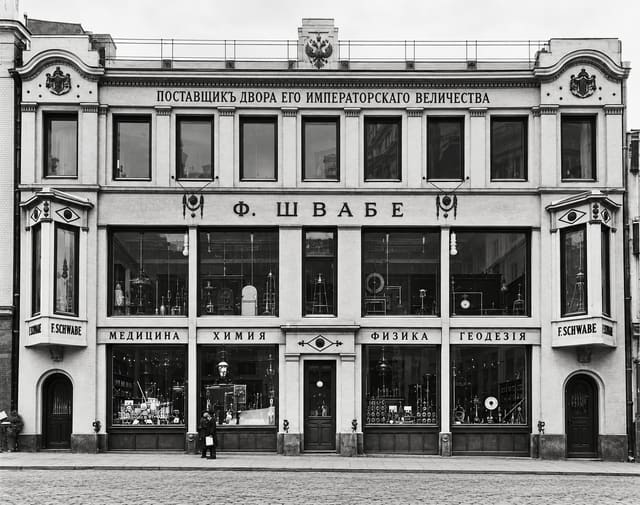
This was the largest production of geodetic instruments in the country. The factory turned out up to one hundred and fifty large angle-measuring instruments a month. The shop on Kuznetsky Most was rebuilt as well — in 1907–08 a four-storey building took in the sales floor, the administration and the offices.
In January 1908 the Society of Russian Land Surveyors staged the first exhibition of geodetic instruments in the hall of the Institute of Land Surveying. The firm showed forty-eight exhibits, including seven theodolites, two astrolabes and six levels. Professor S. M. Solovyov, chairman of the exhibition committee, observed: "The firm at present competes with the oldest Russian factory of geodetic instruments, that of H. Gerlach in Warsaw."
Competing with Gerlach on equal terms was a statement of rank.
In 1910 the Department of Trade and Industry approved the trading house's factory mark. In 1911 the firm began issuing the News of the Schwabe Firm (Известия фирмы Швабе), a periodical appearing twice a year in which novelties and modifications were published before being folded into the full catalogues. In effect, a technical bulletin.
In 1912 the trading house was converted into the F. Schwabe Joint-Stock Company with a nominal capital of one million roubles (two thousand shares at five hundred). Nicholas II approved the charter on 14 February 1912 at Tsarskoye Selo; the company commenced operations on 5 June. M. Yu. Gamburger was elected chairman of the board, Ye. F. Steiner became managing director, and V. P. Lappekin director. On 28 December 1913 the company was granted the title of Purveyor to the Court a second time: on a change of legal form the title had to be reconfirmed.
In the same year of 1912 the remaining free land on Stromynka was bought and a second building begun.
The growth figures speak for themselves. In 1871: twenty-two people and three thousand roubles of income. In 1882: one hundred people and one hundred and twenty-five thousand. In 1912: two hundred and forty-five people and six hundred thousand in turnover. In 1914: three hundred people and one million two hundred thousand.
The board sat at Kuznetsky Most 16. The telegraphic address was terse and rather wonderful: "Москва. Хирургоптику" — "Moskva. Khirurgoptiku." It is a coined word, welding khirurg (surgeon) to optika (optics) and putting the result in the dative case, as telegraphic addresses required. Roughly: "Moscow. To Surgeryoptics." Two lines of business compressed into a single telegram-friendly word.
The war began in July 1914, and the firm threw itself into work at once: surgical, geodetic, chemical and optical instruments, disinfection equipment, urgent defence orders. In September the board opened an infirmary at the factory — first of ten beds, then of twenty-eight.
None of it mattered, because the owners bore a German surname.
The Moscow branch of the All-Russian National Union published a book titled German and Austrian Firms in Moscow, listing addresses of enterprises and names of owners — in substance, a ready-made target list. The law of 11 (24) January 1915 required all German and Austrian firms (Moscow counted about two hundred and fifty large ones and up to five hundred medium and small) to liquidate voluntarily by 1 (14) April.
Matilda Yulyevna understood where matters were heading earlier than most. On 14 September 1914 — that is, six weeks after the outbreak of war and long before the pogrom — she submitted, under pressure from the authorities, an application to withdraw from the joint-stock company, sold her shares to Steiner, and left for Germany in early 1915. Steiner became chairman of the board.
On 27–29 May (9–11 June) 1915 an anti-German pogrom took place in Moscow. At its height, on 27–28 May, the number of participants exceeded a hundred thousand. They worked from lists; only a document proving non-German origin could save a house.
The tally: 476 commercial and industrial premises and 217 dwellings wrecked, more than sixty fires recorded, five people of German origin killed, four of them women. Among the victims were 113 subjects of Germany and Austria-Hungary, 485 Russian subjects with foreign surnames, and 90 people with Russian names and surnames. Losses were estimated at over fifty million roubles. The historian N. V. Savinova notes the bitter irony: those who suffered most were in fact Russian subjects and subjects of neutral and friendly states.
Kuznetsky Most was among the streets wrecked. An eyewitness recalled goods flying out of shops on both sides of the street, amid cracking timber and the ringing of broken glass.
On 10 May 1915 the "Rules, Confirmed by the Highest Authority, on the Liquidation of Commercial Enterprises Belonging to Enemy Subjects" were published. A government inspector was appointed to the company. The formal pretext was that at the company's founding a Bavarian subject had held eight hundred of the two thousand shares — despite the fact that by this point she had had no connection with the business for a year.
The board wrote to the Minister of Trade and Industry. No substantive reply followed.
On 9 August 1916 the Council of Ministers resolved to liquidate the F. Schwabe Joint-Stock Company and appoint a Special Board — acting on a decision of the "Committee for Combating German Dominance" (Комитет для борьбы с немецким засильем). In the spring of 1916 the shop was moved from Kuznetsky Most to Stromynka, into the factory building. By May the second building was finished: workshops, a technical department, a chemical laboratory, the accounts office, and the factory hospital. On 1 December 1916 the former board handed its functions to the Special Board, which in early 1917 put the enterprise up for sale.
So an enterprise that had supplied instruments to Russian universities, the army and the Land Survey Department for seventy years was taken from its owners over a surname.
Before the war a military engineer, Staff Captain Vasily Ivanovich Chetyrkin, had come from Petersburg to the firm. He placed an order for the manufacture of his own invention — an aerial bombsight and rangefinder. The War Ministry bought the instrument, and the inventor received a block of shares.
On 14 July 1917, between the two revolutions, Chetyrkin together with V. P. Lappekin bought the property of the former F. Schwabe company for one million four hundred thousand roubles. On 31 August 1917 the charter of a new joint-stock company was confirmed — Geofizika (formerly "F. Schwabe"), with a capital of two and a half million roubles. Chetyrkin was elected managing director.
The founder's name vanished from the signboard. Not, as it turned out, for good.
The new company was allowed two years. The October Revolution and the Civil War brought production to a halt; at the end of 1919 Geofizika was nationalised. It was run first by a collegium and, from 2 July 1920, by a manager, N. A. Proshchin.
On 3 April 1922 a resolution of the Presidium of the VSNKh (Supreme Council of the National Economy) established the Precision Mechanics Trust, gathering four nationalised Moscow enterprises: Geofizika (formerly F. Schwabe), Metron (formerly "E. S. Tryndin's Sons"), Geopribor (formerly "Tauber and Tsvetkov") and Aviapribor (formerly "Reinin"). The trust's office was installed in the premises of the former F. Schwabe shop at Kuznetsky Most 16 — a detail with something of history's dry humour about it: a Soviet trust moved into the shop where it had all begun.
In September 1922 Geopribor and its optical shop were merged into Geofizika, and the works set up its own production of eyepieces and objectives. From 1926 the geodetic line became the priority. In 1927 the domestically designed TT-30 theodolite-tacheometer with an internally focusing telescope went into series production, followed by the OT and OT-10 optical theodolites. In 1934 the works began turning out levels, biological microscopes and opaque illuminators.
The continuity here is not metaphorical: the plant went on making exactly what it had made under Steiner — theodolites for surveying land, only the land was now being surveyed on different principles.
In January 1937 Geofizika passed to the People's Commissariat of the Defence Industry and became State Union Factory No. 217 (charter confirmed by the People's Commissar's Order No. 69 of 23 February 1937). By an order of Ordzhonikidze and Voroshilov, a group of leading designers was formed at the works and sent to study at the Military Academy.
The principal product became aerial bombsights. By the end of 1939 optical military equipment made up seventy per cent of output. By May 1940 the works had taken its place in the industry's numbered roster: No. 217 (Geofizika) and No. 356 (Geodeziya) in Moscow, No. 69 in Krasnogorsk, No. 355 in Zagorsk, No. 233 in Lytkarino, and the Leningrad plants under their own numbers.
The spectacle shop had become, finally and completely, a defence plant.
On 7 October 1941, as German forces approached Moscow, the State Defence Committee (GKO) resolved to evacuate Factory No. 217 to Sverdlovsk. The factory order followed on 11 October; the director was V. O. Safonov.
In twenty-eight days out went materials, semi-finished goods, tools, machinery, the laboratory, the technical documentation — and, listed separately in every factory chronicle, the library of the Schwabe firm. Somebody, in October 1941, in the middle of an evacuation, thought it necessary to load pre-revolutionary catalogues and reference books onto a train. The move took about ten trainloads; more than ten thousand people went to the Urals.
From this point the history forks in two — and both branches trace themselves legitimately to Schwabe.
The Urals branch. On the basis of the evacuated works there grew up in Sverdlovsk the enterprise later named the Ural Optical and Mechanical Plant — today PO UOMZ, named after E. S. Yalamov, in Yekaterinburg.
The Moscow branch. On the old site the remaining workers organised a workshop for repairing tank sights, artillery panoramas and anti-aircraft instruments. By an order of the People's Commissar of Armaments dated 7 February 1942 it was converted into an independent works, Factory No. 589.
Confusion between these two lines is the commonest error in popular accounts. They should be kept apart.
After the war the Moscow Factory No. 589 underwent a fundamental change: a shift from serial production to the manufacture of prototypes of new equipment. The names changed — a "post-office box" (a Soviet cover designation for classified plants), then the Geofizika Central Design Bureau, then the State Optical Works, from 1980 the Geofizika Scientific Production Association, and from 2002 the Geofizika-Kosmos Scientific Production Enterprise.
In 1957, jointly with the Moscow Studio of Popular Science Films, the works created the PKS panoramic cine camera and the SKU-35 fixed projection unit.
From 1959 the enterprise took part in every Soviet space programme. The list of its work reads like a short history of Soviet spaceflight:
The light vertical, by which on 7 October 1959 the Luna-3 probe was oriented in space — the probe that first photographed the far side of the Moon. Without that instrument the camera would have been pointing into empty space.
The "Grif" solar sensor and the "Vzor" visual instrument for the Vostok spacecraft. Through Vzor, on 12 April 1961, Gagarin saw the Earth.
Then: attitude-control instruments for the interplanetary probes that explored Mars and Venus in the 1960s. Instruments for the Soviet lunar programme. Sensor suites for the attitude control of geostationary communications satellites. Thirty instruments aboard the Mir space station, which on the core module worked for more than fifteen years. Instruments for Buran, the Soviet shuttle.
In all, the enterprise developed around three hundred types of space instrument — mostly for orientation by the Sun, the Earth and the stars. The total number manufactured exceeds ten thousand.
In 1961 the Geofizika Central Design Bureau was awarded the Order of the Red Banner of Labour (sixty employees receiving orders and medals at the same time), and in 1975 the Order of the October Revolution.
The medical line, descended from the old firm's surgical department, was not forgotten either: in 1973–75 the works created the SGD-6 and SGD-8 haemodialysis machines — the "artificial kidney."
Exactly a hundred years after Moscow's doctors came to Schwabe for antiseptic instruments, his factory was making machines that cleaned blood.
The optical-electronic holding of the Rostec State Corporation took shape in the late 2000s under the name of the Optical Systems and Technologies Scientific Production Concern; its management company was registered in 2010, and the holding dates its anniversaries from then. On 26 October 2012 it was renamed Shvabe.
The name returned to the signboard ninety-five years after it had been taken down. With one blemish, admittedly: the approved Latin spelling "Shvabe" corresponds neither to the founder's actual surname (Schwabe) nor to its German pronunciation. The name has come completely adrift from the man and turned into a brand — which is, after all, the usual fate of surnames on signboards.
One hundred per cent of the shares of the management company, JSC Shvabe (Moscow, Prospekt Mira 176), belong to Rostec. The holding brings together several dozen organisations — different sources give up to sixty-four, including some twenty research institutes, design bureaux and production associations — in ten Russian cities: Moscow, the Moscow region, St Petersburg, Vologda, Kazan, Yekaterinburg, Novosibirsk and others. At the end of 2014 about eighteen thousand people were employed at the holding's enterprises.
Among the constituent parts: the Ural Optical and Mechanical Plant named after E. S. Yalamov; the Krasnogorsk Plant named after S. A. Zverev; the Lytkarino Optical Glass Factory; the Zagorsk and Vologda optical-mechanical plants; the Novosibirsk Instrument-Making Plant; the S. I. Vavilov State Optical Institute; the M. F. Stelmakh Polyus Research Institute; the Orion Scientific Production Association; the State Institute of Applied Optics in Kazan; Shvabe-Photosystems (the former Moscow Sapfir plant); Shvabe-Instruments; and the Astrofizika Research and Production Centre.
One correction to the lists usually given: LOMO, the Leningrad Optical-Mechanical Association, often counted as part of the holding, passed to the Kalashnikov Concern in May 2024.
Lines of work: optical and laser systems; optical materials and technologies (the holding is Russia's leading producer of optical glass and optical fibre); medical equipment; aerospace monitoring systems; instruments for scientific research; energy-saving lighting. The Krasnogorsk plant, now part of the holding, took the Grand Prix at the 1958 World's Fair in Brussels.
The directors general of JSC Shvabe have included, at various times, S. V. Maksin, A. P. Patrikeyev and V. S. Kalyugin. The nominal capital exceeds 16.9 billion roubles. The holding's enterprises are subject to Western sanctions imposed after February 2022. The story has had its scandals too: in 2015 two deputy directors general were detained on fraud charges, and in 2019 the press reported financial difficulties at individual enterprises.
Information of this kind dates quickly and should be checked against current sources.
In museums. The Polytechnic Museum holds more than fifty of the firm's objects, over one hundred and forty "shadow pictures" — lantern slides for magic lanterns — as well as catalogues and documents. Among the exhibits are a surveying astrolabe of the 1860s, an astrolabe limb with alidade and compass reading to one minute of arc, and its detachable sights. The museum of the Geostroyizyskaniya company holds an astrolabe, a plane-table compass and a theodolite. Individual objects and documents are kept in the museum of the Geofizika-Kosmos enterprise.
On the antiques market. Drawing-instrument cases, planimeters, protractors, barometers, scales and astrolabes bearing the F. Schwabe mark surface regularly. They are recognised by the stamp and by the inscription with the title of Purveyor to the Court.
In stone. The brick factory building on Stromynka, put up in 1908, still stands and became part of the Moscow Geofizika complex. Prince Golitsyn's house on the corner of Kuznetsky Most and Bolshaya Lubyanka, where it all started, is gone.
In people. Pyotr Ivanovich Gromov, born 16 June 1867 into a family of townspeople in the town of Alatyr, was apprenticed as a boy to the Schwabe factory, rose from journeyman to department head, and in 1895 opened his own workshop for physical-mechanical and optical instruments on Arbatskaya Square. The Schwabe factory was to Moscow instrument-making what a guild workshop was to a medieval craft: a school from which masters came out.
The historiography of the firm is peculiarly arranged: almost the entire body of facts now circulating in encyclopaedias, corporate publications and city media goes back to a single piece of research — the work of S. G. Morozova and E. N. Tryndin, based on the holdings of the Moscow archives. The work is sound, but its replication has created an illusion of consensus where in fact a single voice is speaking.
Independent footing is provided by the firm's own publications — the catalogues, where everything is said in its own words: the twenty years of trust, the absence of commission agents, the T-section of the telescope standard. It is from these, and not from paraphrases, that the prices, the range of goods, the terms of trade and the character of the enterprise have been taken.