Loading
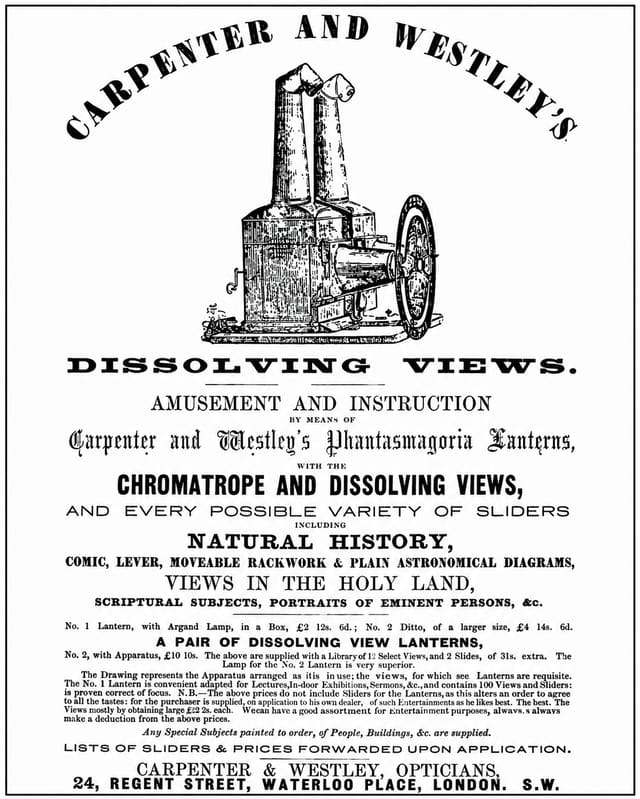
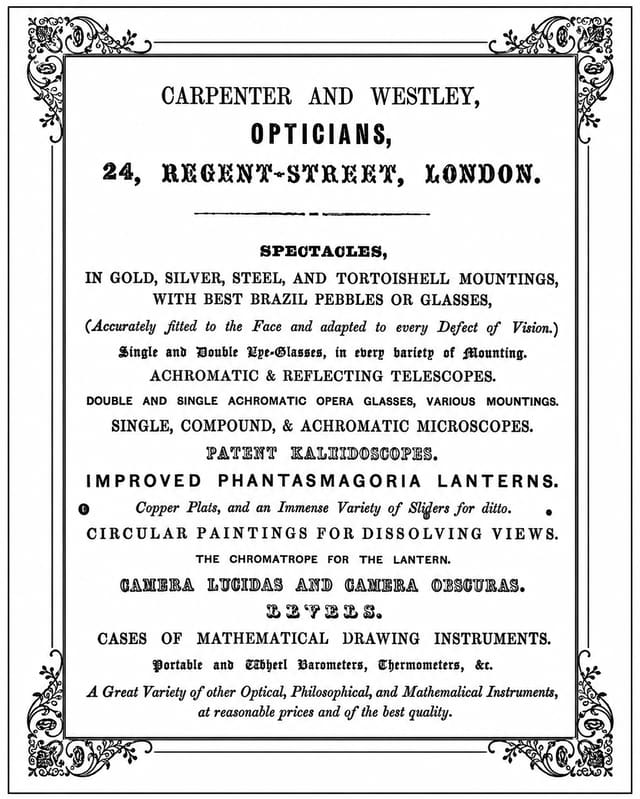
Carpenter & Westley is one of those nineteenth-century London firms in whose history science, craft, commerce and Victorian spectacle came together in a remarkable way. Grown out of the enterprise of the gifted optician and inventor Philip Carpenter, the business continued from roughly the mid-1830s under the name Carpenter & Westley and survived at least until the turn of the twentieth century. In its workshops and showrooms mathematical, philosophical and optical instruments were made and sold: microscopes, telescopes, spyglasses, barometers, thermometers, surveying and demonstration apparatus, along with the celebrated projection lanterns and a wide range of optical entertainments.
Yet the history of Carpenter & Westley is not merely a list of addresses and products. Behind the familiar engraving on ivory, brass or wood lies a complicated family and commercial chronicle: Philip Carpenter's move from Birmingham to London, an unexpected change of ownership, the appearance of the Westley name in the firm's title, its participation in the great exhibitions of the age, and the gradual transformation of a small workshop into a well-known London scientific instrument shop. To follow the fortunes of Carpenter & Westley is to watch how, over nearly seventy years, the very idea of a scientific instrument shifted — from the working tool of the researcher and the lecturer to a refined object for the domestic study, the public lecture and the optical show.
The most reliable biographical reconstruction is the work of the researcher Phillip Roberts, who published the article 'The Early Life of Philip Carpenter' in The Magic Lantern (Magic Lantern Society) and a substantial study, 'Philip Carpenter and the convergence of science and entertainment in the early-nineteenth century instrument trade', in the Science Museum Group Journal (Spring 2017). According to the memoirs of his younger brother Lant Carpenter, Philip Carpenter was born at Kidderminster on 18 November 1776, four years before Lant and eleven years before his sister Mary. His parents were George Carpenter, a carpet manufacturer, and Mary Carpenter (née Hook), daughter of Christopher Hook, mayor of Coventry. The Carpenters were Unitarians and had farmed a small estate near Bromsgrove for generations. The father 'proved unfortunate in business', which obliged the family to leave Kidderminster; the references point to the family living in Birmingham from the 1790s onwards (they narrowly escaped the Priestley riots of 1791, directed against religious dissenters).
Philip Carpenter's will (The National Archives, PROB 11/1815/261) names two sisters and his brother Lant. Accordingly:
In his memoirs Lant describes directly how his brother in London made fine magic lantern sliders, many of them movable, which Lant used to illustrate his astronomy lectures around 1832 — documentary confirmation of the fraternal relationship between Philip and Lant.
Exactly how Philip trained as an optician is not known. In A Companion to the Microcosm he claimed to have worked as an optician in Birmingham for thirty years, which, counting back from his move to London in 1826, places the start of his career around 1796. He may have been apprenticed to a certain William Carpenter, listed at the same Inge Street address in 1808 (no relation). According to Morrison-Low, Carpenter is said to have claimed that he trained in London, though no source is given for this. By 1808 Philip was working as an optician on Inge Street; in 1813 he acquired a leasehold on Bath Row (1,041 square feet for 107 years; the document handled by the solicitors Smythe, Etches and Co.), where he built a dwelling house and a manufactory; in 1816 he mortgaged it for £500. By 1817 he was carrying on a large trade in lenses and, according to Timmins (1866), supplied telescopes even to the great London optician Peter Dollond. Talbot judges that by 1812 he had become the leading supplier of achromatic lenses to the British optical trade.
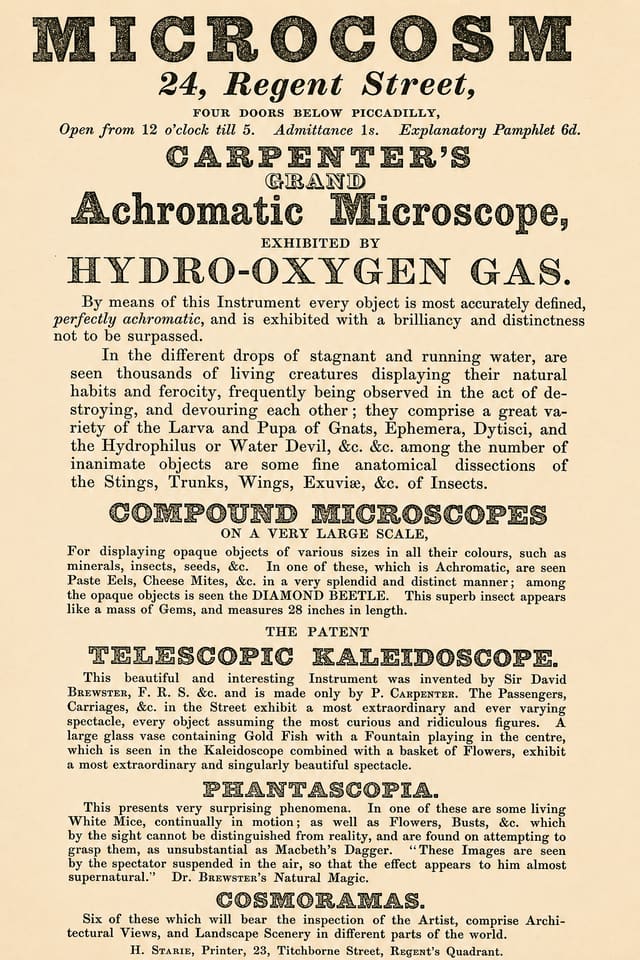
In 1817 David Brewster chose Carpenter as the sole maker of his patented kaleidoscope. The success was enormous: by Brewster's own account, some two hundred thousand kaleidoscopes were sold in Paris and London within three months. The figure cannot be verified, and Brewster himself reckoned that no more than a thousand of them were correctly made, authorised copies, the great majority being pirated versions that failed to convey his invention properly (Brewster's Treatise, cited via Wikipedia, 'Kaleidoscope'). Carpenter's instruments were stamped 'Sole Maker'. On 17 May 1818 Brewster asked Carpenter's leave to transfer production to other makers as well, since he could not keep pace with demand; in the end some seventeen makers were producing kaleidoscopes (Dollonds, W. & S. Jones, R. B. Bate, John Ruthven and others).
From 1821 Carpenter was manufacturing the Improved Phantasmagoria Lantern and Copper-Plate Sliders. He dated their appearance himself in the 1823 edition of Elements of Zoology with the words 'about two years ago'; an advertisement in the Liverpool Mercury of 12 April 1822 confirms that they were already on sale. The lantern was of tinplate, with a tall curved chimney, an Argand lamp, a double condenser and an objective with a stop to reduce aberration; it was simpler and cheaper than the widespread single-lens 'bull's-eye' lanterns. It was sold as a package: in 1827 the price was £4 4s for the equipment plus 4s 6d for slides and 1s for the companion booklet (£4 9s 6d for the whole). A more expensive set with a microscope attachment for showing objects 'in the manner of the solar microscope' cost £2 8s. The sliders were made to a standard size to fit Carpenter's own lantern — an early example of tying hardware to software.
A slider consisted of three or four transfer-printed and then hand-coloured images on small glass discs, set into long wooden frames with spring catches. These were the first slides printed from a single matrix (a copper engraving). Carpenter's process was based on the ceramic transfer method of Sadler & Green (in use from 1756). Historians — John Barnes, Hermann Hecht, F. J. Frutos — stress that this was NOT true mass reproduction: each slide still required substantial work from painters, and genuine mechanical reproduction only became possible with lithography. The significance of the process lay in standardisation and accuracy of image. Mervyn Heard calls the transfer process revolutionary for slide production, while Laurent Mannoni regards Carpenter as the first to perfect the mass production of slides.
By 1822 the series already included natural history (Mammalia and others from Elements of Zoology), 'Ancient and Modern Costumes', portraits of the kings and queens of England, microscopic objects 'as seen in the solar microscope', public buildings and views, 'Astronomical Diagrams' and comic subjects. The companion texts (for instance Elements of Zoology, 1823) carried sensational, entertaining descriptions that reveal an orientation towards a respectable but spectacle-hungry middle-class public.
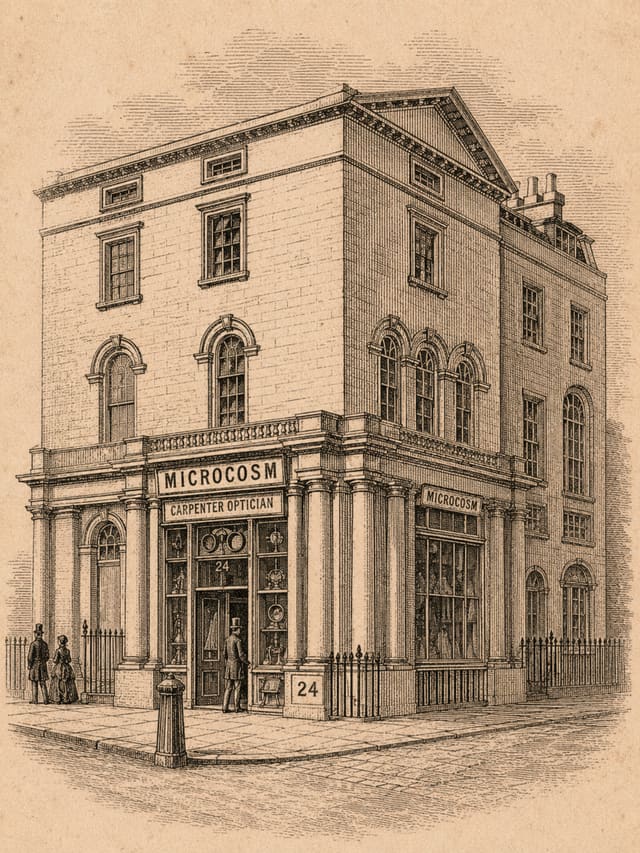
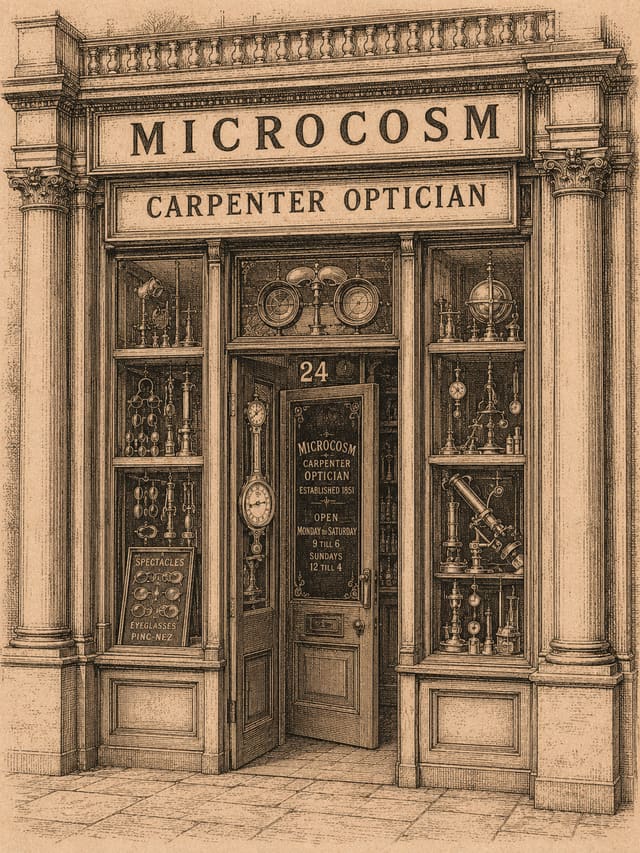
In 1826 Carpenter moved the business to 24 Regent Street in Westminster (at the corner of Jermyn Street), retaining the Bath Row manufactory and the New Street shop in Birmingham. The Westminster rate books record him paying rates of £178 on the Regent Street property (1634–1900: folio 42), which Roberts takes as evidence that he had become quite affluent (Science Museum Group Journal, Issue 07, section 'The Microcosm'). There he set up a public exhibition of microscopic views, 'The Microcosm', which operated in the Regent Street shop between 1827 and 1835 (the signage read 'P. Carpenter Optician' and 'MICROCOSM', 'Microcosm open from Eleven till Eight'; George Scharf's drawings of 1828 survive in the British Museum). The exhibition consisted of about twelve large lucernal microscopes; it won considerable fame and appears to have inspired William Heath's caricature 'Monster Soup commonly called Thames Water' (1828). Timmins (1866) wrongly credited Carpenter with inventing the first solar microscope; more probably he merely mounted the first permanent display of the kind.
A single catalogue of 1834 survives (16 pages; the only copy in the archive library of the Museum of the History of Science, Oxford). The finest instrument was 'Carpenter's Improved, Opake and Transparent Compound Microscope' — a compendium priced at £30 in the 1834 catalogue; an example is in the Oxford museum (see Gerard Turner, Collecting Microscopes, 1981). Many of Carpenter's microscopes were in fact made to his specifications by the young opticians of the following generation — James Smith, Hugh Powell, Andrew Ross and John Benjamin Dancer.
Philip Carpenter died at Regent Street in April 1833. Most sources give 20 April 1833; Stuart Talbot's article (Bulletin of the Scientific Instrument Society, No. 88, 2006) gives 30 April 1833 — a discrepancy worth noting. His burial is recorded in the Worship Street Burial Register (The National Archives, RG 4/4515).
After Philip's death the business was taken over by his sister Mary Carpenter. According to Lucerna, Mary was a partner in the firm from 1835 to 1877 (the year of her death). This is a rare and notable episode: a woman at the head of a scientific instrument firm in the fashionable West End of London in the 1830s. The Science Museum Group records Mary Carpenter as active in 1834–1837 as the immediate successor. The role of a female proprietor matters for the history of gender in science and commerce, even though technical direction and the public face of the firm passed increasingly to Westley.
Other members of the family: the younger sister Sarah; the brother Lant (the minister); and the probable second brother Thomas. Once again, the distinction must be maintained from the namesake nephew and niece (Mary Carpenter the reformer and W. B. Carpenter the physiologist).
William Westley was born, according to Grace's Guide, around 1807, in Birmingham. He was apprenticed to Philip Carpenter from about 1821 and later became foreman. When the business moved to London (c. 1827) Westley rejoined his employer — first as foreman, then as partner. In Phillip Roberts' account (Science Museum Group Journal, Issue 07, 2017), Carpenter died in 1833 and was succeeded by his sister Mary; in 1837, having disposed of the Birmingham side of the business to the earlier foreman Robert Field, Mary took William Westley into partnership — Westley having been apprenticed to Carpenter from 1821 and having become foreman after Field's departure. Different sources give the date of the change of name as either 1835 or 1837; probably 1835 marks the first use of the name and 1837 the formal constitution of the partnership.
A number of secondary sources (including the English Wikipedia and microscopehistory.com) state that Westley was Mary Carpenter's husband. The more specialised and archivally grounded sources (Roberts, Talbot, Grace's Guide, Lucerna) describe him specifically as her brother's former apprentice and foreman, and offer no confirmation of a marriage. The claim should be treated as unreliable collectors' folklore until it is supported by primary documents.
Grace's Guide, citing The Engineer of 13 November 1891, records that around 1836, when dissolving views first appeared, it was William Westley who brought them before the public, while the method of producing them was kept secret; that Westley employed the best artists to paint the slides, among them Thomas Kearnan and Henry Childe; and that Childe claimed the invention of the dissolving view for himself. Westley eventually became sole proprietor (in Lucerna's record, 'owner' from 1877 to 1887, after Mary's death). He died in 1887 and is buried at Highgate Cemetery. In 1887 the firm was described as <cite>"the oldest manufacturers of magic lanterns in this country"</cite> (Grace's Guide, quoting The Engineer, 13 November 1891).
Drawing on the Science Museum Group, Roberts and Lucerna:
Signatures help to date objects. A mark reading 'P. Carpenter' or 'Carpenter, 24 Regent St' indicates a date before 1835–1837 (under Philip, or during the transitional period); 'Carpenter & Westley, 24 Regent St, London' indicates after c. 1835–1837. Early microscopes bearing the address '111 New St., Birmingham' date from about 1835. The attribution is supported by Tallis's London street directory (London Street Views, 1838–1840), where No. 24 Regent Street is listed as 'CARPENTER and WESTLEY, Opticians'.
In the nineteenth-century British trade the terms optical, mathematical and philosophical instruments covered a far wider range of goods than the modern words 'optics' and 'mathematical instruments' suggest. Mathematical instruments included drawing and surveying instruments, measuring scales and navigational equipment; philosophical instruments meant demonstration apparatus for physics, meteorology, electricity, mechanics and natural history.
The foundation of the early business was spectacles, lenses, magnifiers, telescopes, microscopes and optical toys. Museum collections hold compound monocular microscopes and Gould-type microscopes signed or retailed by Carpenter & Westley. A shop signature, however, does not always mean that every part was made on the premises in Regent Street: London opticians regularly bought brass stands, tubes, objectives and cases from independent makers.
The firm also sold imported and licensed novelties. A Jules Duboscq stereoscope, for example, is known to have been retailed through Carpenter & Westley. Such an object shows that the company acted not only as a manufacturer but as a prestigious dealer through whom the British public obtained French and other Continental optical instruments.
The range included special forms of eyewear, among them folding and pocket spectacles and so-called hat spectacles, which could be attached to headwear or used without conventional temples. In the later period it was precisely spectacles and ophthalmic optics that became the core of the business.
Carpenter's most historically significant products were the Improved Phantasmagoria Lantern and his systematised series of images. The 1822 catalogue already offered religious, scientific, comic, literary, geographical and instructive subjects. By the catalogue of 1850 the range had retained the early series and added botanical, biblical and astronomical subjects together with more elaborate movable images.
Surviving sets include views of landmarks, travel scenes, astronomical phenomena, microscopic objects, biblical episodes, comic transformations and motion effects. The Science Museum holds a group of thirty-six hand-painted Carpenter & Westley glasses; other museum objects demonstrate movable images of transits, eclipses and the motion of celestial bodies.
Displays of dissolving views required two synchronised lanterns, so that one image faded away while the next appeared in its place. Surviving paired apparatus bearing the firm's mark shows that Carpenter & Westley supplied not only the images but technically matched projection equipment.
Philip Carpenter was dealing in microscopes as early as his Birmingham period. After the move to London, microscopes were displayed in the Microcosm and sold in the shop. Westley belonged to the Microscopical Society, and the firm maintained links with the professional community. By the middle and later nineteenth century, however, Carpenter & Westley appears to have ceded specialised microscope manufacture to workshops such as Ross, Smith & Beck and Powell & Lealand, concentrating instead on retail, projection and general optics.
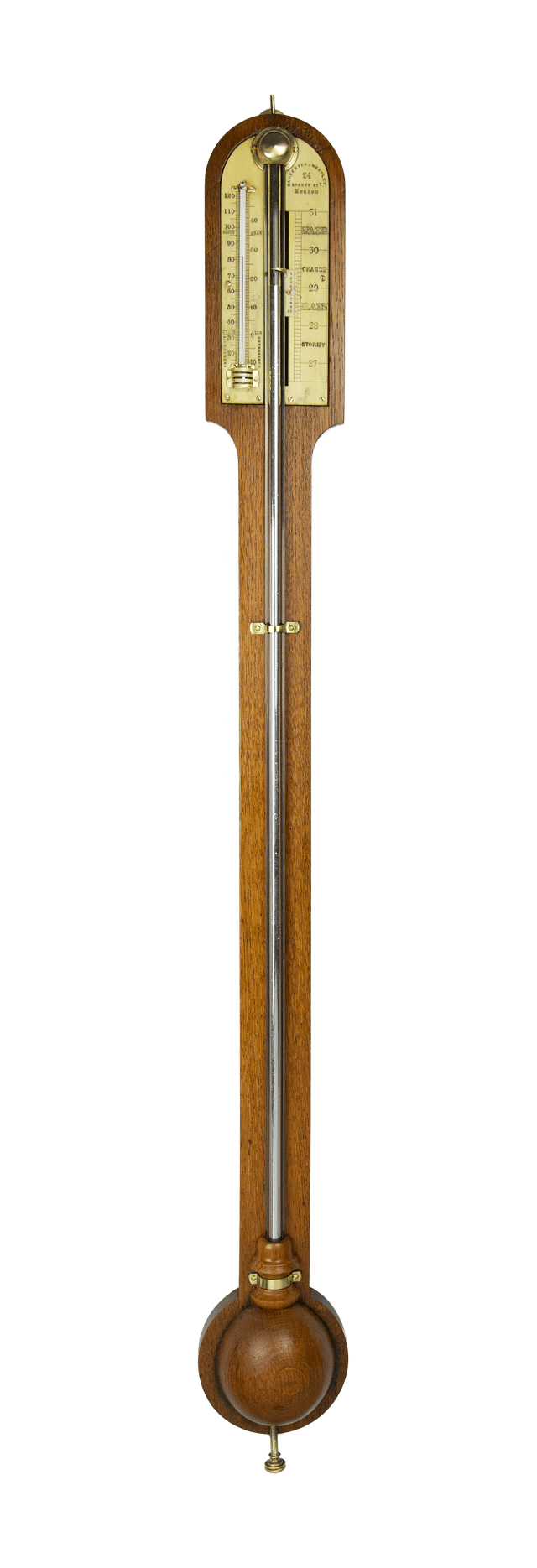
The firm sold barometers, thermometers, sympiesometers and other instruments for atmospheric observation. The Science Museum holds a pocket sympiesometer of 1839 on Ronchetti's system signed by Carpenter & Westley. The sympiesometer used a liquid and a volume of gas in place of the traditional long mercury column and was particularly suited to portable or marine use.
The presence of the Carpenter & Westley name on a barometer does not necessarily mean that the whole instrument was made in the firm's workshop. Like many London opticians, the company might:
Old eighteenth-century Dutch barometers are known that later received Carpenter & Westley scales or trade plates. Such examples prove that the firm's signature may record a later alteration or a retail sale rather than the original manufacture of the case.
In the early period Carpenter was above all an organiser of production. He designed the system, controlled the optical parameters, standardised dimensions and assembled the products, but used a network of Birmingham craftsmen for the metal, wooden and decorative parts.
Once established in London the firm combined several functions: manufacturer of its own designs, publisher of visual material, importer, retail shop, repair workshop and supplier to scientific institutions and wealthy private clients. By the 1850s and 1860s the proportion of goods actually made by outside workshops had probably increased. Museum reference works describe the later Carpenter & Westley explicitly as a retailer and supplier of a broad range of goods rather than the maker of everything it signed.
After Westley's death the artistic production of lantern slides declined rapidly. Photography changed the projection market, while industrially produced spectacle lenses and the professionalisation of ophthalmic optics made the sight-correction trade more secure. By the early twentieth century Carpenter & Westley retained the prestige of a historic name, but in the character of its work it already differed substantially from Philip Carpenter's manufactory of the 1810s and 1820s.
Carpenter's significance lies in a commercial and organisational transformation: he carried the skills of lens grinding and the methods of the Birmingham putting-out system into a mass consumer market, repackaging the magic lantern and the microscope as respectable educational and entertaining goods for the middle class. His standardised sliders and companion texts anticipated the industry of educational and spectacular projection; the firm's dissolving views and chromotropes form an important part of the prehistory of cinema.
Competitors and contemporaries: Newton & Co. (Fleet Street), Negretti & Zambra, Horne & Thornthwaite, W. & S. Jones, Cary, Dollond, Ross, Smith & Beck. From the 1850s Carpenter & Westley became increasingly retailers rather than manufacturers, buying much of their stock from Negretti & Zambra (according to London Fine Antiques, a large part of the firm's stock in the 1850s came from that renowned manufacturer) — which is to say that Negretti & Zambra acted as a supplier, not as a firm that absorbed Carpenter & Westley.
The Great Exhibition of 1851: Carpenter & Westley exhibited at the Crystal Palace in Class X ('Philosophical, Musical, Horological and Surgical Instruments') under number 270 (per the index of the official catalogue reproduced by Grace's Guide). The precise list of exhibits and any award are not established from the available sources; no record of a medal has been found. Participation in the 1862 exhibition is not documented.
The date on which trading ceased is disputed:
The suggestion that the firm was absorbed by Newton & Co. is plausible as a general pattern (Newton bought up the stocks of competitors — for example York & Son after its liquidation in 1912), but no direct documentary confirmation that Carpenter & Westley's stock or copper plates passed to Newton has been found in the available sources. The presence in the Science Museum collection of a 'Newton's colour disc chromotrope by Carpenter & Westley' shows a commercial overlap between the two firms but does not prove an acquisition. No relevant notice of dissolution or liquidation naming Carpenter & Westley of Regent Street could be found in The London Gazette — this remains a direction for further archival work, around the years 1877, 1887, 1914, 1922 and 1940.
The history of Carpenter & Westley spans more than a century — from Philip Carpenter's Birmingham workshop, documented from 1808, to a London optical business that retained its historic name, probably until 1940. Over that time the firm moved from the craft production of lenses and scientific instruments to a substantial shop combining its own manufacture with retail, importing, repair and the supply of instruments to private clients and scientific institutions.
The particular place of Carpenter & Westley in the history of technology rests on its ability to unite science, education and spectacle. Kaleidoscopes, microscopes, telescopes, barometers, projection lanterns and painted glasses together made up a single culture of observation, one that sought to make the invisible visible, the distant near, and the complex both intelligible and impressive. Standardised series of images, movable slides and dissolving views became an important part of the prehistory of screen entertainment and of cinema.
Surviving instruments signed by Carpenter & Westley call for cautious attribution: the firm might be the maker, but equally the retailer, the supplier, the repairing workshop or the moderniser of an older object. That very versatility, however, reflects the structure of the nineteenth-century instrument trade, which rested on collaboration between opticians, mechanics, engravers, painters and independent craftsmen.
Today the name Carpenter & Westley lives on upon brass plates, ivory scales, instrument cases and the wooden frames of lantern slides. Each such object is not only the product of a well-known London firm but also a witness to an age in which the scientific instrument served research, education, the domestic study and the public spectacle all at once.