Loading
"The glassblowers' rooms looked like smokehouses, because beef tallow was burned as fuel in the blowing lamp; noses there were as sooty as a chimney." This is how an old glassblower remembered the workshops of the Thuringian Forest (Thüringer Wald) in days gone by; his account was recorded by Pastor Löber in the essay (1926). From rooms like these grew an industry that by the end of the nineteenth century produced most of Germany's thermometers. One of its firms was the Thermometer-, Barometer- & Glasinstrumentenfabrik of Carl Emil Rose in the village of Mellenbach on the river Schwarza. It was a small concern that for more than ten years advertised in export directories in three languages, kept an agent in Berlin and drew a bill of exchange on a customer in León, Spain.
Glassworks were already operating in the Thuringian Forest in the Middle Ages. The forest gave the glassmakers almost everything they needed: wood for the furnaces; ash, from which potash was obtained — an alkaline flux that lowered the melting temperature of the batch; quartz sand; and lime, which gave the glass its chemical durability. Mountain streams turned the mill wheels. Sand from around Martinroda contains about 3.5 per cent alumina, and later research showed that it is precisely this admixture that lets the surface of the glass stay bright for a long time in the flame, while an abundance of alkalis made Thuringian glass easy to melt. Dr H. Fischer of Ilmenau concluded in his 1927 paper on the development of the Thuringian thermometer industry: "Es war also kein Zufall, daß gerade Thüringen die Gegend Deutschlands war, wo die Glasbläserei ihren Anfang nahm" (It was therefore no accident that Thuringia, of all the regions of Germany, was where glassblowing began).
For a glassworks, the forest was both its fuel and its limit: once the surrounding trees had been felled, the furnace was put out. Around 1589 a shortage of wood brought to a halt the glassworks at Langenbach near Schleusingen, which had belonged to the Greiner family for four generations. Its owner, Hans Greiner, known as Schwabenhans, together with Christoph Müller, set up a new glassworks at Lauscha in the south-east of the Thuringian Forest; on 10 January 1597 Duke Johann Casimir of Saxe-Coburg granted them a concession. A small town grew up around the glassworks, and the founders' descendants, by the reckoning of the historian Herbert Kühnert, remained connected with glass in one way or another for eleven or twelve generations.
From the late eighteenth century, glass around Lauscha came to be worked not only at the furnace but also "at the lamp" (vor der Lampe): beads, toys and Christmas-tree ornaments were blown over a flame from ready-made tubes and rods. The craft spread quickly through the forest because it gave a growing population a tolerable living. The glassblower's lamp was a tin vessel filled with beef tallow or rapeseed oil — and, for particularly fine work, even with butter; air was blown into the flame with bellows. Foot-operated bellows were reportedly introduced around 1820 by Johann Georg Greiner; from the mid-1850s paraffin took the place of tallow, and from the mid-1860s, as gasworks appeared, gas burners took over. The simplicity of the equipment shaped the whole industry: "Die Einfachheit der Hilfsmittel begünstigte die Ausbildung der Heimindustrie, durch welche in Thüringen der weitaus größte Teil der Thermometer hergestellt wird" (The simplicity of the tools favoured the growth of home industry, by which by far the greater part of the thermometers in Thuringia is produced), wrote Fischer.
The turning point came around 1830 in Stützerbach. The miller Franz Ferdinand Greiner (1808–1855), a scion of a Lauscha glassmaking family, kept a glassblowing workshop at his father's mill, where beads, toys and trinkets were made. An oral tradition retold by Fischer preserves an almost detective-story plot: a journeyman named Berkes used to work in his own room in the evenings; one day his master secretly looked in through the window and saw that he was blowing a thermometer. The Neue Deutsche Biographie names the man — the bead blower Wilhelm Berkes (d. 1881) — and regards Greiner as the first to put thermometer making in the Thuringian Forest on a commercial footing. By then beads and toys had fallen sharply in price, whereas thermometers and hydrometers brought in far more. Fischer summed it up in a single sentence: "F. F. Greiner hat damit den Grund zur thüringischen Thermometerindustrie gelegt" (With this, F. F. Greiner laid the foundation of the Thuringian thermometer industry).
As early as 1833 the historical and geographical description of Henneberg characterised the establishment at the Stützerbach mill as follows: "Eine verfeinerte Glas- und Spielwarenfabrik, welche nach Preußen, Baden, Bayern und der Schweiz viel absetzt, fertigt ferner gegen 64 verschiedene Sorten von Aräometern und Thermometern, außerdem viele Kunstsachen nach Zeichnung, Werkzeuge zu chemischen Operationen, physikalische Instrumente" (A factory of refined glassware and toys, which sells widely to Prussia, Baden, Bavaria and Switzerland, also makes some 64 different kinds of hydrometers and thermometers, as well as many artistic pieces to drawings, apparatus for chemical operations and physical instruments). Scales called for knowledge the miller did not have, and he was helped by the cantor Ephraim Alexander Walther, the schoolteacher in the Prussian part of Stützerbach — according to Fischer, the first scale writer (Skalenschreiber) in the Thuringian Forest. When the Stützerbach porcelain factory burned down around 1835, the porcelain painters thrown out of work found employment painting milk-glass scales; besides milk glass, scales were made of wood, ivory and paper. Prices fell rapidly: in 1829 a Jena author, Dr Körner, priced a thermometer on wood with a free-standing bulb at 20 Silbergroschen, while in the 1844 commission book of the Stützerbach firm of Gundelach a thermometer on wood cost 10. After Greiner's death his son-in-law carried on the business; it went bankrupt in 1870, but the people who had worked for him founded firms of their own, some of which survived into the 1920s.
The following decades widened the range. From the mid-1860s, first in Stützerbach, clinical thermometers went into mass production. In the early 1870s the Ilmenau craftsman Julius Brückner invented the "prismatic" capillary, which magnified the mercury thread like a lens, and from the mid-1870s the pin-type maximum device, first used by the London firm of Negretti & Zambra, took root in Thuringia.
Mellenbach lies in the Schwarza valley, in the Upper Lordship (Oberherrschaft) of the Principality of Schwarzburg-Rudolstadt; the village's firms were entered in the register by the princely district court (Fürstliches Amtsgericht) at Königsee. The village later merged with neighbouring Glasbach to form the Gemeinde of Mellenbach-Glasbach, and since 1 January 2019 it has been part of the town of Schwarzatal. The 1864 edition of the Adressbuch aller Länder der Erde finds little here: a dyer, Krannich's crate-and-box workshop, mills, the shops of Bornkessel and Köhler, and Carl Staschen's wholesale trade in porcelain, glass, wooden and stone goods. Thermometers were being made at the time in neighbouring Lichtenhain, between Oberweißbach and Mellenbach, where the same directory names makers of the Bock family.
The origins of the Rose firm are reported by a late source. A list of Thuringian thermometer makers compiled at the Thermometer Museum in Geraberg (Thermometermuseum Geraberg), probably by Gerhard Stöhr, gives the following note on it, citing a directory of 1926: "gegr. 1855, 1898 Neubau des Firmengebäudes, noch 1926; Thermometer; 20 Mitarbeiter (1895)" (founded 1855; new company building 1898; still in existence 1926; thermometers; 20 employees in 1895).
The earliest known printed mention dates from 1878. In the new edition of the Adressbuch aller Länder der Erde, the entry for Mellenbach (section "Fürstenthum Schwarzburg-Rudolstadt", pp. 589–590) already lists two firms in the trade. One belonged to Staschen, who had turned from merchant into manufacturer: "Thermometer- u. Barometerf. mit Dampfbetr., Werkstätte aller meteorologischen, physikalischen, chemischen u. pharmaceutischen Glasinstrumente u. Apparate" (thermometer and barometer factory with steam power, workshop for all meteorological, physical, chemical and pharmaceutical glass instruments and apparatus). The other belonged to his neighbour: "Thermometer- u. Barometerf., Spec.: Metall- u. Holzthermometer: Rose, Carl Emil" (thermometer and barometer factory, speciality metal and wooden thermometers: Rose, Carl Emil). This speciality — thermometers on wooden boards and with metal scales — remained the core of the business until the end of the century.
In these years science caught up with the craft. Investigations undertaken at the instigation of the Kaiserliche Normal-Aichungskommission (Imperial Standards Commission) showed that thermal after-effect — the slow drift of a thermometer's zero point — is greatest in glasses containing soda and potash in equal proportions. From 1884 Otto Schott's glassworks in Jena produced thermometer glass 16III, almost free of after-effect; from 1886 the Stützerbach firm of Greiner & Friedrichs melted a glass of equal quality; and in 1885 the commission urged the Thuringian glassworks that drew thermometer tubing to change over to improved compositions.
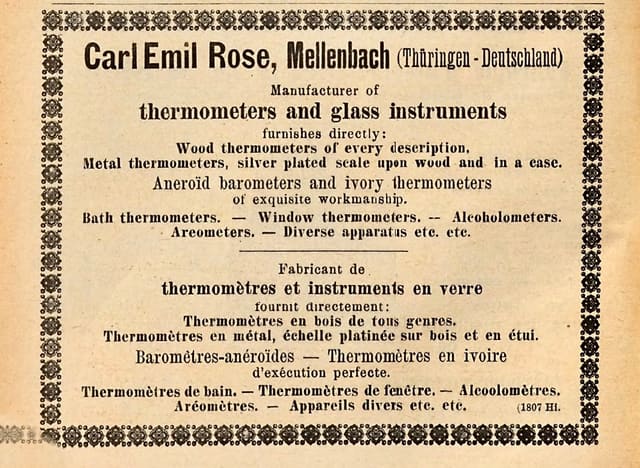
In 1887 Rose's name appeared in the Nuremberg Leuchs' Adressbuch der Export-Geschäfte, the directory of exporters from Germany, Austria-Hungary and Switzerland. In the trade index the firm appears twice: under "Glasinstrumente", alongside Albert Kühn of Manebach, its neighbour Staschen and W. Walther of Stützerbach, and on its own under "Metallthermometer". On page 95 of the same edition there is an advertisement in a Greek-key border:
"Carl Emil Rose, Mellenbach in Thüringen. Thermometer- u. Glasinstrumentenfabrik, direkte Bezugsquelle, offerirt: Holzthermometer von gewöhnlichsten bis zu feinsten Sorten, Metallthermometer, versilberte Scala auf Holz und in Etui, Aneroidbarometer, Elfenbeinthermometer in feinster Ausführung, Badethermometer, Fensterthermometer, Alkoholometer, Aräometer, diverse Aparate etc. etc." (Carl Emil Rose, Mellenbach in Thuringia. Thermometer and glass instrument factory, direct source of supply, offers: wooden thermometers from the most ordinary to the finest kinds, metal thermometers with silvered scale on wood and in a case, aneroid barometers, ivory thermometers of the finest workmanship, bath thermometers, window thermometers, alcoholometers, hydrometers, various apparatus, etc. etc.)
The 1887–1890 edition of the Adressbuch aller Länder der Erde describes Mellenbach as a village on the Schwarza with 936 inhabitants, 15 kilometres from Gehren railway station, with "Fabrik für physikal. Glasinstrumente, äther. Oele u. Holzwaren" (manufacture of physical glass instruments, essential oils and wooden goods). Staschen is listed here as "Thermometer-, Barometer- u. Glasinstrumentenfabr. mit Wasser- u. Dampfbetrieb" (thermometer, barometer and glass instrument factory with water and steam power), and Rose under "Thermometerf. (Spez. Metall- u. Holzthermometer)" (thermometer factory, speciality metal and wooden thermometers), together with Hermann Erdmann, who lived in neighbouring Glasbach. The village lived on wood and glass at once: Krannich's factory made crates and boxes for gardeners, confectioners, pharmacists and perfumers; Staschen also ran a box-making business with a turnery; the trading house of M. H. Bornkessel made and exported glassware and instruments for pharmacists, chemists and druggists, and F. G. Bornkessel exported "Erzeugnisse des Thüring. Waldes, als Glasflaschen, Spritzen, ärztliche u. andere Thermometer, Glasaugen etc." (products of the Thuringian Forest, such as glass bottles, syringes, clinical and other thermometers, glass eyes, etc.). In the 1888 edition of Leuchs, the "Glasinstrumente" heading lists, among others, Jul. Brückner of Ilmenau; Emil Fischer, Günther Heym and Christ. Kob & Co. of Stützerbach; Hermann Griebel of Kammerberg; Kessler & Hauff of Schmiedefeld; Albert Kühn of Manebach — and both Mellenbach firms.
From 1889 the Physikalisch-Technische Reichsanstalt in Berlin tested thermometers of every kind, and in the same year a testing office opened in Ilmenau: "Da der größte Teil der deutschen Thermometer in Thüringen hergestellt wird, wurde auch in Ilmenau 1889 eine amtliche Prüfungsstelle eingerichtet" (As the greater part of German thermometers is made in Thuringia, an official testing office was also set up in Ilmenau in 1889).
In the summer of 1892 the business was formally registered. The July issue of the Handelsblatt der Chemiker-Zeitung (No. 56, p. 995) noted under "Handelsregister": "Neue Firmen: … Geitner, Müller & Co., Glasfabrik, Lauscha i. Thüringen. Carl Emil Rose, Thermometerfabrik, Mellenbach" (New firms: … Geitner, Müller & Co., glass factory, Lauscha in Thuringia. Carl Emil Rose, thermometer factory, Mellenbach). In the Königsee court's register the firm was given folio 183; in the inventory of the corresponding volume, now held by the State Archive in Rudolstadt (Landesarchiv Thüringen – Staatsarchiv Rudolstadt), the entry is listed in exactly these words: "Carl Emil Rose aus Mellenbach HR 183".
In the 1892/93 to 1898/99 editions of Leuchs, Rose's advertisement appeared in English and French, the languages of the export trade. In the 1896/97 version (Part I, p. 14) it reads:
Carl Emil Rose, Mellenbach (Thüringen - Deutschland). Manufacturer of thermometers and glass instruments furnishes directly: Wood thermometers of every description. Metal thermometers, silver plated scale upon wood and in a case. Aneroïd barometers and ivory thermometers of exquisite workmanship. Bath thermometers. — Window thermometers. — Alcoholometers. Areometers. — Diverse apparatus etc. etc.
The French half says the same: "Fabricant de thermomètres et instruments en verre fournit directement: Thermomètres en bois de tous genres. Thermomètres en métal, échelle platinée sur bois et en étui. Baromètres-anéroïdes — Thermomètres en ivoire d'exécution perfecte. Thermomètres de bain. — Thermomètres de fenêtre. — Alcoolomètres. Aréomètres. — Appareils divers etc. etc." In the directory's trilingual indexes of 1896/97 to 1898/99 the firm appears under alcoholometers, aneroid barometers, hydrometers, bath, window, metal and wooden thermometers, ivory thermometers, and glass instruments and apparatus. Under the German heading "Barometer" in the 1896/97 edition it had only three neighbours, all of them Thuringian: A. G. Bock and C. O. Bock of Lichtenhain near Oberweißbach, and Kilian Cramer of Großbreitenbach.
On 10 January 1895 the firm issued a new price list, the Preis-Liste der Thermometer-, Barometer- & Glasinstrumenten-Fabrik von Carl Emil Rose, Mellenbach in Thüringen. On the cover an engraved initial P is surrounded by samples of the goods: a folding A-frame thermometer with a Réaumur scale, a bath thermometer in a wooden mount, flasks and bottles. According to the museum list, the firm employed twenty people that year. The forty-seven pages of the price list open with a table of contents that is in itself a map of the trade:
The contents were followed by an "Avis", the terms of trade signed by the owner:
"With the appearance of the present price list all earlier ones cease to be valid. Prices are in marks and pfennigs, loco here, packing excluded; packing is charged at cost price but can be taken back, carriage paid, only at two-thirds of the price charged. Goods are dispatched at the consignee's expense and risk. Packing is done with the greatest care, and no compensation is given for any breakage. Terms: three months net against my draft, or 2 per cent discount for cash within 14 days of the invoice date. Foreign paper is accepted only at the day's rate; for bills on 'secondary places' (Nebenplätze) I accept no responsibility for timely presentation or for the making of protests. Buyers of larger lots will find me very accommodating, as I quote the lowest wholesale prices. I make it my duty to execute all your orders well and kindly request you to send them to me. Mellenbach, 10 January 1895. Respectfully, Carl Emil Rose."
The surviving pages of the price list show how finely the range was subdivided. Wooden thermometers from 15 to 44 cm long were offered on boards of imitation boxwood (imitirtes Buxbaumholz), on pearwood polished natural, white, yellow or black, and on maple, oak and walnut; in the "English" profile (engl. Façon); with bevelled, half-round, oval or sharp-edged facets, with a cove (Hohlkehle), with inlaid strips of ebony and mahogany, and with light blue, green, white and black scales. The bulbs varied too: spherical (Kugelrohr), cylindrical (Cylinderkugel), pointed (Spitzkugel), a mercury or spirit spiral (Quecksilber-Spiralrohr, Weingeist-Spirale), or a serpentine spirit tube. Prices were per dozen: from 3 marks 50 pfennigs for a 15 cm thermometer on a black octagonal board (No. 132) to 33 marks for 44 cm models with a polished blue or green scale, cylindrical bulb and nickel-plated fittings (Nos. 89 and 90). A second scale — Celsius beside Réaumur, for instance — added 20–30 pfennigs to the price of a dozen.
The metal thermometers had silvered scales on boards of black-polished wood, mahogany, jacaranda, olive wood and amaranth, in "rococo" frames, on carved boards and on boards engraved in the antique manner, and in the "Viennese" style (Wiener Façon). At the top of the range were boards inlaid with mother-of-pearl and edged in German silver: No. 265 cost 40 marks 50 pfennigs a dozen, and No. 247, 32 cm long, with a shaped head and a spiral tube, 43 marks. Model No. 240, on an olive, mahogany or jacaranda board with a brass support, was "zum Stellen und Hängen eingerichtet" (arranged for standing or hanging). Any thermometer in this group could be ordered with a celluloid scale, in which case the price came down by 10 per cent. Greenhouse thermometers from 16 to 45 cm were protected by sheaths of sheet copper or of green- or black-lacquered sheet metal. Cylindrical glass thermometers with paper scales were sold in cardboard cases from 3 marks 15 pfennigs a dozen, and with milk-glass scales and a brass cap from 6 marks 30 pfennigs to 10 marks 80 pfennigs; models Nos. 309–310, with a cylindrical bulb, were recommended "vorzüglich für Gärtner, um die Temperatur der Warmbeete zu ermitteln" (especially for gardeners, to ascertain the temperature of hotbeds). Chemical thermometers reading to 100, 200 and 360 degrees Celsius came in three versions: with a paper scale, with a milk-glass scale, and with the divisions etched directly onto a white-backed tube.
A special place belongs to items that were not finished goods in their own right. Tiny silvered thermometers 6–10 cm long (Nos. 200–201, from 3 marks a dozen) were intended "zu Stickereien" (for embroidery), and models from 11 to 18 cm long (Nos. 202–205) "zum Aufschrauben auf Barometer" (for screwing onto barometers).
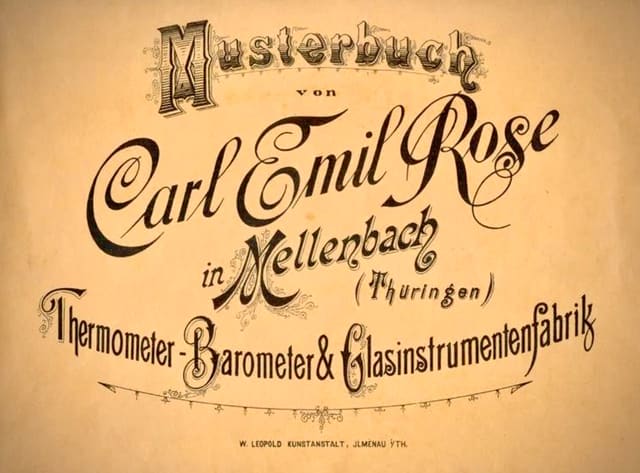
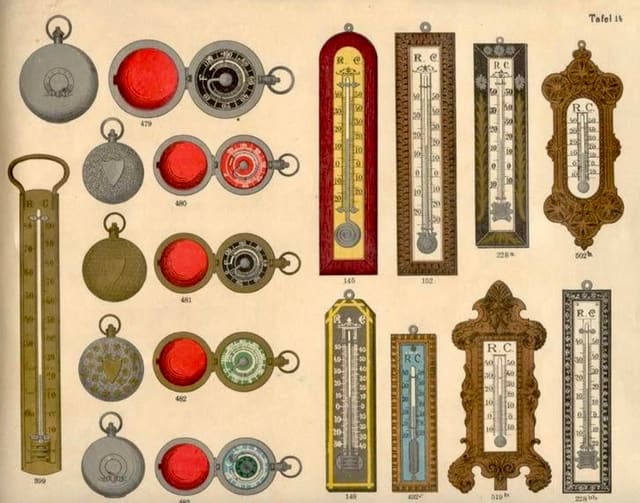
The price list was accompanied by an illustrated pattern book, the Musterbuch von Carl Emil Rose in Mellenbach (Thüringen). Thermometer-, Barometer- & Glasinstrumentenfabrik: fourteen colour-lithographed plates (Tafel 1–14) with a title page printed by W. Leopold's art printing works in Ilmenau (W. Leopold Kunstanstalt, Ilmenau i/Th.). It gives no prices, only model numbers, and these numbers match those of the 1895 price list. Thermometer No. 115 on Plate 2 is shown with a border of red and white diagonal stripes, and the price list describes it as a pearwood model "mit braun und weiss aufgelegter engl. Kante … mit Fries" (with applied brown and white English edging … with a frieze); No. 134 on Plate 12 has a copper-red scale on a black board — in the price list, "schwarz Brett, aufgelegte Kupferscale" (black board, applied copper scale); No. 228b is a red celluloid scale on a black engraved board; No. 284 is a greenhouse thermometer in a copper sheath, and No. 288 one in a green-lacquered sheath. Picture, number, price per dozen: that was how a customer put together an order.
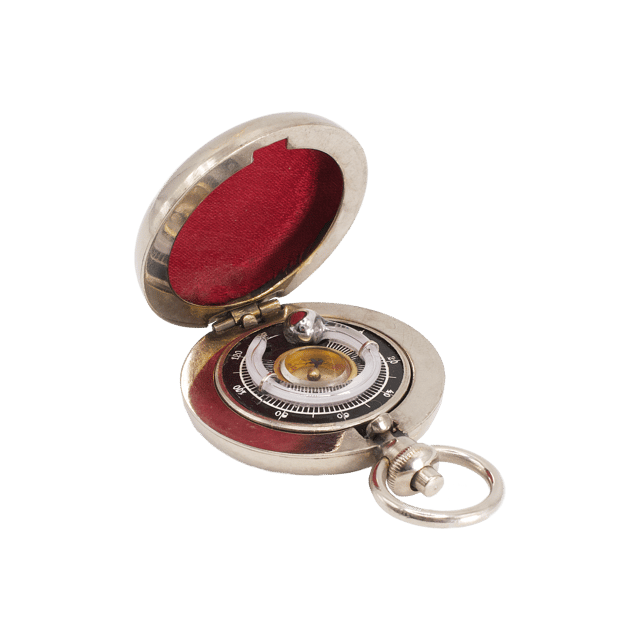
The plates bring the range to life. The first plates are devoted to room thermometers on boards of every conceivable colour and shape — blue, yellow, green, red, black, imitation boxwood and imitation ebony — with square, rounded and shaped heads, some with a mercury "snail" instead of a bulb; the scales are Réaumur, Celsius and Fahrenheit, often double ("R. C.", "Reaum. Cels.") and even triple ("Cels. Reaum. Fahr."). Plates 3, 4, 5 and 13 show metal scales on mahogany and jacaranda boards, with mother-of-pearl and coloured inlays, in carved frames; Plate 9 shows them in cast gilt and bronzed frames with rocaille and acanthus. Plate 10 has desk thermometers on easel stands, on turned columns and in the form of an obelisk and an arch, together with window thermometers on brass brackets; Plate 6 has bath thermometers in turned wooden mounts with handles, and metal models in brass and sheet-metal mounts. Plate 5 shows clinical thermometers with red marks on the scale, in metal, black and wooden cases; Plates 7, 8 and 13 show pocket and travelling thermometers in cases, among them folding triangular A-frames (the very motif on the cover of the price list) and a thermometer in a cigar-shaped case. Plate 14 opens with pocket thermometers in watch cases with hinged lids.
Meteorology is represented by only a few items, but telling ones. Plate 11 shows a Six's maximum and minimum thermometer (No. 613) with Réaumur scales marked "Minimum" and "Maximum", and a pair of horizontal thermometers on a shaped board inscribed "Réaumur & Centigrade" (No. 610) — the classic Rutherford arrangement, in which a spirit thermometer registers the minimum and a mercury one the maximum. On the same plate is aneroid barometer No. 19 in a turned round wooden frame, with a German weather scale running from STURM to S. TROCKEN and the inscription ANEROID BAROMETER. On Plate 13, No. 647a combines on a single black board a Réaumur thermometer and a "Baroskop" (BAROSKOP) — a sealed tube containing a crystalline mass, that is, a chemical storm glass — with a short legend linking the appearance of the liquid and the crystals to the weather. Plate 9 includes thermometer No. 497 with a Fahrenheit scale.
In 1895–1897 Rose advertised in the Nuremberg journal Kosmos, an international trade paper for the jewellery, watch and allied trades; the same page carried advertisements from, among others, optical works in Rathenow:
"Thermometer auf versilbert Messingscala, Celluloid-, Zink-, Milchglas- und Pappcartonscalen etc. etc. für Massenartikel. Zimmer-, Fenster-, Bade- u. Krankenthermometer als Spezialität offeriert in vorzüglicher Qualität zu äussersten Preisen die Thermometer- und Glasinstrumentenfabrik von Carl Emil Rose, Mellenbach in Thüringen. Preisliste gratis und franco." (Thermometers on silvered brass, celluloid, zinc, milk-glass and cardboard scales, etc. etc., for mass-produced articles. Room, window, bath and clinical thermometers as a speciality, offered in excellent quality at the keenest prices by the thermometer and glass instrument factory of Carl Emil Rose, Mellenbach in Thuringia. Price list free of charge and post-paid.)
"Für Massenartikel", "zu Stickereien", "zum Aufschrauben auf Barometer": these formulas reveal the other side of the business. The Mellenbach factory supplied thermometers not only as goods in their own right but also as parts of other makers' products, from embroidered trifles to barometers.
In the 1896 Neues Adreßbuch für Berlin und seine Vororte, in the section "Chemische, physikalische u. pharmaceutische Geräthschaften" (chemical, physical and pharmaceutical apparatus), the agencies include: "Czempin, Edm., S Ritterstr. 90 pt. T. Vertr. v. Carl Emil Rose, Mellenbach i. Th." (Czempin, Edm., Berlin S, Ritterstraße 90, ground floor, telephone. Agent for Carl Emil Rose, Mellenbach in Thuringia). Meanwhile Mellenbach itself had a glassworks: in the 1896/97 Leuchs index, "Glashütte Mellenbach, Eduard Bornkessel" appears under "Glas", "Glasröhren" (glass tubing), "Glasbläsereien" and "Glashüttenwerke".
In 1898, as the Geraberg museum list records, the Rose firm put up a new building. From 1 October that year clinical thermometers began to be officially tested at Gehlberg, and the Kosmos Adreßbuch der deutschen Industrien für das Jahr 1898/99 entered "Rose, C. E., Mellenbach" under "Meteorologische Instrumente. Barometer, Thermometer etc." — alongside Alt, Eberhardt & Jäger, Jul. Brückner and C. A. Pensky of Ilmenau, Bahmann & Spindler and Emil Fischer of Stützerbach, Franz Schilling of Gehlberg and Carl Staschen of Mellenbach.
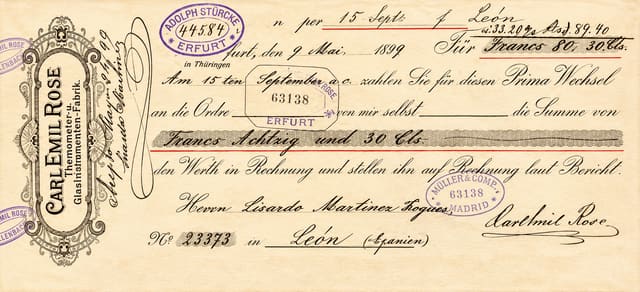
How Rose settled accounts with customers abroad is shown by a surviving bill of exchange. It is a printed form with the vignette "Carl Emil Rose / Thermometer- u. Glasinstrumenten-Fabrik" in the left margin, filled in by hand: "Mellenbach in Thüringen, den 9. Mai 1899. Für Francs 80,50 Cts. Am 15ten September a. c. zahlen Sie für diesen Prima Wechsel an die Ordre von mir selbst die Summe von Francs Achtzig auch 50 Cts. den Werth in Rechnung und stellen ihn auf Rechnung laut Bericht. Herrn Lisardo Martinez Droguería in León Espagne" (Mellenbach in Thuringia, 9 May 1899. For 80 francs 50 centimes. On 15 September of the current year pay for this first of exchange to my own order the sum of eighty francs and 50 centimes, value in account, and place it to account as advised. Mr Lisardo Martinez, droguería, in León, Spain). It is signed "Carl Emil Rose" and numbered 2327.
This is a draft: the seller drew it on his customer, the owner of a droguería in León, payable to his own order, and sent it along a chain of banks. Across the left margin the buyer wrote in Spanish "Acepto" (I accept) and signed: "Mayo 24/99 Lisardo Martinez". The bill's route can be read from its stamps: the Erfurt banking house of Adolph Stürcke, the Madrid house of Guillermo Vogel y Cª (going by the surviving letters of the impression) and an octagonal stamp inscribed LEÓN. The Madrid firm of Guillermo Vogel & Co. was a limited partnership (Kommandite) of the Deutsche Bank, converted from the Banco Hispano Alemán that the bank had founded in 1889; in its report published in 1899 the Deutsche Bank noted a very satisfactory result from this partnership "trotz der durch den spanisch-amerikanischen Krieg geschaffenen schwierigen Lage des spanischen Geschäftes" (despite the difficult situation of Spanish business created by the Spanish–American War). The bill is the 1895 "Avis" put into practice: deferred payment "gegen meine Tratte" (against my draft), and foreign paper "nur zum Tagescourse" (only at the day's rate).
A little over eleven weeks after drawing this bill, Carl Emil Rose was dead. On 13 October 1899 the princely district court at Königsee entered the change in the register, and on 17 October the Deutscher Reichsanzeiger (No. 245, p. 10) published it: "Fol. 183 des Handelsregisters ist zur Firma Karl Emil Rose in Mellenbach an Stelle des bisherigen, am 28. Juli 1899 verstorbenen Karl Emil Rose dessen Sohn Edmund Rose in Mellenbach als Inhaber eingetragen worden" (On folio 183 of the commercial register, for the firm of Karl Emil Rose in Mellenbach, his son Edmund Rose of Mellenbach has been entered as owner in place of the previous owner, Karl Emil Rose, who died on 28 July 1899). The León bill fell due on 15 September, seven weeks after the drawer's death. The advertisement bearing his name still stood in the 1898/99 edition of Leuchs.
Just over a year later, on 18 August 1900, the Royal Railway Directorate at Erfurt opened to public traffic the last section of the Oberrottenbach–Katzhütte line, from Sitzendorf to Katzhütte, and the village gained a station, Mellenbach-Glasbach; until then the nearest station had been Gehren, fifteen kilometres away. In 1902, according to an estimate by the chamber of commerce of the Grand Duchy of Saxony, Thuringia produced about half a million thermometers.
Edmund Rose carried on the business under his father's name. A company seal label (Siegelmarke) survives — a paper sticker for sealing letters: a blue disc about 3 cm across with a scalloped edge and white embossing reading "CARL EMIL ROSE / Thermometer Fabrik / MELLENBACH IN THÜR.". According to the Geraberg museum list, the firm was still in existence in 1926.
The end of the 1920s hit the Schwarza valley hard. The records of the Thüringisches Kreisamt Rudolstadt preserve files on the closure of one Mellenbach business after another: an application to close the thermometer and glass instrument factory of Gebrüder Eichhorn (1929), and the closures of Eduard Bornkessel's glass factory (1929–1932), the thermometer, barometer and glass instrument factory of Gebr. Bergmann (1930), Krannich's woodworking factory and sawmill (1930–1931) and Carl Staschen's thermometer factory (1931). In April 1932 the Coburger Zeitung reported: "In Mellenbach hat die Notlage einen besonderen Höhepunkt erreicht. In allen Betrieben der Holz-, Stein- und Glasbranche liegt keine Arbeit mehr vor. Mellenbach konnte bisher über 1000 Arbeitern Brot bieten, während jetzt nur noch 200 in Kurzarbeit beschäftigt sind" (In Mellenbach the distress has reached a particular peak. In all businesses of the wood, stone and glass trades there is no more work. Until now Mellenbach was able to give bread to over 1,000 workers, whereas now only 200 are employed on short time). The paper put the cause down to a lack of working capital.
There is no separate closure file for the Rose firm in this series; its end is recorded in the commercial register. On 28 May 1938 the Deutscher Reichsanzeiger (No. 122, p. 14) printed a notice from the district court at Königsee dated 19 May: "In unser Handelsregister Abt. A haben wir heute eingetragen: … bei Nr. 101, betr. Firma Carl Emil Rose in Mellenbach, … Die Firmen sind erloschen" (We have today entered in our commercial register, section A: … under No. 101, concerning the firm of Carl Emil Rose in Mellenbach, … The firms have ceased to exist). The same list includes another Mellenbach firm, "Alfred Siegmund, vorm. A. E. Ludwig Witwe". Sixty years after its earliest known mention in print, and eighty-three years after the founding date given by a late reference work, the name of Carl Emil Rose disappeared from the commercial register.
The history of the Rose firm is the history of the Thuringian thermometer in miniature. It grew up in a village where the forest supplied crates, boards and turned wares and the neighbours traded in glass and drew tubing; it went into export as the Leuchs directories carried its advertisements in German, English and French; it sought customers among jewellers and watchmakers, kept an agent in Berlin and received payments from Spain through banks in Erfurt and Madrid. Its range — from a dozen tiny thermometers for embroidery at three marks to mother-of-pearl boards at more than forty marks a dozen, from bath and greenhouse thermometers to clinical ones, from Réaumur scales to Fahrenheit, from the "Baroskop" and the aneroid to Six's maximum and minimum thermometer and thermometers for barometers — shows how widely a single village factory served the needs of its time. The founder died in the summer of 1899, a year before the railway reached Mellenbach; the firm bearing his name survived the First World War and the inflation and was struck off the register in the spring of 1938, after the crisis of the early 1930s had emptied Mellenbach's factories. What remains of it is paper: the lithographed Musterbuch, the price list with its "Avis", a postcard, a seal label and a bill of exchange accepted in León on 24 May 1899 — the documents of a small firm whose life spanned the best decades of the smoke-blackened rooms of the Thuringian Forest.