
Loading
In the first third of the twentieth century, Chemnitz was known as the "Saxon Manchester". Its industry ran on steam and pressure, so the pressure gauge there was a working tool more than a scientific instrument. Every boiler house, compressor and dyeing machine needed one. A whole cluster of gauge workshops grew up around the city as a result. One of them was founded by Arthur Josef Förster and passed into local memory under a short nickname: "Manometer-Förster".
Over eight decades the factory went through nearly every stage the twentieth century had in store for a Saxon business:
Förster's household barometers hung in East German living rooms next to instruments from Drebach. According to the family, its products went to more than twenty-five countries. A surviving company catalogue in Russian shows which buyers Karl-Marx-Stadt had in mind. Meanwhile the family craft crossed the border: the founder's grandson went on making pressure gauges in Baden, and his company is still in business.
Gauge making took root in Chemnitz in the nineteenth century. From the mid-1880s the city had Max Schubert's factory, which produced "Manometer für Dampf-, Luft- und hydraulischen Druck" (gauges for steam, air and hydraulic pressure).
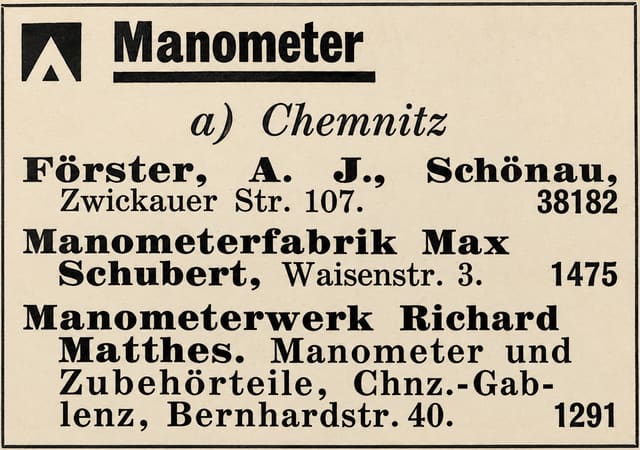
In 1920 the city directory listed four firms under the heading "Manometer":
In the 1920s and 1930s more neighbours appeared: Drechsel & Kretzschmar ("Manometer- u. Thermometerbau"), the workshop of Rob. Karl Uhlig, and in the surrounding area Alfred Preiß's factories in Grüna and Wüstenbrand and Max Preiß's in Oberlungwitz.
These neighbours existed alongside Förster for almost its entire history. In the GDR, the Matthes firm, which had moved to Wittgensdorf under the brand "Mano", became VEB Manometerwerk Wittgensdorf in 1972 and the company MANOWI after 1990. Alfred Preiß's factory in Grüna became a KG with state participation. Max Preiß's Oberlungwitz factory was turned into a state-owned enterprise as early as the early 1950s.
The founder's full name is known from the company's commercial register file. Its documents include a "Beglaubigte Abschrift des Erbscheins für Arthur Josef Förster" (certified copy of the certificate of inheritance for Arthur Josef Förster). A 2013 newspaper article based on family recollections calls him a Chemnitz watchmaker and chemist. The watchmaking trade explains his choice of industry: the dial movement of a Bourdon-tube gauge and the mechanism of an aneroid are precision mechanics of the same kind as a clock.
In the records the founder appears under both of his first names:
In everyday life, in other words, he went by Josef, and in business and public life by Artur. He was a visible figure in local life:
According to the 2013 article, Arthur Josef had two sons, Herbert and Gotthard, and a daughter, Erika, who worked for many years in her father's business. A 1949 archival file names the father and both sons together: "Gotthard Förster, Herbert Förster und Arthur Förster in Fa. Arthur J. Förster, Siegmar-Schönau". The probate proceedings for the founder's estate were registered as 7d VI F 108/52, which means they were opened in 1952. Arthur Josef Förster therefore died around the turn of the 1940s and 1950s, no later than 1952.
Family tradition dates the start of gauge production to 1913. The 2013 anniversary article states that "die Förster Manometer-Produktion nahm 1913 ihren Betrieb … auf" (Förster's gauge production began operating in 1913). The local heritage database Industrie.Kultur.Ost, citing the State Archive in Chemnitz, dates the construction of the factory building to 1912. It also reports that the firm's hundred-thousandth measuring instrument was shipped to a customer as early as 1919.
The first firm documentary trace is in Chemnitz itself. The 1920 and 1922 city directories list "Förster, Jos., Uferstr. 20, T 5499" under "Manometer". Yet Josef Förster does not appear among the residents of Chemnitz in those years. The Uferstraße address was evidently a city workshop or office, while the manufacturer himself lived outside the city limits.
The change came in 1922–1923. In 1922 the neighbouring municipality of Neustadt was merged into Schönau, an industrial suburb west of Chemnitz. The 1923 Chemnitz directory carries a boxed advertisement under the same heading: "Manometer, Zugmesser liefert A. J. Förster, Schönau, T 176 Amt Siegmar" (pressure gauges and draught gauges supplied by A. J. Förster, Schönau, telephone 176, Siegmar exchange). Draught gauges, which measure draught in furnaces and chimneys, were a natural complement to pressure gauges in boiler plants.
The 1925 telephone directory of the Chemnitz postal district gives the full picture. The firm is entered as "Förster, A. J., Manometer- u. Armaturenfabrik, Apparatebau, Schönau, Zwickauer Str. 107", telephone 38182. It appears under both "Manometer" and "Thermometer", so it was already making pressure gauges, fittings, apparatus and thermometers.
By the late 1920s the business at Zwickauer Straße 107 was well established. The 1928 directory calls it "Arthur J. Förster, Manometer- u. Thermometerfabrik" and lists Josef Förster as manufacturer and house owner at the same address. The site lay in the part of Schönau that had been Neustadt until 1922, as the later street numbering shows (see below).
In 1931 the firm was entered in the commercial register of the Chemnitz local court: "Arthur J. Förster, Manometer- u. Thermometerfabrik (9506), Zwickauer Str. 107; Inh.: Artur Förster". The register number 9506 matches the one under which the company file is kept in the Saxon State Archive ("Bl. 9506"). The same directory carries a boxed advertisement for "Arthur J. Förster, Chemnitz-Schönau … Manometer-, Thermometer- u. Pyrometerfabrik", with a drawing of a gauge reading up to 10. Pyrometers, for measuring high temperatures, had now joined the gauges and thermometers.
In the same year, 1931, a second entry appears in the telephone directory next to the father's factory: "Förster, Herbert, Meßinstrumente für Wärme, Dampf, Rottluff, Kriegersiedlung" (Herbert Förster, measuring instruments for heat and steam, Rottluff, veterans' settlement). The engineer Herbert Förster, apparently the founder's elder son, was starting a business of his own in neighbouring Rottluff. His path later merged with his father's again.
On 1 October 1935 Schönau and neighbouring Siegmar were combined into the town of Siegmar-Schönau. The new town's main road, running from Chemnitz towards Mittelbach, was given the single name Hofer Straße. Schönau's Zwickauer Straße became part of it, and the houses were renumbered. From then on the Förster factory was listed at Hofer Straße 126. This was a renumbering, not a move:
By then Herbert Förster lived nearby at Hofer Straße 163. The 1937 directory lists him as an engineer; in 1942 he appears as "Ing. u. Fabrikbesitzer" (engineer and factory co-owner).
From 1936 the factory took up war production, making "Höhen- und Tiefenmesser für Luftwaffe und Marine" (altimeters for the Luftwaffe and depth gauges for the navy). Independent confirmation comes from a survey of Chemnitz's industrial history in the "Sächsische Heimatblätter". Among the city's armament plants of the Second World War it lists "Manometer-Förster (Höhenmesser für Flugzeuge)" (altimeters for aircraft).
Several records show the firm growing in these years:
The town itself suffered badly in the last year of the war. On 11 September 1944, 74 American B-17 bombers attacked the industry of Siegmar-Schönau. In the armament plants alone 85 people were killed, 41 of them foreign workers.
The firm came through 1945–1946 as a private business. In June 1948 Arthur J. Förster KG submitted a form to the district council for the "Aufbauberichte der Industrie des Landkreises" (reconstruction reports on the district's industry). It recorded the type of production, the number of employees and the output from 1939 to June 1948, together with details of dismantling and the extent of war damage.
In 1949 proceedings for an economic offence (Wirtschaftsstrafverfahren) were opened against Arthur, Herbert and Gotthard Förster. They were dropped under the amnesty of 11 November 1949.
On 1 July 1950 Siegmar-Schönau was incorporated into Chemnitz. In the same year the local court opened a new register file (HRA 1768): "Arthur J. Förster KG, Spezialfabrik für Meßinstrumente, Siegmar-Schönau". It contains the 1944 agreement and the certificate of inheritance issued after the founder's death. In 1953 Chemnitz became Karl-Marx-Stadt. In 1954, according to the family, Herbert Förster left the business.
In January 1956 the GDR Council of Ministers allowed the German Investment Bank (DIB) to join private limited partnerships as a limited partner. This created the "Betriebe mit staatlicher Beteiligung", enterprises with state participation. The Förster firm became one of them. The bank's file on "Arthur J. Förster KG, Karl-Marx-Stadt, Spezialfabrik für Meßinstrumente", covering September 1956 to August 1971, holds the first and second partnership agreements with state participation.
In 1961 Herbert Förster left the GDR for the West with his son Steffen. In August of the same year, according to the family, the business was "angegliedert" (affiliated) to VEB Meßgerätewerk Beierfeld in the Ore Mountains. Beierfeld was the republic's leading gauge works; production of the Magdeburg firm Schäffer & Budenberg had also been moved there. Legally, however, the KG continued to exist. The "affiliation" apparently meant subordination to the industry's lead enterprise rather than a merger.
According to the family, 1963 was the peak year. The works turned out some 80,000 barometers and 300,000 pressure gauges "für den Inlandsbedarf und den Export in über 25 Staaten" (for the domestic market and for export to more than 25 countries). In 1964 the partnership concluded a new agreement. Minutes of partners' meetings and audit reports for 1966 and 1967 also survive.
From 1970, Beierfeld and with it the whole industry became part of VEB Kombinat Mess- und Regelungstechnik Dessau. In the second half of that year the Industrie- und Handelsbank reviewed applications concerning Förster KG of the kind that dealt with the legal position of the general partners and increases in the state's share. Also in 1970 Gotthard Förster, the founder's second son and a former co-owner, left the business.
Perhaps the most telling document of the firm survives from this period: its catalogue in Russian. It consists of 22 sheets from a large multi-section publication:
At the foot of every sheet are the company emblem and the line "ARTHUR J. FÖRSTER K.-G. · KARL-MARX-STADT 31 (SACHS.)".
This line helps date the catalogue:
The catalogue was most likely printed between the mid-1950s and the mid-1960s.
The section "Room aneroid barometer" lists about two dozen variants. Model numbers combine a base number with suffixes: "T" means with a thermometer, and a figure after a slash gives the dial diameter. Examples:
African makoré, walnut, oak and beech put these instruments on a level with the furniture of their time. Three "multi-element meteorological instruments" (barometer, hygrometer and thermometer in one frame) were offered separately: No. 1101, No. 1101 Pg "with a gold edge", and No. 1102 with tall raised rings.
The hygrometer section shows the firm reaching beyond household instruments:
The photographs of the hygrometer and polymeter dials show the triangular DAMW quality mark with the figure "1". The German Office for Materials and Goods Testing (DAMW) introduced this system of marks in 1950.
The barometer photographs are the most surprising part. The text has been translated into Russian, but the dial inscriptions are in five other languages:
The scales are in millimetres (680–790) and centimetres (70–79) of mercury. The catalogue seems to have been assembled from existing photographs of export versions made for Scandinavia, Finland and the French- and German-speaking markets, with a Russian description added.
Foreign trade in the GDR was a state monopoly. A firm like Förster KG did not sign contracts with foreign buyers itself; it reached foreign markets through the foreign trade organisations. A Russian-language catalogue issued in Karl-Marx-Stadt was aimed above all at Soviet buyers, the GDR's main trading partner. Together with the "more than 25 countries" of 1963, it shows that the barometers from Schönau were an export product, not just a local one.
In 1972 a Council of Ministers decision of 16 February completed the transfer of nearly all enterprises with state participation into public ownership. The State Bank's liquidation records for 1972 list "Fa. Arthur J. Förster KG" among the former semi-state firms. The business became a state-owned enterprise: VEB Manometerwerk Karl-Marx-Stadt.
Household barometers stayed in production. The Haus der Geschichte in Wittenberg holds a 1972 guarantee card for an "Aneroïd-Zimmerbarometer" (room aneroid barometer) made by VEB Manometerwerk Karl-Marx-Stadt:
In 1978–1979 two neighbouring state-owned enterprises were merged into the works: VEB Mechanische Geräte Karl-Marx-Stadt (a former cork factory) and VEB Kunststoff- und Metallwaren Grüna. From 1979 VEB Manometerwerk was the legal successor of both.
In these years the works' engineers patented a number of inventions:
The patent holder's address in the applications is "DDR 9031 Karl-Marx-Stadt". In 1984, according to a former employee named Herbst, the works had 270 employees.
The last years of the GDR left traces in party records:
In 1990 the enterprise came under the Treuhandanstalt. The legal successor of the VEB was Chemnitzer Manometerwerk GmbH (HRB 256). In 1991 production on Zwickauer Straße stopped; Industrie.Kultur.Ost gives 1990 as the year of liquidation.
The family still tried to stay in the business. On 20 August 1991 Gotthard Förster, then living in Chemnitz, filed a patent application for a "Manometer-Rohrfeder und Verfahren zu seiner Herstellung" (pressure gauge Bourdon tube and method of making it). The tube was deep-drawn from a single brass blank, and the bottom formed by the drawing served as the sealed end of the spring. The same blank could be used for different pressure ranges, which simplified mass production. The founder's grandson, Steffen Förster, tried to buy the works but gave up because the site was too heavily contaminated. The property was then managed by a Leipzig company.
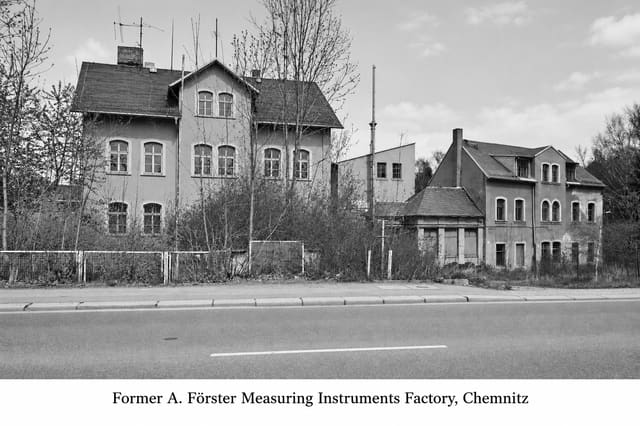
In April 2013, for the firm's centenary, some twenty descendants of Arthur Josef Förster gathered in Chemnitz. At their own expense they put up a commemorative plaque by the ruins at Zwickauer Straße 322; the permit was for four weeks. This is probably the same site as the earlier Zwickauer Straße 107 and Hofer Straße 126, but no document directly linking the numbers has been found. Three years later, in 2016, the buildings of the former Manometerwerk were demolished.
Steffen Förster, who had left in 1961, studied in the West and became a graduate engineer (Dipl.-Ing. (FH)). In the mid-to-late 1960s he founded his own gauge company, Förster & Rothmann (F+R), in Neuenburg am Rhein, right on the French border. Sources differ on the date: the 2013 newspaper article gives 1968, while a Badische Zeitung report on the sale of the firm in 1997 "nach 32 Jahren" (after 32 years) points to about 1965.
Patent registers trace its development:
In 1998 Steffen Förster founded FT Manovia GmbH Druckmesstechnik in Buggingen near Freiburg. According to a trade publication, the company "ging aus der damaligen F+R Förster und Rothmann GmbH hervor" (emerged from the then F+R Förster und Rothmann GmbH). According to the Badische Zeitung, the letters FT stand for "Förster-Technik". F+R itself was acquired by the American group Watts Industries on 29 July 2002. Watts's annual report states: "F&R manufactures and distributes a line of gauges predominantly to the French and German OEM markets. F&R's annual revenue, prior to the acquisition, was approximately 4 million euro."
FT Manovia specialises in gauges for fire extinguishers:
In 2011 the company won the Baden-Württemberg state innovation prize named after Rudolf Eberle. Its website says: "Seit 3 Generationen fertigen wir Messgeräte" (we have been making measuring instruments for three generations). It is run by Steffen Förster and Robert Schaettel.
The firm's range changed with the times:
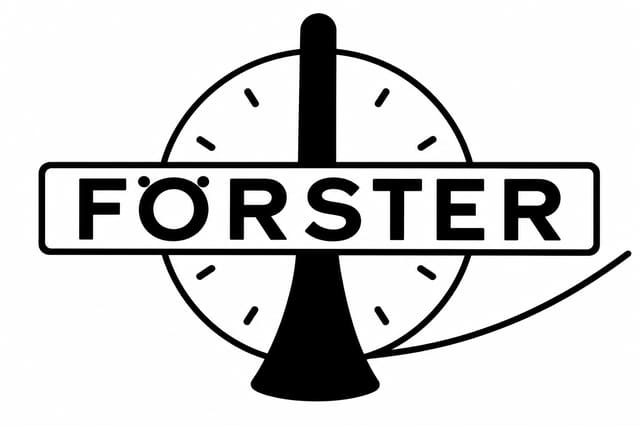
The company emblem is a plate bearing the word FÖRSTER against a round graduated dial. A vertical pointer with a heavy black base crosses it, and a curved line runs from the base. The emblem appears on every sheet of the Russian catalogue. It was by no means always put on the dials. As the German Meteorological Society observes, "ein schlichter Namenszug" (a plain name inscription) is missing from many pieces. The same source describes a typical barometer: 8 cm glass, a dial of white tinplate with a printed double scale, and a small mercury thermometer.
Inscriptions, addresses and markings help date instruments and documents:
The history of Arthur J. Förster is that of a medium-sized family business that became neither a giant nor a legend, yet mirrored its century closely:
Even in the state-owned works a family thread survived: Gotthard worked there until 1970, and in 1991 he patented a Bourdon tube designed for mass production. His nephew's company in Baden still turns out millions of gauges. The barometers from Schönau, with their Swedish, Finnish, Danish and French dials, and the Russian-language catalogue remain physical evidence that the products of this small Saxon factory travelled far beyond the Ore Mountains.
| Language | Inscriptions | Models |
|---|
| Swedish | REGN — OSTADIGT — VACKERT | No. 1009, No. 1009 T/Ba, No. 1102 (hygrometer: TORRT — NORMALT — FUKTIGT) |
| Danish | REGN — FORANDERLIGT — SMUKT | No. 1032 T, No. 1054 T/K |
| Finnish | SADETTA — VAIHTELEVAA — KAUNISTA | No. 1041 T, No. 1053 |
| French | TEMPÊTE — VARIABLE — TRÈS SEC | No. 1001, No. 1011 T |
| German | REGEN — VERÄNDERLICH | No. 1011, No. 1013 T, No. 1031 T |
| Year | Event |
|---|
| 1912 | Factory building constructed (Industrie.Kultur.Ost) |
| 1913 | Gauge production begins (family tradition) |
| 1919 | Hundred-thousandth instrument produced (Industrie.Kultur.Ost) |
| 1920–1922 | "Förster, Jos., Uferstr. 20, T 5499" in Chemnitz directories |
| 1922 | Neustadt merged into Schönau |
| 1923 | "Manometer, Zugmesser liefert A. J. Förster, Schönau" |
| 1925 | Zwickauer Str. 107, telephone 38182; gauges, fittings, apparatus, thermometers |
| 1928–1931 | "Manometer- u. Thermometerfabrik"; pyrometers in 1931; register entry "Inh.: Artur Förster" |
| 1931 | Herbert Förster: "Meßinstrumente für Wärme, Dampf", Rottluff |
| 1935 | Siegmar-Schönau formed; address becomes Hofer Straße 126 |
| 1936 | Altimeters for the Luftwaffe and depth gauges for the navy |
| 1942 | Welfare fund registered; Herbert listed as "Ing. u. Fabrikbesitzer" |
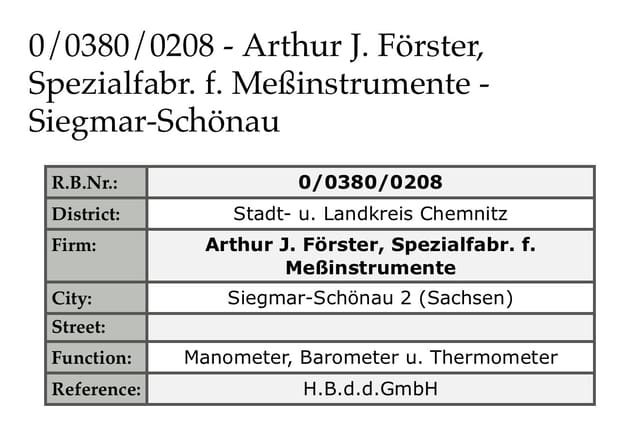
| 1944 | Hoppenstedt directory, RBNr 0/0380/0208; KG agreement of 18 March |
| 1948 | Industrial reconstruction report |
| 1949 | Proceedings against Arthur, Herbert and Gotthard Förster, dropped under amnesty |
| 1950 | Siegmar-Schönau incorporated into Chemnitz; new register file HRA 1768 |
| by 1952 | Death of the founder (probate file of 1952) |
| 1953 | Chemnitz renamed Karl-Marx-Stadt |
| 1954 | Herbert leaves the business |
| 1956 | State participation (DIB as limited partner) |
| 1961 | Herbert and Steffen leave for the West; in August, "affiliation" to VEB MGW Beierfeld |
| 1963 | About 80,000 barometers and 300,000 pressure gauges, exports to more than 25 countries |
| 1953–1965 (probably) | Russian-language catalogue |
| 1964 | New partnership agreement |
| 1970 | Dessau measuring and control combine; Gotthard leaves |
| 1972 | VEB Manometerwerk Karl-Marx-Stadt |
| 1979 | VEB Mechanische Geräte and VEB Kunststoff- und Metallwaren Grüna merged in |
| 1981–1984 | Patents filed by the works |
| 1984 | 270 employees |
| 1990 | Treuhand; Chemnitzer Manometerwerk GmbH (HRB 256) |
| 1991 | Production stops; Gotthard Förster's patent application |
| 1998 | FT Manovia founded in Buggingen |
| 2002 | Watts Industries acquires F+R |
| 2013 | Commemorative plaque and gathering of descendants |
| 2016 | Buildings demolished |