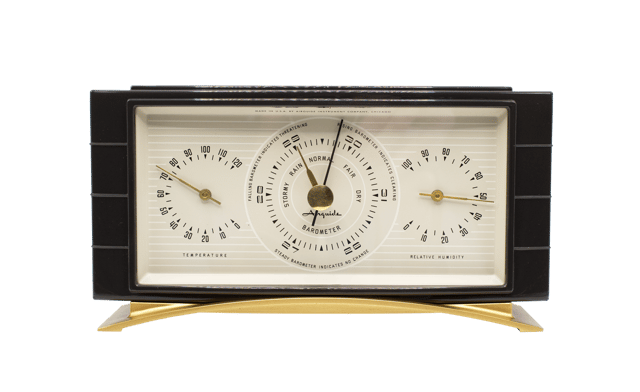
Loading

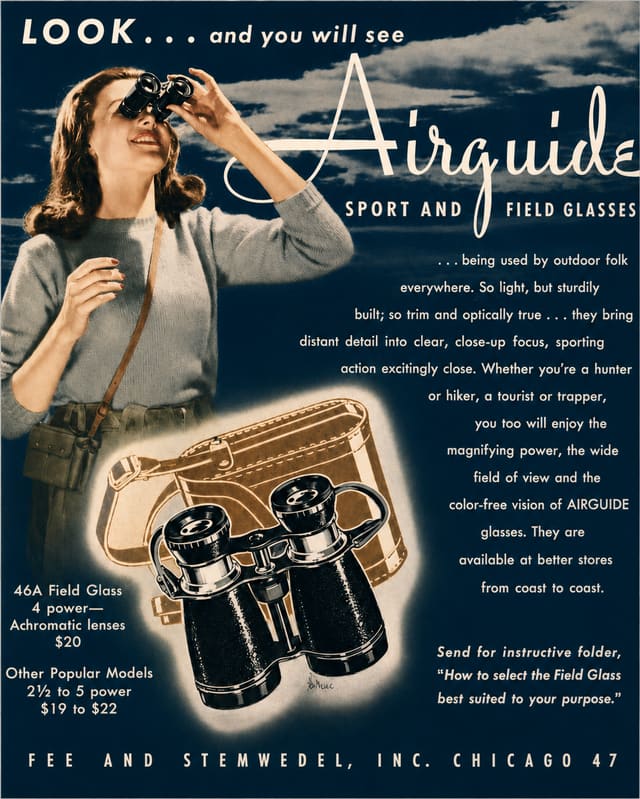
The story of Airguide begins amid the ashes of the 1929 stock-market crash. Two young Chicago electrical engineers — Albert L. Stemwedel (born 1904), a graduate of the Armour Institute of Technology who lived in the Rogers Park neighborhood and worked as an electrical contractor, and Richard L. Fee (born 1900), who had spent the 1920s as an electrician in Waukegan — decided to join forces at the very moment the economy was collapsing. They belonged to the same generation of Chicago entrepreneurs that produced radio giants Zenith, Motorola, and Admiral, but, as historian Andrew Clayman of the Made-in-Chicago Museum aptly put it, they “arrived late to the party.”
By the recollection of the founder’s son, Charles G. Stemwedel, given to the Chicago Tribune in 1979: “My father and his partner scraped together $1,000 to buy a company that made battery eliminators for radios, or what we’d today call transformers.” This venture, briefly known as Chicago Service Station, Inc., opened an office at 219–221 W. Chicago Avenue in 1930 or 1931. In that era many homes were not yet connected to the electrical grid, and “battery chargers” for home radios were a sought-after product.
An Accidental Discovery and the Birth of the “Airguide” Brand (1932–1933)
The pivot to meteorological instruments came about through a chance observation. By the account of Fred D. Eckert, who worked at the company for 35 years: “While running Chicago Service Station, Dick Fee and Al Stemwedel noticed that the paper used in condensers curled up in humid weather and lay flat in dry weather. It occurred to them that this could be used to indicate relative humidity instead of the wet-and-dry-bulb thermometers used at the time.”
The task of developing a direct-reading hygrometer was given to Howard Taylor — an employee recently laid off from Western Electric because of the Depression, a man “with an inquiring mind and a great deal of practical experience.” Taylor combined a paper-and-brass hygrometer with an ordinary thermometer in a Bakelite housing. In Eckert’s words (quoted 1975), it was “the first direct-reading thermometer-hygrometer of this type for home use” — though the museum itself cautions that it “cannot confirm this — nor locate a patent, if one ever existed.” Howard Taylor would remain the company’s chief engineer until the mid-1960s.
By 1933 Fee & Stemwedel, Inc. had been formed, securing an exclusive contract with the famous Chicago department store Marshall Field’s to sell the dual instrument. As part of the deal, the device received the resonant name that would define the company for decades to come. A Field’s advertisement in the Chicago Tribune in 1933 read: “For the well-ordered home — ‘Airguide’… which shows on a single dial both temperature and humidity, two important factors of health in the home and office.” The price was $3.50, and with the purchase of a gift set of five or more units, engraving of a name was free. A psychrometric slide rule of the same era (held by the Smithsonian NMAH, object nmah_1804320) bears the inscription “PSYCHROMETRIC SLIDE RULE” and “COPYRIGHT 1933 / FEE AND STEMWEDEL INC. / CHICAGO, ILL.”
Expanding the Line and the FTC Scandal (1937)
The success of “Airguide,” even in the conditions of the Depression, gave rise to a whole family of related products under the same trademark: large streamlined thermometers, barometers, and “air-condition indicators.” But the rapid growth of the range raised a question — were they all really manufactured at Fee & Stemwedel’s own factory?
In 1937, despite the company’s having a substantial factory at 4949 N. Pulaski Road, it became the subject of an investigation by the Federal Trade Commission (FTC). As the Chicago Tribune reported in August of that year: “According to the complaint, they add a dial and indicator to a finished barometer movement and enclose the movement in a case bearing the legend ‘Made in the U.S.A. by Fee & Stemwedel, Inc., Chicago.’ In fact, the barometers and other instruments are manufactured abroad and imported into this country.” The company received a “reprimand,” but rather than acknowledging the imported origin, it apparently reoriented itself toward expanding its own production.
The War Years: a Defense Contract (1941–1945)
During the Second World War the company’s new factory at 2210 W. Wabansia Avenue (the Wicker Park neighborhood) was transformed into an active defense plant. Here they made compasses for the Army, as well as barometers, telescopes, and clinometers (inclinometers) for the Navy. One such instrument — a Bakelite clinometer, model MK III (model O) of 1942 — was donated to the collection of the Made-in-Chicago Museum in 2024 by Rand M. Eller in memory of his uncle Charles M. Holleb, Jr., “a longtime Chicago resident, attorney, and sailor.” The clinometer measured angles of heel and was important to how Navy ships were loaded with cargo and fuel. Newspaper advertising in 1943 called men to the Fee & Stemwedel factory for “100% defense” work. During the war the company also made barometers for the U.S. Navy (for example, bearing the Bureau of Ships marking).
Postwar Flourishing and a Change of Name (1945–1956)
After the war Fee & Stemwedel returned to the consumer market with an expanded range of “scouting gear”: field binoculars, telescopes, and compasses. Advertising in Boy’s Life and Popular Mechanics magazines of the 1940s–50s showcased the Airguide range of compasses, telescopes, and binoculars. An exemplary product of the era — the wall-mounted aneroid barometer “Highlander” — cost $10, had a 5×5-inch walnut case with a (faux) brass bezel and a built-in altitude scale from 0 to 5,500 feet; a 1948 advertisement read: “Because it forecasts weather trends hours in advance, the Highlander is extremely handy.” The No. 36 field binocular also cost $10.
By 1953 the staff of the Wabansia factory had grown to 200; Howard Taylor remained chief engineer, while war veteran Fred Eckert became sales and advertising manager. Around 1953 the company won a defense contract to supply hand-held lensatic compasses for the U.S. Army.
In 1956 Dick Fee sold his share to Al Stemwedel and retired. Stemwedel renamed the business Airguide Instrument Company — the name “Airguide” had by then been the principal trademark almost from the very beginning. (The first “AIRGUIDE” trademark, for clocks, was filed by the company on August 9, 1956.) The Smithsonian National Museum of American History phrases it this way: “The firm became Airguide Instrument Co. in the 1950s.” The company moved into new fields: “speedometers, tachometers, and other measuring instruments, mainly for marine use, but a secondary market for automobiles also opened up.”
The Variety of Mid-Century Production (1956–1970s)
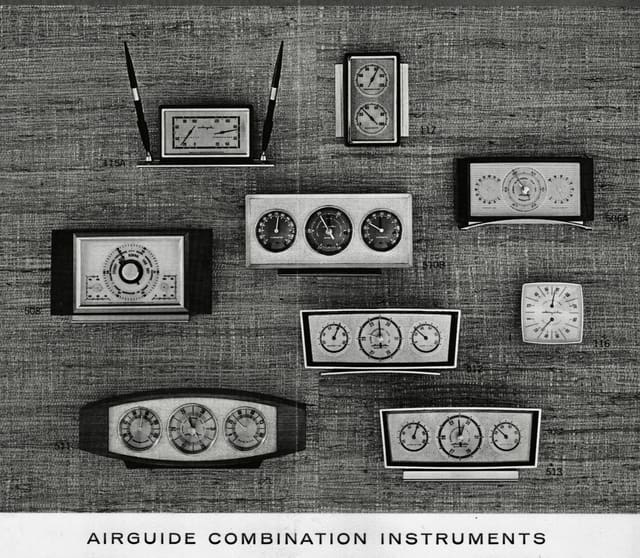
Under the Airguide brand a strikingly broad assortment was produced:
Al Stemwedel was known for his concern for his workers and the neighborhood around the factory. In 1964 he led an initiative to create a “cooperative community employment bureau,” encouraging local hiring: “We try to hire within the neighborhood… It allows our employees to walk to work.”
Design: Why Collectors Prize Airguide
Airguide instruments are valued for their distinctive American mid-century modern and Art Deco design: the streamlined Bakelite and chrome cases of the 1930s–50s, brass engraved dials, convex glasses, walnut and mahogany cases with brass trim and finials, and nautical motifs (ship’s wheels, anchors). The “atomic age” / “Danish modern” aesthetic makes them popular as decorative objects. At the same time, the build quality was so high that many instruments made in the 1930s–60s still keep accurate time to this day after cleaning and calibration.
Decline: Foreign Competition and a Generational Change (1960s–1989)
In the 1960s–70s foreign competition undermined sales of weather instruments; the once-revered Airguide thermometers and barometers now accounted for only about a third of sales, while marine and automotive instruments kept the business afloat. In 1976, burdened by excess inventory, Al Stemwedel began looking for a buyer.
In 1979 leadership passed to the founder’s 42-year-old son, Charles Stemwedel — a lawyer rather than an engineer or salesman. He tried to aim the brand at a more discerning audience: “We want to make a better thermometer, a little more elegant than the rest, and a little more expensive.” At the time the company, a small business with annual revenue of about $10 million, had a staff of 150 and a reputation built over 50 years. But Charles acknowledged the chief obstacle: “Instrument-making in every field we work in is rapidly going electronic. We’re moving quickly toward using it.” The company continued to operate at the Wabansia factory through the 1980s, introducing new technologies, but no surge in sales followed.
The Sale to Johnson Worldwide and the End of the Brand (1990–2000)
In 1990 the business was finally sold to Johnson Worldwide Associates (JWA) of Racine, Wisconsin — a division of the Johnson Wax family of companies. This dating is confirmed by the article “Johnson Worldwide Buys Compass Maker” in the Press & Sun-Bulletin (Binghamton, New York) of June 16, 1990, as well as by JWA’s Form 10-K annual reports (SEC EDGAR), where, as of September 30, 1994 and September 29, 1995, “Airguide Instrument Company” is listed as a principal subsidiary with the jurisdiction of incorporation “Illinois.” (The version frequently encountered in collectors’ retellings of a “sale in 1980 following Chapter 11” is almost certainly mistaken and anachronistic: the name “Johnson Worldwide Associates” itself only appeared around 1985–87, and the company went public in 1987.)
After the sale, part of production was moved to the Chicago suburb of Buffalo Grove, where the management and sales office was located, while the manufacturing-and-shipping center remained on Wabansia. Under the Airguide brand, JWA continued to produce compasses, speedometers, and weather instruments, registering new trademarks (“The Outdoorsman,” 1993; “Accupro,” 1994). By the account of a former worker, Chicago production was moved to Tijuana (Mexico) around 1996–97. By 2000 JWA had ceased marketing products under the Airguide name, bringing to a close roughly a 70-year run for the company. JWA was subsequently renamed Johnson Outdoors, Inc.
Albert Stemwedel outlived the company he founded: he died at home in Kenilworth, Illinois, on February 1, 2002, at the age of 97.
Legacy
The former Airguide factory at 2210 W. Wabansia Avenue survives and has been converted into residential lofts, now known as the Pinnacle Lofts. Airguide instruments are held in collections including the Smithsonian National Museum of American History (a thermometer-hygrometer, object nmah_1762075, accession no. PH.337176; engraved “TEMPERATURE Airguide RELATIVE HUMIDITY MADE IN U.S.A. BY AIRGUIDE INSTRUMENT COMPANY, CHICAGO”) and the Made-in-Chicago Museum.
Sources