Loading
Foundation and Development of the Workshop: The Cammenga watchmaking dynasty in Leeuwarden was founded at the beginning of the 19th century by the master Petrus Jacobus Cammenga (1775–1840). He settled in Leeuwarden around 1800 as a watchmaker (his name is recorded in archival documents). After his death, the business was continued by his descendants. The elder son, Jillert Petrusz Cammenga, worked as a watchmaker and maintained a workshop in Leeuwarden (in the 1820s on Heerestraat, later on Wirdumerdijk). Jillert died around 1860, and the family business passed to the next generation. By the mid-19th century, the firm was headed by Willem Jillerts Cammenga (1837–1906), the founder’s grandson and Jillert’s son. It was his name — “W. Cammenga, horlogiemaker, Leeuwarden” — that appeared in advertisements and on company letterheads in the 1860s–1880s. He continued the family business until his death in 1906. After Willem Cammenga’s passing, the enterprise apparently no longer had a direct watchmaker heir and was either closed or sold to external parties (in the Leeuwarden address books after 1906, the Cammenga name no longer appears among watchmakers). Thus, the workshop’s origins lie at the turn of the 18th–19th centuries under Petrus Jacobus, and it reached its greatest flourishing in the second half of the 19th century under the name W. Cammenga.
Specialization and Products: Historically, the Cammenga family specialized in horology — the manufacture and repair of clocks. It is known that under Willem Cammenga, the firm not only sold pocket and wall clocks but also manufactured large clock mechanisms. An 1871 company letterhead refers to W. Cammenga as “Horlogiemaker” and “manufacturer of a new type of tower clock and Frisian clock,” as well as a maker of interior and garden fountains. “Frisian clocks” referred to longcase or wall clocks of a traditional type popular in the province of Friesland. Thus, the Cammenga workshop possessed its own production capacity for large clocks and mechanisms. In addition, the firm expanded its activities to include the sale of various precision instruments and luxury goods. A 1875 advertisement states that W. Cammenga at his shop on Wirdumerdijk offered “horologiën, uurwerken, orgels, articles de Paris, etc.” — that is, clocks of all kinds, organs (likely small domestic models), and so-called “Parisian goods” and other items. The term “articles de Paris” in the 19th century usually referred to elegant technical novelties and decorative instruments of French manufacture. These included, in particular, barometers, thermometers, optical devices, and other household accessories. Indeed, the firm’s business papers mention trade in barometers, spectacles and pince-nez, alongside jewellery (gold, silver, and diamond). Willem Cammenga also acted as an appraiser and repairer of clocks and jewellery, offering valuations and repair services (as reflected in the firm’s advertising materials).
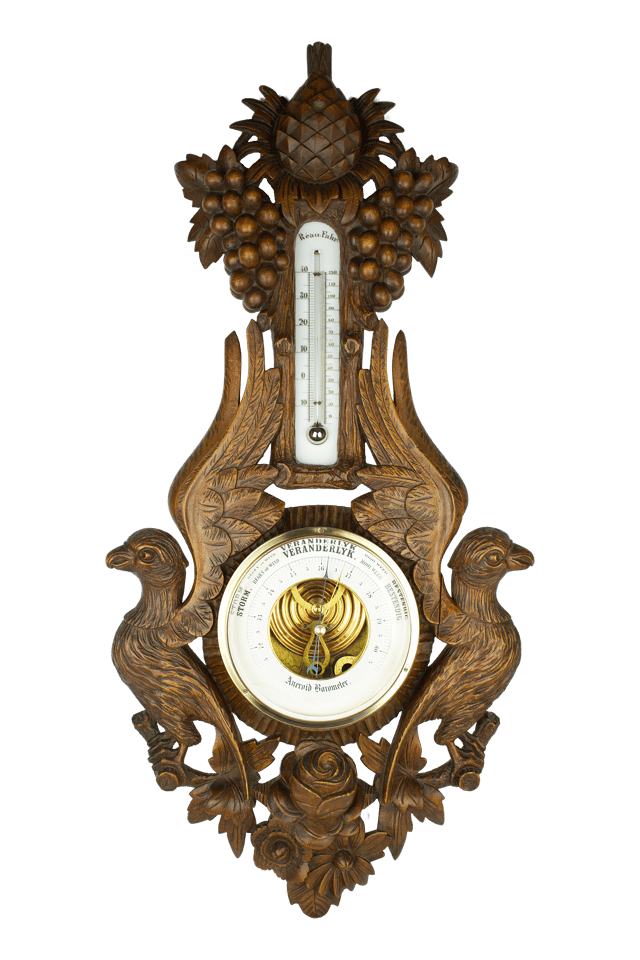
Work with Barometers: Willem Cammenga paid special attention to the sale of barometers — a product in high demand during the era of rapidly developing meteorology and the growing interest in domestic scientific instruments. He apparently did not manufacture barometers himself (at least, no evidence of barometer production in his workshop exists). As was common among watchmakers of the time, Cammenga acted as dealer/retailer: he purchased ready-made barometers from specialized manufacturers (possibly from Amsterdam, London, or Paris) and sold them under his own name. This is supported by the mention of “Parisian goods” — many new types of instruments, especially aneroid barometers, were imported from France in the second half of the 19th century.
Apprentices and Successors: No direct references to formal apprentices are found in sources. Knowledge was likely transmitted within the family — from father to sons. Thus, Petrus Jacobus trained his elder son Jillert and likely his younger son Petrus (from his second marriage) in watchmaking. Willem Cammenga, in turn, received his training from his father, Jillert. No documented apprentices outside the family appear in official records, though the workshop may have employed hired assistants. In obituaries and directories of the late 19th and early 20th centuries, the Cammenga surname no longer appears as an active watchmaking family, indicating the absence of a professional successor. After 1906, the Cammenga enterprise either ceased to exist or was absorbed by another jewellery and clockmaking firm in Leeuwarden. Thus, generational succession within the family — from Petrus Jacobus to Jillert, then to Willem — remained the primary path of continuity. It was Willem Cammenga’s activity (mid and late 19th century) that marked the firm’s zenith, transforming it from a purely horological workshop into a diversified store of precision instruments, including barometers, musical automata (seraphines), optical devices, and more. The end of this watchmaking dynasty in the early 20th century closed a nearly century-long history of the company.
Conclusion: Willem Cammenga of Leeuwarden — a representative of the third generation of a watchmaking family — successfully maintained the trade from the mid-19th century onward, expanding its assortment to include barometers (aneroid and mercury), organs, and other technical novelties. He most likely did not manufacture barometers himself but purchased them from specialized makers (for instance, French manufacturers) and sold them under his brand. In an 1875 advertisement, his firm was explicitly positioned as a universal shop for clocks and “scientific novelties” (articles de Paris). The Cammenga workshop was renowned for the quality of its clocks and services — it produced complex mechanisms (tower clocks, carillons), repaired and appraised valuable instruments. Its successors were exclusively within the family; no external successors remained, and after Willem’s death in 1906, the firm ceased to operate. Nevertheless, the contribution of the Cammenga family is significant: they enriched the horological culture of Friesland and supplied the region not only with clocks but also with barometers of all types — from traditional to the most modern instruments of the 19th century.
Sources: These conclusions are supported by archival and genealogical data on the Cammenga family, as well as by historical advertisements and surviving company letterheads. GESCHIEDENIS VAN DE UURWERKMAKERSKUNST IN FRIESLAND. These sources confirm the workshop’s addresses, the masters’ lifespans, and the range of products, including barometers and other meteorological instruments. This combined profile (clocks + barometers) was characteristic of 19th-century watchmakers, and the case of Willem Cammenga exemplifies it perfectly.
Due to the limited information available on W. Cammenga, as well as the coincidence of his name with other individuals (for example, the well-known organist W. Cammenga), and the various historical spellings of the surname (Camminga, Cammenga, Kammenga), certain inaccuracies in the reconstruction of the history of the Cammenga Company in Leeuwarden are possible.