Loading
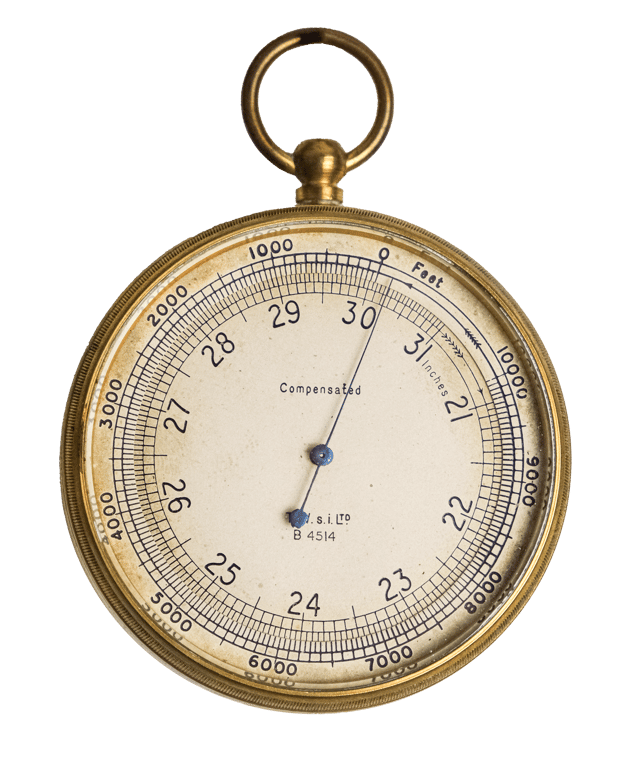
In 1918 the firm's registered telegraphic address was "Scienoid". The word plainly combines scientific and aneroid, and nothing describes the business better. The firm was founded by Thomas Henry Wheeler, and it bore his name to the end. For more than a hundred years, from a workshop in a side street off City Road to a factory at Bounds Green, it made essentially one instrument: the aneroid, usually a small one — watch, pocket or surveying size. Its customers were First World War aviators, the Meteorological Office, the Army and the Navy. In the 1960s they included Post Office engineers who monitored the dry-air pressure inside telephone cables. The firm never went bankrupt. In 1982 it was absorbed by R. W. Munro Ltd, and in 1987 the company bearing its name was wound up by its own members.
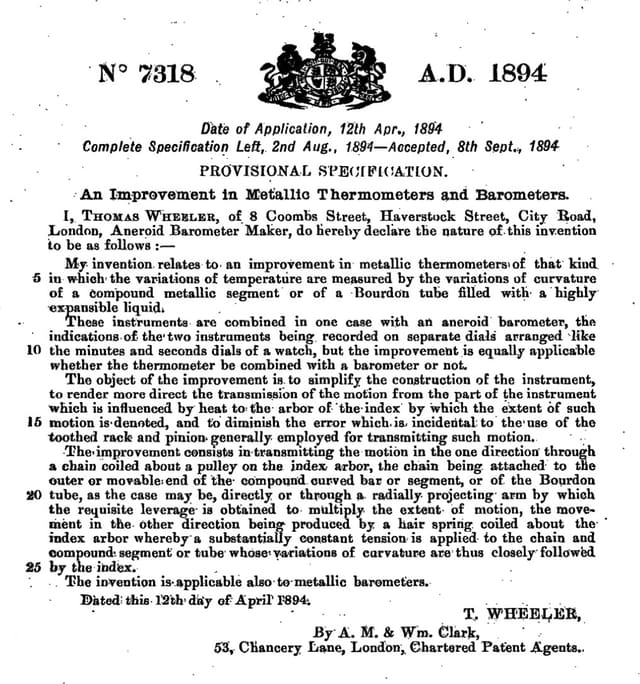
The firm gave 1878 as its year of foundation: "Established 1878" appears in its 1920 advertisement. The earliest document naming both the maker and his address is the patent of 1894. There the applicant describes himself as "Thomas Wheeler, of 8 Coombs Street, Haverstock Street, City Road, London, Aneroid Barometer Maker". Coombs Street is a street off City Road in the Angel district, built up in the 19th century (today in the N1 postcode).
The Post Office London Directories confirm this. The 1895 and 1899 editions list "Wheeler Thomas, manufacturer of pocket & surveying aneroid barometers & metallic thermometers, 8 Coombs street, City road N". The 1895 street directory gives No. 8 to "Wheeler Thomas, barometer maker". In 1910 the trades section lists him among aneroid makers with the note "pocket & surveying aneroid a speciality". In 1914 and 1915 the entry reads "aneroid barometer maker, 8 Coombs street, City road".
Catalogues survive from this period. The Whipple Museum holds copies of a twenty-page illustrated catalogue, "Watch, Pocket and Surveying Aneroid Barometers", with prices, at the address 8, Coombs Street, City Road, London N. One copy contains a blank customs declaration form. Another set of the same catalogue comes with half of a typewritten letter from Short and Mason Limited about catalogue discounts.
Application No. 7318 was filed on 12 April 1894 through the patent agents A. M. & Wm. Clark (53, Chancery Lane). Its title was "An Improvement in Metallic Thermometers and Barometers". The complete specification was left on 2 August and accepted on 8 September 1894. The printed specification cost eightpence.
A "metallic" thermometer, in the patent's sense, is one in which temperature is shown by the bending of a bimetallic bar or of a Bourdon tube filled with a highly expansible liquid. Such thermometers were usually fitted in the same case as an aneroid, with the two dials arranged like the minute and seconds dials of a watch. Wheeler wanted to simplify the design, transmit motion directly to the index arbor, and get rid of the error introduced by a toothed rack and pinion.
His solution is this. The sensing element pulls a chain. The chain is attached to the moving end of the tube or bar, either directly or through a radial arm that increases the travel, and it is wound round a pulley on the index arbor. A spiral hairspring turns the arbor back, so the chain is always under tension. The same principle serves for a "metallic" barometer made from an exhausted Bourdon tube. The claim reads:
"In a metallic thermometer or barometer, the herein described means for transmitting motion to the index arbor, consisting of a chain or its equivalent attached directly or through a radially-projecting arm to the outer end of the Bourdon tube (or compound bar) and to a pulley on the index arbor, in combination with a volute hair spring applied to act on the index arbor, substantially as specified."
The drawings were photo-lithographed by Malby & Sons.
At least one instrument made under this patent survives. The Smithsonian's National Museum of American History holds a surveying aneroid of about 1900. It has three altitude scales to 15,000 feet (in 25-, 50- and 100-foot divisions), a pressure scale of 18–31 inches and a small temperature scale of 30–130 °F at the bottom of the dial. The dial is inscribed "Improved Altitude Scale / Surveying Aneroid / Compensated", "GEORGE E. BUTLER / SAN FRANCISCO", "MADE IN ENGLAND" and "IMPD PAT / NO 7318"; the case is marked "TRADE MARK LONDON". The museum links the instrument to Thomas Wheeler's 1894 patent and suggests it may have been made by F. Barker & Son. It was sold by George E. Butler, a jeweller in San Francisco.
The firm last appears at Coombs Street in the 1915 directory. Next comes a catalogue that gives two addresses at once: 8, Coombs Street, City Road, London N, and 217, Goswell Road, London, E.C., marked "new address". The new address is still written "E.C.", without the district number that London postal districts received in 1917. The catalogue includes aneroids for ballooning and aviation, watch and combination aneroids, travelling sets, pocket aneroids, thermometers, compasses, and surveying and military aneroids.
The war years are recorded in the 1918 directory. It was published by Wyman and Sons Ltd. It lists the firms that had undertaken contracts and sub-contracts for "munitions of war", and it was compiled by the Department of Engineering of the Ministry of Munitions. Entry No. 13679 reads: Wheeler, T., 217, Goswell Road, London, E.C.1, telephone City 419, telegraphic address Scienoid, Area No. 7. Grace's Guide transcribes the telegraph office as "Tsling"; the original prints "Isling". The rest appears only on the image of the page. War work: "Aneroid barometers. Altimeters. Scientific instrument making." Staff: "Male 26, Female 7". Pre-war work: "Scientific instrument makers."
These thirty-three people made instruments directly for the Army and the air services:
The end of the war brought the end of the orders. The catalogue of the Hydrographic Office archive (UKHO) for 1920 contains a file headed "Mark I Aneroid barometers ordered from Mr J Wheeler as to cancellation of balance of order". The initial in the catalogue is "J".
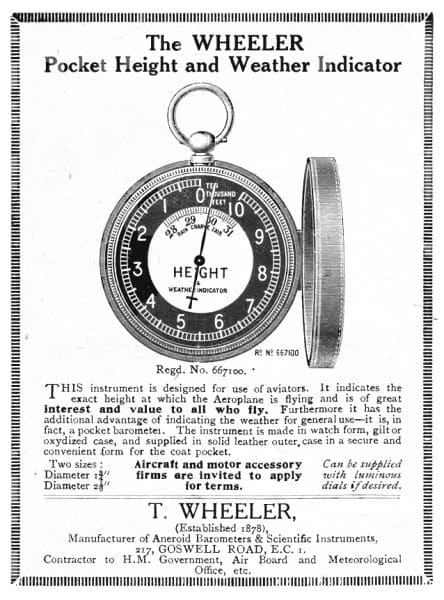
Registered design numbers 666128 to 673749 were issued in 1919, so No. 667100 on Wheeler's new instrument dates from early that year. According to the dealer Vavasseur, the design was registered to Thomas Wheeler on 6 March 1919. "The Wheeler Pocket Height and Weather Indicator" was advertised to aviators in Flight on 7 August 1919.
The 1920 advertisement (reproduced in Grace's Guide), in full:
The WHEELER Pocket Height and Weather Indicator Regd. No. 667100. THIS instrument is designed for use of aviators. It indicates the exact height at which the Aeroplane is flying and is of great interest and value to all who fly. Furthermore it has the additional advantage of indicating the weather for general use — it is, in fact, a pocket barometer. The instrument is made in watch form, gilt or oxydized case, and supplied in solid leather outer case in a secure and convenient form for the coat pocket. Two sizes: Diameter 1¾″ / Diameter 2⅜″ [fractions indistinct in the reproduction] Aircraft and motor accessory firms are invited to apply for terms. Can be supplied with luminous dials if desired. T. WHEELER, (Established 1878), Manufacturer of Aneroid Barometers & Scientific Instruments, 217, GOSWELL ROAD, E.C. 1. Contractor to H.M. Government, Air Board and Meteorological Office, etc.
The illustration shows a watch-form case with a hinged lid and a bow. The outer black ring of the dial is numbered 0 to 10 and marked "TEN THOUSAND FEET". On the light centre field is a pressure arc of 28–31 inches with the words RAIN–CHANGE–FAIR, and in the middle "HEIGHT & WEATHER INDICATOR". The Air Board named in the advertisement was the wartime air body replaced by the Air Ministry in January 1918. The phrase "Contractor to … Air Board" therefore records wartime supply.
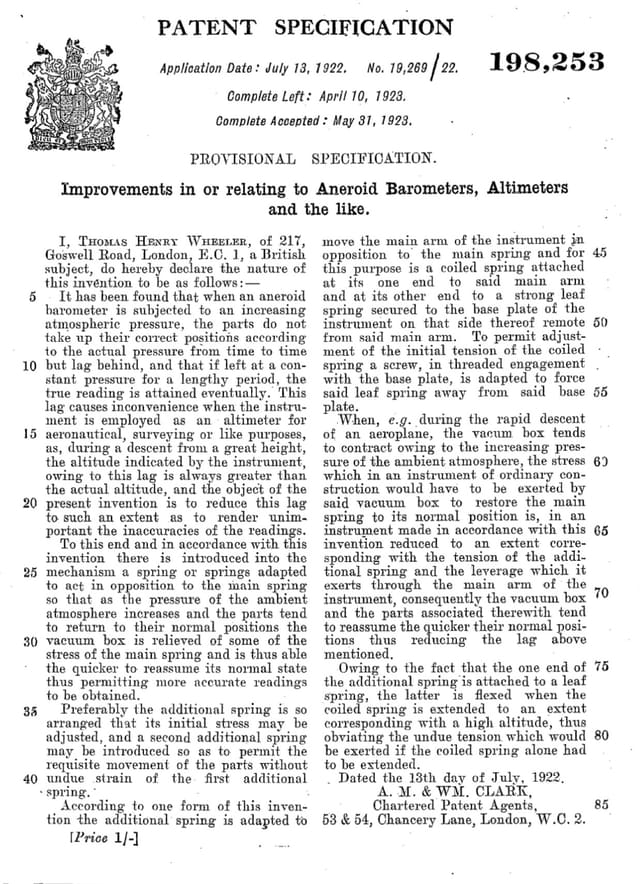
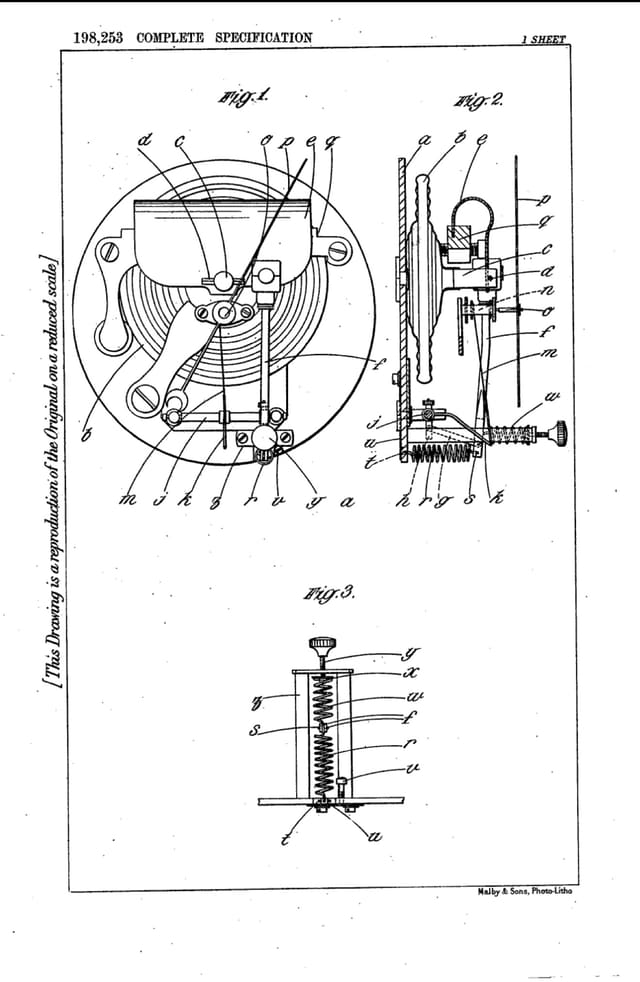
Application No. 19,269/22, "Improvements in or relating to Aneroid Barometers, Altimeters and the like", was filed on 13 July 1922. The complete specification was left on 10 April 1923 and accepted on 31 May 1923 as British Patent No. 198,253. The applicant was "Thomas Henry Wheeler, of 217, Goswell Road, London, E.C. 1, a British subject". The agents were again A. M. & Wm. Clark, now at 53 & 54, Chancery Lane.
The patent deals with hysteresis. When pressure rises, an aneroid's mechanism lags behind the true value and reaches it only after a time. So during a descent from a great height, an altimeter reads higher than the actual altitude. The mechanism described is a standard one: vacuum box b, central rod c with knife-edge fulcrum d, main spring e on bridge q, main arm f, link g, arm h on spindle j, lever k, fine fusee chain m, and drum n on the needle spindle o.
The innovation is an additional spring working against the main spring. It relieves the vacuum box of part of the main spring's stress, so the box returns more quickly to its normal state. There are three versions:
There are seven claims. The first covers an additional spring "for the purpose of reducing the lag during rapid increases of pressure". The Whipple Museum holds a typescript copy of the complete specification: six pages with drawings, a cover dated 13 July 1922, and a letter of 10 April 1923 signed by Andrew Clark.
In 1937 T. Wheeler was listed in "The Aeroplane Directory of the Aviation and Allied Industries"; Grace's Guide classes it among scientific instrument manufacturers. The firm's main inter-war contract was the Air Ministry pocket barometer-altimeter. One example is marked "A.M." beneath the royal crown, "Ref. No. 6B 114", "Barometer Aneroid Pocket Mark I", "T. Wheeler, London" and "No 134". Another, "No 138/39", has a 2½″ silvered dial with an inner pressure scale of 20–31 inches and a rotating altitude scale of 0–12,000 feet. Its leather case is stamped "A.I.D.95.V" within a frame. The number "326/38" is also recorded.
The mechanism has one distinctive feature: "an additional recovery coil spring has been added to the primary lever". This is exactly the counter-spring described in the 1922 patent.
In the same years the name of a limited company appears on the instruments. A compensated barometer signed T Wheeler Scientific Instruments Ltd in the Australian National Maritime Museum is dated to the 1930s; its scale runs from 24 to 31 inches and to 6,000 feet. The History of Science Museum in Oxford holds a surveying aneroid inscribed "Surveying Aneroid / Compensated / T. WHEELER / Scientific Insts LTD / LONDON / 1584".
The best-documented wartime order came from the Meteorological Office. The Science Museum holds a Mark I compensated aneroid made by T. Wheeler Scientific Instruments Ltd in 1940. Its Meteorological Office number is 11450/50, and it is scaled in inches and millibars. The model was portable, intended for places where a mercury station barometer was impractical. It has a brass case (inv. 1997-1311). Another such barometer is known signed "T Wheeler Scientific Insts. … Mark I MO 10642/40", with the MO emblem on dial and case.
Other dated instruments from the war years:
After the war, one of the firm's main customers was the General Post Office, which until 1969 ran the whole national telephone network. The GPO list of supplier codes includes: "AJC Wheeler T (Scientific Instruments) Ltd - London EC1 Barometer 1A". Under GPO marking practice, an item carried the manufacturer's code, the mark number and the year of manufacture. For example, "Telephone 162 C34/1" means telephone No. 162, made by GEC in 1934 to Mark 1. By analogy, the marking "AJC 65/1" reads as Wheeler, 1965, Mark 1.
Why a telephone service needed a barometer is explained in the Post Office engineers' journal. In the October 1963 issue, R. A. M. Light and H. P. Brooks wrote about operating gas-pressurised cables and locating leaks. Cable pressure was measured with a mercury manometer, the Manometer No. 1B, with a range of 0–9.5 lb/in². Because it is sensitive to atmospheric pressure, a barometer is required. The authors write: "The barometer used (Barometer No. 1A) is a small watch-type aneroid mechanism". The absolute pressure in the cable is the sum of the barometric and gauge readings (B + G). Changes in atmospheric pressure could put the estimated leak position out by 20–30 yards.
This explains the dual scale of the No. 2A, a barometer in a flanged case for screw mounting. Surviving examples have "G.P.O." on the dial, an "INCHES" scale from 26 to 31 and an outer "LBS./SQ.IN." scale; the back is stamped "BAROMETER No 2A" and "AJC 65/1". With atmospheric pressure in pounds per square inch, the linesman could add it to the manometer reading without conversion. Seventy years after its first watch aneroids, the firm was supplying the state with the same type of instrument — a "watch-type aneroid".
A twelve-page catalogue, "Aneroid Barometers", with barographs and prices, at 217 Goswell Road E.C.1, apparently belongs to this period.
The firm's last address is known from its sales leaflets. T. Wheeler Ltd, Cline Road, Bounds Green, London N11 2LY, issued leaflets for "Surveying aneroids" (SA.2001), "Barometers" (B.2003), "Barographs" (B.2002) and "Marine equipment" (ME 2000). The range included load-line hydrometers, hydrometers, salinometers and brinometers, barographs, barometers and altimeters. The catalogue record names R.W. Munro Ltd as a second maker. R. W. Munro was an old-established firm. It was founded in 1864 by Robert W. Munro, became a limited company in 1916, and by 1965 was working at Bounds Green.
The end of the story is precisely documented. The Whipple Museum's collection includes a letter from the general manager, Neil Munro, to customers, sent with a new catalogue and price list. It also includes his letter of 31 March 1982 announcing that the company had been absorbed into R.W. Munro Limited. With them are a price list for hydrometers and salinometers dated 1 December 1980, an altimeter handbill W/554, sales flyers listing services, and colour leaflets for a "pointer stick barometer", a "display barograph" and a "banjo barometer".
The London Gazette of 28 October 1987 reports that on 29 July 1987, at Pentagon House (Sir Frank Whittle Road, Derby), several companies resolved to wind up voluntarily. Among them was T. WHEELER (SCIENTIFIC INSTRUMENTS) LIMITED. The liquidator was R. S. Harding (Pannell Kerr Forster, Nottingham), and it was a members' liquidation, not a creditors' one. The company's previous names were Browne Watts & Co., H. Browne (Depot) Ltd and Sestral International Ltd. Its nature of business was given as "nautical manufacturers and dealers (marine & yachting)". The final meeting was called for 30 November 1987. Sestrel was the trade mark of the Barking compass makers Henry Browne & Son. So the legal entity wound up in 1987 bore Wheeler's name but had previously traded under other names.
Wheeler's business continued inside Munro. R. W. Munro of Bounds Green was succeeded by the Munro Group, which in 1999 bought the environmental monitoring division of Negretti Automation. Negretti Automation sold that part of its business to the Munro Group of Woodford Green. Today the company is Munro Instruments Limited, based in Harlow and part of the MRC group since 2019. The legacy of the small Coombs Street workshop thus ended up in the same company as the legacy of Negretti & Zambra.
The history of T. Wheeler is a history of specialisation. The firm had no West End showroom and did not exhibit at world fairs, but for a century it did one thing: small, precise aneroids. Two patents mark the beginning and the maturity of that work. The 1894 chain drive to the index arbor simplified the combined instrument; the 1922 spring countered the lag of an aneroid as an aircraft descended. And the state kept ordering these instruments throughout: the Air Board and the Meteorological Office in the 1910s, the Air Ministry in the 1930s, the Army and Navy in the Second World War, and the GPO telephone service in the 1960s.
Patents and registrations
Directories and newspapers
Archives and trade literature
Museum collections
All these records are reliable for inscriptions and numbers.
Dealers and auctions — used only as evidence of markings; their interpretations (e.g. "for a submarine") have not been verified:
Successors