Loading

Springfield Instrument Company was an American manufacturer of household and decorative meteorological instruments that operated during the second half of the twentieth century and became known primarily for its aneroid barometers, thermometers, and domestic “weather stations.” The company’s production facilities were located in the United States, and by the 1960s–1970s its instruments were widely distributed across the North American market as inexpensive mass-produced products intended for home use and souvenir retail.
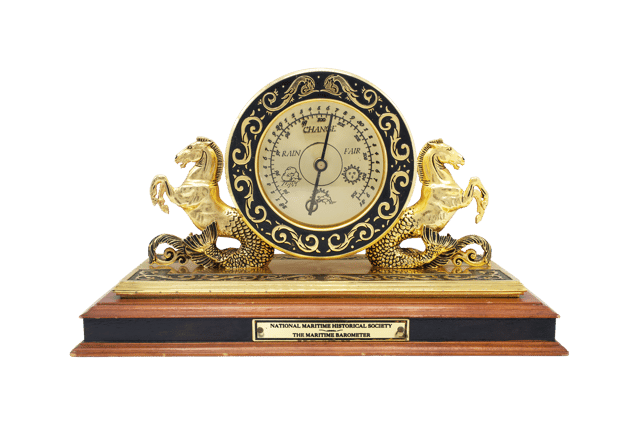
The company produced mainly wall-mounted and tabletop aneroid barometers, often housed in decorative cases made of brass, wood, or cast metal. Many models were styled as “marine” or “navigation” instruments, intended more for interior decoration and the popularization of meteorology than for professional observation. The construction commonly employed stamped aneroid capsules and standardized mechanisms that allowed instruments to be manufactured in large production runs.
Within collector circles, a frequently repeated claim states that Springfield Instrument Company was founded around 1956 by two entrepreneurs from New York. However, this assertion has not yet been confirmed by primary registration documents. Archival information concerning the exact circumstances of the company’s founding remains fragmentary, and the early history of the enterprise is reconstructed mainly through patents, advertising catalogues, and industrial directories of the second half of the twentieth century.
By the early 1970s Springfield already possessed its own engineering base and production framework, which is confirmed by patents and by the addresses of assignees and inventors associated with northern New Jersey and the suburbs of New York.
Two patents are known to be associated with Springfield Instrument Company:
Both patents were issued on the same day—April 23, 1974—and both were assigned to Springfield in Hackensack, indicating a period of active product standardization and, likely, production scaling in this region.
A rare “view from below” is provided by a 1978 publication (a worker’s note in the political periodical News & Letters): there Springfield Instrument Corp. is described as a plant in Hackensack employing “one or two thousand” workers and operating production lines with hazardous machinery. The source is clearly polemical in genre and intent, but it is valuable as an external testimony regarding the scale of the enterprise and the factory-type nature of its production by the late 1970s.
Another important marker appears in a museum archival record of the Smithsonian Institution (finding aid): in an entry dated July 3, 1979, Springfield is described as a “division of Sunbeam Corp.” in Hackensack. This confirms the corporate linkage “Springfield ↔ Sunbeam” by at least 1979 (the precise date of acquisition or reorganization has not been established in the available body of sources).
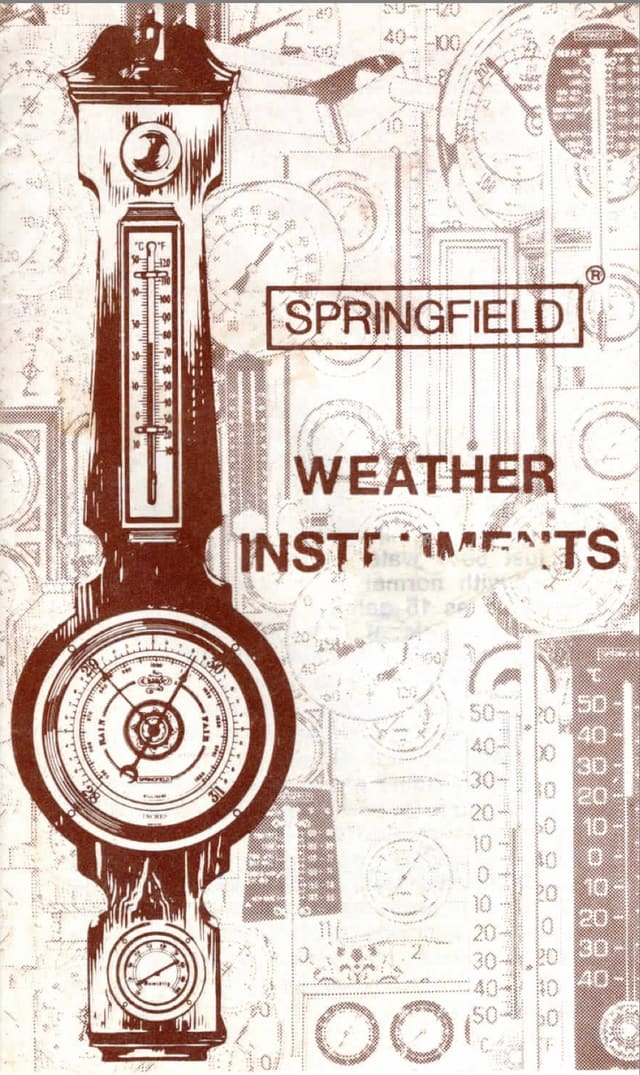
An informative Springfield service booklet (instruction/warranty manual) reveals three important details at once:
This document provides an important internal indication of how the company positioned its materials and service model: a decorative “brass” appearance achieved through coatings and lacquer finishes rather than through solid brass intended for regular polishing.
The instruction booklet demonstrates a typical domestic product portfolio: thermometers (including indoor/outdoor models), hygrometers, barometers, and explanatory sections on indoor placement and the initial adjustment of barometers.
From the service instructions it is also evident that sales were conducted through retail channels involving dealers: the text explicitly mentions “dealer pre-adjustment” and the return of instruments “postpaid” to the service address under warranty. This reflects a typical structure for the period: mass retail distribution combined with centralized service.
The most explicit address-level document is a government report of the National Oceanic and Atmospheric Administration / National Weather Service (October 1989). In an appendix listing manufacturers of consumer NOAA Weather Radio receivers, Springfield Instrument Company appears as a consumer-grade manufacturer with the address 76 Passaic Avenue, Woodridge, NJ 07075, together with a telephone number.
This indicates that by the late 1980s Springfield was involved not only in mechanical “weather dial” instruments but also in the manufacture—or at least the marketing under its own name as a producer—of tabletop NOAA Weather Radio receivers, thus operating at the intersection of “weather in the home” and the civilian warning system.
Its presence in the official NOAA Weather Radio manufacturers list (1989) directly confirms the expansion of the company’s product line toward electronic “weather safety” devices within the consumer segment of small tabletop receivers.
A late but important trace appears in trademark records in the Canadian database: for one of the marks, the owner/applicant is listed as Springfield Precision Instruments, Inc. (Wood-Ridge address), and a title assignment dated 2009-12-07 records the transfer from Springfield Precision Instruments, Inc. to Springfield Acquisition Co., LLC (Michigan), with the assignment registered later.
Further information emerges from disclosures of the United States Securities and Exchange Commission: in a document related to the group Lifetime Brands, Inc., it is stated that when Taylor Acquisition, Inc. was formed (June 8, 2012), it acquired various assets, and within Taylor North American Scales were included, among other things, the intellectual property of Springfield Acquisition Co. LLC. After the transaction, Taylor Acquisition changed its name to Taylor Precision Products, Inc.
Taken together, this trajectory resembles the typical end of a consumer measuring-instrument brand of the second half of the twentieth century: the manufacturing company or division gradually dissolves, while the trademarks and intellectual property move into the portfolio of a larger conglomerate producing measuring and household goods. The name “Springfield” continues to appear in circulation as a brand, yet Springfield Instrument Company as an independent manufacturing factory in New Jersey effectively disappears through the reassignment of rights rather than through any explicit public announcement of closure.