Loading

Around the turn of the 1920s and 1930s, the people of Munich could find out the weather simply by looking up. The Deutsches Museum stands on an island in the middle of the Isar, and on its tower ran the vertical scale of a giant thermometer. It was twenty-two metres high and two metres wide, with maximum and minimum indicators. Above the scale hung a round barometer dial. On the same tower an anemometer was at work, with a dial five metres across, so that wind direction and strength could be read from far away, from the bridges and embankments. The city had acquired something like a town-hall clock, except that it showed not the time but the state of the air.
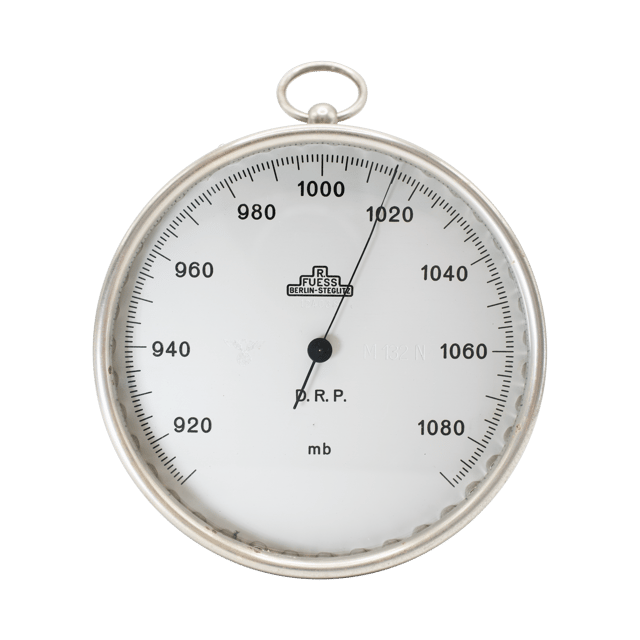
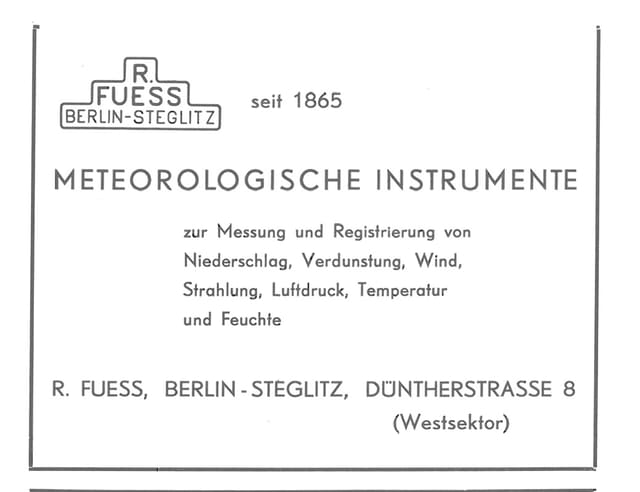
Few passers-by knew where this meteorological tower had come from. The answer was given by the catalogues that the Berlin firm of R. Fuess printed in French in 1931–1932 for its foreign customers. Photographs of the Munich tower appeared on their covers, with a note that the giant weather installation had been built and erected by the firm. Beneath the registered trademark, a stepped cartouche bearing the words "R. Fuess / Berlin-Steglitz", was the line: founded in 1865. Inside, seven production departments were listed, ranging from barometers and recording instruments to spectrographs and crystal-optical apparatus.
Behind these catalogues lay a story more than a century long. Its founder was the son of a paper-mill owner from the Hanoverian provinces and had no university degree. He attended the lectures of great physicists as an auditor, came to Berlin as a journeyman, and had to struggle for a long time even for the right to open a workshop of his own.
Under the founder's heirs the firm made rangefinders and heliographs for colonial troops, rifle sights for the trenches of the First World War and on-board instruments for the Luftwaffe. After 1945 the company lost its machine tools, its branch factory and most of its past. Even so, it held on in West Berlin for another three decades, until electronics devalued its core skill, precision mechanics.
This history has its own paradox. For more than a century the firm measured the invisible: pressure, humidity, wind. Yet it left behind remarkably few visible traces of itself. The factory archive has been lost. The manuscript of the founder's autobiography was still kept at the works in 1961 and then disappeared. The buildings have been demolished, and a block of flats now stands on the site. The history of R. Fuess has to be pieced together from instruments in museum cases, catalogues in private libraries, patents, obituaries and encyclopaedia entries. What follows is an attempt to assemble these fragments into a single continuous narrative.
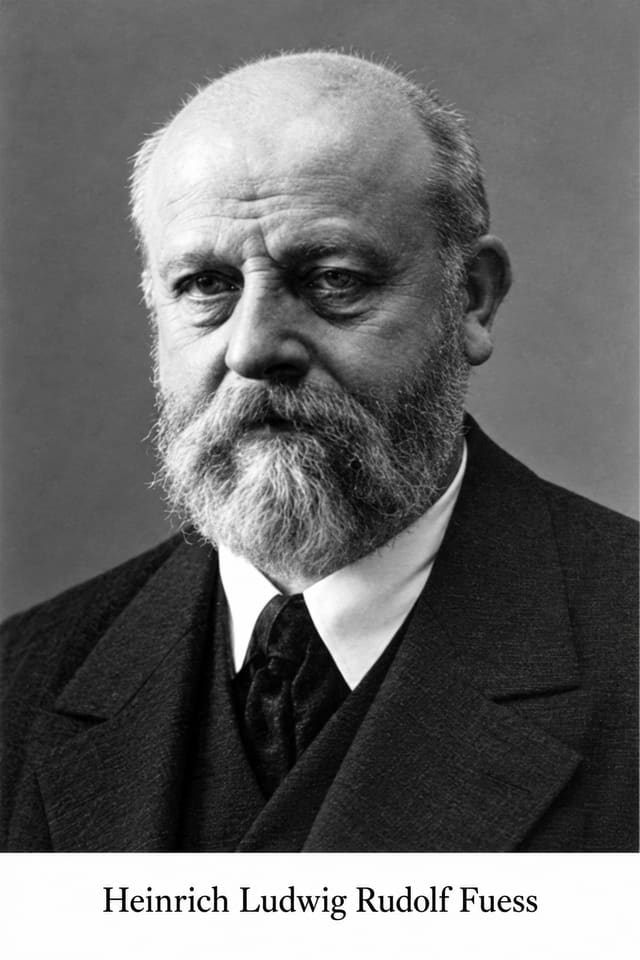
Heinrich Ludwig Rudolf Fuess (in older texts also Fueß and Rudolph) was born on 28 September 1838 in Moringen, a small town in the Kingdom of Hanover, north of Göttingen. Rudolf was the tenth child of a Protestant family. His father, Ludwig Fuess (1800–1874), owned a paper mill. His mother, Johanna, née Biltz (1797–1842), died before the boy was four.
Paper ran in the family. His paternal grandfather, Heinrich Ludwig Daniel Fuess (1772–1829), had kept a paper works in Herzberg. His maternal grandfather, Carl Biltz (1759–1801), was a starch manufacturer. From childhood Fuess grew up in a world of provincial industrial enterprise, a world of water wheels, machinery, accounts and attention to the quality of the product.
In 1853 the fifteen-year-old Rudolf was apprenticed to the Göttingen Mechanikus Hermann Pfaff. Göttingen was then one of the capitals of European physics. Wilhelm Eduard Weber, who had built an electromagnetic telegraph together with Gauss, taught there. So did Johann Benedict Listing, a mathematician and physicist, a researcher in physiological optics and the man who coined the word "topology". The mechanic's apprentice attended their lectures in mathematics, physics and optics. The Neue Deutsche Biographie (NDB) specifically notes that Fuess made up for his gaps in physics through university courses and self-study.
This double training, the workshop by day and the lecture hall in the evening, did much to shape the character of the future firm. Fuess understood the language of the scientists he worked for. He could therefore not only carry out their drawings but also improve them.
His apprenticeship ended in 1857. Fuess stayed with Pfaff as a journeyman for about another six months and then went to Hamburg to join his friend, the optician Hugo Schröder (1834–1902), whose workshop made telescopes and microscopes. According to the NDB, the young mechanic worked on astronomical and other instruments in Göttingen and Hamburg. Tony Benson describes these years in much the same way in his reference work Brass and Glass, but names the Hamburg master as Heinrich Schröder.
In 1860 Fuess moved to Berlin. Benson writes that in this year Fuess moved to Hamburg, but all the other sources agree that it was the Prussian capital.
According to a family tradition retold by the historian Heidrun Siebenhühner, the firm of Siemens turned the young Hanoverian away. He found a position with R. Löhmann. Gerhard Stöhr, in his book on aneroid barometers, specifies that this was a factory making levelling instruments. The owner is said to have taken on the newcomer with the remark that mechanics from Hanover were known as good workers. But, according to Stöhr, Fuess aimed for independence from the very start.
The road to it proved bureaucratic as well as professional. In Prussia a native of Hanover counted as a foreigner, and to set up his own business he needed Berlin citizenship. Heinrich Wilhelm Dove, director of the Royal Prussian Meteorological Institute, refused to recommend him. Help came from Kochhann, chairman of the city council; according to tradition, he said that Berlin needed people like him.
The story is not without irony. The institution whose director would not vouch for the young mechanic was, a quarter of a century later, to become one of his firm's chief customers. Its stations would be equipped largely with Fuess barometers, psychrometers and rain gauges.
On 1 April 1865 Rudolf Fuess opened his own mechanical workshop at Mauerstraße 84 in Berlin's Friedrichstadt. This date is given by Siebenhühner, Stöhr and the Museum of Optical Instruments. The firm itself dated its foundation the same way: its catalogues of the early 1930s read "Fondés en 1865". Other sources give 1864 (the NDB and Benson) or even 1859 (the Harvard and Smithsonian collections). The last date is plainly impossible, since in 1859 Fuess was not yet living in Berlin.
The beginnings were modest and varied. The workshop made:
The very first price list of 1865 already included three microscope stands, three objectives and two eyepieces, giving magnifications from 60 to 300 times.
The first real success came through an order that looked like a trifle. No Berlin mechanic was willing to engrave a glass circle six millimetres across for a telescope eyepiece, but Fuess managed it.
Through the mathematician Karl Heinrich Schellbach, for whom he had earlier done small jobs, Fuess came into contact with Wilhelm Foerster. Foerster was director of the Berlin Observatory (1865–1903), and Fuess built a chronograph for it, an instrument that records the moments of astronomical observations. The chronograph stayed in the firm's range for a long time. It still appears in the 1891 catalogue as No. 108, priced at 450 marks. The catalogue refers to the report on the Berlin Trade Exhibition of 1879, in which the reviewer for this instrument was Foerster himself.
The observatory was followed by orders from the Standards Commission (Normal-Eichungs-Kommission), which Foerster headed from its foundation. The commission was responsible for uniform weights and measures, first in the North German Confederation and then in the German Empire. In this way the workshop in Mauerstraße entered the circle of suppliers to state metrology.
In 1866 Fuess married Alma Kaiser (1839–1877), daughter of Jakob Kaiser (1807–1889), director of the paper factory at Hohenofen. The paper trade, which he had left for mechanics, was close at hand once again. In 1867 his son Paul, the future successor, was born.
The second line of work, mineralogy, grew out of a simple service. From 1868 the workshop prepared thin sections of rock samples sent in by customers: transparent slices of stone that are studied in polarised light. Together with the Berlin professor Justus Roth, Fuess began selling systematic collections of thin sections around the world. From the mid-1880s the firm also supplied institutes with machines for making them. Thin sections marked "R. FUESS / BERLIN" survive to this day, for example in the Harvard collection. A petrographic microscope needs a thin section, a thin section needs a microscope, and the Fuess workshop found itself at both ends of this chain.
In 1870 the workshop moved to Wassertorstraße 46 in the Luisenstadt (today's Kreuzberg). In 1871 the young mineralogist Paul Groth ordered from Fuess a "crystallographic-optical universal apparatus". Groth later recalled that he had found in Fuess not a mere executor but an "artist", who not only built the apparatus but simplified and improved its individual parts.
Three years later, Stöhr writes, lack of space forced a move to Alte Jakobstraße 108. The literature also gives 1875 and house number 110. However, the 1891 catalogue, still published from this address, explicitly names number 108. According to the Harvard collection, five mechanics, two opticians and two apprentices worked there. Fuess himself was at once owner, designer, draughtsman and workshop foreman.
It was here that the firm's first speciality took shape: crystallography.
Around 1873 the workshop produced its first anemometers. As Stöhr notes, until then all such instruments had to be imported from England. The first buyers were mines, for which monitoring ventilation was a matter of life and death.
The year 1877 brought Fuess both loss and a turning point. He received a patent on the construction of thermometers, above all on the method of fixing the scale. The 1891 catalogue reports this in the founder's own voice: the design was patented "to me in 1877". The method spread quickly and attracted the attention of meteorologists. In the same year Alma Fuess died. And in the same year Fuess bought the firm with which the most productive period of his business began.
The Berlin firm of J. G. Greiner jr. & Geißler was a glass-blowing business producing thermometers, barometers and anemometers. By the late 1870s it had run into difficulties, and Fuess acquired it. The year of the purchase varies in the literature between 1875, 1876 and 1877. Siebenhühner, Stöhr, Benson and Wikipedia give 1877.
Benson describes the acquisition as the purchase of a glass manufacturer, after which Fuess's range expanded to include meteorological, geodetic and hydrographic instruments, spectrometers and heliostats.
Fuess did not erase the old name straight away. The Berlin district lexicon lists him as owner of Greiner & Geißler from 1877 to 1890. The 1891 catalogue still appears under the heading "R. Fuess (vorm. J. G. Greiner jr. & Geissler)", that is, "formerly Greiner & Geissler". The formula is repeated in the running head of every page: for fourteen years the reputation of the acquired firm was treated as an asset.
From this point on, according to Siebenhühner and Stöhr, meteorological instruments were produced on a large scale. The timing was right:
Fuess found himself at the centre of this process. He could do what scientists valued most: turn a physicist's idea into a production instrument.
In 1879 Fuess married again. His second wife was Laura Kaiser (1853–1882), another daughter of Jakob Kaiser. In 1882 she too died. By the age of forty-four Fuess had been widowed twice. From the two marriages he had two sons and three daughters.
The first great meteorological partnership was with the Swiss physicist Heinrich Wild (1833–1902), who from 1868 to 1895 directed the Main Physical Observatory in St Petersburg. Together they created the siphon-cistern barometer (Gefäßheberbarometer) of the Wild–Fuess system. The 1891 catalogue shows a whole family of these instruments.
The catalogue accompanies this series with two proud but verifiable claims:
The design could be dismantled. The glass tube with its mercury was removed and shipped separately, and the recipient could reassemble the instrument without a mechanic. This mattered a great deal for postal shipments to distant countries. The catalogue even advised ordering at least one spare tube.
Fuess made his public debut as a meteorological instrument maker at the Berlin Trade Exhibition of 1879. He showed goniometers of models I and II, a microscope goniometer and a lever goniometer. The report on the scientific instruments at the exhibition (the barometer section was prepared by Leopold Loewenherz) also described:
The 1891 catalogue refers to this report more than once. It shows that the collaboration with the meteorologist Adolf Sprung (1848–1909) had begun no later than 1879. This is somewhat earlier than 1880, the year usually given as the start of his experiments with recording instruments at the Naval Observatory.
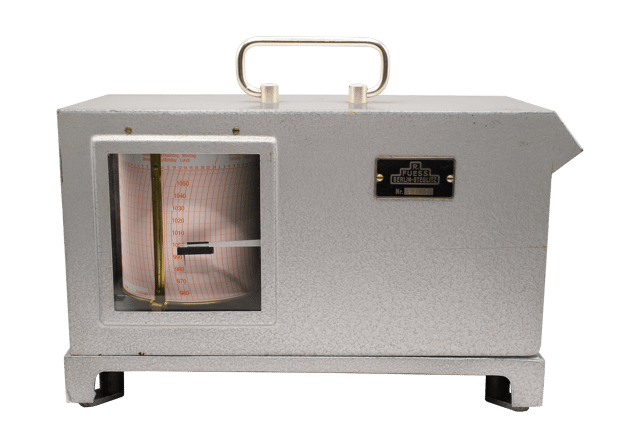
The chief fruit of their work was the sliding-weight barograph (Laufgewichtsbarograph). In it a mercury barometer was balanced on a beam, and the movement of a weight recorded the pressure continuously, with temperature compensation and a magnification of five times or more. In 1891 the instrument cost 1,100 marks; the catalogue notes that this is a model improved on the basis of many years' experience. Other developments followed:
Sprung's weight barograph remained in the firm's range for decades. The 1931 catalogue describes it as an instrument for central stations, housed in a glazed mahogany cabinet and recording pressure magnified 5 or 10 times.
The firm's most famous instrument was the aspiration psychrometer. The 1891 catalogue tells its story as follows: it was invented in 1886 by the Berlin physician and meteorologist Richard Assmann (1845–1918), and in 1889 its design was improved together with the balloonist Hans Bartsch von Sigsfeld.
The principle is simple. The bulbs of the dry and wet thermometers are enclosed in double polished metal tubes that shield them from radiation. A clockwork-driven fan draws a strong current of air past them. As a result, true temperature and humidity can be measured anywhere, even in bright sunshine.
The catalogue emphasises three points:
The 1891 prices show how the range was structured:
| Model | Price |
|---|---|
| Basic nickel-plated psychrometer No. 32 with clockwork fan, clamp and wind shield | 155 marks |
| Full tropical outfit (spare thermometers, clockwork drums in soldered tin capsules) | 230 marks |
| Balloon psychrometer with two wet and one dry thermometer, system personally tested by Assmann | 400 marks |
The firm also promised separate prospectuses for aspiration meteorographs for captive balloons and free flights.
Assmann published the classic description of the instrument in the Zeitschrift für Instrumentenkunde in 1892. In 1898 the international commission coordinating research into the free atmosphere recommended the psychrometer as a standard instrument. In 1902 measurements in the free atmosphere enabled Assmann, simultaneously with Léon Teisserenc de Bort, to announce the discovery of the stratosphere.
The number 32 stayed with the Assmann psychrometer for good. In the 1931 catalogue it still denotes the instrument recognised as an international standard. It carries the same number in the catalogue of today's maker of the "R. Fuess model".
The 1891 catalogue, with 43 pages, 45 wood engravings and 113 items, gives a detailed cross-section of the business on the eve of the move and names its customers directly.
Meteorological stations. The Prussian network, reorganised in the 1880s, received from Fuess:
Gustav Hellmann (1854–1939), later director of that institute, also proposed a lightweight travelling siphon barometer. For travellers in the tropics there was a rain gauge designed for tropical downpours.
The navy. The naval authorities bought:
Hydrology. The most expensive instrument in the catalogue was the universal water-level gauge of the Seibt–Fuess system (D.R.P. No. 50568); a complete set cost 2,750 marks. The gauge recorded the water-level curve automatically. A pendulum integrator calculated the mean level for any period. A chronoscope allowed the level to be read remotely by wire and, if desired, by microphone and telephone. A separate levelling device (D.R.P. No. 57718) monitored any shift in the gauge zero.
Industry. For monitoring ventilation in buildings and mines, the firm made technical anemometers. The catalogue calls the anemometer counting up to 10 million metres the most widely used instrument in mining. A static anemoscope monitored the draught in ventilation ducts; eighty of them were installed at the municipal Am Urban hospital in Berlin.
The physics laboratory. The offer here included:
Standard thermometers were made of Jena standard glass. High-temperature standards with nitrogen filling came with test certificates from the Physikalisch-Technische Reichsanstalt, and the firm had agreed the testing method with that institute.
The catalogue is also honest about what the firm did not yet make itself:
The catalogue soberly notes that such recorders need to be checked against standard instruments and are suitable as interpolation instruments. The firm that sold Sprung's barograph for 1,100 marks bought in French barographs for the mass market. Twenty years later it would be patenting aneroid barograph designs of its own.
A few more details show the firm's place in the scientific world. Supplements to the catalogue were to be published in the Meteorologische Zeitschrift, the journal edited by Julius Hann and Wladimir Köppen. Customers were urgently asked to quote the instrument number and the year of the catalogue. Crystallographic, physical and measuring instruments were described in a separate list.
In 1886 Fuess built for Robert Koch a projection apparatus for demonstrating microscope preparations. It worked by sunlight, and partly already by electric light.
By the 1880s Fuess had become not only a supplier but also one of the organisers of German precision mechanics.
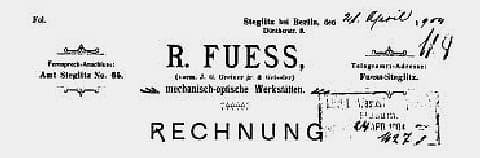
In 1891 the firm expanded once more. Fuess bought a plot at Düntherstraße 8 in Steglitz and built a house and a factory building with room for a hundred workers; Stöhr adds that business was good. The move is sometimes dated to 1892.
Steglitz was then an independent municipality outside Berlin, so the firm's signature read "Steglitz bei Berlin". The familiar "Berlin-Steglitz" became formally accurate only after 1920, when the Greater Berlin Act incorporated Steglitz into the capital. In 1931 the firm's address was:
The firm remained on this street to the very end.
The optical department was headed by Carl Leiss (1868–1940). He had trained as a mechanic in Heidelberg, came to Fuess by way of Vienna at the beginning of 1890, and was already head of the department by 1893. In 1899 his manual Die optischen Instrumente der Firma R. Fuess, deren Beschreibung, Justierung und Anwendung was published in Leipzig. A description of a firm's instruments that became a textbook was a rarity at the time. Under Leiss the firm took the lead in crystallographic rotating instruments. Optics, crystallography and petrography formed "Abteilung I", while meteorological instruments were described in separate catalogues.
The polarising microscopes grew ever more refined, and their serial numbers ever higher:
Mappes also gives an overall figure: by 1920 only about 4,000 Fuess polarising microscopes had been made. This was not mass production but scientific craftsmanship.
The meteorological line, meanwhile, reached world standing. After the 1898 recommendation the Assmann psychrometer became an international standard. Around 1900 the firm was making optical pilot-balloon theodolites, followed by balloon barographs. From instruments for measuring the weather at ground level grew equipment for studying the free atmosphere.
A third, less glamorous line also appeared. According to the historian Christiane Brennecke, from 1899–1900 the firm produced for the army and navy of Imperial Germany:
Hypsometers, which determine altitude from the boiling point of water, were used in mapping colonial territories. Brennecke draws a stark conclusion: military production, intensified in both world wars, was the very foundation of the company's success. Early Fuess binoculars of frame construction are extremely rare.
From 1905 Paul Fuess became his father's partner. Around 1911 the form "R. Fueß & Co." appears, probably reflecting this partnership. In 1913 the 75-year-old Rudolf Fuess handed over the management to his son. The letter "R." remained in the name and trademark for good.
In the same year, 1913, the firm received British Patent No. 13761, noted by W. E. Knowles Middleton in his classic History of the Barometer. In an aneroid barograph the stack of vacuum capsules was normally fixed to the base plate. Fuess proposed mounting it on one end of a heavy bimetallic strip that compensated for the effect of temperature. Twenty-two years after the catalogue offering French barographs, the firm was improving their design itself.
The First World War brought the firm many military orders. Stöhr, Siebenhühner and Benson agree on the essentials: production came to include rifle sights and other items that Benson calls "optical munitions", as well as on-board instruments for military aircraft. Aviation was a young branch of the forces, and a pilot needed to know altitude, speed and pressure. The aneroid technology the firm had mastered was in greater demand than ever.
Design work continued through the war. Middleton cites German patent D.R.P. 288537 (1914) for an aneroid capsule with an internal helical spring. The spring sat inside the vacuum chamber, and a single spring could serve several capsules. In 1918 patent D.R.P. 309578 followed. Springs had always been the weak point of aneroids, and the firm returned more than once to the question of how to combine elasticity, compactness and temperature stability.
Rudolf Fuess did not live to see the end of the war. He died on 21 November 1917 in Steglitz, in his eightieth year. His obituaries were written by people for whom he had built instruments for half a century:
Fuess was buried in the old cemetery of the St. Jacobi parish (Karl-Marx-Straße 4, Neukölln). From 1990 to 2015 his grave had the status of an Ehrengrab, an honorary grave of the city of Berlin. A bronze bust of the founder stood at the factory, and an oil portrait remained with the family. His unpublished autobiography, Ein Mechanikerschicksal ("A Mechanic's Fate"), was still in the firm's archive in 1961; after that its trail goes cold.
Peace proved harder for the firm than war. Military orders vanished, the years up to the end of the 1923 inflation were a struggle for survival, and only after the mark was stabilised did things begin to improve. Stöhr, following Siebenhühner, names two pillars that kept the firm going at the time:
The firm also supplied instruments to the Deutsches Museum in Munich. According to Siebenhühner, branches were opened in these years in Yokohama, Bologna and New York, and general agents operated in a number of countries. The branches have not been independently confirmed, but the agencies are documented. The French catalogues of 1931–1932 bear the stamp of the general agent for Spain: H. Mergard, Barcelona, Calle Enrique Granados 41. The catalogues listed the commercial telegraphic codes Rudolf Mosse and ABC (5th edition). The firm was set up for international correspondence.
In 1921 Carl Leiss left (in March according to some sources, in May according to others). In Steglitz itself he founded his own workshop, Dr. Carl Leiss, which made goniometers, spectrometers and X-ray spectrographs after Manne Siegbahn. In 1924 the University of Marburg awarded him an honorary doctorate as the former scientific director of the Fuess firm. After Leiss's death in 1940 the business was continued by his son-in-law, Karl Koletzko. The firm lasted until 1985, longer than its parent.
Work on aneroids went on:
In 1927 microscopes for biomedicine appeared in the range for the first time; until then the firm had made almost exclusively polarising microscopes.
The mature firm of the Weimar era is best shown by two short French catalogues: that of department A ("Mess 21 F", probably November 1931 according to the imprint) and that of department B ("Mess 22 F", probably January 1932). Production was divided into seven departments:
Department A began where the firm's meteorology had begun.
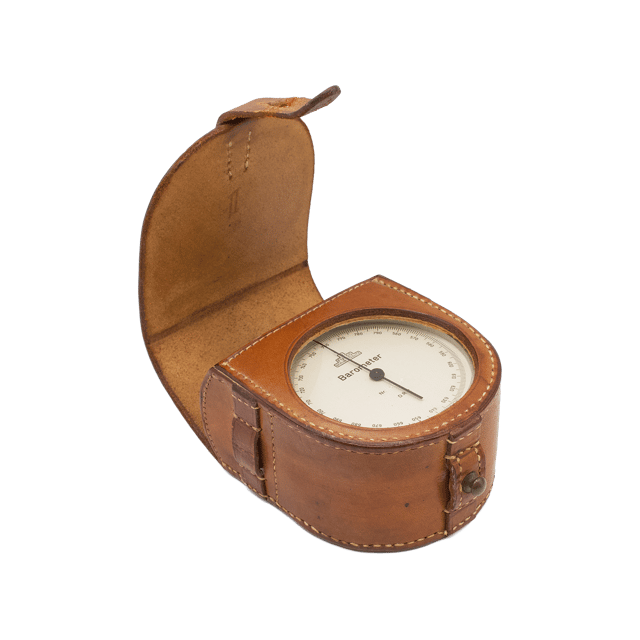
Barometers. The precision standard barometer No. 1a, with a 0.02 mm vernier and a 15 mm tube, was the direct descendant of the Wild–Fuess precision barometer of 1891. It was followed by:
All aneroids were supplied temperature-compensated. Among them were the barometer-altimeter No. 14b, with an altitude scale based on PTR data, and the station aneroid No. 15a of the Prussian pattern. The catalogue notes separately that all barometers were also available with millibar scales, a sign of meteorology's transition to the new unit.
Thermometers. This section was enormous:
Psychrometers and hygrometers. The Assmann psychrometer No. 32 with clockwork mechanism was surrounded by numerous variants:
According to the catalogue, the Fuess probe hygrometer was officially adopted for testing bulk foodstuffs.
Aerology. This was represented by the Wigand–Koppe–Fuess aircraft meteorograph, a streamlined nacelle suspended from an aeroplane or airship. It recorded temperature, humidity, pressure and airspeed on a drum running for two or four hours.
Testing apparatus and shelters. According to the catalogue, the thermometer-testing apparatus were the very models used by the PTR in Charlottenburg. For spa towns the firm offered a meteorological kiosk of its own design: a glazed booth with a barograph and thermohygrograph under a wide roof.
Department B was no less varied.
Wind:
Aerology and clouds: balloon theodolite No. 820, pilot balloons, the Moltchanov device for evaluating pilot-balloon observations, and the Koelzer–Fuess and Thomas–Fuess nephoscopes.
Precipitation:
Evaporation: the Wild balance, the Kassner–Fuess recording evaporation balance, and the Piche evaporimeter, the model of the French meteorological service.
Sun and radiation: Campbell–Stokes, Stade–Becker and Robitzsch polar heliographs; Bellani and Arago–Davy actinometers; the Robitzsch recording bimetallic actinograph.
Visibility: instruments after Professor Albert Wigand, with graduated light filters and an optical wedge.
The model names read like a list of collaborations: Hellmann, Kassner, Robitzsch, Wigand, Koppe, Haude, Stade. The old formula, "the scientist devises, Fuess builds", still held half a century after the founding.
The German brochure "Meß 2" shows the same approach applied to industry. It is titled Instruments and Devices for Measuring Air Pressure, Temperature and Humidity in Industry and Trade. The text opens with the thought that systematic monitoring of all the conditions accompanying production is becoming indispensable. Like the 1891 catalogue, it is written in the owner's first person ("my products"). The numbers and models are the same:
The Munich tower became the showcase of this era. But the world economic crisis, according to Siebenhühner, threw the firm back to a new low.
The new upturn came from the sky. Stöhr writes that in the 1930s turnover rose again, above all thanks to demand for aircraft instruments. According to Siebenhühner, the turning point came in 1934, with the production of modern on-board instruments for aviation.
At the same time a branch factory was built in Potsdam. Siebenhühner places it in Düppelstraße. A local Potsdam source, however, points to the site of the later Soviet military compound in Zeppelinstraße and states that the branch produced technical equipment, including for the Luftwaffe.
During the war the firm was called "R. Fuess, Feinmechanische und Optische Werke, Berlin-Steglitz und Potsdam". Its file at the Bank der deutschen Luftfahrt AG is held in the Bundesarchiv under reference R 8121/466 (1940–1946). It contains:
The aneroid school continued its work. Middleton relates that in 1937 the American Bendix Aviation Corporation patented an aneroid chamber whose two sides were made of different metals with opposite temperature dependence of the modulus of elasticity. R. Fuess in Germany took out a similar patent (D.R.P. 717707, 1939), and its Göttingen competitor Wilhelm Lambrecht patented in 1940 walls differing not only in metal but in shape. For aircraft altimeters, this contest for temperature stability was of direct practical importance.
In 1940 the firm celebrated its 75th anniversary. The advertising campaign ran under the slogan "75 Jahre Wertarbeit und Welterfolg" ("75 years of quality work and worldwide success") and listed on-board instruments for aircraft and equipment for the weather service and airports. The Zeitschrift für Instrumentenkunde published an anniversary article by H. Ebert (vol. 60, 1940).
Stöhr writes that the Second World War again brought a great many military orders. Capacity was insufficient, and production had to be expanded continually. According to Benson, the firm marked its military optics with the manufacturer code "cro". These three letters of the German system of coded manufacturer marks make it possible to identify wartime Fuess products that carry no firm name.
Little is known about who carried out these orders and at what cost:
According to Stöhr, the bombing of Berlin forced the company to keep changing location. Workshops were moved, among other places, to the Ore Mountains, to Schönheide in Saxony. From 21 February to 13 April 1945 a subcamp of the Flossenbürg concentration camp existed there.
The memorial's records give the firm's name with a misprint, "R. Feuss". The postwar list of the International Tracing Service names "R. Fuess, Schoenheide" among the companies that used forced labour.
In 1944 Paul Fuess died, after leading the firm for thirty-one years. Who took over after him, and in what legal form the firm then existed, could not be established from the available sources. No evidence of "Aryanisation" of the family firm has been found.
By May 1945, in Siebenhühner's words, the firm had "nearly come to an end". The main works and the Potsdam branch were destroyed and the equipment dismantled. Steglitz fell within the American sector of Berlin, Potsdam within the Soviet zone. According to local sources, the Potsdam branch was expropriated and occupied by the occupying forces.
There was almost no demand for scientific instruments in the ruined city, and the firm started again with household goods. From 1950 an upturn began, thanks to new developments:
The catalogue of today's maker of the "R. Fuess model" allows the postwar meteorological range to be reconstructed:
In 1961 the NDB still reports that the buildings erected in 1891 continued to house the company. But time was against the firm. Meteorology was moving to electronic sensors, automatic stations and telemetry. Fuess's greatest strength was fine mechanical craftsmanship: beams, aneroid capsules, clockwork recorder drums. And it was precisely this that was losing its value. Stöhr, following Siebenhühner, sums it up soberly: the fresh start after 1945 never managed to return the firm to its former position.
The final act is dated in different ways.
Most probably the liquidation began in 1975, and the physical disappearance of the company was completed with the demolition at the end of 1976. The exact procedure, whether bankruptcy, liquidation or deletion from the commercial register, has not been established.
The craft, however, did not vanish. A long-standing supplier of Fuess, the firm of Dr Alfred Müller, seized the opportunity, according to Stöhr. After the liquidation it took on several employees, various machines and all the production documentation. The DMG article is more cautious and speaks of some of the machines and documentation. At first Müller continued only part of the range, later all of it. Instruments made from the original documentation kept the designation "Modell R. Fuess". In 2004 production moved to Königs Wusterhausen (Senzig, Brandenburg). Today the firm is Dr. Alfred Müller Meteorologische Instrumente KG, Chausseestraße 39/42c, and "R. Fuess" still appears in its website address.
The question of succession has no clear answer. On its website, Müller's firm describes itself as founded in 1975 as the successor to R. Fuess. On the same page, however, it wrongly dates the founding of R. Fuess to 1885. Stöhr stresses the opposite: Müller's firm does not regard itself as the direct successor and acquired only the rights to the production documentation. No old stock was found. Surviving semi-finished parts made it possible to recreate a few instruments, but, as Stöhr notes, these too are gradually running out.
The chief legacy of R. Fuess is its instruments and standards.
Fuess instruments are held in many museums:
The Steglitz Museum devoted a major exhibition to Fuess, together with Manfred von Ardenne.
Least of all has documentation survived. Yet the link between eras is unexpectedly clear in the catalogue numbers. The 1891 catalogue insistently asked customers to quote the instrument number. These numbers outlived changes of generation, two wars and the firm's liquidation. Under a single number, the product evolved from resold goods made by others to the firm's own models, and reached the catalogue of today's maker of the "R. Fuess model".
| No. | 1891 | 1931–1932 | After 1975 (Müller) |
|---|---|---|---|
| 11 | station barometer (Prussia, Bavaria) | 11a, station barometer, Prussian pattern | 11a9, 11b9, 11i |
| 15 | pocket aneroid | 15a–e, station aneroid | 15pm, 15ps |
| 32 | Assmann psychrometer | Assmann psychrometer, international standard instrument | Assmann psychrometer No. 32 |
| 78 | Richard Frères aneroid barograph (resold) | own aneroid barograph, Prussian pattern | 78a, 78b, 78m |
| 82 | anemograph with Robinson cups (Naval Observatory model) | Fuess "universal anemometer" | 82a "Universal" |
| 95 | Hottinger recording rain gauge (resold) | Hellmann–Fuess pluviograph | 95, 95c, 95y |
The firm has disappeared, but its system of designations has outlived it by half a century. It is one of those rare cases in which a catalogue has proved more durable than the factory.
Books
Company catalogues and brochures
Biographical and historical publications
Museum collections
Archives, war and forced labour
Dr. Alfred Müller ("Modell R. Fuess")
Reference and market materials