Loading
The famous Dollond family, makers of optical and scientific instruments, began their work in the 1750s when John Dollond established a workshop in London.
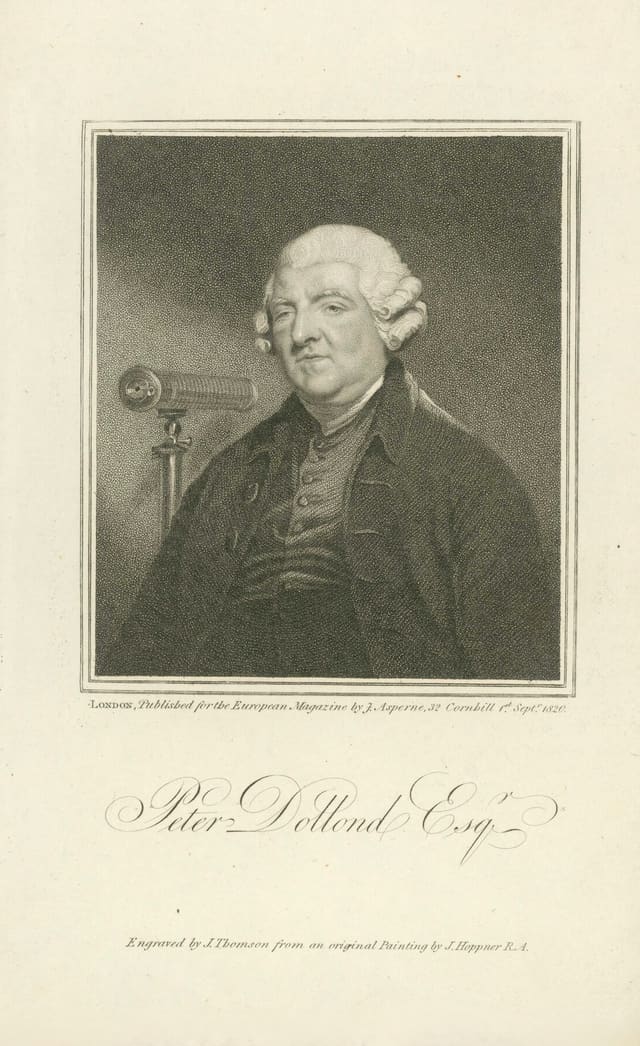
John Dollond, the first instrument maker to bear this name, was entirely self-taught. He was descended from a family of French Protestants (Huguenots) who had emigrated to England during the previous century. Born on 10 June 1706, he was originally employed as a silk weaver. In 1752, together with his son Peter Dollond (1730–1820), he opened an optical instrument workshop on the Strand. John Dollond brought the manufacture of achromatic objectives into practical production, an achievement that earned him widespread recognition. He was awarded the Copley Medal and elected a Fellow of the Royal Society. To protect the manufacture of achromatic lenses, he secured a patent that firmly established the reputation of his workshop.
Despite the existence of this patent, other English opticians soon began producing achromatic lenses as well. John Dollond wisely chose to ignore these infringements during his lifetime. He died on 17 November 1761, and three years later his son Peter, who had succeeded him as head of the firm, brought legal action against several manufacturers accused of violating the patent. In response, a number of them sought to have the patent declared invalid, arguing that Chester Moor Hall and George Bass had invented the achromatic lens as early as 1733. A lengthy lawsuit followed, in which Peter Dollond found himself opposed not only by his own brother-in-law, Jesse Ramsden, but also by George Bass, James Champneys, Nathaniel Hill, Mann, Pyefinch, Benjamin Martin, and several other instrument makers. Nevertheless, Dollond won the case, placing some of his opponents in severe financial difficulty. The patent expired in 1772, after which the price of achromatic lenses immediately fell by approximately half.
In 1766, Peter Dollond moved the workshop to St. Paul’s Churchyard and entered into partnership with his younger brother John. It was during this period, when the Dollond workshop was at the height of its prosperity, that Johann Bernoulli, having visited the establishment, remarked that the quality of its products had suffered somewhat in favour of increased production. Under Peter Dollond’s direction, however, the firm continued to manufacture instruments of the highest quality, including large quadrants and astronomical circles, equatorial telescopes, and theodolites, all of which fully satisfied the demands of their customers. At the time, Jesse Ramsden was universally acknowledged as the foremost maker of large, high-precision scientific instruments, and observatories as well as learned societies generally preferred to entrust their commissions to him. Ramsden, however, worked slowly and was often notoriously difficult, frequently refusing new commissions altogether. In such cases, customers turned instead to Dollond. It is quite possible that Dollond occasionally assisted his brother-in-law by manufacturing certain instruments in his own workshop, after which they were sold bearing Ramsden’s signature.
In 1795, the workshop moved once again, this time to Haymarket. Following the death of John Dollond Jr. in 1804, Peter entered into partnership with his nephew George Huggins, who subsequently adopted the surname Dollond. Prior to joining the firm, George had trained under another member of the extended Dollond family, Charles Fairbone, who was working as an optician on New Street in 1780. Peter Dollond lived until 1821. George Dollond was elected a Fellow of the Royal Society and remained active until his death in 1852, after which the business continued under members of the same family as Dollond & Co. Today the company survives as Dollond & Aitchison, although it now specialises exclusively in ophthalmic optics.
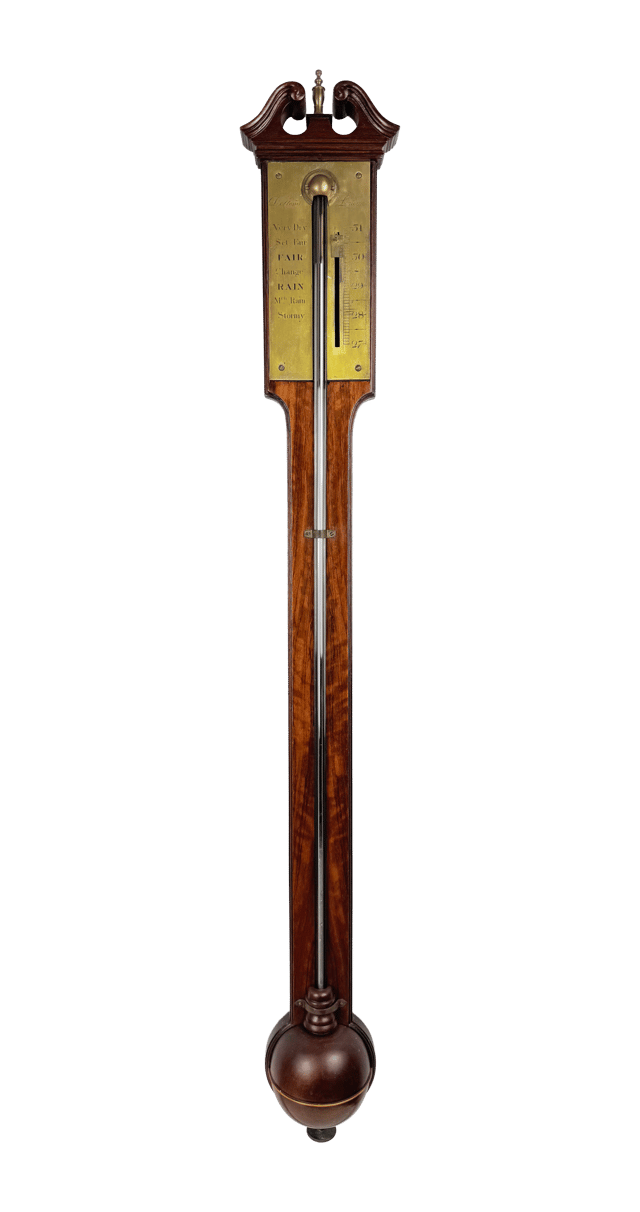
Instruments bearing the Dollond signature remain so widely represented in museum and private collections that it would be impossible to enumerate them all. Telescopes of every size are particularly common, but the Dollond workshop manufactured virtually every type of scientific instrument of its era, and numerous examples of most of them have survived to the present day.
The reputation of the Dollond workshop appears to have been so outstanding that it inevitably gave rise to counterfeit instruments. Genuine Dollond instruments, regardless of their quality or complexity, are invariably distinguished by careful workmanship, and the engraved signature is remarkably consistent. It is virtually inconceivable to encounter the name misspelled on an authentic Dollond instrument, unlike the frequent inconsistencies that are often found on the products of many French makers.