Loading
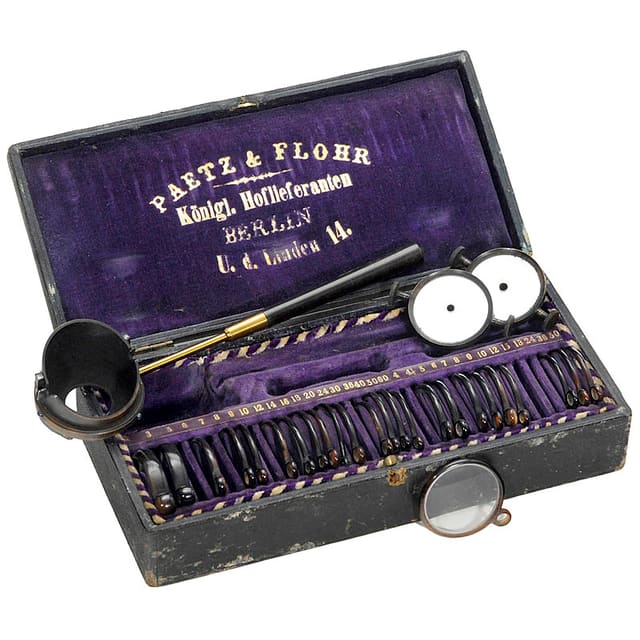
The firm Paetz & Flohr was founded in Berlin in the mid-19th century. As early as 1853, it was already producing complex ophthalmological instruments—for example, one of the earliest ophthalmoscopes based on the design of Josef Gassner was manufactured by the Paetz & Flohr workshop. The company specialized in optics and precision mechanics (listed in business records as “Optiker und Mechaniker”—optician and mechanic). The high quality of its products quickly gained recognition among specialists. Thus, the renowned ophthalmologist Frans Cornelis Donders, in the preface to the German edition of his work (c. 1862), explicitly thanked “the gentlemen opticians Paetz & Flohr (Berlin, Unter den Linden 13)” for supplying cylindrical lenses for the correction of astigmatism. Around the same time, Berlin ophthalmologist Karl Schweigger referred to Paetz & Flohr as one of the earliest manufacturers of cylindrical lenses , noting that by approximately 1862 they had already mastered the production of such lenses—an optical product that was rare at the time.
The first shop-workshop of Paetz & Flohr was located at Berlin, Unter den Linden 13. From this central part of the city (close to the Royal Palace and the University), the firm served both local clientele and international customers. It is noted, for example, that clinics abroad ordered specialized spectacle lenses from Paetz & Flohr in Berlin, with delivery times of up to 8–10 weeks. This attests to the company’s reputation as a supplier of high-quality, technically sophisticated optical products as early as the mid-19th century.
Paetz & Flohr combined the roles of manufacturer and retailer. The firm independently produced a wide range of optical and scientific instruments, while also selling them under its own name. By the end of the 19th century, Paetz & Flohr had developed into a comprehensive retailer of precision instruments. Its assortment included, in particular:
Thus, Paetz & Flohr functioned simultaneously as a manufacturer of high-quality optical instruments and as a retail supplier of a broad range of scientific devices from the late 19th to the early 20th century. Its products bore its own branding, and the firm also likely acted as a dealer for other prestigious manufacturers.
Thanks to its location in the capital and the consistently high quality of its products, Paetz & Flohr is widely mentioned in directories and catalogues of the late 19th and early 20th centuries. In the official Berlin Address Book of 1866, the company appears among the city’s opticians at Unter den Linden 13. Later sources indicate changes of address: late-19th-century branded materials list Unter den Linden 14, while early-20th-century travel guides give Unter den Linden 59a. This likely reflects either relocation of the shop or changes in street numbering along this principal avenue.
The firm’s authority was such that it received the title “Königlich Preussischer Hoflieferant”—Purveyor to the Royal Prussian Court. This status indicates that the firm supplied instruments to the imperial court and likely to major scientific institutions as well. Paetz & Flohr also participated in industrial exhibitions and was referenced in specialist publications. For example, the journal Deutsche Gesellschaft für Mechanik und Optik noted binoculars exhibited by Paetz & Flohr, listing the firm with an address in Berlin’s N.W. district—evidence of its active role in the professional community. Travel guides such as Baedeker likewise recommended Paetz & Flohr as one of the best places in Berlin to purchase optical instruments; in early-1900s editions, the firm is listed among leading Berlin opticians alongside Dorffel and Rodenstock.
Advertisements for the firm appeared in both specialist and popular press of the period. In some medical publications, instruments are described as being “available from Paetz & Flohr, Berlin”—for example, references in ophthalmological literature note that demonstration devices by Dr. Liebreich could be purchased from Paetz & Flohr on Unter den Linden. All of this indicates that by the turn of the 19th–20th centuries, the company had acquired a solid reputation not only in Germany but internationally.
In the first half of the 20th century, Paetz & Flohr continued operations, though little is known about its activities between the two World Wars. The last known address remains Unter den Linden 59a, where the shop was located during the 1920s–30s. In 1935, the building at this address (the block of houses Nos. 59a–63) was demolished as part of the redevelopment of central Berlin. There is no evidence that Paetz & Flohr continued operations thereafter; the firm may have been dissolved or absorbed by other enterprises even before the outbreak of the Second World War.
After 1945, the name Paetz & Flohr no longer appears among opticians in either West or East Berlin. In post-war East Germany, most private optical workshops were nationalized or never reopened, especially if their owners had emigrated or perished during the war. It appears that Paetz & Flohr did not resume activity after the Second World War. No direct successor firm is known; none of the later Berlin opto-mechanical companies claimed lineage from Paetz & Flohr. The firm likely ceased to exist entirely, with its material base either lost during the war years or redistributed to other organizations.
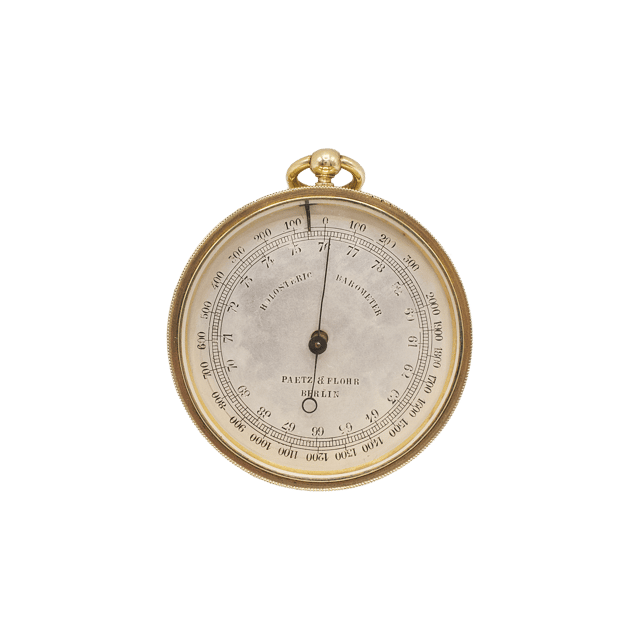
The company Paetz & Flohr (Berlin) thus left a significant mark on the history of the opto-mechanical industry of the 19th and early 20th centuries. Founded around 1850, it became renowned as a producer of barometers, binoculars, telescopes, and especially medical optical instruments. The firm was awarded the title of royal purveyor and was repeatedly cited among Berlin’s leading opticians. Its instruments were distributed worldwide and today constitute valuable objects in museum and private antique collections. Although the company did not survive the upheavals of the First and Second World Wars, its name endures on vintage barometers, lorgnettes, and ophthalmological instrument sets—as testimony to a distinguished era of Berlin optical craftsmanship.
Sources
This study draws on historical Berlin address books (www.heimat-der-vorfahren.de), museum materials and auction catalogues (for example, descriptions of trial lens sets bearing the Paetz & Flohr mark, and information on the early ophthalmoscope of 1853, as well as memoirs and writings of 19th-century ophthalmologists (including references by F. C. Donders and others ). These sources confirm the firm’s date of foundation and scope of activity, the evolution of its addresses, its status as royal purveyor, and documented examples of instruments bearing the Paetz & Flohr name.