Loading
__96343e44.png)
The history of the enterprise is based on S.G. Tikhonov’s book Defense Enterprises of the USSR and Russia. Vol. 1, Moscow, 2010.
OKB-3 of Plant No. 133 (2nd MPI)
was a design collective known, at different times, under a whole series of names by which one can read the biography of the entire sector: ; then (, i.e., State Special); later — a (Main Committee for Aviation Technology) at Plant No. 133; after which it acquired the resonant name ; later (); in correspondence it hid behind the index ; in the 1990s it became an (open-type joint-stock company) and then
Its addresses are also milestones of history: Moscow, 105318 (105058, E-58), E-318, 19 Tkatskaya Street, next to Cherkizovo station of the Moscow Belt Railway, P.O. Box 2347 “Saga”; later — again Moscow, 105318, 19 Tkatskaya Street.
The birth of the bureau is fixed by a dry line of Order No. 431s of 14 July 1944: to form an OKB at Plant No. 133 of the NKAP (People’s Commissariat of Aviation Industry) by merging personnel from various enterprises engaged in aneroid-membrane, tubular, and bellows instruments, within the orbit of the 5th Main Directorate of the NKAP. Behind this phrase stood the post-war concentration of experience and skilled hands — an attempt to gather the schools of precision mechanics scattered across the country into a single “heart.”
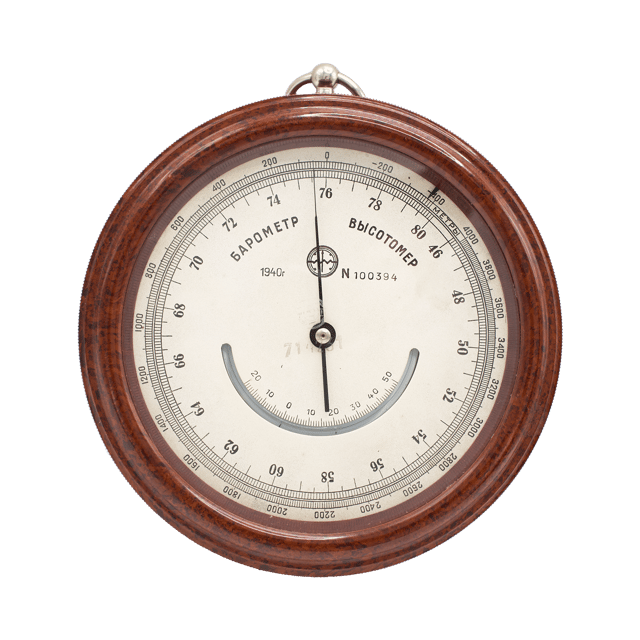
Already in OKB-3 of Plant No. 133, MAP was transformed into an independent , and in it received the status of (a bureau) — a sign of special responsibility and closed subject matter. The logo that can be found on OKB-3 instruments is very likely tied to its aneroid-membrane production: a represents the at the core of barometers and altimeters; a is the indicating hand of any measuring instrument; both are encircled by and a , plausibly imitating a . Another variant places the emblem within , with a small below.
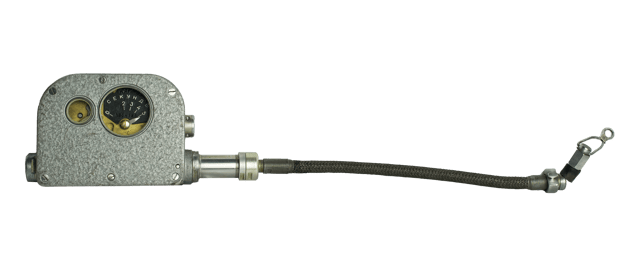
Immediately after the war the bureau’s agenda included what is directly tied to human life: the development of parachute activation devices. In the mid-1940s the team brought, to the technical standards of Plant No. 118, MAP, a barometric altitude corrector from the German autopilot “F-1” — clear evidence of work with trophy technology and an example of its rapid adaptation to Soviet flight-safety standards.
From the bureau was transferred to the , and confirmed its subordination to the GKAT’s 4th Directorate. In received a new name and public identity — In it worked under the , and by under the . Correspondence from carries the cipher indicative of the sector’s characteristic secrecy.
From 1955 the bureau had a Kharkov branch (operating at least until 1987) at Plant No. 157: there the work focused on altimeters and sensors — everything that forms an aircraft’s “sense of altitude.” The Council of Ministers Decree No. 656-267 of 18 June 1960 records the team’s participation in the development of telemetry sensors for the D-6 missile complex — a step beyond aviation into rocketry.
After the bureau was renamed On it was transformed into an , and soon received its modern name In the enterprise entered the scientific-production center and later the concern. included it in the ; and placed it on the ; by operated under the .
The speaks for itself. In the it created , a , for general aviation, , , and . By the enterprise not only designed but also : , , , ; in parallel it produced , , and .
Behind the figures are people. In the bureau employed people; by —about . : (July 1944–1959), (1959–1986), (1987–2005). In First Deputy Chief Designer was , with as deputy. At various times the team was led by ; served as General Director in , with as First Deputy in ; the classified section was headed by in .
the , , , an entire family of ; the ; various ; and for the ; ; . In lines — , , . In lines — for , for , , , . For — for the . In — and , and also the . is marked by the of the landing system for the and for spacecraft. includes , , ; the — for the , for the , and the on the windscreen.
Second Moscow Instrument-Making Plant
OJSC “Second Moscow Instrument-Making Plant” (2nd MPI)—the base on which OKB-3 was organized—appeared by State Defense Committee decree in the harshest years of the Great Patriotic War, when the front needed high-precision flight-navigation instruments and sensors. Early Moscow addresses are likewise memorable: until 1947 — 17 Bolshoy Bozheninsky Lane, Vorobyovy Gory station; later — 17 Rossolimo Street, “Krylo” (postal code 119019, G-19).
The plant’s roots lie in the , organized in on the site of the evacuated . and formalized the next step: on the basis of the workshops to form for the . The plant itself was initially formed in , carved out of the evacuated , and in it was transferred to . After the war, it was here that began — a theme that would become the enterprise’s calling card.
From Plant No. 133 was subordinated to the , then by transferred to the , appearing in documents as confirmed the current name — ; in the plant was placed under the , in — under the ; a cipher appears. The plant took part in creating the , and in had and branches.
By the end of the twentieth century the plant’s catalog included: , , , , as well as . The reforms of the followed the industry-wide scenario: by the state enterprise was transformed on into a ; included the plant in the . brought the OJSC into the contour of the (now ), while and confirmed inclusion in the ; by the plant operated under .
In the the produces of products for aviation and missile technology; in practice it is hard to name a type of aircraft where its products are not found. Its core mission is . Even before the war, the developed a with preset delay; after the war the plant set up mass production of improved devices, giving airborne troops a tool for and real life protection. In the late plant designer created , an device that sharply expanded the task set. With the advance of came the demand for special ; crucial elements of that system — and the — were also made here. Over decades, the of these devices became decisive in saving .
The numbers show the scale: in the plant had ; the headcount was , by — , and on — . The enterprise was headed, at various times, by (from July 1942), (1943–1947), (director in 1987; general director in 2000 and 2003–2004), and (general director in 2003). in May 1946 was . In the classified section was headed by , and in marketing was led by .
The product line was large and distinctive. The enterprise produced , including , the (since 1945), and parachute devices, , , , fuel-delivery and manifold-pressure instruments — , as well as . In the list included , , , , , the and ; ; , ; a wide range of — ; — ; the for the ejection seats (2004); ; as well as .