Loading
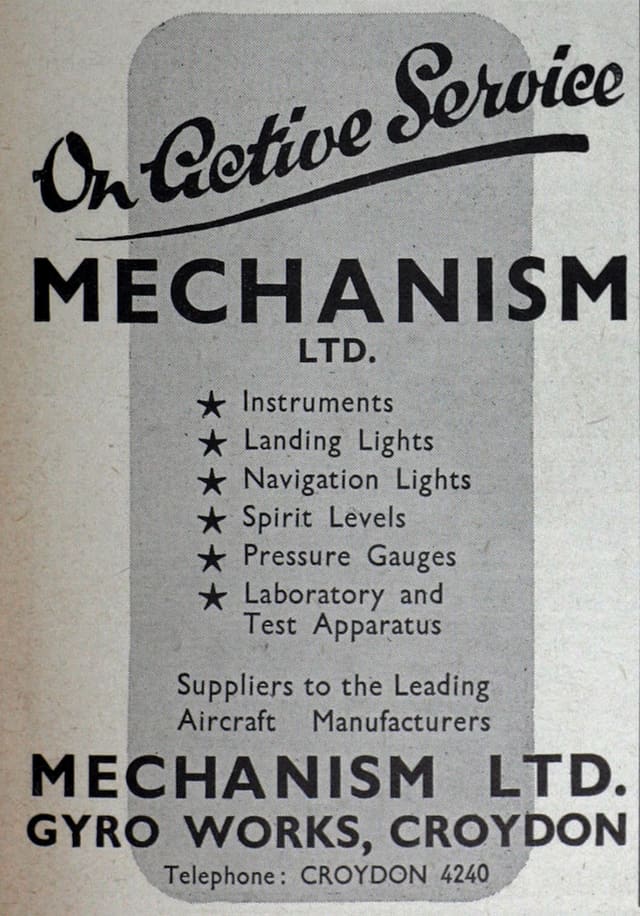
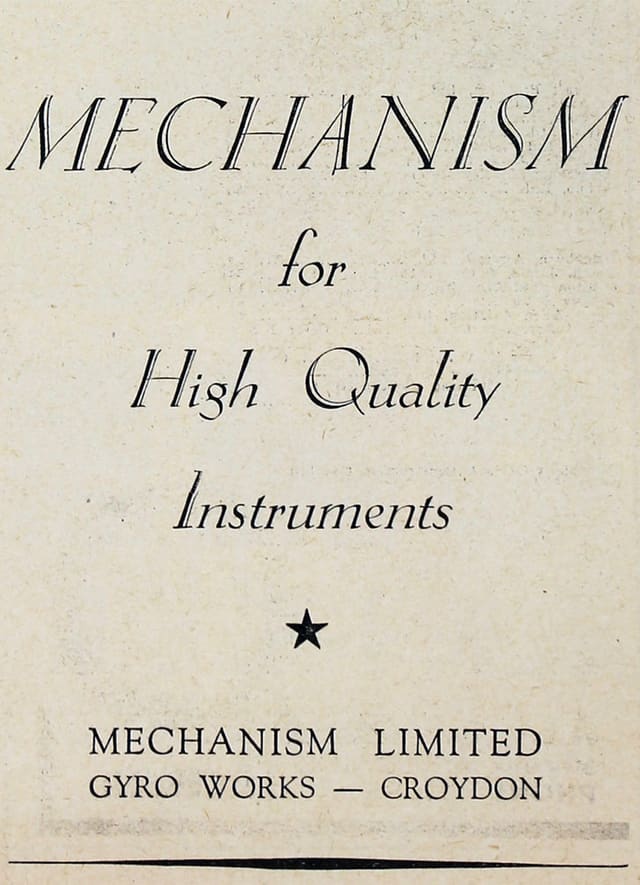
Mechanism Ltd was a British company from Croydon (Surrey), specialising in scientific instruments and aviation devices. The company was founded in the early 1930s and was originally known as Makers Mechanism. Its first years were connected with the production of aircraft instruments and on-board lighting systems: as early as 1933–1937 aviation journals were already carrying advertisements for “Mechanism of Croydon – Precision Aircraft Instruments & Lights” (precision aircraft instruments and lights). The headquarters were located at the Gyro Works factory at 6a George Street in Croydon – this name can be seen in advertisements of the time (“MECHANISM LTD., GYRO WORKS, CROYDON” and the telephone number Croydon 4240). In the 1960s the company moved to 73–77 Lansdowne Road, Croydon, where it continued to operate until the mid-decade. According to the Science Museum, Mechanism Ltd traded at this address roughly between 1960 and 1965.
From its foundation, Mechanism Ltd developed and manufactured a variety of precision instruments, primarily for aviation and military needs. In the 1930s the firm became known for its DEMEC series navigation lamps (for aircraft) and a range of aviation indicators. For example, its runway and navigation lights are known from advertisements of 1934–1936. During the Second World War Mechanism Ltd produced instruments under contract to the British Air Ministry. Surviving examples include an aircraft clinometer (inclinometer) dated 1940 with Air Ministry markings. This instrument was intended to control the bank angle of an aircraft or ship; it was supplied in an individual wooden case and was used by the Royal Air Force during the war. The company also produced airspeed indicators, altimeters and other on-board instruments.
After the war the firm continued to develop precision analogue measuring equipment. High-accuracy aneroid barometers occupied a special place in its range. In addition, in the 1950s–1960s Mechanism Ltd took part in innovative projects for military and scientific purposes. For example, in cooperation with the Royal Aircraft Establishment (RAE Farnborough) the company produced experimental instruments for monitoring aircraft loading. One of these was an Aircraft fatigue meter, Type M1829, designed by the RAE and manufactured by Mechanism Ltd around 1957. This instrument was installed on aircraft (such as English Electric Lightning fighters) to record accumulated loads in order to assess structural fatigue. It is also known that Mechanism produced aircraft instruments for measuring speed in Mach numbers – for example, the Machmeter Mark 3A (Ref. 6A/3300) for jet aircraft, probably commissioned by the Ministry of Supply or the RAF. Thus, by the early 1960s the company had substantial experience in designing precision mechanical and electromechanical devices (gyro instruments, altitude, pressure and g-load indicators, etc.).
In the mid-1960s Mechanism Ltd even showed prototypes with electronic components at air shows. At the Farnborough Air Show in 1964 the company presented a servo-driven precision aneroid barometer with digital indication. In this experimental device the pressure sensor was coupled to a servomotor that continuously adjusted to pressure changes: the contacts made and broke in a cycle, and the motor shaft drove a decade voltage selector connected to five digital indicator lamps. In this way the pressure was displayed in digital form on electronic indicator tubes, and the instrument could transmit readings remotely. Such developments showed Mechanism Ltd’s ambition to combine mechanical sensors with electronic indication in order to improve accuracy and ease of reading.
Mechanical digital aneroid barometer
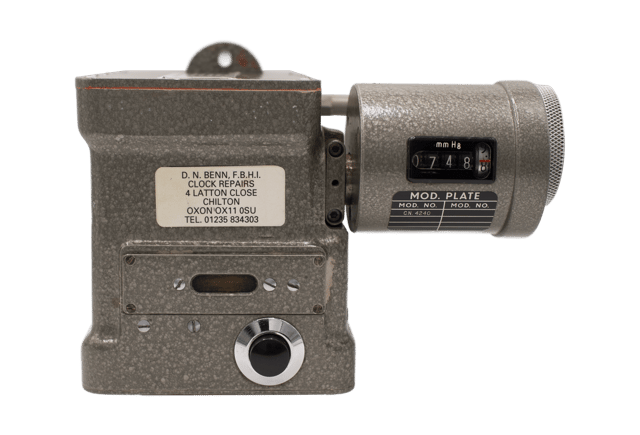
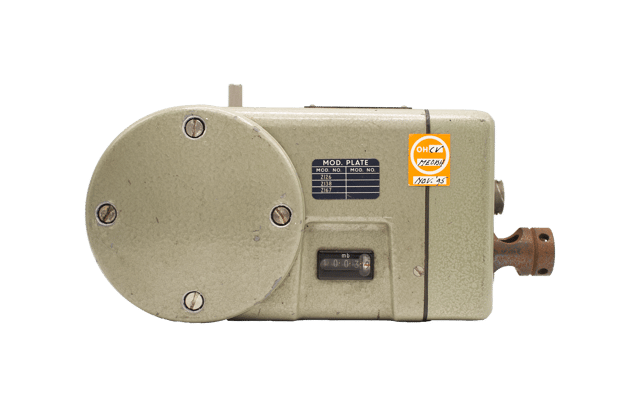
One of Mechanism Ltd’s best-known products was a precision aneroid barometer with mechanical digital indication, manufactured in the early 1960s. The British Patent Office granted the company two key patents: no. 816,073 (application filed in 1955, patent published in 1957) and no. 848,172 (c. 1960). Foreign patents were also obtained – Swiss no. 342,011 and Swedish no. 175,657 – which confirms the originality of the design and its potential export appeal.
The first series-produced precision aneroid by Mechanism Ltd appeared around 1962. Several modifications were developed in the 1960s. They differed in details: possibly in range (for example, for higher-altitude measurements), the number of capsules (2 or 3), case design (for marine use or for aviation), etc. Judging by archival numbers, one model bore the designation Type M1991/A (presumably the first version, around 1962), and another – M2016/A. These codes appear in catalogues and on the instruments themselves. An example from the collection of the University of New South Wales is marked Model: Type 2016, Serial No. 271/61 (i.e. no. 271, produced in 1961) and refers to patents GB 816,073 and CH 342,011, which confirms its belonging to this series. According to other data, the M1991/A model was the direct predecessor of later Negretti & Zambra instruments and had the same characteristics.
Each instrument was supplied in a sturdy portable wooden case with a set of accessories and instructions. A brief operating guide was usually fixed to the inside of the lid. For example, the instructions required the instrument to be set strictly level, the air vent to be opened, then the button or toggle switch to be held in the ON position (closing the power circuit) and the micrometer knob to be turned smoothly until the “magic eye” changed its glow. After that the button was released and the pressure reading was taken from the digital display. Tables or guidance for applying corrections (for temperature, height above sea level, etc.) were provided to convert readings to standard conditions. According to surviving manuals, Mechanism Ltd barometers were calibrated to give pressure reduced to mean sea level (the altitude of the site could be entered using an adjustment scale).
It is worth noting separately that similar instruments were later produced under the Negretti & Zambra brand – for example, the N&Z M2236. Its manual (1970s) confirms the same operating procedure.
Use of the instrument in aviation and at sea
Precision aneroid barometers by Mechanism Ltd found application in both military and civilian spheres – wherever portable, accurate and reliable atmospheric-pressure instruments were required. The main areas of use were: *Aerodrome meteorological services and aviation *The Royal Navy and merchant fleet *Height determination and ballistics *Calibration work and scientific measurements.
In essence, this instrument was a forerunner of modern digital barometers and was far ahead of its time, using electro-mechanical “digital” indication.
Cessation of activity and succession (Negretti & Zambra)
By the late 1960s Mechanism Ltd ceased to exist as an independent company, becoming part of a larger instrument-making group. Historical archives indicate that around 1968–1969 the business of Mechanism Ltd was taken over by Negretti & Zambra, the oldest British manufacturer of meteorological and aviation instruments. In the 1970s a subsidiary, Negretti & Zambra (Aviation) Ltd, was established in Croydon on the basis of the absorbed company, inheriting Mechanism Ltd’s designs, staff and production facilities. Internal Negretti & Zambra documents contain correspondence and reports related to the integration of Mechanism Ltd, including staff lists and financial figures for the ten years prior to the merger. These suggest that the process of full integration took several years and was completed by the mid-1970s.
After the merger, Mechanism Ltd’s technical legacy was preserved and further developed under the Negretti & Zambra name. In particular, the unique precision aneroid barometer did not disappear – N&Z released updated versions of it. The Negretti & Zambra M2236 model is known – essentially the same mechanical digital barometer, brought to full-scale production in the 1970s. Structurally it was almost identical: the same odometer-type mechanism, green indicator, accuracy of 0.1 mbar and battery power. Negretti & Zambra distributed these instruments worldwide; instructions and service bulletins survive for the M2236 and related models (M2237, M2238 – modifications with altitude switches). In addition to barometers, N&Z (Aviation) inherited from Mechanism the line of aviation instruments. For example, the Negretti & Zambra catalogue included similar fatigue meters for jet aircraft and other developments that had previously carried an “M…” index. It can be concluded that the takeover enriched Negretti & Zambra with Mechanism Ltd’s technologies and enabled the production of modern instruments for aviation.
Official sources (the Science Museum Group archive) state explicitly that in the 1970s Negretti & Zambra (Aviation) Ltd was established in Croydon after the acquisition of Mechanism Ltd. Thus, N&Z became the successor in most areas of the company’s activity. Indirectly this is also confirmed by the fact that in the 1980s Negretti & Zambra continued to manufacture the Precision Aneroid Barometer Mk I for the UK Meteorological Office – for example, a 1981 N&Z instrument in a metal case virtually repeats the Mechanism Mk I design.
In conclusion, Mechanism Ltd left a noticeable mark on the history of instrument-making. From its beginnings in the 1930s as a small manufacturer of aircraft instruments it progressed to becoming the creator of an innovative mechanical “digital” barometer that was ahead of its time. Its products served the RAF, the Royal Navy and scientific expeditions, and their accuracy was confirmed in practice. Although by the 1970s the firm no longer existed independently, its designs continued to live under the Negretti & Zambra brand, ensuring continuity of technology and expertise. Today Mechanism Ltd instruments can be found in museum collections – for example, the London Science Museum holds “Precision Aneroid Barometer Mk I, Mechanism Ltd, 1963” (inv. no. 463/63), and the National Maritime Museum in Greenwich holds a Type M1991 instrument from 1962 with a complete documentation set. These rarities recall the golden age of British instrument-making and the engineering heritage of a small but outstanding company from Croydon.
Sources: museum reports and catalogues (Science Museum, RMG Greenwich), the Negretti & Zambra company archive, patent data, the company profile in Rochester Avionic Archives, and digitised materials from military collections and private holdings (announced instruments, advertisements and technical descriptions). These sources confirm the facts presented and the description of the instrument’s design.