Loading
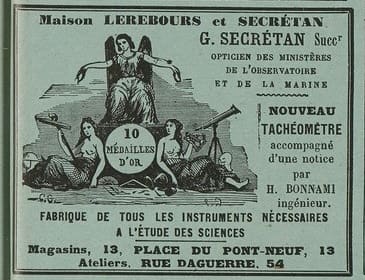
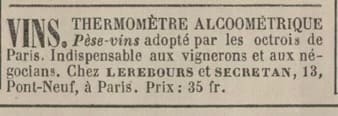
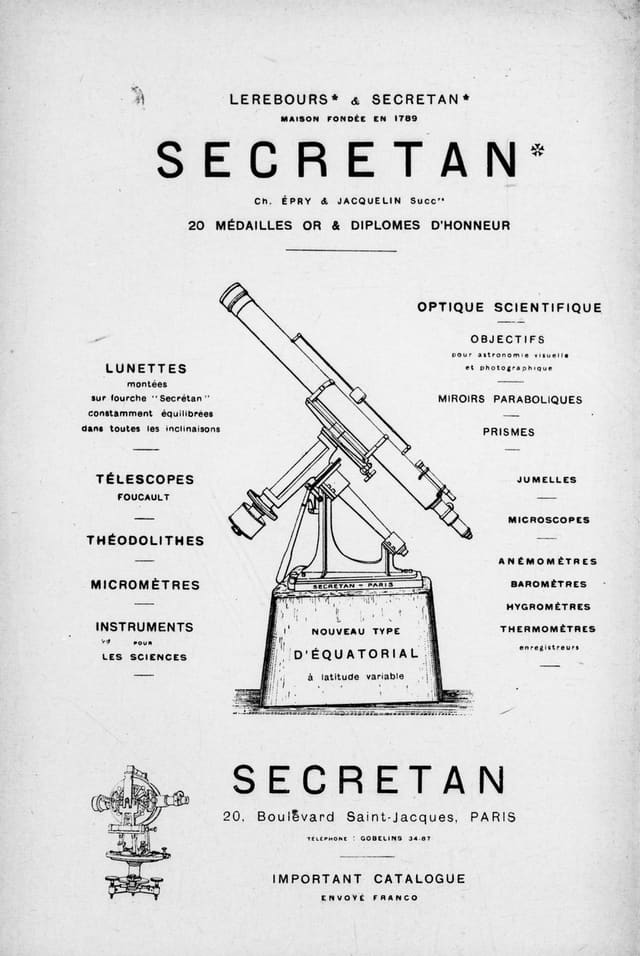
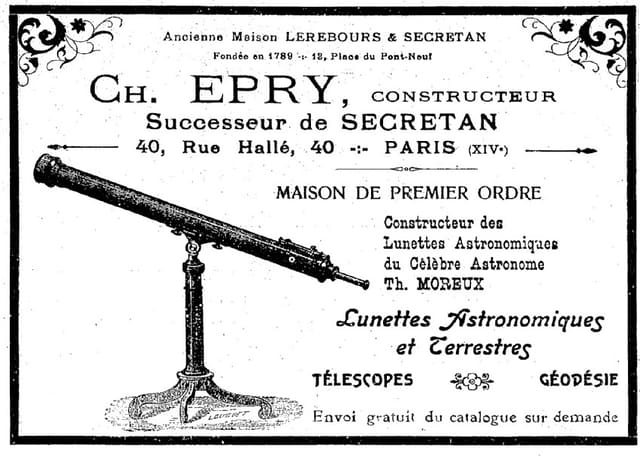
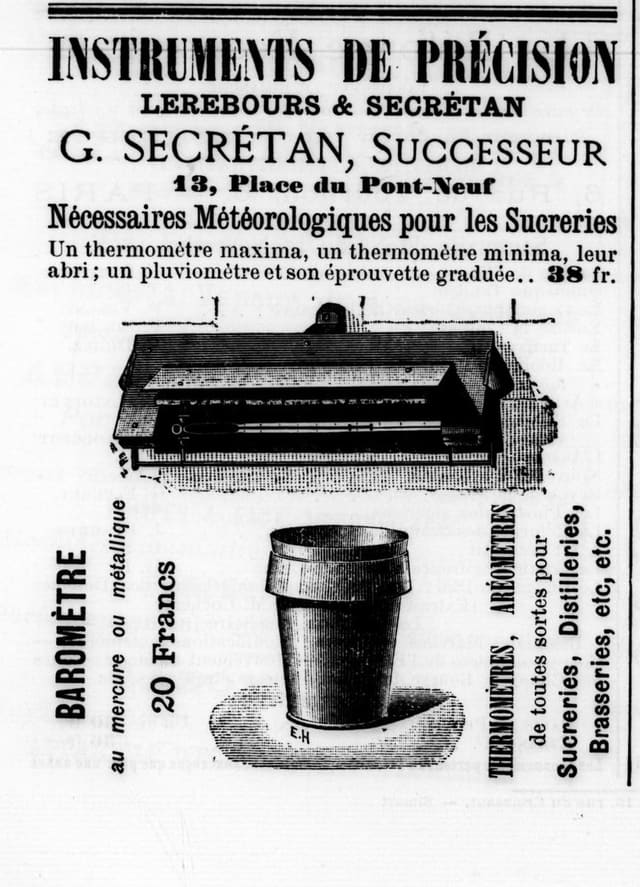
Lerebours et Secretan was one of the leading French firms manufacturing scientific and optical instruments in the nineteenth and early twentieth centuries, based in Paris at 13, Place du Pont-Neuf (formerly Quai de l’Horloge). It is known above all for its high-quality lenses, microscopes, telescopes, photographic apparatus, and geodetic instruments, but it also manufactured and sold meteorological instruments, including both mercury and aneroid barometers.
The firm Maison Lerebours & Secretan was founded in 1845 by Noël-Marie Paymal Lerebours and Marc François Louis Secrétan in Paris, France. The company produced mathematical, optical, and philosophical instruments and enjoyed a very high reputation for the quality of its optical lenses.
Lerebours et Secretan was the product of a long line of Parisian instrument-making, growing out of an optical shop of the late eighteenth century and developing into a workshop and commercial house for scientific instruments serving astronomy, geodesy, navigation, and meteorology.
The history of Lerebours et Secretan in the nineteenth century begins long before the appearance of the double name itself: official inventories and reference sources trace the “house” directly back to an optical shop founded in 1789 in the center of the capital.
Noël-Jean Lerebours
The key figure in the early history of the firm was Noël-Jean Lerebours. Noël-Jean Lerebours (1761–1840) came from a modest family in the town of Mortain, Normandy. At the age of twelve he arrived in Paris as an apprentice to a spectacle maker, and later worked for Louvel, a supplier of optical goods to Parisian craftsmen. In 1789—the year of the French Revolution—he opened his own workshop at 69, Quai de l’Horloge, and subsequently moved to Pont Neuf. After obtaining the title of Ingénieur Breveté (Patented Engineer), Lerebours quickly established himself as one of the leading opticians in Paris.
He gained recognition at an early stage for the exceptional quality of his telescopes, although at the beginning of his career he also manufactured mathematical instruments. Lerebours succeeded in producing achromatic objectives that surpassed their English counterparts in quality. Instead of the traditional three-lens construction, he employed only two lenses, resulting in brighter and clearer images. He also produced large-aperture achromatic objectives in which the lenses were no longer cemented together with mastic. In 1789, following his very first presentation before the Academy's commission, he was appointed a certified engineer to the King. In February 1793 he received a national award of 5,000 livres. After 1800 his reputation grew rapidly. He became Optician to the French Navy and to the Bureau des Longitudes. In 1804 he was appointed Optician to the Emperor (Opticien de l’Empereur), and later Optician to the King. He was made a Chevalier of the Légion d’Honneur and served as an official supplier to both the Paris Observatory and the French Navy.
In August 1786, Noël-Jean Lerebours married Marie-Marthe Legat. He later took under his protection Noël Paymal, the son of an unmarried woman, and formally adopted him in 1836. Following the adoption, Noël Paymal added the surname Lerebours to his own, and Noël-Jean Lerebours designated him as his sole heir. Upon Lerebours' death in 1840, it was his adopted son who continued the family business.
Lerebours published several catalogues of his products, in which optical instruments occupied the central place. He manufactured both refracting and reflecting telescopes, and his largest objective lenses—including a 15-inch objective with an f/8 focal ratio—were supplied to the Paris Observatory. His achromatic telescopes, fitted with mahogany bodies and brass drawtubes, were sold at prices ranging from 80 to 400 francs, depending on their length. He supplied Étienne Lenoir with achromatic telescopes fitted with uncemented doublet objectives, which were incorporated into Lenoir's geodetic and navigational instruments. He also produced an 11 cm telescope for Napoleon. In addition, Lerebours supplied objective lenses to other opticians and manufactured telescopes, microscopes, barometers, octants, sextants, balances, compasses, and a wide range of other scientific instruments. Barometers—specifically mercury barometers—were already listed in the firm's 1809 catalogue.
Lerebours received an exceptional series of the highest distinctions at the French Industrial Exhibitions, being awarded gold medals in 1819, 1823, 1827, 1834, 1839, and 1844. The jury report of the 1823 exhibition famously declared: "Rien de plus parfait n’est certainement sorti des ateliers d’aucun opticien" ("Certainly nothing more perfect has ever come out of the workshops of any optician.").
Noël Marie Paymal Lerebours
Noël-Marie Paymal Lerebours, the adopted son of Noël-Jean, was born in Paris on 16 February 1807. His mother, Marie Jeanne Françoise Paymal, was unmarried, and the identity of his father was never revealed.
On 5 March 1836, Noël-Jean Lerebours designated Noël Paymal as his sole heir. On 11 June 1836, Noël-Jean Lerebours formally adopted Noël Paymal as his legal son. Shortly thereafter, in July 1836, Paymal legally changed his surname to Lerebours: “Par requête adressée à M. le garde des sceaux, M. Noël-Marie Paymal, majeur, opticien, demeurant place du Pont-Neuf, n. 13, à Paris, est autorisé à joindre à son nom celui de Lerebours”.
Noël Paymal Lerebours married the widow Renée Madeleine Colas, who already had children, on 11 July 1850. In 1853 they moved into a house on rue Newton.
Noël-Marie Paymal Lerebours was one of the early practitioners of photography and quickly understood its commercial potential. By 1839 he was already building large daguerreotype cameras capable of producing large images. He established his own enterprise in Paris, manufacturing optical, physical, and mathematical instruments. He supplied a number of artists and writers with his daguerreotype equipment and commissioned them to photograph various places around the world. In addition, he received daguerreotype images of different places from other daguerreotypists. Over time he assembled a large collection of daguerreotypes, part of which he published in several volumes. In 1840 he introduced a quarter-plate camera designed specifically for portrait photography. It was fitted with either single or double achromatic plano-convex lenses of very short focal length. Such a camera could produce a portrait in only two minutes.
In 1843, Lerebours published the photographic manual Traité de Photographie, the work on electrotyping Traité de Galvanoplastie, and also a French translation of Andrew Pritchard’s 1832 Microscopic Cabinet.
In 1845, Noël Marie Paymal Lerebours entered into partnership with Marie Louis François (Marc) Secrétan, a mathematician from Lausanne who had moved to Paris in the mid-1840s, thereby founding the firm Lerebours et Secretan, which continued to exist until 1955.
This was the period of greatest flourishing: the firm produced microscopes, including Raspail and Amici models and the large “Microscope d’une Grande Dimension”, solar microscopes, telescopes, levels, polariscopes, gyroscopes, photographic lenses and cameras, and geodetic instruments. In 1853, the detailed catalogue Catalogue et Prix des Instruments d’Optique, de Physique, de Chimie, de Mathématiques, d’Astronomie et de Marine (244 pages) was published, including sections devoted to meteorology (barometers, thermometers, etc.).
Noël Paymal Lerebours withdrew from the optical business in 1854 at the age of 47, having by then invested heavily in real estate. He used the property inherited from his adoptive father to acquire a large number of plots and buildings. In this way he accumulated considerable wealth.
After the departure of Noël Paymal Lerebours, the firm Lerebours & Secrétan, which had existed from 1845 to 1854, continued its activity. In 1855 the firm received a first-class medal and a Medal of Honor at the Paris Universal Exhibition.
Marc Secrétan
Marc Secrétan was born in 1804. He initially received a legal education and practiced for some time as a lawyer. However, his growing interest in mathematics led him in 1834 to become “Capitaine du génie pour le Canton de Vaud” (“captain of engineering for the Canton of Vaud”), and in 1838 he was appointed Professor of Mathematics at the Académie de Lausanne.
Marc Secrétan was married twice: first to Suzanne Louise Mercier of Lausanne, with whom he had six children, and later to Lazarette Moncharmont, whom he married in 1858.
From 1855, Marc Secrétan became the sole owner. The firm continued to operate for decades under the name Lerebours et Secretan (or Maison Lerebours et Secretan / Secretan).
The outstanding engineer-mechanician William Eichens served as director of the company and head of the workshop. In 1860, Paul Gautier entered Secrétan’s service under Eichens’s supervision. In 1866, Eichens left the firm to found his own company, and Gautier left to work with him.
Marc Secrétan collaborated closely with Léon Foucault in order to develop and bring to market a reflecting telescope based on the silvered-glass parabolic mirror proposed by Foucault.
From June 1861, Marc Secrétan brought his son Auguste-François Secrétan into the business, appointing him manager of the optical workshop and shop at Pont-Neuf, while he himself later returned to Switzerland, handing over full management of the enterprise to his son. Marc Secrétan died in Lausanne on 28 June 1867. After Marc’s death in 1867, Auguste inherited the business, but died young in 1874, the same year as Noël Paymal Lerebours. Management was then entrusted to Marc’s nephew and Auguste’s cousin, Georges Emmanuel Secretan, a teacher from Lausanne and one of the founders of the Société Astronomique de France in 1887. He managed the business successfully until his death in 1906. His son, Paul-Victor Secrétan, inherited the optical business.
In 1911, the family sold the enterprise to Charles Épry, who in 1913 entered into partnership with Gustave Jacquelin (1879–1939). Together they managed the firm as the “sole successors” of Lerebours & Secretan.
In 1934, the firm Georges Prin, successor to Paul Gautier, who in turn had succeeded William Eichens, became part of Lerebours & Secretan.
The company Lerebours & Secretan continued to exist and remain active until 1955.
Products and Specialization
Official inventory texts and regional cultural heritage surveys define the profile of the house in the broadest possible terms: the firm “manufactures instruments of optics, physics, astronomy, and maritime use.” This definition is extremely important, because it accurately reflects the true nature of the enterprise. It was neither a shop selling isolated objects nor a narrowly specialized factory. Lerebours et Secretan functioned as a hybrid of shop, workshop, laboratory, publishing center, and supplier to scientific and state institutions.
Independent dictionaries of scientific instrument makers record the structure of the business as early as 1846–1850 as a combination of a commercial address at Place du Pont-Neuf and a separate atelier, that is, a workshop at another address. Exhibition awards are mentioned, including a gold medal at the industrial exhibition of 1849, as well as patent activity—for example the microscope-breloque, a pocket “microscope pendant.” All this shows that the firm was not merely selling objects, but was genuinely designing, refining, and introducing its own types of instruments to the market.
If one schematizes its range of products on the basis of catalogues, museum descriptions, and specialist historiography, the house operated simultaneously in several major markets. First and foremost came optics and astronomical instruments. In its later phase, under the name Secrétan, the firm was associated with the production and commercialization of large astronomical instruments and telescopes; studies of the Foucault-Secretan reflecting telescope make it clear that this was not a matter of simple resale, but of real engineering projects.
The second major field was geodesy, topography, and engineering measurement. Here the formula frequently encountered in catalogues and instrument descriptions is especially telling: Maison … / magasins … / ateliers …. This is the typical formula of a manufacturer who combined trade and manufacture and worked simultaneously for the private market, engineering corps, military services, and state institutions.
The third area was microscopes and laboratory physics. Here the combination of “instrument + literature” is especially revealing. The books and manuals of Noël Paymal, including his repeatedly reissued guide to microscopes, were published under the name of the house and at the same time served as technical descriptions of the range, educational manuals, and a subtle form of advertising. The house did not simply supply the instrument — it shaped the culture of its use.
The fourth market was photography, one of the most important technological fields of the 1840s. According to the Musée d’Orsay, Noël Paymal’s workshop on the Île de la Cité was one of the Parisian footholds of early photography. He published Excursions daguerriennes and took part in the formation of the first photographic communities. For the history of the company, this matters not for the sake of an attractive anecdote but in substance: the firm worked with lenses, glass, precision mechanics, image chemistry, and technical printing, placing it at the very center of the technological culture of its age.
The house had its own workshops; it polished lenses, assembled instruments, and supplied them to observatories, the navy, military services, and scholars. Lerebours lenses were sometimes even resold by British firms under their own name, which in itself is an eloquent indication of the international level of their quality.
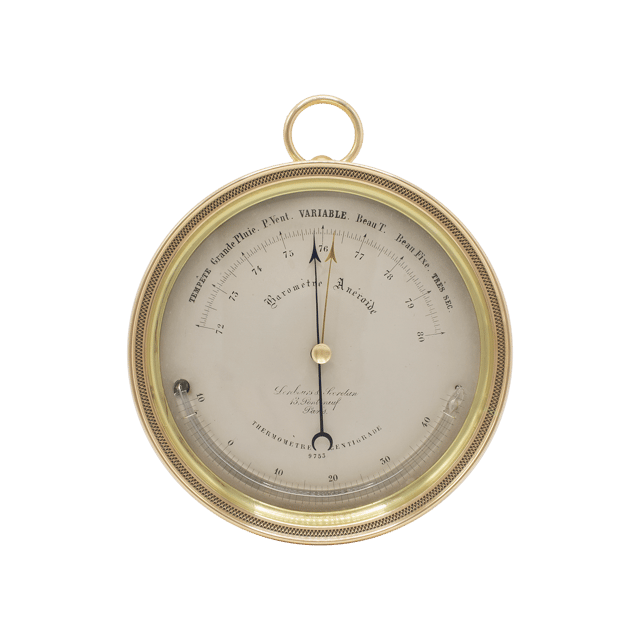
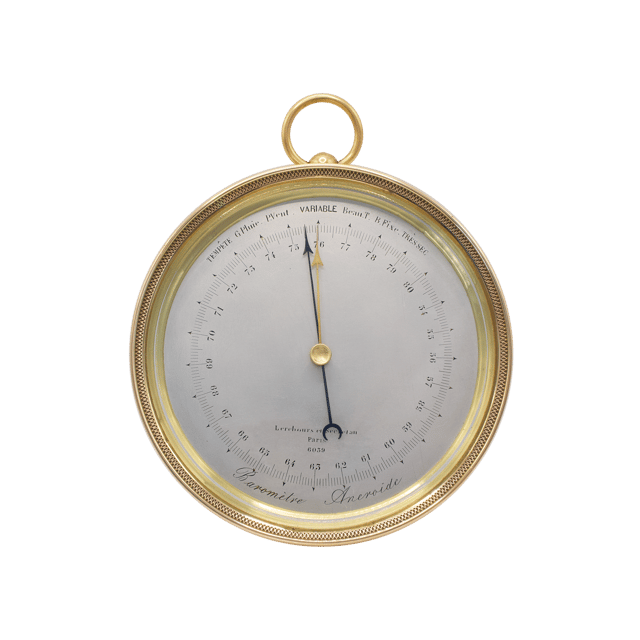
Barometers by Lerebours et Secretan
Meteorology occupied a very visible place in the activities of Lerebours et Secretan. Even before the appearance of fluidless barometers, the firm was producing high-quality mercury instruments, and scientific literature of the mid-nineteenth century repeatedly uses the phrase that a given mercury barometer employed for observations “was constructed by MM. Lerebours et Secrétan.” For the researcher, this is an extremely important nuance: the barometers of this house were not merely goods on display in a shop window, but were perceived by contemporaries as instruments emerging from the workshop of the house itself.
As for aneroids, their presence within the firm’s sphere of activity after the invention of the fluidless barometer in 1844 is confirmed by several independent classes of sources. First, there is the catalogue evidence: in the firm’s 1853 trade catalogue there is a section devoted to barometers, presenting both mercury and the new aneroid models. In the text of the catalogue there appears an important statement: aneroid barometers have now been adopted by the Imperial Navy. Such wording shows that the firm presented the aneroid not as a curious novelty, but as a serious instrument of maritime and technical application.
Second, there is the museum and registry level. The French state database Palissy/POP describes a nineteenth-century aneroid barometer and directly uses the term fabricant, that is, manufacturer, in relation to Lerebours et Secretan. In museum practice, this is a strong signal: such a designation is generally not given to a casual seller or a simple reseller. At least some of the known aneroids bearing this signature are perceived and catalogued precisely as products of the house.
Third, there is the market and collecting sphere. Auction descriptions record lots with direct markings of the type: “Aneroid barometer … LEREBOURS & SECRETAN 13 Pont Neuf Paris.” In the same way, museum and private collections outside France also preserve objects marked “Lerebours & Secretan, 13, Pont neuf, Paris,” including cased aneroids. This demonstrates the stability of precisely such a signature as a firm mark and indicates the house’s systematic presence on this market.
Finally, there is the evidence of periodical literature. In L’Argus des Théâtres, 30 August 1851, in M. Poitevin’s article “Ascension du ballon le Zodiaque,” a balloon ascent in Paris is described. The author writes that he prudently took with him an aneroid barometer, “without which an aeronaut should never set out on a journey,” along with other physical instruments, and explicitly states that these instruments had been kindly provided by Messrs. Lerebours et Secretan. What matters here is not only the presence of the aneroid, but the very context of its use: the firm appears linked to real contemporary practice — not merely cabinet science, but field, technical, and even adventurous use.
Even more revealing is the text published in the illustrated journal Journal pour tous, issue no. 11 of 16 June 1855. In a popular explanation of the operating principle of the new instrument, one reads directly: “Dans le baromètre anéroïde, construit par MM. Lerebours et Secretan…” — “In the aneroid barometer constructed by Messrs. Lerebours and Secretan…” The article then goes on to describe the operation of the metallic capsule, within which a vacuum has been created, and the mechanism by which its deformation is transmitted to the pointer. This testimony is of special value: it shows that in the mid-1850s French periodical literature perceived the firm not as a general seller of aneroids, but as the maker of a specific aneroid instrument.
Additional interest is provided by the biography of Lucien Vidie, written by Auguste Laurant in 1867. There it is mentioned that Vidie was well acquainted with the owners of Lerebours & Secretan and corresponded with them. In this correspondence, reflections on the mechanism of aneroid barometers are discussed, in particular the soldering of the membranes of aneroid capsules. In itself, this fact is not final proof that the house fully manufactured aneroid capsules in-house, but it clearly shows that the firm was involved in technical discussion of aneroid construction not at a superficial level, but at a professional one.
All known aneroids bearing the mark Lerebours et Secretan belong to the period of the partnership, that is, to 1845–1855, and use the Vidie model — both in its earlier form, most often with an external spiral spring, and in the subsequent arrangement with a C-shaped spring and rackwork, later also encountered in Breguet instruments. Some of these barometers carry serial numbers on the dial alongside the Lerebours et Secretan marking. This circumstance is highly significant. It suggests that the firm acted not merely as an official retailer, as Dent did in Britain, but rather as a manufacturer, or at the very least a licensed assembler, entitled to issue the instrument under its own name.
At the same time, ordinary branding was entirely typical of the period. Even very prominent opto-mechanical houses often placed their own names on specialized instruments, some of whose individual components may have been made outside the principal workshop. This did not make them mere resellers: such houses possessed their own workshops, qualified staff, a culture of precision mechanics, and the capacity to assemble, adjust, test, and release an instrument under their own responsibility. Therefore, the most cautious — and probably the most accurate — conclusion is the following: in the case of Lerebours et Secretan, both things were true at once. Some of the aneroids, especially those bearing serial numbers, were most likely assembled and issued by the house as its own products; others may have relied on outside sources for certain mechanisms or individual components, but nevertheless passed through the workshops and firm expertise of the house before reaching the market under the name Lerebours et Secretan.
Sources:
Main Biographical and Historical Sources on the Company
Sources on Barometers
Catalogues and Primary Company Documents
Additional Reliable Sources (confirmation of successors and products)