Loading
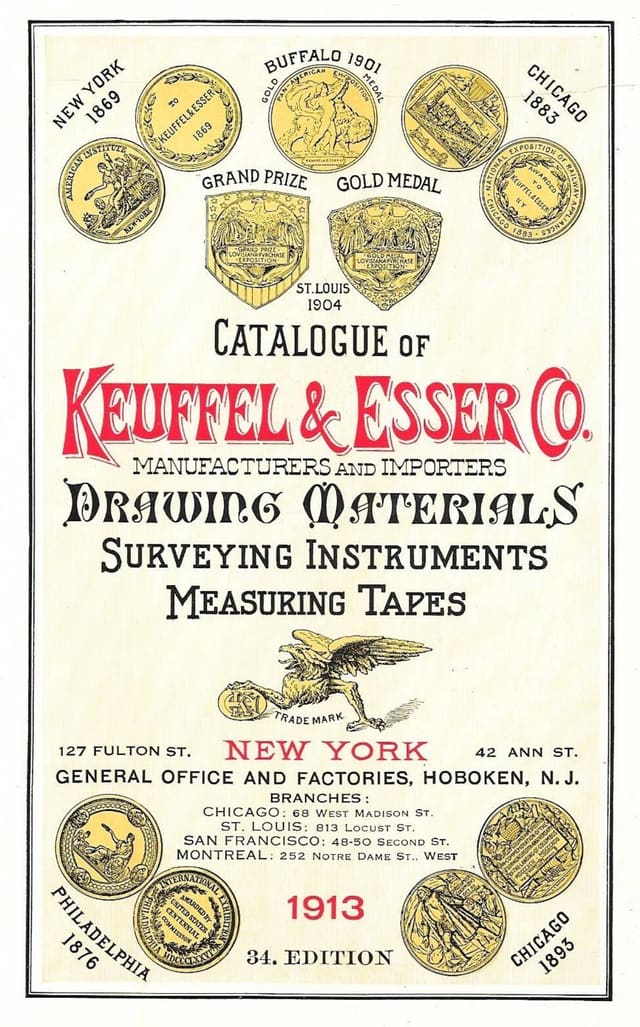
Keuffel & Esser (K&E) was one of the key American firms of the “analog” age of engineering: from drafting materials and surveying instruments to optics, reprography, and precision measurement systems. Its history is particularly well documented through three “skeletal” bodies of primary sources: the New York City Landmarks Preservation Commission report on the company’s Fulton Street building (as a concentrated corporate chronicle with addresses), the National Park Service nomination materials for the Hoboken industrial complex (as a production and urban-development chronicle), and the collections/publications of the Smithsonian Institution (as “material” evidence of the product line and its evolution).
Early K&E positioned itself as an importer and wholesale-retail supplier of European drafting and instrument goods for engineers and architects.
Foundation and the first decades in New York
The company began as a partnership between two German immigrants — Wilhelm Johann Diedrich Keuffel (1838–1908) from Walbeck, and Hermann Esser (1845–1908) from Wuppertal-Elberfeld) — who opened a business in New York on in 1867, starting with the import and “jobbing” (essentially wholesale distribution) of European materials and instruments for mechanical drawing and engineering practice. Their first proprietary products were hard rubber curves and triangles. This was the first American company fully specialized in drafting materials, mathematical and drawing instruments.
The early commercial focus was highly pragmatic: to sell “everything an engineer and architect might need” — from paper/ink/triangles to precision instruments — initially through direct sales (including visiting potential clients’ offices) and catalog trade. Already in the late 1860s, the firm advertised the breadth of its drafting materials and supplies for architects and engineers, and then rapidly expanded, moving between Manhattan locations as turnover increased. A clear trajectory emerges: “trade → own production → industrial base.”
By the 1870s, the firm had shifted from pure supply toward manufacturing selected items, while simultaneously developing showroom/retail spaces and forming what today would be called an “engineering ecosystem” — shop-showroom, catalogs, and reprographic/drawing-copying services.
The manufacturing turn: Hoboken and industrial infrastructure
The key step was the relocation of production facilities to Hoboken (across the river from Manhattan) at Third and Grand Street. Archival and preservation documents record that already in 1875–1876 the partners leased production space in Hoboken, subsequently constructing increasingly larger buildings — from the first structures and expansions of the 1880s to a large-scale factory complex.
A crucial detail explaining why Keuffel & Esser became more than just a store: in its Hoboken buildings the firm not only assembled/manufactured instruments but also developed the material infrastructure of engineering documentation. In particular, early production of blueprint paper is documented here — a technological consumable for copying drawings that would later grow into a major reprography division.
In 1875 the firm was incorporated as Keuffel & Esser Company. In 1876 it began selling surveying instruments, and from 1885 it started producing them in-house. In 1880 a three-story factory was built in Hoboken (corner of Third and Adams Streets), significantly expanded in 1887. By 1889 the partnership had evolved into a full corporation (Keuffel & Esser Company), registered in New Jersey.
In 1892–1893 the company built its famous 8-story showroom and office building at 127 Fulton Street in Manhattan (architects De Lomos & Cordes, Renaissance Revival style). This served as the main retail and exhibition center until 1961 (the building survives and was designated a NYC landmark in 2005). In 1902 Hermann Esser retired and sold his share to Keuffel, returning to Germany.
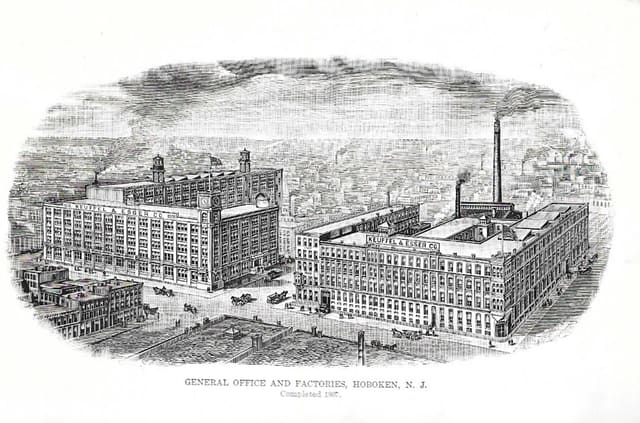
In 1905 a fire destroyed part of the Hoboken factory. The company engaged Turner Construction Company to build a new reinforced-concrete structure — one of the early and very large examples of such construction — featuring a distinctive clock tower. A new fully fireproof concrete building was completed (opened in 1907), occupying nearly half a block along Third Street (from Grand to Jefferson Street). It became the main production complex.
In 1908 both founders died (Keuffel in Hoboken, Esser in Germany). The company passed into the hands of Keuffel’s sons and sons-in-law (W. G. Keuffel, Carl M. Bergenau, and others). Expansion continued: branches opened in Chicago, St. Louis, San Francisco, Detroit, and Montreal (Canada).
In 1918 the company acquired Young & Sons (Philadelphia), another manufacturer of surveying instruments.
Product range and technological “niches”
Unlike many single-category manufacturers, K&E grew as a “universal supplier of engineering practice”: drafting materials, measuring instruments, surveying, reprography, and later optics and precision measurement systems. In the 1900s–1930s this led to explosive catalog growth: sources record thousands of items by the 1930s and further expansion thereafter.
A distinctive “signature” product line was slide rules. The National Museum of American History notes that in the United States K&E became a pioneer in the 1890s, first importing and then manufacturing straight slide rules domestically; parallel documents on the Hoboken complex and the company’s urban building indicate that American production began in 1891.
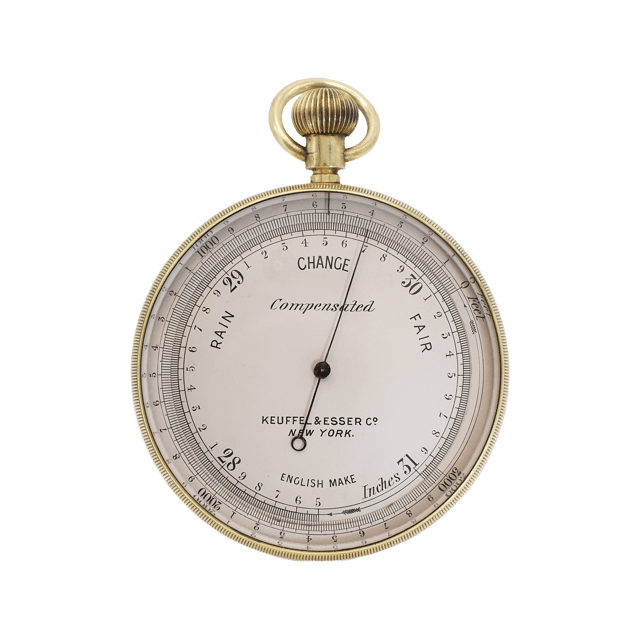
In the full 1909 catalog, K&E offered a range of aneroid barometers/altimeters in “watch pattern” and “pocket pattern,” including temperature-compensated versions, altitude scales (3,000–12,000 feet and higher), as well as separate “Surveying Barometer” and “Mining Barometer” models with vernier and rack-and-pinion mechanisms for precise altitude reading. In the same catalog section, pocket thermometers and recording instruments (barographs/hygrographs) appear alongside, demonstrating that Keuffel & Esser marketed a “meteorological set” as part of the engineer’s toolkit.
Museum collections in the United States confirm this line: a “Surveying Aneroid Barometer” bearing the name Keuffel & Esser, dated around 1900, appears as an artifact of field engineering practice, including mining.
Keuffel & Esser did not manufacture barometers itself, but imported and branded them under its own name — as it did with many other precision instruments (compasses, anemometers, etc.). Such barometers are widely represented in company catalogs under sections like “Barometers. For Measuring Altitude and Atmospheric Pressure” and “Surveying Instruments.” The company positioned itself explicitly as “Manufacturers and Importers.”
Government contracts, optics, and the “spider farm”
World War I radically reshaped the market for precision instruments in the United States due to the disruption of European supply, and K&E was among the firms that filled part of the technological gap. Hoboken records (NPS materials) indicate that during WWI the company produced a significant share of submarine periscopes for the U.S. Navy, as well as “fine control instruments,” including optical glass for such devices.
In World War II, the firm specialized in anti-aircraft rangefinders for army and navy use; optical theodolites with glass circles were developed for engineering units. These directions are essential for understanding continuity: by the mid-20th century, the company was no longer just about slide rules and compasses, but about complex opto-mechanical and measurement systems.
The most unusual aspect of its production culture was the so-called “spider farm”: breeding exotic spiders to obtain ultra-fine threads for crosshairs in sights and periscopes. This is documented both in the industrial history of the complex and in museum accounts of the Hoboken period. The “spider farm” (Mary Pfeiffer — the “Spider Lady”) operated from 1889 until World War II.
Late period and decline (1920s–1980s)
The company remained family-owned until 1965, when it went public on NASDAQ. By the 1960s, several thousand employees worked in Hoboken, and the total area of factories and offices exceeded 300,000 square feet. Its products were used in projects such as the Brooklyn Bridge, the Panama Canal, and expeditions to the North Pole.
From the mid-20th century onward, Keuffel & Esser increasingly shifted away from the image of a “draftsman’s supplier” toward industrial systems: sources note the creation in 1959 of a division working on optical, mechanical, and electronic systems for precision measurement of length and angles; at the same time, the firm began selling parts of its Hoboken factory buildings already in the 1950s.
What followed was a “geography of withdrawal” and structural reorganization. The company left its New York sales headquarters on Fulton Street in 1961; became a public corporation in 1965; and then moved its management/research center and production to New Jersey suburbs (variously documented as Morristown/Morris Township and Rockaway/Rockaway Township), with the final closure of its key Hoboken presence by the end of 1970.
The technological “shock” came in the 1970s: the engineering and design market shifted toward electronic calculators, CAD, and laser measurement systems. The K&E building report explicitly states that the company was forced to discontinue slide rule production, after which its assets began to be transferred to other firms from the early 1980s onward.
A symbolic “end of an era” was the transfer of the last slide rule produced by K&E to the Smithsonian Institution: the Computer History Museum records this as the “last slide rule,” manufactured on July 11, 1976, and presented to the Smithsonian.
The corporate finale unfolded in stages. A historical study of the founder notes the acquisition of the company by Kratos Corporation in 1981; a New Jersey archival guide records a Chapter 11 bankruptcy filing in 1982 and the subsequent breakup of the business, with different parts acquired by various companies, while the trademark and name ultimately became associated with AZON Corporation.
Significantly, the breakup included reprography: the U.S. Federal Register (NHTSA regulations) explicitly states that drawings/manuals formerly supplied by Keuffel & Esser were thereafter handled by Rowley-Scher Reprographics, Inc. — “as a result of the sale of Keuffel and Esser’s reproduction facilities to Rowley-Scher.” This provides independent governmental confirmation of the fragmentation of K&E assets in the 1980s.
Finally, from the AZON side, a corporate note tied to the exhibition “Analog City” at the Museum of the City of New York states that in 1987, through a series of mergers and acquisitions, National/AZON obtained the K&E brand and the rights to use the Keuffel & Esser name. Together with the New Jersey archival guide (which explicitly states that AZON owns the name and trademarks), this forms a consistent picture of “brand continuity without the original company”: the name survives as an asset, while the historical K&E ceased to exist as an independent manufacturer. Azon Corporation still owns the Keuffel & Esser trademark and name. The company continued producing drafting paper and film, but the classical production of precision instruments was discontinued.
Thus, Keuffel & Esser represents a classic example of 19th-century German-American entrepreneurship that dominated the niche of precision instruments for nearly a century, yet failed to adapt to the digital revolution of the 1970s–1980s.
Sources:
(Details on the Hoboken factory complex, 1905 fire, 1907 rebuilding, and National Register of Historic Places designation.)
(Scholarly account of founders Wilhelm J.D. Keuffel and Hermann Esser, German immigrant background, and wartime production.)
(Administrative history, surveying instruments from 1876, factory in Hoboken 1880, incorporation 1889, cessation of production ~1969.)
(Detailed chronological timeline from 1867 founding through manufacturing start dates and locations.)
(Archival records confirming incorporation 1875, move to Hoboken, and later corporate changes.)
(Biographical details on founders, 1867 New York office, 1902 Esser retirement, 1905 fire, and 1907 factory reopening.)
(Exhibition on company growth, Manhattan offices, Hoboken factories 1875–1968, and community impact.)
(Details on 1875 Hoboken move, manufacturing period 1875–1967/68, and later corporate ownership changes.)
(Timeline, 1875 incorporation, and links to historical catalogs.)
(Production of slide rules starting 1891, transition from importer to manufacturer, and decline in the 1970s.)
Keuffel & Esser catalogue - 1944